Monthly Archives: March 2010

Collapsing Contract Service, the Draft, and Professional NCOs

General Staff Chief Makarov’s recent death pronouncement for contract service means, as he said, more conscripts in the near future (or an attempt to conscript more soldiers).

In the longer run, however, the collapse of contract service means the Russian Army faces several manpower policy choices, each unpalatable for its own reasons.  The army will likely be less combat ready, and less combat capable, than desired.

Think back about where the army’s been, and how it reached the current predicament.

The armed forces were reportedly 1.13 million men, but probably more, in recent years.  At any moment, they had four distinct draft contingents of about 130,000 conscripts, totaling 520,000 draftees.  Next, they had a layer of perhaps 300,000 contractees and warrant officers.  The contractees included probably 90,000 long-term enlisted, NCOs, and females as well as no more than 80,000 contract soldiers from 2002 and later.  There were probably about 130,000 warrants.

So, let’s count 520,000 conscripts and the middle layer of 300,000, for a total of 820,000.  Lastly, on top, let’s add nearly 400,000 officers. 

What did this manpower structure mean for the Russian Army’s force structure?

With practically the same number of conscripts and officers, the force structure was hollow–few units or formations were fully manned and many low-strength (cadre) units had officers and equipment, but only small numbers of soldiers–conscript or contract–and they existed only to be fleshed out with mobilized reservists in the unlikely event of a big war.

This structure didn’t work well in little wars like Chechnya or more recently Georgia in which the army had to piece together regiments by finding combat ready battalions and capable commanders wherever they could be found.

In 2006, Putin said of the military dilemma at the outset of the second Chechen war:

“. . . we needed to gather a force of at least 65,000 men.  And yet the in all of the Ground Troops there were only 55,000 in combat ready units, and even they were scattered all around the country.  The army was 1.4 million strong, but there was no one to do the fighting.  And so unseasoned lads were sent to face the bullets.”

And in late 2008, Medvedev emphasized the need for 100 percent combat ready units as the number one lesson of the August conflict over South Ossetia:

“Overall, these changes aim to make the Armed Forces more combat ready.  We talked about the war in the Caucasus, where our armed forces demonstrated their best qualities, but this does not mean that there were not also problems that became apparent.  We need to continue improving our Armed Forces. What steps does this require?  First, we need to move over to a system of service only in permanent combat ready units.”

So, after the August war with Georgia, Serdyukov moved to eliminate the huge, big-war mobilization base, hollow units, and unneeded officers, and to use the savings to man and outfit 85 Ground Troops brigades in a permanently combat ready condition.

Given a nominal strength of 3,000 men in them, the army needs roughly 260,000 troops to man these new combat brigades.  And this doesn’t count conscripts needed elsewhere in the Ground Troops, Rear Services, VVS, VMF, RVSN, VDV, or KV.

With the commencement of the one-year draft in 2008, Moscow doubled its induction of conscripts from 130,000 to 270,000 every six months.  And the Ground Troops need fully half the 540,000 conscripts present in the armed forces at any given moment.

Like any country, Russia has a real and an ideal army, the army it has and the army it wants (a la Rumsfeld).  Moscow’s ideal army by 2012 has one million men, including 150,000 officers, a layer of 64,000 professional NCOs, and conscripts as the balance, perhaps 800,000.

But the Arbat military district hasn’t articulated it this clearly for several reasons.  First, shedding officers and (warrants) year after year isn’t an easy task.  Second, the number of professional NCOs desired or available in the future is in doubt given General Staff Chief Makarov’s and Defense Minister Serdyukov’s statements on the failure of contract service and the apparent withdrawal of funding for the current contract sergeants program.  And third, it’s unclear if Moscow can draft 400,000 young men semiannually to put 800,000 soldiers in the ranks.

The army Russia has is messier than the vision stated above.  Serdyukov says they are at 1 million already.  There were a reported 355,000 officers at the outset of the current reform in late 2008.  About 40,000 officer billets were vacant and 65,000 officers were released in 2009, putting them at 250,000 officers today.  Serdyukov has set about the elimination of almost all warrant officers, but he hasn’t said what they’ve done in this regard yet. Let’s guess 30,000 have been dismissed, leaving 100,000 warrants.  Let’s also make reasonable guesses that 60,000 recent contractees and 70,000 longer term ones remain in the troops.

So what is there?  Armed forces with 540,000 conscript soldiers and about 480,000 officers, warrants, and contract enlisted.  Moscow will have to revitalize its military education system to get the smaller number of quality officers needed in the future.  Getting the requisite numbers of conscripts will be a challenge given the country’s well-known demographic problems which are biting hard right now.  But obtaining the noncommissioned officer layer of military unit leadership is also proving difficult.  The layer is presently a jumble of perhaps 230,000 warrant officers, contract sergeants, and even officers and warrants who’ve accepted downgraded positions rather than dismissal.  It is not the army’s ideal, but this middle layer fulfills some functions.

With all this said, what are the Russian Army’s manpower options for the future?

If Moscow actually reduces the officer corps to 150,000 by 2012 and the contract sergeant program is not put on track, the balance of its 1 million man army could be 800,000 or 850,000 conscripts (including conscript-sergeants trained for only 3 or 6 months).  Drafting 400,000-425,000 men every six months would be practically impossible.  Of the current cohort of maybe 900,000 18-year-olds, maybe 300,000 can be inducted, leaving the army to find 500,000-550,000 conscripts among men who are 19-27 and have not already served, but can be difficult to induct for various reasons.

Even if manned fully, a 12-month force has to make Moscow wonder whether this mass of conscripts with this amount of training really meets its definition of a modern, combat-ready, and combat-capable army.

Reducing the manpower requirement by cutting the army’s overall size would reduce the draft burden, but it would contravene the decreed million-man army policy.  There would be howls of protest that the army is too small to cover Russia’s borders (as if one million is even enough to do it).

Extending conscription back even to 18 months would ease this task considerably.  Moscow could take just slightly more than the 270,000 it is conscripting now for 12 months, and by keeping them an extra six months, it could work its way up to a conscripted force of nearly 850,000 in the space of a year and a half.  An increased draft term would be unpopular but Russians would swallow it.  It’s not like it would lead to a Medvedev (or Putin) defeat at the polls in 2012.  The real problem might be the draft’s similarity to taxes–the longer (or higher) they get, the more incentive for people to avoid them.

So that brings us back to the central point.

The way to reduce the number of conscripts needed for a million-man army, keep the draft term at 12 months, and have a reasonably well-trained and capable force is the one path that has been abandoned–developing a large and professional NCO corps that has the right material incentives to serve for a career.

The slow-to-start, small-scale, and apparently recently eviscerated Federal Goal Program to train only 64,000 professional sergeants is not enough.  The current ranks 230,000 of former officers turned sergeants, warrant officers, warrants turned sergeants, contract sergeants, and enlisted contractees is a stew that could theoretically be converted to a professional NCO corps, but it would be far from easy.  In terms of size, however, it’s more like what’s required to do the job, lighten the conscription load a little, and impart some professionalism to a mass, short-term draftee army, if these NCOs become professionals themselves.

What professional NCOs demand in return is pretty basic (higher than median income wages, family housing, and guaranteed off-duty time outside the garrison), but they haven’t gotten it since the most recent contract experiments began in the early 2000s.  In many cases, even officers haven’t got these things.  But the pay promised in the contract sergeant program (up to 35,000 rubles per month after graduation) is more like what’s needed to attract men.

The sergeant program seems to be the army they want, but the Defense Ministry appears to have pulled the financial plug on it.  The flotsam and jetsam is the army they have and might be turned into something, but there’s no move in this direction as yet.  Meanwhile, recall that Serdyukov’s plan for mass officer reductions was partly justified by the thinking that many officer tasks would go into the hands of capable NCOs.  And as recently as the 5 March Defense Ministry collegium, Medvedev said:

“Particular attention also should go to sergeant personnel. Sergeants need to be capable, if the situation demands it, of replacing their tactical level officers.”
A Dismissed Colonel’s View of the Collegium

Sunday’s Svobodnaya pressa ran an interesting interview on the just-completed Defense Ministry collegium.  Svpressa talked to a named, and recently dismissed, colonel who had worked in proximity to the collegium. 

This colonel said the session left participants, to put it mildly, depressed.  He said, “. . . from the first minutes the conference hall had such a blatant odor of stagnation [Brezhnevian] that it was clear there’d be no talk of any reform.”

President Medvedev had apparently attended the General Prosecutor’s collegium and asked why there were so few women attending that meeting.  So, according to Svpressa’s colonel, the organizers of the Defense Ministry’s collegium flooded the hall with women in shoulderboards and without them.  The zeal of the reformers went so far that some generals from Genshtab directorates were asked to surrender seats for ladies and return to their offices.  The colonel says that, not being a strictly men’s affair, the severe talk needed didn’t occur.

Practically no one in attendance honestly considered analyzing the course of military reform.  Serdyukov said that part of reform connected with cutting the army is going forward (the other directions of reform have practically collapsed).  He reported on the rout (if, the colonel says, we call things by their real names) of officer training.  But sergeants will replace dismissed officers under Serdyukov’s plan [but what happens when officers are gone and the contract sergeants never appear?].

According to the interviewee, Serdyukov simply sweetened the pill for Medvedev–in reality, everything is significantly worse than he described it.  He asks how brigades can be combat ready if contract service is a failure. About 80 billion rubles went toward this and it’s unknown where the money ended up.

But at the collegium, there were no speeches analyzing the contract program’s failure or identifying people who are to blame for it.  Everyone was silent.  The Supreme CINC simply would be admitting failure on his part and the part of all authorities.  Who wants that?

Svpressa asked the colonel why not a single formation commander wouldn’t stand and really say what’s happening out in the forces.

He answered that, like the old days, most of the generals attending are Arbat generals, and their main professional traits are caution and the inability to put their noses to the wind.  The collegium was a litmus test for army reforms which don’t really exist and never have, according to him.  There’s just the same ‘money grab’ that goes on everywhere in Russia.

Serdyukov’s Post-Collegium TV Interview

After last Friday’s Defense Ministry collegium, Serdyukov was interviewed on Rossiya 24.

He probably fielded more pointed questions than normal, but he easily navigated them.  At times, he answered partially and the interviewer didn’t follow up with the next logical question.

Asked about officers dismissed in 2009, he said the armed forces shed 65,000 of them, who retired on age or health grounds, requested dismissal, or violated their contracts.  There was no mention of those put in limbo outside the TO&E, without duty posts and only their rank pay to live on.  These are the officers who can’t formally be dismissed because they don’t have housing, and are living at their ‘commander’s disposal.’  There was also no mention of how many warrant officers were put out in 2009.

Serdyukov said some officers accepted civilianized posts, and 4,000 received job retraining–a pretty small number against the large need for it.

The Defense Minister said dedovshchina was officially down 15 percent, and he doesn’t want only platoon and company commanders punished when it happens in their units.  He wants to see all levels of command take more responsibility for the problem.  Not sure what he’s insinuating, but it could be a warning to higher ups that they could suffer too when big time violence cases hit the news and make the Arbat military district look bad.

Serdyukov talked about higher officer training and appraisals, mentioning the assembly for 550 officers from the military districts and army commands.  He said we tried to make them understand what it is we’re trying to do.  But many lacked the knowledge and necessary skills–presumably to continue in the service.  See today’s Nezavisimaya gazeta.  Viktor Litovkin writes about generals and senior officers dismissed under Serdyukov.  Military district and fleet staffs which used to number 500-700 officers have been cut to 300.  Trimming the ‘bloated egg’ is generally a good idea, but as Litovkin says, it really depends on the quality of those left behind.

Back to Serdyukov’s interview . . . in cutting the military educational establishment from 65 to 10 mega-institutions, he said fewer officers will be needed but the quality of their training must be improved.  The 10 left standing have or will have their faculty members assessed for fitness to serve and they’ll get facility improvements.

On contract service which General Staff Chief Makarov has pronounced dead, Serdyukov said:

“The results of the program were not satisfactory.  In reality, we underestimated the situation somewhat, as regards who should switch to contract service and on what terms, or with what pay.”

“. . . the next program should be revised in an attempt after all to think it out regarding what specific positions should be filled by contract service personnel.  Of course, this applies to complex skills, where expensive equipment is operated.”

Nevertheless, he noted that he expects the contract sergeant program [albeit small-scale and apparently no longer funded] to succeed.

He said the army borrowed from foreign military experience in deciding on the shift from divisions to brigades.  He said the latter’s potential is virtually the same or even greater in some cases than that of the former.

Serdyukov said the Defense Ministry has reported to the Supreme CINC on its view of how it would like to reequip over the next 5-10 years.  He repeated that cuts to R&D and maintenance had allowed for bigger buys of new arms in 2008 and 2009.

He admitted Bulava hasn’t been successful, but he expects this system to be put right and completed.

He addressed possible foreign arms purchases:

“. . . in some areas we are lagging behind quite badly.  This relates not just to the Navy but also other services.  We are buying things in single numbers right now.  They are things like UAVs, all kinds of sights, night vision equipment–it is a very broad spectrum where we are specifically lagging.”

Despite reports that Moscow would be negotiating only with Paris on Mistral, Serdyukov claimed Russia is talking to the Netherlands and Spain.  He denied it was no more than a glorified cruise ship, saying it could perform many roles and had many different capabilities.

Plug Pulled on Contract Service

On Friday, Interfaks said a source in the Federation Council’s Defense and Security Committee indicated the latest contract service program (the Federal Targeted Program (FTsP) for Manning Sergeant (Petty Officer) and Soldier (Sailor) Ranks with Contract Servicemen) has been scrapped.  The program was supposed to produce 64,000 contract NCOs by 2015. 

The financial resources for this 2009-2015 program have been slashed by 86 percent according to an Audit Chamber report given to the upper house of the Russian legislature.  A Defense and Security Committee representative says 22.4 billion rubles of the 26.6 billion ruble program were slashed.

This certainly sounds like losses have been cut to what’s already been spent on selecting and beginning to train a little more than 200 future sergeants at Ryazan.  The program was slow in starting, and of 2,700 candidates who came to Ryazan, only 239 were ultimately accepted.

General Staff Chief Makarov and Ground Troops CINC Postnikov recently admitted contract service had failed, but said the contract sergeant program would continue.  They didn’t say it would basically be limited to its current very small scale.

Infox.ru on Friday quoted Prime Minister Putin who, in 2008, called the contract sergeant program “the logical development of plans for the organizational development of a modern and highly professional Russian Army.”

On cutting conscription to 12 months, Putin said, “For this decision we went logically over the course of the last six years, developing a system to attract citizens to military service in a voluntary manner, on contract.”

He continued, “. . . the main load of servicing new weapons systems will be on contract-sergeants in coming years” and “forming the professional sergeant corps is an important step toward a more modern organization of combat training.”

Apparently, none of this will happen now, and the army will rely more on its conscripts and traditional conscript-sergeants with six, or more likely three, months of training.

Russians Don’t Want to Serve in the Army

Three polls are better than one.  Three different opinion polls find Russians prefer their sons and brothers not serve in the army by a margin ranging from fully one-half to nearly two-thirds of those queried.  Press reporting on these polls didn’t do them justice, so here’s another take on them.

Look first at Levada-Tsentr, the most independent and well-respected Russian polling firm.  Levada’s published numbers on yes-or-no to army service date back to 1998, when 84 percent said they’d prefer their relatives not serve in the armed forces.  This no-to-service number declined to 77 percent in 2004, and to 53 percent in 2008, before increasing again to 57 percent of respondents indicating a preference against service this year.  The corresponding yes-to-service numbers start from a low of 13 percent in 1998, rising to 35 in 2007, 36 in 2008, and 34 percent this year.

So, in late January-early February 2010, 57 percent said don’t serve, 34 percent said serve.  Presumably, 9 percent just didn’t answer either way even though that wasn’t a choice in Levada’s survey.

Levada also asked, ‘if not, why not?’  Respondents could choose from multiple ‘why not’ reasons.  ‘Dedovshchina, nonregulation relations, violence in the army’ was the top ‘why not’ answer with 40 percent in 1998 and still 37 percent in 2010.  It’s interesting that the 2006 number spiked to 49 percent, probably because the poll came right after the notorious Sychev abuse case broke.

Levada’s next top 5 ‘why not’ answers:

  • ‘Death/injury in Chechen type conflicts’
  • ‘Denial of rights and humiliation of servicemen by officers, commanders’
  • ‘Difficult living conditions, poor food, health dangers’
  • ‘Moral decay, drunkenness, drug abuse’
  • ‘Collapse of the army, irresponsible policy of the authorities in relation to the army’

The number of those picking these declined by nearly, or more than, half over the 12-year period, 1998-2010.  But dedovshchina, hazing, abuse, violence, whatever you call it, persisted.

Since 1998, Levada has also asked whether Russians prefer conscript or contract service, and they’ve consistently answered contract, but the gap has narrowed since the mid-2000s to 54 percent for contract and 39 for conscript in 2010.

Similarly, for three years, Levada asked Russians whether a family member should serve, or seek a way to avoid serving, if drafted.  This one’s pretty much a toss-up this year, with 46 percent saying serve, and 42 percent saying find a way to avoid serving.

Levada also published two years of responses on whether Russia should preserve a million-man army or cut it and use the savings to equip the army with the newest weapons.  The gap on this question went wider this year with 36 percent favoring the million-man army and 50 percent the smaller, better equipped one.

Levada always asks about threats to Russia and the army’s ability to defend the country.

On threats to Russia from other countries, the poll tends to go up or down by 10 percent from year to year, but has still been pretty consistent over the last decade.  In 2010, 47 percent said there are definitely or likely threats to Russia (48 percent said this in 2000).  This year 42 percent said there are most likely or definitely not threats to Russia (vs. 45 percent in 2000).

On the army’s ability to defend Russia, the number also goes up or down by 10 percent from year to year.  In 2010, 63 percent said definitely or most likely yes it can defend Russia.  This figure was 60 percent in 2000, and 73 percent in 2008 and 2009 (perhaps still high from victory in the war with Georgia).  So it seems the number returned more to the norm this year.  Those who said it definitely or most likely can’t defend Russia was just 22 percent this year.  It had been 38 percent in 2005, and 31 percent in 2000.

But back to the mainline question on serving or not serving in the army . . . .

The All-Russian Center for the Study of Public Opinion (VTsIOM or ВЦИОМ) asks the same basic question as Levada—effectively, would you want your son or brother to serve in the army?  It’s the same question because Levada and his close associates went on their own when the Russian government moved to assert control over this inconvenient organization in 2003.

In VTsIOM’s mid-February poll, 50 percent said no-to-service and 36 percent yes-to-service.  Unlike the yes-no on Levada’s survey, VTsIOM allows for ‘I find it difficult to answer’ and 14 percent indicated that (but in Levada’s poll 9 percent didn’t answer, so there’s not a great difference here).  VTsIOM also breaks its responses out by sex.  Women were not surprisingly less likely to say yes-to-service than men and somewhat more likely to say no-to-service. 

VTsIOM also cross-referenced responses to its yes-or-no-to-service question by the respondent’s evaluation of the Russian Army’s condition.  So, of those who said the Russian Army’s condition is ‘very poor,’ 67 percent also said no-to-service.  But 54 percent of those who said its condition is ‘very good’ still favored no-to-service.

VTsIOM’s ‘if not, why not’ data is a little different from Levada’s.  It only gives data for 2000, 2002, and 2010.  Like Levada, in 2010, the number one reason was ‘Dedovshchina, nonregulation relations, violence in the army,’ but with 75 percent of respondents picking it in this closed, multiple choice question.  Otherwise, its list of top ‘why not’ answers tracked closely with Levada’s.

VTsIOM also collected data on responses by geographic region and educational attainment, though it didn’t fully publish it.  For instance, Russians in Siberia and the Volga basin are more likely to say yes-to-service than the average Russian, according to VTsIOM.  Poorly educated [undefined] respondents said yes-to-service slightly more than half the time.

Educated [undefined] Russians said no-to-service at a 57 percent clip.  And southerners and northwesterners said no at 56 and 55 percent respectively.

Early last October, SuperJob.ru conducted a poll on the issue of service.  But it limited its respondents to Russians with sons, and its question to whether they would want their sons to serve in the army.  SuperJob.ru also broke out respondents whose sons have already served (6 percent) and it also allowed for a ‘I find it hard to answer’ option (11 percent).  That said, this poll’s responses were 63 percent no-to-service and 20 percent yes-to-service.

SuperJob.ru also broke out its data by sex, age groups, and educational attainment.  The age group data was interesting for the 45-55 and the above 55 groups.  Respondents in those groups reported that their  sons had already served at the rates of 22 and 23 percent respectively.  This is a good indication of the general rates at which young Russian men serve (about one-fifth) or manage to avoid serving (about four-fifths) one way or the other.

Russians with higher education were more likely to say yes-to-service (25 percent) and those with only secondary or technical degrees were more likely to say no-to-service (66 percent).

Some of what SuperJob.ru’s respondents said:

‘Yes, I would’ – 20 percent.

  • ‘All men in our family served, and he is no exception.’
  • ‘I myself am an officer.’
  • ‘Why not?’
  • ‘A good school for life.’
  • ‘Let the lad grow.’
  • ‘Yes, I would.  But in my region, so there’s a chance to see him more often.  And on the condition that there’s access to the Internet and mobile phones.  Even more desirable would be if there they taught some kind of profession:  telephone operator, driver, draftsman, etc.’
  • ‘Of course, this is the obligation of every man.’
  • ‘Avoiding army service is shame for a man.’
  • ‘My first son didn’t serve, and should have.’
  • ‘Who can’t survive the army won’t survive in life.’

‘No, I wouldn’t’ – 63 percent.

  • ‘My husband and I gave 30 years to the service, and now don’t have anything.  And we raised two sons without the state’s help.  And now when they are grown, it turns out, they have a debt to the state!  When will the state pay its debts to us?  Enough, we’ve already served ten years for each child.’
  • ‘My brother served, after which he said he would never send his son to the army.’
  • ‘I’m afraid for my child.’
  • ‘I served 25 years myself.  Today year-long service in the army is wasted time for a man with higher education, even during [financial] crisis conditions.’
  • ‘I prefer to get a higher education in a VUZ with a military faculty.’
  • ‘Service needs to be on contract.’
  • ‘What we have is not an army.’
  • ‘There’s still no order in the ranks of our army even among officer personnel, so I wouldn’t want my sons to serve.’
  • ‘I’m afraid for his life and health.’
  • ‘To lose a year of your life is too expensive a present for Russia.’
  • ‘Why put a moral invalid in my family?’

‘I find it hard to answer’ – 11 percent.

  • ‘I want my son to go through training for life, but I don’t want this experience to consist only of beatings.’
  • ‘My son is still young.  And I don’t know what will be in 12 years when he will have to go into the army.  It could be they won’t be conscripting any longer and everything will be volunteer, but it could be, to the contrary, they could ‘shave’ everybody no matter what.’
  • ‘Every young man needs to go through this school to feel like a man and, if necessary, stand up for his country.  However, when kids come back from the army with ruined health, even in peacetime, you begin to think, is this necessary?’

Moscow Considering Italian Light Armored Vehicles?

Russkiy Newsweek yesterday said a source close to the Defense Ministry claims Moscow is considering buying Italian IVECO M65 vehicles, also known  as the LMV (Light Multirole Vehicle).  The source said negotiations are in the final stage, and LMVs are reportedly being tested in Russia, but opinions on their suitability for Russian conditions are varied.

Another problem–the LMV is basically an analogue of Russia’s Tigr, produced by Arzamas Machinebuilding Plant, a company belonging ultimately to Oleg Deripaska.  The LMV is 1.5 or 2 times more expensive than Tigr and carries fewer personnel.  But it is considered more explosion resistant.  Deripaska’s people dispute this, however, saying it depends on how close the vehicles are to the explosion.

Russkiy Newsweek says the LMV was shown to Putin last year, and Medvedev this year.  It adds LMV to a list of proposed or actual Russian arms buys abroad, including British sniper rifles, Israeli UAVs, and French Mistral helicopter carriers.  The possibility that United Shipbuilding Corporation (OSK or ОСК) chairman and Deputy PM Igor Sechin (a long-time Kremlin insider and Putin crony) could still derail the Mistral deal is raised, but somehow this seems unlikely now for many reasons.  Why wreck a lucrative deal when you can get a piece of it instead?

The article concludes noting that this is the logical continuation of a new Russian military-technical policy–Russia can no longer be considered a closed market and soon Russian companies will have to compete with foreign producers for this internal market, according to CAST’s Ruslan Pukhov.

But there’s more to this story than that . . . some foreign samples are always good if you can get them, some palms might get greased in the process too.  It’s not a bad idea to scare the domestic defense industries, but are they really in a condition to compete with foreign producers?  Rather than stimulate them to get better and more efficient, they could just collapse in the face of a real competition for sales.  And it really goes against everything Russian to rely on foreigners, especially when they’re part of an allegedly hostile NATO.  But mucking about in NATO’s Old European rear area isn’t bad for stirring a little alliance discord.  Just weeks ago too the Russian press had stories featuring President Medvedev with the Tigr and the VDV seems pretty committed to the vehicle.  Let’s just say many factors are in play, which will be the critical ones?

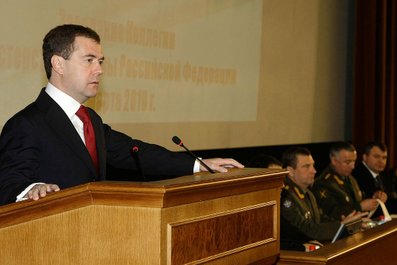
Medvedev Speaks at Defense Ministry Collegium

President Medvedev (photo: kremlin.ru)

In his remarks [text and video], President Dmitriy Medvedev reviewed the results of 2009 and talked about future plans for the armed forces.

He focused first on the international situation, noting that, “. . . today we have no requirement to increase further our strategic deterrence potential,” although it remains a determining factor in Russia’s conduct of independent policies and the preservation of its sovereignty.

He noted Moscow’s new law authorizing the use of force to protect Russian citizens abroad, and he pointed to unresolved conflicts on Russia’s borders [where presumably the new law could be used].

Medvedev acknowledged some positive tendencies such as work on a new strategic arms control agreement and renewed Russia-NATO contacts.  But he called the West’s reaction to Russia’s draft treaty on European security a barometer of relations with the U.S. and NATO.  He said it could prevent conflicts like Georgia-South Ossetia.  Medvedev asserted that, unfortunately, far from all countries and politicians drew the correct lessons from the August 2008 events.  And, unfortunately, he said the reestablishment of Georgia’s military potential continues with external assistance.

Then Medvedev turned more to the exact points of his speech.

He said the main goal is the qualitative improvement of the armed forces, the creation of a modern army and fleet equipped with the newest weapons.  He said last year the organizational base for this was established, as planned, without expending additonal resources.

In 2009, Moscow got its authorized personnel down to 1 million, and, according to the President, the Defense Ministry largely achieved its task of getting to the military’s future combat composition.  Medvedev said the results of Osen-2009 confrmed this, and more exercises like it are needed and need to have a ‘systematic character.’  Because, “Without this there simply are no armed forces.”

Medvedev called the training of officers the ‘most important task. Motivated, high-class specialists are needed, but the recently degraded military educational system and its material base need improvement. Medvedev said particular attention also needs to go to sergeants.  They need to be capable of replacing front-line officers when needed, according to the Supreme CINC.

On to rearmament . . .

Medvedev called the task of reequipping the troops with new armaments ‘extremely complex and very important.’  He said last year Russia stabilized the condition of its arms and equipment, despite the financial crisis, and fulfilled the GOZ, although not without problems.

He called the contracting mechanism for arms purchases ‘not effective enough,’ and said we are  working on this, but it’s slow.  This year the State Armaments Program, 2011-2020 will be written.  Medvedev gave the government the task of renewing arms and equipment at an average rate of 9-11 percent annually to allow Moscow to reach 70 percent modern armaments by 2020.  Reequipping has to be supported by full and timely financing.  He referred to his Poslaniye list of  priority systems and arms to be acquired.  He said this task will not be adjusted, and old weapons need to be decommissioned [He seems to have gotten it into his head that new means good and old bad which is not necessarily the case with Russian weapons.  What happens if you scrap lots of stuff, but you don’t succeed in producing new stuff?]. 

Medvedev said, as he’s already said more than once, steps are needed to bring order to the use, storage, and upkeep of missiles, ammunition, and explosives.  The events of the last year have shown there are problems here [alluding to Ulyanovsk, Karabash, etc.].

Medvedev noted another issue, providing the armed forces with automated command and control, and information systems, and transferring the military to digital comms by 2012, as put forth in the Poslaniye.  He said Zapad-2009 worked on mobile automated C2, but this was only a beginning to the work, which needs to be intensified, because “the communications situation is problematic.”

The President said forces will increase their combat readiness in their new TO&E structures [aren’t they 95 or 98 percent combat ready already?].  The main effort will be forming and training inter-service troop and force groupings, and supporting nuclear deterrence forces.  Medvedev said he’ll attend the main, key phases the coming Vostok-2010 operational-strategic exercise.

Medvedev obligatorily cited increasing the prestige of military service and improving the social defense of servicemen as a priority task.  

“I’d like to note that all obligations of the state to current and released servicemen will be fulfilled unconditionally, I will not accept any amendments for budget changes, or for other reasons.”

Medvedev said the government has the clear task to guarantee that all servicemen needing permanent housing have it by the end of this year, and service housing by the end of 2012.

“The realization of this task is not going badly, I will also take this under my personal control.”

Finally, Medvedev spoke for a moment to pay issues.  Increasing pay, and instituting a new pay system for active duty troops from the beginning of 2012, and increasing pensions to retired military men [but nothing specific promised].

He said he thinks premium pay or the well-known Order 400 brought respectable results, and it will be important to preserve ways of rewarding servicemen with extra money under the new pay system, and he expects proposals on doing this.

Defense Minister Serdyukov had some comments after Medvedev’s speech, but they’ll have to wait until tomorrow.

18-Month Conscription or More Money for Contract Service

Vladimir Mukhin’s report on General Staff Chief Makarov denouncing  contract service has not received much attention.  See Monday’s Nezavisimaya gazeta

Mukhin concludes the military leadership has decided the longstanding effort to transfer some troops to a professional basis and reduce the length of conscript service has been a total fiasco.  And contractees will be reduced, and conscripts increased. 

Mukhin says, with this, Makarov touched the very painful issue of increasing conscript service back to 1.5 years.  He says such a plan is allegedly with the country’s leadership right now [this will really add to Medvedev’s popularity, won’t it?]. 

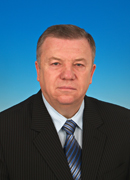
Duma Deputy Vladimir Komoyedov

Mukhin cites former Black Sea Fleet Commander, Admiral Komoyedov, now a KPRF Duma deputy and member of the Duma’s Defense Committee, who says the issue of raising the draft term is under discussion among generals as well as among legislators. 

Mukhin says all this is perfectly logical to military leaders.  A longer draft term will allow conscripts to be better trained and more knowledgeable and to compensate for the absence of professionals.  But this approach in no way  connects with the political statements of the country’s leadership which assures society there won’t be any increase in conscript service time. 

Komoyedov says: 

“The situation here is complicated.  The idea of increasing the military service term to 1.5 years is written into our, the KPRF, program.  We understand well that in current conditions it’s almost impossible to train a skilled and knowledgeable specialist in the troops in a year.  They’ve begun, apparently, to understand this in the Genshtab also.  It seems to me that military leaders know how to convince the president and prime minister to take unpopular steps on questions of changing to the side of increasing the military service term.  Otherwise the army expects significant undermanning–because of the demographic hole, losses on health grounds, and the like.”  

Mukhin turns next to the Chairman of the All-Russian Professional Servicemen’s Union (OPSV or ОПСВ) Oleg Shvedkov who says:   

“It seems to me that the idea of increasing the conscript military service term to a year and a half, even if it today it’s actively lobbied for by someone in military circles, neither the Kremlin nor Okhotnyy Ryad (the Duma) will support it.  Our leaders have already made so many mistakes including in questions of military reform.  Changes in the conscription and troop manning system will cause significant agitation in society.  The authorities of course won’t allow this.  More likely a decision on increasing military budget parameters for use in selecting and training contractees will be taken.” 

Valentina Melnikova, Secretary of the Union of Committees of Soldiers’ Mothers (СКСМ) of Russia, told Mukhin she still thinks a complete transition to contract service could be made. 

She and Shvedkov are right of course.  Theoretically, Russia could shift to all professional enlisted, but it would take political will lacking heretofore.  After what Makarov and Postnikov said (and knowing the generalitet’s predilections anyway), an effort to reinforce a badly, badly sagging contract service effort seems very unlikely.  And it would seem Makarov and his protege would have to resign too.

NATO Exercise in Baltic Region

People apparently love this issue, almost as much as information and netcentric warfare . . . .  So, give the people want they want.

Today’s Kommersant says, “They’ve Decided to Have Maneuvers on Russia’s Doorstep.”

The NATO leadership has decided to exercise in the airspace over Lithuania, Latvia, and Estonia, with forces from those countries plus the U.S., France, and Poland.  Kommersant calls it a symbolic start to a large-scale program with the Baltic member-states that will continue through this year.

The staff of NATO’s joint air forces command is quoted as calling the exercises ‘routine’ and having a strictly ‘organizational character.’  But they will also be “a demonstration of alliance solidarity with the countries of the Baltic region that have joined it.”

Participants intend to give special attention to increased coordination between NATO air forces and to patrolling air space.  It will give NATO a great opportunity to use regional air forces and evaluate their readiness.

The Baltic Region Training Event scheduled for 17-20 March was developed at the end of 2008.  France will use its Mirage 2000C, Lithuania its L-39 Albatros, Poland F-16, and the U.S. tanker aircraft.  Latvia and Estonia will provide ground control.  Fighters will land at Tallinn airport for refueling and simulated maintenance.

Kommersant says the issue of serious exercises with the Baltic members came up after Russia’s short war with Georgia in August 2008.  Baltic concerns were reinforced after Moscow’s Zapad-2009 exercise with Belorussia.  According to the paper, Baltic leaders saw in this exercise work on various scenarios for seizing the Baltic countries.  It notes that Russia’s possible purchase of France’s Mistral has also caused a stir in the Baltics and Poland.  Leaders of the former Soviet republics have asked the U.S. to press Paris not to sell it, according to Kommersant.

Washington and Brussels have heard Baltic concerns and planned a series of political and military steps to calm them.  Kommersant names the agreement to place Patriot air defense missiles in Morong, Poland, 75 km from Kaliningrad’s border in April as one of the steps.  NATO’s Parliamentary Assembly will meet in Riga in May.  Also noted is the June amphibious exercise in Estonia in which 500 U.S. Marines will participate.  Kommersant says Estonian officers will command the exercise.

The steps will culminate this fall in a joint ground exercise involving 2,000 U.S., Lithuanian, Latvian, and Estonian troops as well as transport ships.

Newsru.com added a comment from Fedor Lukyanov, chief editor of the foreign affairs journal ‘Russia in Global Politics.’  He noted that the Baltics don’t trust NATO completely, and European members of the alliance most of all, and suspect that they won’t risk relations with Russia in a crisis.  The fact that these will be the first on-the-ground exercises in the Baltics since the countries joined the alliance 6 years ago just serves as extra confirmation of this.

Golts on Makarov, Postnikov, and Contract Service

In Yezhednevnyy zhural on 1 March, Aleksandr Golts says Makarov’s and Postnikov’s pronouncements on the failure of contract service were, of course, an open secret.  Analysts and journalists had been writing about its failure for two years [much longer actually].  He recalled being at a December roundtable including GOMU generals, who had implemented contract service, who railed against slanderers who dared describe things as they are, including the failure of the contract program.  And now Defense Ministry chiefs have also acknowledged the obvious.

Golts concludes that Makarov and company also finally recognized something known to ‘liberal experts’ seven years ago–it was senseless to try to go to volunteer service without first creating a professional NCO corps.

Then Golts describes a Defense Ministry propensity for lying–GOMU Chief Smirnov gives one figure on the number of draft evaders, his deputy gives a different figure; Deputy Defense Minister Pankov says the 85 permanent readiness brigades are ready for battle in one hour, Ground Troops CINC Postnikov says actually they are ready only to depart their garrisons in one hour; Armaments Chief Popovkin says 5-6,000 tanks are needed, Postnikov says 10,000, or maybe only 2,000 are needed.

This irresponsible and unpunished lying pervades the army, it’s an everyday automatic reflex, and it’s not harmless.  The country’s leadership takes decisions on it.  God forbid they should trust GOMU when it says it’s possible to provide for conscription just by stopping draft evasion.  This would indicate that the complete collapse of the military manning system is near.  And the generals would use this as an argument to overturn the current reforms.