Monthly Archives: November 2010

Chistova Goes with Sobyanin

Effective today Vera Chistova will head the Moscow city government’s finance department under new Mayor Sergey Sobyanin.  She served for about a year and a half as Deputy Defense Minister for Finance-Economic Work.  Defense Minister Anatoliy Serdyukov picked Chistova to replace Ivanov-era appointee Lyubov Kudelina in April 2009.

Look for Serdyukov to elevate another of his tax service minions into Chistova’s job . . . or he could move one of his current deputy defense ministers into the post.  Chistova and Kudelina both came from the Minfin’s Department of Budget Policy for Military and Law Enforcement Services, and State Defense Order.

Shamanov Looking at 3-Months Recovery Time

RIA Novosti reports VDV Commander Vladimir Shamanov will require fairly lengthy recuperation time following his injury in an auto accident last month, according to a Burdenko Main Military Clinical Hospital source.

The source said:

“After the operation performed on Shamanov, doctors evaluated his condition as satisfactory, the operation went successfully and his rehabilitation is also going normally — no complications have appeared at this time.”

Despite this, Shamanov’s recuperation will take a long time:

“According to preliminary assessments of the attending doctors, for the general’s complete recovery and return to duty a minimum of three months could be required.”

The source added that the 106th Division’s Colonel Naumets is currently still serious but stable, and he may be looking at a 6-month recovery time.  Shamanov’s aide Colonel Chernous, also in the accident, wasn’t mentioned in this report, but his condition was less serious than Naumets’.

Poklonnaya Gora Coverage

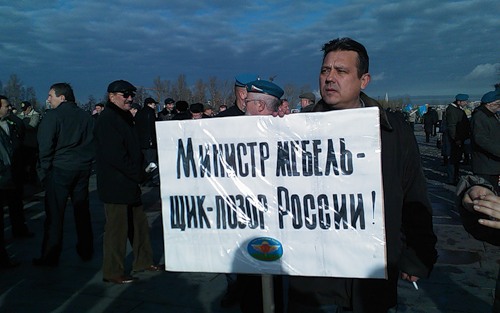
Furniture Man Minister Is Russia's Shame

A Livejournal blogger’s provided photos and comments on today’s meeting of airborne and other veterans on Poklonnaya Gora.  Organized by former VDV Commander Achalov, the protest is dedicated to denouncing Defense Minister Anatoliy Serdyukov and his reforms.  The blogger puts the number of demonstrators at less than 4,000.

According to Lenta.ru, current and former VDV generals have appealed to airborne veterans not to get into it with the Defense Ministry.  They included current chief of staff, Nikolay Ignatov, former Commander Georgiy Shpak, and former First Deputy Defense Minister Aleksandr Kolmakov.  An address from VDV Commander General-Lieutentant Vladimir Shamanov, who remains in the hospital following last weekend’s car accident, was also read.

Shamanov asserted that an ‘unprecedented propaganda campaign’ has been unleashed against Serdyukov in the last month to force his dismissal.  He added that some of ‘our respected and honored comrades’ have been drawn into this ‘politicized game.’

He said everyone from platoon commander to Defense Minister makes mistakes:

“However, this doesn’t mean that we need to demand their immediate resignation for every miscalculation.”

Sounding like the ultimate devotee of civilian control of the army, Shamanov said Serdyukov is making long overdue changes at the Supreme CINC’s direction.  He denied the VDV has lost any combat capability due to Serdyukov’s reforms and again promised it’ll remain an independent branch, receive new weapons and equipment, and get two more formations.  

He told airborne men ‘not to believe loud, but misleading announcements about how the VDV’s combat capability will supposedly decline.’  He said corrupt people of all stripes and so-called oppositionists are against the army’s renewal.

Shamanov called on delegates to this ‘conference’ of the Russian Airborne Union not to allow themselves to be dragged into an unnecessary confrontation with the Defense Ministry.

GRU Birthday

Valentin Korabelnikov

Somewhat oddly, former GRU Chief, Army General Valentin Korabelnikov spoke to ITAR-TASS today on the 92nd anniversary of Soviet and Russian military intelligence, not its current boss General-Lieutenant Aleksandr Shlyakhturov.  Korabelnikov remains in thrall, and apparently on call, as an ‘advisor’ to the Chief of the General Staff.

Shlyakhturov spoke for the GRU last year in a brief, and very, very similar (actually identical) setpiece interview filled with factoids.

Recall that the former 12-year-veteran chief, the 64-year-old Korabelnikov, retired, or was retired, in favor of 63-year-old Shlyakhturov in early spring 2009.  Not exactly a youth movement.

Today Korabelnikov said the GRU is actively making a “preventative response to new challenges and threats for Russia, and also forecasting the development of the military-political and military-strategic situation in the world.”

It follows the “situation in the Near and Middle East, on the Korean peninsula and in the Asia-Pacific region as a whole, issues of nuclear security, the situation in the Caucasus accounting for United States and NATO tendencies to draw Georgia into the North Atlantic alliance, U.S. plans and intentions to deploy elements of global missile defense.”  Among other things, of course.

Korabelnikov said the GRU’s role is high-profile given the increased threat of international terrorism, proliferation of WMD, their components, missiles, and missile technology, growth in transborder crime, and the rise of piracy.  And he noted:

“In the interests of countering these threats we cooperate with the special services of a number of foreign countries, including NATO, effectively exchanging intelligence data with them on terrorist plots, base locations, camps, training centers, channels for inserting combatants, weapons, narcotics, and finance means.”

All this, of course, was already said to ITAR-TASS on 5 November 2009.  So the GRU’s world apparently didn’t change much this year.

Anybody have a picture of Shlyakhturov?

Not One of My Generals Looks Down on Me

Serdyukov with Der Spiegel (photo: Yevgeniy Kondakov)

Let’s look at Defense Minister Serdyukov’s two most recent media interactions, starting with his interview Sunday on Rossiya TV’s ‘News of the Week’ program.  If anyone finds the video for this, please send it in.  As it is, we have just the wire service snippets.  Better than nothing.  Much of this you will have heard before, but there will be things of interest, so don’t stop reading.

On the army’s winter preparations, Serdyukov said the Defense Ministry has studied the ‘serious emergencies’ [so there were more than just Steppe] in military garrisons last winter, and taken necessary measures to prepare the army for this winter.  He says the army is 98-99 percent ready, so he concludes this winter will go very quietly. 

This is, of course, quite a contrast with what Minregion and Basargin have reported, as well as with Severomorsk’s predicament.  There hasn’t been any press release announcing that the Severomorsk garrison’s utilities debt has been cleared, or that the heat’s been turned on yet.  The Navy had been preparing to move several hundred people from buildings belonging to eight different units without heat.

On allowing parents and public representatives to accompany conscripts to their service locations, Serdyukov had this comment:

“It seems to me this removes a certain tension from both parents and public organizations.  And this worried us enough, therefore we, including commanders, became more seriously inclined to it.”

Serdyukov issued yet another denial of any intent to change the current one-year draft term:

“Once again I want to say we don’t intend to increase the term (of service).  The term is 12 months, and so it will remain.”

He called a professional army a goal “we still can’t allow ourselves.”

He commented, yet again, on Russia’s plans for foreign arms purchases:

“Unfortunately, in recent years, in a number of (cases) and types of equipment we have fallen behind a little.  This, certainly, concerns both armored equipment and communications and UAVs somewhat.  We, naturally, won’t go over to mass purchases of foreign armaments and military equipment, we will only buy that which interests us, in limited quantities, to understand and evaluate those tactical-technical characteristics which they possess, on the one hand, and on the other – to try to formulate for our industry what we want to see from ourselves very soon.”

Serdyukov mentioned again Russia’s desire for two large amphibious carriers from abroad, and confirmed that two more would be built in Russian shipyards using the full technical documentation transferred along with the first two units.

The Defense Minister described a three-stage military reform to 2020:

“In the first part there are TO&E measures, and we have essentially already completed them.  We’ve gone to 1 million (servicemen) in size, of them 150 thousand will be officers, on the order of 100-120 thousand will be professional noncommissioned personnel, and the rest will be conscript soldiers.”

“The second task is, naturally, social issues which we need to take care of for our officers.  And armaments are the third task.  Armaments is a quite lengthy process.  We’ve broken it into two parts:  to 2015 is the first phase and out to 2020 will be the second.  We need to get to these parameters:  by 2015 modern equipment in the army must be not less than 30 percent and by 2025 on the order of 70 percent.  We believe that 2020 will be the completion of the transition to a new profile of the armed forces.”

It looks like Serdyukov is giving more wiggle room on rearmament.  Most reports to date have quoted Defense Ministry representatives saying 70-100 percent new arms by 2020.  Well, perhaps ITAR-TASS heard it wrong.  For this writer’s money, even 30 percent in 2015 looks like a longshot.

Also, not really much to say about those military social issues – and this presumably would be the main focus now since task one’s pretty much done and task three’s a long-term deal.

Even the pretty much completed task one is interesting.  Many press and media outlets seized on this one to finally understand, more precisely, the composition of the armed forces.  So Serdyukov says they’re down to 150,000 officers already.  And with a thinner layer of sergeants, that leaves between 730,000 and 750,000 conscripts at any given time.  But drafting 270,000 semiannually would leave Moscow short by roughly 200,000 conscripts.  Better round up those evaders.  And with all the varying comments, it’s very hard to say if Russia’s at one million men (150,000 officers) yet or not.

But moving on . . . on 27 October Der Spiegel copped an interview with Serdyukov.  It focused on relations and cooperation with NATO, Europe, and the U.S., and Russia’s view of missile defense, but there was stuff on Serdyukov’s reforms.  The Defense Minister told Spiegel flatly:

“As far as weapons go, in recent years, no modern weapons have been bought for the Russian Army.  Our armaments are largely outdated.”

Quite a stark admission he might not make to a Russian magazine.  Perhaps he’s willing to be a little more painfully blunt with a Western publication.

On buying abroad, Serdyukov told Spiegel that Russia can produce everything it needs, but some things are simpler, cheaper, and quicker to get from foreign producers.  He confessed that Russian industry has fallen behind the last 20 years.

Serdyukov goes on to discuss the million-man army, the imbalance in officers and grunts, eliminating corruption, Rosoboronpostavka, and cutting administrative layers. 

Then he’s asked why military men might oppose his changes:

“It’s obvious.  Who wants to lose his job?  Over the coming three years, we will cut the size of the officer corps to one hundred fifty thousand men.  At the same time, we will make service in the army more attractive, in particular, by raising pay.  The attractiveness of army service has now reached the very lowest level.”

Again, are they at 150,000 officers or not?  No one’s clear on this.  And one would think, with all Serdyukov’s efforts, serving might already be a little more attractive.

Asked if he’s worried about a military putsch, Serdyukov said:

“This doesn’t worry me.  We aren’t taking any impetuous measures.”

Of course, impetuous depends on whether you’re on the giving or receiving end of policy.

His interviewers asked if it’s easier for a civilian to conduct reforms in the military.  Serdyukov said:

“I can’t do everything myself.  We are working in a team – the Chief of the General Staff and my deputies.  It’s possible some things are simpler for me to do because I’m not connected to certain traditions and understandings which exist in the army.  I see problems from the outside, and because of this it’s easier for me to ask why we can’t do things differently.”

And finally they asked him if a general can take a civilian seriously, and he replied:

“I can assure you not one of my generals looks down on me.”

Shades of Seltsy perhaps . . . it seems it would have sufficed to say something bland like ‘we have our own spheres and mutual respect’ or we’ve created a two-branch Defense Ministry with civilians occupied with this and military men with that.  But instead Serdyukov comes off sounding like it’s a choice between dominating and being dominated.

Vox Populi

How did readers react to the Vedomosti editorial supporting Defense Minister Serdyukov and his reforms?  Basically, two ways — perhaps about 30 percent expressed qualified agreement, and 70 percent believed it was paid PR written, if not by Serdyukov himself, then by one of his minions.

None of this is scientific, of course.  It’s just an attempt to make sense of 84 posted comments on the article.  Vedomosti is a mainstream, semi-liberal paper (certainly neither far left nor far right) with an educated readership.  Take it for granted that those disagreeing with the editorial were more likely to comment.

With that said . . . let’s look at opponents of the piece.

The thrust of their comments, if it’s even possible to summarize them, boils down to this: 

  • The editorial is part of a ‘special operation’ to rehabilitate Serdyukov and reforms after the Seltsy dust-up (was it really that serious or damaging?), and to head off Achalov’s 10,000-man meeting (which Achalov now says will be more like 5,000).
  • The editorial fails to recognize how demoralized the army is by reforms and a reformer like Serdyukov.  One reader even suggested that, after buying arms abroad, Russia might once again hire foreign officers too.
  • The editorial’s opponents say it’s Serdyukov who’s destroyed the army, and one argued you can only reform the army if you were commissioned a lieutenant and fought in a ‘hot spot.’
  • Finally, less polemical types argued Vedomosti didn’t address the state of the Russian Army’s combat capability under Serdyukov.  One said cutting is not reform, and the division-to-brigade transformation was really no more than a recognition of the true state of affairs in most formations.  Another suggested going to Siberia or the Far East and sounding the combat alarm in a motorized rifle brigade to observe directly how combat readiness has collapsed (of course, maybe that’s why this year’s training is to focus on small units).

The comments of those who agree with the editorial actually mesh up kind of nicely (at least for purposes of contrast) with those above:

  • The army was destroyed in the 1990s by its own bloated cadre officer corps that turned into a band of uniformed profiteers (but were they any different from other Russians at that time?).  This generals’ mafia was capable neither of defending the country nor returning conscript sons home safely to their mothers.  One reader said the near-disaster in South Ossetia only confirmed the correctness of Serdyukov’s direction.
  • These readers said the right civilian makes a good Defense Minister.  One compared Serdyukov (once again) to Robert McNamara.
  • Another reader said he supports Serdyukov, but he still can’t tell if Russia’s combat readiness or the effectiveness of its defense expenditures is higher under him or not.
  • A final reader wants to give Serdyukov a chance and more time to see if he can improve the country’s defense capability.  He says he was a conscript in 2000-02 and only fired his weapon three times during that period.

Serdyukov’s Carte Blanche

In an editorial Monday, Vedomosti supported the carte blanche President Dmitriy Medvedev has apparently given Defense Minister Anatoliy Serdyukov and his military reforms.  The paper likes the reforms enough that it wants the President to think about the possible effectiveness of the ‘army method’ in reforming the MVD.  Here’s what Vedomosti had to say:

“Renaming the Army”

“Dmitriy Medvedev’s and Anatoliy Serdykov’s joint trip to a model Moscow suburban military unit went beyond the protocol of the visit.  The President’s speech in awarding outstanding military men became a new signal to officers, the army, and society:  ‘Despite the fact that all changes are difficult, they are necessary…  Everything that is now being done is directed at establishing modern and effective armed forces.  Here there are both problems and good decisions, I am following this personally as Supreme CINC.’  The Kremlin demonstrated that, despite the recent media scandal, it trusts the civilian Defense Minister, won’t bow to the generals’ and veterans’ opposition, and intends to continue its planned military reform.”

“The new carte blanche for Serdyukov for further transformation is important for many reasons.  The current minister is not the first civilian director of the military department.  However, he specifically replaced a campaign of reforming with systematic transformations.  In his inheritance from Sergey Ivanov, Serdyukov received a much truncated army of the Soviet type, not answering modern requirements.  Dedovshchina, obsolete armaments (modern equipment is not much more than 10% of the general inventory) and command and control, and manning were its main problems.  Add to this corruption among the generals which prevented equipping the army with new types of armaments and communications.  The victorious August war of 2008 showed that the victors couldn’t suppress the enemy’s aviation and artillery and were inferior to the vanquished in modern communications and reconnaissance means.”

“Serdyukov’s attempts to establish control over expenditures on purchases for the army met severe resistance from rear services officers and generals.  Not long ago he acknowledged to journalists:  ‘When I came to the Defense Ministry, speaking plainly, I was surrounded by large amounts of thievery.  Financial licentiousness, the impunity of people whom no one had checked out (…) was so deeply ingrained that it had already become a way of thinking.’  The minister confirms that the transparency of the defense order is a ways off.  The unnecessary secrecy of the military budget is interfering with this.  Meanwhile, progress in the struggle against traders in shoulderboards is obvious.  In 2006, corruption cases were started against seven generals, in 2007, when Serdyukov became minister, — against 16, in 2008 — against 20, in the first half of this year — against eight more.”

“Besides this, the Defense Ministry put up for sale unneeded property and facilities which were being illegally rented out to enrich a few people, and didn’t allow for building apartment blocks for officers needing housing on these grounds.”

“On the whole, it’s possible also to consider organizational transformations a success:  the transition to a more modern system of command and control and the reduction in the excess number of generals and higher officers.  In 2008, of 249 generals and admirals who underwent certification [аттестация], 50 were dismissed, and 130 sent to new places of service.  One can’t avoid mistakes in cutting and dismissing officers, but those deprived of a sinecure cried loudest of all about the collapse of the army and treason.”

“The struggle with barracks hooliganism goes on with varying success.  According to the Main Military Prosecutor’s data, in 2006, more than 5,800 people suffered beatings from fellow servicemen, in 2009 — 3,000.  And for the first five months of 2010, 1,167 soldiers suffered from dedovshchina — 1.5 times more than the analogous period of 2009, of them, four died.  The cause is not only in the growth — because of the cut in the service term — the number of new conscripts went from 123,000 in the fall of 2006 to the current 270,600.  Generals, having botched the program costing 84 billion rubles to transfer to contract, now are forced to call up those with criminal records.  Military police will remain a paper tiger for ‘dedy’ and ethnic clans.  We note that Serdyukov hasn’t forsaken a professional army, but put off its creation until the time when the Defense Ministry will be able to select and not collect contractees through deception and duress.”

“Nevertheless, it’s notable that over 3 and 1/2 years, the reform, being conducted by independent managers without legal changes and loud renamings, has really moved forward.  It’s possible it’s worth the President considering the effectiveness of the army method in reforming the MVD.”

Shamanov Update

This morning’s press says VDV Commander, General-Lieutenant Vladimir Shamanov had a complex but successful four-hour surgery yesterday to repair hip and elbow joints damaged in Saturday’s head-on collision near Tula.  A spokesman for the Burdenko Main Military Clinical Hospital said Shamanov was feeling ‘normal’ after his operation.

Acting 106th Division Commander, Colonel Naumets’ condition remains serious and his surgery hasn’t been scheduled.  Colonel Chernous has improved, and he’s been moved out of intensive care.

Medvedev Inspects Strategic Forces

In Friday’s Nezavisimoye voyennoye obozreniye, Viktor Litovkin claimed, the day before, President Dmitriy Medvedev visited the inner sanctum of Russia’s Aerospace Defense (VKO or ВКО) – the Central Command Post (ЦКП) of the 3rd Independent Air Defense (Missile Warning) Army in Solnechnogorsk.  Now Litovkin admits VKO doesn’t technically exist yet.  But preparations are underway, and he suggests, besides PVO, SPRN, PRO, space monitoring, etc., it will even include the RVSN.  Litovkin maintains tests of this system are ongoing, and Medvedev came to inspect it.  He watched troops track all three of Thursday’s SLBM and ICBM launches, and saw the missiles’ warheads land on their respective targets.  And, according to Litovkin, the point was to demonstrate the reliability of Russia’s nuclear missile capability to Medvedev as new SNV treaty limits loom.

Could the shrinking RVSN be subsumed under VKO as a new service or branch?  Could this explain the fairly rapid command shifts from Solovtsov to Shvaychenko to Karakayev?

Shamanov Update

Shamanov's BMW 525 (photo: Lifenews.ru)

If we needed reminding, the extent of media coverage of Shamanov’s narrow escape from Saturday’s horrific head-on collision proves again that this two-star general is a national figure.

So what happened?  Shamanov’s warrant officer driver was killed; some press is saying he turned the car to take the blow himself and protect the boss.

Shamanov was in serious, but stable condition, and was moved from Tula to Moscow’s Burdenko Main Military Clinical Hospital.  Also injured were the acting commander of the VDV’s 106th Division, Colonel Aleksey Naumets, and Shamanov’s assistant Colonel Oleg Chernous.  Naumets’ condition is serious, but Chernous has improved a little. 

Putin Visits Shamanov (photo: RIA Novosti)

Prime Minister Putin and Defense Minister Serdyukov visited his bedside.  Izvestiya reported Putin said Shamanov was in a good mood despite what happened to him.  Serdyukov said:

“Vladimir Shamanov is real airborne, and airborne, as is well-known, are spiritually strong and physically powerful people.  Therefore I’m sure that he’ll get right and return to the line.”

Shamanov was in satisfactory condition this morning, and he went into surgery at 1200 MSK.  The focus of today’s operation was the general’s left leg.  Reports say Shamanov suffered a concussion and unspecified fractures to his arms and legs.

One has to wonder if Shamanov can rebound from this.  He might, but he might not be the same.  It would be surprising if he’s able to resume his regimen of jumping with the troops, etc.  He’s 53 and faces retirement on age grounds in a couple years unless he adds another star.  If he emerges from this accident with any kind of disability, he could be put out for that reason.  Of course, it all comes down to whether the powers-that-be want him in or out.

And this story wouldn’t be complete without possible conspiracy.  More than a couple commentators wonder if someone isn’t out to eliminate Shamanov . . . could be his son-in-law Glyba’s enemies . . . could be airborne veterans who might object to his slavish support for Serdyukov.  The Defense Ministry denies that anyone was out to get the VDV Commander.  It might just be an accident.