Category Archives: Air Forces

VVS Taking VMF’s Land-Based Fighters and Bombers

Vesti.ru has rebroadcast Interfaks information from a Main Navy Staff source who says, on 1 April, Naval Aviation (VMA) will begin transferring its land-based fighter and bomber aircraft to the Air Forces (VVS).

By year’s end, the VVS will get the Navy’s remaining Su-27 fighters, MiG-31 fighter-interceptors, long-range Tu-22 [sic] supersonic bombers, and also part of the VMA’s transport aircraft.

Russian Naval Aviation Tu-22M3

The Interfaks report will probably get garbled into all aircraft, or all land-based aircraft, going to VVS, which is not the case, as it makes its way into other Russian and English language news stories.

VMA will retain control of its Il-38, Tu-142, and Be-12 ASW aircraft, and its deck-based aircraft, the Su-33 fighter and Ka-27 helicopters, according to the Interfaks source. 

According to the Vesti.ru article, missile-carrying naval aviation has deteriorated since the Soviet collapse, and only the Northern and Pacific Fleets have long-range ASW aircraft which, it claims, amount to only 25 Il-38 and 15 Tu-142.  It says the Baltic Fleet has no ASW aircraft, and the Black Sea Fleet only four old Be-12 likely to be completely worn out by 2015.

The article notes that the Su-33, Su-25UTG trainer, multipurpose Ka-27 and Ka-29 combat-transport helicopters will remain in the air wing of heavy aircraft-carrying cruiser Fleet Admiral of the Soviet Union Kuznetsov.  There are reported plans to procure 26 MiG-29K fighters for Kuznetsov.

Here’s a nicely done, data-filled Russian language Wiki article on Russian Naval Aviation.

VMA lost something else recently.  A BMW-X5 used by VMA Chief, General-Colonel Igor Khozhin was stolen in Moscow on Friday, according to Interfaks.

ITAR-TASS also reported Friday that more than 80 RVSN aircraft — An-72, An-26, and Mi-8 helicopters — will also be going over to the VVS starting on 1 April.

PAK FA Engine Update

Saturday ITAR-TASS printed an interesting update on the PAK FA engine story.  It doesn’t really clarify anything (actually quite the opposite), but it’s part of the story. 

Recall last spring the engine designers were saying developing a “second phase” engine for PAK-FA could take another 5-6 years, while Sukhoy was saying it might be 10-12 years.  In what follows below, the engines aren’t specifically identified as “second phase,” but they are called “seriously distinct from the 117S.”

General Designer of the A. M. Lyulka Scientific-Technical Center (a Moscow subsidiary of NPO Saturn) Yevgeniy Marchukov claims the construction of an engine for the fifth generation fighter is going successfully, and it will go into serial production. 

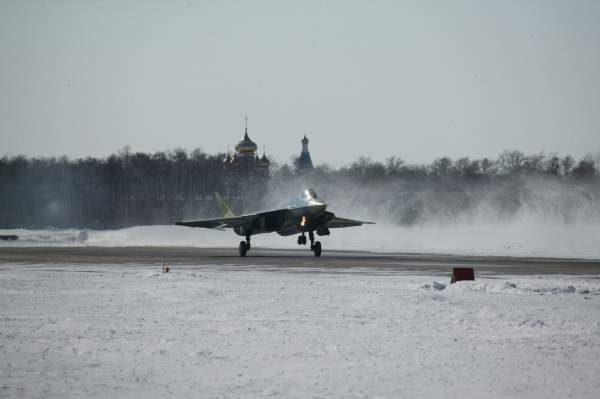
The second experimental T-50 reportedly took off with this engine on 3 March.

Marchukov said:

“The engines in the experimental prototypes of the future Russian fifth generation fighter are seriously distinct from the 117S engines intended for Su-35 aircraft, both in their parameters and in their fundamentally new automated control system.  The T-50 aircraft with NPO Saturn engines fully corresponds to the tactical-technical requirements for the aircraft.  And with these engines produced serially, the PAK FA will be supplied for the needs of the Russian Air Forces.”

For his part, Saturn managing director Ilya Fedorov noted that the enterprise “supported the takeoff of the aircraft in the necessary time,” just as it was ready for flight.

ITAR-TASS goes on to add that special stand tests and service life tests on the engine continue at the Lytkarinskiy Machinebuilding Plant (another Saturn subsidiary).  Ground development is being conducted on the T-50-KNS model with aircraft systems from OKB Sukhoy at the Gromov Flight Test Institute.  Flight tests are also ongoing.  T-50-1 has more than 40 flights, the T-50-2 two flights, and the Su-27 flying laboratory has 32 flights.

Second PAK FA Prototype Flies

Novyye izvestiya has 1TV’s video coverage and story on the flight.

Pilot.strizhi.info posted these photos, along with links to the high resolution originals from Sukhoy.org.

Second PAK FA Takes Off

Landing

PAK FA Chutes Deployed

Mi-28N Crash

Mi-28N Night Hunter

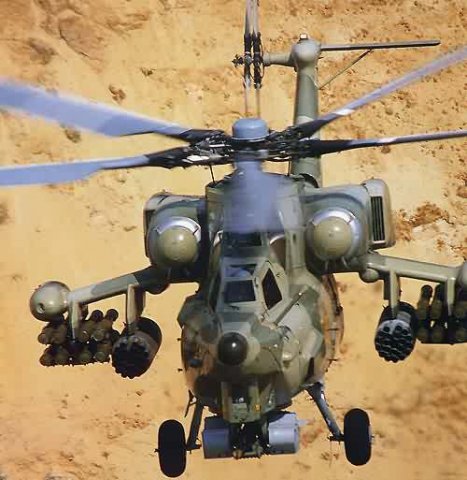
Russia’s Mi-28N Night Hunter helicopters are grounded pending completion of the investigation into Tuesday’s crash in which the pilot died and his co-pilot was hurt.  The Mi-28N belonged to the Budennovsk-based 487th Helicopter Regiment in the Southern MD.

Unnamed sources tell RIA Novosti investigators attribute the crash to engine failure caused by metal shavings in the engines or gear box.  But one experienced test pilot told Vzglyad.ru that shavings usually don’t cause a sudden loss of control or engine failure.

Over the last year, problems with the Mi-28N’s gear box, flight controls, and tactical performance have been reported in the media. 

In January, Izvestiya’s Dmitriy Litovkin visited the flight training center in Torzhok to look at the Mi-28N.  He discussed the June 2009 crash of an Mi-28N at the Gorokhovets training range with the center’s chief, Colonel Andrey Popov.  Litovkin said people believe that crash occurred when powder gases from a rocket firing got in the helicopter’s engines.  Here’s a video.  Popov acknowledged the Mi-28N’s growing pains, and said the manufacturer is constantly modifying the aircraft.

This certainly sounds like production problems to these nonexpert ears.  There’s still a struggle between those who back the Mi-28N and others who favor the Ka-52 as Russia’s primary attack helicopter.  With stronger state support, the Night Hunter has been winning the battle, but this accident might hurt its case.  Meanwhile, a second Mi-28N squadron is supposed to be established at Budennovsk this year.

A Second Regimental Set of S-400s

Russian news outlets reported yesterday that two new S-400 SAM battalions (a “regimental set”) will soon go on duty in the 210th Air Defense Missile Regiment at Dmitrov north of Moscow. They will join the first two battalions fielded at Elektrostal east of Moscow in 2007 and 2008.

In early 2010, Air Forces CINC, General-Colonel Aleksandr Zelin talked about getting up to 5-6 battalions last year, but this didn’t happen. Zelin has also said 18 S-400 battalions will be in service by 2015.

The factory handover of the two new battalions began Wednesday at Kapustin Yar. The acceptance process included various test firings yesterday with OSK VKO Commander, General-Lieutenant Valeriy Ivanov and Air Defense Missile Troops Commander, General-Major Sergey Popov in attendance.

Lenta.ua quoted Ivanov saying 3-4 S-400 regiments will defend Moscow by 2020, with most going on duty in 2016-2020. He told Interfaks:

“If earlier we accepted it (the S-400 SAM) in separate units of equipment by battalion, by launcher, then today for the first time everything is being received fully – as a regiment.”

One supposes these regiments will only have two S-400 launch battalions then.

Lots has swirled around the inability to get S-400s in the field.

General Director Igor Ashurbeyli was dismissed from Almaz-Antey early this month. There’s been the talk of the government financing two new plants to speed the process of building the S-400.

Last May, Viktor Litovkin was reporting that the VVS would receive six S-400 battalions in 2011. He also said the Defense Ministry would not order more after that.

Ashurbeyli said last April the Defense Ministry was not signing contracts for S-400 production in 2012.

Zelin Out?

An Interfaks source in the Defense Ministry says Air Forces CINC, General-Colonel Aleksandr Zelin might be retiring on age grounds.  The rumor goes that Zelin’s Deputy for Aviation, General-Lieutenant Igor Sadofyev will relieve him, while Zelin moves into a defense industry job.  RIA Novosti reports the same story, citing several media outlets.  The Air Forces spokesman, meanwhile, says the VVS cannot comment because it doesn’t have any information to this effect.

RIA Novosti talked to defense commentator Igor Korotchenko, who expressed caution about the Zelin rumor, but said the move to four MDs / OSKs has diminished the service CINC’s influence:

“The role and place of the main commands of the services of the Armed Forces has been reduced accordingly.  Practically all aviation, except strategic, will be subordinate to the OSK commander.”

He says the story of Zelin’s possible departure may have surfaced because of the downgrading of the service CINCs.

It’s interesting that age was cited since Zelin’s only 57, and can serve until age 60 under the law.  He’s headed the VVS since May 2007. 

The three-star general was the subject of dismissal rumors in 2009 when the General Staff Chief and Defense Minister were allegedly unhappy with his insufficient command of air-space (aerospace) defense (VKO) issues.  See Newsru.com and Grani.ru for that story.

Fighters Flying Nowhere?

The first flight test of China’s ‘fifth generation’ J-20 fighter inspired Trud’s Mikhail Lukanin to address the subject.  If you’d like a translation of it, see Russia Today.

Lukanin notes China’s now third behind the U.S. and Russia to unveil a ‘fifth generation’ fighter, and he cites Ruslan Pukhov and Vitaliy Shlykov who conclude these future aircraft are little suited to modern wars, and are being developed exclusively to satisfy political ambitions.

About China’s “very raw prototype,” Pukhov says:

“According to its technological possibilities, China is still not ready to develop new generation aircraft, since even usual Chinese fighters are copies of foreign ones, mainly Russian aircraft.  The Chinese really still need at least ten years to get the J-20 to 5th generation fighter parameters.”

Lukanin recaps that Russia’s PAK FA, the T-50, started design in 2002, flew in 2010, and is looking for serial production by 2015.  He gives a quick, limited definition of 5th generation (that would horrify U.S. Air Force types):  supercruise, stealth, and 360° radar.

Shlykov tells Lukanin the T-50 and F-22 are unlikely to meet in battle, and employing a ‘superfighter’ in a small war like the Russian-Georgian one is senseless since today’s aircraft can handle such a conflict.  Shlykov calls the fifth generation fighter an “offspring of the arms race” created for a world war between superpowers.

Lukanin highlights the F-22’s exorbitant pricetag and the cut in its production run, and he puts the T-50’s price at $80-100 million, 4-5 times cheaper than the F-22 [perhaps it’s cheaper because it’s not a full-fledged 5th generation aircraft, at least by the USAF definition].

Finally, Lukanin returns to Pukhov, who says:

“For China and Russia, 5th generation fighters are first and foremost political projects, necessary for assuring themselves that they are leading world economies.”

Pukhov says the lion’s share of T-50 aircraft will be exported.

There are at least two interesting issues Lukanin might have addressed here, but didn’t. 

First, is it possible that China might actually be uncomfortably close to Russia in technological capabilities?  Is the J-20 really ten or more years behind the T-50?  Or how about this — is the T-50 anywhere close to the F-22?

Second, fifth generation aircraft could also become passe quickly if the U.S. moves on to a sixth generation unmanned, robotic aircraft.

There are a couple additional articles today worthy of attention.  Argumenty nedeli calls the J-20 a fifth generation Frankenstein, with the nose of the F-22, and the body of the old MiG 1.44 design.  AN says the J-20 lacks an engine [possibly also true of T-50].  The Chinese unveiling might just an elaborate PR show.

Vedomosti isn’t quite as dismissive, and says the J-20 might push Russian development faster.  The paper notes questions about what’s really inside the aircraft, and concludes the flight may have been timed for the U.S. Defense Secretary’s trip to China.

It cites Konstantin Makiyenko to the effect that, for Russia, the J-20’s first flight means it’s essential to increase the financing and pace of the T-50 program, both to preserve the military balance, and to preserve Russia’s competitiveness as an exporter.

Once again, maybe it is all about prestige and exports.

Latest on VVS Procurement

Su-35

Russian Air Forces (VVS) spokesman Colonel Vladimir Drik picked the day after New Year’s to make some specific announcements on his service’s plans for procuring airplanes and helicopters out to 2015.  Not sure what inspired or spurred the sound bites, but one’s glad for every morsel.

He said the VVS will acquire up to 100 Sukhoy aircraft by 2015.  Sukhoy has three state contracts to provide, as Drik put it:

“. . . nearly 50 multifunctional highly-maneuverable Su-35 fighters (they should be delivered by 2015), more than ten modernized Su-27SM and nearly five two-seat multipurpose Su-30M2 fighters (they will be delivered before the end of 2011).”

It doesn’t read as awkwardly in RIA Novosti’s original:

“. . . около 50 многофункциональных сверхманевренных истребителей Су-35 (их должны поставить до 2015 года), более десяти модернизированных Су-27СМ и около пяти двухместных  многоцелевых истребителей Су-30М2 (их поставят до конца 2011 года).”

It’s not clear whether “before the end of 2011” applies to just the Su-30M2, or Su-27SM deliveries as well.

What Drik describes is basically Sukhoy’s VVS contracts signed at MAKS-2009 (48 Su-35, 12 Su-27SM, and 4 Su-30M2).  In all, 64 aircraft for about 80 billion rubles.

Drik also said 25 Su-34 fighter-bombers will be procured.  The Su-34 purchase has always been reported as 32. 

It’s easy to lose track – were there 2, then the 4 at the end of 2010, plus 25 for a 31?  Or was it really 3, then 4, plus 25 for a total of 32?

He concludes that, in all, there are long-term contracts for “nearly 130 combat aircraft.”

Recall that Deputy Air Forces CINC Sadofyev said the VVS order for 2011 includes the Su-27SM, Su-30M2, Su-34, Su-35, Yak-130, and helicopters, but he gave no numbers.

Now this observer counts 90 Sukhoy airframes in Drik’s comments, so that’s pretty much “up to 100.”  Less clear is where the balance of 30-40 combat aircraft will come from by 2015.  Will they be new Yak-130 combat trainers, helicopters?

Drik did enlighten us a little on VVS plans for helicopters.  He said three (not four as reported elsewhere) Ka-52 / Alligator arrived at Torzhok at the end of last month, and he noted that serial deliveries of this helicopter will begin this year.

Ka-52 (photo: RIA Novosti / Anton Denisov)

He emphasized that the Mi-28N / Night Hunter, accepted into the inventory in 2009, is no less important to the VVS.  He said Army Aviation will need it for a long time.  For trainers, series deliveries of the Ansat-U began in 2009, and preliminary testing of the Ka-60U continues, but Drik didn’t say anything about numbers the VVS expects to receive.

If this is the complete plan until 2015, it’s fairly modest.  Modest can be good.  Modest is achievable.  It may or may not be the whole picture.  We have to continue parsing the statements, and triangulating the words, to try and see where the VVS will be in the next few years.

If this is the plan, it doesn’t sound like what’s been touted as 500 new airplanes and 1,000 new helicopters by 2020. 

Yes, this is a skeptic’s viewpoint.  Maybe VVS procurement is backloaded after 2015. 

But a few other thoughts linger . . .

  • The Su-35 still faces state testing.  It was supposed to start this past fall. 
  • Seems like a lot of aircraft are gap-fillers for PAK FA.  It’ll be interesting if it’s not an obvious success well before 2015.
  • One supposes MiG aircraft are completely out of the picture.
  • Nothing was said about transport aircraft.  They’ve been emphasized a little lately, and sooner or later someone’s got to talk exact numbers.
  • Interesting that there’s so little specific said on helicopters.

Government Credit for Two New Almaz-Antey Factories

In a 29 December interview on Vesti’s Rossiya-24 program, Deputy Prime Minister Sergey Ivanov addressed modernization, development, arms sales, and defense industry.  He said international demand for Russian air defense systems has led the government to take a decision to extend credit for Almaz-Antey to build two new factories.

As written in an earlier post about shortfalls in productive capacity in the OPK, this possibility has been under discussion since at least last February.

Military Parity picked up additional RIA Novosti coverage of Ivanov’s remarks:

“This year we decided on additional support to ‘Almaz-Antey’ and the allocation of credit for the construction of two more factories.”

Ivanov explained that most of Almaz-Antey’s production is going to satisfy the Russian Army’s requirements, and:

“Now they don’t have production capacity for large volume exports.  But this good, if it’s possible to call it that, is in great demand on the international market.”

A bit from the video . . . Ivanov’s interviewer asks about the state of military-technical cooperation (i.e. arms sales), and aviation’s role in it.  Ivanov says it got along “not badly” in 2010.  Arms sales exceeded $10 billion for the first time.  This, he says, attests to the competitiveness of, and demand for, Russian equipment, and so, in many areas, the defense sector isn’t doing badly.  Aviation represents more than a third of arms sales, or more than $4 billion.  He thinks military transport aviation sales have a good future, and, of course, buyers stand in line for Almaz-Antey’s PVO systems.  Thus, with internal and external demand, the need for two completely new factories.

Of course, saying they’ve decided for two factories is not the same as actually building them and starting new production lines.

Video of Su-34s at Lipetsk

St. Petersburg’s Channel 5 carried this video of the new Su-34s at Lipetsk.  The reporter talks to the center’s commander, General-Major Aleksandr Kharchevskiy, as well as pilots about the Su-34s.  Thanks to Military Parity for finding it.