Category Archives: Air Forces

Zelin’s Update (Part II)

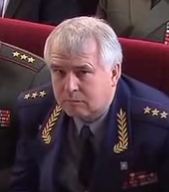
General-Colonel Zelin

In his recent NVO interview, VVS CINC, General-Colonel Aleksandr Zelin wasn’t as specific about transport aircraft and helicopter acquisition as about fighters.

He mentioned “reestablishing” An-124-100 and An-124-300 production, and said the Il-76MD-90A will fly in July.  The An-70 is moving forward with Ukraine, he says.

The VVS has settled on the An-140-100 as a light transport.  Russia will work jointly with India on a light MTA (multirole transport aircraft?), and Moscow may buy up to 100, according to Zelin.

Zelin concludes VTA must have not less than 300 aircraft.  That might actually be about what it already has.

The CINC says the General Staff wants VTA to be capable of lifting a “light” brigade anywhere in the country or abroad if necessary.

On helicopters, General-Colonel Zelin reemphasized the goal of 1,000 new ones by 2020.

He mentions getting about 100 Mi-26, or Mi-26T, heavy lift helos, as well as the Mi-8AMTSh, Mi-8MTV5, and Mi-38 (another Mi-8 variant). 

Zelin says little about the Mi-28N and Ka-52 except they’re complementary.  He sees no need to choose between them, but the former will be the military’s line combat helicopter.

Zelin’s Update (Part I)

Air Forces CINC, General-Colonel Aleksandr Zelin gave NVO editor-in-chief Viktor Litovkin an extremely long interview last Friday.  Zelin expanded on things he’s said in previous press encounters.  Some interesting stuff.

Here’s the first part of a quick synopsis.

Su-34.  Zelin mentions the contract for 92 by 2020, but says the VVS will buy 124 or even 140.  He again talks about making it a strategic platform by adding a long-range cruise missile.

Su-35.  The contract for 48 could become 100.

Su-30SM.  This fighter will be used in the progression of pilot training for Su-35 and PAK FA / T-50.

Yak-130.  Zelin mentions using this trainer as the base to develop a light strike fighter for training Su-34 and Su-35 pilots.

MiG-31.  The Air Forces CINC expounds on this old interceptor and plans for it.  About 100 will be kept, and Zelin talks about using a meter wavelength navigation system on it (and other aircraft) so it can operate from civilian airfields.

Su-24.  Two squadrons of “high series” Su-24 will be kept under Gusar and Metronom R&D efforts.  This is necessary because the VVS can’t go entirely to the Su-34, which, incidentally, will be based at Khurba, Chelyabinsk, Krymsk, Voronezh, and Lipetsk.

PAK FA / T-50.  Still planning on 60.

More later.

Meeting on Gogolevskiy Boulevard

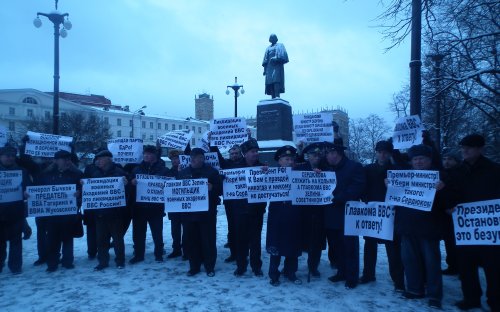
Protesters and Placards (photo: KPRF.ru)

Thursday about 50 military men gathered near Gogol’s statue in the park across from the Defense Ministry to protest the closure of the Air Forces Academy named for Professor N. Ye. Zhukovskiy and Yu. A. Gagarin. 

These largely middle-aged protesters held placards saying “Air Forces CINC Zelin is the Gravedigger of Air Forces Academies!” or “Prime Minister:  Get Rid of Defense Minister Serdyukov!” or “General Bychkov is a Traitor to VVA Gagarin and VVIA Zhukovskiy!”
 
Recall the Zhukovskiy and Gagarin academies — the former for engineers, the latter for pilots and staff officers — were melded in 2008 in the latest and most painful drawdown of an enormous leftover Soviet-era military educational establishment. 
 
The functions of these mid-career academies are being transferred to the new, consolidated Air Forces Military Training-Scientific Center (VUNTs VVS) in Voronezh.
 
The KPRF organized the protest, and it said about 100 attended.  KPRF.ru and Nakanune.ru recapped the event.
 

KPRF Duma member Vyacheslav Tetekin told Novyy region destroying these academies damages VVS combat readiness since the majority of their 1,600 (perhaps not much lower than the total number of flyable VVS aircraft) instructors and professors won’t go to Voronezh to train future senior officers.

Tetekin argued there are already protests against aircraft noise in Voronezh, and he’ll ask fellow KPRF member and Duma Defense Committee chairman Vladimir Komoyedov to address the prime minister and president on the fate of Zhukovskiy and Gagarin.

Apparently now retired, General-Lieutenant Ivan Naydenov — a former deputy chief of the academy — claimed Defense Minister Serdyukov just wants the institution’s valuable real estate.  Naydenov said only 29 younger instructors have gone to Voronezh.  He put the total staff at only 700, in contrast to Tetekin’s 1,600.

Naydenov has recorded and posted this appeal to save VVA im. Gagarin.

No one will mistake this little event on Gogolevskiy for what took place on Bolotnaya or Sakharov Square.  Nor will anyone confuse the characters in this drama with demonstrators against Duma election fraud.  Or a scarcely-noticed gathering of older military men with the resonance of the first large-scale political protest in years. 

Nevertheless, older Russian officers have taken to picketing about their grievances more frequently of late.  The personal toll in their situation is lamentable.  But cuts and consolidations Serdyukov has made in Russian military education were very deep and difficult simply because they were so long overdue.

Without a doubt, some of those choosing dismissal over moving will add to the queue for military apartments in Moscow and its suburbs.

Barabanov’s Top 20

Defense commentator Mikhail Barabanov published his annotated list of the top 20 military stories of 2011 in yesterday’s Voyenno-promyshlennyy kuryer.

Some we’ll just note, but Barabanov’s provided interesting details for others.

1.  The continuation of military reform.  The start of the next phase of reforming the Air Forces and Navy.

Barabanov says Air Forces’ reform included the formation of VVKO and the enlargement of Russian air bases.  The reform of the Navy started December 1 and it will soon be restructured into a “new profile.”

2.  Establishment of VVKO.

He comments, “The given construct essentially looks fundamentally like a return to Soviet Voyska PVO Strany (National Air Defense Troops) in the form of a separate service [well, branch] of the Armed Forces.”

3.  The new pay system effective this year.

4.  GPV 2011-2020.

5.  The increase in the Gosoboronzakaz.

Barabanov puts GOZ-2011 at 460 billion rubles, 570 if RDT&E is added.  This was 20 percent more than GOZ-2010, and allowed for the series production of weapons and equipment.

6.  The war between industry and the Defense Ministry.

7.  Development of the PAK FA.

8.  Large helicopter procurement.

Apparently a post-Soviet record.  About 100 new helos, including Mi-28N, Ka-52, Mi-26, and Mi-24 (Mi-35M), were expected to reach the troops.

9.  Bulava began to fly.

10.  OSK “megacontracts” for submarines.

About 280 billion rubles for modernized proyekt 885 and 955.

11.  Ending serial procurement of many ground systems and equipment.

The Defense Ministry said it didn’t need the T-90, BMP-3, or BMD-4 (!?).  Development of an entire spectrum of new armored vehicle platforms began for procurement after 2015.

12.  Domestic space sector failures.

They evidenced the decline of the OPK’s production capability in the space sector.

13.  “Tsentr-2011” exercises.

They checked the “new profile,” and the greatly enlarged military districts.

14.  Importing arms.

Mistral, Rheinmetall’s training ground in Mulino, foreign sniper rifles, and Israeli UAVs.

15.  Continued growth in Russian arms sales.

$11 billion as opposed to 2010’s $10 billion.  This despite the revolutions in the Arab world.  Rosoboroneksport’s order portfolio is $36 billion.

16.  Arab revolutions.

17.  NATO intervention in Libya.

18.  Military actions in Afghanistan, American troops leave Iraq.

19.  Deadend in missile defense negotiations.

20.  Start of reduced U.S. military spending.

PAK FA Update

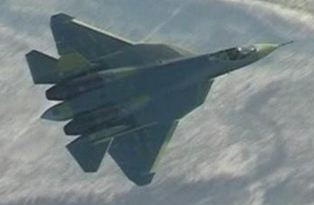
PAK FA

Sukhoy announced that its third PAK FA prototype conducted its first test flight today.  Operating from KnAAPO’s factory runway, the aircraft flew for more than an hour.

To run back a few milestones, the first PAK FA flew on January 29, 2010.  A second prototype joined it in March of this year.  PAK FA’s first public flight was August 17 at MAKS-2011.  And Sukhoy says the PAK FA has completed more than 100 test flights to date.  The hundredth flight apparently occurred early this month or in late October.

On November 11, ARMS-TASS reported that the third prototype will test the onboard phased array radar (AFAR)  system designed by the Tikhomirov NII of Instrument-building (NIIP).  Nezavisimoye voyennoye obozreniye published the same news, citing a Sukhoy spokesman.

VKO Cadre Changes

Didn’t have to wait long for this.  This morning President Medvedev signed out the ukaz with appointments to command positions in the VKO Troops (VVKO).

Kommersant’s source was mostly, but not completely, right.  Valeriy Ivanov will be chief of staff, and Sergey Popov, the chief of air defense for the Air Forces, will move to VVKO to command its Air and Missile Defense Command.

Appoint:

  • General-Lieutenant Valeriy Mikhaylovich Ivanov, Chief of Staff, First Deputy Commander, Troops of Aerospace Defense, relieved as Commander, Operational-Strategic Command of Aerospace Defense.
  • General-Lieutenant Sergey Aleksandrovich Lobov, Deputy Commander, Troops of Aerospace Defense, relieved as Deputy Commander, Space Troops.
  • General-Major Oleg Vladimirovich Maydanovich, Commander, Space Command, relieved as Chief, 153rd Main Test Center for Testing and Control of Space Systems.
  • Colonel Konstantin Aleksandrovich Ogiyenko, Commander, 5th Air Defense Brigade.
  • General-Lieutenant Oleg Nikolayevich Ostapenko, Commander, Troops of Aerospace Defense, relieved as Commander, Space Troops.
  • General-Major Sergey Vladimirovich Popov, Commander, Air and Missile Defense Command, relieved as Chief, Air Defense, Deputy CINC of the Air Forces for Air Defense.

There you have it.  What looks like it will be a new service — VVKO — is born, and an old branch — KV — apparently will go away.  More presidential paperwork on that is likely forthcoming.  But today we’ve learned who’s in VVKO’s head shed, and that its two major components will be, not surprisingly, the Space Command and Air and Missile Defense Command.

Team VKO Taking Shape

Team VKO is taking shape according to Kommersant.  Last fall, President Medvedev, of course, ordered the establishment of a unified VKO.  Since then, it’s become clear that Space Troops (KV) Commander, General-Lieutenant Oleg Ostapenko would head it.

And KV will be the base for the new service [vid or вид].  According to the Genshtab plan, VKO will unite all PVO and PRO systems.  And it will control the current KV, Moscow-based OSK VKO, and PVO units from the Air Forces.

The paper’s Defense Ministry source says VKO’s top officers have been identified, and paperwork was sent for Medvedev’s signature last month.  So expect a decree soon.

General-Lieutenant Valeriy Ivanov will be in charge of PVO and PRO for VKO.  He’s a 50-year-old career SAM officer, who commanded PVO divisions or corps in the Far East, Volga, and Moscow MDs.  From 2007-10, he commanded the Far East’s 11th AVVSPVO.  He became commander of the OSK VKO about this time last year.

General-Major Oleg Maydanovich is a 47-year-old KV missile engineer who will head VKO’s space monitoring.  He has long service at Plesetsk and Baykonur, and has been chief of both.  He’s now chief of Russia’s space systems testing and control center.

Colonel Andrey Ilin will be chief of the VKO’s command and control post at Krasnoznamensk.  He served many years at the space tracking post in Shchelkovo.  He’s been chief of staff at Plesetsk since last year.

Death of Mikoyan

On October 21, the labor union of the Engineering Center of the Experimental-Design Bureau (OKB) named for A. I. Mikoyan went public with its claim that  well-known aircraft maker RSK MiG is in a catastrophic state.  Metronews.ru published part of the union’s open appeal as well as MiG’s official reaction.  The union’s letter is addressed to the president, prime minister, and heads of political parties, and dated October 11.

Union chairman Yuriy Malakhov says:

“The situation taking shape in our engineering center forced me to write this letter.  We’ve always been the brain of the company, it’s right here that new aircraft models were developed.  For a long time, we’ve had no new orders.  In the past five years, six general directors have been replaced, they all come from the Sukhoy company, and the impression’s created that they are strangling us, they want to close our company.  All the best orders go there [Sukhoy].  For example, we aren’t even allowed to participate in developing unmanned aerial vehicles.  Sukhoy is working on them, but this aircraft company doesn’t have our experience.  They focused on heavy fighters.  The pay of our colleagues is lower than in the trolleybus yard next door.  Lead engineers get 8-10 thousand rubles [per month].  Sometimes with occasional bonuses they get 30 thousand.  Talented young specialists leave for other firms, for example, Boeing, where they get two-three times more.  Now 10 percent of orders come from Russia, the rest from abroad.  In the course of several years we tried to get a response from our leadership, but no one wanted to start negotiations with us.  And the engineering center’s director decided to meet with employees only after this letter.  We are very much hoping for this meeting.  We expect new orders and increased wages.”

 MiG’s press-secretary offered this response:

“The absence of the Gosoboronzakaz in the 1990s was a serious blow to the country’s defense industry, including to RSK MiG.  Only those companies that had large export contracts could develop successfully, for example in that period the Sukhoy company managed to conclude contracts with India and China.  At that moment, MiG had only a contract with Malaysia.  In recent years, RSK MiG’s been headed by directors from Sukhoy corporation – Nikitin, Fedorov, Pogosyan, Korotkov.  From outside this could look like a raider’s seizure of MiG.  But who needs to seize debts and problems?  A positive dynamic began precisely with the arrival of these people – large foreign contracts were signed, the contract with the Defense Ministry to supply MiG-SMT.  Aircraft were supplied against this contract and they’re being successfully employed in the RF VVS.  Presently, a contract with the Defense Ministry to supply the MiG-29K is being discussed.”

“Today RSK MiG’s order portfolio is more than $4 billion, serial production of new aircraft is unfolding. There is a positive dynamic, maybe it’s not as quick and wages not as high as all of us would like.  Some young specialists come and stay, some leave.  But on the whole the company has good prospects.”

A couple points on these claims.  We know raiders take and sell what’s good, and leave “debts and problems” behind.  The Defense Ministry’s acceptance of the Algerian MiG-SMTs was more a financial bailout for the company and face-saving maneuver for Russia writ large than a real contract.  Not mentioned is Aleksandr Sukhorukov’s October 11 statement that MiG-29K procurement won’t come until 2013-2015.

The text of the union’s letter says MiG is simply dying.  It cites many problems and complaints, including a 48-billion-ruble debt, losses and delays in contracts, moving engineers to Zhukovskiy, closing MAPO, etc.  It says crucial pay bonuses can’t always be paid, and MiG is just supplying skilled people to Sukhoy and Irkut.  The letter calls OAK an incomprehensible middle layer blocking competition, but allowing personal lobbying.  Finally, it blames Mikhail Pogosyan for closing MiG’s promising future projects.

Scanning other recent MiG headlines – the Indian tender wasn’t the only blow to the MiG-35, its chances with the Russian Air Forces didn’t look too rosy anyway, and the early September MiG-31 crash indicated again what dire straits that old airframe is in.

Izvestiya’s Ilya Kramnik published recently on the MiG-29’s fate.  He wrote that (unlike the Su-27 or Su-24) the Defense Ministry doesn’t plan to modernize the MiG-29.  His military source says replacement of these worn-out aircraft in the future is deemed more cost-effective.

Kramnik’s source describes production of the generation “4+++” (?!) MiG-35 as an unavoidable but not yet decided step.  He sees the MiG-29 variant line ending since it’s outclassed by updated Su-27s.

Kramnik’s OPK source sees 20 or 24 MiG-35s being produced each year, for about 25 billion, to replace 150 or 160 MiG-29s in Russia’s inventory.

He cites Konstantin Makiyenko who sees the MiG-35 as important not just as a MiG-29 replacement, but also to keep Russia in the light- to medium-, $60-million-range fighter export market and not leave this industry segment to China and its J-10.

But Konstantin Bogdanov tells Kramnik he thinks the MiG-35’s loss in the Indian tender hurt its chances at home because it raises questions about MiG’s ability to support a production program for the Russian Air Forces.

One also wonders how much MiG-35 and MiG-29 will be needed with T-50 / PAK FA, with Su-35, and with Su-27 upgrades out there.

It’s hard to see the MiG story as anything but another chapter in the painful and necessary process of post-Cold War industrial downsizing and restructuring.  After all, the U.S. is down basically to Boeing and Lockheed Martin.  In MiG’s case, one can question whether the selection is really natural and the fittest are truly surviving.  The answer is probably yes.  However they managed it, Sukhoy and Irkut played their post-Soviet hand better, and it shows today.  The Russian aviation sector will be better off with further consolidation.  Still it doesn’t need Sukhoy to be a monopolist.  Managing that outcome will be tricky.

Cadre Changes

President Medvedev’s decree yesterday dismissed Russia’s senior military representative to NATO, Army General Aleksey Maslov, who was once Ground Troops CINC.  Fifty-eight-year-old Maslov leaves a little early for a four-star general.  No word on whether he requested to retire.  At any rate, other generals might be shuffled about to fill the NATO milrep spot, or it might be gapped for a time.

But on to the decree.

Appoint:

  • Captain 1st Rank Igor Valentinovich Grachev, Chief, Missile-Artillery Armaments Directorate, Northern Fleet.
  • Colonel Sergey Semenovich Nyrkov, Commander, 9th Independent Motorized Rifle Brigade.

Relieve:

  • Colonel Sergey Faatovich Akhmetshin, Deputy Chief, Main Staff, Air Forces.
  • Colonel Dmitriy Valeryevich Laptev, Commander, 9th Aerospace Defense Brigade.

Relieve and dismiss from military service:

  • Rear-Admiral Yuriy Prokopyevich Yeremin, Chief, Navy Military Training-Scientific Center “Naval Academy” (1st Branch, St. Petersburg).
  • General-Major Aleksandr Viktorovich Shapekin, Chief of Staff, First Deputy Commander, Operational-Strategic Command of Aerospace Defense.

Dismiss from military service:

  • Army General Aleksey Fedorovich Maslov.

Cadre Changes

In yesterday’s decree, President Medvedev retired General-Lieutenant Sadofyev, Deputy CINC of the Air Forces and Aviation Chief.  As you’ve read, he was sometimes the service’s spokesman, especially on modernization issues.  Sadofyev turned 55 (normal age limit for two-stars) in January.  At one time,  he looked like a candidate to replace Air Forces CINC, General-Colonel Zelin, who continues to serve. 

Medvedev made General-Major Vladimir Gradusov Deputy CINC of the Air Forces.  He wasn’t given the Aviation Chief title to replace Sadofyev directly.  But he has the background for it.

General-Major Gradusov

As the decree said, Gradusov comes from the 185th Combat Training and Combat Employment Center in Ashuluk.  Krasnaya zvezda recently profiled him. 

He’s 53 (maybe 52).  Native of Moscow Oblast.  Trained at the Kharkov Higher Military Aviation School for Pilots.  Served as pilot-instructor at Kharkov.  Commanded the training squadron at the Krasnodar Higher Aviation School,  training foreign students on the L-39 and MiG-21. 

He’s commanded fighter regiments, and served in the former Kiev, North Caucasus, Transbaykal, and Siberian MDs.  In 2003, he left the post of aviation chief of the Siberian MD’s air and air defense army for the training center job in Ashuluk. 

He’s mastered the L-29, L-39, MiG-21 (all mods), MiG-29, MiG-31, and An-26.  Apparently not a Sukhoy guy.  KZ notes without elaboration that Gradusov has been in combat.

But on with the decree . . .

Appoint:

  • Colonel Andrey Mikhaylovich Bulyga, Chief, Material-Technical Support Planning and Coordination Directorate, Central MD.
  • General-Major Vladimir Yuryevich Gradusov, Deputy CINC, Air Forces, relieved as Chief, 185th Combat Training and Combat Employment Center.
  • Lieutenant Colonel Andrey Borisovich Yefimov, Chief, Missile-Artillery Armament Service, Southern MD.
  • General-Major Fraiz Fazlyakhmetovich Salyyev, Chief, Technical Support Directorate, Central MD, relieved as Chief, Technical Support Directorate, Southern MD.
  • Colonel Mikhail Anatolyevich Khvostenkov, Chief, Missile-Artillery Armament Service, Eastern MD.

Relieve and dismiss from military service:

  • Rear-Admiral Vitaliy Nikolayevich Ivanov, Chief of Fleet Communications, Deputy Chief of Staff for Communications, Pacific Fleet.
  • General-Lieutenant Igor Vasilyevich Sadofyev, Chief of Aviation, Deputy CINC of the Air Forces for Aviation.