Category Archives: Command and Control

Exploding Arsenals

Media commentaries on the arsenal explosions were outstanding.  Here are excerpts from some . . .

Viktor Myasnikov in Nezavisimaya gazeta:

“The father of one of 300 conscripts assigned to the arsenal, Andrey Chukavin, said three days before the incident he complained on the Defense Ministry website about safety rule and regulation violations in the loading-unloading work.  In his opinion, the arsenal didn’t figure on the quantity of munitions that arrived in the last month.  ‘Conscripts and civilians had to work in two shifts for loading-unloading.  Work went on from 8:30 until three in the morning or later,’ — he told journalists.”

“However, in past years there hasn’t been a single explosion at a civilian enterprises disarming munitions.  Because automated systems of disassembly are working there, safe techniques of eliminating explosives are employed and safety rules are strictly observed.  But it’s more advantageous for the Defense Ministry to use draftees, old-fashioned manual disassembly and save budget resources on its arsenals.  And then the state will spend billions covering the damage from such economizing.”

“Soon, as punishment, the president will dismiss the next batch of generals and colonels.  But the system remains.  So explosions will rumble in the arsenals again in a year or two, or even earlier.”

Itogi’s Oleg Andreyev:

“. . . they’ve made responsible for the explosion in the artillery depot in the Bashkir village of Urman a conscript whose guilt consists probably of not being trained to work with explosive substances.”

“Really everything that’s happening now under Serdyukov’s administration is absolutely natural.  Specifically, under him, the last professionals who received a classical military education departed the Armed Forces.  In essence, continuity was destroyed, and, as they say, the experience of organizing service, literally paid for with blood, drained away into the sand.  Including also experience in storing and servicing explosive substances, munitions and combat means.  To put it differently, there are still shells and missiles, bombs and torpedoes in the arsenals, but experience and skill is lacking!  Explosions in depots don’t just cause deadly fireworks.  In society’s consciousness, the shock wave will raze all of military reform to the ground.”

In Nasha versiya, Vadim Saranov writes:

“Can it be that in June 2010 [sic] after the explosions at the arsenal in Ulyanovsk, the president dismissed an entire handful of generals, but, as we see, nothing came out of this.  On the other hand, several other Defense Ministry decisions, in the opinion of specialists, are increasing by several times the risk of similar events at depots and ranges.  As ‘Nasha versiya’ already wrote, at the beginning of 2010, Defense Minister Anatoliy Serdyukov issued a directive, according to which the Russian Army should rid itself of all old munitions by the end of 2011.  But no kind of serious investment in this program was foreseen.  It was ordered to get rid of shells either by explosive methods or in army arsenal workshops which have obsolete equipment.  Today, according to our Defense Ministry sources, to fulfill these instructions, dismantlement is taking place in a rush in units.  It isn’t excluded that this hurrying itself could even be the cause of future accidents.  Judge yourself:  according to official statements, the first explosion in the depot in Udmurtia happened on the night of 2-3 June during some ‘loading-unloading’ work.  Ask yourself:  from what kind of panic, really, is loading-unloading work conducting at night in a second-rank arsenal?  Did a war start?  According to regulations, at this time there should only be sentries, duty officers, and orderlies on watch.  Then who was handling shells?  How much time did this soldiers rest in the previous day?  For this reason, it can’t be hoped that the events in Bashkiria and Udmurtia will be the last in the series of bombardments of peaceful Russian towns.  The minister’s order will be fulfilled at any price.”

Lastly for this post, Pavel Felgengauer in Novaya gazeta:

“In every separate instance (according to the results of official investigations) the guilty one is either a negligent officer or soldier (one-year conscript) who somehow didn’t handle shells and artillery powder casings carefully enough or threw down a butt.  And then the negligent chiefs who didn’t ensure supervision, order and discipline.  Even if all this is true, it isn’t possible with just one administrative dressing-down, even if Medvedev removed the minister [Serdyukov] as punishment, to solve universally the problems of masses of unneeded, expired munitions in Russia.  It wasn’t under Serdyukov that ammunition began to burn and explode regularly in Russia, and it won’t stop after him.”

“We need, of course, to arrange a reliable, effective and safe system of dismantling old munitions instead of the usual, harmful and dangerous  explosive demolition.  We need to construct reliable storage bases with secondary containment and strong concrete shelters.  Medvedev is right — we have to struggle against sloppiness.”

Felgengauer goes on to note that Russia has had to keep old shells for its old guns and tanks that haven’t been replaced.

“When the chiefs say that the army and navy’s weapons are 90 percent obsolete — this is true, but this isn’t all.  The munitions have become obsolete just the same, if not worse.  That is, old munitions are used and saved, but they from time to time randomly explode, maiming and killing people, destroying buildings.  So here’s the system, because of which it’s impossible to avoid tragedies and accidents.  And in the future, undoubtedly, there will only be more of them since weapons and munitions are getting even older, and discipline in the troops will continue to fall in response to half-baked reforms.”
Not Utopia

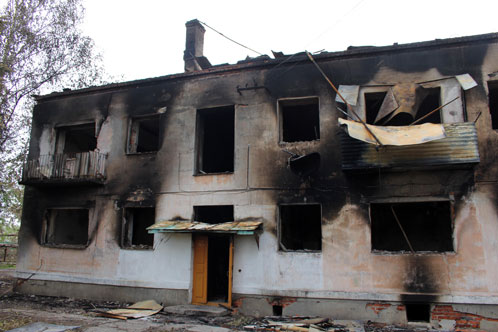
Burned Out Building in Urman Near the 99th Arsenal (photo: Komsomolskaya pravda / Timur Sharipkulov)

Yes, it’s definitely not utopia.

Sometimes it seems Anatoliy Serdyukov resides in a special dystopia reserved for reformers.  In an interview at the very end of last year, Serdyukov said as much.  He admitted his reform of the military isn’t solving every problem.

Addressing munitions dismantlement on December 31, the Defense Minister said:

“The problem is very serious.  For long years, munitions were stockpiled to excess, calculated for a multimillion-man army.  Besides, in the last twenty years, virtually no attention was given to combat training and firings, but the norms of munitions stockpiling remained as before.  As a result, so much ended up in excess that we have work for several years.  To dismantle them by industrial methods is quite complex – there aren’t enough enterprises.  Besides, this is very expensive and not safer than destruction.”

“Therefore, we’re now preparing special teams, certifying equipment, and selecting officers.  They mainly need to be combat engineers.  We’re picking ranges.  We’ve figured where, in what volume, and what we need to blow up, and worked out safe techniques.  We need at a minimum two, maybe three years of such work.  Yes, this will create some temporary discomfort and difficulties.  But it’s impossible to not do this.  If the entire arsenal at Ulyanovsk had blown up, the trouble would have been much more serious.”

Well, he’s right.  It’s a huge problem that has to be resolved. 

There was lots of good (albeit repetitive) news reporting on the two arsenal explosions, and the news analyses and op-eds had a lot of common themes we’ll summarize below.  Many of the same points were made at the time of the 31st Arsenal disaster in 2009.  The major shared ideas are:

  • Russia’s munitions depot problem is enormous, and massive resources are required to resolve it.  The current effort is very belated, and probably grossly underfinanced.  And now the dismantlement and destruction of excess ammunition is being rushed with tragic consequences.
  • Conscripts and crude methods are being employed in place of professional military specialists, civilian experts, and modern equipment.  There’s a willingness to ignore basic safety regulations since draftees are still considered expendable.
  • Military district commanders were not appropriately prepared to supervise storage depots and the dangerous work of eliminating explosives when they took control of them from the Defense Ministry’s Main Missile-Artillery Directorate (GRAU). 
  • The three criticisms above all add to blaming Serdyukov’s reforms for the exploding arsenals.  Critics say he’s rushed the process, forced now sorely-needed ordnance officers out of the army, and taken the situation out of the GRAU’s experienced hands.

Now, to be fair, some of the conditions listed above existed before Serdyukov arrived, and some he created or exacerbated.  And arsenals exploded before.  But these disasters seem to occur more frequently now.

A few other points made by commentators:

  • Trying to destroy munitions on the cheap is leading to even greater losses for the state when it has to compensate injured civilians.
  • Other countries have eliminated huge munitions stockpiles safely, but Russia seems to have a peculiar national tradition of technological carelessness that keeps it from doing the same.
  • The Kremlin and the Defense Ministry won’t find the guilty in these explosions, but some officers and, possibly, officials, will be appointed to fill the role.

Moreover, the MChS says wildfires already cover an area three times larger than this time last year.  Another terrible fire season might threaten many military facilities, including arsenals.

To sum this all up, it’s worth reprinting how Vladislav Shurygin was recapped on these pages 18 months ago:

“He cites the catastrophic state of Russia’s overflowing arsenals and munitions depots.  This summer Serdyukov transferred responsibility for them from the GRAU to the MDs and fleets who aren’t technically prepared to manage them.  Shurygin notes it was GRAU personnel who were punished for the November blasts at the Navy’s arsenal in Ulyanovsk.  Convenient people are punished rather than those who are truly guilty, according to him.”

More Appointments, Dismissals

Vedomosti’s been following the rather turgid decrees from Defense Minister Serdyukov, and apparently managed to notice that he’s ordered 30 percent of Armed Forces officers to change duty stations before 1 December (the beginning of the 2012 training year).

Rotating officers every three years is a policy Serdyukov’s pushed since at least late 2009, if not earlier.  And it’s quite a shift in thinking for a military establishment in which officers often served their entire careers in the same district or garrison, or even unit. 

It’s a good and overdue shakeup, but one that brings costs and headaches that the Defense Ministry always wanted to avoid.  For example, in the not-distant past, officers would try to avoid remote assignments, of course, or ones where their wives would find it difficult to work or their children to get a good education.  Or they might not want to go somewhere that couldn’t provide equivalent service housing, or might be a terminal assignment in an undesirable location.

All this is just by way of saying that the cadre moves we’ve followed in President Medvedev’s decrees on Armed Forces personnel changes seem to confirm a pretty unprecedented rate of reassignments and rotations, at least for O-6s and above.  And they’ve confirmed more of an effort to move senior officers up in rank, or out at age 50, 55, or 60.

In any event, an overlooked decree from 30 March.

Appoint:

  • Colonel Nikolay Nikolayevich Galchishak, Commander, 5th Independent Tank Brigade, 36th Army.
  • Colonel Vyacheslav Nikolayevich Gurov, Commander, 6th Independent Tank Brigade, 20th Army.
  • Lieutenant Colonel Vladislav Nikolayevich Yershov, Commander, 21st Independent Motorized Rifle Brigade, 2nd Army.
  • Colonel Sergey Nikolayevich Kombarov, Commander, 7th Independent Tank Brigade.
  • Colonel Eduard Vladimirovich Filatov, Commander, 9th Independent Motorized Rifle Brigade, 20th Army.

Relieve:

  • General-Major Aleksandr Sergeyevich Nikitin, Chief, Operational Directorate, Far East MD.

Relieve and dismiss from military service:

  • General-Major Yuriy Eduardovich Kuznetsov, Commander, 6950th Aviation Base (1st Rank).

Dismiss from military service:

  • General-Major of Justice Grigoriy Petrovich Kuleshov.

Aerospace Defense Troops

Svpressa.ru’s Sergey Ishchenko published an interesting piece on VKO late last Friday.  He wrote that Space Troops Commander, General-Lieutenant Oleg Ostapenko recently reported to the Federation Council on the creation of VKO, making it clear that Ostapenko’s branch, as reported earlier and elsewhere, will be the basis of Russia’s unified VKO due to stand up by 1 December.

Ishchenko makes these additional points:

  • The long-range missile for the S-400 is still in testing.
  • He doubts the S-500 will be delivered in 2015.
  • His interviewee believes the new Aerospace Defense Troops will get all or some of Russia’s SAM force from the VVS.
  • The interviewee thinks the S-500 is on schedule.

Ishchenko says the debate over the lead for VKO didn’t necessarily center on what’s best to protect Russia’s security, but rather on who would receive new resources and general officer billets.

The Air Forces argued they were best suited to lead it, but the Space Troops apparently argued persuasively that they were better prepared to handle Russia’s future transatmospheric threats.

Now, a quick editorial aside from Ishchenko’s narrative . . . this decision is probably a good thing for the Air Forces, which already have their hands full and don’t need more missions.  They stand to lose only some part of the surface-to-air missile business (which hasn’t always been a core mission for them anyway).  And the VVS will benefit by concentrating on their most important tasks.

But back to Ishchenko . . . he provides a fine review of the USSR’s space weapons and space defense efforts, which, arguably, met or exceeded those of the United States.  He notes President Yeltsin’s 1993 decree on creating VKO, for which no one moved so much as a finger, at least partially because of the country’s economic and budgetary predicament at that time. 

Then Ishchenko gets more interesting.  He details the danger posed to Russia by U.S. “noncontact” wars in Iraq (sic), Yugoslavia, and Libya.  These, however, are really wars of the past rather than the future, he says.  Ishchenko moves on to the threat of Prompt Global Strike.

He talks about a hypersonic bomber cruising at Mach 5-7 speeds and altitudes up to 30,000 meters, beyond the reach of Russia’s current SAMs.  Of course, IOC isn’t before 2025, but Moscow needs to start thinking today about how to counter it.  Meanwhile, the state-of-the-art Russian SAM, the S-400, is barely fielded and its extended range missile is still being tested.  Its successor, the S-500, is supposed to be ready in 2015, but Ishchenko is skeptical.

The end of Ishchenko’s article is a brief interview with the chief editor of the journal Vozdushno-kosmicheskaya oborona, Mikhail Khodarenok.  Khodarenok’s a retired colonel, professional air defender, graduate of the General Staff Academy, and former staffer of the General Staff’s Main Operations Directorate (GOU).  In the late 1990s and early 2000s, he was an outstanding military journalist for Nezavisimoye voyennoye obozreniye, but by 2003 or 2004, he left for VKO and Voyenno-promyshlennyy kuryer, both wholly owned by air defense system designer Almaz-Antey.

Ishchenko asks what Khodarenok knows about the process of creating the Aerospace Defense Troops.  The latter hems about not having access to secret directives and documents before concluding:

“But I can say that much has already been determined.  In particular, it’s decided that Space Troops will be the basis of VKO.  Although there were other proposals.  The Air Forces, in particular, proposed taking their service as the basis.”

Asked about this tug-of-war for VKO within the Defense Ministry, he says:

“And this is a beloved Russian pasttime.  In our Armed Forces, they are constantly getting rid of something or resubordinating.  What happened, for example, with army aviation.  In my memory, five times it was given to the Air Forces, then returned to the Ground Troops.  Usually then five years of complete confusion.  Billions lost.  And it all begins again.”

Asked what will be in VKO:

“The basis is the Space Troops.  Evidently, the surface-to-air missile troops (ZRV) will be transferred to them from the VVS.  Fully or partially.  This isn’t determined yet.”

Finally, asked whether Almaz-Antey General Director Igor Ashurbeyli was replaced because of problems with the S-400’s long-range missile or issues in the S-500’s development, Khodarenok says:

“Ashurbeyli’s resignation was not connected with engineering problems in any way.  Neither with difficulties on the S-500, nor on the S-400.”

“I have my suppositions on this score.  But I don’t want to share them.  I repeat:  the most important thing is that the S-500’s development is on schedule.  And this system really will very much help the country’s aerospace defense.”

Navy Main Staff Moving 1 June

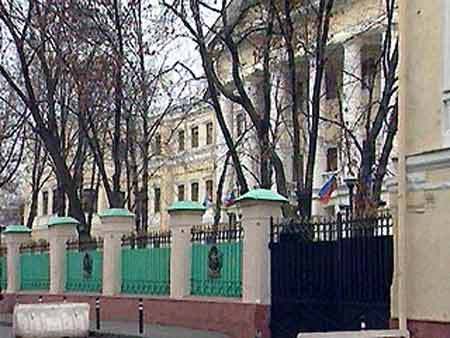
Navy Main Staff in Moscow

A Defense Ministry representative told RIA Novosti Friday that the main complex of the Navy’s Main Command has to be emptied before 1 June in connection with its move to St. Petersburg.  This means the Navy Main Staff building on Bolshoy Kozlovskiy.  The representative said 200 admirals and other officers have to head for the northern capital by the end of the month.
 
The source couldn’t say who will occupy the Main Staff’s old digs.  But other Navy Glavkomat buildings in Moscow aren’t being emptied yet.  These include the Navy Armaments Staff on Bolshoy Zlatoustinskiy, the Naval Aviation Staff in Skakovaya Alley, and the Rear Services Staff on Spartakovskaya Square.
 
RIA Novosti notes the back-and-forth, on-again / off-again nature of talk about moving the Navy’s headquarters to Piter.  Admiralty’s had a sign for several years saying it’s the home of the Navy Main Staff and Navy CINC.

The wire service failed to mention that Defense Minister Serdyukov has been solid all along, saying the transfer would happen eventually and gradually, even if his deputies or senior uniformed officers sometimes wavered on the issue.

RVSN’s Fourth Generation ASBU Being Introduced

The press this morning says a fourth generation automated command and control system for Russia’s land-based strategic missiles is being fielded.  It describes a more net-centric, skip-echelon capability with a central commander able to communicate directly with launchers in the field.

It’s not clear, however, how much in the fourth generation system is different from its immediate predecessor.

RIA Novosti writes . . .

MOSCOW, 27 Apr — RIA Novosti.  The fourth generation automated combat command and control system (ASBU) has started introduction into Russia’s Missile Troops of Strategic Designation (RVSN), official RVSN representative Vadim Koval told RIA Novosti on Wednesday.”

“‘In the RVSN and jointly in cooperation with industry, work continues on improving the system of combat troop command and control.  In particular, presently, development is complete and introduction of the fourth generation ASBU into troop echelons has begun,’ Colonel Koval said.”

“The new system supports automated exchange of employment plans and operational retargeting of missiles, along with the resolution of traditional missions of transmitting orders, gathering reports and monitoring the combat readiness of launchers.”

“‘And the transmission of combat command and control orders directly to launchers, without intermediate echelons, is supported, including under nuclear effects and radioelectronic suppression,’ Koval noted.”

“He noted that each of the system’s stations, which are made using a new domestic component base, is provided with triple reserve communications and data transmission systems and malfunction scanning which precisely identifies the individual element needing replacement.”

“Further improvement of the ASBU is connected, first and foremost, with improving the RF Armed Forces command and control system as a whole, and also with the command and control requirements of new generation nuclear missile weaponry.”

“From 2010, rearmament with the new missile system ‘Yars’ has been conducted in the RVSN.  Rearming of the Tatishchevo division with the silo-based ‘Topol-M’ missile system is also occurring.”

To RIA Novosti’s account, ITAR-TASS adds only that:

“The system’s paths for transmitting orders and gathering reports are established by land-line, radio, and satellite communications channels and possess the required survivability and jam-resistance.”

“Earlier orders issued by one of the central command posts came to launchers through army, division, regiment (battalion for mobile launchers) command posts.”

The new ASBU’s capabilities aren’t described much beyond what former RVSN Commander Solovtsov outlined in 2009.  See also RIA Novosti.

However, in late 2007, Solovtsov told Rossiyskoye voyennoye obozreniye (p. 21) that the RVSN was completing introduction of the third generation ASBU, and he described capabilities that sound much like what’s being advertised as fourth generation today.

So the issue may be, is this really something new, or the continuation of an earlier upgrade presented like major progress on an important modernization front?

Could Serdyukov Go?

Svpressa.ru asked yesterday if it’s possible Defense Minister Anatoliy Serdyukov might be dismissed in the runup to the presidential election.

It asked political analyst Aleksey Makarkin if any ministers might be dismissed to appease angry voters.  Svpressa noted the Kremlin has something of a tradition of firing some high-ranking officials to garner the electorate’s good will.  The media outlet asked him which current ministers might be sacrificed.

Makarkin answered:

“Society is pretty calmly inclined toward the current ministers.  But the people and the elite have different irritants.  If, let’s say, in the elite, great attention is given the role of Deputy Prime Minister Igor Sechin, then the populace is poorly informed about what he’s doing.  It happens that there’s what they write in the business press, and there’s what they show on television.  And the public, on the whole, watches television.”

“I think if ministerial dismissals happen, they will be connected not with an allegeric reaction among the people.  There are ministers that have complicated relations with the bureaucratic structures they direct.  These relations have formed in the course not of decades, but of centuries.  Now problems are notable in two such bureaucracies.”

“The first is the Defense Ministry which from the very beginning was very critical of Anatoliy Serdyukov — a strictly civilian person without a general’s rank.  The second is the Ministry of Health and Social Development.  It’s true the situation there is somewhat different.  It wasn’t initially negative for Tatyana Golikova.  But she isn’t a doctor, and she’s running up against a sufficiently cohesive medical community.”

“The difference [between Serdyukov’s and Golikova’s situations] is that Serdyukov has military men as his subordinates.  They aren’t inclined toward opposition demonstrations, and military retirees don’t have real influence on army processes.  There was the situation when Serdyukov had a conflict with the VDV Academy in Ryazan.  But General-Lieutenant Vladimir Shamanov, a well-known army figure, thought it best not to exacerbate the affair — the brakes were quickly put on the conflict.”

“Of course, internal dissatisfaction with Serdyukov is strong in the military.  Whereas at first this was dissatisfaction with the minister’s persona itself, the details of his biography (Serdyukov was once in the furniture business), but later with his activity in seriously reforming the army (that is the work to which they assigned Serdyukov).”

“Yes, it’s possible to recall the army reform under Aleksandr II — one of the greatest reforms of that time, together with freeing the serfs.  Then Milyutin’s military reform was also met very critically by a significant part of the military corporation.  They accused him of being a professor who didn’t have sufficient military experience.  And his accusers were famous combat generals . . .”

“Serdyukov’s situation is more complex, because he’s an outsider.  Naturally, the reforms he’s conducting — cutting the army as a whole, cutting generals, restructuring the military district system, taking the shoulderboards off some representatives of the military corporation, whose duties civilians can fulfill — are causing serious disapproval.”

It’s interesting to hear a purely political perspective on where Serdyukov and the Defense Ministry stand.  But it seems unlikely the Defense Minister would be cut loose when this would be a more public admission of failure than the recent reversal of several of his policies.  Serdyukov is more likely to be moved aside under cover of an ostensible elevation.

Makarkin’s right when he points out that army problems almost exclusively concern and affect the military caste.  They are routinely low on the list of worries of average Russians.   

But Makarkin shouldn’t dismiss the significance of unhappiness among military veterans and retirees.  True, they don’t necessarily have influence.  Their attitudes toward defense policymaking roughly mirror the moods of active duty military men who can’t attend political demonstrations or speak out in public.  Most Moscow commentators, like Makarkin, have probably gotten used to not pausing long to ponder what Russian military men think about politics.

More Mistral Negotiations

Mistral in Piter (photo: RIA Novosti / Aleksey Danichev)

Might as well start the week with Mistral news.  An informed RIA Novosti source in the OPK suggests this week could be decisive for negotiations on the sale of Mistral to Russia.  But can anything really be decisive in a drawn-out process like this?

The news agency’s interlocutor, much like Anatoliy Antonov, says:

“The situation is not very simple, the negotiating process is going with difficulty.”

“The stumbling block remains the ship’s outfitting, disagreement concerns two NATO standard command and control systems — combat information-command system Senit 9 and battle group (fleet) command and control system SIC-21.”

“The French agreed to transfer Senit 9 to Russia without a production license, they don’t want to transfer SIC-21 with the ship at all.”

RIA Novosti reminds that Russia has insisted on Mistral’s transfer with all  its systems and equipment.

Ruslan Pukhov bravely tells RIA Novosti, when it comes to amphibious command ships, it’s a buyer’s market, so Russia will find another country to sell it if France declines.  That’s at least half true, but it’s also true that France is something of a special case.  The Dutch, Spanish, or South Koreans might not be willing to give everything Moscow wants either.

Does That Box Come With Electronics?

The latest Mistral story is more complex than what you’ve probably read so far.

Russian press services report a highly-placed military source claims Paris has “registered” Moscow’s demand for systems and equipment on Mistral that fully satisfy the Russian Navy’s requirements.

Media sources also say the negotiations foresee a state contract for the provision of two Mistrals, spare parts, instrumentation, and essential operator documentation, as well as equipment, services, and construction documentation needed to build two more Mistrals in Russia.

A source also told the wire services preparation for the acquisition of Mistral “is going logically and systematically” within the bounds of the negotiating process with the French side.

Newsru.com, by contrast, claims this is the Defense Ministry’s way of countering reports that Moscow has decided not to buy Mistral since France is trying sell Russia “empty boxes” for a billion euros. 

Newsru is referring to Vedomosti’s story from earlier this week saying the entire Mistral deal is under threat because the ships’ outfitting is unacceptable to Russia since it doesn’t include modern command, control, and communications systems, and is only a “basic variant” of the ship, a “box without electronics” essentially.

Newsru recaps Tuesday’s Vedomosti:

“. . . the preliminary agreement actually didn’t include the construction of two more ships in Russia, or crew training and the transfer of shipbuilding technologies.  As “Vedomosti” stated with reference to sources in the Presidential Administration and the RF Defense Ministry, the negotiations with the French have reached a dead end, and now resolution of the problem is being sought at the political level.”

On the issue of providing C3 systems (specifically, Senit 9 and SIC-21) on-board Mistral, Vedomosti implies it’s more about money than technology transfer.  Russia can either pay an extra 200 million euros for a full electronics fit, or try to argue at the political level for the ships at the price of 890 million euros which was supposedly on the protocol signed late last year by now-retired Vice-Admiral Nikolay Borisov and Deputy PM Igor Sechin.  Other sources have said Borisov and Sechin exceeded their mandate in agreeing to a price well over 1 billion euros.  We don’t really know what was on that protocol.

The point – overlooked by many including yours truly – is that there’s no real contract for Mistral yet, and it’s a long way off.  All there are so far are protocols, agreements, and understandings.  What was signed in January at Saint-Nazaire was an “intergovernmental agreement” for the possible construction of two Mistrals, not a specific contract covering that and the construction of two more in Russia.

Wednesday Interfaks.ru ran its review of the Mistral story concluding that the negotiating process is difficult, but the French have decided to meet Russia’s requirements.

Interfaks also published something else that might be useful when thinking about Mistral:

“Meanwhile in mid-March, Deputy Defense Minister Anatoliy Antonov, who’s overseeing international cooperation issues, told journalists in Paris that Russia doesn’t intend to force the signing of the contract for the purchase of the French ‘Mistral’ helicopter carriers until it’s determined that all technical parameters won’t impinge on the Defense Ministry’s interests.  ‘It’s early to talk about dates, too many technical details have to be decided.  The contract has to be adapted to our conditions.  Complex expert professional work in the verification of all parameters of a future agreement is going on,’ said the Deputy Minister.  And he noted talk about how all technical nuances are reflected and have been laid down in the contract.  ‘The negotiating process is complex, I would say difficult,’ said Antonov.  He added that, essentially, the negotiations have just begun.  ‘We have to discuss the entire complex of issues.  The task of acquiring ships and their technologies has been given to us.  That’s the most important thing,’ said the Deputy Minister.  In his opinion, an important part of the negotiating process is ‘the contract’s price.’  ‘It’s important to understand that on the issue of buying Mistral type ships agreements were reached at the level of the presidents of the two countries, and negotiators have all necessary authorities and instructions.  We have to work calmly and implement all agreements,’ said Antonov.  He noted that now it’s essential that all agreements ‘be put on paper and to reflect the political agreements of the two presidents in figures so that they meet the interests of the two countries.’”

A professional diplomat and negotiator is never going to say a process is easy, and this one isn’t.  But it does sound like there’s a draft contract, while price and exactly what the presidents agreed remains at issue.

Another Trouble Brigade

Today’s Presidential ukaz on military personnel changes is attracting attention because it relieved and dismissed General-Lieutenant Vadim Volkovitsky from the service.  Of late Volkovitskiy was First Deputy CINC of the Air Forces (VVS), and Chief of the Main Staff. 

General-Lieutenant Volkovitskiy

He’s a career air defender who’s been a two-star for the last ten years.  He’ll be 55, statutory retirement age next Friday.  He commanded air and air defense troops in the Urals in 2006, and came to Moscow and the VVS headquarters in 2007.

We don’t really know why Volkovitskiy’s going out right on time, but it does seem President Medvedev and Defense Minister Serdyukov have made an effort to keep senior officers from serving forever.

God-Forsaken Pechenga

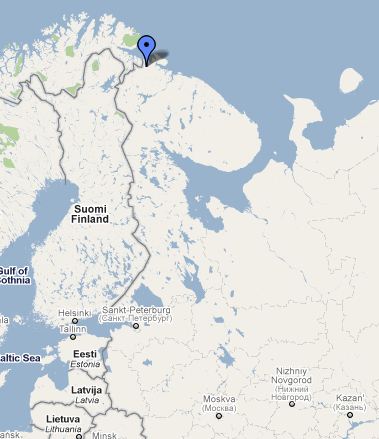
Far more interesting is the President relieving Colonel Vitaliy Leonidovich Razgonov, Commander of the 200th Independent Motorized Rifle Brigade based at god-forsaken Pechenga.  He’s only been commander there for 18 months. 

The 200th Brigade remains in its Cold War deployment along the Russian border with Norway.  It’s probably not what the Defense Ministry has in mind for its future Arctic brigade. 

This brigade has more than its share of trouble, and Colonel Razgonov’s apparent inability to control his men might — repeat might — have something to do with the change of command.  The ukaz, of course, gives no reason.

Just on Monday, Komsomolskaya pravda published on all of v / ch 08275’s problems.  The paper’s reporters say this command is unable to maintain elementary order.  The brigade’s officers complain that today’s young men are already so corrupted that the army can’t fix them, and that they don’t have any tools to deal with disorder among their men.  But KP says the soldiers don’t look disorderly during the day, but become that way at night when they’re unsupervised in the barracks.  The paper suggests the officers themselves are corrupt and disorderly at Pechenga.

Several weeks ago a conscript from Dagestan got three and a half years for killing an ethnic Russian junior sergeant in June 2010.  The command initially tried to make it look like an accident rather than murder.  Svpressa.ru suggests 4 or 5 men from Dagestan beat the victim.  The Soldiers’ Mothers Committee helped his family get the military prosecutors on the case.

Another conscript was beaten severely right on the brigade’s parade ground in early March.  According to IA Regnum, the young man — a graduate of the Murmansk School of Music — had two operations and his spleen was removed.

Last September a conscript shot and killed another conscript before shooting himself to death.  The parents of the shooter don’t believe this version of what happened, and have turned to the Soldiers’ Mothers Committee for help.

Last May, the chief of the brigade’s missile-artillery service stabbed his wife and six-year-old son to death.  He was subsequently diagnosed as a paranoid-schizophrenic.  This can happen anywhere, but it’s interesting it happened in a place already so afflicted with misfortune.  One wonders if there isn’t more to the story.

Where does this leave us?

It’s hard to say.  All the evidence of trouble is, so to say, circumstantial when it comes to Colonel Razgonov and whether he’s up to the job or has been derelict.  We don’t have enough information.  Maybe Razgonov himself asked to be relieved.  Who knows?  But it may be that someone in the chain, in the Defense Ministry or elsewhere, recognized a situation that needs to change.  The question now is will it?