Category Archives: Crime and Corruption

Blaming Yudashkin

Aleksandr Kanshin has reemerged . . . late of the Public Chamber, he’s now Deputy Chairman of the Defense Ministry’s Public Council, and he blames new army uniforms designed by fashion mogul Valentin Yudashkin for the recent outbreak of illnesses among conscripts in the Central Military District.

Vesti.ru and Newsru.com picked up what Kanshin told Interfaks:

“Judging by documents I’ve been made familiar with, one of the causes of illnesses among the young reinforcements in the troops, particularly in the Central Military District (TsVO), is manufacturing defects in the new winter field uniform supplied to conscripts at the assembly points of the military commissariats.  In other words, the new type uniform ‘from Yudashkin’ doesn’t defend soldiers against freezing in low temperatures.”

“At times, TsVO servicemen have to wear warm things under the new winter uniform.”

Kanshin also said he’s talked with TsVO Commander, General-Lieutenant Vladimir Chirkin who recognizes the new uniform needs improvement, but he also indicates 80 percent of his personnel are dressed in the old field uniform which is much warmer.

Vesti.ru reported the majority of the district’s servicemen are negative about the Yudashkin uniform because the air temperature is -20° (-4° F) and the wind blows through it outside.

Newsru.com pointed back to several scandals over the Yudashkin uniform, including last December when it said 250 soldiers became seriously ill in their unit in Yurga.  It was proposed at the time that they became sick because the new uniform didn’t protect them against the cold.

These new digital cammies were developed between May 2007 and 2010.  Besides fashion designer Yudashkin, specialists from the Central Scientific-Research Institute of the Garment Industry and the Defense Ministry’s Central Clothing Directorate participated in creating them.

Gzt.ru claims Yudashkin isn’t to blame.  The winter uniform was changed and sewn in defense industry factories with cheap materials.  Perhaps these are Kanshin’s “manufacturing defects.”  Sounds like corruption though, if someone substituted inferior materials.

Doctors told journalists that Yudashkin’s boots don’t keep out the cold either.

According to Gzt.ru, the military prosecutor is checking the situation in the TsVO.  Meanwhile, the military officially denies the uniforms are to blame, and maintains the emergency situation is just a seasonal outbreak of illness.

It’s Not Corruption

In a very unusual step yesterday, Mil.ru published an explicit denial that recent cadre changes have any connection to corruption.  The possibility of a link between high-ranking personnel dismissals and corruption cases has been the subject of some speculation.

The press release says the Defense Ministry is devoting great attention to anticorruption efforts, and talking openly about cases like Gaydukov’s.  But it denies that any other [read Verkhovtsev’s] recent dismissal is connected to this.

It maintains high-ranking officers are being dismissed for the usual reasons — age, health, and their own request.  It adds that they have many years of worthy service behind them.

As far as other moves go, it says “organizational-personnel measures” [i.e. orgshtat or TO&E changes] have caused some officers to be relieved of their duties or be assigned to new ones.

The Defense Ministry “doth protest too much” perhaps.  It might not want Congress asking questions about where U.S. Cooperative Threat Reduction money has gone.  At any rate, it’s uncommon for the Defense Ministry to take offense, and react so immediately to media speculation.

Corruption in 12th GUMO?

Is corruption the cause for the recent spate of decrees on military personnel?

In today’s Nezavisimaya gazeta, Vladimir Mukhin reports a Defense Ministry source says the recent dismissals of high-ranking military men are connected to corruption by them or their subordinates.  He puts the sudden retirement of 12th GUMO Chief Vladimir Verkhovtsev in this category.  He reminds that the 12th GUMO is responsible for the safety, security, storage, testing, and reliability of Russian nuclear weapons, and is also primary recipient of years of U.S. taxpayer funding through the Nunn-Lugar Act.

Though he’s headed the 12th GUMO for the last five years, General-Colonel Verkhovtsev’s a relatively young 55, and could still serve 5 years under the law.

Mukhin says Defense Ministry sources say Verkhovtsev’s going down for corruption and theft by General-Major Viktor Gaydukov, commander of a nuclear weapons storage site, who together with his wife managed to steal 20 million rubles worth of U.S. aid intended for engineering work for “improving the secure storage and accountability of nuclear weapons.”

Gaydukov was the first to fall for failing to report his income and assets accurately under the provisions of the latest government anti-corruption campaign.  However, the authorities’ discovery of his theft of money intended for nuclear security was purely incidental.

Mukhin cites Defense Minister Anatoliy Serdyukov’s persistent proponent, Igor Korotchenko:

“To the Defense Minister’s credit, he didn’t hide these facts and continues to sign dismissal paperwork for all officers and generals discovered mixed up in corruption.  That’s why there are so many retirements of military chiefs figuring in the president’s decrees.”

An anonymous 12th GUMO officer says:

“In Russia and the U.S., there are few ordinary people who know that, almost 20 years after the USSR’s collapse, Washington gives unreimbursed aid to the RF for the defense and support of its nuclear-technical facilities.  Why aren’t such activities promoted – it wouldn’t do to talk about them.  In Russia, they’re afraid that so-called patriots [Tea Party types?], the opposition, U.S. taxpayers wouldn’t like it.”

Mukhin says Moscow has spent much less on these facilities than the U.S. ($11 billion over two decades), but no one knows how much for sure because that budget article is still secret.  He says the Russian government may soon have to say whether the money’s been used as planned and effectively.

Viktor Litovkin called Verkhovtsev and asked him to react to claims his dismissal is linked to misuse of Nunn-Lugar funding.  He responded:

“My retirement has no relationship to this issue.  And to link it to the Nunn-Lugar program would be incompetent.  This is some kind of gibberish.  I personally made the decision to retire.  I wrote a request addressed to the Defense Minister at the beginning of November.  And I also recommended a man for my post.  He is a very good specialist whom I know well through joint work and service.  I’m sure that he’ll manage very well.”

Sounds like he’s pretty sure he won’t be facing any prosecutor. 

One should also observe that it might also be very convenient for a Defense Minister to label as corrupt anyone who opposes his policies and actions.  To complete the picture of possibilities, it’s also possible some are both corrupt and oppose Serdyukov on principle.

A short post-script . . . it’s a pity Mukhin didn’t also explore General-Major Fedorov’s move from one nuclear facility to another . . . Korotchenko credits Serdyukov for not hiding information about corrupt generals, but if he isn’t hiding it, where are the details of their crimes?

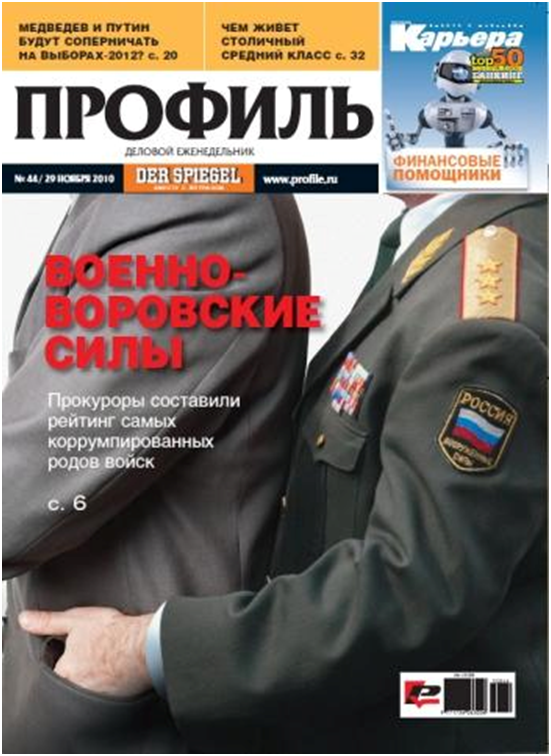
Military-Theft Forces

Prosecutors Rate the Most Corrupt Service Branches

40-50 Percent of State Defense Order Simply Stolen in Recent Years . . . no wonder large-scale procurement hasn’t happened.  Serdyukov supporter Korotchenko tries to paint opponents of military reforms as people trying to protect their corrupt schemes.  This surely goes on, but there also have to be people opposing them for reasons other than greed.  Finally, it’s at least conceivable that, if Serdyukov doesn’t make progress against corruption, it could cost him his job (if he stays that long, he is approaching the four-year mark).  Thus endeth the precis for this post . . .

This week Profil investigates military corruption.  The magazine notes the number and scale of Defense Ministry corruption cases is growing by leaps and bounds, reaching losses of 2.2 billion rubles for the first ten months of 2010.  It concludes, despite a significant cut in the officer corps and Defense Minister Anatoliy Serdyukov’s battle against “thieves in broad stripes [generals],” the number of corruption crimes is not only not declining, but has substantially increased.  Profil obtained an analytical report compiled by the Main Military Prosecutor (GVP) showing who has stolen how much this year.

The GVP presented its report to a closed session of the Duma Defense Committee.  It says its analysis shows “efforts to counteract corruption in the troops are insufficiently effective.”

Profil’s first graphic . . .

Growth of Corruption Crimes in the Army (First 10 Months of 2010)

Troops/Military District/Fleet                     2009       2010       Growth (%)

North Caucasus MD                                             184          311                 69

Moscow MD                                                              94           152                61.7

Air-Assault Troops (VDV)                                 34            119                250

Siberian MD                                                             76            117                 54

Strategic Missile Troops (RVSN)                  59              93                 57.6       

Northern Fleet                                                      50              59                 18

Space Troops                                                        27              44                 63

Caspian Flotilla                                                      5                  7                 40

Black Sea Fleet                                                      2                  6                 200

Profil suggests the recent wave of military retirements signed off by President Dmitriy Medvedev could have been sparked by corruption charges.  While possible, there’s no evidence to support this thesis. 

A Profil source in the Defense Ministry says, not surprisingly, officials responsible for the State Defense Order (GOZ or ГОЗ), capital construction, and the disposition of military property (first and foremost real estate) inflict the greatest losses on the budget.  The article quotes Igor Korotchenko:

“In the course of recent years, 40-50% of resources allocated for the State Defense Order were simply stolen.  This happened, for example, when money was directed at the fulfillment of some concrete work, but there were no real results.  Write-offs appeared in the end or a weapons system was developed that simply didn’t meet its technical requirements.”

Profil suggests that many officers are rushing to get one last bite of military money before Serdyukov’s reforms completely derail their schemes.  It cites Ruslan Pukhov offering two different explanations for rising military corruption:

“Feeling an impending dismissal, officials are probably trying to take the maximum from their positions.  However, it can’t be ruled out that the prosecutor has really reinforced his work in different areas.  Corruption is an acute issue for the prosecutor.”

Pukhov thinks that, although the percentage increase in corruption looks really bad for the VDV, “corruption in the armed forces is spread equally and the growth in corruption crimes in separate branches or districts is connected only with where they are being investigated.”

A very good point, Mr. Pukhov.  Yes, the results of this little anticorruption experiment are very much influenced by where and how it is being conducted.  One should also pay much more attention to the absolute numbers of corruption cases than the percentage changes, and nothing has been said about the relative size of the various parts of the armed forces . . . no per capita figures are provided.  Are 44 crimes in the relatively small Space Troops more significant than 152 in the larger Moscow MD?

Korotchenko, a fairly strong Serdyukov proponent, says the Defense Minister and his tax service colleagues are beginning to break existing corrupt ties, institute financial transparency, and deprive the generals of the right to conclude any contracts.  Dividing the Ministry into military and civilian halves will keep military men out of financial expenditures, and this “process of shifting generals out of the feeding trough” will continue until 2012.  The generals will provide requirements, and civilians will allocate the financing.

A second graphic with some absolute figures on losses due to corruption . . .

Growth of Corruption Crimes in the Army (First 10 Months of 2010)

Troops                                                                  Loss Amount                      Annual Growth

                                                                           (millions of rubles)                        (times)

Strategic Missile Troops (RVSN)                      59.8                                            15          

Air-Assault Troops (VDV)                                   57.5                                            12.2

Space Troops                                                            47.6                                              2.2

Korotchenko claims:

“The campaign against Serdyukov is mainly heated up by those people who’ve been deprived of the feeding trough.  So, the director of a large defense enterprise has for many years sawed off rubles by the billion every year in the transfer of money that comes to fulfill the Gosoboronzakaz.  When Serdyukov deprived this director of such a trough, he began to finance any actions directed at discrediting and, possibly, even removing the Defense Minister.”

So, Korotchenko asserts most conflicts over army reform are banal conflicts of interest for those who can’t steal like they used to.  But didn’t the GVP just say they’re doing a better job of stealing than ever before?

Korotchenko continues:

“Of course, Serdyukov is not an angel, and many of his actions on the military reform plane call forth questions, but it’s another thing that before he arrived, corruption in the Defense Ministry had achieved such a level that he was forced to cut to the bone.  Many scandals proceed only because their financial-economic interests were affected:  the meetings of the airborne guys is just one in this series.”

Then Profil turns to Vitaliy Shlykov, who says:

“Broad publicity for corruption scandals in the Defense Ministry cannot but affect the minister.”

But he believes the Kremlin knows no one can fight corruption like Serdyukov, therefore the GVP report isn’t a real blow to him.

Profil concludes, so far, Serdyukov hasn’t squandered the trust placed in him, but the struggle against corruption only strengthens him as long as it’s a success.  If corruption keeps growing, it’s possible the Defense Minister himself could wind up on the “shot list.”

Serdyukov’s Carte Blanche

In an editorial Monday, Vedomosti supported the carte blanche President Dmitriy Medvedev has apparently given Defense Minister Anatoliy Serdyukov and his military reforms.  The paper likes the reforms enough that it wants the President to think about the possible effectiveness of the ‘army method’ in reforming the MVD.  Here’s what Vedomosti had to say:

“Renaming the Army”

“Dmitriy Medvedev’s and Anatoliy Serdykov’s joint trip to a model Moscow suburban military unit went beyond the protocol of the visit.  The President’s speech in awarding outstanding military men became a new signal to officers, the army, and society:  ‘Despite the fact that all changes are difficult, they are necessary…  Everything that is now being done is directed at establishing modern and effective armed forces.  Here there are both problems and good decisions, I am following this personally as Supreme CINC.’  The Kremlin demonstrated that, despite the recent media scandal, it trusts the civilian Defense Minister, won’t bow to the generals’ and veterans’ opposition, and intends to continue its planned military reform.”

“The new carte blanche for Serdyukov for further transformation is important for many reasons.  The current minister is not the first civilian director of the military department.  However, he specifically replaced a campaign of reforming with systematic transformations.  In his inheritance from Sergey Ivanov, Serdyukov received a much truncated army of the Soviet type, not answering modern requirements.  Dedovshchina, obsolete armaments (modern equipment is not much more than 10% of the general inventory) and command and control, and manning were its main problems.  Add to this corruption among the generals which prevented equipping the army with new types of armaments and communications.  The victorious August war of 2008 showed that the victors couldn’t suppress the enemy’s aviation and artillery and were inferior to the vanquished in modern communications and reconnaissance means.”

“Serdyukov’s attempts to establish control over expenditures on purchases for the army met severe resistance from rear services officers and generals.  Not long ago he acknowledged to journalists:  ‘When I came to the Defense Ministry, speaking plainly, I was surrounded by large amounts of thievery.  Financial licentiousness, the impunity of people whom no one had checked out (…) was so deeply ingrained that it had already become a way of thinking.’  The minister confirms that the transparency of the defense order is a ways off.  The unnecessary secrecy of the military budget is interfering with this.  Meanwhile, progress in the struggle against traders in shoulderboards is obvious.  In 2006, corruption cases were started against seven generals, in 2007, when Serdyukov became minister, — against 16, in 2008 — against 20, in the first half of this year — against eight more.”

“Besides this, the Defense Ministry put up for sale unneeded property and facilities which were being illegally rented out to enrich a few people, and didn’t allow for building apartment blocks for officers needing housing on these grounds.”

“On the whole, it’s possible also to consider organizational transformations a success:  the transition to a more modern system of command and control and the reduction in the excess number of generals and higher officers.  In 2008, of 249 generals and admirals who underwent certification [аттестация], 50 were dismissed, and 130 sent to new places of service.  One can’t avoid mistakes in cutting and dismissing officers, but those deprived of a sinecure cried loudest of all about the collapse of the army and treason.”

“The struggle with barracks hooliganism goes on with varying success.  According to the Main Military Prosecutor’s data, in 2006, more than 5,800 people suffered beatings from fellow servicemen, in 2009 — 3,000.  And for the first five months of 2010, 1,167 soldiers suffered from dedovshchina — 1.5 times more than the analogous period of 2009, of them, four died.  The cause is not only in the growth — because of the cut in the service term — the number of new conscripts went from 123,000 in the fall of 2006 to the current 270,600.  Generals, having botched the program costing 84 billion rubles to transfer to contract, now are forced to call up those with criminal records.  Military police will remain a paper tiger for ‘dedy’ and ethnic clans.  We note that Serdyukov hasn’t forsaken a professional army, but put off its creation until the time when the Defense Ministry will be able to select and not collect contractees through deception and duress.”

“Nevertheless, it’s notable that over 3 and 1/2 years, the reform, being conducted by independent managers without legal changes and loud renamings, has really moved forward.  It’s possible it’s worth the President considering the effectiveness of the army method in reforming the MVD.”

Two More Perspectives on Serdyukov Flap

Defense Minister Serdyukov (photo: RIA Novosti)

A couple more interesting ones today . . . .

Calls for Serdyukov to resign seen as an effort to stop the ‘revolution from above’ . . . journalist Mikhail Leontyev told United Russia’s website:

“Serdyukov is a very severe man.  He’s conducting a very severe reform.  The very logic and mission of reform is merciless in relation to many people.  Serdyukov himself and others understand this, but this is not a reason not to renovate the army.  Reform is being conducted from аbove and by a man who’s a stranger to the army.  Moreover such a task was set from the beginning so it would be exactly like this.  Because they won’t ever do anything to ‘their own.’  In essence, the system is resisting.  Many would want to stop military reform at the current stage but this is stupidity.  Therefore a rumor beneficial to a large number of people is launched that they’re removing Serdyukov.”

Serdyukov almost a victim of his own success when it comes to making military officers focus exclusively on military affairs . . . Aleksandr Golts writes in today’s Yezhednevnyy zhurnal:

“The entire business, in my view, consists in the fact that a new revolution is ripening in the armed forces today.  They are removing officers, almost to the very top, from the heavy responsibility of distributing finances.  Unit commanders and district commanders alike henceforth don’t need to answer for the work of a boiler or cafeteria, or for guaranteeing electricity to the district’s troops.  Civilian departments — Oboronservis, Rosoboronpostavka and the like — will be occupied with supporting the troops with all essentials — from ammunition to the most complex armaments.  Military reformers set as their goal to put an end forever to commanders as ‘big business managers.’  In the course of decades, the commander was hardly evaluated by senior chiefs according to how he trained his unit for action on the battlefield.  They evaluated him according to whether he succeeded in building the cafeteria or bathhouse ‘efficiently,’ that is without allocating the necessary resources.  All this submerged commanders in tangles of corrupt relationships.  Besides lumber and bricks, the officer could pay his debts with the help of a natural resource which was at his disposal — a free work force.  If in Soviet times this system was somewhat limited by party control, then in the 1990s, when the state didn’t have any money at all to support its gigantic military machine, military units were practically condemned to self-support.  As a result, now officers have come to be brigade commanders and deputy army commanders who know perfectly how to ‘operate,’ but not to command.  This is not their fault, but their misfortune.  And the Defense Ministry is creating a special system for retraining senior and higher officer personnel [to learn or relearn their strictly military business].”

“But far from all military leaders are inspired by the prospect of perfecting troop command and control, and combat training methods day and night, meanwhile having at their disposal only that money that came to their personal bank card from their salary.  Many long ago became accustomed to side profits which now seem like their base pay.  In the minister’s innovations, they see the main threat to their interests.  And, as we’re seeing, they aren’t standing on ceremony.”

No, they aren’t standing on ceremony.  They’re using the opportunity to come after the guy who dared threaten their profitable arrangements.  Who knows how widespread this kind of corruption is, but it certainly exists and those benefiting don’t want it to end.  Similarly, one can only guess to what extent Serdyukov’s been successful instituting his civilian control over Defense Ministry financial flows.  And no one should assume the civilian hands on these flows will be any cleaner.

Prosecutorial Prophylaxis

In this instance, the military legal system’s effort to prevent the scourge of dedovshchina, or hazing and other violence against servicemen . . . .

Today’s Krasnaya zvezda covered military prosecutors’ special campaign to warn servicemen against breaking the ‘regulation rules of relations’ between them this month.  The paper talked to the acting military prosecutor of the SibVO’s Yurga garrison to find out what measures he’s trying.

Recall our last mention of Yurga covered its role as test bed for Defense Minister Serdyukov’s attempt to ‘humanize’ military service, so this is obviously a good spot to work to uproot dedovshchina culture.

The Yurga prosecutor said he’s used anonymous questionaires to gather a ‘sufficiently complete picture of the existing situation.’  Taking this and information from sub-unit commanders, the prosecutor proceeds to ‘individual prophylactic conversations.’  He calls such ‘prosecutorial warnings’ a very effective instrument; 18-year-old soldiers have to sign a paper acknowledging they’ve been warned about possible criminal liability for violating regulations and this may have a psychological and deterrent effect on them.

The prosecutor also conducts round tables and extra dissemination of special SibVO ‘pamphlets’ in sub-units.  More on these later.  The pamphlets include a hotline number for reporting violations of law and order (presuming that conscripts have a phone, and aren’t afraid of who’s listening to their call).  He puts up displays informing soldiers of judicial punishments meted out for various violations.  All and all, the prosecutor expects more inquiries coming into his office this month as a result of the campaign.

Moskovskiy komsomolets has a number of these ‘pamphlets’ and concludes they’re generally given to conscripts all over Russia.  They urge the victims of barracks violence not to break the law themselves, show courage, and, if absolutely necessary, hide on the grounds of the unit rather than go AWOL.  But, the paper notes, the ‘pamphlets’ don’t say how long to hide out, or how to eat while hiding.

The ‘pamphlets’ urge conscripts to tell their tormentors that they intend to go to their commander, and to believe that the law is on their side.  It exhorts them not to even think about resorting to using a weapon or committing suicide.

Moskovskiy komsomolets concludes, for all their absurdity, the pamphlets show the fundamental plague of today’s army remains the legal illiteracy of conscripts, their inclination toward violence, and the inability of their officers to cope with them.

Vesti FM interviewed ‘Citizen and Army’ coordinator Sergey Krivenko about the pamphlets.  He said at least they show the Defense Ministry acknowledges dedovshchina is a problem, and it’s growing, not declining.  He believes the pamphlets’ appearance is an indication of hopelessness; military reform is not transforming conscript service or giving conscripts adequate legal protection.

Deputy Defense Minister Shevtsova

Tatyana Shevtsova at the FNS

Last Friday, Tatyana Shevtsova became the newest deputy defense minister – the ninth overall, seventh civilian, second female.  By all accounts, Shevtsova will oversee and audit Defense Ministry spending and other activities.  Kommersant calls her an ‘oversight and monitoring specialist.’  The Defense Ministry’s spokesman has said as much, according to Vedomosti (read it in Moscow Times as well).  Shevtsova’s another member of Defense Minister Serdyukov’s former team at the Federal Tax Service (FNS or ФНС).  Kommersant describes her as a ‘trusted individual’ who will help Serdyukov supervise all but the Defense Ministry’s purely military functions.  In particular, several commentators believe Shevtsova will track outsourced service and support activities paid for in the state defense order (GOZ).

The 41-year-old Shevtsova was born in Kozelsk, Kaluga Oblast, and graduated from the Leningrad Financial-Economic Institute in 1991.  She’s a candidate of economic sciences (Ph.D.). 

She started in the tax service in 1991 as an inspector in the central rayon of St. Petersburg, eventually heading the tax service’s St. Petersburg directorate.  Kommersant reminds that Serdyukov was a deputy director in the St. Petersburg directorate during Shevtsova’s time there in the early 2000s. 

Shevtsova went to Moscow to head the tax service’s large taxpayer department in early 2004.  In mid-2004, Serdyukov became Director of the FNS, and Shevtsova became one of his deputies. 

Shevtsova stayed at the tax service under Mikhail Mokretsov after Serdyukov left for the Defense Ministry in early 2007.  She was in charge of the oversight directorate and all nine inter-regional inspectorates for large taxpayers.

When Mokretsov and others members of Serdyukov’s FNS team departed for the Defense Ministry in mid-2010, Shevtsova did likewise, becoming an advisor.  According to one official who spoke to Kommersant, she spent the last few months ‘studying the situation’ in the Defense Ministry.

A former Defense Ministry official told Vedomosti Shevtsova is “a talented economist as well as an exacting official, whose subordinates at the Federal Tax Service were very afraid of her.”  She reportedly will turn ten Defense Ministry oversight bodies into a system.

Kommersant said Shevtsova will direct oversight organs for administrative, organizational, and financial activities as well as military housing.  The paper’s source says this could translate into oversight over everything except military command and control and operations.  The ninth deputy minister will reportedly gain some responsibilities once discharged by the chiefs of the ministry’s apparatus, Rear Services, and Housing and Construction Service.

Radio Svoboda was kind enough to interview Aleksandr Golts who concluded:

“It’s more or less obvious Anatoliy Eduardovich Serdyukov rapidly gathers his team in those areas important to him.  As we know, at present a so-called second civilian branch of the Defense Ministry is being formed.  Operational troop command and control, combat training remain with the Genshtab.  At the same time, a very strong area which will withdraw from the ministry a great number of functions connected with service and support of all Defense Ministry units and formations is being formed.  This is very complex work in the realm of the state defense order and the like.  Evidently, Ms. Shevtsova will work in this area.”

 Asked about her first steps, Golts commented:

 “If there will be first steps, we haven’t found out anything about them.  The Defense Ministry very precisely hides the most important directions of its activity from any public scrutiny.  Everything happens very quietly.”

Radio Svoboda also asked Viktor Baranets about ‘civilianization’ and the appointment of a reported 50 women to high posts under Serdyukov:

“They are already sarcastically joking  in the army about the ‘feminization’ of the Defense Ministry leadership.  A large number of women who’ve appeared in key Defense Ministry posts, at various times crossed paths with Serdyukov, and with Putin, and with Medvedev.  Of course, they’re Petersburg natives . . . .  There are unofficial reports that [Shevtsova] actively assisted Serdyukov in destroying Khodorkovskiy’s empire.”

Baranets’ sources in the Defense Ministry also say Shevtsova will be responsible for large sums of service and support funding being directed to contractors.  His general and colonel friends joke:

“We only have one vacant post left – deputy defense minister for corruption.  Because all the other jobs are filled.”

 Or anti-corruption one supposes . . . .

Igor Korotchenko told Vedomosti the Defense Ministry’s growing civilian component is designed to supervise the generals’ spending and accounting, especially in the GOZ.  Ruslan Pukhov calls the ‘invasion’ of former tax officials perfectly normal since Western defense ministries are full of civilian auditors who scrutinize massive military budgets.

High-Level Corruption Up, Crime Down in Military

A little more news on the military crime and corruption front.  Corruption is up at least 26 percent year-on-year for the first half of 2010.  General military crime, however, is down more than 10 percent.  Officer crime is down 11 percent.  And draft evasion declined by a factor of two.  Without reciting his recent figures on a 50 percent increase in dedovshchina, GVP Sergey Fridinskiy noted that prosecutors need to ‘activate their work’ against ‘nonregulation events,’ now that there’s a much larger number of conscripts in the ranks.

How do these numbers track with the past?  Just a few days ago, the GVP said general crime was down by 12 percent in all military units and by 15 percent in the Armed Forces.  The decline in general crime follows a reported decline in 2009 as well.  Corruption has accelerated in 2010 apparently.  In January and February, it was only up by 10 percent.  The number of officers convicted in corruption cases looks to be about the same this year as last, but the GVP may be on a pace to convict more generals in 2010.

“More Than 250 Officers Convicted for Corruption Offenses Since Beginning of Year — GVP”

“MOSCOW, 27 July – RIA Novosti. More than 250 officers, including seven higher ranks [general or flag officers], have been convicted for crimes of a corruption nature in the first half of 2010, the RF Main Military Prosecutor Sergey Fridinskiy announced Tuesday at an expanded session of the department’s collegium.”

“‘The quantity of offenses in the given (corruption) area for the first six months of 2010 increased by almost 26 percent.  The quantity of misappropriations, embezzlement, and exceeding duty authority grew.  270 officers, including seven higher ranks [general or flag officers], were convicted for such crimes in the indicated period,’ – the press-service announcement quoted Fridinskiy.”

“According to him, military prosecutors uncovered more than 128 thousand legal violations, nearly 17 thousand officials were brought to account, more than 4.6 thousand people were convicted for various crimes, and the rights of more than 270 thousand servicemen were restored.  And 3.3 billion rubles were returned to the state as a result of prosecutorial investigations.”

“At the same time, the prosecutor noted a tendency toward a reduced number of crimes in the RF Armed Forces.”

“For the first half year in the RF Armed Forces, other troops, military formations and organs 10.5% fewer crimes were committed than in the same period of 2009.  The quantity of grave and particularly grave crimes, including those causing grave bodily harm, declined.  The quantity of  military service evaders declined almost two times.  In the current half year a decline – almost by 11% – was registered in the number of crimes committed by officers,” – Fridinskiy was quoted in the statement.”

“Taking note of the increased number of conscripts, the Main Military Prosecutor directed his subordinates to activate their work to uncover nonregulation events in military collectives, the announcement said.  Fridinskiy noted that ‘in connection with the continued growth of these legal violations we must, together with commands, come up with steps to more effectively implement systematic measures to prevent and interdict them.'”

Fridinskiy enumerated some predictable priorities for the GVP’s work during the balance of 2010 — struggle against corruption and misuse of budget resources, oversight of military reform, fulfilling legislation on the State Defense Order (GOZ), and ensuring housing and other social benefits for servicemen.

Dedovshchina in RF Army Up 50 Percent — GVP

A translation, no commentary . . .

“MOSCOW, 21 Jul – RIA Novosti.  The level of dedovshchina [violent hazing usually perpetrated by senior soldiers] in the Russian Army grew 1.5 times for the first five months of this year compared with the same period in 2009, according to analytical information provided to the RF Federation Council by the Main Military Prosecutor (GVP).  1,167 servicemen have suffered from nonregulation manifestations in 2010, four have died, and more than 90% of offenses were committed by conscript servicemen.”

“As the GVP notes, the number of corruption-related crimes is also growing.  Material losses from them amount to almost a billion rubles this year.” 

“At the same time, the GVP notes that the general crime level in the state’s military organization has declined by more than 12% over five months this year compared with the same period of 2009, and by almost 15% in the armed forces.”

“In particular, the amount of evasion of military service declined by almost two-fold.”