Category Archives: Defense Industry

Death of Mikoyan

On October 21, the labor union of the Engineering Center of the Experimental-Design Bureau (OKB) named for A. I. Mikoyan went public with its claim that  well-known aircraft maker RSK MiG is in a catastrophic state.  Metronews.ru published part of the union’s open appeal as well as MiG’s official reaction.  The union’s letter is addressed to the president, prime minister, and heads of political parties, and dated October 11.

Union chairman Yuriy Malakhov says:

“The situation taking shape in our engineering center forced me to write this letter.  We’ve always been the brain of the company, it’s right here that new aircraft models were developed.  For a long time, we’ve had no new orders.  In the past five years, six general directors have been replaced, they all come from the Sukhoy company, and the impression’s created that they are strangling us, they want to close our company.  All the best orders go there [Sukhoy].  For example, we aren’t even allowed to participate in developing unmanned aerial vehicles.  Sukhoy is working on them, but this aircraft company doesn’t have our experience.  They focused on heavy fighters.  The pay of our colleagues is lower than in the trolleybus yard next door.  Lead engineers get 8-10 thousand rubles [per month].  Sometimes with occasional bonuses they get 30 thousand.  Talented young specialists leave for other firms, for example, Boeing, where they get two-three times more.  Now 10 percent of orders come from Russia, the rest from abroad.  In the course of several years we tried to get a response from our leadership, but no one wanted to start negotiations with us.  And the engineering center’s director decided to meet with employees only after this letter.  We are very much hoping for this meeting.  We expect new orders and increased wages.”

 MiG’s press-secretary offered this response:

“The absence of the Gosoboronzakaz in the 1990s was a serious blow to the country’s defense industry, including to RSK MiG.  Only those companies that had large export contracts could develop successfully, for example in that period the Sukhoy company managed to conclude contracts with India and China.  At that moment, MiG had only a contract with Malaysia.  In recent years, RSK MiG’s been headed by directors from Sukhoy corporation – Nikitin, Fedorov, Pogosyan, Korotkov.  From outside this could look like a raider’s seizure of MiG.  But who needs to seize debts and problems?  A positive dynamic began precisely with the arrival of these people – large foreign contracts were signed, the contract with the Defense Ministry to supply MiG-SMT.  Aircraft were supplied against this contract and they’re being successfully employed in the RF VVS.  Presently, a contract with the Defense Ministry to supply the MiG-29K is being discussed.”

“Today RSK MiG’s order portfolio is more than $4 billion, serial production of new aircraft is unfolding. There is a positive dynamic, maybe it’s not as quick and wages not as high as all of us would like.  Some young specialists come and stay, some leave.  But on the whole the company has good prospects.”

A couple points on these claims.  We know raiders take and sell what’s good, and leave “debts and problems” behind.  The Defense Ministry’s acceptance of the Algerian MiG-SMTs was more a financial bailout for the company and face-saving maneuver for Russia writ large than a real contract.  Not mentioned is Aleksandr Sukhorukov’s October 11 statement that MiG-29K procurement won’t come until 2013-2015.

The text of the union’s letter says MiG is simply dying.  It cites many problems and complaints, including a 48-billion-ruble debt, losses and delays in contracts, moving engineers to Zhukovskiy, closing MAPO, etc.  It says crucial pay bonuses can’t always be paid, and MiG is just supplying skilled people to Sukhoy and Irkut.  The letter calls OAK an incomprehensible middle layer blocking competition, but allowing personal lobbying.  Finally, it blames Mikhail Pogosyan for closing MiG’s promising future projects.

Scanning other recent MiG headlines – the Indian tender wasn’t the only blow to the MiG-35, its chances with the Russian Air Forces didn’t look too rosy anyway, and the early September MiG-31 crash indicated again what dire straits that old airframe is in.

Izvestiya’s Ilya Kramnik published recently on the MiG-29’s fate.  He wrote that (unlike the Su-27 or Su-24) the Defense Ministry doesn’t plan to modernize the MiG-29.  His military source says replacement of these worn-out aircraft in the future is deemed more cost-effective.

Kramnik’s source describes production of the generation “4+++” (?!) MiG-35 as an unavoidable but not yet decided step.  He sees the MiG-29 variant line ending since it’s outclassed by updated Su-27s.

Kramnik’s OPK source sees 20 or 24 MiG-35s being produced each year, for about 25 billion, to replace 150 or 160 MiG-29s in Russia’s inventory.

He cites Konstantin Makiyenko who sees the MiG-35 as important not just as a MiG-29 replacement, but also to keep Russia in the light- to medium-, $60-million-range fighter export market and not leave this industry segment to China and its J-10.

But Konstantin Bogdanov tells Kramnik he thinks the MiG-35’s loss in the Indian tender hurt its chances at home because it raises questions about MiG’s ability to support a production program for the Russian Air Forces.

One also wonders how much MiG-35 and MiG-29 will be needed with T-50 / PAK FA, with Su-35, and with Su-27 upgrades out there.

It’s hard to see the MiG story as anything but another chapter in the painful and necessary process of post-Cold War industrial downsizing and restructuring.  After all, the U.S. is down basically to Boeing and Lockheed Martin.  In MiG’s case, one can question whether the selection is really natural and the fittest are truly surviving.  The answer is probably yes.  However they managed it, Sukhoy and Irkut played their post-Soviet hand better, and it shows today.  The Russian aviation sector will be better off with further consolidation.  Still it doesn’t need Sukhoy to be a monopolist.  Managing that outcome will be tricky.

Suit, Countersuit Over GOZ

Kurganmashzavod (photo: Nakanune.ru)

This story should be of particular interest to those following the VDV, Ground Troops, and their combat vehicles.  The specific problems of KMZ illustrate general dilemmas of the GOZ.  The GOZ money trail is slippery.  And it explains why modern, or at least new, weapons and equipment aren’t produced or delivered, and the GOZ is only partially fulfilled. 

RIA Novosti (via Vedomosti) reports the Defense Ministry filed suits against Kurganmashzavod (KMZ), of “Tractor Plants” Concern, for breaking GOZ contracts.  KMZ, in turn, entered three countersuits seeking 1.5 billion rubles from the Defense Ministry for violating its contracts.

KMZ claims the Defense Ministry stopped accepting its products in fall 2010, causing the factory to fail to meet its obligations.  RIA Novosti reports First Deputy Defense Minister Aleksandr Sukhorukov said KMZ would be fined 3 billion rubles for breaking its 2010 contract to produce the BMP-3.  Two billion has also been cited.  The first hearing will be next week.

Nakanune.ru indicates KMZ had no GOZ contracts for 2011, during which the plant counted on 12 billion rubles worth of production.  Instead, it produced only 4.7 billion worth for the first eight months of the year.

In May, Main Military Prosecutor Sergey Fridinskiy pointed to KMZ as a prototypical failure of the GOZ.  The factory got an advance of 350 million rubles but, instead of sending money to its sub-contractors, it used it on internal needs.

Academy of Military Sciences Professor and PIR-Center Conventional Arms Program Director Vadim Kozyulin says:

“I understand that the enterprise’s leadership could have its own reasons.  The plant has many problems which could look more important and pressing from a local viewpoint.  But some way or other the resources to fill the order for the supply of armored equipment for the VDV came in, but went for something else.”

Kozyulin says they have the same problem in other enterprises, “but ‘Kurganmashzavod’ fell right under the chop.”  He says it won’t go well for KMZ, and the Defense Ministry may refuse to give the factory future orders. 

Nakanune also cites CAST analyst Dmitriy Vasiliyev who agrees this isn’t just KMZ’s problem, but a problem of the Gosoboronzakaz as a whole.  Igor Korotchenko suggests KMZ has little chance of winning its case, and needs to seek an out-of-court settlement.  But perhaps it’s too late already. 

It may be that KMZ is being made into a convenient example because others want to take it over.  It is an area of the OPK that could stand some consolidation.

Kozyulin suggests troubled KMZ should merge with Uralvagonzavod (UVZ).  UVZ and Russian Machines are apparently after KMZ parent “Tractor Plants” Concern.  They’ve approached Vnezhekonombank, which owns 100 percent of its shares, about managing “Tractor Plants” Concern, but the choice of a managing firm has been put off until 2012.

It certainly sounds like KMZ is headed downhill.  The dueling law suits, the untangling of KMZ’s management, and, at some point, the reorganization and restoration of its production capability will take time.  This means possibly years of delays in filling armored vehicle orders for the VDV and Ground Troops.

You may recall United Russia member Igor Barinov excoriated KMZ earlier this year for its poor handling of GOZ funds.  VDV Commander, General-Lieutenant Vladimir Shamanov also blamed KMZ for delays in getting the first BMD-4Ms for his troops. 

MER and SP Doubt GOZ Prospects

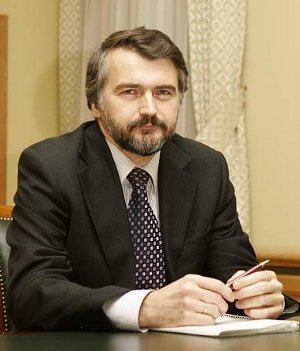
Andrey Klepach

Yesterday the Ministry of Economic Development (MER) and the Audit Chamber (SP) expressed serious doubt about the government’s ability to fulfill the state defense order in 2011 and 2012.  Speaking to a Duma hearing on the draft budget for 2012-2014 covered by RIA Novosti, Deputy Minister Andrey Klepach said:

“Our Gosoboronzakaz won’t be substantially fulfilled this year and it’s highly probable it won’t be fulfilled next year.”

Deputy SP Chairman Valeriy Goreglyad also told the parliamentarians that expenditures on the army and national defense are:

“. . . not only the least transparent, but also the least effective from the point of view of using state resources, particularly those connected with the Gosoboronzakaz.”

“Therefore, in the first place, a different system of contracting is needed in this area, like in no other [area], a transfer to a federal contracting system where the entire technological cycle [planning to contract fulfillment] is supported.”

Other media outlets largely repeated RIA Novosti while adding a little background.  They reviewed President Medvedev’s comments on the failure of GOZ-2010, and on GOZ problems this spring, as well as repeated government and industry failure to meet Prime Minister Putin’s deadlines for completing all GOZ-2011 contracts.

These outlets also mishandled Defense Minister Serdyukov’s statement from last week about having only 20 billion of 581 billion rubles in GOZ-2011 funds remaining to obligate.  Several news sources inaccurately called it GOZ-2012 money.  As ARMS-TASS reports, the government’s Military-Industrial Commission won’t start reviewing the draft GOZ-2012 until mid-November, and no contracts for next year have been negotiated or placed.

To make things just a bit worse for the government, ex-Finance Minister Aleksey Kudrin repeated his budget priorities to a U.N. Millennium Development Goals conference yesterday in Moscow.  According to Utro.ru, Kudrin said:

“I already expressed my position that the increase in military expenditures in Russia is creating a threat to increasing and supporting programs in the area of health and education.  I would give less of an increase in money now for military needs than for health.”

Serdyukov and Baranets

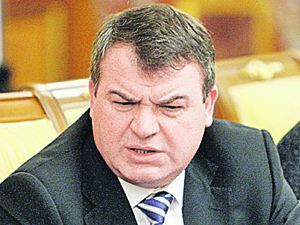
Anatoliy Serdyukov (photo: Vladimir Belengurin)

Komsomolskaya pravda’s Viktor Baranets got to prompt Defense Minister Anatoliy Serdyukov for a few statements on various topics in today’s paper.  It doesn’t seem like he really got to ask questions.

Serdyukov claims all but about 3% of GOZ-2011 has been placed, and 100% advances to the defense sector for 2012 will make for a smooth year of orders and production.  He “dodges the bullet” on not ordering Kalashnikovs.  He returns to the possibility of giving serving officers and contractees money to rent their own apartments, but this never worked well in the past.

Serdyukov says the first phase of military reform involved changing the Armed Forces’ org-shtat (TO&E) structure.  Now, he says, the second phase has begun, and it’s connected with rearming the troops.

On the state defense order (GOZ), Serdyukov says:

“During the formation of the Gosoboronzakaz, we had two issues with the defense sector — the price and quality of armaments.  We got them to open up their production “cost history.”  That is, they showed us everything transparently.  We needed to understand what they were getting and from where.  After long arguments, a compromise was found in the end.  We settled on quality criteria.  The Gosoboronzakaz is almost completely placed.  Of 580 billion rubles a little more than 20 billion was left ‘to settle.’  But we’ve also drawn conclusions from the lessons of this year.  Now the next Gosoboronzakaz will be formed in the Defense Ministry before December with such calculation that they will begin to fulfill it in January.  At the same time, we’re trying to make the Gosoboronzakaz 100% paid in advance to the defense sector.  Not another country in the world has such comfortable conditions for its VPK.”

Serdyukov says the Defense Ministry is still working on MPs, their regs, missions, training, structure, and size.  They’ll be responsible for discipline and order in garrisons and investigations.

The Defense Minister opines that Russia’s Israeli UAVs aren’t bad, but they are looking at Italian ones while domestic development continues.

Serdyukov confirmed that two new factories for producing the S-400 system will be built.  They are designed, and, he hopes, will begin production by 2015.

On tanks, the Defense Minister says they’ve taken the position that they can modernize T-72s to the level of a T-90 or better for 38 million rubles.  He believes it’s cost effective.

On the AK-74, Serdyukov claims they aren’t rejecting it, but they have depots overflowing with 17 million automatic rifles.  He says they’ll be used or modernized, some will be sold, and others transferred to other power ministries.

Serdyukov believes the draft military pay law now in the Duma will raise pensions by 50 or 60 percent.  Active military pay will be as advertised:  a lieutenant is supposed to get 50,000 or more rubles a month.  Contract enlisted will start at 25,000 or more depending on their duties.

Serdyukov hopes the problem of housing for retired servicemen will be concluded in 2013.  Then he can focus on service housing for contractees.  He proposes paying contractees to rent apartments while the Defense Ministry acquires or builds service housing.  “Apartment money” is a possibility but it has to be thought out.

Difficult Course to a Grand Fleet

Konstantin Bogdanov sees reason for pessimism when looking at the course ahead for rebuilding Russia’s fleet.  Writing in Friday’s Nezavisimoye voyennoye obozreniye, he says, despite an intention to spend 4.7 trillion rubles of the ten-year GPV on the Navy, there are technical challenges, clearly impractical schemes, and failures in what he calls the “organization-financial plan” ahead. 

Bogdanov provides us a handy review of the state of Russian shipbuilding.

He points first to OSK’s insistence on seeing new aircraft carriers (with nuclear-powered destroyers in their battle groups) on the Russian Navy’s horizon.  But Defense Minister Serdyukov has only a cold rebuff for the idea.  Early R&D into what a new carrier might look like is as far as he’s being willing to go.  It was made pretty clear that a carrier isn’t part of this GPV.

Bogdanov says OSK may be looking for work for the New-Admiralty Wharves it sees on Kotlin Island in the future.  The 30- to 60-billion-ruble shipyard could be ready in 2016.  An aircraft carrier project would help launch this idea.

Then Bogdanov turns to the Navy’s more immediate needs — frigates and corvettes.  

Proyekt 22350 frigates are needed by tens, if not 30, or even 40, of them.  But Northern Wharf is having trouble building them.  Lead unit Admiral of the Fleet of the Soviet Union Gorshkov was five years in construction, and its underway testing isn’t complete.  Fleet Admiral Kasatonov was laid down just about two years ago.  Its SAM system, Poliment-Redut with 9M96 missiles isn’t ready, and will have to be fitted right to finished frigates.  But Bogdanov sees the frigates’ VLS — the Multipurpose Ship Fire System (UKSK or УКСК) as a positive step.  It could fire antiship, antisubmarine, land-attack cruise missiles, torpedoes, and possibly SAMs.

When proyekt 22350 didn’t come along quickly, Bogdanov says, the Navy went for its own proyekt 11356M frigates like those being built for India.  But, he notes, Baltic Shipbuilding Plant “Yantar” in Kaliningrad isn’t having an easy time constructing them for its Indian and Russian customers.  There are delays in the Indian units, but Admiral Grigorovich and Admiral Essen have been laid down for Russia, and Admiral Makarov should join them soon.  The contract for a second batch of three was just signed.  They’re supposed to be “localized,” but may actually be more like the Indian versions.  They’re slightly cheaper than the proyekt 22350 at 10 billion vs. 16 billion rubles per ship.

Northern Wharf has the order for nine proyekt 20380 Steregushchiy-class corvettes (with the proyekt 22350 frigates this comes to more than 220 billion rubles).  Soobrazitelnyy (proyekt 20381) began sea trials this year, Boykiy was launched, Stoykiy is under construction, and Provornyy (proyekt 20385) was laid down.  Sovershennyy (proyekt 20380) remains under construction at Komsomolsk-na-Amure.  Bogdanov says the proyekt 20385 ships will have an eight-cell UKSK.

Bogdanov notes, however, that Northern Wharf’s production won’t be steady until its ownership issue is finally resolved.  If OSK takes over, this could have a good or bad effect on fulfilling defense orders, but the current financial questions around Northern Wharf are even worse.

Turning to submarines, Bogdanov believes the situation is more transparent, but there are still questions.

The SSBN picture is pretty clear.  Proyekt 955 Borey-class SSBNs finally have a missile that looks like it works.  Yuriy Dolgorukiy has fired it, and Aleksandr Nevskiy might this year.  Vladimir Monomakh is under construction, and they’re preparing production materials for Saint Nikolay.

The problem, he notes, is units 1 and 2 used sections and components of proyekt 971 and 949A submarines never built.  Units 3 and 4 will be built from scratch, and it’s too early to say how this will be reflected in their cost.  Bogdanov concludes another battle over inflated prices awaits, and there is, of course, still no 2011 contract with Sevmash.

It’s less clear with the multipurpose proyekt 885, Yasen-class, of which the Navy wants ten by 2020.  But these boats have been the focus of the Defense Ministry’s familiar complaint about unjustified price increases.  Unit 1 Severodvinsk was built from materials and resources on hand, and its rising price was frozen at 47 billion rubles in 2005.  The Defense Ministry says Sevmash wants 112 billion for unit 2 Kazan

Bogdanov thinks it’s hard to tell who’s justified here.  There is structural industrial inflation, and a higher costs could be the result of the frozen handover price on Severodvinsk.

Bogdanov mentions the thought given to cheaper attack boats like the Victor III or Akula, or proyekt 957 Kedr which never left the design phase.  The Yasen is intended to replace Soviet-era SSNs and SSGNs, but Bogdanov thinks it’s too complex and expensive to be built in the numbers Russia may need.  Twenty years ago the Russian Navy was planning for not less than 30 [sized of course against the U.S. fleet], and currently it has not more than 30 SSNs and SSGNs, and this is considered insufficient. 

Despite the uncertainty above, Bogdanov says one still hears talk about the need to develop a fifth generation submarine, but it’s unknown if there will be any development work on one.
 

The Military’s Most Authoritative

Russkiy reporter published its 2011 list of the 100 “most authoritative” Russian people — ten each in society, business, bureaucracy, academe, education, medicine, law, military, culture, and sports.

Avtoritetnyy, of course, isn’t just a cognate; it can mean influential, competent, trusted, reputable, respected, expert, etc.

You can read about last year’s picks in the military field here.  This year’s military list includes:

  • Deputy Defense Minister Anatoliy Antonov, for knowing how to talk to foreigners.
  • Western MD Commander, General-Colonel Arkadiy Bakhin, for housing officers.
  • Sukhoy test pilot Sergey Bogdan, for testing the fifth generation fighter.
  • General Staff Chief, Army General Nikolay Makarov, for disbanding the “Arbat Military District.”
  • State Secretary, Deputy Defense Minister Nikolay Pankov, for reforming military education.
  • President, General Director of RSK MiG, Chairman of the Board of Sukhoy, Mikhail Pogosyan, for developing the latest Russian weaponry.
  • Head of the Veteran-Military Chiefs Club, Marshal of the Soviet Union Sergey Sokolov, for 100 years in the ranks.
  • General Director, “Tactical Missile Armaments” Corporation, Boris Obnosov, for fast, accurate missiles.
  • Air Forces Senior Lieutenant Igor Sulim, for courage.
  • President, Academy of Military Sciences, Army General Makhmut Gareyev, for asserting the results of the Second World War.

It’s an interesting and eclectic list.  Clearly, many would dispute the names.  Some would say Pankov wrecked the military education system; others would say he implemented unavoidable reductions and consolidations.  Picking Makarov for breaking up the “Arbat Military District,” and sending more officers out to serve with the troops is also controversial, but he’s done something essential and long overdue.

Sokolov’s honored for his longevity. 

Obnosov’s interviewed in the lead article.  He talks about attracting and retaining young scientists and engineers in the defense sector, and about the OPK’s attempt to reach an understanding with the Defense Ministry on price formation.

Sulim’s a surprise, and a rather bold choice.

Only Makarov, Pogosyan, and Gareyev repeat from last year’s list.

RR picked Deputy Defense Minister, Army General Dmitriy Bulgakov as its goat of the year for the spate of deadly army arsenal explosions. 

The big “loser” Bulgakov’s in the same boat as some of the “winners.” 

He found himself in charge of a long-neglected and untenable situation, and he’s tried to fix it.  But many people will object and argue about his methods, the results, and consequences.

Su-34 Completes State Testing

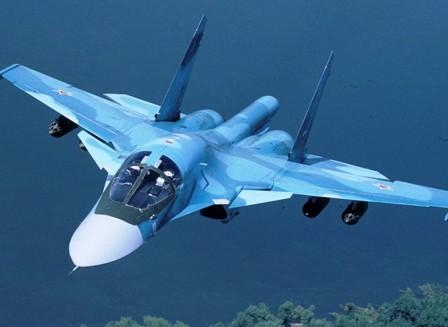
Su-34

This week an aviation industry source told Interfaks-AVN that the Su-34 fighter-bomber completed state joint testing, and Air Forces CINC, General-Colonel Zelin signed off recommending state acceptance of the aircraft.  The Russian government is preparing the paperwork to this effect for release in 2012.

AVN also said the Su-34 will undergo additional special testing “conducted with the goal of broadening the Su-34’s combat potential.”  The report noted, in testing thus far, the aircraft employed 20 different weapons – including practically all Russian laser-, television-, and satellite-guided precision munitions.

One wonders if this “broadening combat potential” relates to outfitting the Su-34 with cruise missiles.  Lenta.ru’s Vasiliy Sychev recalled General-Colonel Zelin’s words:

“In its maneuver capabilities and missions it can conduct, it is close to Long-Range Aviation’s aircraft inventory.  If it carries a cruise missile, it belongs in a different class.”

According to Izvestiya’s Ilya Kramnik, there are 16 Su-34s in the inventory at present.  They first arrived in 2006.  The VVS are supposed to add six in 2011, get 12 in 2012, and reach 70 in 2015 and 120 by 2020, according to Zelin’s announcement at MAKS in August. 

Let’s recall a couple past promises . . . when Sergey Ivanov was Defense Minister, there were supposed to be 50 Su-34s by 2010, and 200 by 2015.

Kramnik writes that 120 Su-34s will be 70 percent of the fighter-bomber inventory, and some 50 modernized Su-24s will make up the balance.  Right now, there are about 160 Su-24M and 40 Su-24M2 in the force with their average ages in the 25-27 year range.  It sounds like about 10 of these aircraft can be modernized each year.

Lenta reviewed a little Su-34 history.  Conceived in the 1980s as a generation 4+ modification of the Su-27, it had its first prototype flight in 1990 as the T-10V-1.  It’s survived to this day, and been through many convolutions.

Henceforth the Su-34 will have a modernized AL-31F engine, the AL-31FM1 or AL-31F-M1.  See Aviaport.ru on it.  The Su-34 will carry new air-to-air and air-to-surface missiles on its 12 hardpoints.  It has new electronics, a Sh141 phased array radar, aerial refueling capability, and an updated L-150 “Pastel” radar warning system.  It also features an auxiliary power unit so it can use airfields without ground support equipment.

Lenta says the factory in Novosibirsk (NAPO) is modernizing its production lines to the tune of 2 billion rubles with some of the money reportedly coming from the state program of OPK modernization, about which we’ve heard little.  Putin talked about 3 trillion rubles for this over 2011-2020 back in April.

NAPO will give half its capacity to the Su-34, and will allegedly be capable of assembling 20 of them simultaneously, while cutting the time for repairs on other aircraft in half.

The news outlet lauds the Su-34 (rather obviously) as a new aircraft rather than a modernization of an aged one.  But then again one could argue it’s not completely new given that it’s been around, in one form or another, since the 1980s.

Kramnik, citing Konstantin Makiyenko, writes that a multirole fighter like the  Su-30 could perform the Su-34’s missions, but there’s some desire to send NAPO orders.  And the VVS, for their part, will take everything new that the aviation industry can give them.

GOZ War Winding Down?

Vedomosti’s Aleksey Nikolskiy sees a possible end to the conflict between the Defense Ministry and industry over the production of strategic nuclear systems.  His OSK source claims a multiyear Defense Ministry contract with Sevmash for proyekt 955 Borey-class SSBNs will be concluded in the coming week.  This would reportedly leave OSK with just one contract remaining to be completed.

Conclusion of a 40-billion-ruble contract for three proyekt 11356M frigates was announced Wednesday.

Vedomosti’s source said the Defense Ministry and OSK also finished a deal for proyekt 885 Yasen-class SSNs several days ago.  The paper once again cites Konstantin Makiyenko’s 500 billion ruble price tag for the new SSBNs and SSNs.

An industry source tells Vedomosti that all MIT’s ballistic missile contracts are complete.

While deals for renovating Russia’s strategic forces are apparently done at last, not all contracts for conventional armaments are finished, particularly those involving Rostekhnologii and its enterprises, according to the director of one of them.

What’s this mean?

The conclusion of submarine / SLBM / ICBM production contracts would be a relief to both sides since their absence has been the biggest GOZ news story.  If all this is done, or almost done, one would expect a major government or Defense Ministry press announcement soon.

If the submarine deals are worth 500 billion rubles, that is, once again, apparently closer to Defense Minister Serdyukov’s price than to OSK’s.

The proyekt 11356M frigates are updated Krivaks (or Talwars for India), and they aren’t exactly cheap.

The issue of incomplete contracts with Rostekhnologii’s enterprises is significant given the size and breadth of their work on weapons and military equipment.  People will ask which enterprises and systems are in question.  It also contradicts Serdyukov’s recent claims that only OSK deals needed to be inked, and implies there are lingering problems and issues in areas other than shipbuilding.

Makarov’s Press-Conference (Part II)

Krasnaya zvezda provided a summary of General Staff Chief Nikolay Makarov’s press-conference yesterday.  The rest of us are still parsing and digesting.  Let’s look at more complete press reporting to do justice to Makarov’s remarks.

Gazeta.ru cited RIA Novosti in adding to Makarov’s comparison of French and Russian artillery systems:

“In France, we were shown the work of an artillery battalion which was ready to fire 30 seconds after a march.  Our analogous norm is 15 minutes.  The difference between one minute and 15 minutes is huge.  I think over this time an entire artillery battalion could be destroyed.”

But Gazeta noted Makarov said Moscow doesn’t intend to buy the French Caesar howitzer.

Gazeta, citing Interfaks this time, expanded on this comment on buying Western military technologies:

“We need to understand what to get, and what to acquire, but to acquire the technologies, and to produce on Russian territory.  Some technologies certainly have to be bought in the West.”

Igor Korotchenko explained to Vesti FM what Makarov and the Defense Ministry will or won’t buy:

“If suddenly for some reasons those models which industry proposes don’t correspond to declared requirements, the Defense Ministry will toughen its demands.  But on the whole the mainline remains – reliance on the domestic defense-industrial complex.  Makarov has spoken clearly about this.”

“Meanwhile, we’ll buy some leading technologies which will be required in Russia’s armed forces in the West.  In principle, these announcements are fully anticipated, they correspond to that policy that both Defense Minister Anatoliy Serdyukov and General Staff Chief Makarov have conducted since 2008.”

Gazeta and Novyye izvestiya contrasted Makarov’s criticism of Russian tanks with Putin’s praise for them.  Both news outlets see President Medvedev, Serdyukov, and Makarov lining up to make tougher demands on the OPK while Prime Minister Putin defends it. 

They cited RIA Novosti this way with Makarov’s comments:

“The T-90 turret calls for our serious respect, it doesn’t lag the leading foreign analogs, and in a number of characteristics exceeds them.”

“The T-90S still has a number of flaws which need to be fixed soon.”

“Experimental-design work to perfect this tank will continue.”

At Nizhniy Tagil, Putin sympathized with tank builders as they described their latest developments, saying:

“This is just what the Defense Ministry always complains about.”

Rounding out the tank news, Nezavisimaya gazeta’s Viktor Litovkin talked about the Defense Ministry’s continuing refusal to buy modernized versions of old tanks. 

He says it wants a new class of armored vehicles on a common tracked or wheeled chassis to simplify operation and maintenance, and different combat modules as needed – BMP, tank, reconnaissance, self-propelled artillery, or ATGM launcher – mounted on the same basic platform. 

Litovkin suspects, though, that this good idea could be ruined by “interdepartmental contradictions,” and a lack of leadership vision. 

He concludes that, while Makarov was critical of their product, Putin was promising Russia’s tank builders 64 billion rubles in government support.

Makarov’s Press-Conference (Part I)

General Staff Chief Nikolay Makarov apparently held a lengthy press-conference today covering many topics.  He’s still advocating buying weapons abroad (when necessary), despite Prime Minister Putin’s strong support of the domestic OPK against the military’s demands.

ITAR-TASS quotes Makarov on the pending Navy headquarters move to Piter:

“Concerning a decision by the Supreme CINC [President Medvedev] to revoke the transfer of the Navy Main Staff to St. Petersburg, there has been no such decision.  We are now working on this issue.”

The General Staff Chief seemed to say there won’t be any diminution of the role or place occupied by service Glavkomaty, according to the news service.  He said the Main Commands of the services of the Armed Forces are part of the military branch of command and control which he heads.

ITAR-TASS quotes Makarov on buying arms and equipment abroad:

“We will need to buy something that isn’t produced with the quality we require.”

He compared domestic Msta-S and longer-range French Caesar howitzers:

“In France, we were shown the work of an artillery battalion which was ready to fire 30 seconds after a march.  Our analogous norm is 15 minutes.  The difference between one minute and 15 minutes is huge.”

“Therefore, we have to acquire something in order not to lag behind, but on the condition of arranging joint production in Russia.”

Interfaks quoted him on buying armor abroad:

“Some technologies certainly have to be bought in the West.”

The Defense Ministry, he says, has no desire to buy arms and equipment abroad if Russia has analogs or more modern models.  But Russia will find it hard to compete with Western firms that are cooperating with each other.  Makarov cited Renault’s APC which uses a Volvo engine.  “Our producers need to make a revolutionary leap,” Makarov concluded.

The General Staff Chief was ambivalent about the T-90 tank, according to ITAR-TASS:

“I visited the Nizhniy Tagil exhibition and got familiar with our T-90 tank.  The tank they showed us, particularly its turret, calls for serious respect.  But we have questions remaining about many drawbacks.”

“. . . the experimental-design work the factory is conducting will allow them to realize those requirements the Russian military is placing on this new product.”

ITAR-TASS also picked up Makarov’s remarks on the Tsentr-2011 exercises:

“We want to work out common approaches to employing armed forces within the ODKB [CSTO] framework.”

“Besides militaries, all other power structures, which are understood as part of the state’s military organization, in the ODKB countries will participate in these exercises.  As far as Russia goes, we want to check the country’s military organization fully by conducting a series of mobilization measures, including also industry.”

“Starting today, we’ve started into mobilization deployment of a number of formations and units according to independent plans.”