Category Archives: Force Modernization

How’s It Look for VDV?

On Monday, Voyennoye obozreniye took a look at the VDV and their rearmament needs.  It notes they’ve received virtually nothing new since the USSR collapsed, and what new equipment has arrived came in small amounts.

The composition of the VDV has shrunk from 65,000 personnel in seven divisions to about 35,000 in four divisions (Novorossiysk, Tula, Ivanovo, and Pskov) today.  Its airborne combat vehicles include BMD-1, BMD-2 Budka, BMD-3 Bakhcha, and BMD-4 Bakhcha-U, armored personnel carriers include BTR-RD Robot and BTR-3D Skrezhet.

Here’s a RenTV video about the Bakhcha and Bakhcha-U.

Artillery includes ASU-57, ASU-85, 2S9 Nona-S, 2S25 Sprut-SD, and howitzers 2A18 D-30 and 2A18M D-30A.

In January 2007, then VDV Commander, General-Colonel Aleksandr Kolmakov said the troops would soon be getting BMD-4, 2S25 Sprut, BTR-D3 Rakushka, KamAZ-43501, D-10 and Arbalet parachutes, and new infantry and special weapons.  In 2010, the Defense Ministry reportedly said it was buying Italian-made IVECO LMV combat vehicles for its “winged infantry.”

According to VO, the press says VDV has gotten more than 300 BMD-4 since they were accepted for service in 2004.  The BMD-4M, however, basically remains in testing, and only 10 of them are being used in the VDV.  Its future with the airborne troops might be in doubt.  Last December, VDV air defense sub-units got their first Strela-10M3 self-propelled anti-aircraft systems.  They will replace aged ZU-23-2 anti-aircraft guns.

VO concludes the VDV need to reestablish both their air and ground mobility.  VTA has degraded and can’t support airborne operations large enough to seize and hold strategic or tactical objectives in enemy rear areas, or to destroy enemy government and military command and control systems:

“As it was in the USSR, so it is in the RF, airborne troops are really used like the best trained motorized rifle units — for example in Chechnya, Ossetia.”

For off-road mobility, VO says VDV need Tigr, Vodnik, dune buggies, and ATVs.

It argues VDV divisions need their own fixed- and rotary-wing aviation, including multipurpose, transport, strike, and reconnaissance aircraft and UAVs.

The missions of the VDV need to be formulated like Spetsnaz, so they aren’t used like regular infantry.

Finally, VO says the VDV need to be fully professional, with career personnel, and pay twice the country’s median wage.  It can’t be done with today’s contractees who are mostly lazy and drunk, but this is the fault of the army’s reformers, according to VO.

Then, VO concludes, the VDV would be a real elite of the Russian Army.

The Foggy Goal of the GPV (Part II)

Sovershenno sekretno’s Vladimir Spasibo describes the early post-Cold War process of mergers and consolidations in the Western defense industries, and then asks:

“And how are our integration processes going?  By altogether different schemes.  Mainly by creating industrial ‘kolkhozy.’”

His example is the United Aircraft Corporation (UAC or OAK) which conglomerated most Russian aircraft designers and producers.

Spasibo says this consolidation should have eliminated problems with skilled personnel shortages, technology losses, obsolete production lines, low labor productivity, product quality, duplicative development, and excess capacity.  But it didn’t.

Spasibo examines the labor force in the OPK’s aircraft industry.  He claims with VVS purchases of 380 billion rubles per year, and productivity of 6 million rubles per worker (three times less than Boeing’s rate), there should be 66,000 workers in Russia’s industry, but its 6 lead plants have more than 100,000 workers, and the aviation industry overall has more than half a million.

He looks then at the labor force for the entire OPK.  With purchases totaling 19 trillion rubles, with modest productivity of 3 million rubles per worker over ten years, the OPK should have 630,000 workers, but Rostekhnologii General Director Sergey Chemezov says there are now 1.2 million.  And Spasibo concludes good specialists won’t work for what companies are able to pay as a result.

Chemezov has pointed out that only 36 percent of Russia’s “strategic enterprises” are financially stable; at the same time, 30 percent show all the signs of bankruptcy.  The situation is particularly bad in the munitions and special chemicals sector, where nearly 50 percent of companies look like potential bankruptcies.

Spasibo adds that only 15 percent of the OPK’s technologies meet world standards, 70 percent of basic production assets are outdated, and the equipment renewal rate is only 3-4 percent.  He says:

“To count on these companies being able to produce the weapons required is laughable.  But they will absorb the money they receive.  Naturally, without any particular result for the reforming Armed Forces.”

Spasibo concludes:

“The ‘estimated expenditures’ of the Defense Ministry obviously demonstrate that we’re again being dragged into a senseless and dangerous arms race which in no way increases our military security.  On the contrary, it increases the risk of creeping into military conflicts.”

“NATO and the U.S. absolutely don’t need a war with Russia.  China doesn’t either.  Even despite periodic rumors that it has territorial claims on us.”

“But it’s impossible to make these claims by military means.  Especially if Russia will have a modern high-tech army.  But once again no one is building it.  And doing this is impossible, scattering resources on strategic arms, VKO, an ocean-going fleet, whose role in the hypothetical case of war is completely incomprehensible.  The situation’s exacerbated by the lack of an entire series of experimental models fit for production and supply to the Armed Forces, an obsolete technological and organizational structure of OPK enterprises which, most likely, will turn the money into dead metal.”

“During perestroyka, we learned that the USSR lost the ‘Cold War’ to the U.S. and that the arms race killed the Soviet economy.  Scholars and commentators talked about this with figures and facts.  In those days, there were many suggestions about what to do with the Armed Forces and VPK.  But all this ended in empty talk.  In fact, they simply killed the VPK.  They practically didn’t invest money in the Armed Forces.  There was neither an army, nor a defense industry to arm the army.”

“And here a time has come when the Kremlin and the White House have decided to modernize the army and, using the financial possibilities that have appeared, to pour 20 trillion rubles into it before 2020.  But won’t we now be stepping on the very same rake as in the eighties, won’t the president and premier be repeating the mistakes of the Politburo, initiating a thoughtless and dangerous arms race?  The key word here is thoughtless.”

“Of course, the draft State Program of Armaments, 2011-2020 is a document under the top secret seal.  Does this mean the public shouldn’t discuss and understand what trillions will be spent for.  Or is it the prerogative of a narrow circle of interested officials — lobbyists for the VPK and the military?”

“The trouble is old and familiar.  Recently deceased  Academician Georgiy Arbatov wrote about it in 1990:  ‘An affair most important for the country and the people — defense, security, fantastically large military spending — was monopolized by a narrow group of generals and general designers from military industry.’  And further:  ‘I think the military shouldn’t be given a monopoly on assessing the threat of war.  Just the same it’s reasonable not to make this assessment without accounting for its opinion.’  It just shouldn’t dominate this.”

Thank you Mr. Spasibo.  A good article.  He has a clear point of view on the issue of the GPV and where the Russian military might or might not be headed.  But where does it leave us?

Just a little commentary . . . Spasibo says Russia aims to match NATO, the U.S., and maybe China too.  This raises the issue of whether it should aim for this and whether it can achieve this.  The answer to both is no.

That is, however, not the same thing as saying the Russian Armed Forces don’t need to modernize.  If they were smart, they’d aim for capabilities to offset the advantages of their stronger potential enemies.

That means difficult picking and choosing, something we haven’t seen much of in the GPV, where it looks like every service is at the table awaiting a full meal.

Russia is definitely not France, but this doesn’t mean Moscow has to defend everywhere.  Perhaps it should prioritize and worry more about Vladivostok and China than about Iturup and Japan.

Spasibo does a good job of pointing out that there are at least as many problems in the VPK, the OPK as in the military itself.  And yet there’s no real effort yet to remedy them.  All of this goes to whether Russia can reach whatever aim it sets for military modernization.  As Spasibo says, they might just be sending good money after bad.  They may be risking a repetition of past mistakes by overspending on arms, but, of course, they may not even get a chance to repeat these mistakes if money isn’t allocated.  Remember that previous GPVs died of financial starvation in their infancy.

One’s not sure about Spasibo’s argument on Moscow’s promotion of an arms race.  Right now, only the Russians need to ‘race’ — and the race is to catch up after years of falling behind.  And it doesn’t necessarily need to catch up to the extent that it duplicates U.S. capabilities.

And yes Spasibo’s right in saying these defense expenditures should be debated and decided more widely and publicly, but unfortunately Russian citizens have even more basic and important political and social issues that need that kind of scrutiny first before they get down the list to military procurement.

The Foggy Goal of the GPV (Part I)

In its February issue, Sovershenno sekretno’s Vladimir Spasibo examines the State Program of Armaments, 2011-2020, and tries to say if Russia can afford it.  Or more importantly, whether the new GPV makes sense given that Russia is unlikely to go to war with NATO, the U.S. or China.  Spasibo also casts a critical eye at whether the OPK is up to the task of fulfilling the GPV.  This author doesn’t vouch for Mr. Spasibo’s numbers and math; they are relayed as in the original.  But his arguments are interesting and useful.

Spasibo says, after 2013, the GPV’s 22 trillion rubles [19 trillion for the Armed Forces] will amount to almost 4 trillion annually for the military, or 8 percent of Russia’s GDP as compared with 5 percent in the U.S. and 2-3 percent in other NATO countries.  Buried a little down in the text, he cites Deputy Prime Minister Sergey Ivanov on the 1.2 trillion ruble State Defense Order for 2010, and Prime Minister Putin’s assertion that this amount will triple in 2013.

And the military actually wanted more — 36 trillion, which Spasibo claims would be 15 percent of GDP, an amount equal to the Soviet defense burden before the USSR’s collapse.  He asks if this isn’t too much for a country just emerged from an economic crisis.  And what threat is this colossal military budget directed against?

He turns to Defense Minister Serdyukov’s explanation to Der Spiegel:  terrorism, proliferation, and NATO expansion.

Spasibo suggests the thrifty French defense reform which, for less than Russia’s 22 trillion rubles, “Created a small, balanced grouping with modern equipment.  Capable of instant reaction and an adequate response to any threat to France’s interests.”  He continues:

“The approach of the current Russian military, more precisely civil-military, leadership toward reform of the Armed Forces is somewhat similar.  The preconditions, it’s true, are different, and the goals are foggier.”

Who, asks Spasibo, are Russia’s enemies, and against whom is it supposed to fight?  The Military Doctrine and other pronouncements make it sound like the answer is the U.S. and NATO, as well as nonstate irregular armed forces inside and outside Russian Federation borders . . . leaving Moscow to prepare both VKO against a high-tech enemy with highly accurate long-range weapons, and low-tech enemies conducting guerrilla warfare and sabotage-terrorist actions.

Spasibo then turns to thinking about which services and defense enterprises will get GPV money:

  • According to its commander, the RVSN will replace 80 percent of its ICBM inventory (roughly 300 missiles) by the end of 2016 for a price that Spasibo puts at 1.9 trillion rubles.
  • Spasibo thinks VKO and PRO might cost 3 trillion by 2020.
  • The Air Forces are looking to renew 70 percent of their aircraft, 1,500 aircraft in all including 350 new combat aircraft for 3.8 trillion.
  • Spasibo believes the Ground Troops will get 7.6 trillion to replace combat vehicles including 60 percent of their tanks and BMPs, and 40 percent of their BTRs, that are over 10 years old.
  • And the Navy, as reported elsewhere, will get 4.7 trillion.

That all adds to 21 trillion rubles.

Hypersonic Cruise Missile for Navy?

Yesterday Lenta.ru relayed an Interfaks item in which NPO Mashinostroyeniye General Director Aleksandr Leonov said Russia is working on a naval hypersonic cruise missile.  But, he said:

“It’s difficult to say when all this will be turned into metal.  But technically today I don’t see obstacles to this direction being realized this decade.”

Leonov also claimed that development of this missile is included in GPV 2011-2020.  He didn’t talk about the characteristics of the missile, but said the general trend is to increase its speed to hypersonic, not to increase its range.  It’s designed for anti-ship and land attack missions, and will be fired from various launch platforms.  

Leonov noted that today up to 80 percent of Russian Navy cruise missiles were developed by NPO Mashinostroyeniye.  It produced both the Granit (SS-N-19) and Bazalt (SS-N-12) ASCMs.

He didn’t mention that the hypersonic missile development’s being done as part of Russia’s BrahMos joint venture with India.  Some sources claim the BrahMos II cruise missile has surpassed Mach 5 in stand testing.

Makarov Interview

Voyenno-promyshlennyy kuryer published an interview with the Chief of the General Staff, Army General Nikolay Makarov last Tuesday.  It’s not exactly a hard-ball interview.  But it’s fairly consistent with his other statements.  Among the priorities, preserving mobilization appears again.  Inter-service C2 in the new OSKs is a big theme.  He can’t explain why the Air Forces aren’t getting more new aircraft, and PVO sounds like it’s destined for joining VKO under the Space Troops. 

VPK asked about the possibility of changes in Russia’s military doctrine following the NATO-Russia summit and more talk of a strategic partnership.  Makarov said the approach of NATO infrastructure to Russia’s borders and the alliance’s continued “open door” policy vis-a-vis Ukraine and Georgia are still factors in Russia’s military doctrine.  Therefore, there’s no need to adjust it.

Makarov expounded on the concept of force and force structure development [строительство] to 2020 adopted by President Medvedev last April 19.  Its main measures include:

  • Establishment of the air-space (aerospace) defense (VKO) system;
  • Formation of the optimal composition of inter-service troop (force) groupings on strategic axes;
  • Supporting mobilization of military formations and troop groupings;
  • Establishing modern command and control systems;
  • Deploying military towns of a new troop basing system;
  • Reequipping formations and units with new and future types of armaments and military equipment;
  • Resolving social protection issues of servicemen.

Asked about military science and operational training, Makarov said the main task of the military-scientific complex is to “support the training and employment of the Armed Forces in their new profile, especially inter-service training of the military command and control organs” of the new MDs / OSKs. 

Makarov admitted that Russia lags behind developed countries in reconnaissance and command and control, and is still using communications systems developed in the 1990s.  He continued:

“Another problem is the fact that every service and troop branch of the Armed Forces developed its own means of automation and communications without looking at the others.  The command and control systems of the Ground Troops, Navy, and Air Forces didn’t interface with each other, that lowered the possibilities for controlling troop groupings on the operational-strategic and operational level.”

He says the General Staff has given the OPK requirements for high-tech digital reconnaissance and communications systems.  Industry is already developing a fundamentally new, sixth generation radio system with digital signal processing to implement a net organization in radio communications.  He says it’s being built as a unitary, integrated net at all levels, from the General Staff to the individual soldier on the battlefield.  Command and control systems will get 300 billion rubles under GPV-2020, according to Makarov.

Sounding very much the net-centric warfare disciple, Makarov says the main task is to form a unitary information space uniting reconnaissance, navigation, command and control, and new generation weapons.

Makarov doesn’t have a good answer when asked why the Air Forces don’t have a single fully reequipped unit despite increased defense expenditures.  He maintains they are getting new aircraft and their units are now all permanently combat ready and fully equipped and manned.

On aerospace defense, Makarov says PVO, PRO, SPRN, and KKP (space monitoring) will be concentrated in the hands of one commander, but:

“I’d like to note this won’t be a simple, mechanistic merger of different military entities under the leadership of a new strategic command.  Their deep integration and echelonment by mission, information exchange, and interception fire is envisaged.  We’ve already started fulfilling the initial measures on this issue.”

Obviously speaking much prior to last week’s news about reversing cuts in the officer ranks, Makarov addressed the moratorium on inducting new cadets.  He said 78.5 percent of 2010 VVUZ graduates became officers.  Others, he says, who wanted to stay in the service were temporarily placed in lower-ranking [i.e. sergeant] posts, but will participate in command training and form a cadre reserve for filling officer positions.

Lastly, Makarov talked about the new military pay system coming next year.  Military retirees have been especially concerned about its effect on pensions.  Makarov didn’t say much to assuage them.  He said there will be no difference in pensions depending on when servicemen retired, and a commission under Finance Ministry leadership is working on the issue.  That will probably reassure army pensioners.

The Results of Reform

Trud’s Mikhail Lukanin offered an interesting one last Wednesday . . . with help from other frequent commentators, he takes a swag at describing the results of Anatoliy Serdyukov’s nearly 4-year tenure as Defense Minister.

It’s interesting because it’s unclear if Lukanin’s article is intended to damn by faint praise, to be sarcastic, or was ordered by someone.  Maybe he intends to say these are just results, the good and the bad.

It’s easy to see some good in Lukanin’s first five, but his final three are pretty much unleavened.

The Army’s Become More Mobile

Lukanin quotes Vitaliy Shlykov:

“Until 2008, our army looked like fragments of the old, Soviet one, weighed down with heavy weapons, oriented toward global nuclear war with practically the entire world.”

He says even in the August war against Georgia the army was still “Soviet” — slow to stand up, with an archaic command and control structure.  But now the situation’s changed with mobile brigades that can answer an alert in 1 hour instead of days.

The Army’s Rid Itself of the Spirit of the Barracks

Valentina Melnikova tells Lukanin that the soldier’s life has changed cardinally under Serdyukov.  She says, until recently, one-third of soldiers were typically involved in nonmilitary work every day.  Now soldiers are gradually being freed from such duties as commercial firms take them on.

New Equipment Has Come to the Troops

Lukanin writes that finally a start’s been given to the largest rearmament of the army in post-Soviet times.  One that will take new weapons and equipment from about 10 percent of today’s inventory to 90-100 percent [official sources only claim 70 percent] by 2020.

Lukanin quotes Ruslan Pukhov:

“The Navy alone will receive 40 submarines and 36 new ships, and the Air Forces 1,500 aircraft in the next decade.”

Officer Pay Has Grown

Lukanin says lieutenants and majors made 14 and 20 thousand rubles per month respectively before Serdyukov’s reform,  but now 50 and 70 thousand if they receive premium pay for outstanding combat training results.  And from 2012, premium payments will be included in their permanent duty pay, and 50 thousand rubles will be the minimum base pay for officers.

Lukanin quotes Aleksandr Khramchikhin: 

“The officers of our army are actually comparable with the armies of developed countries in pay levels. “

They Didn’t Talk Reform to Death

Lukanin says experts think it’s good Serdyukov’s reform was pursued energetically, without lengthy discussion and debate.  Pukhov gives the cut from 6 to 4 military districts as an example:

“At one time, it would have taken years to transfer a huge quantity of officers and generals from place to place, but the Defense Ministry did this in just 4-5 months.”

They Stopped Training Officers

Lukanin refers to Serdyukov’s halt to inducting new cadets into officer commissioning schools until at least 2012.  He says 2010 graduates were either released or accepted sergeant positions.  This led to the departure of experienced instructors, and their replacement with younger officers lacking the necessary experience.

Sergeants Almost Ceased to Exist

Contract sergeants were dispersed in 2009-2010.  The Defense Ministry considers them poorly trained, and in no way superior to ordinary [conscript] soldiers.  Now it’s counting completely on conscripts with an even lower level of training.

There’s Nothing to Defend Against China

Here Lukanin notes that some results of reform have put people on guard.  Anatoliy Tsyganok tells him tank units have been practically eliminated: 

“Now only 2,000 tanks, old models at that, remain in the army.”

In Tsyganok’s opinion, tanks are still very relevant for the defense of Russia’s border with China.

What do we make of all this?

  • It’s good that the Russian Army was restructured into smaller, more combat ready formations, i.e. brigades, and sub-units. 
  • We really have no clear picture of the extent and success of outsourcing nonmilitary tasks in the army.  Meanwhile, the “spirit of the barracks” is alive and well when it comes to dedovshchina and violence in the ranks. 
  • The promise of another rearmament program shimmers on the horizon, but it’s not delivering much yet, and there are plenty of serious obstacles to completing it. 
  • The officer pay picture has improved, but the Defense Ministry has real work to do this year to implement a fully new pay system next year.  Meanwhile, several years of premium pay have caused divisions and disaffection in the officer corps. 
  • Moving out smartly on reform was a change over endless talk, but there are areas where more circumspection might have served Serdyukov well. 
  • The Defense Ministry definitely had to stop feeding more officers into an army with a 1:1 officer-conscript ratio.  We’ll have to see what kind of officers the remaining VVUZy produce when the induction of cadets restarts. 
  • Aborting contract service cut the army’s losses on the failed centerpiece military personnel policy of the 2000s.  But something will have to take its place eventually to produce more professional NCOs and soldiers. 
  • Russia is probably right to deemphasize its heavy armor.  It doesn’t appear to have much of a place in the coming rearmament plan.  And tanks really aren’t the answer to Moscow’s largely unstated security concerns vis-a-vis China anyway.

So what’s Serdyukov’s scorecard?  A mixed bag.  Probably more good than bad, but we’ll have to wait to see which results stand and prove positive over the long term.  Definitely superior to his predecessor’s tenure.  Expect more Serdyukov anniversary articles as 15 February approaches.

Inflation, GOZ, and GPV

RIA Novosti military commentator Ilya Kramnik has some thoughts on this issue.  Inflation has disrupted Russian rearmament efforts for years, and this year it’s likely to remain in the 9 percent range, or higher.  But, besides inflation, Kramnik notes, the way arms prices are formed and tenders are conducted also create higher prices and complicate the process of obtaining new weapons and equipment.

Kramnik attributes delay in adopting the GPV to the problem of reaching agreement on constantly rising prices for arms and military equipment.  These price increases, he notes, actually outstrip the official inflation rate and devalue the much-touted growth in the military’s budget.

A just-signed law (402-FZ) modifies the budget code and the law on the State Defense Order (GOZ), allowing this year’s GOZ to be financed without an adopted State Program of Armaments (GPV).  The law is also supposed to limit price increases on the OPK’s products.

According to Kramnik, in 2007, the Russian government ordered a 25 percent limit on profits from arms production, based on prices registered with the Federal Tariff Service.  This didn’t work too well.  The T-90 tank’s price tag increased from 42 to more than 70 million rubles, and the cost of the Steregushchiy (proyekt 20380) corvette rose from 1.8 to 5 billion rubles during its construction.

However, increased costs aren’t always attributable to more complex and expensive systems, or to inflation, or to small production runs.  Prices for military equipment are formed through “informal means” or personal ties between those who order and those who produce it.  Kramnik doesn’t utter the word corruption, but that’s what these informal ties lead to. 

At any rate, this is why the Defense Ministry’s been divided into military and civilian parts — to break the link between uniformed buyers and factory directors.  But who’s to say civilians can’t take the military’s place in a corrupt relationship?  To his credit, Kramnik concludes:

“We’ll see soon enough how much this series of measures will slow the growth of prices for military equipment in Russia.”

Kramnik also notes serious problems with GOZ tenders and the government procurement law.  Competitive tenders have to be conducted even when there’s only one supplier, leading to time wasted, and to the rise of middle-man firms that pass orders to sub-contractors who actually do the work.  To fix this, changes in the state purchase law (94-FZ) are needed, but haven’t come in many years.

And the problem of funding multi-year work still hasn’t been solved, and long-term, science-intensive project and RDT&E prices have to be renegotiated annually.

Kramnik sums up:

“All these ‘holes’ lead to budget money too often accumulating in vain in treasury accounts, or else too actively being ‘turned’ and ‘sawed off’ — the ineffective expenditure of state defense order resources in recent times has reached many tens of billions of rubles.  The coming year will become a real test for the reformed Defense Ministry — the degree of effectiveness of military budget expenditure will demonstrate how much Anatoliy Serdyukov and his team have managed to fulfill the tasks set before them.”

Is the GPV Doable?

This post is dedicated to a friend and mentor who highlighted the source material . . . .
 

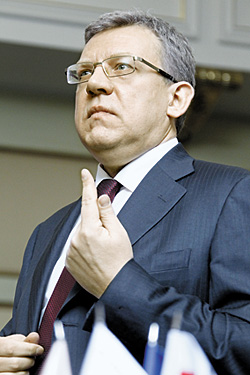
Do I Look Happy About the GPV? (photo: RIA Novosti)

Is Russian Finance Minister Aleksey Kudrin on-board with plans for increased military spending contained in the State Program of Armaments, 2011-2020?  The economic press seems to think he’s not, and his reticence leads one to ask if the new GPV will fit Russia’s economic and budgetary realities in coming years.  One thing’s certain (if you read on), 2011 is the first year of this GPV, and already, for a variety of reasons, many new arms will be bought with state-backed credits and loans.

The GPV came into the headlines last spring when Kudrin and his ministry offered 13 trillion rubles, and the uniformed military replied that 36 trillion would be about right.  Not much was heard about negotiations over the GPV until mid-July, when First Deputy Defense Minister Popovkin announced the figure would be about 20 trillion.

Then, President Medvedev described the GPV in his annual Federal Assembly address (Poslaniye) on 30 November:

“Today the fundamental task of creating a new high-technology mobile army stands before us.  We are setting out to spend more than 20 trillion rubles on these aims.”

The same day, Moskovskiy komsomolets published Kudrin’s reaction from RIA Novosti:

“The country is living with a deficit . . . .  The redistribution of expenditures from other areas is required.”

And from a television interview:

“The task of strengthening defense capability was set down very seriously, and a figure of 20 trillion rubles was named, and it will need to be directed at strengthening defense capability over the course of 10 years.  This is a new task, financial sources still haven’t been considered sufficiently, this could be an additional burden for the economy.  In this case, the president believes it’s essential.”

Kudrin didn’t mean new as in news to him, but in the sense that it hasn’t been factored into the federal budget. 

On 3 December, in MK, Nikolay Vardul critiqued Medvedev’s explanation of the GPV.

Vardul said we’ve heard about the high-technology army and using defense industry as an economic locomotive before, but this no longer fools anyone.  Large military expenditures ruined the Soviet economy, although falling oil prices were the coup de grace.  He continues:

“And here again is Medvedev talking about how investments in military technology will pay for themselves in the production of ‘dual-use products.’  Stepping on the same rake, as if we didn’t have sad experience.  The army passage in the Poslaniye is generally contradictory.  Medvedev drew an alternative:  either Russia and NATO manage to agree on joint missile defense, or a new arms race.  And then how do expenditures of 20 trillion rubles on military-technological needs by 2020 present themselves?  Is this just a running start?  In order to understand the scale of the spending, the entire Russian GDP in 2010 is on the order of 51 trillion rubles, and all federal budget expenditures for 2011 should be 10.8 trillion. There you have it.  But the questions continue:  who is now the potential enemy?  Can it be NATO again?  Too many questions and very few answers.”

“There is, by the way, one clear answer.  From the point of view of the economy, the main threat to its relative equilibrium is precisely inflated military, not social expenditures.”

“And there’s no doubt:  the higher the state expenditures, the greater the chances of inflation.  But military expenditures are distinct from investments in education or health care by the fact that the path to recouping them is more thorny and tortuous, if it’s even possible.  On the other hand, the road leading from them to inflation is as straight as a pipe.”

He concludes it’s true Russia’s economy needs a more modern engine to replace oil and gas revenues, but: 

“Instead of this, huge resources  are diverted to military spending, even though armaments not only won’t lift the economy, but drain it further.”

On 10 December, Nezavisimaya gazeta’s Anatasiya Bashkatova addressed Kudrin’s comments that redistributing federal budget to the regions and increasing the country’s defense capabilities will be very difficult to do simultaneously.  As Bashkatova put it, “there isn’t enough money for everything,” and “a high-technology defense sector interferes with regional development.”

Kudrin also said: 

“This program [GPV] is now being prepared.  It will soon be adopted, and the main expenditures will fall not in 2011, but in subsequent years.”

NG chief military correspondent Viktor Litovkin explained that it was simply too late for changes in the defense budget for 2011 with expenditures already starting according to the adopted budget law.

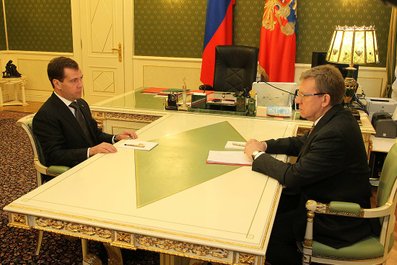
Then President Medvedev met with Kudrin meeting on 13 December.

Medvedev and Kudrin (photo: Kremlin.ru)

Medvedev told him his priorities are economic modernization and social spending, and regarding the latter:

“I consider that this is very important for preserving social peace and stability in our country.”

But with his very next breath, Medvedev said:

“And, of course, we must devote attention to issues of guaranteeing the security and defense of our state.”

And, of course, after wishing it weren’t necessary, he said:

“Therefore, the corresponding state program of armaments, and the Armed Forces modernization program need to be fulfilled in the specified parameters.”

The same day, Prime Minister Putin conducted a government conference in the submarine-building capital Severodvinsk to review the GPV, and even he confessed:

“For me it’s terrible even to say this amount [20 trillion rubles].”

Later in December, Vedomosti quoted one of Kudrin’s deputies who said, many expenditures which have “already been announced – and first and foremost these are defense expenditures” have not been figured into the 2011-2013 budgets, and it’s “still unknown” how these obligations will be financed.

Dmitriy Butrin in Kommersant quoted Duma Defense Committee Chairman Zavarzin to the effect that, in 2011, 30 percent (about 500 billion of 1.5 trillion rubles) will be financed by state-guaranteed credits rather than by budget funds.  Butrin went on to repeat Kudrin’s warning that the GPV can’t be covered by the projected budget income level, and the 20 trillion could make increased taxes unavoidable.

The Kudrin deputy also said that, without growth in the income portion of the budget, new budget obligations – like the APEC summit, Sochi Olympics in 2014, Skolkovo, World Cup soccer in 2018, and the State Program of Armaments – appear unrealizable.  He concludes, “We’ve set out on a trajectory for higher taxes.”

So where does this leave the GPV.  These economic commentators describe the same general picture . . . the GPV is extra spending for which financing has not been identified, at a time when key categories of budget income (i.e. oil and gas revenues) will decline (from 17 percent in 2009 to 13 percent by 2020) and the prospect of higher deficits already looms.

Russia also faces lower receipts and more payouts for pensions and health care over this period.

Kudrin and company are looking at possibilities, mainly increasing some taxes, but also maybe raising the retirement age.  None of this will help economic growth or make people happy.

No wonder the Finance Minister has resisted extra military spending to the extent that he can.

This GPV, if implemented, will impede the economic modernization President Medvedev wants.

But history says this GPV’s not likely to happen.  Even its most recent predecessor, started under favorable economic conditions, was superceded rather than completed.  And now is definitely not a favorable time like that.

Fighters Flying Nowhere?

The first flight test of China’s ‘fifth generation’ J-20 fighter inspired Trud’s Mikhail Lukanin to address the subject.  If you’d like a translation of it, see Russia Today.

Lukanin notes China’s now third behind the U.S. and Russia to unveil a ‘fifth generation’ fighter, and he cites Ruslan Pukhov and Vitaliy Shlykov who conclude these future aircraft are little suited to modern wars, and are being developed exclusively to satisfy political ambitions.

About China’s “very raw prototype,” Pukhov says:

“According to its technological possibilities, China is still not ready to develop new generation aircraft, since even usual Chinese fighters are copies of foreign ones, mainly Russian aircraft.  The Chinese really still need at least ten years to get the J-20 to 5th generation fighter parameters.”

Lukanin recaps that Russia’s PAK FA, the T-50, started design in 2002, flew in 2010, and is looking for serial production by 2015.  He gives a quick, limited definition of 5th generation (that would horrify U.S. Air Force types):  supercruise, stealth, and 360° radar.

Shlykov tells Lukanin the T-50 and F-22 are unlikely to meet in battle, and employing a ‘superfighter’ in a small war like the Russian-Georgian one is senseless since today’s aircraft can handle such a conflict.  Shlykov calls the fifth generation fighter an “offspring of the arms race” created for a world war between superpowers.

Lukanin highlights the F-22’s exorbitant pricetag and the cut in its production run, and he puts the T-50’s price at $80-100 million, 4-5 times cheaper than the F-22 [perhaps it’s cheaper because it’s not a full-fledged 5th generation aircraft, at least by the USAF definition].

Finally, Lukanin returns to Pukhov, who says:

“For China and Russia, 5th generation fighters are first and foremost political projects, necessary for assuring themselves that they are leading world economies.”

Pukhov says the lion’s share of T-50 aircraft will be exported.

There are at least two interesting issues Lukanin might have addressed here, but didn’t. 

First, is it possible that China might actually be uncomfortably close to Russia in technological capabilities?  Is the J-20 really ten or more years behind the T-50?  Or how about this — is the T-50 anywhere close to the F-22?

Second, fifth generation aircraft could also become passe quickly if the U.S. moves on to a sixth generation unmanned, robotic aircraft.

There are a couple additional articles today worthy of attention.  Argumenty nedeli calls the J-20 a fifth generation Frankenstein, with the nose of the F-22, and the body of the old MiG 1.44 design.  AN says the J-20 lacks an engine [possibly also true of T-50].  The Chinese unveiling might just an elaborate PR show.

Vedomosti isn’t quite as dismissive, and says the J-20 might push Russian development faster.  The paper notes questions about what’s really inside the aircraft, and concludes the flight may have been timed for the U.S. Defense Secretary’s trip to China.

It cites Konstantin Makiyenko to the effect that, for Russia, the J-20’s first flight means it’s essential to increase the financing and pace of the T-50 program, both to preserve the military balance, and to preserve Russia’s competitiveness as an exporter.

Once again, maybe it is all about prestige and exports.

New Year’s Peep Show (Part II)

On with Krasnaya zvezda’s peep into the Defense Ministry’s organizational and force development document . . .

What about strategic nuclear forces in the future:

“Their further development will support a guaranteed counter to forecast changes in the strategic balance of forces, connected in the first place with the deployment of a U.S. global anti-missile system, but also the growing potential of U.S. and NATO highly accurate weapons.”

The three-component structure of the SYaS (land, sea, and air) will be preserved.  And the plan repeats earlier assurances that the SYaS will be 70 percent modern by 2015, and 100 percent by 2020, as a result of the GPV.

Does the composition of the armed forces meet today’s threats?

The document says, despite everything, the threat of aggression against Russia has receded, and there’s no need to maintain a multimillion-man army.  But it sounds like they’re still trying to convince people.  Then there’s this.

Russia can still mobilize.  The document offers reassurance that, in wartime, storage bases can outfit a significant number of new formations and units.  The districts have preserved a mobilization base, and mobilization deployment plans.  This comes after the Defense Ministry has spent a good bit of time and effort denigrating the old system of hollow cadre-level units.  Who is manning storage bases and cadre units after recent downsizing, cuts, and consolidations?

The document re-runs the rationale for four MDs / OSKs.  It calls the MD an inter-service strategic territorial large formation [объединение].  The old MD system didn’t correspond to existing military threats.  To repulse aggression, a large formation of the troops and forces of several districts and fleets is needed.  On strategic axes, there were no organs to unite ground, air, and naval forces.  In a crisis, temporary, uncoordinated inter-service command and control organs were established.  The army lacked commanders capable of planning and conducting operations in TVDs.  Old MDs didn’t correspond to air defense boundaries.  New MD / OSK commanders are personally responsible for security in their regions, and uniting forces under them has shortened their response times and increased their striking power.

What about command and control?  There’s an emerging two-pipe system — the military plans for the use and development of the armed forces on the one hand, and civilians plan for their support on the other.  The new three-level command system works like this — main commands of services, armies, and brigades answer for tactical issues, and the General Staff, OSKs, and armies answer for operational issues.  The army-level command looks like an important hinge in this scheme.  In days past, their staffs were never very large.  The General Staff has lost duplicative functions and become a full-fledged strategic planning organ.

Where is the line drawn between the main commands of the services and the OSKs:

“The main commands of the services concentrate their efforts on the organizational development of the services, the organization of combat training, junior specialist [i.e. conscript] training, planning of peacekeeping activity and support in special aspects.”

“The unified strategic command of the military district is becoming the inter-service command and control organ, dedicated to planning and controlling all armies, brigades and military units in the inter-service troop grouping on the strategic axis, with the exception of those in the composition of strategic nuclear forces.”

Now any MD / OSK commander worth his salt will want to train and exercise the forces he’ll fight with.  He may impinge on the diminished role of the main commands to the extent that he does it.

KZ’s review of the document finishes up talking about combat possibilities and combat potential.  It claims that, far from just cutting, the TO&E of formations and units has been optimized and their combat possibilities increased.  The example given is the new Western MD vs. the old Leningrad MD.  It says the combat potential of the former is 13 times greater than the latter.  Not exactly tough since the latter didn’t have a single combined arms army.  Finally, it says resources reclaimed by cutting units give a “chance for real rearming of the army and fleet, and not endless modernization and repair of obsolete and worn-out armaments and military equipment.”