Category Archives: Force Structure

Combat Readiness Percentages

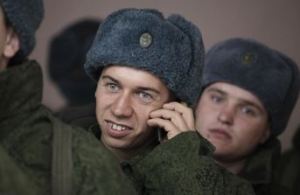
Conscript on His Mobilnik (photo: Reuters

Conscript on His Mobilnik (photo: Reuters)

Nezavisimaya gazeta’s editorial has the title above.  It’s sub-titled “An Unprejudiced Look at Military Reform.”

Here’s what it says.

“One of the most serious accusations against the former defense minister and former chief of the General Staff is the low combat readiness of armed forces units and sub-units caused by the military reform they conducted.  And the basic argument is the fact that only 15 of 35 combined arms brigades of permanent combat readiness are manned at 100%, the rest have personnel deficits from 20 to 30%.”

“There’s some truth in this.  If you figure the number of servicemen in the force structure — 220 thousand officers, 186 thousand contractees, 320 thousand conscripts and 50-60 thousand VUZ cadets — then the million required by the president’s decree has in no way been gathered.  But the main cause of this is by no means military reform, but the demographic situation in the country for which neither Serdyukov nor Makarov can answer.  And increasing conscript service, as proposed by some [Duma] deputies, can’t patch this hole.  And only those who contrary to Suvorovist science trained to fight the old way with numbers, and not skill, can talk about combat readiness relying just on arithmetical calculations.”

“Many concepts are part of combat readiness.  And not just manning.  Among its components, in particular, are the presence of modern combat equipment and combat support systems in the force, high operational-tactical qualifications of officers, their combat experience, skill and training of personnel…  The military reform of Serdyukov and Makarov, it seems, managed to deal with the last indicator.  We’ll cite just one fact — the average flying time of Russian Air Forces pilots reached 125 hours per pilot in 2012.  And squadron commanders flew 175 hours, and at Vyazma air base — more than 215 hours.  If you remember just several years ago our pilots had an average flying time of 30-40 hours, some of them generally 5-7 hours a year, and they got lost in the sky over the Baltic, then who would dare say that our military aviation is suffering from a lack of combat readiness.”

“The picture is approximately the same in the Ground Troops where soldiers and officers literally don’t leave the training grounds, conducting integrated tactical and operational-tactical exercises jointly with the Air Forces and Air Defense, with the Naval Infantry — if they’re on maritime axes.  They can’t complain about low combat readiness even in the Navy, whose ships, earlier tied to the piers, today ply the waters of the world’s oceans year-round, joining in the struggle against pirates in the Gulf of Aden.  They don’t complain of boredom in the VDV where over the past year more than 65 exercises of varying scale and intensity have been conducted, together with 1,150 combat training events, including more than 800 section- and 270 platoon-level combat firings, 73 company and 14 battalion tactical exercises.  Including with USA spetsnaz on American territory.  Additionally, the blue berets completed several tens of thousands of parachute jumps…  If these are not indicators of combat readiness, then what kind of percentages can you talk about?!”

“One more indicator of combat readiness is the evaluation of strategic nuclear deterrence forces which President Vladimir Putin recently carried out.  Launches of ground, naval and air-launched missiles were conducted then with high accuracy.  And the Supremo directed them from the Unified Central Command Post created in the framework of the reform this very year.”

“Yes, the reform according to the prescriptions of the ex-minister and the ex-NGSh has many deficiencies and mistakes.  ‘NG’ and ‘NVO’ wrote about them not once or twice.  We hope the new Defense Ministry leadership will rectify and correct them.  But not one more or less serious army dared test the combat readiness of our country’s armed forces after August 2008.  And no percentages can refute this fact.”

Yes, Serdyukov and Makarov are to blame for the mistakes of army reform.  Primarily for moving too fast across too broad a front without without adequately understanding the situation and consequences of their actions.  In some sense, this was their task — to break the logjam on military reform.  And that some people in Serdyukov’s team were venal didn’t help matters.

But NG’s right to argue they aren’t to blame for undermanning that leaves only 15 maneuver brigades at full personnel strength.  That’s a number not different from Putin’s first and second terms, the 1990s, or the late Soviet period.

NG’s also right to point to higher levels of training activity as an unalloyed good thing from Moscow’s perspective.  It’s a start.  It’s a function of having money and fuel, and a political leadership willing to allocate them.  But it’s only a necessary condition for building a modern army.  Sizeable Russian forces are probably ready to leave garrison when ordered.

The sufficient condition goes deeper.  Are those formations and units armed, equipped, supported, as well as trained to execute the missions their leadership envisions (and ones it doesn’t)?  It’s simply much harder to tell if they are ready for battle, if they will be capable in combat.  Much depends on the situation and scenario into which they’re thrown.  If, as NG alludes, Georgia should test the Russian Army’s readiness, it would perform better than in 2008.  It would probably do better in a new North Caucasus counterinsurgency.  But these cases are on the low intensity side of the warfare spectrum.  But perhaps they’re the most likely places where the Armed Forces would be employed.

But let there be no mistake, training activity doesn’t equal combat readiness, and combat readiness doesn’t equal combat capability.  It is significant and necessary, yes, but not sufficient.  One has to know a lot more about the condition of the forces and what goes on in those exercises.
Zelin’s Update (Part III)

In the middle part of General-Colonel Zelin’s incredibly long NVO interview, he reacts to Defense Minister Serdyukov’s high command changes and other structural realignments over the last couple years.  He also shares thoughts on the state of VVS training.

Zelin speaks to interviewer Viktor Litovkin like a 58-year-old three-star who’s surprised to have stayed at his post as long as he has.  He speaks like he isn’t concerned about being retired.

Asked what he and his Main Staff do now that the VVS operate under the four MD / OSK commanders, Zelin responds that plans to create an automated C2 system (ASU) haven’t quite gotten there.  He talks and is online with the district commanders often.  But, he says:

“The main thing is combat training remains with the VVS Main Command. Organizational development (stroitelstvo or строительство) of the service and combat training.  And without combat training what kind of employment can there be?”

There were, he continues, arguments and unresolved issues:

“But during the decisionmaking I proved my point of view, my vision of present problems, sometimes they had to agree, sometimes they had to listen on several issues, but, since now decisions have been made, we have to fulfill them.  To get to work.”

But he grouses a bit more.  He sounds like a man with responsibility who lacks authority.

The ASU isn’t working, but service central command posts (TsKP or ЦКП) were eliminated.  Regardless, Zelin says he has to organize and control training.  Every day 70-80 units have aircraft flying, and they have to be tracked.  They can’t just be given a mission and forgotten.

Asked about the newly-established Aerospace Defense (VKO) Troops, Zelin claims interestingly, that only PVO brigades in Russia’s central industrial region — the old Moscow AD District, KSpN, or OSK VKO — went over to them.  He says MD / OSK commanders got the rest, and he equips and trains them for regional commands to operate.  His view seems to be VKO is limited to strategic and theater MD.  You can’t, he opines, have PVO without air defense aviation integrated into it.  According to Zelin, a single national system of air defense, including Troop Air Defense, is needed, but a decision’s been made and it’s left but to fulfill it.

Before talking more about training, Zelin reiterates that a single system of net-centric strategic C2 and decisionmaking is the goal, but they aren’t quite there.

He seems envious of the large-scale, largely automated airspace control systems he’s seen in the U.S., Europe, and Japan.

On training and flight hours, Zelin says he’s got no problems with material support (i.e. POL), but problems addressing aircraft service life support [ресурсное обеспечение].  He states frankly he worries about maintenance provided (or not) by civilianized, outsourced Oboronservis affiliate Aviaremont.  There is plenty of money for maintenance, but those responsible aren’t getting it done.  While the Glavkomat has heartache about aircraft serviceability:

“Our other structures for some reason are responsible only for financial flows.”

Zelin was asked earlier if 130 flight hours was the VVS goal.  He says last year pilots got 340,000 hours, or 90 per pilot.  That makes roughly 3,800 pilots, if they’re shared evenly (they’re not).  Eighty percent of young pilots got not less than 100. In some cases, it was harder and they got a little more than 50.  Zelin adds this is still better than the 1990s.

BSF Gets an Unsat

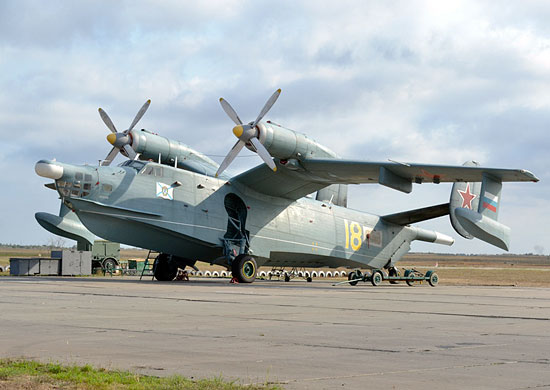
A BSF Be-12

Kommersant reported Saturday that Defense Minister Serdyukov presided over an unscheduled collegium at which the Black Sea Fleet (BSF) commander received a month and a half to rectify problems identified during an inspection this fall.

The inspection — conducted by Chief Military Inspector, General-Lieutenant Gennadiy Borisov — focused on the state of operational and combat training, the weapons and equipment inventory, logistical and medical support, and fire safety.  Kommersant’s source said the results were unfavorable, and there were deficiencies in many areas.  Serdyukov received the inspection report, and wanted to hear the BSF commander speak about it at the collegium.

A Main Navy Staff source told the paper two of three formations inspected at Novorossiysk Naval Base got unsatisfactories in artillery, missile, and torpedo firing, and mine warfare.  The 11th Independent Coastal Missile-Artillery Brigade and 184th Ship Brigade received comments, and General-Lieutenant Borisov also noted problems in the Naval Infantry battalions at Temryuk.

But no one got fired.  Serdyukov gave BSF Commander, Vice-Admiral Aleksandr Fedotenko, and Navy CINC, Admiral Vysotskiy, until February to remedy all defects before a repeat inspection.

On a related note, Monday the Defense Ministry announced BSF Naval Aviation bases at Gvardeyskoye and Kacha will consolidate into the 7057th Aviation Base.  The unified base will have ground attack, ASW, and transport airplanes and helicopters.  Press reports weren’t explict, but Kacha is the 7057th.  So Gvardeyskoye — the 7058th — will apparently close.

Where’s the Logic? (Addendum)

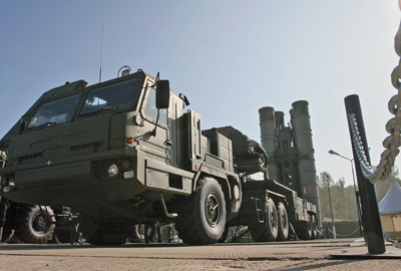
S-400 Launcher (photo: ITAR-TASS)

One shouldn’t ignore what doesn’t make sense . . . last week the Russian press reported again that the Baltic Fleet’s PVO units (Kaliningrad’s 3rd Aerospace Defense Brigade?) will receive their first S-400 launchers before year’s end.  The first report came in August.  ITAR-TASS cited a source this time – Baltic Fleet Commander, Vice-Admiral Viktor Chirkov.

Chirkov didn’t say how many the fleet will get, but he said the S-400 will replace old S-200 (SA-5 / Gammon) surface-to-air missiles.  He says his crews are currently conducting “acceptance-handover” launches, presumably at Ashuluk.

It doesn’t seem logical.  SAM brigades around Moscow can’t get S-400s on time and Chirkov is talking about putting them in Kaliningrad.  And his assertion he’ll get them this month seems odd given the loose schedules and passed deadlines associated with the program.

President Medvedev just finished saying one measure against European missile defense would be deploying the S-400 to protect SYaS.  But SYaS aren’t based in the Russian exclave.  It seems Medvedev would’ve announced it if the military intended to put the new SAMs in Kaliningrad.  Are S-400s going to intercept    SM-3s launched from Poland?  Are they going to protect Iskanders in Kaliningrad?

We’re left waiting to see the logic (and truth) in these reports.  Of course, there doesn’t necessarily have to be a logic compelling or sensible to outsiders.

“New Profile” Brigades

Representative "New Profile" Brigade

Not long ago someone asked what Russia’s “new profile” brigades look like.  There’s a good bit available on this. 

General Staff Chief Makarov signed off on the TO&E (org-shtat) as far back as three years ago, just a couple months after Defense Minister Serdyukov’s reforms were launched. 

The org chart for a typical motorized rifle brigade shown above is inelegant.  Some elements aren’t represented due to your author’s lack of graphic skills.  Among important missing items are the artillery command recce battery and air defense radar platoon.

The sniper platoon has been part of the new TO&E, but its existence was only emphasized by the media of late.

And this post doesn’t delve into precisely how postulated Russian light, medium, and heavy brigades might differ.

The manpower looks to be under 4,400 officers and men, 327 officers and 4,066 soldiers (including 1,005 sergeants) to be exact.  Russia’s officer corps bloat doesn’t seem to apply to serving out here “in the troops,” as they say.  Officers are only 8 percent of the brigade’s personnel. 

However, this representative brigade is (or was) commanded by a general-major (O-7), and had 5 full colonels, and 29 O-5s.  There are almost as many majors (43) as captains (68), and a fairly low number of senior lieutenants (181).

In terms of equipment, battalions remain battalions — 40 tanks or armored vehicles per.  The SP howitzers are 152mm 2S19 Msta-S or 2S3M Akatsiya and/or 122mm 2S1 Gvozdika.  MRLs are the venerable BM-21 Grad, in a battalion of three batteries with six launchers per.  Antitank artillery is towed and ATGMs are Konkurs (AT-5 / Spandrel) and Shturm-S (AT-6A / Spiral).  Air defense isn’t particularly modern consisting of batteries of 2S6 Tunguska (SA-19 / Grison), Strela-10 (SA-13 / Gopher), and Osa (SA-8B / Gecko). 

Other English-language observers have looked at the same data.  This one shows the organization and manpower distribution for a brigade’s sub-units (battalion-level and lower).  This one does much the same with some guessing at tactical organization and equipment.

P.S.  One forgotten thing here is how logistics and maintenance may, or may not, have changed at the brigade level with Serdyukov’s outsourcing, Oboronservis, and taking soldiers off noncore (i.e. non-combat) duties.  But the supply and repair battalions still appear on the org charts.

Thirteen VKO Brigades

Thirteen VKO Brigades

A little additional on that westward-leaning VVKO . . . the 13 VKO brigades are only a part of VVKO, but here’s how they’re laid out. 

They’re numbered 1-12 and 14. Six are in the Western MD. One in the Southern. Three in the Central. And three in the Far East MD.
 
  • 1st Aerospace Defense Brigade, Severomorsk, Western MD.
  • 2nd Aerospace Defense Brigade, Khvoynyy, Western MD.
  • 3rd Aerospace Defense Brigade, Kaliningrad, Western MD.
  • 4th Aerospace Defense Brigade, Dolgoprudnyy, Western MD.
  • 5th Aerospace Defense Brigade, Petrovskoye, Western MD.
  • 6th Aerospace Defense Brigade, Rzhev, Western MD.
  • 7th Aerospace Defense Brigade, Rostov-na-Donu, Southern MD.
  • 8th Aerospace Defense Brigade, Samara, Central MD.
  • 9th Aerospace Defense Brigade, Ob, Central MD.
  • 10th Aerospace Defense Brigade, Chita, Central MD.
  • 11th Aerospace Defense Brigade, Komsomolsk-na-Amure, Far East MD.
  • 12th Aerospace Defense Brigade, Vladivostok, Far East MD.
  • 14th Aerospace Defense Brigade, Yelizovo, Far East MD.

VVKO Faces West

How Will They Represent VKO on the Space Troops Flag?

VVKO faces west.  And north . . . ok, northwest.  Makes sense, that’s the direction those hypersonic missiles are coming from, right?  Maybe, maybe not.

Mil.ru, as is its wont, printed a little item on military preparations for the December 4 Duma election.

It indicates 80 percent of 53,000 servicemen and civilian personnel of the new Troops of Aerospace Defense (VVKO) will vote [i.e. are based] in the Western MD (ZVO). 

The press-release says more than 150 of 171 polling places (88 percent) for VVKO bases, garrisons, and military towns are located in the ZVO.

Space Troops weren’t very big, and they’ve gotten much bigger by swallowing as-yet unclear parts of the OSK VKO (the former KSpN or Moscow PVO District) and other Air Forces’ PVO units into the new VVKO.  OSK VKO, in particular, was a large, westward-leaning formation.

Still it’s surprising VVKO’s center of gravity has shifted so drastically to the west.  One would have thought there’d be a substantial chunk of VVKO-controlled PVO in the Far East, or northeast, too.

New Poll on Conscription

FOM's Poll on Conscription

The Public Opinion Foundation (FOM) just published a major poll looking at Russian attitudes toward the callup and obligatory military service.  It’s 48 pages, but here are some highlights.

The poll was conducted in July, with 3,000 respondents in 204 populated places in 64 of Russia’s regions.

Fifty-two percent of respondents favor a mixed manning system combining conscription with contract service, and 23 percent favor the callup only.

Sixty-four percent support the announced plan to cut conscripts and increase contract soldiers, although only 22 percent would support taking money from education and health care to pay for them.  Survey participants on average thought 34,500 rubles was worthy pay for contractees.

Fifty-five percent liked reducing conscript service from two years to one while 37 percent did not.  In the 18-30 age group, 65% supported the shorter service term.

In the population as a whole, 29% believe one-year service has reduced dedovshchina and “nonregulation relations” against 46 percent who feel nothing’s changed by it.  There were fewer of the former and more of the latter among respondents claiming intimate knowledge of army life.

The FOM poll showed strong support for a number of Defense Ministry initiatives to “humanize” conscript service.

Fifty-four percent were critical of draft evaders, but 34% were sympathetic toward them.

Finally, buried deep in the results, participants were asked for their views on the state of affairs in the Russian Army in coming years:

  • 19% said it will improve.
  • 19% said it will worsen.
  • 35% said it will stay the same.
  • 26% said hard to answer.

However, when asked to compare military service conditions today against those 10-15 years ago, more respondents said they are easier (39%), and many fewer said they are harder (14%), by comparison with Russians asked the same question in 2002 (just 6% and a whopping 64% respectively).

A Rock and a Hard Place

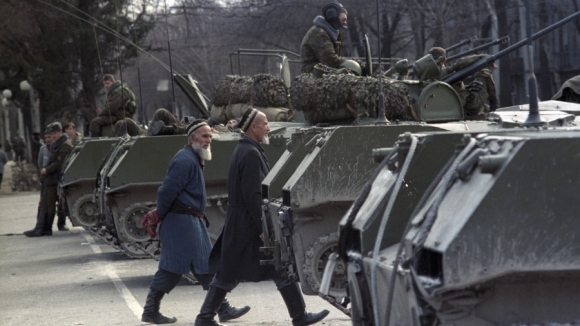
Russians in Tajikistan (photo: RIA Novosti / Vladimir Fedorenko)

Conscripts or contractees?  It’s difficult for the Russian Army to get the right kind of conscripts, where it needs them.  But, over time, it hasn’t been any easier to obtain long-term contract enlisted either. 

Last week, Izvestiya wrote about army plans to replace conscripts currently serving in its 201st Military Base in Tajikistan with contractees. 

An officer in the formation told the paper it’s too costly to keep 3,000 conscripts in Tajikistan, and, by the end of 2012, the Russian Army will replace half with contractees.  A GOMU source tells the paper replacing all 3,000 at once is “unrealistic.”  Contractees will reportedly serve on three-year deals getting 30,000 rubles per month.

The situation for Russians in Tajikistan, the officer says, is strained, and Tajik authorities regularly detain conscripts for one reason or another.  As an example, he cites the case of a conscript driver who killed three Tajiks last January.  Thus, he concludes, it would be easier with “professionals” – contractees —  who “know what they’re doing, and can be responsible for their actions.”

But there’s no reason to think contractees will avoid trouble any better than conscripts.  The first contract experiment proved that.  Contractees are more costly and just as difficult to control, if not more than their conscripted brother-soldiers.

According to Izvestiya, the 201st now has 5,500 personnel, including the 3,000 conscripts.

An old Krasnaya zvezda report says, in early 2007 – at the height of the first, failed attempt at introducing contract service – the military base had 7,000 servicemen in all, about 60 or 65 percent contractees.  Its two maneuver units had 50 percent or fewer in their ranks.

Back then, the Defense Ministry daily said the military was all set to send conscripts in place of hired soldiers.  It was hard to convince older, experienced men to go to Tajikistan because of the difficult living conditions and prospects for serving on contract in Russia.

As Izvestiya’s interlocutor intimated, relations between Moscow and Dushanbe are a bit strained right now, prompting some to wonder out loud if manning the 201st won’t become a moot issue.

VKO Cadre Changes

Didn’t have to wait long for this.  This morning President Medvedev signed out the ukaz with appointments to command positions in the VKO Troops (VVKO).

Kommersant’s source was mostly, but not completely, right.  Valeriy Ivanov will be chief of staff, and Sergey Popov, the chief of air defense for the Air Forces, will move to VVKO to command its Air and Missile Defense Command.

Appoint:

  • General-Lieutenant Valeriy Mikhaylovich Ivanov, Chief of Staff, First Deputy Commander, Troops of Aerospace Defense, relieved as Commander, Operational-Strategic Command of Aerospace Defense.
  • General-Lieutenant Sergey Aleksandrovich Lobov, Deputy Commander, Troops of Aerospace Defense, relieved as Deputy Commander, Space Troops.
  • General-Major Oleg Vladimirovich Maydanovich, Commander, Space Command, relieved as Chief, 153rd Main Test Center for Testing and Control of Space Systems.
  • Colonel Konstantin Aleksandrovich Ogiyenko, Commander, 5th Air Defense Brigade.
  • General-Lieutenant Oleg Nikolayevich Ostapenko, Commander, Troops of Aerospace Defense, relieved as Commander, Space Troops.
  • General-Major Sergey Vladimirovich Popov, Commander, Air and Missile Defense Command, relieved as Chief, Air Defense, Deputy CINC of the Air Forces for Air Defense.

There you have it.  What looks like it will be a new service — VVKO — is born, and an old branch — KV — apparently will go away.  More presidential paperwork on that is likely forthcoming.  But today we’ve learned who’s in VVKO’s head shed, and that its two major components will be, not surprisingly, the Space Command and Air and Missile Defense Command.