Category Archives: Ground Troops

Ten Pantsir-S1s for Russia, or for UAE or Syria?

We all miss things, right?

In Friday’s NVO, Viktor Myasnikov published an insightful article on Pantsir-S1.  He hints that maybe the ten Pantsir-S1s ceremoniously delivered to the VVS aren’t actually for Russia’s VVS.  More interestingly, he provides numbers on the quantity really needed to rearm the Russian Armed Forces by 2020—500 for the VVS and 500 for the Ground Troops’ VPVO.

“‘Pantsir’ is one of the most talked about combat vehicles of the last 20 years.  Everything about it’s been heard, many have seen it at exhibitions, but it only began to come to the troops in recent days.  In the long years of design work (which began in 1990), testing, and disrupted contracts, ‘Pantsir’ received the honorary epithet ‘longsuffering.’”

“Now they’re talking about it again in superlative terms.  One could get the impression this is some panacea against all means of aerospace attack.  Actually, this is a close-range—up to 20 km—air defense system.  It exceeds hand-held ‘Igla’ and ‘Strela’ SAMs, but doesn’t approach the level of ‘Tor.’  And ‘Pantsir’s’ place in the order of battle has been designated perfectly concretely—it will replace ‘Tunguska,’ which in its time replaced ‘Shilka.’  True, it will really only replace ‘Tunguska’ when it gets on a tracked chassis.  For now this is a wheeled rear area variant designated to cover important targets—airfields, bases, air defense positions . . .”

“Initially ‘Pantsir’ was planned for tracked transport in as much as it needed to take the place of ‘Tunguska’ in tank columns to cover them against helicopters and other low flying enemy aircraft.  But the concept began to change due to underfinancing.  And a cheaper variant ‘Pantsir’ put on wheels, became positional as the last line of air defense for rear area targets.”

“The uniqueness of ‘Pantsir’ in the arms market is guaranteed by the fact that U.S., NATO, and Israeli armed forces are not threatened by cruise missiles, planned munitions and UAVs of the potential enemy [many would differ with this assertion].  It [Russia?  Arab states?] doesn’t have them in the necessary amount and won’t have them in the coming years.”

“In accordance with the State Program of Armaments to 2015 it’s planned to deliver 20 of such systems to the RF Armed Forces.  10 have already been received.”

“At the same time the Russian Air Forces’ demand is specified as a minimum of 100 systems of this type.  Incidentally, other specialists believe it’s essential to buy 200-250 systems by 2015 and 400-500 by 2020.  Besides that, the Ground Troops could buy 500-600 vehicles by 2020 for replacing ‘Tunguskas.’  They certainly could, of course, they could, but who will provide them?”

“Besides this, there’s no trusting official announcements that all overdue export contracts for the supply of ‘Pantsirs’ to the UAE and Syria have been fulfilled [actually it’s pretty clear supplies are just starting].  Therefore it’s strange that 10 vehicles suddenly turn out to be withdrawn from the export orders.  Suspicions immediately arise that the buyer has refused them or not accepted them due to complaints about quality.  Meanwhile, some anonymous sources from Tula defense industrial enterprises maintain that everything’s normal with the quality, but the vehicles are just taking a pre-sales run on normal asphalt road conditions.  After the [9 May Victory Day] parade the ‘Pantsirs’ will be repainted desert camouflage and handed over to the foreign buyer.  There’s no need to show them to anyone until the next parade.”

“There are suspicions that the ‘KamAZes’ for these ‘Pantsirs’ are not quite serial models.  ‘Cause in their build-out they are too close to the one in which Vladimir Chagin wins ‘Dakar.’  Would it make sense to have imported turbocharged engines on them?  Such capability of automotive equipment for covering stationary S-400 SAMs is a little unnecessary.  But it’s exactly right for the Middle Eastern or North African desert.”

“But there is another side to this.  It’s been announced that these 10 ‘Pantsirs’ will participate in joint exercises of Russia, Belorussia and Kazakhstan.  And also before the handover to the troops at the ‘Shcheglovskiy val’ enterprise an archpriest blessed them.  Such a ritual wouldn’t be arranged for a buyer from a Muslim state.”

Pantsir-S1 and the Priority on Arms Exports

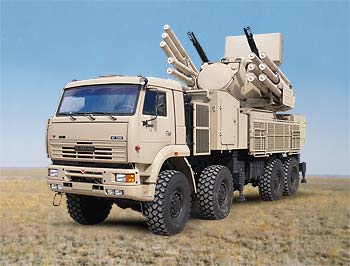
KBP's Pantsir-S1

Recent announcements about deliveries of the Pantsir-S1 highlighted the priority still enjoyed by arms exports over domestic procurement of weapons systems for the Russian Armed Forces.

On 18 March, the Russian Air Forces took delivery of their first 10 Pantsir-S1 antiaircraft missile-gun systems (ZRPK) from the Tula-based Design Bureau of Instrument-building (KBP).  These Pantsir-S1 systems will march on Red Square during the coming 9 May Victory Day parade, before heading to the Elektrostal-based 606th Guards Air Defense Missile Regiment that also has the S-400.  Some of the regiment’s Pantsir-S1s will participate in live-fire exercises at Ashuluk in April.

The Pantsir-S1 will replace the 1970s-era Tunguska-M1 in Russian air defense units.  A short- and medium-range missile-gun system, it provides point defense for civilian or military assets like S-400 SAMs.  VVS Deputy CINC for Air Defense, General-Lieutenant Sergey Razygrayev has said three Pantsir-S1 systems will be deployed around each S-400 launcher.

The Pantsir-S1 has 2 twin-barrel 30-mm 2A38M antiaircraft guns and 12 57E6-E SAMs.  It is reportedly effective against targets with a reflective surface of 2-3 square centimeters and speeds to 1,000 meters per second, at a maximum range of 20 kilometers and altitude of 15 kilometers.

The Pantsir-S1 can be mounted on various vehicles and ships, and General-Lieutenant Razygrayev has said it will become a standard air defense system for each of Russia’s armed services and combat arms in the future.

When the VVS got its 10 Pantsir-S1 systems, the KBP deputy general director announced that the Air Forces will receive more than 20 units in coming years.  An unnamed source told ITAR-TASS, the VVS would get 25 Pantsir-S1 by 2012.

Development of the Pantsir-S1 dates back to the early and mid-1990s.

The United Arab Emirates (UAE) signed a contract to buy 50 Pantsir-S1s for $734 million in 2000. Syria also contracted for 36 systems.  Ex-Defense Minister, now Deputy PM for the OPK Sergey Ivanov said in early 2008 that 24 systems would go to customers in 2008, from a total order book of 64 for the Pantsir-S1 (of course, 50 + 36 should be 86, not 64).  But the Pantsir-S1 didn’t finish development and testing until some time in 2008, and entered production later in 2008 or in 2009.

Pantsir-S1 deliveries to the UAE and Syria reportedly began in 2009, and the system is already supposedly operational in the UAE.  An OPK source told Interfaks that the first stage of Pantsir-S1 deliveries to these two countries had been successfully completed.

This month Moscow announced the sale of 38 Pantsir-S1s to Algeria for $500 million.  The systems are supposed to be delivered this year and next.  The Russians are reportedly close to a Pantsir-S1 export deal with Libya, and Saudi Arabia, India, and Belarus have been mentioned as other potential buyers of the system.

So these are pretty lucrative sales for KBP, roughly $13-15 million per unit.

Now back to the Russian Armed Forces which have only 10 newly-received Pantsir-S1 themselves.

In late 2007, the commander of Troop Air Defense for the Russian Ground Troops gave his opinion that Pantsir-S1 needed improvements before it could enter his inventory, specifically he wanted its size reduced and better performance against certain types of targets.  For its part, the VVS had been looking, and waiting, for Pantsir-S1 since at least 2002.  AVN reported in late 2008 that the VVS wants to buy more than 100 of the systems.

Even if the Defense Ministry paid $15 million (unlikely), 100 is still a modest buy of $1.5 billion against annual military procurement of about $40 billion these days.  But one can guess that the military is haggling with KBP over the price it’ll pay for the Pantsir-S1.  And this purchase has to fit with other defense procurement and KBP’s production for its foreign buyers.

Makarov Describes the Army He’s Building

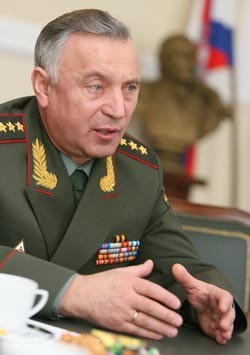
Nikolay Makarov (photo: Viktor Vasenin)

Today’s Rossiyskaya gazeta interview with General Staff Chief Nikolay Makarov has lots of questions and answers on the state of U.S.-Russian negotiations on a new strategic arms treaty, and on missile defense.  If you’re interested in those, you’ll need to read for yourself.

If you’re interested in the other things Makarov said, read on.

Asked isn’t it strange that Russia’s army would be cut when NATO is drawing closer to its borders, Makarov answers:

“We proceeded from the fact that the world has changed to a significant degree in the last 15-20 years.  Russia needs armed forces capable of reacting promptly to any threats and challenges.  Our army, if you take the first Chechen campaign, couldn’t cope with these functions.  To fulfill missions we were forced to man military units with, as a rule, untrained soldiers and officers in the course of combat actions.”

Makarov goes on, saying, after 1996, the army manned 13 percent of its regiments at 80 percent of their wartime complement, so they would be ready for action in a few days if needed.  The remaining 87 percent stayed at cadre level, with equipment and supplies in storage.  So Russia kept a big army that ate up enormous resources, but couldn’t carry out missions. Officers and warrants were almost 50 percent of personnel, and there weren’t enough soldiers.  Possible variants for the best structure were considered and the brigade was selected.  And today any brigade can be ready for action in only one hour, according to Makarov.

Makarov says, in Afghanistan and Chechnya, battalions were reinforced with reconnaissance, artillery, air defense, logistics, and repair units before they deployed for combat.  But battalion commanders weren’t so good at commanding these attached units not normally in their TO&E.  So, says Makarov, it was decided to add these units to battalions, so their commanders can learn how to employ them.  And three battalions organized as such and fully manned comes to 4,500 or 5,000 men–a ‘half division’ rather than a regiment.  And, he notes, battalions can operate independently or as part of brigade tactical groups.

He goes on to explain the Russian Army’s changed outlook:

“In the past we fought with multimillion-man groupings of troops, the basis of which were fronts.  The experience of military conflicts of the past decades showed that such a war was possible, but unlikely.  In the future, troops will go over to actively maneuvering actions.  The actions of inter-service groupings on the entire depth of the enemy’s force structure are replacing frontal battles.  The sides will try to destroy critically important objectives, and also conduct noncontact combat actions.”

The interviewer asks Makarov why only 2 tank brigades in 85 Ground Troops brigades, doesn’t the infantry need armored support?

Makarov answers that, like cavalry in the new age of automatic weapons, today the tank’s role is becoming secondary.  But what’s causing the change? He says it’s the information and artificial intelligence inside equipment, highly accurate weapons used as part of a single information space, and weapons that ‘see’ and ‘know’ everything and can be used against troops and targets in automatic mode.  But he calls robot-tanks with highly accurate weapons a thing of the future at this point.  And Makarov adds that no one is forsaking tanks:

“Here you’re talking only two brigades. Actually we are filling motorized rifle brigades with a great number of tanks.”

Makarov explains the advantages of modular brigades and battalions. Modularity means freedom in structuring battalions and brigades.  If we need a fist of motorized rifle and tank battalions and artillery batteries, we make it.  Commanders in the past didn’t have this freedom.  The entire army force structure was laid out for the conduct of a large-scale war.

Makarov explains modularity as a reaction to Chechnya and even World War II where C2 and force structure was created out of troop units that weren’t coordinated [неслажённые –a difficult one in English, troops that weren’t previously trained and melded together into a cohesive unit or formation].

Asked if there aren’t place in the RF where one can fight with divisions, Makarov says the Russian Army hasn’t gone completely away from divisions [but almost].  But he goes on to insist that their modular nature allows brigades to be used just as well as divisions in Siberia or the Far East, just as well in a large-scale war as independently.

Asked how the army can be trained to fight in a new way, he says:

“The last twenty years there was no intensive combat training in the Russian Army, graduates of commissioning schools and academies didn’t reinforce their theoretical knowledge with practical actions.  And like a foreign language–if there’s no practice, in 2-3 years it’s forgotten.  At the same time, officers without such practice rose in position and rank, some even served to the point of commanding armies.”

“Two tasks stood before us.  First of all, to change the mentality of commanders and their views on war.  It certainly wouldn’t be the one they were taught in the past.  Troop actions, capabilities and forms of their employment have become absolutely different.”

“In order to get to a common understanding, a common methodology is needed.  We are beginning to introduce it, but we are dedicating the current year to individual training of servicemen and combat coordination [слажевание]  of brigades.  From January to February 2010 at the base of the Military Academy of the General Staff we conducted supplementary courses with military district, fleet, and army commanders and their deputies.  Officers ranking from general-colonel to colonel serve in these positions in the armed forces.  Special demands are made on them as organizers, directors, those directly responsible for teaching and training subordinate military command and control organs and troops.”

“We’ve built a training chain, but we understand that this is just the first step.  Everything that officers study in theory still needs to be assimilated in practice.  For this in the second half of May we plan to conduct an operational assembly on the base of one of the units of the Moscow Military District where we are developing a single methodology of training in brigades and below.”

Makarov says 148 new ‘programmatic-regulation documents’ have already been developed.  The Kavkaz, Zapad, and Ladoga exercises last year showed some problems with them, but working groups from the Center for Military-Strategic Research and the Main Combat Training Directorate are reworking them.  The revised regulations will be used in Vostok-2010.  The goal is to have a new combat training program and new combat manuals before 1 October.  Once approved, they’ll be used to organize training starting in 2011.

Makarov also takes this opportunity to expound on his views of netcentric command and control.  He mentions that the U.S. war in Iraq showed that former canons about needing to have 2-3 or 5-6 times superiority in forces and means for military victory no longer necessarily apply.  He says Moscow has the ambitious goal of achieving netcentric command and control in 2-3 years, but the future system is being established in the SKVO this year.

The last issue raised for part one of Makarov’s interview–contract service.  Makarov says the media claimed he had recognized the failure of military reform, when what he really addressed were the miscalculations in contract service over a period of several years.

He says 6-month conscripts were forced into contracts just to meet the [previous] Genshtab’s dictate to have not less than 95 percent contractees in permanent readiness units.  He says these guys were not professionals, but rather just highly [well, not terribly highly] paid conscript soldiers who left the army at the end of their two years anyway.  So, Makarov concludes, it’s no surprise that contract service became a fiasco.

But he adds, we aren’t turning away from it.  A fully contract army would be the very best variant if Russia could afford it [can’t it?], but it can’t according to Makarov.  So he continues:

“Therefore we want to select as professionals only those who’ve served in the army [as conscripts], and only for positions determining the combat capability of military units, related to the operation of complex and expensive equipment.  In the Navy, practically all positions are such.  In motorized rifle brigades not less than 20 percent of the TO&E will be contractees–tank, antiaircraft, and artillery system drivers, gunner-operators, some other specialties.  Plus sergeants.”

“Moreover, if a sergeant is a professional, has served 10-15 years and the level of his training is higher than a new lieutenant, he should get more than the young officer.  We understand that the pay of a contract soldier has to guarantee the attractiveness of military service.  All this will be put into the new pay system.”

Asked about housing for contractees, Makarov says professional soldiers and sergeants need to live like officers in service apartments or dormitories.

Winter War 2010

The Russian press has noted the 6 March article in leading Finnish daily Helsingin Sanomat describing how a Russo-Finnish war might play out in 2010.  With the conveniently provided English, one can read for oneself.  But here’s a capsule version.

The imaginary war scenario begins with a Russian cruise missile strike on the Finnish Broadcasting Company compound.  Under the State of Defense Law, mobilization begins and the Chief of Defense becomes Commander-in-Chief of the Finnish Defense Forces.  Russian fighter aircraft engage Finnish F/A-18 Hornets around Helsinki.  Finnish government entities evacuate to safer locations.  Russia’s motorized offensive presses across the Karelian isthmus, trying to reach the Finnish capital in two days.  The Finns respond with antitank weapons and German-made Leopard tanks.  Russian airborne are dropped in Helsinki to disrupt rear areas; fierce urban warfare ensues. Civilian casualties mount and noncombatants flee for Sweden.  The Russians and Finns are engage each other on the electronic front [but few details are fleshed out].

The war is decided in the air.  Russian air power overwhelms Finland’s 100 combat-capable aircraft.  But it’s no quick victory for Moscow, and the Finns receive lots of international support [it makes them feel much better to be sure].

There’s obviously a lot to question in the conjecture above.

Rossiyskaya gazeta from 19 March indicated that there’s buzz about the article in Russia and Finland, and people mostly want to know why such a ‘provocation’ has been published.  So RG asked the Finnish paper’s editor to comment, and he replied:

“In the last two months we’ve written a lot about the Winter War and its results.  And this article was part of that series of publications.  I want to note that in this material a fictional war scenario is presented.  Its purpose was to show how such a situation would develop if such a conflict broke out like at the start of the Winter War.”

“I’m not prepared to talk about what kind of war scenarios exist in the Finnish military.  This is exclusively their business.  We just published our view of an imaginary war.”

“It’s not possible here to say that we, in any case, wanted somehow to harm the relations of Finns toward Russia with our publication.  I don’t think it’s possible to do this with one article.  Or just the same draw Finland closer to NATO membership.  Therefore I ask you not to find any kind of secret designs in our publication.”

“I want to note that our material cannot be put in the same row with reporting on a Russian attack on Georgia from Georgian television station ‘Imedi.’  The aim of the story of our Caucasian colleagues was to shake up the country’s population.  In our material, we immediately indicated that the published war scenario was completely fictional.”

On 17 March, Argumenty nedeli criticized the author of the war scenario for not explaining why Russia and Finland would end up in a war.  Even in the Cold War, Finland was a better friend to Moscow than some of its socialist allies.

According to Argumenty nedeli’s defense correspondent Yaroslav Vyatkin, Helsinki lived pretty well off trade with the USSR from the 1950s to the 1980s.  But in the 1990s, an anti-Russian mood came over Finnish society.  Finland forgot about its role as bridge between East and West, and reoriented its economy toward the EU.  Some social movements actively agitated for Finland to join NATO.  Vyatkin believes the U.S. has stoked these sentiments in hopes of broadening NATO’s northern flank.

But, according to Vyatkin, Finns who want NATO membership don’t understand that the alliance can’t defend them, whatever it promises.  But he has confidence in the rational and calm Finns to make the right choice when it comes to Russia and NATO.

Then Vyatkin takes a closer look at the article’s military propositions and Finnish forces–about 90 Leopard and 65 T-72 tanks, about 200 BMPs and 800 BTRs.  BUK-M1 air defense systems around Helsinki (which it stopped procuring due to reported unhappiness with their poor resistance to jamming).  Vyatkin says the Finns’ F/A-18s and Hawk trainers would just meet a glorious death in close combat with A-50 controlled Su-27, MiG-29, and MiG-31B fighters. He thinks, though not strong, the Baltic Fleet is more than a match for the Finnish Navy.  However, he acknowledges that only the 138th Independent Motorized Rifle Brigade and 76th Airborne-Assault Division are adjacent and immediately available for action against Finland.

Vyatkin tails off by noting that, although brave, and not badly trained and equipped, the Finns lose, but Russians and Finns won’t be fighting anyway.

Vyatkin’s assessment seems a bit overconfident.  Russia’s Genshtab surely wouldn’t be this sure of easily subduing the Finns, especially or hopefully not after what was nearly, in many ways, a debacle against the Georgians in South Ossetia two years ago.

Svobodnaya pressa talked to Leonid Ivashov’s assistant at the ‘Academy of Geopolitical Problems,’ Konstantin Sivkov, about the new Winter War scenario.  Sivkov calls it nonsense, saying it sounds like someone confused Russia with the U.S., since backward Russia’s not capable of such operations. He adds that he really doesn’t want to comment on such stupidity.  Sivkov’s hard-pressed to come up with any conceivable reason why Moscow would want to go to war with Helsinki.  So, he chalks this all, like the ‘Imedi’ incident, up to an effort to cast Russia in the role of an enemy, and to prepare for Western aggression against Moscow.

In early March, Voyenno-promyshlennyy kuryer published an article on northern Europe and NATO written by a candidate of military sciences, corresponding member of the Russian Academy of Rocket and Artillery Sciences and the chief of the scientific-research department of the Defense Ministry’s Military History Institute.  The authors examined the possible negative consequences of Sweden and Finland joining NATO.  They concluded that Finland has been a true military neutral, but domestic political debate and swings in public opinion on joining NATO have become more pronounced since the late 1990s.  Some Finnish leaders have favored NATO, while others have argued for orienting more toward the U.N. or EU instead of joining NATO, which would, in their view, only add to international tension.  The authors note that, despite its formal military neutrality, Helsinki has taken practical steps toward more integration with NATO, including going over to NATO arms standards, conducting joint maneuvers with NATO, and using Partnership for Peace to promote military compatibility.

Regarding the ‘Atlanticization’ of northern Europe, they conclude that the region’s military-political configuration and balance of forces would change radically if Sweden and Finland joined NATO.  For Moscow, they recommend not only following the situation closely, but adopting a more clearly ‘multivariate and weighted’ line in relation to these countries.  It is noted that, even if they joined NATO, they might not agree to host foreign troops.

Finally, the authors say that Finnish military policy could have particular significance for northern European security in coming years.

State of the ‘New Profile’ in One District

General-Lieutenant Bogdanovskiy

Leningrad Military District (LenVO) Commander, General-Lieutenant Nikolay Bogdanovskiy held a news conference today and, along with talking about the upcoming Victory Day parade on St. Petersburg’s Palace Square, he talked about his district’s ‘new profile.’

Firstly, following General Staff Chief Makarov, Bogdanovskiy said contractees will be reduced and conscripts increased.

Specifically, he stated:

“. . . the number of contractees will be signficantly reduced, many of those who showed themselves incapable of serving will need to be dismissed.”

The LenVO needs 25,000 draftees from this spring’s consription campaign beginning on 1 April. But he said this won’t create problems because, last fall, 100,000 young men came through the LenVO’s voyenkomaty and 25,000 were deemed fit to serve.

The LenVO Commander said, in the process of ongoing personnel cuts, 1,600 officers and 1,200 warrants have been ‘placed at the disposition’ of their commanding officers, but only 346 and 284 respectively have been discharged from the service.

These are surprisingly small numbers.

So, in the LenVO at least, only 22 percent of the officers destined for dismissal could actually be dismissed with the benefits and apartments owed them.  The other 78 percent remain in limbo, without duty posts and living on their rank pay [perhaps one-fourth of their former total monthly pay].  And 24 percent of warrants could be sent home with benefits and housing while the other 76 percent wait for these things.

Bogdanovskiy has also asked St. Petersburg’s governor to resolve a situation with owners of garages located on land the Defense Ministry claims near the village of Yukki, where the LenVO now wants to build apartments for servicemen.  But that one will be hard; the Defense Ministry’s old nemesis Rosimushchestvo says the property doesn’t belong to the military.  The builder and construction equipment have already been out to the site with the intention of knocking down the garages.  Boganovskiy says the plan is to put 50 apartment houses on this territory.

The LenVO Commander also acknowledged problems with military housing built in the district:

“I’ve more than once tried to sort out the quality problem in the housing in Pushkin.”

He indicated the problems started small, but failure to fix them in a timely manner means ten times the amount of money must be spent to repair them now.  But he promised to do so by the end of spring.

On the force structure front, he says the LenVO’s reforms were largely completed in 2009.  Ten brigades and other units were formed or reformed in the process [the district has 3 combined arms brigades–the 25th, 138th, and 200th].

Regarding problems with the command and violence in the 138th Independent Motorized Rifle Brigade at Kamenka, Bogdanovskiy said:

“. . . we haven’t managed to complete fully tasks connected with discipline–in particular, in the 138th Kamenka Brigade the commander, chief of staff, and assistants for armaments and socialization work were dismissed because of events there.  Now the situation is normalizing, we are trying not to repeat past mistakes.”

Interesting insights into what the Serdyukov’s reforms have meant for one, albeit small and not particularly significant, district.  But, if such a large percentage of officers are being left ‘at the disposal’ of their commanders, can one believe Serdyukov’s assertion that 65,000 officers were put out of the armed forces last year?  Does this include a small number of dismissed and a much larger number of those left ‘at the disposal’ of commanders?  On an issue closely tied to officer cuts, can one believe that the Defense Ministry really obtained 45,000 apartments last year if so many soon-to-be-ex-officers are ‘at the disposal’ awaiting them?

It would seem that, if Serdyukov has failed, or been unable, to move as speedily on officer reductions as he wanted, the door might be left open for someone to reverse this policy, especially if a large number of potentially angry officers remains for a long time in the limbo of being neither in, nor out of, the army.

Collapsing Contract Service, the Draft, and Professional NCOs

General Staff Chief Makarov’s recent death pronouncement for contract service means, as he said, more conscripts in the near future (or an attempt to conscript more soldiers).

In the longer run, however, the collapse of contract service means the Russian Army faces several manpower policy choices, each unpalatable for its own reasons.  The army will likely be less combat ready, and less combat capable, than desired.

Think back about where the army’s been, and how it reached the current predicament.

The armed forces were reportedly 1.13 million men, but probably more, in recent years.  At any moment, they had four distinct draft contingents of about 130,000 conscripts, totaling 520,000 draftees.  Next, they had a layer of perhaps 300,000 contractees and warrant officers.  The contractees included probably 90,000 long-term enlisted, NCOs, and females as well as no more than 80,000 contract soldiers from 2002 and later.  There were probably about 130,000 warrants.

So, let’s count 520,000 conscripts and the middle layer of 300,000, for a total of 820,000.  Lastly, on top, let’s add nearly 400,000 officers. 

What did this manpower structure mean for the Russian Army’s force structure?

With practically the same number of conscripts and officers, the force structure was hollow–few units or formations were fully manned and many low-strength (cadre) units had officers and equipment, but only small numbers of soldiers–conscript or contract–and they existed only to be fleshed out with mobilized reservists in the unlikely event of a big war.

This structure didn’t work well in little wars like Chechnya or more recently Georgia in which the army had to piece together regiments by finding combat ready battalions and capable commanders wherever they could be found.

In 2006, Putin said of the military dilemma at the outset of the second Chechen war:

“. . . we needed to gather a force of at least 65,000 men.  And yet the in all of the Ground Troops there were only 55,000 in combat ready units, and even they were scattered all around the country.  The army was 1.4 million strong, but there was no one to do the fighting.  And so unseasoned lads were sent to face the bullets.”

And in late 2008, Medvedev emphasized the need for 100 percent combat ready units as the number one lesson of the August conflict over South Ossetia:

“Overall, these changes aim to make the Armed Forces more combat ready.  We talked about the war in the Caucasus, where our armed forces demonstrated their best qualities, but this does not mean that there were not also problems that became apparent.  We need to continue improving our Armed Forces. What steps does this require?  First, we need to move over to a system of service only in permanent combat ready units.”

So, after the August war with Georgia, Serdyukov moved to eliminate the huge, big-war mobilization base, hollow units, and unneeded officers, and to use the savings to man and outfit 85 Ground Troops brigades in a permanently combat ready condition.

Given a nominal strength of 3,000 men in them, the army needs roughly 260,000 troops to man these new combat brigades.  And this doesn’t count conscripts needed elsewhere in the Ground Troops, Rear Services, VVS, VMF, RVSN, VDV, or KV.

With the commencement of the one-year draft in 2008, Moscow doubled its induction of conscripts from 130,000 to 270,000 every six months.  And the Ground Troops need fully half the 540,000 conscripts present in the armed forces at any given moment.

Like any country, Russia has a real and an ideal army, the army it has and the army it wants (a la Rumsfeld).  Moscow’s ideal army by 2012 has one million men, including 150,000 officers, a layer of 64,000 professional NCOs, and conscripts as the balance, perhaps 800,000.

But the Arbat military district hasn’t articulated it this clearly for several reasons.  First, shedding officers and (warrants) year after year isn’t an easy task.  Second, the number of professional NCOs desired or available in the future is in doubt given General Staff Chief Makarov’s and Defense Minister Serdyukov’s statements on the failure of contract service and the apparent withdrawal of funding for the current contract sergeants program.  And third, it’s unclear if Moscow can draft 400,000 young men semiannually to put 800,000 soldiers in the ranks.

The army Russia has is messier than the vision stated above.  Serdyukov says they are at 1 million already.  There were a reported 355,000 officers at the outset of the current reform in late 2008.  About 40,000 officer billets were vacant and 65,000 officers were released in 2009, putting them at 250,000 officers today.  Serdyukov has set about the elimination of almost all warrant officers, but he hasn’t said what they’ve done in this regard yet. Let’s guess 30,000 have been dismissed, leaving 100,000 warrants.  Let’s also make reasonable guesses that 60,000 recent contractees and 70,000 longer term ones remain in the troops.

So what is there?  Armed forces with 540,000 conscript soldiers and about 480,000 officers, warrants, and contract enlisted.  Moscow will have to revitalize its military education system to get the smaller number of quality officers needed in the future.  Getting the requisite numbers of conscripts will be a challenge given the country’s well-known demographic problems which are biting hard right now.  But obtaining the noncommissioned officer layer of military unit leadership is also proving difficult.  The layer is presently a jumble of perhaps 230,000 warrant officers, contract sergeants, and even officers and warrants who’ve accepted downgraded positions rather than dismissal.  It is not the army’s ideal, but this middle layer fulfills some functions.

With all this said, what are the Russian Army’s manpower options for the future?

If Moscow actually reduces the officer corps to 150,000 by 2012 and the contract sergeant program is not put on track, the balance of its 1 million man army could be 800,000 or 850,000 conscripts (including conscript-sergeants trained for only 3 or 6 months).  Drafting 400,000-425,000 men every six months would be practically impossible.  Of the current cohort of maybe 900,000 18-year-olds, maybe 300,000 can be inducted, leaving the army to find 500,000-550,000 conscripts among men who are 19-27 and have not already served, but can be difficult to induct for various reasons.

Even if manned fully, a 12-month force has to make Moscow wonder whether this mass of conscripts with this amount of training really meets its definition of a modern, combat-ready, and combat-capable army.

Reducing the manpower requirement by cutting the army’s overall size would reduce the draft burden, but it would contravene the decreed million-man army policy.  There would be howls of protest that the army is too small to cover Russia’s borders (as if one million is even enough to do it).

Extending conscription back even to 18 months would ease this task considerably.  Moscow could take just slightly more than the 270,000 it is conscripting now for 12 months, and by keeping them an extra six months, it could work its way up to a conscripted force of nearly 850,000 in the space of a year and a half.  An increased draft term would be unpopular but Russians would swallow it.  It’s not like it would lead to a Medvedev (or Putin) defeat at the polls in 2012.  The real problem might be the draft’s similarity to taxes–the longer (or higher) they get, the more incentive for people to avoid them.

So that brings us back to the central point.

The way to reduce the number of conscripts needed for a million-man army, keep the draft term at 12 months, and have a reasonably well-trained and capable force is the one path that has been abandoned–developing a large and professional NCO corps that has the right material incentives to serve for a career.

The slow-to-start, small-scale, and apparently recently eviscerated Federal Goal Program to train only 64,000 professional sergeants is not enough.  The current ranks 230,000 of former officers turned sergeants, warrant officers, warrants turned sergeants, contract sergeants, and enlisted contractees is a stew that could theoretically be converted to a professional NCO corps, but it would be far from easy.  In terms of size, however, it’s more like what’s required to do the job, lighten the conscription load a little, and impart some professionalism to a mass, short-term draftee army, if these NCOs become professionals themselves.

What professional NCOs demand in return is pretty basic (higher than median income wages, family housing, and guaranteed off-duty time outside the garrison), but they haven’t gotten it since the most recent contract experiments began in the early 2000s.  In many cases, even officers haven’t got these things.  But the pay promised in the contract sergeant program (up to 35,000 rubles per month after graduation) is more like what’s needed to attract men.

The sergeant program seems to be the army they want, but the Defense Ministry appears to have pulled the financial plug on it.  The flotsam and jetsam is the army they have and might be turned into something, but there’s no move in this direction as yet.  Meanwhile, recall that Serdyukov’s plan for mass officer reductions was partly justified by the thinking that many officer tasks would go into the hands of capable NCOs.  And as recently as the 5 March Defense Ministry collegium, Medvedev said:

“Particular attention also should go to sergeant personnel. Sergeants need to be capable, if the situation demands it, of replacing their tactical level officers.”

Plug Pulled on Contract Service

On Friday, Interfaks said a source in the Federation Council’s Defense and Security Committee indicated the latest contract service program (the Federal Targeted Program (FTsP) for Manning Sergeant (Petty Officer) and Soldier (Sailor) Ranks with Contract Servicemen) has been scrapped.  The program was supposed to produce 64,000 contract NCOs by 2015. 

The financial resources for this 2009-2015 program have been slashed by 86 percent according to an Audit Chamber report given to the upper house of the Russian legislature.  A Defense and Security Committee representative says 22.4 billion rubles of the 26.6 billion ruble program were slashed.

This certainly sounds like losses have been cut to what’s already been spent on selecting and beginning to train a little more than 200 future sergeants at Ryazan.  The program was slow in starting, and of 2,700 candidates who came to Ryazan, only 239 were ultimately accepted.

General Staff Chief Makarov and Ground Troops CINC Postnikov recently admitted contract service had failed, but said the contract sergeant program would continue.  They didn’t say it would basically be limited to its current very small scale.

Infox.ru on Friday quoted Prime Minister Putin who, in 2008, called the contract sergeant program “the logical development of plans for the organizational development of a modern and highly professional Russian Army.”

On cutting conscription to 12 months, Putin said, “For this decision we went logically over the course of the last six years, developing a system to attract citizens to military service in a voluntary manner, on contract.”

He continued, “. . . the main load of servicing new weapons systems will be on contract-sergeants in coming years” and “forming the professional sergeant corps is an important step toward a more modern organization of combat training.”

Apparently, none of this will happen now, and the army will rely more on its conscripts and traditional conscript-sergeants with six, or more likely three, months of training.

Moscow Considering Italian Light Armored Vehicles?

Russkiy Newsweek yesterday said a source close to the Defense Ministry claims Moscow is considering buying Italian IVECO M65 vehicles, also known  as the LMV (Light Multirole Vehicle).  The source said negotiations are in the final stage, and LMVs are reportedly being tested in Russia, but opinions on their suitability for Russian conditions are varied.

Another problem–the LMV is basically an analogue of Russia’s Tigr, produced by Arzamas Machinebuilding Plant, a company belonging ultimately to Oleg Deripaska.  The LMV is 1.5 or 2 times more expensive than Tigr and carries fewer personnel.  But it is considered more explosion resistant.  Deripaska’s people dispute this, however, saying it depends on how close the vehicles are to the explosion.

Russkiy Newsweek says the LMV was shown to Putin last year, and Medvedev this year.  It adds LMV to a list of proposed or actual Russian arms buys abroad, including British sniper rifles, Israeli UAVs, and French Mistral helicopter carriers.  The possibility that United Shipbuilding Corporation (OSK or ОСК) chairman and Deputy PM Igor Sechin (a long-time Kremlin insider and Putin crony) could still derail the Mistral deal is raised, but somehow this seems unlikely now for many reasons.  Why wreck a lucrative deal when you can get a piece of it instead?

The article concludes noting that this is the logical continuation of a new Russian military-technical policy–Russia can no longer be considered a closed market and soon Russian companies will have to compete with foreign producers for this internal market, according to CAST’s Ruslan Pukhov.

But there’s more to this story than that . . . some foreign samples are always good if you can get them, some palms might get greased in the process too.  It’s not a bad idea to scare the domestic defense industries, but are they really in a condition to compete with foreign producers?  Rather than stimulate them to get better and more efficient, they could just collapse in the face of a real competition for sales.  And it really goes against everything Russian to rely on foreigners, especially when they’re part of an allegedly hostile NATO.  But mucking about in NATO’s Old European rear area isn’t bad for stirring a little alliance discord.  Just weeks ago too the Russian press had stories featuring President Medvedev with the Tigr and the VDV seems pretty committed to the vehicle.  Let’s just say many factors are in play, which will be the critical ones?

Golts on Makarov, Postnikov, and Contract Service

In Yezhednevnyy zhural on 1 March, Aleksandr Golts says Makarov’s and Postnikov’s pronouncements on the failure of contract service were, of course, an open secret.  Analysts and journalists had been writing about its failure for two years [much longer actually].  He recalled being at a December roundtable including GOMU generals, who had implemented contract service, who railed against slanderers who dared describe things as they are, including the failure of the contract program.  And now Defense Ministry chiefs have also acknowledged the obvious.

Golts concludes that Makarov and company also finally recognized something known to ‘liberal experts’ seven years ago–it was senseless to try to go to volunteer service without first creating a professional NCO corps.

Then Golts describes a Defense Ministry propensity for lying–GOMU Chief Smirnov gives one figure on the number of draft evaders, his deputy gives a different figure; Deputy Defense Minister Pankov says the 85 permanent readiness brigades are ready for battle in one hour, Ground Troops CINC Postnikov says actually they are ready only to depart their garrisons in one hour; Armaments Chief Popovkin says 5-6,000 tanks are needed, Postnikov says 10,000, or maybe only 2,000 are needed.

This irresponsible and unpunished lying pervades the army, it’s an everyday automatic reflex, and it’s not harmless.  The country’s leadership takes decisions on it.  God forbid they should trust GOMU when it says it’s possible to provide for conscription just by stopping draft evasion.  This would indicate that the complete collapse of the military manning system is near.  And the generals would use this as an argument to overturn the current reforms.

The Contractees Are Dead, Long Live the Contractees!

Asked about professional soldiers and contract service last week, General Staff Chief Nikolay Makarov said: 

“We are not switching to a contract basis.  Many mistakes were allowed, and that task which was given—construction of a professional army—was not completed.  Therefore a decision was made that conscript service needed to remain in the army.  Moreover, we are increasing the draft , and decreasing the contract part.  We’ve come to understand that a contractee has to be trained by altogether different methods than there were earlier.  Therefore now we’re taking on contract only sergeants who are studying for 2 and a half years.  We plan to reach a contract army through this.  Many people talked even in the Soviet Army about the need to train sergeants, but now we’ve thought everything through well and we’re promptly moving forward, so that in 2.5 years in our army there will be a sergeant, an assistant commander who’s capable of independently resolving an entire complex of tasks that are now resolved by officers.”

The effort to build a professional NCO corps will continue, but the experiment in recruiting career enlisted personnel—a main line of the army’s development since 2003—has failed.  The tenor of Makarov’s statement almost makes it sound as if he didn’t think or know a mixed manning system with conscripts predominating was the plan all along.  The Russian Army was always going to remain mixed, but now it will be much more one-sided in favor of conscripts.  A Vedomosti editorial pointed out that Russia’s generalitet (what remains of it) never supported contract service anyway.  The training of professional NCOs begun on a very small scale last fall will continue, but how long will it be before that effort too is abandoned?

Makarov’s announcement will only add to pressure on Russia’s dwindling manpower resources.  The start of one-year service basically doubled the semi-annual requirement for draftees from 133,000 to 270,000 or so.  Now it’s clear that conscripts are needed to fill spots contract enlisted were supposed to occupy.

Rossiyskaya gazeta and Krasnaya zvezda covered similar comments last week from new Ground Troops CINC Postnikov.  Both papers concluded that, while the effort with professional NCOs will continue, the army’s priority will be on meeting its manpower requirements through conscription.

Vremya novostey quoted Postnikov:

“The federal program to transfer permanent readiness units to manning with contractees did not achieve its intended goals.”

It didn’t succeed in making contract service prestigious, they didn’t select those who could be true professionals, they fully manned units with contractees to the detriment of quality.  Now corrections have been made in the troop manning plans.  Only those positions that determine the combat capability of units and formation will be contract.  There both pay and social conditions will be fitting – just like officers.  They will train contractees for the positions of professional sergeants, just as in the U.S.

And Izvestiya:

“. . . we can’t say that we have precisely those contractees which we wanted to have ideally.  We understood that we had to change the system of training contractees.  It’s planned to do this through the institution of sergeants – an assistant commander capable of independently resolving a whole block of tasks which officers now resolve.  For this reason they have to occupy positions directly answering for the combat readiness of army units and sub-units.  We have to increase their pay, create social conditions for living at the level of officers.”

But one basic problem has always been the jealousy of officers (who rarely get all their pay and benefits) toward contractees or NCOs who might possibly get almost as much as them. 

Novyye izvestiya quoted Sergey Krivenko, a member of the RF President’s Human Rights Council:

“Contractees were not provided housing or normal pay, or even timely indexing of their wages . . . .  Instead huge sums were invested in construction of housing, reequipping ranges and other facilities where the money could easily be hidden and stolen.”

Krivenko adds that contractees didn’t experience a change in their status, were often forced to sign contracts, and were not allowed to leave the garrison or live a normal life with their families outside the garrison.  So there was nothing to distinguish them from conscripts.

To sum Krivenko up, the army failed to find the right candidates and deliver the benefits it promised them.  So one has to be skeptical that the selections and Defense Ministry follow through on the professional NCO effort will be any better.

Krivenko believes that the army has virtually no choice but to increase the conscription term from one year to cover the lack of contract soldiers.  But simply allowing undermanning of units would have the same effect, but that might impinge on Makarov’s claims that most units are now fully manned and permanently ready.