Category Archives: Military Leadership

Serdyukov’s Two Presidents

One can’t avoid Wikileaks forever . . . you’ve already read about “alpha dog” Putin, and Medvedev who plays Robin to Putin’s Batman.  But not many media outlets picked up on Defense Minister Serdyukov’s story, but Argumenty nedeli did.

In early 2009, the Azeri Defense Minister reportedly shared details of his meeting with Serdyukov with the U.S. Ambassador in Baku.  Sufficiently lubricated after sharing two bottles of vodka, Serdyukov allegedly asked his Azeri counterpart:

“Do you follow the orders of your President?”

Then Serdyukov volunteered:

“Well, I follow the orders of two Presidents.”

This is really no more than anecdotal confirmation of what’s been known all along — Serdyukov was put in place by Putin, and he’s part of Team Putin.  While appropriately deferential and respectful of President Medvedev, Serdyukov is very unlikely to get in a situation where he might have to cross his mentors from Team Putin.  Medvedev himself is part of the Team writ large, but he’s from a different, and less influential branch.  So, the ruling tandem has a senior and junior member and everyone knows it.

Not exactly a revelation, but Serdyukov’s admission makes for a funny story, and no small embarrassment for him now in dealing with Dmitriy Anatolyevich.

Scapegoat Biront Wins in Court, for Now

Lieutenant Colonel Biront (photo: http://www.odnoklassniki.ru)

Last Tuesday, the Lyubertsy Garrison Military Court held President Medvedev’s dismissal of Lieutenant Colonel Viktor Biront to be illegal.  Recall Biront was the President’s and the Defense Ministry’s scapegoat when the 2512th Central Aviation-Technical Base of Naval Aviation burned in this summer’s infernos near Moscow.

A criminal case for negligence was also raised against Biront, but, according to Moskovskiy komsomolets, they punished him by dismissing him “in connection with nonfulfillment of contract.”  Biront fought back, and an inquiry revealed that, as of 1 February, the base’s firefighting unit had been disbanded, a 50-meter fire break hadn’t been established, and firefighting supplies were absent.  Biront had informed his leadership, but was ignored.  Biront’s lawyer also argued that his client had an impeccable 26-year service record, and had only been in charge of the Kolomna base for 3 months and 25 days.

The lawyer said Biront was left with 70 sailors to dig a fire safety zone around an 8-kilometer perimeter.  And Biront’s predecessor was fined for trying to dig this zone on his own.  The lawyer says the Defense Ministry plans to appeal the overturning of Biront’s dismissal.

In its coverage, Kommersant said Biront’s lawyer pointed out that every due process was violated in his client’s case: 

“First an investigation is performed regarding the disciplinary violation which served as the basis for dismissal, then the serviceman should be familiarized with its results and guaranteed the right to present his objections.  None of this was done.”

The lawyer continues, “The president gave the order to sort it all out and dismiss the guilty, but they didn’t sort it out and found a scapegoat among the unit’s officers.”

In Kommersant’s version, Biront and 30 sailors fought the fires armed with nothing but axes. 

One officer told the paper a chain reaction following Biront’s victory was likely, as others dismissed make similar appeals based on the lack of due process.

So, one can conclude that Medvedev’s ‘tough guy’ on-the-spot firing in the 4 August special Sovbez session was really nothing more than feelgood PR at best, or stupid at worst.  But, if they want to get Biront, they will, especially for being impudent enough to fight the system, and not being a quiet, cooperative victim. 

Biront is one of those allegedly superfluous officers denigrated by the victors in Serdyukov’s ‘new profile’ reforms for being a ‘housekeeper,’ uninterested or unprepared to conduct combat training.

The news about the Biront case has received very little media attention.

Medvedev’s Military Personnel Decrees

President Dmitriy Medvedev’s decrees on changes in Defense Ministry personnel are a relatively new phenomenon.  Decrees have been common for changes in the MVD, but not the Defense Ministry.  Now they’re coming out for generals and colonels occupying nomenklatura-level duties. 

After two years of Serdyukov’s reforms, changes, and cuts, the personnel machinery has begun to make decisions and grind out paperwork on people. 

Interest piqued when General-Lieutenant Burutin, a Putin favorite, was dropped as First Deputy Chief of the General Staff.  But General-Major Buvaltsev moved in the opposite direction, taking a newly-created post as the General Staff Chief’s assistant for command and control.  Serdyukov also swapped out military aides — General-Lieutenant Miroshnichenko for General-Major Medoyev.

Some “general” points on all these dismissals, appointments, etc.

  • Changes in nomenklatura generals and colonels probably represent the “tip of the iceberg” to more widespread changes in colonels, lieutenant colonels, and majors below them in their organizations.
  • The squeeze down to four military districts has made many former MD staff officers redundant.  This is especially pronounced in the Moscow and Leningrad MDs.  It’s also true for the North Caucasus MD and its 58th Army.  This is harder to understand since it just rolled over directly into the new Southern MD. 
  • Individual services and their main staffs were hit, since some of their responsibilities are reportedly moving to the four new MDs.  This was true for Ground Troops, Navy, Engineering Troops, and Rear Services.
  • There’s been a veritable bloodbath in the Defense Ministry’s Main Armaments Directorate — recall this is following First Deputy Defense Minister Vladimir Popovkin’s move to the new civilian side of Serdyukov’s Defense Ministry (he’s taking the armaments portfolio with him, possibly in swap for combat training).  So many, if not all, of these posts will be civilianized and possibly reorganized and consolidated.  Similarly, Rear Services (logistics) is being civilianized, reorganized, and outsourced.
  • Space Troops were touched up pretty well; maybe this is a prelude to melding into the Air Forces.
  • There were several changes at the helms of military-educational institutions.  Not surprising since they are being consolidated rapidly. 
  • Mr. Korotchenko notwithstanding, corruption cases probably don’t have much to do with these changes.  If you’re going to be put on trial, they keep you in the service.
  • In all the decrees, there were some plain old appointments, especially in the Pacific Fleet.  We’re still waiting for a new commander to replace Vice-Admiral Sidenko who now commands the Eastern MD.

November 23 was so busy, there were actually two separate decrees on military personnel posted to Kremlin.ru

In the first decree . . .

Those relieved of current duties:

  • Colonel Vladimir Gennadyevich Gulin, Chief, Armor-Tank Service, North Caucasus MD.
  • Colonel Aleksandr Nikolayevich Ivanov, Chief of Armaments, and Deputy Commander of Space Troops for Armaments.
  • Colonel Anatoliy Mikhaylovich Mordvin, Chief of Reconnaissance, Deputy Chief of Staff for Reconnaissance, Leningrad MD.
  • Colonel Nikolay Borisovich Ostrin, Chief, Missile-Artillery Weapons Service, North Caucasus MD.
  • General-Major Yuriy Ivanovich Rukovichnikov, Chief of Rear Services, Deputy Commander for Rear Services, 58th Combined Arms Army.

These guys are just in limbo, awaiting some reassignment or possibly dismissal from the service.

Dismissed from military service: 

  • Vice-Admiral Sergey Viktorovich Kuzmin, Chief, Combat Training Directorate, Navy.
  • Rear-Admiral Aleksandr Sergeyevich Litenkov, Commander, Central Combat Post, Navy (he had also been a surface force commander in the Northern Fleet in the past).

In the second decree, General-Major of Medical Service Aleksandr Borisovich Belevitin added the duty of Chief, Military-Medical Academy to his primary job as Chief, Main Military-Medical Directorate.

Relieved of current duties:

  • Colonel Nikolay Fedorovich Arkhipov, Chief, Directorate of Planning and Organization of Development and Serial Orders of Weapons and Military Equipment, Main Armaments Directorate.
  • Colonel Sergey Valentinovich Vasiliyev, Chief, Directorate of Coordination of Use, Repair, and Disposal of Armaments and Military Equipment, Main Armaments Directorate.

Relieved and dismissed from military service:

  • General-Lieutenant Aleksandr Germanovich Burutin, First Deputy Chief, General Staff.
  • General-Major Anatoliy Vasilyevich Gulyayev, Chief, Organizational-Planning Directorate, and Deputy Chief, Main Armaments Directorate.
  • General Major Yevgeniy Ivanovich Safonov, Chief Engineer, and Deputy Commander, Railroad Troops.

Dismissed from military service:

  • Admiral Viktor Nikolayevich Gladkikh (he was the Defense Ministry’s Chief Personnel Inspector, and had worked on establishing military police, his staff element has probably been civilianized).
  • General-Major Viktor Valentinovich Boronchikhin.
  • General-Major Vladimir Petrovich Kuzheyev.
  • General-Major Viktor Sergeyevich Skrobotov.
  • Rear-Admiral Vyacheslav Vladimirovich Trofimov.
  • Rear-Admiral Yuriy Aleksandrovich Uvarov.

On 18 November, Medvedev’s decree made General-Major Ivan Aleksandrovich Buvaltsev an Assistant to the Chief of the General Staff for Command and Control – a new post.  He had been Chief of Staff, First Deputy Commander, Leningrad MD.  And he was once Chief of Combat Training for the Moscow MD.

Relieved of current duties:

  • Colonel Aleksandr Nikolayevich Anistratenko, Chief of Staff for Armaments, First Deputy Chief of Armaments, Moscow MD.
  • Colonel Aleksandr Anatolyevich Arzimanov, Chief of Armaments, Deputy Commander of the 58th Army for Armaments.
  • Colonel Gleb Vladimirovich Yeremin, Chief of Air Defense Troops, Moscow MD.
  • Colonel Oleg Yuryevich Knyazyev, Chief of Staff, Rear Services, First Deputy Chief of Rear Services, Moscow MD.
  • Colonel Aleksandr Nikolayevich Nesterenko, Chief, Engineering Troops, Siberian MD.
  • Colonel Boris Aleksandrovich Ovsyannikov, Chief, Missile-Artillery Weapons Service, Moscow MD.
  • Colonel Pavel Polikarpovich Ovchinnikov, Chief of Rear Services, Deputy Commander of Air-Assault Troops for Rear Services.

Relieved of current duties and dismissed:

  • General-Major Vadim Anatolyevich Odrinskiy, Deputy Commander, North Caucasus MD.
  • General-Major Viktor Nikolayevich Tamakhin, Chief of Radiological, Chemical, and Biological Defense Troops, Volga-Ural MD.

Dismissed from military service:

  • General-Lieutenant Sergey Ivanovich Antonov.  He was a Deputy Chief of the Ground Troops’ Main Staff.

Medvedev’s 29 October decree appointed:

  • Captain First Rank Oleg Viktorovich Apishev, Chief of Fleet Reconnaissance, Deputy Chief of Staff for Reconnaissance, Pacific Fleet.
  • Captain First Rank Anatoliy Vladimirovich Zelinskiy, Deputy Commander for Personnel, Pacific Fleet.
  • Captain First Rank Igor Olegovich Korolev, Chief, Technical Directorate, Pacific Fleet.
  • Rear-Admiral Andrey Vladimirovich Ryabukhin, Deputy Commander, Pacific Fleet, relieved of duty as Commander, Belomorsk Naval Base, Northern Fleet.
  • Captain First Rank Viktor Nikolayevich Liina, Commander, White Sea Naval Base, Northern Fleet, relieving him from duty as Deputy Commander, Submarine Forces, Northern Fleet.
  • Captain First Rank Igor Vladimirovich Smolyak, Commander, 30th Surface Ship Division, Black Sea Fleet.
  • Colonel Roman Valeryevich Sheremet, Commander, 8th Brigade, Aerospace Defense.

Relieved of current duty and dismissed from military service:

  • General-Major Sergey Stepanovich Ivanitskiy, Commander, 14th Missile Division.

The 26 October decree appointed:

  • Colonel Igor Sergeyevich Afonin, Commander, 14th Missile Division (he had commanded the 8th Missile Division).
  • General-Major Valeriy Alekseyevich Konurkin, Deputy Chief, Military Training-Scientific Center, “Air Forces Academy,” Air Forces (the academy has simply been renamed).
  • General-Lieutenant Aleksandr Ivanovich Miroshnichenko, Assistant to the RF Defense Minister.
  • Colonel Leonid Aleksandrovich Mikholap, Commander, 8th Missile Division.
  • General-Major Yuriy Petrovich Petrushkov, Chief, Military Training-Scientific Center, “Air Forces Academy” Branch (Yeysk, Krasnodar Kray).

Relieved of current duty:

  • Colonel Dmitriy Aleksandrovich Yashin (he commanded the 138th Independent Motorized Rifle Brigade, Leningrad MD).

Relieved of duties and dismissed from military service:

  • General-Major Nikolay Ivanovich Vaganov, Deputy Chief for R&D, Main Armaments Directorate.
  • General-Major Aleksandr Nikolayevich Ionov, Chief, Organization-Mobilization Directorate, Deputy Chief of Staff for Organization-Mobilization Work, Leningrad MD.
  • General-Major Aleksandr Vasilyevich Mazharov, Chief of Armaments, Deputy Commander for Armaments, Leningrad MD.

The 1 October decree appointed:

  • Colonel Gennadiy Nikolayevich Lapin, Deputy Chief of the Military Academy of Rear Services and Transport for Training and Scientific Work.
  • Mr. Igor Nikolayevich Lyapin, Director, Transportation Support Department, Defense Ministry.
  • Colonel Aleksey Anatolyevich Obvintsev, Chief, Military-Medical Academy Affiliate (St. Petersburg), relieved of duty as Chief, Military Institute of Physical Fitness.

Relieved of duties:

  • General-Major Yuriy Mikhaylovich Rovchak, Deputy Chief of Military Academy of Communications named for S. M. Budennyy.

Relieved and dismissed from military service:

  • General-Major Aleksandr Viktorovich Kochkin, Chief, Organization-Planning Directorate, Deputy Chief, Main Missile-Artillery Directorate.
  • General-Major Igor Basherovich Medoyev, Assistant to the RF Defense Minister.

Dismissed from military service:

  • General-Major of Medical Service Vladimir Borisovich Simonenko.

The 21 September decree relieved:

  • Vice-Admiral Sergey Viktorovich Kuzmin, Chief of the Combat Training Directorate, Navy.
  • Colonel Vladimir Mikhaylovich Prokopchik, Deputy Chief, Engineering Troops.
  • Captain First Rank Vasiliy Anatolyevich Shevchenko, Chief, Technical Directorate, Pacific Fleet.

Appointed:

  • Rear-Admiral Valeriy Vladimirovich Kulikov, Chief, Combat Training Directorate, Navy.

Relieved and dismissed from military service:

  • General-Major Aleksandr Vasilyevich Stetsurin, Chief, Automotive Service, Volga-Ural MD.
  • General-Major Aleksandr Nikolayevich Yakushin, Chief of Staff, First Deputy Commander, Space Troops.

Dismissed from military service:

  • Rear-Admiral Anatoliy Ivanovich Lipinskiy.

Medvedev’s first military personnel decree on 8 July made Grigoriy Naginskiy a Deputy Defense Minister without portfolio, though he’s continued to work on housing and construction.  The decree also appointed Vice-Admiral Vladimir Korolev as Commander, Black Sea Fleet.  And it made General-Lieutenant Sergey Zhirov Director of the Defense Ministry’s Department of Rear Services Planning and  Coordination, instead of Chief of Staff, First Deputy Chief of Rear Services.

Medvedev Talks to Brigade Commanders

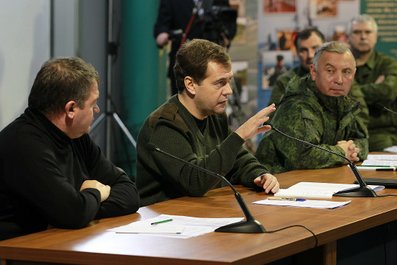
Medvedev Speaks at Brigade Commanders' Assembly

According to Kremlin.ru, President Dmitriy Medvedev traveled to the Gorokhovets training ground near Nizhniy Novgorod today to observe battalion-level ground and air maneuvers.  It’s a modern twist on an old tradition of presidential speeches before end-of-training-year assemblies in Moscow. 

Medvedev inspected a new field camp, different weapons and equipment, and watched a Tunguska demonstration.

Afterward he met brigade commanders observing the exercise, and addressed them about the process of reforming the armed forces.

Medvedev said for two years Russia has been actively modernizing its armed forces to make them more compact, effective, and better equipped, and completing ‘org-shtat’ measures [i.e. TO&E changes] to achieve a ‘new profile.’  Flanked by Defense Minister Serdyukov and General Staff Chief Makarov, he promised the assembled commanders a defense budget worth 2.8 percent of Russia’s GDP every year until 2020, but he said getting this level of spending will not be easy, and it requires adjustments and cuts elsewhere.

He particularly emphasized establishing the new system of higher pay to replace earlier ad hoc measures like premium pay.  He seemed to say extra money will be squeezed out for this, but people will be watching how it’s spent.  Kremlin.ru posted some of Medvedev’s opening remarks:

“This is creating the conditions to equip the troops with new equipment in accordance with the current edition of the State Program of Armaments and, what is a no less important task and really no less complex, to resolve all social issues which exist for servicemen.  This issues are also well-known.”

 “First and foremost is the indexation of pay which we are already now conducting, and implementation of the housing construction program.  From 2012, the planned reform of the military pay system not according to those fragmentary pieces which exist at present, not according to those selective approaches which exist, but a full reform of pay.”

“In the final accounting, we should get so that base salary, monetary salary of servicemen will be increased practically three times. And in the process to preserve and to extend to all the Armed Forces that which we talked about in the past, that which we did according to groundwork laid in bounds of order 400 and some other Defense Ministry documents.”

“All planned measures, reform measures should be calculated and materially supported in the most rigorous way.  An adjustment in the military budget is being conducted and oversight of the use of resources is being organized for this.  I promise the attention of all Defense Ministry leaders on this:  all these processes need to be completed in coordination with other government structures in order that we should have absolute precision here.”

“A high level of financial support for the Armed Forces allows, I hope, for freeing servicemen from noncore housekeeping functions – that, in fact, was done long ago in the armies of other countries.  The troops need first and foremost to put their attention on operational training, combat exercises, to concentrate exclusively on these issues.  Security duties (firstly, perhaps not even security, but cleaning), everyday support, food preparation should be transferred to civilian organizations.”

Medvedev told the commanders their brigades should be self-sufficient, modern, balanced, and capable of fulfilling missions given them, and he invited their feedback because, as he said, the success of the military’s transformation depends on it.

“It would also be useful for me to know your opinion on the quality of the reform, on the organizational changes, what, in your view, has proven itself useful, and where there are problems.”

Despite soliciting their honest opinions, one doubts the Supreme CINC will hear many complaints from this audience.  They are, after all, winners in the reform process since they managed to continue serving in command positions.

Mending Fences with the Church?

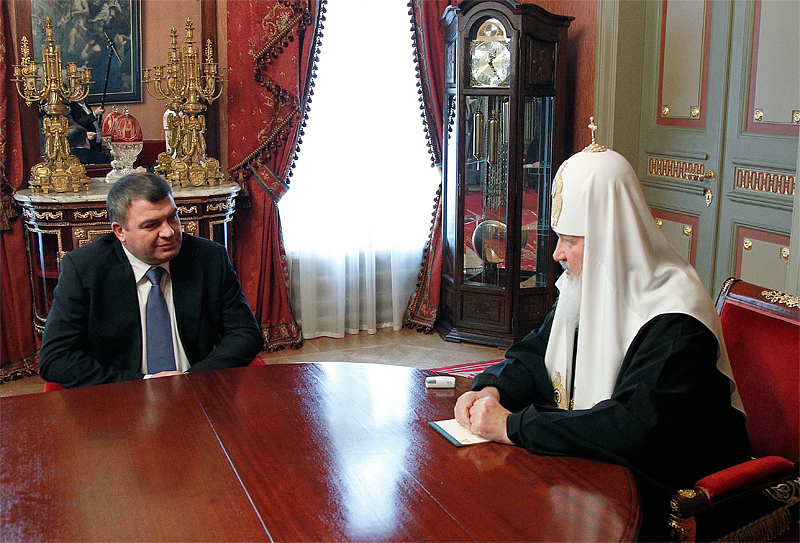
Serdyukov and the Patriarch

Defense Minister Anatoliy Serdyukov met Patriarch Kirill yesterday, and only Rossiyskaya gazeta alluded to the possibility it might be a fence-mending effort following the Seltsy incident several weeks ago.  Serdyukov had met Kirill previously, but the timing of this meeting sure looks like an effort to repair  army-church ties.

Patriarchia.ru, Krasnaya zvezda, and Komsomolskaya pravda reprinted portions of the Patriarch’s comments:

“The Armed Forces are now undergoing a very important phase of reform, and we are attentively following what is happening.” 

“The army in Russia was always a powerful patriotic force influencing the mood of society, and the well-being of people.  The army was always an elite of our society, including intellectual and cultural.  Therefore I am deeply convinced the Armed Forces reform, which assumes an entire series of very important organizational decisions, scientific-technical and simply technical, must include both spiritual and cultural dimensions.”

Defense Minister Serdyukov told the Patriarch: 

“It’s always pleasant for me when there’s a chance to meet with you, to discuss these or other issues connected with reform.”

“This reorganization now being conducted is a deliberate, calculated process and, as the initial results already show, quite effective.”

According to RG and KP, Serdyukov told Kirill about plans to open a center for regimental priest training on the base of one of the military academies, most likely in Moscow.  Alluding to the Seltsy problem, Serdyukov also noted the Defense Ministry now has a working group on the issue of constructing Orthodox Churches in military units.  And Serdyukov repeated yesterday he never gave anyone an order to take down the church on the VDV’s Seltsy training grounds.

Shurygin on the VDV’s Discontent

Writing in Zavtra, Vladislav Shurygin has added his take on Sunday’s VDV protest.  As usual, it’s a different cut with different details, but a unique one that shouldn’t be ignored.

Here’s the gist.  Shurygin says it’s not just the VDV’s discontent, but the military’s.  He enumerates the VDV’s specific grievances.  He claims the airborne has lost its status as the Supreme CINC’s strategic reserve and been placed operationally under OSKs West, South, Central, and East. 

Much of Shurygin’s article comes down to the VDV’s alleged loss of elite status.  Others, however, would say Serdyukov’s handled the airborne with kid gloves compared to how other services have suffered.  They might also say it’s high time the VDV got knocked down a notch or two.  

Shurygin seems to want to say that vlasti are more worried, or should be more worried, about discontent in the army than they appear.  He says Serdyukov can’t be dislodged from the Defense Ministry by his opponents, only the internal imperatives of vlasti will move him to another job; then he’ll be replaced by someone who’ll begin his own reform.

Shurygin quotes one Russian Airborne Union (SDR or СДР) official on how servicemen are left socially unprotected:

“In the framework of this reform which is destructive for the country, the overwhelming majority of servicemen have been dismissed without serving the term enabling them to get a pension.  Half of them don’t have housing.  Our country already has a sad experience of dismantling troops.  In the distant 1950s, the Defense Ministry decided to eliminate Naval Infantry under the pretext of missile-nuclear weapons development, saying that, if necessary, conventional infantry could fully replace it.  Nearly 50 years later history’s repeating itself.  Only now the VDV and Spetsnaz ended up in the role of unneeded forces.”

Shurygin continues:

“Meanwhile, the attitude of high state officials toward the VDV has been drawing criticism for a long time already.  In July, when the VDV observed its 80th anniversary, neither the Supreme CINC, nor the Prime Minister appeared at a ceremonial concert in the Kremlin palace and they didn’t even send the nominal greeting customary in such instances.  Then a directive according to which the VDV command would become subordinate to the Main Command of the Ground Troops was prepared, and VDV formations and units are in fact being transferred into operational subordination to the commands of strategic axes ‘North,’ [sic] ‘West,’ ‘South,’ and ‘East.’  That is, they’re being taken from the reserve of and immediate subordination to the Supreme CINC of the RF Armed Forces.  Add to this the estrangement of the VDV from work with premilitary youth in DOSAAF and the elimination of the Ryazan Airborne Higher Military Command School, which has been dropped into the Ground Troops training center (Combined Arms Academy), and the elimination of the VDV Personnel Directorate, which will put a final end to the elite status of the VDV, traditionally proud of its own unique personnel school.  In fact, a quiet destruction of the troops is going on.”

Shurygin says VDV Commander Shamanov’s doctors say confidentially that, in intensive care, he was in no condition for paperwork, and his right hand was immobilized when he supposedly authored his message urging VDV on Poklonnaya Gora to avoid confronting the Defense Ministry.   

So Shurygin doubts Shamanov wrote this, but he doesn’t allow for the possibility that the general dictated words to be issued in his name.

Shurygin adds that sources close to the Defense Ministry say the Shamanov document turned up in the hands of Deputy Defense Minister Nikolay Pankov, was edited by his people, and sent to the hospital for Shamanov’s signature as he was being wheeled into surgery. 

Shurygin shifts gears reprinting part of an interview he gave Baltinform prior to the Poklonnaya Gora demonstration.  Asked about Serdyukov, he says:

“The reform Serdyukov is conducting causes confusion in specialists.  The opposition to the pogrom he’s conducted in the army is very great.  Tens of thousands of people are opposed — they really see what is happening in the troops, and are trying to get this information to the public.”

“The fact that this [Seltsy] scandal received publicity is not evidence of conspiracy, but evidence of the crudest error in Serdyukov’s judgment, who left himself open, conducting himself rudely and offending an honored officer, a Hero of Russia.  And this outrageous incident only became the latest reason again to raise the theme of reform.  If the main reformer conducts himself in such an unworthy manner, then this automatically calls forth questions about the entire reform he’s conducted.  I think that opposition to Serdyukov is located not at the Kremlin level or any mysterious officials, but at the level of those whom military reform has literally ‘run over like a tank.'”

 I relate to [Serdyukov] as an absolutely incompetent person who occupies a job that is not his.  And for three years already he’s been learning the completely new business of managing the army at the cost of huge damage to the latter.  First they constantly destroy army structures like a house of cards, then they try to ‘sculpt’ and create something out of them.”

  “Some directives are suspended, others are given out and then are suspended.  The army leadership is feverishly searching as if trying to get a careening wagon down a hill in the necessary direction, but still just increasing the chaos and disintegration.  Massive break-ups were undertaken in place of approaching reforms from a scientific viewpoint and working out experiments on specially selected parts.”

“The Armed Forces have been ‘cut to the bone.’  They’ve broken everything in them, both the bad, and the good.  They broke it, then observed the mistakes, and are now trying to correct them.”

Asked if Serdyukov will finish his reforms or be replaced because of complaints from his opponents, Shurygin concludes:

“It seems to me he’ll go to that phase when it’ll be officially acknowledged that the reform has taken place.  Then a moment will come when it’s necessary to make a change in the official hierarchy, and Serdyukov will be transferred to another position.  The one who comes into his place, will begin his own reform anew, perhaps, a more ‘quiet’ one.  But he won’t avoid long work analyzing the mess of forest cut down by Serdyukov.”

Army Outsourcing

Defense Minister Anatoliy Serdyukov conducted another extramural collegium Wednesday, this time in Khabarovsk.  Serdyukov and company congratulated themselves for completing the ‘large-scale work’ of forming the Eastern Military District (VVO or ВВО), and the other three new districts, ahead of schedule.  This reshuffling was done in less than a year, so it probably really doesn’t count as ‘large-scale work.’

General Staff Chief Nikolay Makarov reported the VVO has operated since 1 October.  For his part, Serdyukov noted:

“The Eastern Military District is the largest in combat composition, area, and length of ground and maritime borders.”

The VVO sports the Pacific Fleet, an air and air defense army, and four combined arms armies, leading the Defense Minister to conclude:

“Unifying all forces and means under a single commander allowed for a substantial increase in the combat possibilities and potential of the district.”

Possibly, yes, but it remains to be realized and proven . . . since the very same forces have just been aggregated in a new way.  Is this new whole more than the sum of its parts, or not?

Attendees discussed unified logistics as well as unified combat forces.  Reports said along with unified commands a unified system of material-technical support (MTO) is being established in the military districts.  As previously reported, it is supposed to unite arms supply and logistics in one function and organization.

At any rate, the collegium had new or semi-new business as well . . .

Serdyukov, Makarov, and other attendees also discussed Defense Ministry outsourcing.

Before the meeting, Makarov told wire services the issue of delimiting spheres of activity between the military department and outside organizations that will provide support functions for servicemen and military towns, including heating, electricity, and food service, would be discussed.  According to Rossiyskaya gazeta, Makarov said:

“We need to clearly determine the bounds within which structures should work to support the everyday life of military bodies.”

Speaking like an old-hand, Makarov said the outsourcing system will take care of noncore tasks like feeding the troops and providing utilities to military towns.  The Defense Ministry’s board of directors discussed transferring responsibilities and corresponding property to these contractors.  Are they going to operate or own these assets?

RG reminded readers 340,000 troops are supposed to be fed by civilian firms by year’s end.  They include students in cadet corps, Suvorov schools, military VUZy, and patients in Defense Ministry hospitals.  The paper said outsourced food service would be coming soon to permanent readiness units.  And laundry services, part of military transportation, and equipment supply, including aviation, POL, and support for all deployed Navy ships, will be outsourced.

Finally, Army General Makarov said the collegium discussed in detail the issue of replacing or scrapping worn out equipment.  According to RIA Novosti, Makarov indicated there’ll be a major inventory and weeding out of what’s usable and what isn’t:

“In the course of 2011, everything that’s inoperable, particularly, in the aviation and ship inventory, we will manage to restore and put back on the line.  That which has outlived its time according to its parameters should be withdrawn from service.  This is quite a solid sum which could be redirected to acquiring new types of equipment and armaments.”

Not sure how much they make on this scrap sale.  Not so long ago the Defense Ministry said it was cutting repairs (as well as RDT&E) to focus more money on buying new systems.

Officer Discontent on Poklonnaya Gora

Reviewing the press on Sunday’s VDV meeting on Poklonnaya Gora, one could say there’s an inclination to dismiss it as the howling of old cranks who don’t constitute an organized challenge to anything or anyone.  But behind that initial take, some media saw palpable discontent among officers, both retired and active duty.  Nezavisimaya gazeta suggested there might be more below the surface of this rather feeble demonstration – either more powerful interests or much larger numbers of affected individuals.  Ekspert concluded, at a minimum, the whole episode might lead Defense Minister Serdyukov to take the opinions of officers more seriously.      

The VDV demonstration goes back to the 30 September Seltsy incident, and the Russian Airborne Union’s (SDR) call for Serdyukov resign for insulting Hero of Russia, Colonel Krasov as well as for destroying the army.  Kommersant put the number of participants at about 1,500.  Retired General-Colonel Vyacheslav Achalov and other organizers threaten to resume protesting on 17 November if President Medvedev doesn’t fire Serdyukov.  They also want General Staff Chief Nikolay Makarov, Deputy Defense Minister Nikolay Pankov, and Main Personnel Directorate Chief Viktor Goremykin to resign. 

The conspiracy-minded protesters maintain that Vladimir Shamanov’s crash was no accident; they think someone tried to kill him since he’s the only man standing in the way of the VDV’s ruin.

The Defense Ministry didn’t officially comment on yesterday’s protest, but Kommersant garnered an unofficial reaction.  An unnamed Defense Ministry representative said:

“Criticism should be constructive.  When memorial days like 7 November are used for political purposes, it’s unseemly.  Moreover, criticizing the minister for the reform is premature, since it’s not complete yet.”

So the Defense Ministry didn’t think the protest was helpful, but they also think 7 November is still a holiday.  The last is the best though.  Exactly when, where, and how are opponents supposed to raise their objections?  When everything’s over and done with?  Another insight into current regime thinking about the proper interaction of politics and policymaking . . . none.

Nezavisimaya gazeta was most interested that it wasn’t just the usual non-systemic outcasts at the VDV rally, but Just Russia (Справедливая Россия) flags showed that some of the official opposition was there too.  Federation Council Speaker and Just Russia leader Sergey Mironov was once a VDV senior sergeant himself.  NG sees SR trying to play an army card to its advantage while remaining part of the official opposition.

The paper says Mironov could be using the military, and showing support for officers against Serdyukov (and Medvedev by extension) for his own purposes.  And he’s politicizing the army – something not done in recent years and generally considered unacceptable.  NG indicates some think there’s more to all this than just a reaction to Serdyukov’s alleged rudeness to the VDV:

“There is, incidentally, an opinion that the [Seltsy] incident was only a pretext, and the interests of some military circles and retired officers connected to them, who feed off the army and are dissatisfied with the current military reform, are behind the protest.”

Novyye Izvestiya describes Poklonnaya Gora as quite the retrograde affair replete with Soviet flags, and the usual representatives of the radical opposition.

One participant bragged to its reporter after passing through one of many metal detectors:

“We don’t need weapons, we could take the Kremlin with a stool leg.”

But Novyye had more serious points too, like one ex-VDV who complained of Serdyukov’s cuts in military medicine, and his commercialization of military hospitals.  He asked:

“What military doctors will be on the battlefield?  There aren’t any remaining.  But there’s no one to fight, in a year’s army service what can you learn?  Only to sweep the parade ground.”

The paper concludes VDV veterans believe only military men can solve the army’s problems, the army needs to be mobile and highly capable, and it shouldn’t be shameful to serve in it.  At least everyone seems to agree on the last two.

Writing for Ekspert, Stanislav Kuvaldin describes Seltsy and Poklonnaya Gora as a breakdown in communications between the Defense Minister and the officer corps.  One SDR leader told Kuvaldin:

“Serving officers are silent, but they think the same things.  We grew them and indoctrinated them.”

He went on to say that even if they are silent about Serdyukov and reforms in exchange for today’s higher officer pay, it doesn’t mean they’ve been suppressed.

A key element of Serdyukov’s reform is basically tripling officer pay, and this higher pay is already a serious factor in calculations about serving, but it hasn’t happened yet (except for those getting special premium pay).  Nevertheless, potentially higher pay won’t automatically mean Serdyukov will be more popular, and it doesn’t mean the VDV will get over Serdyukov’s insult to one of its officers and a Hero of Russia, according to Kuvaldin.

Kuvaldin reports the Defense Ministry may compromise on some of the VDV’s more specific complaints, i.e. not moving the VDV Headquarters to Ryazan and preserving the VDV Museum, but not reversing the VDV Higher Military Command School’s subordination to the Combined Arms Academy.

In the end, Kuvaldin writes, this dissatisfaction is only creating tense moments for Serdyukov, not a serious threat:

“In the end, if after two years of reforms, vulgar insults to the head of one military school have become the cause for veterans to come out, it’s possible only to talk about an unpleasant emotional backdrop for the minister, but not about a hypothetical organized resistance.”

However, possibly, the situation will force the minister to deal with officers’ opinions more attentively and respectfully.

But this author wouldn’t bet on it.

In a not particularly surprising postscript, the GAI stopped SDR leader Pavel Popovskikh — former colonel, VDV Reconnaissance Chief, and defendant in the murder of journalist Dmitriy Kholodov — for driving drunk after the demonstration.  The story was widely reported, but an alternative version hasn’t gotten as much play.  Segodnya.ru reported that Popovskikh’s friends and others say he stopped drinking long ago.  The website also says Vladislav Shurygin wrote in his blog that traffic cops were ordered to stop Popovskikh and check him for alcohol, but they sheepishly released him with an apology when they found he was sober.

Chistova Goes with Sobyanin

Effective today Vera Chistova will head the Moscow city government’s finance department under new Mayor Sergey Sobyanin.  She served for about a year and a half as Deputy Defense Minister for Finance-Economic Work.  Defense Minister Anatoliy Serdyukov picked Chistova to replace Ivanov-era appointee Lyubov Kudelina in April 2009.

Look for Serdyukov to elevate another of his tax service minions into Chistova’s job . . . or he could move one of his current deputy defense ministers into the post.  Chistova and Kudelina both came from the Minfin’s Department of Budget Policy for Military and Law Enforcement Services, and State Defense Order.

Shamanov Looking at 3-Months Recovery Time

RIA Novosti reports VDV Commander Vladimir Shamanov will require fairly lengthy recuperation time following his injury in an auto accident last month, according to a Burdenko Main Military Clinical Hospital source.

The source said:

“After the operation performed on Shamanov, doctors evaluated his condition as satisfactory, the operation went successfully and his rehabilitation is also going normally — no complications have appeared at this time.”

Despite this, Shamanov’s recuperation will take a long time:

“According to preliminary assessments of the attending doctors, for the general’s complete recovery and return to duty a minimum of three months could be required.”

The source added that the 106th Division’s Colonel Naumets is currently still serious but stable, and he may be looking at a 6-month recovery time.  Shamanov’s aide Colonel Chernous, also in the accident, wasn’t mentioned in this report, but his condition was less serious than Naumets’.