Category Archives: Military Leadership

Step Closer to Four OSKs Instead of 6 MDs

ITAR-TASS reports today that the reform of the operational-strategic level of command and control has entered its final phase.  According to the Genshtab’s plan, on 1 December 2010 military districts (MDs) will shrink from 6 to 4.  A Genshtab source told ITAR-TASS that 4 MDs and operational-strategic commands (OSK or ОСК) will be formed–Western, Southern, Central, and Eastern, with their commanders having operational control over all (or most) of the troops (forces) of the armed forces and other militarized structures located on their territory.  

The Genshtab representative says the Western MD/OSK, based in Piter, will include the Moscow and Leningrad MDs, with Baltic and Northern Fleets, VVS, VDV, and other militarized structures operationally subordinate to it.  The Southern MD/OSK in Rostov-na-Donu will have the North Caucasus MD, with the Black Sea Fleet and Caspian Flotilla operationally subordinate.  The Central MD/OSK in Yekaterinburg will have the Volga-Ural MD and the western part of the Siberian MD.  The Eastern MD/OSK in Khabarovsk will have the eastern part of the Siberian MD and the Far East MD, with the Pacific Fleet operationally subordinate to it.

The question of subordinating units and formations of the RVSN, naval strategic nuclear forces, LRA, and the Space Troops hasn’t been decided.  According to the source:

“This issue is now under long-term study, Genshtab Chief Army General Nikolay Makarov is personally occupied with it.”

The Genshtab source said the new MD/OSKs will be tested out during the Vostok-2010 operational-strategic exercise at the end of June.

ITAR-TASS said this major command change will not involve officer cuts, but there will be a redistribution of the officer corps to new service locations.

So there’s more smoke from a fire somewhere, presumably.  If this pans out, it will be the culmination of a command and control change long talked about, and even tried out piecemeal at times.  After many waves of reform since late 2008, one has to wonder whether this is the time for more disruption.  Maybe it is since things are already disrupted.  Which generals will be the winners or losers?

It will be hard to judge the value of this effort just from the name changes or the movement of a major combined formation from one order-of-battle column to another.  A lot will depend on what the exact terms of ‘operational subordination’ are when it comes to the fleets and other major militarized formations outside the Defense Ministry’s administrative control.  The four MD/OSK commanders will certainly have more responsibility, and they must be hoping and working to get the real authority they need to go along with it.

More on OSKs, and ASU TZ

On Monday, Olga Bozhyeva reminded readers the proposed OSKs were former Genshtab Chief Baluyevskiy’s idea, and she called them part of a command reorganization along an American model.  She contends Baluyevskiy lost his job for pushing the change from military districts (MDs) to operational-strategic commands (OSKs).  And now the OSK will apparently win out, even though Baluyevskiy’s long gone. 

Bozhyeva says Baluyevskiy and the shift to OSKs were defeated in the past by MD commanders [and their powerful patrons] who stood to lose out in the process.  She claims Baluyevskiy’s opposition to the  Navy Main Staff transfer from Moscow to St. Petersburg was a pretext for his dismissal when the OSK was the real issue.  And his OSK experiment in the Far East was quietly dismantled after his departure. 

Actually, it’s more likely Baluyevskiy went down for opposing–rightly or wrongly–the whole range of ideas pushed by Defense Minister Anatoliy Serdyukov.  By contrast, Baluyevskiy’s replacement has been a veritable extension of Serdyukov on policy issues.

With Baluyevskiy gone, according to Bozhyeva, the MD commanders bent the OSK idea to their way of thinking, proposing to make every MD an OSK, without cutting or consolidating MDs, and duplicating efforts in the process.  She says this reflected the MDs as ‘sacred cows’ upon which no one would encroach, and this tracked with new Genshtab Chief Makarov’s background as an MD commander.  Recall that Baluyevskiy was a career Genshtabist.

Bozhyeva continues, saying this year Makarov has begun to think about how to command the ‘new profile’ army.  And wars of the future will hardly accommodate a command structure like the MD.  But Bozhyeva reports a rumor that the name Military District could be retained to appease opponents of merging MDs in favor of modern OSKs.  She concludes, if the OSKs are realized, it’ll be possible to talk of a really ‘new profile’ army.

Dmitriy Litovkin also had his say on the OSK story last Friday.  He describes the possible move to OSKs in terms of more responsive command and control, reducing the transmission of orders from 16 to 3 steps.  But, he cautions, the OSKs are still just a proposal at this point.

Litovkin says the military hasn’t tried to hide the fact that the OSK is borrowed from the U.S. concept.  The main thing achieved in such an approach, he continues, is responsiveness in issuing and receiving combat orders.  The Defense Ministry says this new OSK structure will be tightly tied to the new automated battlefield command and control system ASU TZ (АСУ ТЗ).

Litovkin mentions how Prime Minister Putin saw ASU TZ at Voronezh, and how the system is supposed to centralize command and control down to the ‘electronic soldier’ on the battlefield.  This fall brigade exercises are supposed to employ ASU TZ with the aim of controlling several hundred ‘objects’ in battle simultaneously.  This summer the OSK model will be tried as part of the Vostok-2010 exercise in the Far East.

Litovkin’s source says:

“Developing ASU TZ without trying it in the new armed forces structure is impossible.  We need to understand in practice not just how this works, but also, possibly, that we are developing something unnecessary or, conversely, we aren’t making anything.”

Not a big vote of confidence for the new system.

Litovkin concludes by saying the possibility of unit and even garrison relocations might be a limitation on the OSK scheme.  Forces would need to be better balanced among the four strategic directions.  For example, the Western OSK would have too many motorized rifle units and the Eastern too few.

Idea of OSKs Waxes Again

In Russian defense policymaking, ideas never die; they wax and wane, and wax again.  Andrey Nikolskiy in Thursday’s Vedomosti reported a source in the Defense Ministry’s central apparatus claims the idea of establishing four regional Operational-Strategic Commands (OSKs) in place of Russia’s current military districts and fleets is waxing again.  This is hardly a new story.

The West reportedly would combine the Moscow Military District (MD) and Leningrad MD, and the Baltic Fleet, under a headquarters located in St. Petersburg.  The East would combine the Far East MD with part of the Siberian MD, and the Pacific Fleet, with its headquarters in Khabarovsk.  The North would combine the remainder of the Siberian MD with part of the Volga-Ural MD, and the Northern Fleet, with Yekaterinburg as the headquarters.  Finally, the South would put the North Caucasus MD with the remainder of the Volga-Ural MD, and the Black Sea Fleet and Caspian Flotilla, with Rostov-on-Don as the headquarters.

Vedomosti  is circumspect on the four OSKs.  It maintains that no decision has been taken yet, and the possibility of creating them is being studied.  Interfaks was quick to claim they’ll be established before the end of the year.  Putting the West headquarters in Piter would track with the apparently continuing effort to relocate the Navy Main Staff to the country’s ‘northern capital.’

So, a little about what would happen if this idea were implemented . . . clear losers are the LenVO, SibVO, and PUrVO, which all disappear.  The VMF won’t like the idea and the VVS is perhaps more ambivalent since its air forces and air defense armies (AVVSPVOs) pretty much exist within the current MD structure anyway.  The East would have 14 active maneuver brigades instead of the DVO’s 10.  The West would have 9 instead of 6.  And the North might be created with 6 brigades.  Of course, the OSKs would also have greater territory to cover than the MDs.

In retrospect, new Ground Troops CINC General-Colonel Aleksandr Postnikov foreshadowed renewed talk of OSKs replacing MDs when he arrived in March mentioning the possibility of an MVO-LenVO merger.

Former Genshtab Chief Yuriy Baluyevskiy’s one-year experiment with an Eastern Regional Command at Ulan Ude headed by General-Lieutenant Nikolay Tkachev was euthanized by his successor, Nikolay Makarov, in October 2008.  Theoretically, it might have been one regional command alongside analogous western and southern structures.  Baluyevskiy’s initiative probably dated back to 2005 discussions about a new command structure in the RF Security Council.  But it’s not clear what kind of regional commands were considered.  Were they to overlay the MDs and fleets like the High Commands of Forces of late Soviet days or replace them in a more radical restructuring?

This winter, then Ground Troops CINC, Army General Boldyrev said that each MD would become an OSK, and the MD-OSK commander would have operational control over all military units on its territory–Navy, Air Forces, MVD Internal Troops (VV), etc.  Boldyrev said:

“The operational-strategic command is a military district.  Such is its function and standing.  The legal status of the OSK has been drafted, its approval is planned in the very near future, this will possibly happen before the end of this year.  The district commander has been declared the commander of the operational-strategic command.”

Nezavisimoye voyennoye obozreniye has been predicting the MD’s replacement for some time, writing in September last year: 

“. . . the leadership of the country and of the Armed Forces are returning to the idea that was proposed several years ago by former RF Armed Forces General Staff Chief, Army General Yuriy Baluyevskiy, who attempted to create Operational-Strategic Commands in theaters of operations, but not on the basis of individual districts, but rather by unifying several districts and fleets under the command of the OSK.” 

The MD is still more part of the administrative, training, and mobilization system for the paradigmatic ‘large-scale war’ of Soviet planning.  The OSK would have to become a combatant command for fighting regional or local wars here and now.  Consolidating three MDs and possibly downgrading fleet commands somewhat might save a few hundred senior officer positions.

As Vedomosti describes it, if the four OSKs actually stand up, they will include armed forces units, not other militarized forces like the VV or FSB Border Guards.  This isn’t surprising since these OSKs would be permanent, not just wartime, command structures. 

The control of strategic nuclear forces is always an issue in debating structures like the OSK.  Would OSK commanders really control and operate the RVSN, SSBNs, and long-range bombers on their territory?  If not, how would the OSK’s general purpose forces support strategic operations?  

Abolishing 6 MDs and especially 4 fleets and their long histories would be a politically daunting task, sure to raise lots of opposition in the ranks and among the publicly vocal ex-military.

Finally, it might be argued that the military has experienced near ‘permanent revolution’ over the last 18 months, and doesn’t need another major organizational innovation while the situation settles out from previous changes.

In any event, the replacement of MDs with OSKs still remains a rumor at this point.

Who Defends Officers?

On 13 April, Svpressa.ru made the point that officers don’t have a place to turn for help or protection against abuse in the army, unlike conscripts who have the Committee of Soldiers’ Mothers of Russia (KSMR or КСМР).

In response to the suggestion that officers need a “Committee of Officers’ Wives and Mothers” to help them with problems in the service, KSMR Chairwoman Tatyana Znachkova said:

“There’s no one to defend officers, and many of them live unhappily, not better than conscripts.  So their wives could create a committee for their defense.  Officers or their wives actually have come to us very often in recent times.”

Asked what their complaints are, she says:

“Legal violations in the unit, low wages, problems with obtaining housing.  But we can’t help them.”

“So I advise them to create their own organization because their problems are so very great.  But they are silent.  It’s understandable why the officers themselves are silent, they’re not allowed to gripe, but why are their wives silent?  No one can prohibit them.  If the family is without housing, without work, without money, what’s to lose . . .”

Svpressa continues, many of the officers cut have been thrown overboard, without housing, without work.  So in Voronovo, near Moscow, where a unit was closed a year ago, residents say former colonels and lieutenants go around to nearby dachas offering to do repairs or any kind of work on the houses.  They do it to feed their families since they don’t have any other work.

Anatoliy Tsyganok tells Svpressa:

“Officers have now been thrown to the whims of fate.  There’s really no where for them to complain.  Their problems are resolved well only in words.  Look for yourself, in just the last year, more than 3 thousand officers discharged into the reserves without housing and deceived by the state about the payment of monetary compensation have turned to the European Court . . .  The main part of complaints concerns nonpayment to servicemen of money for participation in this or that combat action or peacekeeping operation.  Part of the complaints are collective.  And the quantity of such complaints will increase since there is more and more of a basis for them.”

Asked about the basis of complaints, Tsyganok says:

“Some officers are outside the TO&E, receiving a fifth of their usual pay for several years, although they are supposed to be in such a situation not more than half a year.  They are waiting for apartments from the Defense Ministry.  They have every basis for placing law suits in Strasbourg.  In the framework of armed forces reform almost all billets in voyenkomaty at different levels were cut.  And 90 percent of former voyenkomat officers, dismissed without apartments, will also appeal to the ECHR [European Court of Human Rights in Strasbourg].  These are educated people who understand they won’t get the truth in a Russian court.  And their only hope is the European Court.  Today there are very many officers left without apartments.  They don’t know in what order, when and who will give them apartments.  These people have a direct road to the ECHR.”

Tsyganok goes on to mention how President Medvedev has promised to house officers, and claimed that an unprecedented 45,000 apartments were acquired for them last year.  Tsyganok believes the number was actually less than 30,000.  He notes that in St. Petersburg officers are being offered prefab housing, fit only for summer living, built for the Defense Ministry at a vastly inflated price (5-6 million rubles vs. 1.25-1.35 million market price).  Officers with apartments in abandoned military towns have to hope the nearest municipality will take them over and assume responsibility for services, but they usually don’t want to.

Tsyganok describes the difficulty in employing former officers.  Businesses generally don’t want anyone new over 40.  An initiative to use officers as teachers didn’t get off the ground.  So, according to Tsyganok, many officers choose between working for security firms or criminal groups.

He repeats his familiar lament that Russia is losing its well-trained, well-educated military intelligentsia—officers who completed 4-6 years in a VVUZ, mid-career branch-specific training, and 3 years in the General Staff Academy.  He concludes:

“So I presume, Russia is flashing back to the former Red Army.  In case, heaven forbid, of some conflict, I believe the current Russian Army won’t survive.  In these conditions, I think it doesn’t compare even with Georgia . . .”

Tsyganok says it’s absurd for an officer to have to repair dachas like a guestworker to feed his family.  It’s even more absurd for him to choose between security guard and criminal.  But the saddest thing in this situation is there’s no place from which to expect help.  So maybe officers need an organization to protect their rights, and in light of the current military reform, the need is very acute.

Organizations and institutions that exist, or have existed, to help officers are like most civil society in Russia—weak or eventually dispersed or coopted by the authorities.  There are ones that come to mind—the All-Russian Professional Servicemen’s Union (OPSV or ОПСВ), the Movement in Support of the Army (DPA or ДПА), and the All-Russian Officers’ Assembly that last met in 2005 or so.

On 14 April, Viktor Baranets picked up some similar themes, saying today’s reformist thinking from Defense Ministry and Genshtab chiefs is generally incomprehensible to Russian Army commanders.  For many years, they inspired the troops by telling how superior contract manning would be, and these serious intentions were underscored by hundreds of billions of rubles.  But the result was fewer contractees than before.  And now the Genshtab has said it’s changed its mind about more professionals and is reversing course.

Similarly, for years there’s been talk of ‘raising the prestige of the officer corps.’  And what does Baranets see in reality:

“And the fact is a large number of majors and even lieutenant colonels have started to be put in sergeant billets.  I’m not talking about captains and senior lieutenants.  Because, do you see, there aren’t enough professional junior commanders.  They’ve only just begun to train them.  But why do we need to ‘pay’ for the tactical calculation of reformers at the expense of downgrading people?  Putting officers in lower positions by every army canon is a form of punishment.  And no kind of service expedience can justify this violation.  And where is the logic even?  With one hand the chiefs give such officers impressive premiums for good service, and with the other they write orders on a transfer to a position which is not seldom even 4 steps lower than the one they occupy!  The rampage of personnel abuse has already gone to the point that they’ve already warned cadet-graduates of the Voronezh Military Aviation University [sic] (tomorrow’s lieutenants):  only those who graduate with a gold medal and distinction will get officer’s positions, the rest—sergeant’s.  In such confusion I don’t exclude that soon General Staff Academy graduates will command platoons.  It’s time for the Main Military Prosecutor to sort it out:  but how do these reform outrages accord with the demands of our laws?  But does it even make sense to put a specialist with higher education, whose 4-5 years of preparation cost the state millions of rubles, in a position yesterday still occupied by a junior sergeant who has secondary school and 3-months of training behind him?”

Viktor Litovkin noted this morning that Serdyukov’s Military Education Directorate Chief, Tamara Fraltsova, told Ekho Moskvy that the VVUZ system will again produce an overabundance of lieutenants this year for a shrinking number of junior officer posts in platoons, companies, and batteries.

Fraltsova said:

“Today the army has the right to pick the most worthy officers from the number of VVUZ graduates.  We’ve tightened the rules for passing examination sessions.  Now a cadet can be put out of the military-education institution for one 2, an unsatisfactory evaluation received in the course of a session.”

Litovkin says the overproduction of lieutenants (and decline in officer posts) led to young air defense officers being assigned to sergeants’ duties last summer.  A similar thing happened with VVS pilots; not every graduate-pilot could find an operational aircraft.  So great resources—3-6 million rubles per pilot—were poured into the sand.  Litovkin sees it as indicative of an armed forces reform in which great resources are expended in vain.  Not to mention the trauma to lieutenants who, against the law, are placed in lower-ranking duties.

New Chief of Defense Minister’s Apparat

Mikhail Mokretsov (photo: RIA Novosti)

Yesterday’s press announced that Mikhail Mokretsov, ex-Director of the Federal Tax Service (FNS) and long-time colleague of Anatoliy Serdyukov, will be the Defense Minister’s Apparat Chief.  

Kommersant says Serdyukov had largely kept his old team in place, and still influenced personnel decisions in the Finance Ministry’s FNS.  And the FNS has been a stable supplier of high-level cadres for Serdyukov’s Defense Ministry.  Along with ex-deputy directors of the FNS Dmitriy Chushkin and Yevgeniy Vechko, not less than 10 other highly placed former tax service officials have come over to Serdyukov’s Defense Ministry. 

Kommersant indicates this may represent the end of Serdyukov’s ‘agreement’ with Finance Minister Kudrin to leave his old cronies in place in the FNS for three years.

Mokretsov’s work in the tax service has drawn some praise.  Deputy Chairman of the Duma’s Budget Committee Andrey Makarov says the Defense Ministry can use another strong manager like Mokretsov, and he adds:

“The main thing in reforming the army is to stop the stealing.  Control and auditing are essential there.”

Perhaps playing the provocateur, Gzt.ru suggests that some in the Genshtab see Mokretsov’s arrival as a precursor to Serdyukov’s departure from the Defense Ministry.  Under this scenario, Serdyukov would be preparing Mokretsov to take his place as Defense Minister when he moves to a higher post.  But a PA source denied any prospect for a change of Defense Minister and specifically ruled out Mokretsov’s chances.

Mokretsov will occupy a long-vacant post.  Its last occupant, Andrey Chobotov left with former Defense Minister Sergey Ivanov when he became Deputy Prime Minister.  Chobotov apparently works in Ivanov’s office and in the government’s Military-Industrial Commission (VPK).  Since Chobotov had the job, the apparat has been considered a Defense Ministry ‘service’ [not to be confused with an armed service] and this brings its chief the title of Deputy Defense Minister.

According to Gzt.ru, retired General-Lieutenant Andrey Kazakov has been the acting apparat chief since Chobotov’s departure.  Kazakov has served in the Defense Minister’s apparat, primarily as Chief of the Defense Ministry’s Affairs Directorate, since at least 2001.

The apparat chief wields serious power–at least within the administrative system.  According to Gzt.ru, he is not simply the Defense Minister’s right hand.  He’s a chief of staff and critical gatekeeper whose agreement is necessary to get documents signed and decisions made.  This power is largely unofficial, deriving from personal proximity to the Defense Minister.

The apparat chief’s official, statutory powers are more modest.  Mil.ru lists six official elements under him.  The Expert Center of the RF Defense Minister’s Apparat is something of a ‘think tank’ preparing analytical information and reports on military-technical policy, force structure, and force development, under the Defense Minister’s direction.  The Main Legal Directorate of the RF Defense Ministry has been reinvigorated of late, and its role is self-evident.  The above-mentioned Affairs Directorate serves as property manager and business agent for the Defense Ministry in Moscow.   The Directorate of State Assessment of the RF Defense Ministry is responsible for ensuring that military infrastructure complies with an array of government regulations.  The apparat also includes, without explanation, Inspection of State Architectural-Construction Oversight and the Management Directorate of the RF Defense Ministry.

Gzt.ru got our old friend Leonid Ivashov to comment on yesterday’s news.  Ivashov hates to contemplate the idea of career growth for Serdyukov, and he thinks the idea of Serdyukov putting Mokretsov in place behind him is ‘patently untenable.’  He holds even less back than usual when he says:

“If the task is to destroy the country the way Serdyukov has destroyed the army, then such an appointment is possible.  Serdyukov is a destroyer.  And the fact that they are dragging their nonprofessionals into the [Defense] Ministry supports this.  It’s very sad that the Defense Minister of our country is first when it comes to being an example of corruption and disrespect for the army.  Mokretsov can’t help Serdyukov straighten out financial flows which go through the military department.  But he will absolutely help him steal from them.”

Ivashov goes on to complain about Serdyukov’s commercialization of Defense Ministry functions, e.g. turning rear services into Oboronservis.

Vitaliy Shlykov, who views Serdyukov favorably, sees the Mokretsov move as promoting creation of a civilian Defense Ministry that still doesn’t exist.  And Shlykov doesn’t see Serdyukov leaving the Defense Ministry since it is, in many ways, a higher post than a deputy prime minister with a portfolio, who doesn’t really run anything.

Today’s Vedomosti intimates that Mokretsov will focus on auditing the State Defense Order on the heels of Prime Minister Putin’s remarks this week about corruption, waste, and poor results in the OPK .

More about Mokretsov specifically . . .

He joined the tax service in 2000, moving quickly from department chief to deputy director of the Tax Ministry’s Directorate for St. Petersburg, deputy director of the Directorate for Moscow, and Chief of the Directorate for International Tax Relations.  In 2004, he became deputy director of the renamed Federal Tax Service under Serdyukov, and Director of the FNS in February 2007 when Serdyukov left for the Defense Ministry.  

The 49-year-old Mokretsov was born in Udmurtiya, and graduated in 1984 from the Leningrad Financial-Economic Institute.  He was called up after graduation and served two years as a finance officer in the Soviet Army.  Between 1986 and 2000, he worked in unnamed government and commercial enterprises in St. Petersburg.

Update on Military Corruption, State Losses, and Crime

Main Military Prosecutor (GVP) Sergey Fridinskiy observed last week that it will only be possible to deal with corruption when not just the law enforcement organs, but also responsible officials in the military command hierarchy become involved in fighting it.

At last week’s coordinating conference on fighting corruption in the armed forces and other armed formations, Fridinskiy reported that, in January and February, military corruption cases increased by 10 percent over year ago figures, and material losses to the state in those first months of 2010 were 5 times greater than in 2009.  Inflation and an increased volume of arms purchases were cited as contributing to the spike. 

In 2009, corruption cases increased 5 percent in military units.  Fraud and forgery cases increased 50 percent, but misappropriation, embezzlement, bribery, misuse, and abuse of authority also grew. 

Fridinskiy said:

“For such crimes, 543 officers, including some higher officials, were convicted last year.  Last year military prosecutors uncovered nearly 7,500 violations of the law in this area, more than 2,000 responsible individuals were held to varying degrees of accountability in connection with 540 warnings delivered about unacceptable legal violations.”

Fridinskiy maintains that corruption doesn’t just have a negative economic impact, it also has an extremely demoralizing effect on military units.  He noted that the State Defense Order (GOZ) and the provision of social benefits to servicemen are trouble areas for military corruption.  He said:

“Placing a barrier against incidents of illegal and mismanaged expenditure of budget resources allocated for reequipping troops with new arms and military equipment, but also providing housing to servicemen, people discharged from military service, and family members is one of the complex, but principle tasks.”

Fridinskiy said a systemic fight against corruption was particularly important at a time of rising expenditures on the defense budget and rearmament.  He cited improved legislation, departmental regulations, reduced opportunities for misappropriation, guaranteed transparency and competition in tenders and state contracting as possible measures.  He continued:

“It’s also important to strengthen the role of control-auditing organs at all levels, to raise the level of inter-departmental  coordination, to conduct active propaganda work necessary to create an atmosphere where corruption is unacceptable.”

Fridinskiy reportedly proposed changing the existing GOZ system:

“We’re now working in the first place on putting systematic changes into the purchasing system so that prices will be down to earth, and not astronomical, so that it will be possible to organize this work in the bounds of current demand for purchases, and in order that not only the purchaser, but also those performing the work will bear responsibility for what they are doing.”

Representing the Defense Ministry, State Secretary and Deputy Defense Minister Nikolay Pankov reported that his department has created a special financial inspectorate sub-unit to exercise control on the use of its resources:

“Finance specialists, economists, mostly not from the armed forces, have been asked to join the financial inspectorate, and my presentation today concerned the effectiveness of the work of the financial inspectorate.  All the results that the financial inspectorate turn up are given to the organs of the military prosecutor.”

Recall, of course, that the Defense Ministry claimed it had a major anticorruption drive in progress this winter.  Maybe these are some of the results.

Attendees at GVP conference included representatives of the Federation Council, Duma, Military Collegium of the RF Supreme Court, Military-Investigative Directorate of the RF Prosecutor’s Investigative Committee, Ministry of Defense, MVD’s Main Command of Internal Troops, Ministry of Emergency Situations, and the FSB’s Border Service and Department [once Directorate?] of Military Counterintelligence.

Chief of the GVP’s Oversight Directorate Aleksandr Nikitin  repeated an earlier publicized statistic on a 16 percent reduction in military crime last year.  Nikitin credited widespread GVP preventative measures for the decline in crime.  He also noted the induction of more conscripts with higher education and supplementary performance pay for commanders as positive factors.  According to him, with the extra money, young commanders have started to pay more attention to ensuring order in their units.  Nikitin also says the overwhelming majority of the country’s military units generally function without crime or other incidents.

A Dismissed Colonel’s View of the Collegium

Sunday’s Svobodnaya pressa ran an interesting interview on the just-completed Defense Ministry collegium.  Svpressa talked to a named, and recently dismissed, colonel who had worked in proximity to the collegium. 

This colonel said the session left participants, to put it mildly, depressed.  He said, “. . . from the first minutes the conference hall had such a blatant odor of stagnation [Brezhnevian] that it was clear there’d be no talk of any reform.”

President Medvedev had apparently attended the General Prosecutor’s collegium and asked why there were so few women attending that meeting.  So, according to Svpressa’s colonel, the organizers of the Defense Ministry’s collegium flooded the hall with women in shoulderboards and without them.  The zeal of the reformers went so far that some generals from Genshtab directorates were asked to surrender seats for ladies and return to their offices.  The colonel says that, not being a strictly men’s affair, the severe talk needed didn’t occur.

Practically no one in attendance honestly considered analyzing the course of military reform.  Serdyukov said that part of reform connected with cutting the army is going forward (the other directions of reform have practically collapsed).  He reported on the rout (if, the colonel says, we call things by their real names) of officer training.  But sergeants will replace dismissed officers under Serdyukov’s plan [but what happens when officers are gone and the contract sergeants never appear?].

According to the interviewee, Serdyukov simply sweetened the pill for Medvedev–in reality, everything is significantly worse than he described it.  He asks how brigades can be combat ready if contract service is a failure. About 80 billion rubles went toward this and it’s unknown where the money ended up.

But at the collegium, there were no speeches analyzing the contract program’s failure or identifying people who are to blame for it.  Everyone was silent.  The Supreme CINC simply would be admitting failure on his part and the part of all authorities.  Who wants that?

Svpressa asked the colonel why not a single formation commander wouldn’t stand and really say what’s happening out in the forces.

He answered that, like the old days, most of the generals attending are Arbat generals, and their main professional traits are caution and the inability to put their noses to the wind.  The collegium was a litmus test for army reforms which don’t really exist and never have, according to him.  There’s just the same ‘money grab’ that goes on everywhere in Russia.

Serdyukov’s Post-Collegium TV Interview

After last Friday’s Defense Ministry collegium, Serdyukov was interviewed on Rossiya 24.

He probably fielded more pointed questions than normal, but he easily navigated them.  At times, he answered partially and the interviewer didn’t follow up with the next logical question.

Asked about officers dismissed in 2009, he said the armed forces shed 65,000 of them, who retired on age or health grounds, requested dismissal, or violated their contracts.  There was no mention of those put in limbo outside the TO&E, without duty posts and only their rank pay to live on.  These are the officers who can’t formally be dismissed because they don’t have housing, and are living at their ‘commander’s disposal.’  There was also no mention of how many warrant officers were put out in 2009.

Serdyukov said some officers accepted civilianized posts, and 4,000 received job retraining–a pretty small number against the large need for it.

The Defense Minister said dedovshchina was officially down 15 percent, and he doesn’t want only platoon and company commanders punished when it happens in their units.  He wants to see all levels of command take more responsibility for the problem.  Not sure what he’s insinuating, but it could be a warning to higher ups that they could suffer too when big time violence cases hit the news and make the Arbat military district look bad.

Serdyukov talked about higher officer training and appraisals, mentioning the assembly for 550 officers from the military districts and army commands.  He said we tried to make them understand what it is we’re trying to do.  But many lacked the knowledge and necessary skills–presumably to continue in the service.  See today’s Nezavisimaya gazeta.  Viktor Litovkin writes about generals and senior officers dismissed under Serdyukov.  Military district and fleet staffs which used to number 500-700 officers have been cut to 300.  Trimming the ‘bloated egg’ is generally a good idea, but as Litovkin says, it really depends on the quality of those left behind.

Back to Serdyukov’s interview . . . in cutting the military educational establishment from 65 to 10 mega-institutions, he said fewer officers will be needed but the quality of their training must be improved.  The 10 left standing have or will have their faculty members assessed for fitness to serve and they’ll get facility improvements.

On contract service which General Staff Chief Makarov has pronounced dead, Serdyukov said:

“The results of the program were not satisfactory.  In reality, we underestimated the situation somewhat, as regards who should switch to contract service and on what terms, or with what pay.”

“. . . the next program should be revised in an attempt after all to think it out regarding what specific positions should be filled by contract service personnel.  Of course, this applies to complex skills, where expensive equipment is operated.”

Nevertheless, he noted that he expects the contract sergeant program [albeit small-scale and apparently no longer funded] to succeed.

He said the army borrowed from foreign military experience in deciding on the shift from divisions to brigades.  He said the latter’s potential is virtually the same or even greater in some cases than that of the former.

Serdyukov said the Defense Ministry has reported to the Supreme CINC on its view of how it would like to reequip over the next 5-10 years.  He repeated that cuts to R&D and maintenance had allowed for bigger buys of new arms in 2008 and 2009.

He admitted Bulava hasn’t been successful, but he expects this system to be put right and completed.

He addressed possible foreign arms purchases:

“. . . in some areas we are lagging behind quite badly.  This relates not just to the Navy but also other services.  We are buying things in single numbers right now.  They are things like UAVs, all kinds of sights, night vision equipment–it is a very broad spectrum where we are specifically lagging.”

Despite reports that Moscow would be negotiating only with Paris on Mistral, Serdyukov claimed Russia is talking to the Netherlands and Spain.  He denied it was no more than a glorified cruise ship, saying it could perform many roles and had many different capabilities.

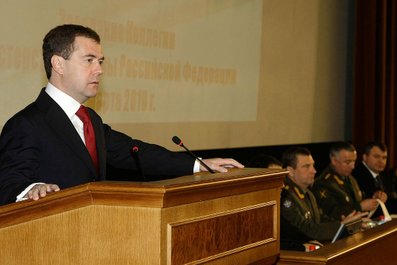
Medvedev Speaks at Defense Ministry Collegium

President Medvedev (photo: kremlin.ru)

In his remarks [text and video], President Dmitriy Medvedev reviewed the results of 2009 and talked about future plans for the armed forces.

He focused first on the international situation, noting that, “. . . today we have no requirement to increase further our strategic deterrence potential,” although it remains a determining factor in Russia’s conduct of independent policies and the preservation of its sovereignty.

He noted Moscow’s new law authorizing the use of force to protect Russian citizens abroad, and he pointed to unresolved conflicts on Russia’s borders [where presumably the new law could be used].

Medvedev acknowledged some positive tendencies such as work on a new strategic arms control agreement and renewed Russia-NATO contacts.  But he called the West’s reaction to Russia’s draft treaty on European security a barometer of relations with the U.S. and NATO.  He said it could prevent conflicts like Georgia-South Ossetia.  Medvedev asserted that, unfortunately, far from all countries and politicians drew the correct lessons from the August 2008 events.  And, unfortunately, he said the reestablishment of Georgia’s military potential continues with external assistance.

Then Medvedev turned more to the exact points of his speech.

He said the main goal is the qualitative improvement of the armed forces, the creation of a modern army and fleet equipped with the newest weapons.  He said last year the organizational base for this was established, as planned, without expending additonal resources.

In 2009, Moscow got its authorized personnel down to 1 million, and, according to the President, the Defense Ministry largely achieved its task of getting to the military’s future combat composition.  Medvedev said the results of Osen-2009 confrmed this, and more exercises like it are needed and need to have a ‘systematic character.’  Because, “Without this there simply are no armed forces.”

Medvedev called the training of officers the ‘most important task. Motivated, high-class specialists are needed, but the recently degraded military educational system and its material base need improvement. Medvedev said particular attention also needs to go to sergeants.  They need to be capable of replacing front-line officers when needed, according to the Supreme CINC.

On to rearmament . . .

Medvedev called the task of reequipping the troops with new armaments ‘extremely complex and very important.’  He said last year Russia stabilized the condition of its arms and equipment, despite the financial crisis, and fulfilled the GOZ, although not without problems.

He called the contracting mechanism for arms purchases ‘not effective enough,’ and said we are  working on this, but it’s slow.  This year the State Armaments Program, 2011-2020 will be written.  Medvedev gave the government the task of renewing arms and equipment at an average rate of 9-11 percent annually to allow Moscow to reach 70 percent modern armaments by 2020.  Reequipping has to be supported by full and timely financing.  He referred to his Poslaniye list of  priority systems and arms to be acquired.  He said this task will not be adjusted, and old weapons need to be decommissioned [He seems to have gotten it into his head that new means good and old bad which is not necessarily the case with Russian weapons.  What happens if you scrap lots of stuff, but you don’t succeed in producing new stuff?]. 

Medvedev said, as he’s already said more than once, steps are needed to bring order to the use, storage, and upkeep of missiles, ammunition, and explosives.  The events of the last year have shown there are problems here [alluding to Ulyanovsk, Karabash, etc.].

Medvedev noted another issue, providing the armed forces with automated command and control, and information systems, and transferring the military to digital comms by 2012, as put forth in the Poslaniye.  He said Zapad-2009 worked on mobile automated C2, but this was only a beginning to the work, which needs to be intensified, because “the communications situation is problematic.”

The President said forces will increase their combat readiness in their new TO&E structures [aren’t they 95 or 98 percent combat ready already?].  The main effort will be forming and training inter-service troop and force groupings, and supporting nuclear deterrence forces.  Medvedev said he’ll attend the main, key phases the coming Vostok-2010 operational-strategic exercise.

Medvedev obligatorily cited increasing the prestige of military service and improving the social defense of servicemen as a priority task.  

“I’d like to note that all obligations of the state to current and released servicemen will be fulfilled unconditionally, I will not accept any amendments for budget changes, or for other reasons.”

Medvedev said the government has the clear task to guarantee that all servicemen needing permanent housing have it by the end of this year, and service housing by the end of 2012.

“The realization of this task is not going badly, I will also take this under my personal control.”

Finally, Medvedev spoke for a moment to pay issues.  Increasing pay, and instituting a new pay system for active duty troops from the beginning of 2012, and increasing pensions to retired military men [but nothing specific promised].

He said he thinks premium pay or the well-known Order 400 brought respectable results, and it will be important to preserve ways of rewarding servicemen with extra money under the new pay system, and he expects proposals on doing this.

Defense Minister Serdyukov had some comments after Medvedev’s speech, but they’ll have to wait until tomorrow.

Training Session for High-Level Commanders

The Defense Ministry’s Press Service and Information Directorate reports that leadership personnel from the MDs, fleets, and combined formations [armies] of the armed services have assembled at the General Staff Academy for days of ‘practical study’ of new forms and capabilities for employing the armed forces in today’s conditions in the framework of operational-strategic commands (OSK).

In the course of the exercises, these high-ranking officers will “work out issues touching on the most acute aspects of the army and navy’s life and activities–from organizing combat training and troop service in formations [divisions and brigades] and military units [regiment and lower] within the new organizational structure of the armed forces to their effective employment in possible military conflicts and operations.”

Their study and exercises will include lectures, seminars, ’round tables,’ group operational meetings, etc.  They will be tested and quizzed on the results.  The assemblies will end with demonstration exercises in mobilization preparation which will occur in SibVO military units.  The training session ends on 5 February.

Wonder if they’ll talk about the new service regulations and combat documents that were in the works last year?

The press service renderings of this Defense Ministry announcement didn’t really do it justice, so perhaps this provides a closer reading on what’s going on.