Category Archives: Naval Modernization

Factory Testing Update for Yuriy Dolgorukiy

Translation, no commentary . . .

“MOSCOW, 21 July.  ITAR-TASS.  The crew’s readiness to fulfill combat missions is being checked onboard the new generation project 955 ‘Borey’ ballistic missile submarine ‘Yuriy Dolgorukiy.'”

“As the press-service director Yekaterina Pilikina of Severodvinsk enterprise ‘Sevmash’ announced today, ‘the missile-carrier has returned from the latest phase of factory underway testing.  This was the nuclear submarine’s first at-sea period this year,’  she reminded.”

“‘The nuclear submarine was in testing more than two weeks.  Navigation equipment, the submarine’s buoyancy control system were checked, essential yearly checks of several of the submarine’s parameters were done,’ Pilikina announced. ”

“In the estimation of the chief builder for military equipment production at ‘Sevmash’ Vladimir Prokofyev, ‘the outlined plan was completely fulfilled.  There are issues which have to be worked out to prepare the boat for the next at-sea period which will happen in the near future,’ he noted.”

“‘While at sea, the boat’s crew’s readiness to fulfill combat missions was checked,’ Pilikina announced.  ‘The crew commanded by Captain First Rank Vladimir Shirin successfully completed all training tasks.'”  

“Earlier it was announced that before the end of this year the Russian Navy plans to conduct not less than three test launches of the ‘Bulava’ submarine-launched intercontinental ballistic missile, and from the ballistic missile submarine ‘Dmitriy Donskoy’ and from the permanent platform for this missile system — nuclear submarine ‘Yuriy Dolgorukiy.’  It is the first ‘Borey’ type submarine.

“At present in ‘Sevmash’ there are three more submarines of this type in various stages of construction.”

“The ‘Borey’ type submarines were designed in St. Petersburg TsKB [Central Design Bureau] of Naval Equipment ‘Rubin.’  According to open source data, several achievements in the creation of shipboard radioelectronic means and noise reduction are employed in the construction of the ‘Boreys.’  They will be armed with the new ‘Bulava’ missile system.  The nuclear submarine can carry 12 solid-fueled intercontinental ballistic missiles with a MIRVed warhead.  The submarines are outfitted with a surfacing rescue chamber for the entire crew.  The hull of the ‘Borey’ type nuclear submarine is 170 m, the beam is 13.5 m, the submergence depth is 450 m, and the crew is 107 men.  According to the Defense Ministry’s plans, not less than eight nuclear submarines of this project  are to be built.  ‘Borey’ is supposed to be the main naval component of Russia’s strategic nuclear forces in the 21st century.”

72ZQ3NRFDWPT
Chernavin on Bulava Design and Testing Problems

Svpressa.ru provided its version of this week’s comments from a Navy Main Staff source: 

“. . . there’s no alternative to equipping new proyekt 955 ‘Borey’ missile cruisers [SSBNs] with the Bulava missile.  Its acceptance into the arms inventory is delayed some, but the testing will be successfully concluded in any event and the missile will be accepted into the arms inventory.  There are no insurmountable obstacles to this.” 

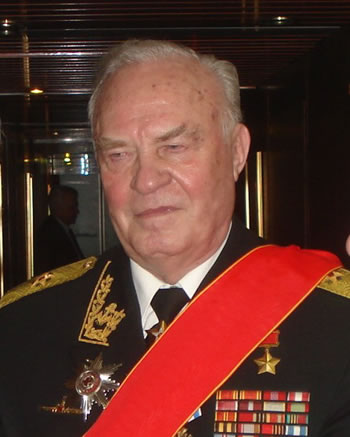
Then former Soviet Navy CINC Vladimir Chernavin answered Svpressa’s questions about naval strategic systems.  He is still focused on what he sees as bad decisions in the process of designing and testing Bulava, rather than defective components and assembly problems.  But like most, he sees no alternative to Bulava at this point. 

Asked why the Navy doesn’t opt for Sineva, Chernavin said: 

“’Sineva’ is a magnificent missile, but it’s liquid-fuelled.  And this is a very dangerous ‘cargo’ for nuclear submarine crews.  The liquid fuel used in it is so corrosive, it burns through metal.  In addition, it’s extremely poisonous.” 

“In Soviet times solid-fueled missiles were put on proyekt 941 nuclear submarines.  But back then for technical reasons we could only make them in very large dimensions.  Proyekt 941 nuclear submarines had 20 90-ton missiles.  And each carried 10 MIRVed, highly accurate nuclear warheads.  The fact is one nuclear submarine [SSBN] could destroy up to 200 important targets, you can say, cities.  The biggest designer of missile-space equipment Vladimir Chelomey and his firm in Miass made all these missiles.  When I was still Soviet Navy CINC, we began to develop a missile [SS-NX-28 or Bark], like the ‘Bulava,’ to replace our heavy missiles on proyekt 941 boats.” 

Fleet Admiral Chernavin

Asked why it didn’t succeed, Chernavin replied: 

“Unfortunately, after Chelomey’s death, the continuity was broken.  One of Chelomey’s assistants headed the firm.  We gave it great resources to perfect this heavy missile – reduced dimensions, increased accuracy.  This work stopped with the USSR’s collapse.  And when the country’s leadership decided to restart it, they took as a basis not a naval missile, but the ground-based ‘Topol M.’  They changed design bureau accordingly.  The idea was tempting – to make one all-purpose missile for ground pounders and for sailors.  This would significantly reduce production costs.” 

But what was the stumbling block? 

“They didn’t figure that the firm that made the ‘Topol’ had no concept about naval missiles.  I remember a sad instance.  When ‘Topol’ specialists learned that a submarine-launched missile had to launch while the nuclear submarine is moving, they grabbed their heads.  Everyone knows ‘Topol’ fires from a stationary platform.  Everything in the calculations had to be completely changed.  The ground-based design bureau encountered problems that Chelomey had already solved, and it had to reinvent the wheel.  Another, to put it mildly, mistake was committed by cutting costs in the very course of missile development.  With Chelomey it was laid out as follows.   After the creation of a prototype so-called pop-up testing began.  We had an old specially reequipped diesel submarine in the Black Sea for this.  A missile tube was placed in it.  A telemetered missile is ejected from it.  Not less than two of such tests were needed.  Only after this did they proceed to other tests, of which there were a great number.  ‘Market consciousness’ in new Russian conditions gave the project’s directors the idea of economizing on tests.  There were no preliminary tests, but immediately they put ‘Bulava’ on a submarine and all steps were conducted with the wave of a hand, having skipped several phases of testing.  Now we all see what a ‘pretty penny’ this ‘economizing’ has cost the state.  The end of testing is not in sight, but ‘Bulava’ won’t fly.” 

 Does Bulava have any future?  

“I think there’s no longer time to give up.  Whether we want this or not, we have to get ‘Bulava’ in shape.” 

But what if its designers aren’t up to it?  

“I think they’re up to it.  They’ve hit so many bumps that they, on the whole, have gained experience and will guide it to the end, but again this will cost not a little money.  But less now than if we set out today to develop a missile from scratch.  Of course, in principle, it wasn’t necessary to let these people build a naval missile.  Now we have to get unscrewed.  And throw resources around.  But, I’m sure, they’ll still get ‘Bulava’ to fly.”

Pressing the French on Mistral

Vladimir Socor has a good piece describing Russian shipbuilders’ complaints to the Federal Antimonopoly Service (FAS) about the Mistral purchase as another way to press Paris to finalize the deal on Moscow’s terms.  Socor says: 

“In line with the Russian government’s tactics, [Deputy PM and OSK Board Chairman] Sechin is signaling that Moscow could turn to other international shipbuilders, or ultimately to Russian shipbuilders, if France does not sweeten the terms of the Mistral deal for Russia.” 

“Thus, Sechin’s subsidiaries [Yantar and Admiralty] ostensibly seek anti-monopoly action in a case handled by Sechin himself for the Russian government.” 

This points up the bizarre circumstance in which Sechin is negotiating with the French, while his OSK subsidiaries complain about the potential deal. 

But, as Interfaks wrote on Wednesday, FAS says it lacks jurisdiction over the complaint from Yantar and Admiralty.  FAS also says there’s no basis for a complaint since no deal for Mistral has been reached. 

The shipyards argue they’ve been excluded from bidding to build amphibious assault ships for the Navy, and the terms of the competition weren’t publicly announced.  Their complaint seems to have merit since, from the outset, the Defense Ministry went directly after a specific ship and supplier, without issuing general requirements for a ship class. 

According to Interfaks, OSK supports Yantar and Admiralty, and calls the Defense Ministry’s actions ‘obscure.’ Its representatives periodically speak of Mistral like a done deal, but how the deal will proceed remains unclear.  An OSK source says, “And every time such statements deliver a blow to the self-esteem of domestic shipbuilders who know how to make these ships.”  

And, as Socor notes, talks continue also with the Dutch and Spanish [as Defense Minister Serdyukov has always pointed out] and now the possibility of a deal with the South Koreans has been thrown in, further roiling the waters. 

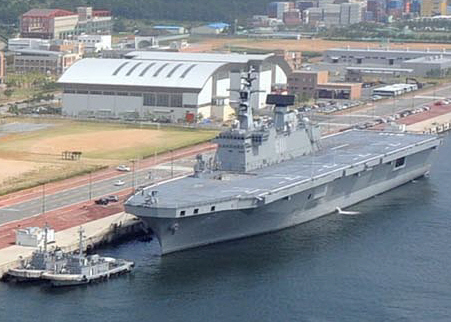
Izvestiya yesterday said OSK President Roman Trotsenko sent a letter to Defense Minister Serdyukov proposing a review of the military’s plans to acquire Mistral.  In its place, Trotsenko suggests building the South Korean Dokdo under license in a Russian shipyard.  He says he can build it in three years, and more cheaply than Mistral by one-third.  OSK has a joint production agreement with Dokdo builder Daewoo. 

Dokdo

The Defense Ministry insists Russian builders demurred when asked if they could build these ships.  Izvestiya doubts Trotsenko’s offer is realistic given the lack of available Russian buildingways.  But the paper concludes the appearance of the letter shows the struggle for the amphibious carrier contract isn’t over.

Serdyukov on Mistral

Defense Minister Serdyukov today said Moscow still plans on acquiring four Mistral amphibious assault ships.  He said Russia is talking not just with France, but also Spain and the Netherlands, about Mistral

According to RIA Novosti, Serdyukov said:

“At present, we’re in pre-contract negotiations on this type of ship with three governments.  They are Spain, the Netherlands, and France.  We plan to sign a contract for four of these ships.”

He also said one ship would be completely foreign-made, but Russian shipbuilders would participate in building the other three.  And the fourth ship will be built, to the maximum extent, in Russia.  

Serdyukov reiterated that the Defense Ministry is working on this acquisition according to President Medvedev’s decision.  And the Defense Minister added: 

“We are now occupied with the issue very seriously.” 

He concluded that the issue of buying the ships will be resolved positively “if there aren’t any revisions, including in the financing question.”  And finally Serdyukov noted:

“We understand now that the Northern and Pacific Fleets need these ships.”

Meanwhile, Baltic Shipbuilding Plant ‘Yantar’ is trying to tout its proyekt 11711 large amphibious ship Ivan Gren as an alternative to buying or building foreign ships.  VPK.name published a version of this story based on an earlier Interfaks report.

Medvedev Can Wait for His BSF Basing Report

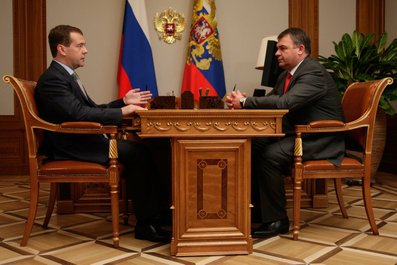
Medvedev and Serdyukov Meeting on 1 May

Whatever the complaints of some Ukrainians, the 21 April deal extending Russia’s basing privileges in Sevastopol is a good deal for Kyiv.  It’s now using the relatively meaningless Russian Black Sea Fleet (BSF) presence to secure a valuable 30 percent discount on Russian natural gas supplies.  

Moreover, in one suited for the ‘be careful what you wish for’ file, Moscow is also left holding the bag when it comes to the economy and infrastructure of Sevastopol, and much of Crimea as well, instead of Kyiv having to worry about assuming responsibility in a few short years. 

On 1 May, President Medvedev ordered Defense Minister Serdyukov to prepare a plan for developing the BSF’s naval base in Sevastopol, and to conclude an agreement with Ukraine on its social infrastructure.  According to Kremlin.ru, Medvedev said: 

“. . . today I want to touch on an issue with you which has taken on particular acuteness for our country in recent times.” 

“We need to think about the social arrangements for this base, that is very important to us, so that our sailors live in modern, full-fledged human conditions, have the chance for recreation and other opportunities a base is supposed to provide.” 

“So we’re agreed that our base will conclude a corresponding agreement with the Ukrainian side, with Sevastopol.  In accordance with this agreement, special support, social-economic support will be rendered to a series of Sevastopol city programs.” 

“This city is really not foreign to us and we need to think in what way to participate in these programs both along Defense Ministry lines and along the lines of other executive organs and business structures.  That’s the task.” 

Medvedev said Serdyukov should present his plan for approval in a month, and the latter responded that he would. 

Curiously, on 7 May, General Staff Chief Nikolay Makarov told RIA Novosti

“A working group’s been created which will evaluate the real condition of the basing point in Sevastopol and make its proposals.  I think this will take not less than two months.” 

“Practically nothing’s been invested there in recent years.” 

One wonders, would Makarov have unilaterally announced that Putin, when he was president, would have to wait an extra month or longer for the plan he ordered? 

Makarov said the Genshtab has no plans to freeze development of other basing points:   

“The fleet has to be.  The more basing points, the better.  And Novorossiysk is one of the key basing points.  And we intend to develop it.” 

Without elaboration, he said the Defense Ministry has modernization plans for the fleet’s ships, submarines, and aircraft to 2020.  Makarov was with Prime Minister Putin visiting the construction work at Novorossiysk.  

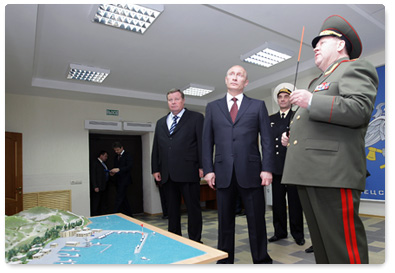
Putin Briefed on Novorossiysk

On 24 April, Anatoliy Tsyganok told RIA Novosti conditions at Novorossiysk are not particularly well suited for major base.  He noted it’s only 25 percent complete, and its price tag is continuously rising. 

Nevertheless, Putin reaffirmed Moscow’s commitment to Novorossiysk.  He acknowledged only 13 billions rubles have been spent, and he’s looking at an ultimate cost of 92 billion.  The base is slated for completion by 2020. 

But Moscow, Medvedev, and Putin may need to worry more about new ships and submarines than about infrastructure when it comes to the BSF. 

On 2 May, Anatoliy Baranov in Forum.msk pointed out that there’s practically no fleet there; a minimum of 2 more first rank ships and a submarine are needed for an adequate order-of-battle.  He says the social infrastructure’s not so bad, but 40- and 50-year-old civilian engineers and technicians have to go out with fleet units to conduct training.  What will the Navy do when they retire?  

Rosbalt.ru described a wave of new officer and civilian dismissals in the BSF, which occurred simultaneously with the new agreement with Kyiv.  The fleet, it says, is nothing more than a mixed force division’s worth of units and personnel.   Viktor Yadukha concludes: 

“NATO’s gracious reaction to the BSF lease extension didn’t surprise politicians more.  But if Western special services knew about real plans for its reinforcement, the reaction would have been very severe.” 

Lastly, in today’s Nezavisimaya gazeta, Aleksandr Khramchikhin says: 

“. . . renting empty piers for a great amount of money is not a mistake, but thoughtless, considering how many ships and how well-outfitted a base in Novorossiysk this money could build.” 

He calls today’s BSF a unique collection of floating antiques.  Even if the oldest units were dropped, most BSF ships would still be 20- to 25-years-old.  It will be impossible to avoid sending ships from the 1960s and 1970s off for scrap soon, as has been officially acknowledged.  Khramchikhin recommends placing what’s left at Novorossiysk as a ‘water area security’ (OVR or ОВР) brigade.

Navy CINC on Bulava Findings and Typhoon SSBNs

Speaking Friday in Novorossiysk while accompanying Prime Minister Putin, Navy CINC Admiral Vladimir Vysotskiy said the Bulava SLBM commission will report 20 May on its findings regarding the last unsuccessful test launch.  He also promised:

“We are working continuously and checking the entire process of the missile’s development.”

“Continuous work of voyenpredy [military factory representatives] is being implemented.  Right down to a screw, with the submission of corresponding certificates.”

“. . . all enterprises active in Bulava production are working under control of military acceptance.  We are checking the entire process from beginning to end.”

RIA Novosti reminded readers that, despite a string of unsuccessful tests (only 5 of 12 have been considered successful), the Defense Ministry still considers it ‘unrealistic’ to put another type of ballistic missile in new proyekt 955 SSBNs.

In February, Defense Minister Serdyukov expressed his certainty that Bulava problems would not affect the laydown of the next proyekt 955 submarine, the fourth in the series.  Officially, Moscow says Bulava will be carried through until the necessary result is obtained, and the missile will be the basis of sea-based strategic nuclear forces until 2040-2045.

One has to wonder, what happens if, after all the emphasis on eliminating production defects, Bulava still doesn’t fly?  Where does Moscow turn next for answers.

Vysotskiy also told journalists two proyekt 941 Akula (Typhoon-class SSBNs Arkhangelsk TK-17 and Severstal TK-20) will remain in the Russian Navy’s order-of-battle until 2019.  He said:

“They will be in a combat condition until 2019.  They have very great modernization possibilities.” 

This isn’t the first time he’s said this, but he hasn’t said how the 1980s-era SSBNs might be used or altered:

“There are several options, but the decision has yet to be made.” 

Of course, TK-208 Dmitriy Donskoy was modified to be the Bulava test platform.

BSF Expects Frigates and Subs

To counter recent predictions of the fleet’s demise, a BSF staff source today told RIA Novosti 3-4 frigates and a similar number of diesel-electric submarines would meet the fleet’s needs in the coming five years.  He pointed to the Admiral Gorshkov class frigate at Northern Wharf and proyekt 677 submarine Sevastopol at Admiralty.

The source said:

“In the course of the next five years, new class frigates and diesel-electric submarines will be included in the order-of-battle of the Black Sea Fleet.  The need to replenish the BSF order-of-battle is caused by the decommissioning of obsolete ships of various classes.”

He said new ships would also support the fleet’s full participation in exercises with NATO and Ukraine, and also exercises and long-distance cruises planned by the RF Navy’s command.  He noted that the renewal of the BSF’s ships in no way would contradict the provisions of Russia’s basing agreement in Ukraine.  He called Russia’s plans transparent and a subject for discussion in the sessions of the Russian-Ukrainian BSF sub-commission.

These hopes are basically the same as those expressed back in February when another source said 2 frigates and 3 submarines.

Other media today reported the possibility that Moscow could get a base agreement extension in return for higher rent payments or lower gas prices for Kyiv.

Viktor Litovkin on BSF

Writing in Friday’s Nezavisimaya gazeta, Viktor Litovkin talked about the procurement of proyekt 20380 corvettes from Piter’s Northern Wharf.  The second unit Soobrazitelnyy was just launched, and three more have been laid down, but it’s not clear when they’ll enter of the order-of-battle.  A total of 20 are planned, but the specialists say everything depends on financing.

Then Litovkin turns to last week’s reports of imminent decommissioning for Ochakov, Kerch, etc.  He says this’ll leave the BSF with about 40 ships (12 of which are either in repair or a ‘conservation’ status).  He puts the average age of the remaining fleet units at 25-30 years, and the youngest are its proyekt 1239 small air cushion missile ships.

As far as capabilities go, the BSF is still stronger than Ukraine and Georgia (at least), but there is a question as to whether it can defend the country’s interests.  But maybe it doesn’t have to be so powerful when the country still has the RVSN, and the BSF wasn’t really challenged in the August 2008 war with Georgia, and it can still show the flag in the Mediterranean, defend the country’s economic zones, and participate in antipiracy operations off the Horn of Africa.  No one would take it into their head to compare it with the U.S. 6th Fleet.

But still Litovkin wants to answer why the BSF reached its current state.  Because the ‘Orange Revolution’ Ukrainians wouldn’t permit Moscow to renew the BSF’s potential in ships, aircraft, or personnel.  And Moscow was busy trying to modernize and preserve parts of the military other than surface ships.  He says:

“It built them for India, China, Vietnam.  Only now is it beginning to launch new corvettes and frigates for the Navy.  But by a drop (by one) per year.  And this is for all four fleets and a flotilla.”

“According to experts’ assertions, in the coming 10-15 years there are no possibilities for renewing the composition of the surface fleet.  Despite even the fact that today two frigates for the distant naval zone are laid down (proyekt 22350), five corvettes of proyekt 20380, three small gun ships of proyekt 21630, large landing ship of proyekt 11711… But even if the program of their construction is successful, they won’t under any circumstances compensate for the ships withdrawn due to age.”

“Even the Mistral won’t help here.”

Incredible Disappearing Fleet

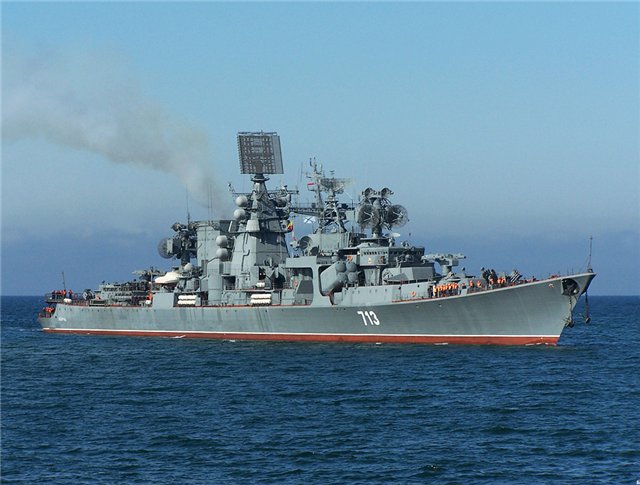
Kara-class CG Kerch (713)

The Black Sea Fleet’s predicament is hardly a news story.  The press in recent months has featured stories claiming that the BSF will receive new ships to replace its aging order-of-battle.

But Gzt.ru maintains the BSF is just about rusted through, and its ships will be unable to go to sea by 2015.  A Navy Main Staff source says the average age of BSF ships exceeds 30 years—the practical limit for naval vessels.  He claims the fleet’s sailors keep their ships in good condition, but, since metal has its limits, their hulls are reaching a point where “no one will risk going to sea in such ships.”

The source says the oldest BSF ships—whose service lives have expired and don’t warrant further investment—will be written off.  They include the Kara-class CG Ochakov (707), Tango-class SS Saint Prince Georgiy (B-380), probably Kara-class CG Kerch (713), and various transport and auxiliary ships.  Ochakov is 37 years old, and spent the past 18 years in the repair yard.  The disappearance of the Ochakov and Kerch will leave the BSF with only two major surface combatants—Slava-class CG Moskva (121) and Kashin-class DDG Smetlivyy (810).  And there is apparently a rumor that the Moskva will remain in the Pacific after participating in Vostok-2010 this summer.  The BSF will also be down to a lone submarine, Kilo-class Alrosa (B-871), which reportedly awaits repair after an engineering casualty during a recent training cruise. 

The final decision to write off some ships is driven by a 30 percent cut in the fleet’s maintenance budget [recall Defense Minister Serdyukov saying the repair budget has been cut by 28-30 percent, supposedly in favor of new procurement].  Since February, personnel at the 13th and 91st ship repair plants have been reduced by 2 times, according to Newsru.com.  And the repair plants have practically no work this year.

So they’re not fixing old ships, but neither are new ones in sight . . . the press noted that the BSF didn’t get new units in the 2000s, will get no new ships this year, and the introduction of new ones isn’t planned.

A BSF staff representative told Gzt.ru that several new corvettes of the Steregushchiy type (proyekt 20380) would restore the BSF’s combat potential. The Steregushchiy is in the Baltic Fleet, and a second unit of the class was just launched on 31 March.  This seems too slow to help the BSF, even if any of these ships were destined for Sevastopol.

 A source tells Gzt.ru the basic problem is the lack of production capacity:

“All shipbuilding plants are overflowing with foreign orders for several years ahead, and even if there is money it’s very complicated to arrange additional production for the Russian Navy’s needs since there isn’t the right quantity of milling machinists, lathe operators, and welders.  There’s great productive potential in Ukraine, and we consider that the warming in Russian-Ukrainian relations could lead to realizing a number of projects on Ukrainian building ways, which never worked for the USSR’s Black Sea Fleet.”

Gazeta.ru provided the opinion of Vladimir Yevseyev, who believes, until the BSF gets a new main base, it won’t get any new ships.  He says all the fleet’s problems are connected with its basing.  Most Ukrainian politicians oppose extending Russia’s presence in Sevastopol beyond 2017.  And Moscow has allocated a billion rubles to build a new base at Novorossiysk, but billions of dollars are required to create modern infrastructure there.  Yevseyev doesn’t like Novorossiysk, or Ochamchira:

“But we need to choose, otherwise the fleet could simply be liquidated.  Russia is just simply marking time.”

Svpressa.ru seconds this line of thought, concluding that malicious people say the fleet’s fate has been decided, and Russia’s Crimean base is folding up, and, in order to avoid a furor, its order-of-battle will be liquidated by taking units out of service.

More on Carriers from Gorshkov Conference

Navy CINC Vysotskiy (photo: RIA Novosti)

RIA Novosti has more coverage of Navy CINC Vysotskiy’s carrier comments from yesterday.  Vysotskiy said there’s a plan to build and launch an aircraft carrier by 2020, and the technical proposal for it has to be developed and ready by the end of 2010.

“According to the plan, by year’s end we’ll receive the technical proposal for a future aircraft carrier with the basic tactical-technical characteristics.  Then development of the working documentation will begin.” 

He said experimental-design work (OKR) was already under way.

Vysotskiy noted that a Federal Goal Program (FTsP) was needed to construct an aircraft carrier, because financing to do it in the State Defense Order (GOZ) would be very complex.

Former Navy CINC, now advisor to the Defense Minister, Vladimir Masorin, remarked that carriers make it possible to influence the situation in the world, and its different regions.  He added that, if Russia wants to become a great naval power, it has to have carriers and they will have to be nuclear-powered.  He believes the main thing is preserving Russia’s scientific potential and carrier pilot skills:

“Aircraft carriers can’t be built in a short period.  We have to preserve our scientists, designers, and pilots.”