Category Archives: Naval Modernization

Difficult Course to a Grand Fleet

Konstantin Bogdanov sees reason for pessimism when looking at the course ahead for rebuilding Russia’s fleet.  Writing in Friday’s Nezavisimoye voyennoye obozreniye, he says, despite an intention to spend 4.7 trillion rubles of the ten-year GPV on the Navy, there are technical challenges, clearly impractical schemes, and failures in what he calls the “organization-financial plan” ahead. 

Bogdanov provides us a handy review of the state of Russian shipbuilding.

He points first to OSK’s insistence on seeing new aircraft carriers (with nuclear-powered destroyers in their battle groups) on the Russian Navy’s horizon.  But Defense Minister Serdyukov has only a cold rebuff for the idea.  Early R&D into what a new carrier might look like is as far as he’s being willing to go.  It was made pretty clear that a carrier isn’t part of this GPV.

Bogdanov says OSK may be looking for work for the New-Admiralty Wharves it sees on Kotlin Island in the future.  The 30- to 60-billion-ruble shipyard could be ready in 2016.  An aircraft carrier project would help launch this idea.

Then Bogdanov turns to the Navy’s more immediate needs — frigates and corvettes.  

Proyekt 22350 frigates are needed by tens, if not 30, or even 40, of them.  But Northern Wharf is having trouble building them.  Lead unit Admiral of the Fleet of the Soviet Union Gorshkov was five years in construction, and its underway testing isn’t complete.  Fleet Admiral Kasatonov was laid down just about two years ago.  Its SAM system, Poliment-Redut with 9M96 missiles isn’t ready, and will have to be fitted right to finished frigates.  But Bogdanov sees the frigates’ VLS — the Multipurpose Ship Fire System (UKSK or УКСК) as a positive step.  It could fire antiship, antisubmarine, land-attack cruise missiles, torpedoes, and possibly SAMs.

When proyekt 22350 didn’t come along quickly, Bogdanov says, the Navy went for its own proyekt 11356M frigates like those being built for India.  But, he notes, Baltic Shipbuilding Plant “Yantar” in Kaliningrad isn’t having an easy time constructing them for its Indian and Russian customers.  There are delays in the Indian units, but Admiral Grigorovich and Admiral Essen have been laid down for Russia, and Admiral Makarov should join them soon.  The contract for a second batch of three was just signed.  They’re supposed to be “localized,” but may actually be more like the Indian versions.  They’re slightly cheaper than the proyekt 22350 at 10 billion vs. 16 billion rubles per ship.

Northern Wharf has the order for nine proyekt 20380 Steregushchiy-class corvettes (with the proyekt 22350 frigates this comes to more than 220 billion rubles).  Soobrazitelnyy (proyekt 20381) began sea trials this year, Boykiy was launched, Stoykiy is under construction, and Provornyy (proyekt 20385) was laid down.  Sovershennyy (proyekt 20380) remains under construction at Komsomolsk-na-Amure.  Bogdanov says the proyekt 20385 ships will have an eight-cell UKSK.

Bogdanov notes, however, that Northern Wharf’s production won’t be steady until its ownership issue is finally resolved.  If OSK takes over, this could have a good or bad effect on fulfilling defense orders, but the current financial questions around Northern Wharf are even worse.

Turning to submarines, Bogdanov believes the situation is more transparent, but there are still questions.

The SSBN picture is pretty clear.  Proyekt 955 Borey-class SSBNs finally have a missile that looks like it works.  Yuriy Dolgorukiy has fired it, and Aleksandr Nevskiy might this year.  Vladimir Monomakh is under construction, and they’re preparing production materials for Saint Nikolay.

The problem, he notes, is units 1 and 2 used sections and components of proyekt 971 and 949A submarines never built.  Units 3 and 4 will be built from scratch, and it’s too early to say how this will be reflected in their cost.  Bogdanov concludes another battle over inflated prices awaits, and there is, of course, still no 2011 contract with Sevmash.

It’s less clear with the multipurpose proyekt 885, Yasen-class, of which the Navy wants ten by 2020.  But these boats have been the focus of the Defense Ministry’s familiar complaint about unjustified price increases.  Unit 1 Severodvinsk was built from materials and resources on hand, and its rising price was frozen at 47 billion rubles in 2005.  The Defense Ministry says Sevmash wants 112 billion for unit 2 Kazan

Bogdanov thinks it’s hard to tell who’s justified here.  There is structural industrial inflation, and a higher costs could be the result of the frozen handover price on Severodvinsk.

Bogdanov mentions the thought given to cheaper attack boats like the Victor III or Akula, or proyekt 957 Kedr which never left the design phase.  The Yasen is intended to replace Soviet-era SSNs and SSGNs, but Bogdanov thinks it’s too complex and expensive to be built in the numbers Russia may need.  Twenty years ago the Russian Navy was planning for not less than 30 [sized of course against the U.S. fleet], and currently it has not more than 30 SSNs and SSGNs, and this is considered insufficient. 
Despite the uncertainty above, Bogdanov says one still hears talk about the need to develop a fifth generation submarine, but it’s unknown if there will be any development work on one.
 

Keep Close to Shore

“In essence, after many years of interruption, we are beginning a large shipbuilding program:  by 2020, 4.7 trillion rubles will be directed at reequipping Russia’s Navy.  The aim is clear — it is creating a modern fleet, capable of carrying out all missions — from nuclear deterrence to presence on the world’s oceans, to the security of our economic interests and Russia’s bioresources.”

That’s how Prime Minister Putin put it at Monday’s party conference in Cherepovets.  But Nezavisimaya gazeta and Vedomosti had sharp and pithy criticism for him and for the naval construction program.

NG concluded military voters might be cheered up, but the paper wants to know what the naval construction program is exactly.  Is it the one that’s buying Mistrals that may not be needed from France?  With what and how will the Navy be equipped?

Apparently not aircraft carriers.  And not other large warships either.  They’re built in Russia, but for sale to India and China.  NG continues:

“Our own fleet is being populated piecemeal.  And, as a rule, we’re talking about a mosquito fleet.  Which, of course, is not capable of completing missions ‘from nuclear deterrence to presence on the world’s oceans.'”

The editorial cites former Black Sea Fleet Commander Vladimir Komoyedov who complains about the retirement of the Kara-class CG Ochakov, and claims nothing new is being developed.  It quotes Aleksandr Pokrovskiy who says the Baltic Fleet’s new Steregushchiy and Soobrazitelnyy corvettes are not participating in exercises because they’re only 50 percent combat ready.

So, asks NG, what kind of modern fleet are we talking about?  About past shipbuilding programs, it says:

“They were concrete and understandable — how many and what types of ships must be built.  Today politicians prefer to talk not about this, but about large-scale financial investment in the future fleet.  And in the very distant future at that.  From the point of view of the 2011 and 2012 election campaigns, it could be, that this is correct.  But from the point of view of the country’s security — hardly.”

Vedomosti takes its turn:

“. . . the idea of turning Russia into a great naval power has agitated the minds of the leaders of the Russian state for more than 300 years already.  The question is how acute this mission is in the 21st century and how Putin’s new slogans correspond to programs already adopted.”
 
“But the thing is not just the quality of the state program [of armaments], but also its strategic aims, which the government’s leader lays out.  We’d like the prime minister to formulate precisely what level of Navy presence in the world’s oceans and what he has in mind for its participation in the defense of bioresources.  Security of mineral and biological resources is an affair for civilian services and maritime border guards . . . .”
The business daily goes on to say corvettes, frigates, and landing ships are capable of completing “understandable and necessary missions.”  Still, it
says:
 
“Many experts consider extravagant the purchase of the Mistrals (four ships cost 2.35 billion euros), intended to support amphibious operations at a great distance from native shores.  Some admirals and VPK directors called for development of aircraft carrier groups.  Similar projects, the cost of which stretches to tens of billions of euros, will cause curtailment of construction of ships needed for the fleet, overloading and technological breakdowns in Russian shipyards.  In any case, Russia’s main problems have to be resolved on land.”
Sound advice given that the procurement problems of the Ground Troops and Air Forces, not to mention the RVSN, are just as serious and urgent as the Navy’s (if not more so).
 

Bulava Success

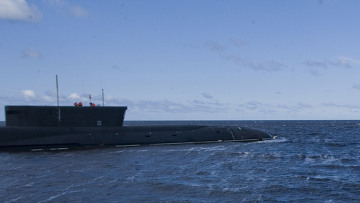
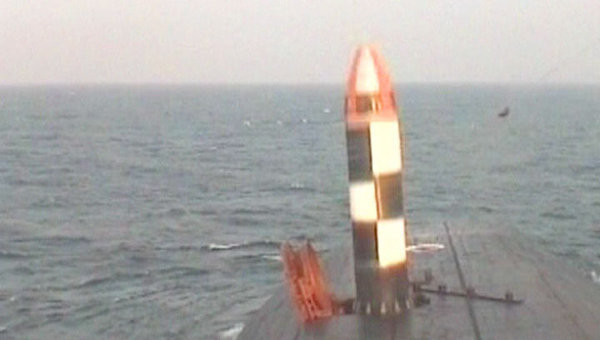
Bulava Launch (photo: RIA Novosti / Avrora)

Cheap post with a pretty picture thanks to RIA Novosti.  This was a maximum range test, from the White Sea to a target area in the Pacific Ocean.  It was the 16th test overall, and the second this year.  It makes nine announced successes out of 16.  And that’s four in a row.

If, as it appears, the designers and manufacturers have finally slicked the Bulava’s earlier problems, now Moscow will have to crank up the Bulava SLBM and Borey-class SSBN production lines.

That is a different kind of problem, a problem of the GOZ and the OPK.

Bulava Test on Saturday

Yesterday RIA Novosti’s source in the state testing commission said Borey-class SSBN Yuriy Dolgorukiy will test fire a Bulava on August 27.  The launch was originally scheduled for last Saturday when a malfunction occurred on the submarine.  The news agency’s Defense Ministry source stressed that, although not impossible, conducting the test on August 20 was deemed “inexpedient.”  The defect in the power supply to one of Dolgorukiy’s systems has been fully corrected, and the submarine is ready for sea.  The state commission source said this launch — the 16th overall, and the second in 2011 — will be a maximum range test.

Failure to Launch

SSBN Yuriy Dolgorukiy (photo: RIA Novosti / Sergey Guneyev)

Not the same as a failed launch, of course . . .

Interfaks reports proyekt 955 Borey-class SSBN Yuriy Dolgorukiy cancelled a Bulava test launch on Saturday.  According to Sevmash, the power supply to one of Dolgorukiy’s systems malfunctioned.  The submarine returned to the factory to investigate.  The Interfaks source said the state commission supervising Bulava testing indicated the launch would be put off until late this week.

The source emphasized there aren’t issues with the Bulava, which was fully ready for launch.  Interfaks recalled the 15th launch scheduled for last December was delayed until June because Dolgorukiy wasn’t ready, although the official reason was White Sea icing.  The June launch from the submerged Dolgorukiy was successful.

In Moskovskiy komsomolets, Olga Bozhyeva’s source says the problem was a sensor in a system needed to prepare the missile for launch.  They postponed until later Saturday, but, when they couldn’t fix it, the SSBN returned to port Sunday morning.  The source says the state commission will probably delay the next launch attempt until September.

RIA Novosti provided a more official spin on the cancelled test.  It emphasized there was no unsuccessful launch.  The news agency’s state commission source stressed that, when submarines go to sea for system testing, the commission makes its decisions based on many factors and conditions.  And the source stated the Bulava flight test program will be completed in the established time frame.

Bulava News

Today Navy CINC, Admiral Vladimir Vysotskiy announced four more tests of the Bulava SLBM this year.  According to Interfaks, Vysotskiy said plans call for a salvo launch either this year or next, depending on the state commission overseeing the Bulava’s testing.

Last Wednesday, a defense sector source told Interfaks to expect the next Bulava test in a month.  Originally, the source said, it was supposed to be a salvo launch a month after the successful June 28 test from Yuriy Dolgorukiy.  But analysis of the June flight test and preparation for the next took longer than expected.  This source said the 16th test will be in late August, or possibly even fall.  He said Dolgorukiy will fire two Bulava SLBMs, one after another. 

On June 30, Vysotskiy claimed the second proyekt 955, Borey-class SSBN Aleksandr Nevskiy will finish sea trials, and test fire a Bulava this year.  But he didn’t repeat the claim today.

Navy Day

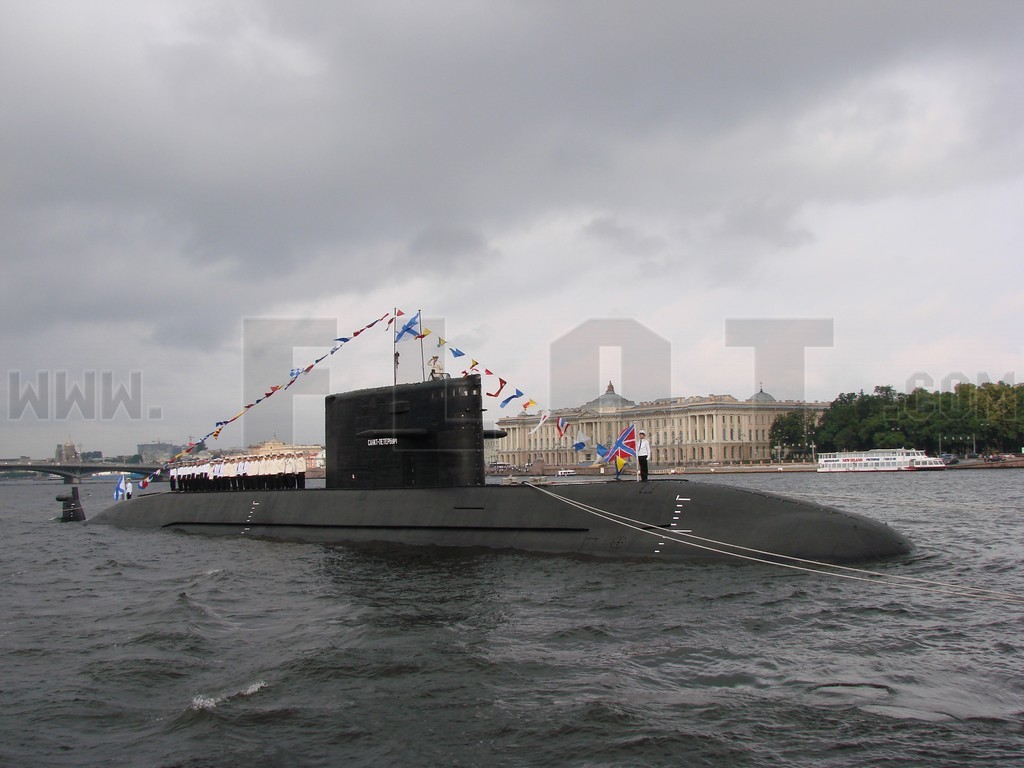
Sankt-Peterburg Submarine in the Bolshaya Neva (photo: http://www.flot.com)

In honor of Navy Day — the 315th anniversary of the Russian Navy’s establishment — here are this week’s sound bites from Navy CINC, Admiral Vladimir Vysotskiy.  RIA Novosti will publish a complete interview with him tomorrow.

Vysotskiy says the Navy expects “not less than eight” proyekt 885 SSNs by 2020.  Some sources maintain the number is six.

Unit 1 Severodvinsk is preparing for sea trials in August, and unit 2 Kazan is expected by 2015.  They’ll have to pick up the pace to get eight by 2020.

Vysotskiy says work on a new destroyer will begin in 2012, and be completed in 2016.  This is the one he suggested might be nuclear-powered.

The CINC’s other comments covered the Black Sea Fleet. 

He claimed the BSF will get six proyekt 636 diesel-electric submarines in the coming years.  Its sole submarine now, proyekt 877 Varshavyanka-class SS Alrosa is currently in the Baltic for repair.

RIA Novosti recalled Vysotskiy’s past comments about obtaining 15 frigates and diesel submarines for the BSF by 2020 in a 60-30 proportion.  He also said a frigate and submarine were specifically laid down for the BSF in 2010, and would be every year henceforth.  He claimed the fleet would be renewed by 2020 through new construction rather than inter-fleet transfers.

Moskovskiy komsomolets and Newsru.com reported on the BSF’s drastic ten-fold decline since 1997.

This week TsAMTO cited a Baltic Fleet press release saying it expects to get the Neustrashimyy-class FF Yaroslav Mudryy, proyekt 20380 Steregushchiy-class FFLs Steregushchiy, Soobrazitelnyy, and Boykiy, proyekt 677 Lada-class SS Sankt-Peterburg, as well as assault ships and other craft.  The BSF may be expecting to get some of these ships as well.

Severodvinsk Trials and GOZ Tribulations

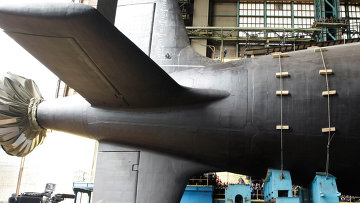
Severodvinsk (photo: RIA Novosti / Vladimir Rodionov)

Your typical good news, bad news story . . . happily for the Russian Navy, the Severodvinsk is nearing its first at-sea testing, but the new submarine has also been held up as a prime example of outrageous price increases in this year’s state defense order.  Final delivery of this SSN, as well as the first two Borey-class SSBNs, represents a big part of troubled GOZ-2011.

RIA Novosti reports new fourth generation Yasen-class (proyekt 885) SSN Severodvinsk will soon head into the White Sea for two months of underway testing, according to Malakhit Design Bureau General Director Vladimir Pyalov.  He added that, after this at-sea period, the final phase of state testing will take place.  

A very precise Mr. Pyalov says Severodvinsk is currently 98.9 percent complete.  He thinks the Navy will accept the new boat before year’s end and, in all, six of these multipurpose submarines will be built.  The second proyekt 885 Kazan is slated for delivery in 2015. 

RIA Novosti says proyekt 885 is a double-hulled, single-shaft boat with a reduced acoustic signature.  The conning tower has a streamlined, oval shape.  The boat is divided into ten compartments. 

For the first time, according to RIA Novosti, Russian designers put the submarine’s torpedo tubes amidships to allow for a new bow-mounted sonar system.  Proyekt 885 has eight vertical launch tubes for supersonic cruise missiles.  It has new communications and navigation systems as well as a fundamentally new nuclear power plant, according to the news agency’s report.  The new submarine is said to be first in noise reduction and stealth among attack submarines worldwide.

But the Severodvinsk couldn’t evade detection in the furor over breakdowns in the state defense order.

Earlier this month, RIA Novosti reported on disputes between the United Shipbuilding Corporation (OSK), submarine-builder Sevmash, and the Defense Ministry over naval construction in this year’s GOZ.  In particular, the military accuses the builder of doubling its prices for proyekt 955 Yuriy Dolgorukiy and proyekt 885 Severodvinsk.

An OSK spokesman defended Sevmash saying the cost of its work on Severodvinsk is only 30 percent of the total price, with the balance being the cost of armaments and components supplied by several dozen enterprises.  He blamed inflation in the industrial sector and the economy more generally.

Summarizing his discussion of submarines with OSK, RIA Novosti reports, Defense Minister Serdyukov said:

“They are giving us an increase in prices on new orders, and, naturally, we don’t agree with this.”

But, he added he’s convinced the Defense Ministry will persuade the producer to lower its prices.

Izvestiya mentioned that Severodvinsk was originally intended for a production run of 30 submarines, now reduced to six more than 20 years later.  As recently as March, the Navy still publicly hoped for ten.

Serdyukov told the paper:

“. . . it’s incomprehensible what the price of the ship [sic] consists of, if the cost of the lead boat was 47 billion rubles ($1.7 billion), but the next, exactly the same is now 112 billion ($4 billion).”

“Of course, the price will grow if, in the cost of one ship [sic], they include all accompanying expenditures on other enterprise projects in no way connected with it, like maintaining kindergartens, infrastructure, etc.”

“We’re prepared to pay, but on the condition that the price formation process will be transparent.  As practice shows, if all articles in the contracts are “decoded,” then it seems it’s possible with confidence to deduct up to 30% from the final cost of a finished product.”

These must be bitter words for an enterprise that went many, many years without completing its trademark product — a nuclear-powered submarine.

A Sevmash source says the cost of submarine construction is directly related to higher prices for materials, energy, and integration:

“The entire range of equipment for a submarine is supplied by monopolistic companies trying to dictate their prices.”

Bulava Launch Window

An OPK source told RIA Novosti yesterday a state commission on experimental flight testing has identified June 28-30 as the window for this year’s first Bulava SLBM test.  The commission will select a precise date within the next two days.  The source says Borey-class SSBN Yuriy Dolgorukiy will be the platform for the launch.

Done Deal

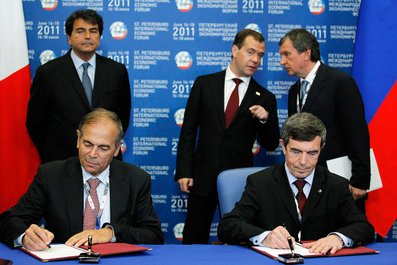
Mistral Contract Signing

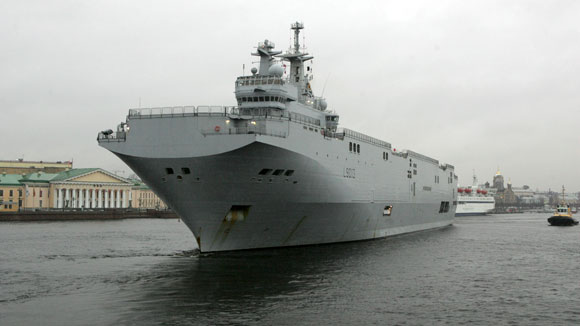
The deal for the first two Mistrals, that is.  With President Medvedev looking on, Rosoboroneksport’s Anatoliy Isaykin and DCNS’ Patrick Bouasie signed the contract at the Petersburg International Economic Forum.  RIA Novosti quoted Isaykin on the €1.2 billion price.  Work can begin after the Russians pay an advance (Versii.com repeated a rumor that the French wanted 80 percent prepayment). 

RIA Novosti also noted Isaykin saying the Russian Mistrals will be identical to French units except they’ll have reinforced hulls and flight decks to handle Russia’s northern waters, and its heavier helicopters.  Isaykin said Russia has an option for two more Mistrals to be built in Russia.  But it’s up to the Defense Ministry to get money for them in the Gosoboronzakaz.

ITAR-TASS made the point that the Senit 9 tactical command and control system, and its documentation, are part of the just-inked deal.  OSK General Director Roman Trotsenko told Rossiya-24, “The French side has gone to an unprecedented level of technology transfer and is transferring technologies, including the programming source codes for battle information-management systems, communications systems.”

Kommersant reported the first Russian unit is expected in 36 months, the second in 48, or 2014 and 2015 respectively.   It cited Trotsenko on Russia contributing up to 40 percent of the work on the two ships to be built at STX in Saint-Nazaire.

While the Mistrals will come with French electronics, the Russians will have the task of outfitting the ships with their own weapons, helicopters, amphibious assault craft, and other systems.

Radio Svoboda asked for some thoughts about the occasion.  NVO’s Viktor Litovkin opined that these expeditionary warfare ships don’t make much sense under Russia’s current military doctrine or in the context of defending the Kurils.  Pavel Felgengauer said the Mistrals may be appropriate for fighting enemies with weak air and naval forces, but Russia’s leadership hasn’t specified who they might be.  Viktor Alksnis complained that they are another stake in the heart of Russia’s dying OPK.  He calls for Russia to modernize its own arms production base instead of buying abroad.  He also fears the French could put an “off switch” in the ships’ C2 systems, effectively turning them into “target barges.”

Aleksandr Golts supports the deal because Russian shipbuilders will participate and get new technologies, but he also because he favors the emphasis on force projection rather than the Navy’s pro-SSBN mission.

Navy CINC, Admiral Vladimir Vysotskiy made some appropriately effusive comments about the capabilities and prospects for employing the Mistrals.

Mistral in Piter (photo: Izvestiya)

Defense Minister Serdyukov was less willing to elaborate saying:

“Let’s build them first, and then we’ll think about where to deploy them.  We have plans to employ them, when they’re closer to ready we’ll disclose them.”

In Moskovskiy komsomolets, Olga Bozhyeva writes that the Mistral deal does several things for Moscow.  An arms sale like this implies a level of acceptance by Europe, it divides old and new Europeans, and it serves as a wedge between the U.S. and its European allies.  She notes that Russian military leaders have kept pretty quiet about Mistral.  And Bozhyeva concludes, overall, it’s a bad deal for Russia.  It’s a high price tag for something that’s not a priority for the fleet.  Its missions are not well thought out.  A relatively old system like Senit 9 won’t help Russia catch up very much.  And Russia didn’t seriously consider Dutch, Spanish, or South Korean shipyards to drive the French price down, but:

“. . . we would have to exclude a certain corruption component, which, in the opinion of many experts, is included in the Russo-French contract (but it’s better to leave this subject to the procuracy).”

As is often the case, Nezavisimaya gazeta sums it all up best:

“The Glavkom [CINC] ought to specify the countries on which our Navy intend to ‘project the power’ of the LHD.  Judging by the fact that it’s intended to deploy the first two ships in the Pacific Fleet, for the defense of the Kuril Islands (can it really be that someone intends to attack them?), then Japan—ally of the U.S., China—our strategic partner or North and South Korea could be the object of this projection.  Again with Seoul it’s somehow uncomfortable.  It’s also an ally of Washington.  And don’t mention projecting power on Pyongyang, apparently, even the Americans aren’t risking doing this.”

“And not everything’s clear with our deck-based aviation for ‘Mistral.’  Our attack helicopters, Mi-24, Mi-28N, Ka-52, and naval Ka-27, Ka-28, Ka-31 are bigger (higher) in their dimensions than French ones, so it’s necessary to redesign the LHD’s hangar deck for them.  This means extra expenditures of financial resources, as well as a change of extremely weak armament for this ship.  Including even air defense.  There are also other problems.  Like the construction of a shore base for the deployment of ‘Mistrals’ on the country’s eastern shore, on the Pacific Ocean.  It still isn’t there.  But to keep such a huge hull tied up at anchor in Petr Velikiy Gulf or in other Far Eastern bays, like it was with domestic Proyekt 1123 class helicopter carriers ‘Moskva’ and ‘Leningrad,’ means to expend their service life in vain and kill it without reason.”

“In a word, the French LHDs, which should enter our Navy’s inventory in 2014 and 2015, could be not a reinforcement of our groupings of ships, which, by the way, also still need to be built up, but a headache for Russian admirals.”