Category Archives: Navy

Kuznetsov Air Ops

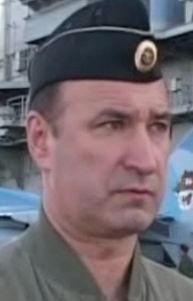
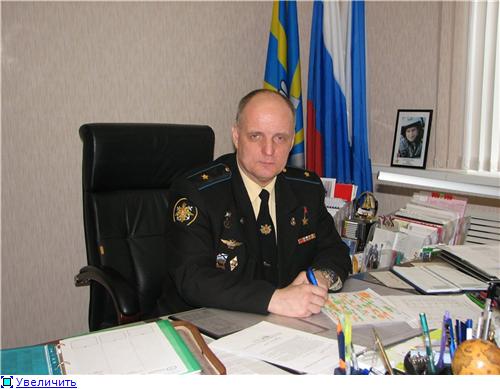
Colonel Nikolay Deriglazov

We’re gradually reaching the end of the slow news season . . . here’s a picture and a couple videos.

Colonel Deriglazov commands the Su-33 squadron aboard Fleet Admiral of the Soviet Union Kuznetsov.  He speaks about flying off the Russian carrier in the video below.

Hat tip to Militaryparitet.com for highlighting this Vesti.ru report on Kuznetsov pilots in action.  The video shows an officer (an LSO-type) at the “visual landing post.”  Some Russian carrier pilots have 160 landings to their credit, according to Vesti.

The Defense Ministry’s TV Zvezda had this video as well.

The Kuznetsov group remained in port (or at least at anchorage near) Tartus, Syria today, as RIA Novosti reported.

BSF Gets an Unsat

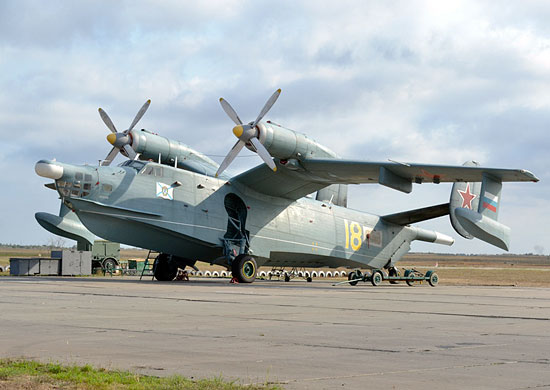
A BSF Be-12

Kommersant reported Saturday that Defense Minister Serdyukov presided over an unscheduled collegium at which the Black Sea Fleet (BSF) commander received a month and a half to rectify problems identified during an inspection this fall.

The inspection — conducted by Chief Military Inspector, General-Lieutenant Gennadiy Borisov — focused on the state of operational and combat training, the weapons and equipment inventory, logistical and medical support, and fire safety.  Kommersant’s source said the results were unfavorable, and there were deficiencies in many areas.  Serdyukov received the inspection report, and wanted to hear the BSF commander speak about it at the collegium.

A Main Navy Staff source told the paper two of three formations inspected at Novorossiysk Naval Base got unsatisfactories in artillery, missile, and torpedo firing, and mine warfare.  The 11th Independent Coastal Missile-Artillery Brigade and 184th Ship Brigade received comments, and General-Lieutenant Borisov also noted problems in the Naval Infantry battalions at Temryuk.

But no one got fired.  Serdyukov gave BSF Commander, Vice-Admiral Aleksandr Fedotenko, and Navy CINC, Admiral Vysotskiy, until February to remedy all defects before a repeat inspection.

On a related note, Monday the Defense Ministry announced BSF Naval Aviation bases at Gvardeyskoye and Kacha will consolidate into the 7057th Aviation Base.  The unified base will have ground attack, ASW, and transport airplanes and helicopters.  Press reports weren’t explict, but Kacha is the 7057th.  So Gvardeyskoye — the 7058th — will apparently close.

Where’s the Logic? (Addendum)

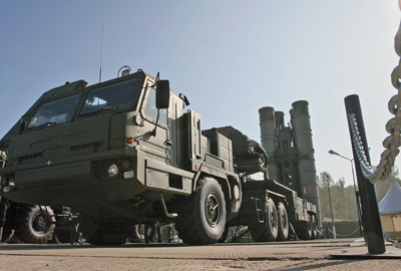
S-400 Launcher (photo: ITAR-TASS)

One shouldn’t ignore what doesn’t make sense . . . last week the Russian press reported again that the Baltic Fleet’s PVO units (Kaliningrad’s 3rd Aerospace Defense Brigade?) will receive their first S-400 launchers before year’s end.  The first report came in August.  ITAR-TASS cited a source this time – Baltic Fleet Commander, Vice-Admiral Viktor Chirkov.

Chirkov didn’t say how many the fleet will get, but he said the S-400 will replace old S-200 (SA-5 / Gammon) surface-to-air missiles.  He says his crews are currently conducting “acceptance-handover” launches, presumably at Ashuluk.

It doesn’t seem logical.  SAM brigades around Moscow can’t get S-400s on time and Chirkov is talking about putting them in Kaliningrad.  And his assertion he’ll get them this month seems odd given the loose schedules and passed deadlines associated with the program.

President Medvedev just finished saying one measure against European missile defense would be deploying the S-400 to protect SYaS.  But SYaS aren’t based in the Russian exclave.  It seems Medvedev would’ve announced it if the military intended to put the new SAMs in Kaliningrad.  Are S-400s going to intercept    SM-3s launched from Poland?  Are they going to protect Iskanders in Kaliningrad?

We’re left waiting to see the logic (and truth) in these reports.  Of course, there doesn’t necessarily have to be a logic compelling or sensible to outsiders.

Its Own Duma Election

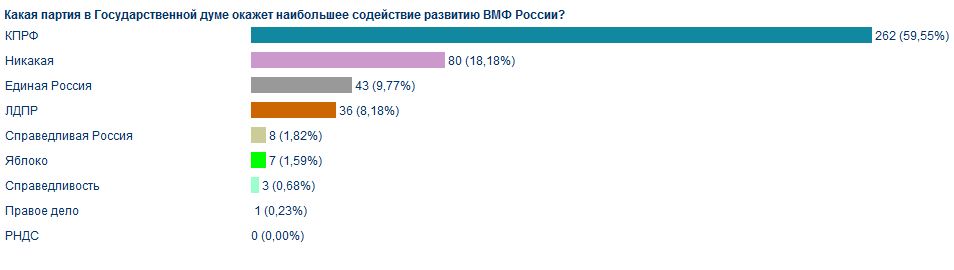
A site dedicated to all things Russian Navy called Flot.com has an interesting Internet poll.

The site asks visitors to vote for the party they feel will provide the greatest assistance in developing the Russian Navy.  Click the image below to see the results as of today.

Looking for the Pro-Navy Party

Pardon one for concluding this is pretty compelling.
 
Sixty percent of those responding say the KPRF will be most supportive of the Navy’s development.
 
Bucking Russia’s electoral law, Flot.com still permits an “against all” option.  So 18 percent say no party will provide the greatest assistance in the development of the VMF.
 
United Russia comes in third at about 10 percent.
 
And to think the “party of power” organized a GPV in which the largest portion will go to the Navy.
 
A pretty damning indictment.
 
Yes, it’s an Internet poll, and it’s influenced by its clientele.
 
No offense to a good site is intended, but Flot.com’s visitors could be older, and still more Soviet than Russian.  Who knows?  But they’re also knowledgable and interested in their subject.  Hence, they represent an elite, tough, and skeptical audience. 
 
The GPV notwithstanding, the yedinorossy have failed to convince them they’ll fix the Navy’s problems.
 

Difficult Course to a Grand Fleet

Konstantin Bogdanov sees reason for pessimism when looking at the course ahead for rebuilding Russia’s fleet.  Writing in Friday’s Nezavisimoye voyennoye obozreniye, he says, despite an intention to spend 4.7 trillion rubles of the ten-year GPV on the Navy, there are technical challenges, clearly impractical schemes, and failures in what he calls the “organization-financial plan” ahead. 

Bogdanov provides us a handy review of the state of Russian shipbuilding.

He points first to OSK’s insistence on seeing new aircraft carriers (with nuclear-powered destroyers in their battle groups) on the Russian Navy’s horizon.  But Defense Minister Serdyukov has only a cold rebuff for the idea.  Early R&D into what a new carrier might look like is as far as he’s being willing to go.  It was made pretty clear that a carrier isn’t part of this GPV.

Bogdanov says OSK may be looking for work for the New-Admiralty Wharves it sees on Kotlin Island in the future.  The 30- to 60-billion-ruble shipyard could be ready in 2016.  An aircraft carrier project would help launch this idea.

Then Bogdanov turns to the Navy’s more immediate needs — frigates and corvettes.  

Proyekt 22350 frigates are needed by tens, if not 30, or even 40, of them.  But Northern Wharf is having trouble building them.  Lead unit Admiral of the Fleet of the Soviet Union Gorshkov was five years in construction, and its underway testing isn’t complete.  Fleet Admiral Kasatonov was laid down just about two years ago.  Its SAM system, Poliment-Redut with 9M96 missiles isn’t ready, and will have to be fitted right to finished frigates.  But Bogdanov sees the frigates’ VLS — the Multipurpose Ship Fire System (UKSK or УКСК) as a positive step.  It could fire antiship, antisubmarine, land-attack cruise missiles, torpedoes, and possibly SAMs.

When proyekt 22350 didn’t come along quickly, Bogdanov says, the Navy went for its own proyekt 11356M frigates like those being built for India.  But, he notes, Baltic Shipbuilding Plant “Yantar” in Kaliningrad isn’t having an easy time constructing them for its Indian and Russian customers.  There are delays in the Indian units, but Admiral Grigorovich and Admiral Essen have been laid down for Russia, and Admiral Makarov should join them soon.  The contract for a second batch of three was just signed.  They’re supposed to be “localized,” but may actually be more like the Indian versions.  They’re slightly cheaper than the proyekt 22350 at 10 billion vs. 16 billion rubles per ship.

Northern Wharf has the order for nine proyekt 20380 Steregushchiy-class corvettes (with the proyekt 22350 frigates this comes to more than 220 billion rubles).  Soobrazitelnyy (proyekt 20381) began sea trials this year, Boykiy was launched, Stoykiy is under construction, and Provornyy (proyekt 20385) was laid down.  Sovershennyy (proyekt 20380) remains under construction at Komsomolsk-na-Amure.  Bogdanov says the proyekt 20385 ships will have an eight-cell UKSK.

Bogdanov notes, however, that Northern Wharf’s production won’t be steady until its ownership issue is finally resolved.  If OSK takes over, this could have a good or bad effect on fulfilling defense orders, but the current financial questions around Northern Wharf are even worse.

Turning to submarines, Bogdanov believes the situation is more transparent, but there are still questions.

The SSBN picture is pretty clear.  Proyekt 955 Borey-class SSBNs finally have a missile that looks like it works.  Yuriy Dolgorukiy has fired it, and Aleksandr Nevskiy might this year.  Vladimir Monomakh is under construction, and they’re preparing production materials for Saint Nikolay.

The problem, he notes, is units 1 and 2 used sections and components of proyekt 971 and 949A submarines never built.  Units 3 and 4 will be built from scratch, and it’s too early to say how this will be reflected in their cost.  Bogdanov concludes another battle over inflated prices awaits, and there is, of course, still no 2011 contract with Sevmash.

It’s less clear with the multipurpose proyekt 885, Yasen-class, of which the Navy wants ten by 2020.  But these boats have been the focus of the Defense Ministry’s familiar complaint about unjustified price increases.  Unit 1 Severodvinsk was built from materials and resources on hand, and its rising price was frozen at 47 billion rubles in 2005.  The Defense Ministry says Sevmash wants 112 billion for unit 2 Kazan

Bogdanov thinks it’s hard to tell who’s justified here.  There is structural industrial inflation, and a higher costs could be the result of the frozen handover price on Severodvinsk.

Bogdanov mentions the thought given to cheaper attack boats like the Victor III or Akula, or proyekt 957 Kedr which never left the design phase.  The Yasen is intended to replace Soviet-era SSNs and SSGNs, but Bogdanov thinks it’s too complex and expensive to be built in the numbers Russia may need.  Twenty years ago the Russian Navy was planning for not less than 30 [sized of course against the U.S. fleet], and currently it has not more than 30 SSNs and SSGNs, and this is considered insufficient. 

Despite the uncertainty above, Bogdanov says one still hears talk about the need to develop a fifth generation submarine, but it’s unknown if there will be any development work on one.
 

Air Forces Prospects

With MAKS-2011 underway, this is something of a moving target.  Before getting to the main topic, a little news from Zhukovskiy . . . some of today’s headlines. 

OAK President Mikhail Pogosyan told the press two more T-50 prototypes will join the development and testing program this year.  He expects more than 100 military transport aircraft to be bought under GPV 2011-2020.  Il-112, Il-476, and Il-76MD will come first, then ten An-124 in 2014-2015, and later a larger number of An-70s.  Pogosyan said, starting from 2011, OAK will deliver more than 20 combat aircraft each year.

VVS CINC, General-Colonel Zelin told the media he foresees five squadrons of Su-34 (possibly as many as 120 aircraft).  The VVS will have six by the end of 2011 and will get 12 next year under the current contract for 32 aircraft.

For Air Forces Day, RIA Novosti had military commentator Konstantin Bogdanov describe how he sees things developing for this armed service.  How he puts the Air Forces’ future picture together is worth a look.

Bogdanov says he sees, for the first time since the Soviet collapse, movement, a turnaround in procurement financing, and real deliveries of aircraft in 2011. 

Interestingly, he begins with the Su-35S.  Forty-eight of these “transitional” 4++ generation fighters will be procured, but there could be more if there is any delay in the 5th generation T-50.  Bogdanov suggests, even without a  delay, the pragmatic Defense Ministry leadership could decide to blend 4th and 5th generation technology and equipment in one aircraft.

Bogdanov maintains one Su-34 flew missions in the 5-day war with Georgia [has anyone seen this elsewhere?], then got its serial production go-ahead, and contract for 32 aircraft in fall 2008.  Modernizing the aged Su-24 is a backup plan for the Su-34.  Bogdanov claims VVS CINC Zelin has hinted that ALCM-armed Su-34s could go to LRA.

Some old Su-27s have been updated to Su-27SM, and even a few new Su-27SM3 — unsold to China — have been obtained.

RSK MiG’s future, according to Bogdanov, looks less certain.  Russia had to buy the defective Algerian MiG-29SMTs.  It’s unclear if the Defense Ministry will have any requirement for the MiG-35.  And this leaves MiG with the possibility of providing MiG-29Ks to replace the Navy’s Su-33 fighters on the Kuznetsov’s deck.

Bogdanov then mentions how Irkut has parleyed its export success into more domestic sales.  He says the firm has redeveloped its Indian Su-30MKI into the Su-30SM, and it may sell as many as 40 to the Defense Ministry.  Twelve might go to replace Naval Aviation’s Su-24s at Gvardeyskoye in the Black Sea Fleet [apparently these aircraft weren’t swept up by the VVS earlier this year].  Similarly, says Bogdanov, KnAAPO last fall sold the VVS four Su-30M2s, domestic versions of its Su-30MK2 export.

Turning to rotary-wing aircraft, Bogdanov sees stable order books for Russian helicopter makers.  The order books are balanced in terms of military and civilian, and internal and external buyers, and all sales sectors are growing.

He says by 2010 the military’s contract for Mi-28N helicopters reached 100 units and serial production of its main competitor, the Ka-52, continued.  Mi-8s have been bought by the dozens.  And the hangars and flight decks of Mistral helicopter carriers will have to be filled in the future.

Bogdanov concludes more than 100 helicopters of all types may be procured before the end of 2011.  He repeats the familiar goal of 1,000 new helicopters by 2020, and says the near-term future for this sector looks good.

Bogdanov sees more clouds in military transport development and production.  Il-476 production at Ulyanovsk still needs to stand up, and Zelin’s already announced that a new A-100 AWACS will be based on it.  Restarting An-124 production and buying the An-70 from Ukraine are possibilities with details to be worked out.

Focused on platforms, Bogdanov gives short shrift to organizational and human aspects of VVS development.  He notes the Air Forces are completing the change from mission-oriented air armies and divisions to territorial composite or mixed formations (air bases), and he briefly mentions scandals over the handling of “order 400” premium pay.  But he concludes:

“In coming years we’ll see more than a few painful symptoms in the VVS, both strictly aviation-related and internal, and those connected to the general background of difficult transformations of the country’s armed forces.  Let there be pains, but let them be growing pains.”

Bulava Plans

Plans for Bulava SLBM testing may be shifting.  When last we checked, Navy CINC Vysotskiy said look for four more tests with a salvo launch this year or next, but an OPK source said expect a salvo test in late August or fall.  The latter sounds more like what we are reading today.  In sum, it seems someone’s in a hurry to give Bulava final approval.

This morning ITAR-TASS reported Borey-class SSBN Yuriy Dolgorukiy will conduct a maximum of two Bulava SLBM test launches, including a salvo launch, before the end of this year.  The news agency’s interlocutor said:

“It’s still planned to conduct the next, the 16th, flight test of one missile in the last ten days of August, and then – in fall or even in December – a salvo launch of two ‘Bulava’ missiles.  But another possibility isn’t ruled out – conducting a salvo launch of two missiles right off in August, omitting a single missile test.  Next week it will be known which possibility was finally selected.”   

The state commission told ITAR-TASS:

“Whatever the testing variant, in the event of a successful ‘Bulava’ salvo launch, a decision on accepting this missile system into our Navy’s arsenal will follow.”

ITAR-TASS also reported Borey number two Aleksandr Nevskiy has begun factory testing, and number three Vladimir Monomakh is 50 percent complete.

Where’s the Logic?

A “highly-placed” Navy source has told RIA Novosti that S-400 / Triumf surface-to-air missile systems are arriving in the Baltic Fleet.  The source claims fleet air defense personnel are going to Ashuluk for training.

The news agency said a “highly-placed Baltic Fleet staff representative” confirmed announcements from several media outlets about the fleet receiving two S-400 battalions before the end of 2011.

Perhaps some healthy skepticism is in order.

The S-400 isn’t exactly bursting out the factory gates.  A second S-400 regiment hasn’t appeared at Dmitrov, and a third has already been promised for Moscow’s outskirts. 

There’s also a little matter of earlier spurious reports about where the S-400 would appear.  Recall General Staff Chief Makarov’s remark that it was deployed in the Far East in 2009.  Since then, there was talk of using it to defend the Kurils or Kamchatka, but Air Forces generals have spoken of the system strictly in terms of protecting Russia’s “central administrative and industrial zones,” i.e. Moscow and adjacent oblasts. 

Maybe it would make some sense to protect the country’s northwestern approaches from ever-dangerous Germans, Swedes, Finns, etc.  But it’s not really logical to do so until Moscow’s air defenses are modernized.

And it’s certainly not logical (from a bureaucratic viewpoint) for the VVS or VKO Troops (VVKO?) to let these precious new systems slip from their hands into the Navy’s control.  A second service operator at this point would complicate training and maintenance.

Maybe it’s another tactic for negotiating with the U.S. over missile defense in Eastern Europe (like deploying Iskander SSMs in Kaliningrad).

For its part, Interfaks (according to TsAMTO) reported the Navy S-400s would be placed in Russia’s Baltic exclave.

At any rate, there would seem to be few persuasive arguments and little sense behind a deployment of the S-400 in the Baltic Fleet any time soon.

Navy Day

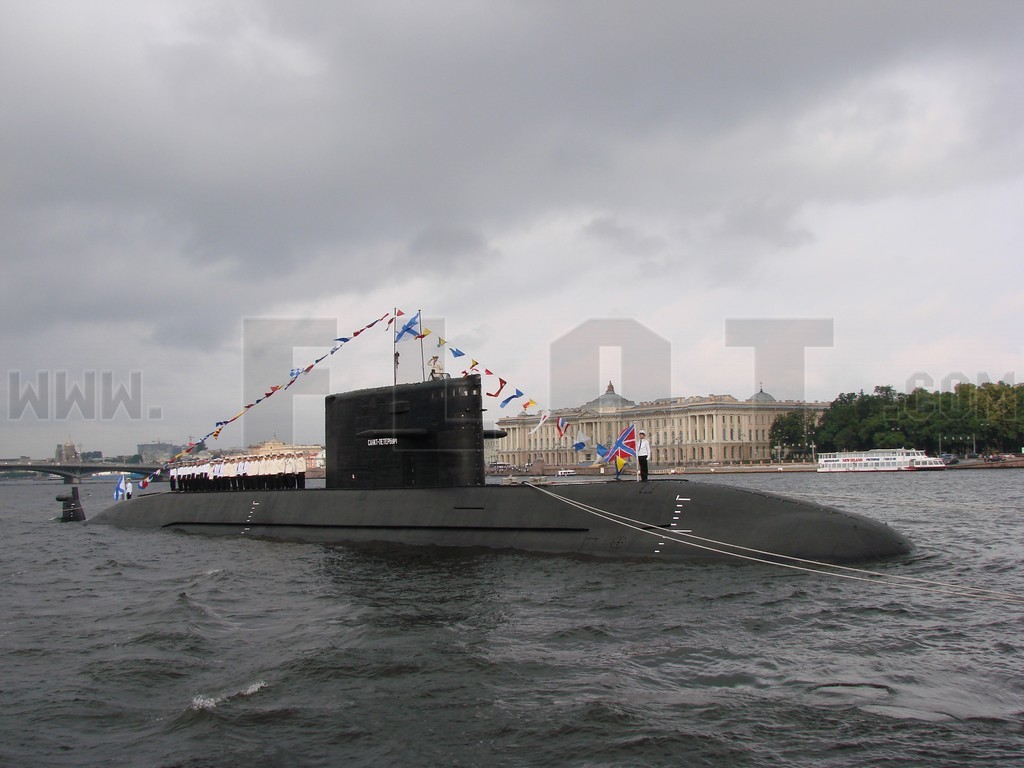
Sankt-Peterburg Submarine in the Bolshaya Neva (photo: http://www.flot.com)

In honor of Navy Day — the 315th anniversary of the Russian Navy’s establishment — here are this week’s sound bites from Navy CINC, Admiral Vladimir Vysotskiy.  RIA Novosti will publish a complete interview with him tomorrow.

Vysotskiy says the Navy expects “not less than eight” proyekt 885 SSNs by 2020.  Some sources maintain the number is six.

Unit 1 Severodvinsk is preparing for sea trials in August, and unit 2 Kazan is expected by 2015.  They’ll have to pick up the pace to get eight by 2020.

Vysotskiy says work on a new destroyer will begin in 2012, and be completed in 2016.  This is the one he suggested might be nuclear-powered.

The CINC’s other comments covered the Black Sea Fleet. 

He claimed the BSF will get six proyekt 636 diesel-electric submarines in the coming years.  Its sole submarine now, proyekt 877 Varshavyanka-class SS Alrosa is currently in the Baltic for repair.

RIA Novosti recalled Vysotskiy’s past comments about obtaining 15 frigates and diesel submarines for the BSF by 2020 in a 60-30 proportion.  He also said a frigate and submarine were specifically laid down for the BSF in 2010, and would be every year henceforth.  He claimed the fleet would be renewed by 2020 through new construction rather than inter-fleet transfers.

Moskovskiy komsomolets and Newsru.com reported on the BSF’s drastic ten-fold decline since 1997.

This week TsAMTO cited a Baltic Fleet press release saying it expects to get the Neustrashimyy-class FF Yaroslav Mudryy, proyekt 20380 Steregushchiy-class FFLs Steregushchiy, Soobrazitelnyy, and Boykiy, proyekt 677 Lada-class SS Sankt-Peterburg, as well as assault ships and other craft.  The BSF may be expecting to get some of these ships as well.

Naval Aviation Chief Interviewed

Hero of Russia, General-Major Igor Kozhin

On Sunday, RIA Novosti interviewed Naval Aviation Chief, General-Major Igor Kozhin on his branch’s 95th anniversary.

The news agency’s recap reminded that Naval Aviation lost its strike assets to the Air Forces on 1 April.  And, by year’s end, all remaining Su-27, MiG-31, Tu-22 and part of its transport aircraft will move to the VVS.  Only land-based ASW and carrier aviation will remain.

Asked about training, General-Major Kozhin focused on cost and retention.  He claimed training a pilot costs a rather exorbitant $1.5 to 2 million annually.  He indicated the need to keep older, experienced personnel — even in a civilian capacity — to train his younger pilots.

On upcoming training, Kozhin said his one regiment of 20 carrier-qualified pilots will conduct 100 takeoffs and landings from the Fleet Admiral of the Soviet Union Kuznetsov in August and September.

Kozhin said Kuznetsov is currently preparing for sea, and there’s no plan for capital repairs even though a replacement isn’t foreseen at this time.

He gave no hint of any impending carrier deployment as rumored earlier this year. 

RIA Novosti asked about renting the NITKA carrier trainer in Ukraine.  Kozhin answered by updating the construction of a similar facility at Yeysk, in Krasnodar Kray.  He said toward fall the takeoff and landing strip will be complete, then landing systems will be installed, and the ground-based carrier simulator will be functional in 2013.  He said the entire Naval Aviation training complex will be finished in 2015.

Finally, on new aircraft, Kozhin said the first four MiG-29K for Naval Aviation could apppear in 2012, but the Defense Ministry will have to sign the contract before mid-August.  Otherwise, the first delivery will be in 2013.  In all, a Navy buy of 20 is planned, but the factory is busy now filling India’s order for fighters for the ex-Gorshkov being renovated at Sevmash.