Category Archives: Officer Corps

Not One of My Generals Looks Down on Me

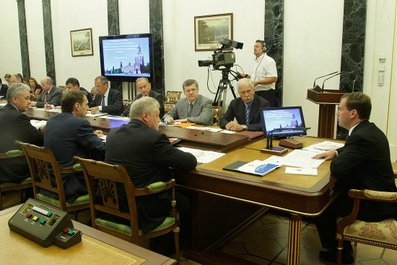
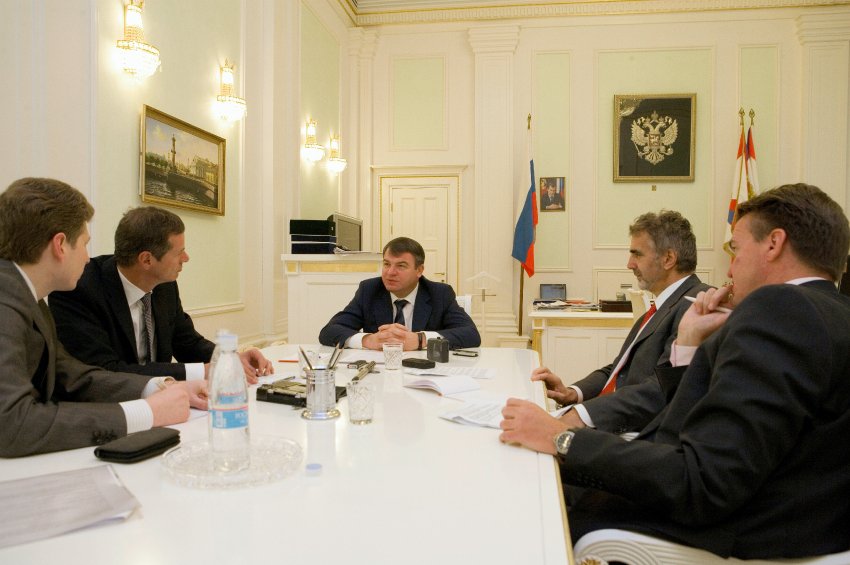
Serdyukov with Der Spiegel (photo: Yevgeniy Kondakov)

Let’s look at Defense Minister Serdyukov’s two most recent media interactions, starting with his interview Sunday on Rossiya TV’s ‘News of the Week’ program.  If anyone finds the video for this, please send it in.  As it is, we have just the wire service snippets.  Better than nothing.  Much of this you will have heard before, but there will be things of interest, so don’t stop reading.

On the army’s winter preparations, Serdyukov said the Defense Ministry has studied the ‘serious emergencies’ [so there were more than just Steppe] in military garrisons last winter, and taken necessary measures to prepare the army for this winter.  He says the army is 98-99 percent ready, so he concludes this winter will go very quietly. 

This is, of course, quite a contrast with what Minregion and Basargin have reported, as well as with Severomorsk’s predicament.  There hasn’t been any press release announcing that the Severomorsk garrison’s utilities debt has been cleared, or that the heat’s been turned on yet.  The Navy had been preparing to move several hundred people from buildings belonging to eight different units without heat.

On allowing parents and public representatives to accompany conscripts to their service locations, Serdyukov had this comment:

“It seems to me this removes a certain tension from both parents and public organizations.  And this worried us enough, therefore we, including commanders, became more seriously inclined to it.”

Serdyukov issued yet another denial of any intent to change the current one-year draft term:

“Once again I want to say we don’t intend to increase the term (of service).  The term is 12 months, and so it will remain.”

He called a professional army a goal “we still can’t allow ourselves.”

He commented, yet again, on Russia’s plans for foreign arms purchases:

“Unfortunately, in recent years, in a number of (cases) and types of equipment we have fallen behind a little.  This, certainly, concerns both armored equipment and communications and UAVs somewhat.  We, naturally, won’t go over to mass purchases of foreign armaments and military equipment, we will only buy that which interests us, in limited quantities, to understand and evaluate those tactical-technical characteristics which they possess, on the one hand, and on the other – to try to formulate for our industry what we want to see from ourselves very soon.”

Serdyukov mentioned again Russia’s desire for two large amphibious carriers from abroad, and confirmed that two more would be built in Russian shipyards using the full technical documentation transferred along with the first two units.

The Defense Minister described a three-stage military reform to 2020:

“In the first part there are TO&E measures, and we have essentially already completed them.  We’ve gone to 1 million (servicemen) in size, of them 150 thousand will be officers, on the order of 100-120 thousand will be professional noncommissioned personnel, and the rest will be conscript soldiers.”

“The second task is, naturally, social issues which we need to take care of for our officers.  And armaments are the third task.  Armaments is a quite lengthy process.  We’ve broken it into two parts:  to 2015 is the first phase and out to 2020 will be the second.  We need to get to these parameters:  by 2015 modern equipment in the army must be not less than 30 percent and by 2025 on the order of 70 percent.  We believe that 2020 will be the completion of the transition to a new profile of the armed forces.”

It looks like Serdyukov is giving more wiggle room on rearmament.  Most reports to date have quoted Defense Ministry representatives saying 70-100 percent new arms by 2020.  Well, perhaps ITAR-TASS heard it wrong.  For this writer’s money, even 30 percent in 2015 looks like a longshot.

Also, not really much to say about those military social issues – and this presumably would be the main focus now since task one’s pretty much done and task three’s a long-term deal.

Even the pretty much completed task one is interesting.  Many press and media outlets seized on this one to finally understand, more precisely, the composition of the armed forces.  So Serdyukov says they’re down to 150,000 officers already.  And with a thinner layer of sergeants, that leaves between 730,000 and 750,000 conscripts at any given time.  But drafting 270,000 semiannually would leave Moscow short by roughly 200,000 conscripts.  Better round up those evaders.  And with all the varying comments, it’s very hard to say if Russia’s at one million men (150,000 officers) yet or not.

But moving on . . . on 27 October Der Spiegel copped an interview with Serdyukov.  It focused on relations and cooperation with NATO, Europe, and the U.S., and Russia’s view of missile defense, but there was stuff on Serdyukov’s reforms.  The Defense Minister told Spiegel flatly:

“As far as weapons go, in recent years, no modern weapons have been bought for the Russian Army.  Our armaments are largely outdated.”

Quite a stark admission he might not make to a Russian magazine.  Perhaps he’s willing to be a little more painfully blunt with a Western publication.

On buying abroad, Serdyukov told Spiegel that Russia can produce everything it needs, but some things are simpler, cheaper, and quicker to get from foreign producers.  He confessed that Russian industry has fallen behind the last 20 years.

Serdyukov goes on to discuss the million-man army, the imbalance in officers and grunts, eliminating corruption, Rosoboronpostavka, and cutting administrative layers. 

Then he’s asked why military men might oppose his changes:

“It’s obvious.  Who wants to lose his job?  Over the coming three years, we will cut the size of the officer corps to one hundred fifty thousand men.  At the same time, we will make service in the army more attractive, in particular, by raising pay.  The attractiveness of army service has now reached the very lowest level.”

Again, are they at 150,000 officers or not?  No one’s clear on this.  And one would think, with all Serdyukov’s efforts, serving might already be a little more attractive.

Asked if he’s worried about a military putsch, Serdyukov said:

“This doesn’t worry me.  We aren’t taking any impetuous measures.”

Of course, impetuous depends on whether you’re on the giving or receiving end of policy.

His interviewers asked if it’s easier for a civilian to conduct reforms in the military.  Serdyukov said:

“I can’t do everything myself.  We are working in a team – the Chief of the General Staff and my deputies.  It’s possible some things are simpler for me to do because I’m not connected to certain traditions and understandings which exist in the army.  I see problems from the outside, and because of this it’s easier for me to ask why we can’t do things differently.”

And finally they asked him if a general can take a civilian seriously, and he replied:

“I can assure you not one of my generals looks down on me.”

Shades of Seltsy perhaps . . . it seems it would have sufficed to say something bland like ‘we have our own spheres and mutual respect’ or we’ve created a two-branch Defense Ministry with civilians occupied with this and military men with that.  But instead Serdyukov comes off sounding like it’s a choice between dominating and being dominated.
Vox Populi

How did readers react to the Vedomosti editorial supporting Defense Minister Serdyukov and his reforms?  Basically, two ways — perhaps about 30 percent expressed qualified agreement, and 70 percent believed it was paid PR written, if not by Serdyukov himself, then by one of his minions.

None of this is scientific, of course.  It’s just an attempt to make sense of 84 posted comments on the article.  Vedomosti is a mainstream, semi-liberal paper (certainly neither far left nor far right) with an educated readership.  Take it for granted that those disagreeing with the editorial were more likely to comment.

With that said . . . let’s look at opponents of the piece.

The thrust of their comments, if it’s even possible to summarize them, boils down to this: 

  • The editorial is part of a ‘special operation’ to rehabilitate Serdyukov and reforms after the Seltsy dust-up (was it really that serious or damaging?), and to head off Achalov’s 10,000-man meeting (which Achalov now says will be more like 5,000).
  • The editorial fails to recognize how demoralized the army is by reforms and a reformer like Serdyukov.  One reader even suggested that, after buying arms abroad, Russia might once again hire foreign officers too.
  • The editorial’s opponents say it’s Serdyukov who’s destroyed the army, and one argued you can only reform the army if you were commissioned a lieutenant and fought in a ‘hot spot.’
  • Finally, less polemical types argued Vedomosti didn’t address the state of the Russian Army’s combat capability under Serdyukov.  One said cutting is not reform, and the division-to-brigade transformation was really no more than a recognition of the true state of affairs in most formations.  Another suggested going to Siberia or the Far East and sounding the combat alarm in a motorized rifle brigade to observe directly how combat readiness has collapsed (of course, maybe that’s why this year’s training is to focus on small units).

The comments of those who agree with the editorial actually mesh up kind of nicely (at least for purposes of contrast) with those above:

  • The army was destroyed in the 1990s by its own bloated cadre officer corps that turned into a band of uniformed profiteers (but were they any different from other Russians at that time?).  This generals’ mafia was capable neither of defending the country nor returning conscript sons home safely to their mothers.  One reader said the near-disaster in South Ossetia only confirmed the correctness of Serdyukov’s direction.
  • These readers said the right civilian makes a good Defense Minister.  One compared Serdyukov (once again) to Robert McNamara.
  • Another reader said he supports Serdyukov, but he still can’t tell if Russia’s combat readiness or the effectiveness of its defense expenditures is higher under him or not.
  • A final reader wants to give Serdyukov a chance and more time to see if he can improve the country’s defense capability.  He says he was a conscript in 2000-02 and only fired his weapon three times during that period.

Serdyukov’s Carte Blanche

In an editorial Monday, Vedomosti supported the carte blanche President Dmitriy Medvedev has apparently given Defense Minister Anatoliy Serdyukov and his military reforms.  The paper likes the reforms enough that it wants the President to think about the possible effectiveness of the ‘army method’ in reforming the MVD.  Here’s what Vedomosti had to say:

“Renaming the Army”

“Dmitriy Medvedev’s and Anatoliy Serdykov’s joint trip to a model Moscow suburban military unit went beyond the protocol of the visit.  The President’s speech in awarding outstanding military men became a new signal to officers, the army, and society:  ‘Despite the fact that all changes are difficult, they are necessary…  Everything that is now being done is directed at establishing modern and effective armed forces.  Here there are both problems and good decisions, I am following this personally as Supreme CINC.’  The Kremlin demonstrated that, despite the recent media scandal, it trusts the civilian Defense Minister, won’t bow to the generals’ and veterans’ opposition, and intends to continue its planned military reform.”

“The new carte blanche for Serdyukov for further transformation is important for many reasons.  The current minister is not the first civilian director of the military department.  However, he specifically replaced a campaign of reforming with systematic transformations.  In his inheritance from Sergey Ivanov, Serdyukov received a much truncated army of the Soviet type, not answering modern requirements.  Dedovshchina, obsolete armaments (modern equipment is not much more than 10% of the general inventory) and command and control, and manning were its main problems.  Add to this corruption among the generals which prevented equipping the army with new types of armaments and communications.  The victorious August war of 2008 showed that the victors couldn’t suppress the enemy’s aviation and artillery and were inferior to the vanquished in modern communications and reconnaissance means.”

“Serdyukov’s attempts to establish control over expenditures on purchases for the army met severe resistance from rear services officers and generals.  Not long ago he acknowledged to journalists:  ‘When I came to the Defense Ministry, speaking plainly, I was surrounded by large amounts of thievery.  Financial licentiousness, the impunity of people whom no one had checked out (…) was so deeply ingrained that it had already become a way of thinking.’  The minister confirms that the transparency of the defense order is a ways off.  The unnecessary secrecy of the military budget is interfering with this.  Meanwhile, progress in the struggle against traders in shoulderboards is obvious.  In 2006, corruption cases were started against seven generals, in 2007, when Serdyukov became minister, — against 16, in 2008 — against 20, in the first half of this year — against eight more.”

“Besides this, the Defense Ministry put up for sale unneeded property and facilities which were being illegally rented out to enrich a few people, and didn’t allow for building apartment blocks for officers needing housing on these grounds.”

“On the whole, it’s possible also to consider organizational transformations a success:  the transition to a more modern system of command and control and the reduction in the excess number of generals and higher officers.  In 2008, of 249 generals and admirals who underwent certification [аттестация], 50 were dismissed, and 130 sent to new places of service.  One can’t avoid mistakes in cutting and dismissing officers, but those deprived of a sinecure cried loudest of all about the collapse of the army and treason.”

“The struggle with barracks hooliganism goes on with varying success.  According to the Main Military Prosecutor’s data, in 2006, more than 5,800 people suffered beatings from fellow servicemen, in 2009 — 3,000.  And for the first five months of 2010, 1,167 soldiers suffered from dedovshchina — 1.5 times more than the analogous period of 2009, of them, four died.  The cause is not only in the growth — because of the cut in the service term — the number of new conscripts went from 123,000 in the fall of 2006 to the current 270,600.  Generals, having botched the program costing 84 billion rubles to transfer to contract, now are forced to call up those with criminal records.  Military police will remain a paper tiger for ‘dedy’ and ethnic clans.  We note that Serdyukov hasn’t forsaken a professional army, but put off its creation until the time when the Defense Ministry will be able to select and not collect contractees through deception and duress.”

“Nevertheless, it’s notable that over 3 and 1/2 years, the reform, being conducted by independent managers without legal changes and loud renamings, has really moved forward.  It’s possible it’s worth the President considering the effectiveness of the army method in reforming the MVD.”

Larger Significance of the Serdyukov Flap

Pavel Felgengauer

You’ll find bits of the following by Pavel Felgengauer in various English language articles, but not his full argument as laid out here.

Writing in Novaya gazeta this week, military commentator Pavel Felgengauer concludes that Defense Minister Anatoliy Serdyukov remains in place, but the army’s problems are growing.  He says:

“Today a dangerous situation of general decay in discipline and order is taking shape which could lead to a loss of control over the armed forces.”

The slow disintegration of the Soviet Armed Forces required Serdyukov to take immediate, radical, and often not well thought out reforms, according to Felgengauer.  Mass officer and warrant officer dismissals have put 70 thousand outside the TO&E “at the command’s disposition,” essentially just waiting for dismissal.  Only 10,000 are junior officers whom the Defense Ministry owes little by way of benefits.

A bit of explanation that Felgengauer doesn’t give you.  We haven’t had any independent observer put this number so high.  These 70,000 are waiting for housing because, by law, surplus officers can’t be discharged until they get permanent apartments.  But they aren’t living on much while they wait.  Because they don’t have duty posts, they get only rank pay, not various monthly supplements that officers in active positions get.  Rank pay might be only 30 percent of what they received when they were in the TO&E.

But back to Felgengauer.  He turns next to NCOs.  He says experts say, with a million-man army and 150,000 officers, the Russian Armed Forces need 200,000 or 300,000 sergeants.  But in Serdyukov’s ‘new profile’ TO&E, there are billets for only 90,000 contractee-specialists and NCOs together.

And these are the guys who’re supposed to help the shrunken officer corps keep order in the ranks.

Felgengauer then recites the Main Military Prosecutor’s announcement that barracks violence is up 50 percent in 2010.  He says incidents of open ‘hooliganism,’ criminal violence, and inter-ethnic conflict are all rising.  And only a declining number of officers is there to hold all this together – with the help of an inadequate NCO corps.  This is why, says Felgengauer, the Soviet officer corps relied on dedovshchina as a lever to keep order among the troops.  He may be suggesting Russian officers are doing the same thing now.

He concludes many are dissatisfied with this state of affairs, and they all focus blame on Serdyukov, somewhat unfairly, according to Felgengauer.  Criticism is focused on the man who actually tried to fix Russia’s decaying defense department, and not his predecessors who drove it to ruin.

Of course, one could ask Felgengauer isn’t this the fate of all reformers?  Maybe those being reformed were happy with the decaying and ineffective bureaucracy and forces that were comfortable, and perhaps profitable, for them.

Felgengauer returns to the issue of attempts to train NCOs.  Instead of officers, military schools are supposed to prepare sergeants instead.  But only the erstwhile Ryazan Higher Airborne Command School is actually doing it, and, ironically, this is where the storm over Serdyukov arose.

Felgengauer concludes that Putin and Medvedev agreed with Serdyukov’s reforms, and so they aren’t ready to dismiss him now.  But the problems and tensions surrounding the Defense Ministry are growing.

In a kind of postscript, Felgengauer sees the decision for military police as something of a ridiculous answer to disorder in the army.  First, they will be selected from the ranks of the most disgruntled – the dismissed officers.  The concept behind using some ‘dissatisfied-dismissed’ to keep order among other dissatisfied is just a little inscrutable.  And, in the best case, it’ll take over a year to change all the laws and regulations to allow military police to operate.  Will Serdyukov and his reforms remain intact by then?

Bad News for Would-Be Officers

Future Officer, or Sergeant? (photo: RIA Novosti / Valeriy Titiyevskiy)

There’s no better time for bad news about changes in military education than the beginning of Russia’s academic year.

The Defense Ministry said Monday it’s stopping induction of cadets into military higher educational institutions (VVUZy or ВВУЗы).  And new students will not matriculate next year either.

There’s no doubt there’s lots of excess capacity that needs to be cut from Russia’s military education system, but, as usual, there seems to be more angst about the way the process is being managed than about the need for some kind of change itself.  The Defense Ministry is trying to ram many young men who signed up to be officers into sergeant’s billets, and generally changing the rules in the middle of the game.  There’s no doubt large numbers of VVUZ professors and other teaching staff will be pushed out of the service, but the Defense Ministry is denying this for now.  Perhaps most interesting, RIA Novosti elected to editorialize on this issue, saying it exemplifies the Defense Ministry’s, and the Defense Minister’s, poor way of dealing with the public and presenting its initiatives.

Deputy Chief of the Defense Ministry’s Main Personnel Directorate (GUK or ГУК), Tamara Fraltsova (who doubles as Chief of the Military Education Directorate) made the announcement during a video conference marking the opening of the Presidential Cadet Corps in Orenburg.  Specifically, she said:

“In the course of this year and next, the Defense Ministry is refraining from selecting cadets for its VUZy.”

“This is connected to an overabundance of officer personnel and a deficit of officer positions in the Armed Forces.”

“At present, graduation of cadets exceeds the officer positions we have in the Armed Forces by four times.”

In other words, the military educational system is still too big, and needs more cuts.  There are 56 teaching institutions in all – VVUZy and their branches (filialy). 

The ‘overabundance’ of officers is part and parcel of Defense Minister Serdyukov’s ‘new profile’ reforms in which officers are being reduced to 150,000 from well in excess of 300,000 in late 2008. 

Fraltsova has previously indicated VVUZy would be cut further and unified into ten ‘inter-service scientific-training centers.’  Duplicative or overlapping specialty training will also be eliminated.

Izvestiya reported that Fraltsova said the military education system is still configured to support a 4-million-man, rather than a 1-million-man, army.

Nevertheless, Fraltsova maintained that all 15,000 VVUZ graduates were placed in military billets last year.  But she didn’t say what kind of billets.

Krasnaya zvezda quoted her:

“. . . there is a chance for higher quality manning of the Armed Forces.  So, the requirements for future officers must be stricter.”

“There is a need for a review and selection of military specialties, according to which education in military VUZy is provided.  Part of [these specialties] will be transferred to the civilian ranks, part will go into to the duty category of sergeant personnel.”

There’s been media reporting for months that any cadet receiving even a single ‘2’ – an unsatisfactory mark – is now drummed out.  But this doesn’t eliminate many – 70 percent of cadets graduate without ever getting even a ‘3,’ according to the Defense Ministry.

Writing in Komsomolskaya pravda, Viktor Baranets indicated that only 100 of 600 lieutenants who arrived in the Pacific Fleet got officer jobs, and, in Voronezh, only the very top-ranked graduates found officer posts in the Air Forces.  About 20 percent of cadets normally graduate ‘with distinction.’  So the remaining 80 percent either accepted a sergeant position, or immediate dismissal into the reserves and the civilian world.  

Grani.ru reported that most graduates of the Defense Ministry’s Military University – a social sciences institution located in Moscow – got a ‘free diploma’ and an immediate discharge.   

According to Izvestiya, Fraltsova said there are only 5,000 command positions in the Armed Forces against an influx of 15,000 newly-commissioned junior officers.  The paper quotes her:

“Let them compete for what they will get.  The rest simply received a free higher education.  In my opinion, this is fair.”

She claims these changes are improving student performance, and she wants to use competitive ratings to make initial officer assignments.

She dismisses worries about the impact of cadet reductions on VVUZy teaching staffs because, in many cases, they’ll be busy teaching noncommissioned officers.  Some will be one-year conscript sergeants, and others three-year contractees getting nearly 3 years of post-secondary schooling.

Fraltsova revealed that 60 percent of VVUZy already teach on a ‘for-profit’ basis, and this will fully employ their instructors.

The effects of officer corps cuts, and VVUZy cuts, have rippled down to Russia’s venerable Suvorov and Nakhimov schools.  Without places in VVUZy, these young men will have to seek spots in other power ministry academies, if they want to be officers.  Premilitary Suvorov and Nakhimov schools now have to compete for students with the new Presidential Cadet Corps, which are supposed to train youth for the civil service in each federal district.

Forum.msk’s Anatoliy Baranov remarked that Fraltsova and her ilk “will suddenly observe in 10-15 years that everyone in higher military institutions has died, and there is no one and no way to teach new officers.”  Leonid Ivashov told Gzt.ru simply, “We are witnessing the destruction of Russian military education.”

RIA Novosti published surprisingly stark criticism of Fraltsova’s (and Serdyukov’s) performance. 

First, it quoted her:

“. . . not everyone in Russian society is sympathetic to this initiative.  Yes, these are very severe measures, not many like them, and we are being subjected to criticism for this decision.”

The news agency said Fraltsova’s press conference left the media with the impression that the Defense Ministry still doesn’t know what to do about the military education system.

It called the halt in VVUZ induction a ‘radical step,’ which calls attention to the Defense Ministry’s secretiveness in making important decisions.  The agency complains that, since 2008, when the ‘new profile’ started, the media and society have learned about most changes after the fact.  Veterans and other social groups have written to Serdyukov asking to give input, but it’s not clear their letters are even answered.  RIA Novosti concludes, in this case, the military department has once again ‘stepped on a rake.’

Yesterday Deputy Defense Minister, State Secretary Nikolay Pankov went on TV in damage control mode, saying these changes are intended to improve military education as well as to save money.  He intimated there will be lots more pain in going from 56 to 10 institutions.  Pankov said 20 percent of this year’s 10,000 VVUZ graduates will become sergeants instead of officers, but the Defense Ministry will keep these reluctant NCOs in mind if officer billets come open.

Winners and Losers in Organizing New MDs and Armies

Today a Ground Troops spokesman told ITAR-TASS three current Leningrad Military District (MD) brigades will form a 6th Combined Arms Army (CAA) in the new Western MD.  The 200th, 138th, and 25th Motorized Rifle Brigades will comprise the new army, and its headquarters will probably be Agalatovo, just north of St. Petersburg.  The spokesman also said a surface-to-air missile brigade and independent engineering brigade will be added to the Western MD.

These comments came in conjunction with a visit by Ground Troops CINC, General-Colonel Aleksandr Postnikov to the region to check on the formation of the new MD.  The spokesman said Postnikov may be working on peacetime coordination between the district’s Ground Troops, the Northern and Baltic Fleets, and Air Forces units.  He said, in wartime, “everything’s clear – [the district’s] commander directly commands everything deployed within the district’s boundaries.  But there’s still no experience of coordination in peacetime and we need to get it.”

Nezavisimaya gazeta’s Vladimir Mukhin also wrote today that the third new CAA will be based in Maykop, Southern MD.  Mukhin says that staffs, commands, formations, and military units in the Far East, Siberian, and Moscow MDs are being liquidated in the shift to four new MDs / OSKs, and, as a result, several thousand officers will be placed outside the TO&E beginning 1 September.  He thinks many of them won’t find vacant posts, and will be discharged from the army.

Serdyukov’s Defense Ministry will also be putting some soon-to-be-vacant properties up for sale, e.g. Moscow MD headquarters (Polina Osipenko Street, Moscow), Far East MD headquarters (Seryshev Street, Khabarovsk).  The initial asking prices for these buildings and land will be several billion U.S. dollars.  As long planned, proceeds from these sales, along with the sale of the Navy Main Staff, military educational institutions, and other military establishments in Moscow, are supposed to fund construction of housing for servicemen as well as military garrison infrastructure in new army deployment locations.

Mukhin talked to General-Lieutenant Yuriy Netkachev about Maykop.  Netkachev says Moscow is resurrecting the army headquarters located there until 1993.  He believes Maykop was chosen to reinforce against threats from Georgia as well as threats to the 2014 Winter Olympics in Sochi.

In the Central MD, Mukhin says the 67th Spetsnaz Brigade will move yet again, from IVVAIU in Irkutsk to Chita or Transbaykal Kray.  The IVVAIU building will be sold.

Mukhin sees Moscow’s demilitarization and moving forces closer to their likely operational theaters as the right policy, but asks if it’s underpinned with resources.  It has serious impact on servicemen and their families, and they’ve been forgotten in this process.

Mukhin quotes servicemen’s union chief Oleg Shvedkov:

“Continuing steps to transition the troops into a new profile supposes not only a significant cut in professional servicemen, but also their relocation to a new place of service.  And this means new everyday life problems are possible:  transfers, absence of housing, work for spouses, education for children, and the like.  The Defense Ministry is trying to resolve these issues on its own, but it would be more correct for the government to work on them through a special federal program.”

President’s Tough Talk to Defense Minister Serdyukov

Medvedev at Security Council Meeting

Let’s look at President Dmitriy Medvedev’s criticism of the Navy and the Defense Ministry, his warnings and dismissals of some Navy officers.  It looks somewhat like a script torn from Vladimir Putin’s ‘tough guy’ handbook. 

Kommersant recounted the details of what sparked the President’s ire.  On 29 July, a fire burned the 2512th Central Aviation-Equipment Base of Naval Aviation and Air Defense near Kolomna, several dozen kilometers southeast of Moscow.  The Prosecutor’s Investigative Committee (SK) said the blaze destroyed the staff headquarters, finance unit, club, two bays of vehicle parking, 13 warehouses with various items of aviation equipment, and 17 open equipment storage stands with vehicles on them. 

Medvedev addressed yesterday’s Security Council meeting: 

“I instructed the Defense Ministry to take part in the firefighting effort and help to protect the civilian population, but sadly, in a number of cases, the ministry has proved unable to protect itself.  A fire took place in Moscow Oblast that has caused very serious damage.  The ministry has already carried out a preliminary internal investigation, and the investigation will continue of course.  The evidence so far indicates that this is quite simply a case of neglect of duty and criminal negligence, when personnel failed to bring under control a fire that was not spreading particularly fast, and no one even knew where the base’s commanders had gone.  I have therefore taken the following decision.”      

“Regarding the Navy’s senior command:  Navy CINC Admiral Vysotskiy has been warned about not fulfilling his duties; Chief of the Navy Main Staff and First Deputy CINC  Tatarinov has been warned about not fulfilling his duties; Deputy Chief of Navy Rear Services Sergeyev is dismissed; Chief of Naval Aviation Kuklev is dismissed; Deputy Chief of Naval Aviation Colonel Rasskazov is dismissed; Acting Deputy Chief of Naval Aviation Rear Services Monakov is dismissed; the chief of base 2512 is dismissed.”  

“I am also instructing the Defense Ministry to dismiss a number of other officers and personnel for disciplinary violations.  If anything similar happens in other places and other departments I will do exactly the same again, and without the slightest regret.” 

After discussing the fire situation with other ministers, Medvedev turned back to Defense Minister Serdyukov later in the meeting: 

“Now the Defense Ministry.  I already announced certain decisions.  The Minister needs to take everything under direct control.  Conduct a meeting today with the Ministry’s leadership and say that, if anything else like this burns, everyone will answer for it.” 

“Are there any concerns about the current situation?” 

Serdyukov responded saying plans have been made, operational groups established at all command levels.  Personnel and equipment have been put at the disposal of MChS and regional authorities.  And he noted that Deputy Defense Minister, General-Colonel Dmitriy Bulgakov is his point man for the fire emergency. 

Medvedev chided Serdyukov because the Vladimir Oblast governor had to go to the Defense Ministry for help instead of suitably empowered local commanders. 

Serdyukov said ‘corresponding’ orders have gone to all commanders and garrisons.  He continued with the Defense Ministry’s support of MChS — 11,000 servicemen, thousands of pieces of equipment, 33 kilometers of water pipelines laid in four rayons.  After Bulgakov’s visit to the Federal Nuclear Research Center in Sarov yesterday, another two battalions and special equipment were allocated to efforts there.  Serdyukov said another 28,000 troops can be brought into firefighting in the Central Federal District within 3-12 days. 

Serdyukov concluded: 

“We are taking all steps in full measure, we reinforced all facilities (there are 164 of them, but in immediate areas where there are fires there are 22) behind every responsible commander.  We are conducting all measures there:  increased volumes of water reserves for extinguishing fires, equipment has been brought in, extra personnel, everything literally transferred into a barracks condition, therefore all necessary steps for this, in fact, have been accomplished.  Therefore I submit that this sad incident that happened at base 2512 will not be repeated.” 

Kommersant helped out with a full run-down on the ranks and names of the lesser known Navy officers:  Rear-Admiral Sergey Sergeyev, General-Major Nikolay Kuklev, Colonel Sergey Rasskazov, Colonel Sergey Monakov, and Base Chief Colonel Viktor Biront. 

RIA Novosti covered Serdyukov’s firing of other officers at the base.  They included:  Deputy Base Chief Major R. Gidayatov; Deputy Chief Main Engineer Lieutenant Colonel V. Marchenko; Support and Security Company Commander Major A. Yermolov; Chief of the Material-Technical Support Department V. Karandak; and Chief of the 7th Storage Department V. Melsisidenkov. 

Today the SK said a criminal negligence case has been initiated.  Gazeta ru said, per usual Russian practice, top officials have blamed lower-ranking ones, in this case Navy officers, allowing the ‘untouchables’ to demonstrate their toughness and avoid responsibility.  Kommersant noted that the warnings for Vysotskiy and Tatarinov are just a step from dismissal.  But history shows other general and flag officers have gotten such warnings and still moved forward in their careers. 

Gzt.ru broached the subject of whether this could provide Medvedev an occasion to purge the Defense Ministry and fill it with his ‘own people.’ Konstantin Sivkov and Aleksandr Konovalov agree that he could use this opportunity.  But one has to ask, does this make sense in the scheme of tandem politics?  Medvedev has changed few in the cast inherited from Putin, and he’s very unlikely to start with a stolid Team Putin guy like Serdyukov.  Especially when he appears to be the first man to make some real headway in fixing the post-Soviet military.

Kramnik on Vostok-2010 and Military Reform

This is complete finally.

Ilya Kramnik’s RIA Novosti piece about the exercise has been quoted by others, but it hasn’t gotten attention as a whole on its own.

So what does Kramnik think?  He cites Makiyenko to the effect that Vostok-2010 showed that reform has been positive for the army, but there are, of course, problems.  Troops aren’t uniformly well-trained, and the failure of contract service has really hurt.  But Kramnik gives Defense Minister Serdyukov a lot of credit, on the order of being a 21st century Milyutin.  But back to the problems again.  Things like contract service, tension over officer cuts and premium pay, military education cuts, and the failure to deliver new weapons have to be fixed.  But Kramnik believes Serdyukov is the kind of guy who’ll go back and fix what he didn’t get right or get done.  Then Kramnik shifts to the type of conflict the military reform is preparing the Russian Army to fight.  Obviously [?] not a nuclear one, but rather, again turning to Makiyenko, a Central Asian local war scenario that might threaten the RF’s internal stability.  The conclusion is that, if reform stays on track and occurs quickly, the army will be able to meet this challenge.  Some, however, might well argue that even a properly and rapidly reformed Russian Army might not be enough to contain and damp down the kind of conflagration Makiyenko describes.  Finally, Kramnik concludes that even the U.S. front isn’t secure; an American regime in 2012 or 2016 might take to renewed active support of new ‘color revolutions’ in Moscow’s back (or front) yard.

Here’s a verbatim text:

“The official results of the just ended ‘Vostok-2010’ exercise are still being reckoned, and this will be done by the Defense Ministry.  Meanwhile, it’s already possible to make some conclusions.” 

“‘Vostok-2010’ was the largest of all in the post-Soviet period of Russian history.  More than 20 thousand men, 75 aircraft, 40 combat and auxiliary ships took part on the ground, in the air, and at sea in maneuvers conducted from Altay Kray to Vladivostok.”

“The aim of the exercise was to check the three-level command structure — operational-strategic command – operational command – brigade, and other new elements in the Armed Forces command and control and support system, and to uncover deficiencies needing correction.  An expert of the Russian Center for the Analysis of Strategies and Technologies Konstantin Makiyenko expressed his opinion on the recent maneuvers:  ‘The recent maneuvers fully refuted the propagated myth about how the army is being destroyed as a result of the actions of the current Defense Ministry leadership.  It’s obvious the army is alive and developing.  Units participating in the exercise demonstrated their combat capability, despite the fact that they are not in the ranks of the best military districts, and scarcely armed with the most modern equipment.'”

“‘It’s especially worth focusing on the good morale of the officer personnel — it’s not possible to speak of general enthusiasm, of course, but I didn’t see dim eyes among the officers.  As a group, they are interested in the success of the current reform and hope for its success.'”

“While agreeing with this point of view, one has to note that the situation with soldiers looks a little different, both RIA Novosti’s reviewer [Kramnik] and Konstantin Makiyenko have also noted this.  Very much depends on the branch of troops and the basic training of the soldiers themselves.  Contract-servicemen in a ‘Tochka-U’ operational-tactical missile launch battery look and are trained much better than conscript-soldiers in motorized rifle units.  In the words of motorized rifle officers up to the battalion commander level, the reduction in the number of contractees has negatively affected platoon and company training.  Ideally, the service term of a specialist-soldier (mechanic-driver, weapons system operator, etc.) needs to be three years, that is achievable only on the contract manning principle for these positions.”

“Speaking about the attainability of the announced goals of the reform, one can say the following:   the will of the military leadership which certainly exists, is the main component of success, a firm understanding of the goal is also obvious, and the possession of authority — it’s not possible to doubt this.  As a result, the current Defense Ministry leadership needs only time to realize its ideas.  Overall, the military reform being conducted is the most significant event of Russian history in the last ten years — since the suppression of the separatist rebellion in the North Caucasus.  The Serdyukov-Makarov reform in the military sphere is the most radical and deepest since the time of Mikhail Frunze’s reforms in the 1920s, if not since Dmitriy Milyutin in the 1860s and 1870s.”

“As proof, it’s possible to note the fact that the Defense Ministry leadership is constantly searching and ready to correct those steps which, when checked, turn out to be incorrect or unattainable in real political-economic conditions.  So, the current principles of manning the army will undergo a serious correction:  it’s obvious that neither the organization of contract service, nor, even more, the existing format of conscript service corresponds to the demands of the time.”

“Evaluating the correspondence of the Defense Ministry leadership to its missions, it’s possible to say, that at present Russia has the most appropriate military leadership since the collapse of the USSR.  At the same time, it’s obvious that the radicalism of the reform, the compressed time of its implementation, unavoidable resistance in the environment and hard economic conditions didn’t allow for avoiding a large number of mistakes and excesses.  Among the most fundamental failures it’s possible to name the collapse of the army’s transition to the contract manning principle, serious social tension arising in connection with the rapid reduction of officer personnel, the ambiguous situation with the scale of servicemen’s complaints after the introduction of the differential pay system [premium pay or Serdyukov’s Order No. 400?], the hurried and not completely thought out reform of military education and many, many other things.  It’s  particularly worth focusing on the implementation of the state armaments programs which fail one after another, not being executed in a significant part.  As a result, the lag of Russia’s Armed Forces behind the most developed countries in the level of  technical equipping continues to grow such that in conditions of a quantitative lag it could become very dangerous.  All these mistakes have to be corrected, since they impact on rudiments of the army’s combat capability.”

“For what type of wars does Russia’s new army need to prepare?  Obviously, the time of long wars between the great powers has gone into the past — nuclear weapons haven’t left chances for such a development of events.  The most probable type of conflict in which the Russian Army will be involved is a local conflict on Russia’s borders and the territory of the former USSR, in the course of which there could be clashes with the most varied enemy:  from a regular army to many bandit formations and terrorist groups.”

“In Konstantin Makiyenko’s opinion, Central Asia presents the greatest danger in the future of a possible hot conflict with Russia’s direct participation:  ‘The U.S. and NATO, obviously, are less and less controlling the Afghanistan situation, and it’s not excluded that in the foreseeable future they may have to abandon this country.  The return to power in Afghanistan of the ‘Taliban’ movement looks most realistic in the event of such a development of events.  The arrival of Islamic radicals in power would unavoidably be a catalyst for conflicts on the territory of former Soviet republics of the region already riven by contradictions.  Weak authoritarian regimes in Tajikistan, Turkmenistan and Uzbekistan, not to mention what’s become the ‘failed government’ in Kyrgyzstan, could be easy prey for the Taliban.  As a result, Russia might be forced to consider the likelihood of a large Asian conflagration which it would have to prevent, or if it didn’t succeed — extinguish, at a minimum with the aim of preserving its own internal stability.  One very much wants to believe that the reform will bear fruit before the described situation becomes a reality.'”

“Besides the described scenario it follows to study also the probability of another development of events:  as experience has shown, on the territory of former USSR republics, the rise of openly anti-Russian regimes with external support at their disposal can’t be excluded.  For today, such a situation is a low probability due to the fact that the current administration in the U.S. — the main sponsor of ‘colored revolutions,’ is clearly not inclined to continue the policy of George Bush.  However by 2012, if President Obama loses the election, the situation could change, and this risk is even greater in 2016 when the administration will change in any case.  Meanwhile, you have to note that even the Democrats remaining in power in the U.S. is not a guarantee of a peaceful life:  Obama’s point of view on a coexistence format with Russia is hardly shared by all his fellow party members.  In the worst case, a return to the next variant of Cold War and new spiral of the arms race isn’t excluded.”

“The coming decade isn’t promising Russia an easy life.  The success of military reform is all the more important.”

Not Enough Officers in ‘New Type’ Brigades?

In today’s Vedomosti, Aleksey Nikolskiy writes that Vostok-2010 has revealed a problem with officer manning in Russia’s ‘new type’ brigades.

In the course of the exercise, practically all SibVO and DVO permanent readiness units have been ordered to training ranges to test out their new TO&E and train their higher-level command elements.

Nikolskiy says:

“In the words of an officer of one of the motorized rifle brigades participating in the exercise, the new structures sent to the troops at the end of 2008 after the beginning of Armed Forces reform showed that officer manning and supply services are extremely inadequate, for this reason part of the brigades’ forces — for example, air defense means — can’t physically reach the training range.  There were bigger problems also with material support of the troops.”

Vedomosti’s source also says the troops are expecting new brigade structures in August that, according to the rumor, will contain even fewer officers.  A brigade’s officers will reportedly be halved, from 200 to 100, and this will just make the situation worse.  However, an officer from the Defense Ministry’s central apparatus says the new structures are being prepared based on the shortcomings of the exercise, and, if it’s decided there aren’t enough officers, their number will increase.

Step Closer to Four OSKs Instead of 6 MDs

ITAR-TASS reports today that the reform of the operational-strategic level of command and control has entered its final phase.  According to the Genshtab’s plan, on 1 December 2010 military districts (MDs) will shrink from 6 to 4.  A Genshtab source told ITAR-TASS that 4 MDs and operational-strategic commands (OSK or ОСК) will be formed–Western, Southern, Central, and Eastern, with their commanders having operational control over all (or most) of the troops (forces) of the armed forces and other militarized structures located on their territory.  

The Genshtab representative says the Western MD/OSK, based in Piter, will include the Moscow and Leningrad MDs, with Baltic and Northern Fleets, VVS, VDV, and other militarized structures operationally subordinate to it.  The Southern MD/OSK in Rostov-na-Donu will have the North Caucasus MD, with the Black Sea Fleet and Caspian Flotilla operationally subordinate.  The Central MD/OSK in Yekaterinburg will have the Volga-Ural MD and the western part of the Siberian MD.  The Eastern MD/OSK in Khabarovsk will have the eastern part of the Siberian MD and the Far East MD, with the Pacific Fleet operationally subordinate to it.

The question of subordinating units and formations of the RVSN, naval strategic nuclear forces, LRA, and the Space Troops hasn’t been decided.  According to the source:

“This issue is now under long-term study, Genshtab Chief Army General Nikolay Makarov is personally occupied with it.”

The Genshtab source said the new MD/OSKs will be tested out during the Vostok-2010 operational-strategic exercise at the end of June.

ITAR-TASS said this major command change will not involve officer cuts, but there will be a redistribution of the officer corps to new service locations.

So there’s more smoke from a fire somewhere, presumably.  If this pans out, it will be the culmination of a command and control change long talked about, and even tried out piecemeal at times.  After many waves of reform since late 2008, one has to wonder whether this is the time for more disruption.  Maybe it is since things are already disrupted.  Which generals will be the winners or losers?

It will be hard to judge the value of this effort just from the name changes or the movement of a major combined formation from one order-of-battle column to another.  A lot will depend on what the exact terms of ‘operational subordination’ are when it comes to the fleets and other major militarized formations outside the Defense Ministry’s administrative control.  The four MD/OSK commanders will certainly have more responsibility, and they must be hoping and working to get the real authority they need to go along with it.