Category Archives: Serdyukov’s Reforms

Sharp Cut in Contract Soldiers Coming

In the wake of General Staff Chief Makarov’s February admission that professional contract service had failed, a Defense Ministry source told Interfaks last week that contractees in noncombat positions will be sharply cut.  According to Newsru.com:

“It’s planned that by 1 July of this year only those specialists affecting combat readiness of military sub-units will remain in contract positions.”

He said this means combat vehicle commanders, driver-mechanics, gunner-operators, and other specialists, and civilians or conscripts will fill other contractee posts.  Lenta.ua noted the source didn’t specify how many contractees would be released or how many would remain.

Some of data cited referred back to a Vedomosti editorial about two weeks ago.  It said, under the 2003 Federal Targeted Program “Transition to Manning by Servicemen Conducting Military Service on Contract in Some Formations and Military Units” for 2004-2007, professional contract soldiers in permanent readiness units were to increase from 22,000 to 147,000 by 2008, and from 80,000 to 400,000 in the armed forces overall.  But in reality, there were only 100,000 in permanent readiness units by 2008, and only 200,000 in the Defense Ministry overall.  Meanwhile, the effort cost 84 billion rubles.  Vedomosti concluded:

“It seems the generals could not fulfill (or sabotaged) the directives of the country’s highest political leadership in peacetime.  Who will guarantee that the generals’ disobedience won’t be repeated in an emergency situation?”

“The Defense Ministry could not organize or make professional service in the army attractive and it sees as a way out stuffing the developing hole with a growing number of conscripts.  It’s understandable that the quality of these one-year draftee soldiers will be lower than that of contractees.”

“The abandonment of the move to a professional army promises many dismal consequences for Russia’s future.  Drafting 27-29-year-old higher educational institution graduates, who are in professional demand, could deliver significant damage to the economy and scratch the country’s modernization.”

So what is to be done?

This spring the Defense Ministry floated several trial balloons to answer its manpower problems.  As Parlamentskaya gazeta reported, the chief of the Genshtab’s GOMU, Vasiliy Smirnov told the Federation Council last month that he wants to increase his conscription base by reducing student deferments, raising the upper limit of the call-up age from 27 to 30, lengthening the semiannual callup until it becomes almost perpetual, and requiring young men to report to voyenkomaty without a summons.  Reportedly, the Kremlin has approved some or all of these proposals.

The Genshtab has proposed cutting the number of VUZy with the right to provide students deferments.  Even though deferments were trimmed in the recent past, Russians still have 21 legal ways to postpone their military service.  Smirnov claimed over 2 million draftees, more than 60 percent of the overall number, legally ‘dodge’ the army with deferments, the vast majority of which are educational deferments.  He continued:

“The number of higher educational institutions in which study is a basis for the right to a draft deferment from military service has to be reduced in stages.  Already this year it would be advisable to cut the number of VUZy having the right to a deferment in half or even by 70 percent, keeping that right only for educational institutions having a state order.  An alternative option could be having students perform conscripted service after the first or second year of studies.  The Education Ministry made this study and sees no negative consequences.”

Noting that voyenkomaty have been unable to notify 200,000 men to report, Smirnov concluded:

“Thus, the existing system of holding citizens liable who for some reason are not fulfilling military service obligation is ineffective today.  We have to change the system of notifying citizens.  In case a person does not receive the notice from the military commissariat, it is proposed that he go to the induction center on his own on the date indicated in the certificate of a citizen subject to call-up for military service.  This procedure functions in many states.”

Summing up, Smirnov said:

“A General Staff analysis of capabilities for manning the state’s military organization with conscripted servicemen showed that the needs of the state’s military organization for a draft contingent will not be supported as early as the end of 2010.”

In other words, the ‘demographic hole’ created by the sharp reduction in male births during the early 1990s is beginning to have its inevitable effect.

Deputy Defense Minister, State Secretary Nikolay Pankov and Main Directorate for Socialization Work Chief Yuriy Dashkin appeared at a Duma roundtable on 31 May to discuss conscription and conscript life.  According to RIA Novosti, Dashkin told Duma members, “Today the armed forces, dealing with a large number of tasks, are forced by the state’s economic condition, by resource provision, to rely still on a conscript army.”  Pankov said he could not give percentage figures on the future mix of conscripts and contractees in the Russian Army.  Soldiers’ Mothers Committee chair Svetlana Kuznetsova expressed doubt that the army will be able to induct 270,000 men as planned this spring.

Trud recently published a number of open letters to President Dmitriy Medvedev, one of which came from Soldiers’ Mothers’ founder Valentina Melnikova.  She asked Medvedev to end conscription, writing:

“Dear Dmitriy Anatolyevich, explain, please, why the Defense Ministry buried the idea of creating a professional army in Russia.   Back in 2003 the government adopted a special Federal Targeted Program on the full manning of all permanent readiness units with contractees.  All together, it was proposed by 2008 to bring into the forces 147,000 professional sergeants, for this 79 billion rubles was allocated.  The Defense Ministry reported that it was managing the task, and promised to increase the number of contractees in the army, and reduce the share of conscripts.  But in the end everything turned out exactly opposite.  At the beginning of this year the military officially stated that the task of building a professional army is being put off for indefinite long term.  As regards conscription into army units, the Defense Ministry intends to take it to 700,000 per year.  It’s simply impossible in Russia to find so many boys fit for military service according to the state of their health.  Almost a third of all conscripts that end up in the army have serious illnesses.  They’ll make just as many young citizens serve who have parents who can’t work.  End conscription and force the generals to create an army not of boys, but of professionals.  And don’t believe the generals when they say Russia doesn’t have the money for a professional army.  Independent experts believe that the state, if all expenditures are considered (pay for voyenkomat doctors, medical evaluation in hospitals, transporting conscripts to their service locations, assistance to soldiers’ wives, etc.), spends 150 billion rubles every year on conscription.  It seems to me that for this money it would be fully possible to maintain a fully contract army in a worthy condition.”
Step Closer to Four OSKs Instead of 6 MDs

ITAR-TASS reports today that the reform of the operational-strategic level of command and control has entered its final phase.  According to the Genshtab’s plan, on 1 December 2010 military districts (MDs) will shrink from 6 to 4.  A Genshtab source told ITAR-TASS that 4 MDs and operational-strategic commands (OSK or ОСК) will be formed–Western, Southern, Central, and Eastern, with their commanders having operational control over all (or most) of the troops (forces) of the armed forces and other militarized structures located on their territory.  

The Genshtab representative says the Western MD/OSK, based in Piter, will include the Moscow and Leningrad MDs, with Baltic and Northern Fleets, VVS, VDV, and other militarized structures operationally subordinate to it.  The Southern MD/OSK in Rostov-na-Donu will have the North Caucasus MD, with the Black Sea Fleet and Caspian Flotilla operationally subordinate.  The Central MD/OSK in Yekaterinburg will have the Volga-Ural MD and the western part of the Siberian MD.  The Eastern MD/OSK in Khabarovsk will have the eastern part of the Siberian MD and the Far East MD, with the Pacific Fleet operationally subordinate to it.

The question of subordinating units and formations of the RVSN, naval strategic nuclear forces, LRA, and the Space Troops hasn’t been decided.  According to the source:

“This issue is now under long-term study, Genshtab Chief Army General Nikolay Makarov is personally occupied with it.”

The Genshtab source said the new MD/OSKs will be tested out during the Vostok-2010 operational-strategic exercise at the end of June.

ITAR-TASS said this major command change will not involve officer cuts, but there will be a redistribution of the officer corps to new service locations.

So there’s more smoke from a fire somewhere, presumably.  If this pans out, it will be the culmination of a command and control change long talked about, and even tried out piecemeal at times.  After many waves of reform since late 2008, one has to wonder whether this is the time for more disruption.  Maybe it is since things are already disrupted.  Which generals will be the winners or losers?

It will be hard to judge the value of this effort just from the name changes or the movement of a major combined formation from one order-of-battle column to another.  A lot will depend on what the exact terms of ‘operational subordination’ are when it comes to the fleets and other major militarized formations outside the Defense Ministry’s administrative control.  The four MD/OSK commanders will certainly have more responsibility, and they must be hoping and working to get the real authority they need to go along with it.

Serdyukov Looks at IVECO Light Armored Vehicles

Defense Minister Serdyukov indicated today that, although Russia is interested in foreign light armored vehicles, it won’t buy any, and wants to produce its own.

During last week’s visit to Italy, IVECO put on a demonstration for Serdyukov at Moscow’s request.

According to RIA Novosti, Serdyukov said:

“The Defense Ministry is actively studying modern tendencies in arms employment.  Particularly in transporting personnel, medical personnel, and also reconnaissance in light armored vehicles.  The experience of Afghanistan and Iraq and our experience (in the regions), where explosions often occur, shows it’s essential to transport Defense Ministry sub-units in armored vehicles.”

Maybe Serdyukov should have said we already transport troops in armored vehicles, but we need to transport them in good, modern ones.

Serdyukov also noted that Germany is actively studying armor protection for troops, and Russia’s Defense Ministry is interested in similar production of its own.  He called Germany the leader in armor, and noted that German armor is mounted on Italian vehicles.  Serdyukov continued:

“We’re not talking about purchases of these vehicles in Italy or another country.  The main thing is to organize production of such equipment in Russia.”

Serdyukov on Mistral

Defense Minister Serdyukov today said Moscow still plans on acquiring four Mistral amphibious assault ships.  He said Russia is talking not just with France, but also Spain and the Netherlands, about Mistral

According to RIA Novosti, Serdyukov said:

“At present, we’re in pre-contract negotiations on this type of ship with three governments.  They are Spain, the Netherlands, and France.  We plan to sign a contract for four of these ships.”

He also said one ship would be completely foreign-made, but Russian shipbuilders would participate in building the other three.  And the fourth ship will be built, to the maximum extent, in Russia.  

Serdyukov reiterated that the Defense Ministry is working on this acquisition according to President Medvedev’s decision.  And the Defense Minister added: 

“We are now occupied with the issue very seriously.” 

He concluded that the issue of buying the ships will be resolved positively “if there aren’t any revisions, including in the financing question.”  And finally Serdyukov noted:

“We understand now that the Northern and Pacific Fleets need these ships.”

Meanwhile, Baltic Shipbuilding Plant ‘Yantar’ is trying to tout its proyekt 11711 large amphibious ship Ivan Gren as an alternative to buying or building foreign ships.  VPK.name published a version of this story based on an earlier Interfaks report.

More on ‘Virtual’ Apartments

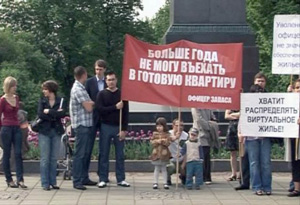
On Friday, TV Tsentr broadcast a story on former military men waiting over a year for new apartments due to the lack of proper transfer and ownership documents.  Two of the men and a military wife were interviewed.  The footage showed a quiet demonstration on Gogolevskiy Bulvar, several blocks from the Defense Ministry.

One officer showed the camera crew his family’s room in an officer’s dormitory.  Another walks through a finished apartment building, saying he is into his second year of waiting.  The ‘virtual’ apartments exist, but the documents for them don’t.  A military wife says their lives and obtaining services are difficult without a permanent place of residence. 

The chief of the regional capital construction directorate talked to the demonstrators about ‘complex relations with the contractor,’ but assured them their apartment problems will be resolved in the next month.

‘Virtual’ Apartments and the Army’s Protest Mood

Ex-Military Men Protesting 'Virtual' Apartments (photo: RIA Novosti)

In Monday’s Nezavisimaya gazeta, Vladimir Mukhin described a 15 May demonstration outside the Defense Ministry by former officers who were allocated ‘virtual’ apartments in Balashikha six months ago, but have been unable to occupy them due to slow paperwork.  Their demands are simple:  these retirees want bureaucratic obstacles removed.  

The protest was not covered by the media, or received only scant coverage.  However, the Defense Ministry’s promise to fix the problems for former servicemen from Balashikha was reported widely in the press. 

Mukhin’s subtitle for the article reads, “Unfulfilled Presidential housing program for the military leading to protest actions.”  He concludes that military demonstrations have been so rare in post-Soviet history that, if they occur, they have to be symptomatic of something.  He says similar protests have happened in other regions with large military garrisons. 

Everyone remembers Defense Minister Serdyukov’s reports about fulfilling the military housing program in 2009.  However, it’s becoming clear that this didn’t happen.  New military housing and construction chief Grigoriy Naginskiy not long ago announced that of 45,000 permanent apartments handed out in 2009, less than half have been occupied.  So the plan wasn’t achieved.  This has provoked a protest mood in the army, and the authorities, it seems, prefer not to notice it.  

Mukhin cites similar situations and actions in Bashkiriya, and elsewhere in  Moscow’s far suburbs.  The All-Russian Professional Union of Servicemen (OPSV or ОПСВ) tells Mukhin it’s pretty simple.  A garrison is drawn down, and officers who don’t want to relocate are put out of their apartments (sometimes into the street).  The garrison is then sold by Defense Ministry officials with a direct interest in this.  Mukhin concludes, that’s the ‘new profile’ army for you. 

OPSV Chairman Oleg Shvedkov told Mukhin several thousand retired officers and servicemen participated in May 1 protests around the country.  They protested not just housing, but also pension and pay problems.  But, of course, active-duty servicemen are prohibited from participating in political actions under the law. 

Viktor Baranets also addressed the plight of former officers in Balashikha in a 12 May article. 

According to ITAR-TASS and RIA Novosti, a Defense Ministry housing official promised on 15 May that the problem of 80 retired servicemen and the apartments allocated to them in Balashikha would be resolved before the end of June.  He said the process of preparing all the necessary documents would be complete by that time. 

A Defense Ministry spokesman said a meeting with an ‘initiative group’ [i.e. the protesters] was held in the ministry.  He also indicated the Defense Ministry is trying to speed up and smooth out the process of preparing and registering survey and property ownership documents.

Supreme CINC Meets Troops at Alabino

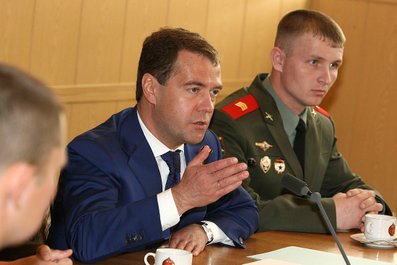
President Medvedev at Alabino

On 5 May, President Medvedev visited Alabino’s 5th Guards Taman Independent Motorized Rifle Brigade (formerly division), a traditional showcase and test bed formation for new equipment and concepts.  

Medvedev and Defense Minister Serdyukov followed up the latter’s late April meeting with the Committee of Soldiers’ Mothers and other public representatives about ‘humanizing’ the armed forces.  At that time, Serdyukov presented ideas for driving the ‘spirit of the prison camp from the army.’  They included freeing soldiers from additional duties to focus completely on training, allowing them more free time, pushing reveille and lights-out back an hour, mandating a rest hour after lunch, instituting a 5-day conscript working week, allowing the possibility of draftees serving close to home, and obtaining weekend passes to leave the garrison. 

Alabino is a place where things like these are typically tried out. 

As Rossiyskaya gazeta put it, Medvedev went to Alabino to see how conscripts live in ‘new profile’ conditions.  He inspected the training grounds, classrooms, and barracks, and answered questions from the new soldiers themselves.  

Medvedev and Serdyukov addressed physical training, one-year conscription, contract service, weekend passes, mobile phones, and hiring civilians to perform nonmilitary support services. 

Taman Brigade Commander Andrey Ivanayev told the Supreme CINC about the experiment with intensive physical training (PT) in his formation.  Ivanayev indicated the troops formerly had 53 hours of PT  per year, but now get 4-5 hours per day, or about 25 per week.  He and Medvedev discussed how soldiers are separated into groups by the physical load they can handle. 

In the Kremlin.ru transcript, Ivanayev said in April testing there were only 88 negative PT evaluations.  According to RIA Novosti’s reporting, Ivanayev thinks the formation’s fitness level has already increased 50 percent.   

Medvedev remarked on the Taman brigade’s outfitting with special PT gear.  He asked Defense Minister Serdyukov about introducing new athletic uniforms in other units.  Serdyukov said:  

“Yes, we are literally this spring buying 50,000 sets and toward fall, apparently, on the order of 100,000 more, the fact is in the course of two years we’re trying to outfit the entire army fully with sports gear for training in summer as well as winter.” 

Most important to the vast majority of Russians, Medvedev told Taman brigade soldiers he doesn’t intend to raise the current 1-year conscription term:  

“That decision on the transition to one-year service which was made, it was painful for us, it isn’t easy, but we won’t change it.  Service in other countries comparable to our country in combat potential is organized in exactly such as way.  And this year still allows us to train a quality specialist, soldier, sergeant.  And despite the fact that there are now certain problems with manning—it’s true, we don’t intend to change the service term.” 

When one soldier asked about enlisted contract service, Medvedev turned to Serdyukov to explain what’s new on this front.  Serdyukov answered: 

“We are now preparing a concept precisely on contract service for soldier and sergeant personnel.  There will be an entire complex of proposals, including on pay, service conduct.  We will equate the entire social package (sergeant like officer) on support, pay and all parameters . . . .” 

“I think in the course of this summer we will prepare and then send you concrete proposals about how this will look, what quantity of contractees we intend to accept, in which specialties particularly and with what kind of pay.” 

Medvedev responded that current pay is not very high, but those who are serving well on it should be retained: 

“However, at the same time, it’s completely obvious according to the well-known principle, better less, but better.  Let there be higher pay and those remaining will really want to serve, instead of us spreading this [pay] among a large quantity of contractees, who won’t have the stimulus, particular desire, or any kind of motive to continue serving and to serve well.” 

When Medvedev pressed him for what he thinks about contractee pay, Moscow MD Commander Valeriy Gerasimov finally said he thinks contractees should get 50-60 percent of lieutenant pay.  Serdyukov said it would be more on the order of 80-85 percent, depending on the duty position.  The more technically complex, the closer to officer pay.  He continues: 

“We are proceeding from the fact that, on the whole, in all the armed forces—a lieutenant from 55, and a sergeant from 35 [thousand rubles per month] . . . .” 

But a little math says that is closer to Gerasimov’s figure, or 64 percent of officer pay . . . 

Medvedev asked his Defense Minister about devising a policy to give conscripts weekend passes to visit home if they live nearby.  Serdyukov said: 

“We are planning over two-three months to proceed on this regime.  Well, naturally, after taking the oath, after he becomes a soldier, after this we’ll introduce it.  We have this really experimental brigade, we are just beginning to work all these approaches out.” 

Medvedev added: 

“Here again we have to proceed from modern approaches.  If a guy serves close by and manning goes according to the territorial principle, then why not let him go home?  Another thing, of course, everyone has to understand what responsibility the soldier carries for any type of infraction in this case, but this is just a question of self-discipline.  You want to go home for the weekend, this means, simply do everything as it’s supposed to be done.” 

Serdyukov chimed in: 

“In the course of five days [of the working week] you need to show the highest indicators, then this will be a particular stimulus for one who wants to pay a visit home on Saturday and Sunday.” 

This policy is especially interesting . . . the possibility of the weekend pass is predicated on several things not really discussed during the Alabino visit.  Working backward, the pass depends on successfully implementing a five-day working week for conscripts.  Then on having conscripts serving relatively close to home in the first place.  At least one voyenkom has already said conscripts from his republic don’t have this chance because they all serve outside their home borders.  A prized weekend pass could also become one more thing to be bought and sold to the highest bidder, or briber.  If implemented, this policy will be difficult to maintain in the face of soldiers who don’t return to the garrison or get into serious trouble while away from it. 

A new conscript asked Medvedev if mobile phones are permitted in the army.  The President asked him if he had one in his pocket, and the soldier replied yes.  Medvedev responded, “Then why did you ask?”  He continued: 

“In fact these rules, as I understand, essentially are established at the unit level, at the level of the corresponding troop formation, but there are no bans on this issue.” 

Gerasimov added that in the Moscow MD anyone may have a cell phone, but they may not be used during training or duty time. 

Discussing training and physical conditioning, Serdyukov turned to one of his earliest initiatives at the Defense Ministry—relieving soldiers from essential nonmilitary duties like kitchen patrol, cleaning, groundskeeping, and utilities maintenance. 

He mentioned the goal of moving to civilian service and support within 12-18 months in all Defense Ministry units, but “everything will depend on our financial condition.  According to preliminary calculations, we have to make do in the bounds of our existing budget.” 

Medvedev said: 

“I think here it’s obvious to everyone that soldiers and officers need to serve the Motherland, be occupied with troop training, improve their physical conditioning, but questions of maintaining the sub-unit, generally, this is an issue which civilian organizations could do successfully for money, as this is done, incidentally, around the world.  Then there won’t be problems with tiresome details and it’ll be possible to concentrate on fundamental service.” 

Civilians already take care of the Taman brigade’s food service, and soon they will maintain its engineering networks, and provide cleaning services.  Serdyukov indicated the FSB is working on licensing firms to work in closed facilities, and Oboronservis will work in remote garrisons where contractors can’t be found.

More on OSKs, and ASU TZ

On Monday, Olga Bozhyeva reminded readers the proposed OSKs were former Genshtab Chief Baluyevskiy’s idea, and she called them part of a command reorganization along an American model.  She contends Baluyevskiy lost his job for pushing the change from military districts (MDs) to operational-strategic commands (OSKs).  And now the OSK will apparently win out, even though Baluyevskiy’s long gone. 

Bozhyeva says Baluyevskiy and the shift to OSKs were defeated in the past by MD commanders [and their powerful patrons] who stood to lose out in the process.  She claims Baluyevskiy’s opposition to the  Navy Main Staff transfer from Moscow to St. Petersburg was a pretext for his dismissal when the OSK was the real issue.  And his OSK experiment in the Far East was quietly dismantled after his departure. 

Actually, it’s more likely Baluyevskiy went down for opposing–rightly or wrongly–the whole range of ideas pushed by Defense Minister Anatoliy Serdyukov.  By contrast, Baluyevskiy’s replacement has been a veritable extension of Serdyukov on policy issues.

With Baluyevskiy gone, according to Bozhyeva, the MD commanders bent the OSK idea to their way of thinking, proposing to make every MD an OSK, without cutting or consolidating MDs, and duplicating efforts in the process.  She says this reflected the MDs as ‘sacred cows’ upon which no one would encroach, and this tracked with new Genshtab Chief Makarov’s background as an MD commander.  Recall that Baluyevskiy was a career Genshtabist.

Bozhyeva continues, saying this year Makarov has begun to think about how to command the ‘new profile’ army.  And wars of the future will hardly accommodate a command structure like the MD.  But Bozhyeva reports a rumor that the name Military District could be retained to appease opponents of merging MDs in favor of modern OSKs.  She concludes, if the OSKs are realized, it’ll be possible to talk of a really ‘new profile’ army.

Dmitriy Litovkin also had his say on the OSK story last Friday.  He describes the possible move to OSKs in terms of more responsive command and control, reducing the transmission of orders from 16 to 3 steps.  But, he cautions, the OSKs are still just a proposal at this point.

Litovkin says the military hasn’t tried to hide the fact that the OSK is borrowed from the U.S. concept.  The main thing achieved in such an approach, he continues, is responsiveness in issuing and receiving combat orders.  The Defense Ministry says this new OSK structure will be tightly tied to the new automated battlefield command and control system ASU TZ (АСУ ТЗ).

Litovkin mentions how Prime Minister Putin saw ASU TZ at Voronezh, and how the system is supposed to centralize command and control down to the ‘electronic soldier’ on the battlefield.  This fall brigade exercises are supposed to employ ASU TZ with the aim of controlling several hundred ‘objects’ in battle simultaneously.  This summer the OSK model will be tried as part of the Vostok-2010 exercise in the Far East.

Litovkin’s source says:

“Developing ASU TZ without trying it in the new armed forces structure is impossible.  We need to understand in practice not just how this works, but also, possibly, that we are developing something unnecessary or, conversely, we aren’t making anything.”

Not a big vote of confidence for the new system.

Litovkin concludes by saying the possibility of unit and even garrison relocations might be a limitation on the OSK scheme.  Forces would need to be better balanced among the four strategic directions.  For example, the Western OSK would have too many motorized rifle units and the Eastern too few.

Defense Industry’s Last Warning

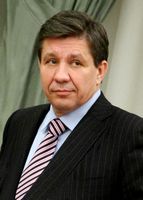
Popovkin in a Suit

Last Friday’s NVO printed an interesting editorial that discussed arms exporter irritation with Deputy Defense Minister, Armaments Chief [former Commander of Space Troops and ex-General-Colonel] Vladimir Popovkin for publicly admitting the Defense Ministry’s dissatisfaction with many of the OPK’s products.  The exporters are obviously upset that Popovkin’s comments have, and will, cost them sales abroad.  But NVO concludes a greater danger would be trying to silence anyone–high-ranking defense official or independent defense analyst–who dares point out the OPK’s problems in the hope of remedying them.

NVO’s sub-title for the article is “The OPK’s systemic crisis threatens a breakdown in the supply of combat equipment to the Russian Army and a lack of export contracts.”

The Greeks have apparently called off a purchase of 420 BMP-3s for $1.5 billion (let’s call it $3.6 million per vehicle).  The deal had been 2 years in the making, and it wasn’t the state of the Greek economy that caused the halt.  According to NVO, the money was already in the defense budget.  Rather it was Popovkin’s specific criticism of the BMP-3 that folded the deal.

Popovkin is quoted:

“We very much need to protect our soldiers.  Today everyone rides on top of the BMP because no one wants to ride in this ‘coffin.’  We need to make a different vehicle.”

Greek journalists published his remarks, and opposition politicians turned them into a scandal:  how can you buy unsuitable equipment that even the country that makes it won’t buy?

Popovkin also complained about the T-90 that the Indians are buying, the tank support combat vehicle (BMPT) that Rosoboroneksport recently demonstrated at an arms show in Kuala Lumpur, and other equipment which the army won’t buy for one reason or another, but which is put forth for export and actively advertised there.

According to NVO, the arms exporters are terribly offended because the [ex-] general cost them several lucrative contracts.  But, in NVO’s estimation, his speech is very necessary.  It says:

“. . . the truth about the condition of the Russian defense-industrial complex, about those processes occurring there, about the systemic crisis in it and the inability of its various directors, including even the government’s Military-Industrial Commission [VPK], to correct the existing situation, is not a secret at all.  It’s been talked about more than once.  On the most varied levels.  Including even presidential.”

NVO says this truth is very important; it could help the powers-that-be uncover the problem areas, fix them, and produce the modern equipment needed for the defense of the country’s interests.  Without an honest discussion, the deficiencies can’t be fixed.  But the Kremlin, government, the legislature, executive organs, or the regions won’t undertake any serious measures against negligent managers.  Despite constant talk of state arms programs, federal programs of technical reequipping of defense enterprises, in reality, with the exception of aviation and air defense firms, nothing is really happening.  It’s moving at a snail’s pace.  Or is it?

Foreign buyers send in 33 warranty claims for every 100 Russian weapons systems exported.  And the scandal with the Algerian MiGs didn’t teach the OPK anything.

It would be possible to silence critics and protect military-technical cooperation with foreign countries and keep the profits coming to the budget and the manufacturers.  But won’t the low quality of these systems, their inability to meet the demands of modern war, really be a negative advertisement?  Does someone really think if they quiet the generals, together with the Moscow media, military analysts and experts then they can sell some kind of half-finished military goods to a serious buyer?  Naive views worked out for illiterate dilettantes.

NVO figures there are two ways out:  either give up, lose export orders, and accept the situation or sharply improve the quality and effectiveness of Russian weapons, reduce prices and defects, and strive to be on the leading edge of technology.  In other words, saving defense industry is in the hands of defense industry itself.  And no one else.  

When it comes to combat vehicles, sniper rifles, UAVs, assault ships, night sights, and armor, the international division of labor in defense industry isn’t such a bad thing after all.  It brings Russia closer to the ‘probable enemies’ of the recent past.  But when it comes to nuclear-powered submarines and strategic missiles we still don’t know how to do them ourselves and no one’s going to sell us those.  And [unless Russia remembers how and gets its OPK in order] it will remember national security the same way it remembers the long forgotten past. 

This is NVO’s way of telling the Putin-Medvedev regime it would be foolish to shut down this feedback channel that tells it what needs fixing in the OPK.

Phantom Apartments

Yesterday NTV aired an expose which helps explain how the Defense Ministry claims it  built 45,600 apartments for officers in a single year.

It’s a bit surprising that a national channel aired this piece.  It depicts quite a mess in military housing, although it doesn’t venture to say how widespread this problem might be.  Recall that the military prosecutor was investigating a case of 8 unfinished buildings in Chekhov back in January. 

It’s unclear how such messes could be cleaned up–how unfinished apartments could be completed, who would do it, and, most importantly, who would pay.  Previous reports made clear the turmoil in the Defense Ministry’s Housing and Construction Service when civilian Grigoriy Naginskiy replaced General-Colonel Filippov at the beginning of 2010.

NTV also hints at pervasive corruption in the military housing program, but doesn’t address this directly. 

Brewing military housing scandals could lead not just to questions about poor management in Serdyukov’s Defense Ministry, but also about Prime Minister Putin’s (and President Medvedev’s) ability to delivery on oft-repeated promises to servicemen.

The video shows poor quality work on an apartment building in a way text alone could never describe it.  The looks and expressions of the jilted officers would similarly be difficult to capture in words.

NTV says officers of the Ufa garrison are thinking not about the upcoming 9 May Victory Day holiday, but about resolution of their everyday problems.  Because of bureaucrats, they and their families could end up out in the street.  They were allocated apartments in a new building where they can’t live.  The multi-story building is incomplete, and several parts of it haven’t even been started.

But according to the documents everything is in order.  There are even acts of acceptance for the nonexistent apartments.  The chief of every organization involved in the project hurried to put check marks on reports about the completion of this state construction order.  For this reason, it will be hard to determine exactly who’s to blame.

The camera turns to one Lieutenant Colonel Valeyev, effectively out of the service for 7 years, but unable to retire (he hasn’t received permanent housing).  He had to surrender his service apartment, and lives in the kitchen of an officer’s dormitory while his daughter lives in his room.  Valeyev concludes simply, “It’s shameful to live in such a situation.”

The construction contract for 350 apartments on the outskirts of Ufa was signed a year ago, and the work was to be finished in just three months, understood to be unrealistic and impossible from the very beginning.  The builders didn’t finish for understandable reasons, but the acts of delivery-acceptance were signed on time.  It turns out this housing existed on paper, but not in reality.

They managed to build only one-third of the apartments promised, and even those remain incomplete after six months.  Nevertheless, the chief of the Ufa KECh (housing management unit or КЭЧ), who distributes housing to servicemen, signed for ceramic tile, linoleum, and wallpaper back in October (so where did these materials end up?).

Asked why the acceptance was signed if the apartments weren’t ready, the KECh chief says only, “It was signed, so to speak, in advance.”

Meanwhile, the other two apartment buildings are just holes in the ground, as shown in the video.  These unbuilt apartments have been distributed already, so 100 military families have housing on paper.

Ufa garrison officers can’t go back to their old service apartments that have been given to others already.  It’s also possible their assigned permanent apartments, when and if completed, could be sold to civilian buyers now that the original contract’s been voided.  The officers will claim they have documents for the apartments, but the builder will tell them to take it up with those that gave them the papers (i.e. the KECh and the Defense Ministry).

The contractor complains that the Defense Ministry contract was lower than market price by one-fourth (well, why did they agree?).  And he claims he went ahead with his own money and now the apartments are more expensive (he seems to be preparing to justify selling them on the private market).

The officers don’t even have anyone with whom they can argue.  The previous KECh chief is under investigation on bribery charges.  And dismissed officers from distant Ural garrisons are being sent back to their units to ask their old commanders for some living space.