Category Archives: Serdyukov’s Reforms

Medvedev Speaks at Defense Ministry Collegium

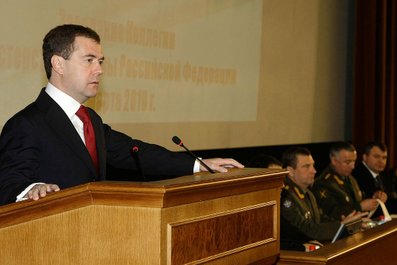
President Medvedev (photo: kremlin.ru)

In his remarks [text and video], President Dmitriy Medvedev reviewed the results of 2009 and talked about future plans for the armed forces.

He focused first on the international situation, noting that, “. . . today we have no requirement to increase further our strategic deterrence potential,” although it remains a determining factor in Russia’s conduct of independent policies and the preservation of its sovereignty.

He noted Moscow’s new law authorizing the use of force to protect Russian citizens abroad, and he pointed to unresolved conflicts on Russia’s borders [where presumably the new law could be used].

Medvedev acknowledged some positive tendencies such as work on a new strategic arms control agreement and renewed Russia-NATO contacts.  But he called the West’s reaction to Russia’s draft treaty on European security a barometer of relations with the U.S. and NATO.  He said it could prevent conflicts like Georgia-South Ossetia.  Medvedev asserted that, unfortunately, far from all countries and politicians drew the correct lessons from the August 2008 events.  And, unfortunately, he said the reestablishment of Georgia’s military potential continues with external assistance.

Then Medvedev turned more to the exact points of his speech.

He said the main goal is the qualitative improvement of the armed forces, the creation of a modern army and fleet equipped with the newest weapons.  He said last year the organizational base for this was established, as planned, without expending additonal resources.

In 2009, Moscow got its authorized personnel down to 1 million, and, according to the President, the Defense Ministry largely achieved its task of getting to the military’s future combat composition.  Medvedev said the results of Osen-2009 confrmed this, and more exercises like it are needed and need to have a ‘systematic character.’  Because, “Without this there simply are no armed forces.”

Medvedev called the training of officers the ‘most important task. Motivated, high-class specialists are needed, but the recently degraded military educational system and its material base need improvement. Medvedev said particular attention also needs to go to sergeants.  They need to be capable of replacing front-line officers when needed, according to the Supreme CINC.

On to rearmament . . .

Medvedev called the task of reequipping the troops with new armaments ‘extremely complex and very important.’  He said last year Russia stabilized the condition of its arms and equipment, despite the financial crisis, and fulfilled the GOZ, although not without problems.

He called the contracting mechanism for arms purchases ‘not effective enough,’ and said we are  working on this, but it’s slow.  This year the State Armaments Program, 2011-2020 will be written.  Medvedev gave the government the task of renewing arms and equipment at an average rate of 9-11 percent annually to allow Moscow to reach 70 percent modern armaments by 2020.  Reequipping has to be supported by full and timely financing.  He referred to his Poslaniye list of  priority systems and arms to be acquired.  He said this task will not be adjusted, and old weapons need to be decommissioned [He seems to have gotten it into his head that new means good and old bad which is not necessarily the case with Russian weapons.  What happens if you scrap lots of stuff, but you don’t succeed in producing new stuff?]. 

Medvedev said, as he’s already said more than once, steps are needed to bring order to the use, storage, and upkeep of missiles, ammunition, and explosives.  The events of the last year have shown there are problems here [alluding to Ulyanovsk, Karabash, etc.].

Medvedev noted another issue, providing the armed forces with automated command and control, and information systems, and transferring the military to digital comms by 2012, as put forth in the Poslaniye.  He said Zapad-2009 worked on mobile automated C2, but this was only a beginning to the work, which needs to be intensified, because “the communications situation is problematic.”

The President said forces will increase their combat readiness in their new TO&E structures [aren’t they 95 or 98 percent combat ready already?].  The main effort will be forming and training inter-service troop and force groupings, and supporting nuclear deterrence forces.  Medvedev said he’ll attend the main, key phases the coming Vostok-2010 operational-strategic exercise.

Medvedev obligatorily cited increasing the prestige of military service and improving the social defense of servicemen as a priority task.  

“I’d like to note that all obligations of the state to current and released servicemen will be fulfilled unconditionally, I will not accept any amendments for budget changes, or for other reasons.”

Medvedev said the government has the clear task to guarantee that all servicemen needing permanent housing have it by the end of this year, and service housing by the end of 2012.

“The realization of this task is not going badly, I will also take this under my personal control.”

Finally, Medvedev spoke for a moment to pay issues.  Increasing pay, and instituting a new pay system for active duty troops from the beginning of 2012, and increasing pensions to retired military men [but nothing specific promised].

He said he thinks premium pay or the well-known Order 400 brought respectable results, and it will be important to preserve ways of rewarding servicemen with extra money under the new pay system, and he expects proposals on doing this.

Defense Minister Serdyukov had some comments after Medvedev’s speech, but they’ll have to wait until tomorrow.
Golts on Makarov, Postnikov, and Contract Service

In Yezhednevnyy zhural on 1 March, Aleksandr Golts says Makarov’s and Postnikov’s pronouncements on the failure of contract service were, of course, an open secret.  Analysts and journalists had been writing about its failure for two years [much longer actually].  He recalled being at a December roundtable including GOMU generals, who had implemented contract service, who railed against slanderers who dared describe things as they are, including the failure of the contract program.  And now Defense Ministry chiefs have also acknowledged the obvious.

Golts concludes that Makarov and company also finally recognized something known to ‘liberal experts’ seven years ago–it was senseless to try to go to volunteer service without first creating a professional NCO corps.

Then Golts describes a Defense Ministry propensity for lying–GOMU Chief Smirnov gives one figure on the number of draft evaders, his deputy gives a different figure; Deputy Defense Minister Pankov says the 85 permanent readiness brigades are ready for battle in one hour, Ground Troops CINC Postnikov says actually they are ready only to depart their garrisons in one hour; Armaments Chief Popovkin says 5-6,000 tanks are needed, Postnikov says 10,000, or maybe only 2,000 are needed.

This irresponsible and unpunished lying pervades the army, it’s an everyday automatic reflex, and it’s not harmless.  The country’s leadership takes decisions on it.  God forbid they should trust GOMU when it says it’s possible to provide for conscription just by stopping draft evasion.  This would indicate that the complete collapse of the military manning system is near.  And the generals would use this as an argument to overturn the current reforms.

GOMU Chief Smirnov Denies Plans to Increase Draft Term

Reacting to spreading rumors that the Defense Ministry intends to increase the current one-year draft term to 18 months, 2 years, or more, GOMU Chief Vasiliy Smirnov said Monday, “There’s no plan to increase the term of conscripted military service in the Russian Army.”

His denial came hard on the heels of General Staff Chief Makarov’s sudden public declaration that professional contract service has failed, at least for enlisted soldiers if not future sergeants, and the army will redouble its emphasis on drafted manpower.

Commenting in today’s Novaya gazeta, the chairwoman of Mother’s Right Veronika Marchenko says:

“If the Genshtab Chief is acknowledging the fact that the Genshtab is not capable of transferring the army to contract service, even though a corresponding [Federal] goal program was adopted, this is not cause to return to the draft system and increase the number of conscripts.  This is a reason to dismiss all the inept generals.”

That is a quaint sentiment, but it doesn’t work that way.  The generals always muttered that contractees wouldn’t work, and men inclined to evade simply had to be herded in.  They’ll say they were right all along.  The chiefs won’t suffer, only the indians.

More interesting, however, Marchenko thinks the rumors could be a trial balloon to gauge society’s reaction–if there’s no reaction, they might try to increase the service term again.

Another human rights organizer claims every 10th conscript is abused in some dehumanizing fashion.  She compares army service to life in a leper colony:

“It’s possible to live [there] ten years and not contract leprosy, or it’s possible for the irreparable to happen in one day.  The army today is potentially dangerous for the human system.”

Komsomolskaya pravda’s Viktor Baranets writes today that he’s amazed that it’s taken 20 years for generals like Makarov, Postnikov, and Chirkin to acknowledge that contract service is doomed.  He goes on:

“And how here can’t you believe that in the same manner in a year or two the Defense Ministry and Genshtab again will publicly ‘scratch their noodles’ and with a funereal sigh announce to us that the transfer of troops to the brigade system, and the transfer of the Navy Main Staff to Piter, and getting rid of warrant officers, and the reduction of almost 200 thousand officers were also mistakes?  But the strategists who reformed the army for no reason will by that time will be wearing pensioners’ slippers and courageously scribbling out their memoirs.”

This Russian (maybe even universal, bureaucratic) penchant for back-to-forth reform, reforms where process is everything and results are nothing is truly amazing and very evident in the armed forces.  But it’s everywhere even on the very same day.  Witness please Putin’s solemn announcement that he’s slashing the rolls of strategically important enterprises after many years of just as solemnly building up their ranks . . . what was the point?  What did they gain, what was accomplished?  Nothing.  It was a political drill to fend off clients desperate for money and bureaucratic attention, and their strategic status was, by and large, a sop.  End of digression.

What else on the topic of the moment?

Baranets.  He speculates the ‘death notice’ for contract service could be a first step backward on Serdyukov’s reforms.  He says there are now 70,000 contractees and contract-sergeants.  He believes in a year the Genshtab will increase conscription to 700-750 thousand guys annually, and they won’t become specialists in anything with demob always just around the corner.  So, he concludes, the rumors about a return to longer conscript service ain’t a coincidence.

Versiya has interesting coverage of the issue.  So Makarov says contract has failed, all sorts of other innovations in army service similarly haven’t brought the desired results.  Dedovshchina didn’t decrease, collecting the requisite quantity of servicemen will now be more complicated, the quality of soldier training has sharply declined.  And the number of conscripts in the ranks will grow.  Versiya asks:

“Can it be we’ll return to the Soviet model of an army which has been publicly declared ineffective in modern conditions?”

One-year service was supposed to eliminate dedovshchina, but General-Lieutenant Chirkin admits it didn’t.

Versiya’s versions:

  • First Version:  Return to Soviet-style manning.  Probability:  50 percent.
  • Second Version:  No alternative but contractees, this is just a pause.  Probability:  30 percent.
  • Third Version:  Course will be unchanged despite Makarov’s announcement.  Probability:  20 percent.

It sounds like Versiya really puts the odds of largely diverting from contract service at 50:50.

Retired Officer Rails Against Army’s ‘Sergeantization’

One retired Colonel A. A. Karasev, deputy of the Saratov city duma and chairman of the Saratov branch of the Union of Soviet Officers, has written in KPRF.ru about communists and former servicemen picketing Prime Minister Putin’s reception office in Saratov on 17 February.

According to him, they demonstrated their concern about ruinous army reforms and carried signs saying “Putin!  Return Serdyukov to the Furniture Store.”  And, of course, they addressed an open letter to Putin.

Their letter said they’d taken to the streets before what used to be Soviet Army and Navy Day to make their woes, pains, and demands known to the head of government, and to defend the army, OPK, veterans, and their families from the outrages committed by bureaucrats and Duma deputies.

Their particulars included:

  • The U.S.-Russian balance of strategic forces is broken.  The leadership’s rush to a new strategic arms agreement is only reducing Russia’s security.
  • The OPK continues to be destroyed.  Defense factories in Saratov have closed.  Remaining plants get financing only in late spring or summer each year.
  • The Defense Ministry has not thought out its reforms of the army in the American mold.  The combat possibilities of Russia’s brigades are less than those of the formations and units of the ‘probable enemy’ [they really think the U.S. and Russia will go head-to-head?].
  • ‘Sergeantization’ [i.e. officer cuts and efforts to create professional NCOs] of the army means its enfeeblement.  There isn’t a sergeant with an intermediate specialized education [i.e. vocational high school diploma] who can replace an officer from a higher command or engineering school.  Promising contract-sergeants 20-30,000 ruble pay after training only adds extra tension to their relations with officers.
  • Military pensions have fallen to the level of pay for the least qualified workers, and below the subsistence minimum in many cases.
  • Military wives have not received social guarantees to compensate for their inability to work in many garrisons.

They want all these problems rectified, of course, but want to start with firing Serdyukov and his team.

The tension over what they’ve termed ‘sergeantization’ is interesting. 

In the Defense Ministry’s view, officers who’ve been cut, or turned into sergeants themselves, either weren’t needed or weren’t performing officer work or supervising troops.  So officers have been cut, and those that remain will really be officers with real units to command.  Some of them will get premium pay to reward them for now, and, from 2012, much higher base pay, for example, maybe 60,000 rubles for a lieutenant.  Meanwhile, as the Defense Ministry sees it, there won’t be any problem with newly-minted professional sergeants entering the ranks and earning higher pay [which still won’t approach that of officers].

The KPRF has an alternate scenario for the future.  It sees many officers, who were needed, put out of the service and replaced by some poorly trained contract sergeants who will earn more than before.  Two-thirds of officers don’t get premium pay for now, and the KPRF is probably skeptical that greatly increased pay for all remaining officers will be actually be delivered in 2012.  The future it sees has a mass of officers and sergeants, not differentiated by much of anything, including pay.  While the officer-NCO interaction was long ago worked out in Western armies, it’s still a troubling vision for an army in the throes of major structural changes and lacking a professional NCO tradition.

KPRF Ramped Up for Defenders Day

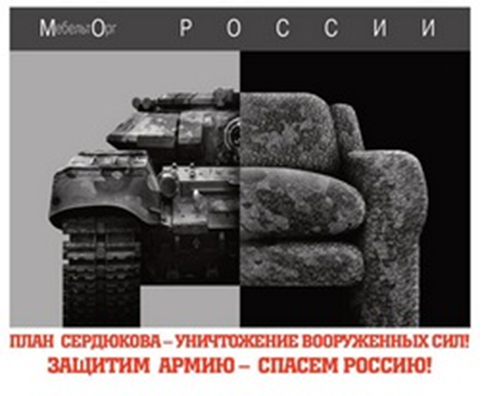
This came from the KPRF.ru site on Saturday.  Instead of МО for Министерство обороны in the upper left, they’ve put it as МебельтОрг or furniture sales, making light of Serdyukov’s background in the furniture business.

The bottom says, “Serdyukov’s Plan is the Destruction of the Armed Forces!  We’ll Save the Army, We’ll Save Russia!”

Sitnov on Serdyukov’s Reforms

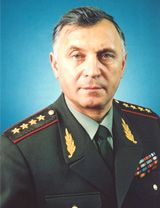
General-Colonel Anatoliy Sitnov

Yesterday’s Segodnya.ru published a speech (or an excerpt) given by former Armaments Chief, retired General-Colonel Sitnov.  He now serves as deputy director of RUIE’s (РСПП) Commission on the OPK.  Not heretofore a prominent critic, he offers a fairly withering critique of Defense Minister Serdyukov’s reforms.

He first offers up Milyutin as an example of someone who made an army reform match its purpose.  According to Sitnov, Milyutin’s reform of the army enabled it to defend Russia from rapidly growing military powers in the West.  He says Milyutin also devised the mobilization system since it was impossible for Russia to maintain a permanent army large enough to cover its expanses.

Then Sitnov fast forwards.  His first major complaint is cutting the officer corps from 355,000 to 150,000.  He believes this was done because the country’s authorities fear it.  He criticizes the Defense Ministry’s remaking of the army on the ‘American principle.’  Sitnov says Russia is now trying to defend an enormous country with brigades that are no more than ‘patrol forces.’  He alleges Russia’s brigades can fight for only one day since they lack rear services, reconnaissance, maintenance, staffs, and command and control systems.  He argues that Russia long ago settled on the division as its basic military unit to cover its open spaces.

Sitnov concludes the Russian Army is unready to fight 5th generation wars.  He says America is already fighting 4th generation wars, employing automated systems that integrate units and highly intelligent weapons.  But 5th generation war features automated command and control, robot systems, and the use and control of systems with automated means of guidance, targeting, and destruction.

And this, he continues, is just the technical part.  He rhetorically asks whether an army can perform its missions when the country has no agriculture, industry, science, education, system of state administration or strategy for its development (ouch!).  The army reflects society and, in Russia’s case, society’s imbalances are reflected in its army.

Sitnov spins off into a geopolitical monologue.  He sounds like other ex-generals of the Soviet generation.  If the U.S. continues to occupy positions on Russia’s periphery, Russia’s territorial integrity will become an issue in 10-15 years.  Foreign pressure on Russia to share its empty spaces and resources, like Baykal’s fresh water, will intensify.

Lastly, Sitnov believes it would be naive to think Serdyukov took the decisions on army reform; rather he thinks Serdyukov was just the instrument picked for a policy of purging the army.  Now he says, parallel with the army purge, there is a campaign against the MVD.

Sitnov’s criticism of brigades makes some sense, but defending the MVD?  Also, most observers probably would agree that Serdyukov was simply sent to fix the army, once and for all, and the leadership didn’t worry too much about how.

Makarov Meets the Press

Chief of the General Staff Nikolay Makarov

General Staff Chief Nikolay Makarov spoke at length to the press yesterday. In no particular order, here are some of the impressions and reports that followed in his wake.

RBCdaily quoted Makarov on the possible Mistral purchase:  “Ships of the Mistral type have very great multifunctionality, and they surpass our ships in all parameters by three times.”  He went on to say that Russian shipbuilders would only be able to produce helicopter carriers of this quality in 5-10 years.  Aleksandr Khramchikhin commented that, in the first place, Russia doesn’t currently have comparable ships and, in the second, it will take 50 years.

Makarov said the final decision on buying the Mistral had not been made.

According to Rossiyskaya gazeta, Makarov said the Russian Army went to brigades vice divisions to avoid the previous need to flesh out units with reservists and take days to bring them to combat readiness.  ‘Modular’ battalions by contrast are permanently ready for battle in an hour.

Makarov didn’t rule out establishment of some type of ‘rapid reaction forces,’ though these are closest in nature to today’s VDV.  And this wouldn’t mean VDV would simply change its name. And other services need rapid reaction capabilities too for action in the air, on the sea, etc.  Aren’t permanently ready brigades rapid reaction forces already?

On the Navy headquarters move to St. Petersburg, Makarov claimed Moscow is overflowing with army and navy leadership [but haven’t they just cut 200,000 officers and lots of excess command structures to create a personnel pyramid?].  And with today’s networks the fleet can be commanded from thousands of kilometers away from the Genshtab and other main commands.

Makarov doesn’t foresee any change to the one-year conscription policy, but there may be changes in NCO acquisition.  Instead of six months training in MD training centers, they may only get 3, so they can serve 9 months in troop units.  Makarov thinks they’ll cut back on conscript sergeants once their professional ones start to appear.

Moskovskiy komsomolets quoted Makarov on the new strategic arms agreement with the U.S. to the effect that it’s 97 percent complete, and it only remains to agree on the relationship between offensive and defensive weapons, and there will not be anything in the treaty to Russia’s detriment in this regard.

On Mistral, Makarov said, after study, we’ve concluded we need this type of ship, which can be an amphibious assault ship, hospital, command ship, and helicopter carrier.

On the Navy and Piter, MK notes Makarov wanted to avoid Baluyevskiy’s fate and didn’t contradict his superiors.  He expounded on his vision (perhaps dream) of Russian netcentric warfare:

“Earlier it was like this:  the closer to subordinates, the more reliable the command and control.  Now all leading countries, including us also, are going to netcentric command and control systems.  This allows completely remote means of reconnaissance, command and control, electronic warfare, fire, command posts–all spread over an enormous distance, but located in a single information-communications space and capable of solving tasks in real time.”

On a related note, Makarov said the new Sozvezdiye tactical level command and control system will be part of the netcentric structure toward the end of the year.

Gazeta’s coverage focused on Makarov’s comments about establishing the personnel pyramid, i.e. going from armed forces with about 500,000 officers and warrants to one of 150,000 officers and 720,000 soldiers in the space of a year.  It also noted Makarov’s remark that brigade commanders in their training assembly at the General Staff Academy are learning new warfare and command and control principles.

Izvestiya quoted Makarov at length on the Navy Main Staff’s move to Piter.

“Presently all command and control organs are concentrated in Moscow, but we want these command and control organs to be as close as possible to the troops they control [didn’t he also call this the old way of doing business?].  The dispersal of command and control and fire means at great distances doesn’t have any great significance, what’s important is maintaining uninterrupted and clear command and control of troops and weapons.  Therefore, the transfer of the Navy Main Staff to St. Petersburg won’t place any kind of extra burden on the command and control system, with the exception perhaps, only in the initial period of its functioning in a new place.”

Viktor Baranets in Komsomolskaya pravda focused on Makarov’s words on the U.S. and Iran, noting his statements that the U.S. has a plan to strike Iran, and, if it occurs, it’ll be terrible for Iran, the region, and the U.S.

Krasnaya zvezda covered the Iran issue.  It noted that Russia’s need for ready units forced the shift to brigades.  It also covered Makarov’s comment that the Voronezh conference agreed on changes needed in the Sozvezdiye C2 system, and that it would be received this July and fielded in November.  KZ also quoted Makarov at length on the capabilities of the 5th generation fighter aircraft.

KZ also indicated that Makarov noted the U.S. as an example where units and commands are often separated by great distances when he talked about the Navy Main Staff and Piter.

Generally, it seems those invited to this press availability only asked Makarov ‘soft ball’ questions.

GOU Chief Tretyak Speaks, A Little

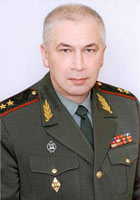
General-Lieutenant Andrey Tretyak

In today’s Krasnaya zvezda, the new Main Operations Directorate (GOU) chief speaks on the anniversary of his organization.  On 20 February, the GOU will trace its lineage back 308 years to Prince Shakovskoy.  Shakovskoy was general-quartermaster in 1702 (early in Petr Velikiy’s Great Northern War) and he began the establishment of organs of operational command and control with the basic missions of preparing proposals for planning troop employment and providing command and control during combat.

Tretyak says the missions standing before the GOU today are imposing and large-scale.  The GOU has to help transition the armed forces to a new level, and create a modern, combat-capable, and mobile army that won’t allow anyone the chance to threaten Russia or its allies.

He continues saying the deep transformation of the army was objectively necessary and the short period for the transition was dictated by the development of ‘leading armies’ and the threats facing Russia.  In 2009, the shift to a three-layer command system and permanent readiness formations and units was completed.  Tretyak says the tasks today are to complete their combat coordination (слаживание) and installations (обустройство).

Addressing the world geopolitical situation, Tretyak says, although a large-scale war is a low-probability event, many other threats have appeared.  For instance, the widening of conflict zones into areas that affect Russia’s vital interests.  He cites South Ossetia as an example.

So the General Staff constantly analyzes and evaluates the world’s military-political situation and develops practical measures to keep the armed forces ready to carry out their missions to guarantee Russia’s military security.  The main part of this job falls on the General Staff, responsible as it is for strategic planning, military organizational development, armed forces development, and the military organization of the state overall, as well as for coordinating the activity of all troops and military formations in the area of defense.  

The General Staff works with the country’s military-political leadership, federal executive organs, other state and military structures, and with the defense-industrial complex.  According to Tretyak, the most important role in this connection goes to the GOU, the history of which is inseparable from that of the Russian Army and the General Staff.

All this sounds a bit doctrinal and it is, but it gives the new top man’s view on how and where his people fit in.  It’s a bit like the new boss issuing a mission statement.

After a longish history lesson, Tretyak reminds that great military leaders have come from the post he now occupies.

Of course there’s nothing about his most recent predecessors Rukshin and Surovikin.  They didn’t fare terribly well.  And there’s the near-debacle in the five-day August 2008 war, i.e. many press reports saying that the GOU had been moved out of its spaces and just dismissed Rukshin had to be begged to run a lot of the war effort.  Afterwards, many have claimed it was the planning previously done by Rukshin that kept the war from becoming a total fiasco for Moscow.  And there’s nothing about cutting the GOU from 550 officers to 150 while its workload is unchanged, or perhaps even increased.  See Segodnya.ru for reporting on this.  Tretyak’s got his work cut out for him.

More details from his bio:  born 11 March 1959, so he’ll soon be 51, in Magdeburg, East Germany.  Graduated from the Kiev Higher Combined Arms Command School in 1980.  Platoon and company commander in the GSFG, then battalion chief of staff, and battalion commander in the Belorussian MD.  After graduating the mid-career Frunze Military Academy in 1991, he became deputy chief of the operations section for a division staff, chief of staff-deputy commander for a regiment, commander of a regiment, commander of a brigade, and division chief of staff in the Far East MD.  He completed the General Staff Academy in 2001, and commanded a division in the Siberian MD.  Here he was also chief of staff-first deputy commander of a corps and an army.  Then he commanded an army (probably 22 CAA)  in the Moscow MD.  From April 2008, he was chief of staff-first deputy commander of the Leningrad MD before taking up his current duties in January 2010.

Pukhov Criticizes Serdyukov’s Reforms

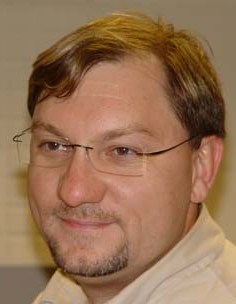
Ruslan Pukhov (photo: Radio Rossii)

In today’s Komsomolskaya pravda, Viktor Baranets interviews Ruslan Pukhov, Director of the Center for Analysis of Strategies and Technologies, and Member of the Defense Ministry’s Public Council.  Pukhov provides a fairly balanced assessment of Defense Minister Serdyukov’s reforms, one year on.

Pukhov believes Serdyukov managed to reorganize and shake up the Defense Ministry apparatus, and partially achieved more rational use of the military’s budget money.  He says the main thing is the breakthrough on the ‘organizational measures’ of military reform.  He calls the ‘new profile’ the deepest organizational change for Moscow since 1945, citing its large-scale relocation of troops and equipment, cutting of personnel and obsolete armaments, reorganization of military education, and civilianization of many military jobs.  Pukhov concludes the administrative tasks of the reform are largely complete.

However, Pukhov also agrees with Baranets that the reforms have created a structural shell that has to be brought to life, made effective, and combat capable.  This will be harder than what’s been done so far.  Pukhov says there are few who doubt the army needed a radical, not just a cosmetic, reform, and the five-day August 2008 war proved it.

Pukhov thinks the reforms have created a new army, fundamentally different from the Soviet or previous Russian Army.  In scale, they can only be compared with the military reform of Peter the Great.  If it’s possible to reproach the Russian leadership for anything, it’s for dragging the process out with half measures which turned into a permanent degradation of the army, according to Pukhov.

Asked about Serdyukov’s greatest achievement and greatest failure, Pukhov says the former is having the political and administrative will to complete the first phase of reform.  But the greatest failure is Serdyukov’s inability to win the support of the entire officer corps, and this has put part of the officer corps against him.  Bureaucratic and poorly explained changes have often demoralized personnel, and poorly thought out personnel cuts have created discontent in the ranks, from contractee to general.  Military discontent with the methods of conducting the reform could discredit the reform itself, and make it too difficult for the political leadership to continue supporting Serdyukov, although for now Kremlin is satisfied with Serdyukov and his role as the army’s ‘surgeon.’

Pukhov says many of the measures have been extremely painful, affecting the fate of hundreds of thousands of servicemen, and often been implemented in a typical Russian fashion he describes as ‘up the ass.’  The Defense Ministry’s ‘secret-bureaucratic’ approach itself has had an effect here as well.

After practically calling Serdyukov’s the army’s proctologist-in-chief, Pukhov cuts him some slack, saying he didn’t personally plan and implement the largest part of the ‘orgshtat measures.’  They were done by military specialists in the Defense Ministry, General Staff, and service and district staffs, by men who’ve served out there themselves and are now engaged in transferring their colleagues, cutting some, putting some outside the TO&E, ‘optimizing,’ and so forth.  But Pukhov notes, all this could be done humanely, with respect toward the men and their professional experience.

Pukhov agrees with Baranets that a ‘soulless’ style of dealing with people, a lack of concern about human capital, and disregard for the human factor is traditional in the army.  And, unfortunately, it permeates the entire military system, according to Pukhov.  And a significant portion of the officer corps has become victim to such an approach during these rapid reforms.

Pukhov ends with some criticism for the top military leadership which often says it has come all the way from the bottom ranks, like those being ‘optimized’ today.  But what’s happening, including the aforementioned ‘excesses’ of reform, in Pukhov’s view, should make one think that there are some unhealthy morale-psychological tendencies in the army, which started long before Serdyukov, and can’t be considered normal.  Perhaps, for the success of reforms, the leadership should focus on the human aspect and recognize that the army, first and foremost, is people, and not pieces of iron.

So it sounds a little like Pukhov is saying the civilian Serdyukov didn’t realize how military men would implement his changes in their own organization, and what the human costs would be.  Again, it sounds like he wants to cut Serdyukov some slack, and share the blame for the pain caused with others around him wearing uniforms with big stars.  This tends to overlook the reality that many of those with the stars who objected were sent packing by someone.

Navy Main Staff Move to Piter Back On

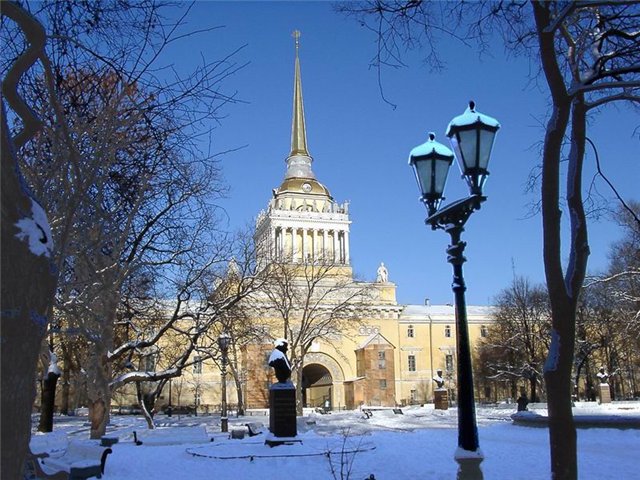
Admiralty

Unnamed Navy sources told the media this week that the Navy Main Staff’s postponed transfer to Admiralty in St. Petersburg is back on, and will begin in July.  But the Navy has not commented officially.  

The Leningrad Naval Base left Admiralty for Kronshtadt, leaving space for the Navy Main Staff in the former.  The Naval Engineering Institute may or may not have left Admiralty for Pushkin. 

The first elements to move could be administrative elements not bearing on the fleet’s combat readiness, while the Navy’s ‘operational services’ remain on Bolshoy Kozlovskiy Lane providing uninterrupted command and control of the fleet, and naval strategic forces in particular.  Some press pieces have said the transfer process could stretch out into 2012. 

A radical ‘optimization’ [i.e. personnel cut] in the Navy’s command and control structures, beginning 1 March, will reportedly precede the move to Admiralty.  Some press sources say the cut will focus on the Navy’s Central Command Post (ЦКП).   

Cutting Navy headquarters personnel may not be all that hard.  Izvestiya notes that, according to some sources, 300 Navy staff officers came out against the transfer to Petersburg when the story first broke in 2007.  Nezavisimaya gazeta has repeated the rumor that  only 10-15 percent of current staff officers will move to Piter and Grani.ru claims most are already looking for other work in Moscow. 

Recall that Duma Speaker Boris Gryzlov first ‘suggested’ the move to Defense Minister Serdyukov in fall 2007, saying that the Navy should return to Russia’s ‘naval capital’ already replete with naval educational institutions and shipbuilding enterprises, and lighten Moscow’s heavy load of governmental organs.  

The plan called forth the late 2007 protest letter signed by many retired admirals, asserting that moving the Navy Main Staff  would “not only lack common sense, but actually undermine the country’s defense capability.”  

Former General Staff Chief Yuriy Baluyevskiy was publicly ambivalent about the wisdom of the transfer.  In early 2009, Navy CINC Vysotskiy told the press he had no orders on the move.  However, new General Staff Chief Nikolay Makarov was quick to remind Vysotskiy: 

“Now command and control organs of the armed forces can be located anywhere.  The main thing is a reliable command and control system should be created which allows for carrying out missions in peace and wartime.” 

But can it really be located anywhere?  

Retired General-Major Vladimir Belous of IMEMO’s International Security Center has been quoted everywhere saying that, in St. Petersburg, the Navy headquarters could come under a devastating enemy air attack in as little as 15-20 minutes. 

Some have guessed the price tag for relocating to Piter at between 26 and 50 billion rubles, Grani.ru guesses 80 billion, and still others say completely rebuilding the Navy’s Moscow infrastructure in the country’s second capital would cost up to 1 trillion rubles.  In any event, a gigantic sum forcing the Defense Ministry to forego lots of other good uses for its money.   

Many experts believe the Navy’s command posts, comms, and underground bunkers will remain in Moscow and Moscow suburbs, since relocating them to Piter will be physically or financially impossible.  Former First Deputy Navy CINC Igor Kasatonov has been widely quoted saying that Piter will be no more than an alternate headquarters for the Navy CINC, from which it will be possible only to exert tactical control over the fleet. 

IA Regnum concludes that, although military experts unanimously believe a Moscow-to-Petersburg move will undermine the Navy’s combat readiness, it’s not clear it matters given the other things [i.e. political considerations, business interests] that are in play. 

Vladimir Temnyy writing for Grani.ru makes the point that old admirals’ alarmist rumblings about disrupting the Navy’s command and control are unimportant to those who want to build a business center and expensive apartments in place of the Navy Main Staff building near the Krasnyye Vorota metro station. 

In Stoletie.ru, Sergey Ptichkin calls the possible move ‘administrative caprice,’ adding that there’s profit motive in this caprice since the Navy headquarter’s building is valuable central Moscow property.  He says not a single expert or Navy leader can justify the move, and brands Gryzlov’s talk of returning the Navy to Russia’s ‘naval capital’ the height of naivete.  He makes the point that the Navy was only in Piter because Piter was the capital of the Russian Empire.  Otherwise, the Navy’s headquarters should be with the rest of the nation’s leadership.  Ptichkin concludes the modern Russian Navy can only be commanded from Moscow’s infrastructure and to replicate it in Piter is, if not impossible, then insanely expensive, especially at a time when there are questions about what kind of Navy will remains to be commanded.

An editorial in Friday’s Nezavisimoye voyennoye obozreniye concluded that the “ambitions of the powers-that-be trump common sense” and “the fact that arguments ‘against’ are clearly superior doesn’t bother them.”