Category Archives: Strategic Forces Modernization

Bulava Plans

Plans for Bulava SLBM testing may be shifting.  When last we checked, Navy CINC Vysotskiy said look for four more tests with a salvo launch this year or next, but an OPK source said expect a salvo test in late August or fall.  The latter sounds more like what we are reading today.  In sum, it seems someone’s in a hurry to give Bulava final approval.

This morning ITAR-TASS reported Borey-class SSBN Yuriy Dolgorukiy will conduct a maximum of two Bulava SLBM test launches, including a salvo launch, before the end of this year.  The news agency’s interlocutor said:

“It’s still planned to conduct the next, the 16th, flight test of one missile in the last ten days of August, and then – in fall or even in December – a salvo launch of two ‘Bulava’ missiles.  But another possibility isn’t ruled out – conducting a salvo launch of two missiles right off in August, omitting a single missile test.  Next week it will be known which possibility was finally selected.”   

The state commission told ITAR-TASS:

“Whatever the testing variant, in the event of a successful ‘Bulava’ salvo launch, a decision on accepting this missile system into our Navy’s arsenal will follow.”

ITAR-TASS also reported Borey number two Aleksandr Nevskiy has begun factory testing, and number three Vladimir Monomakh is 50 percent complete.

Bulava News

Today Navy CINC, Admiral Vladimir Vysotskiy announced four more tests of the Bulava SLBM this year.  According to Interfaks, Vysotskiy said plans call for a salvo launch either this year or next, depending on the state commission overseeing the Bulava’s testing.

Last Wednesday, a defense sector source told Interfaks to expect the next Bulava test in a month.  Originally, the source said, it was supposed to be a salvo launch a month after the successful June 28 test from Yuriy Dolgorukiy.  But analysis of the June flight test and preparation for the next took longer than expected.  This source said the 16th test will be in late August, or possibly even fall.  He said Dolgorukiy will fire two Bulava SLBMs, one after another. 

On June 30, Vysotskiy claimed the second proyekt 955, Borey-class SSBN Aleksandr Nevskiy will finish sea trials, and test fire a Bulava this year.  But he didn’t repeat the claim today.

Quoting Tolya

Tolya’s remarks to the press today made quite a few headlines, and left a few useful benchmarks for the future.  Defense Minister Serdyukov addressed procurement and manpower issues.  Here are his quotes from RIA Novosti and ITAR-TASS.

Tanks for Nothin’

“We met the designers who proposed their preliminary work to us.  60 percent of what was proposed is old work.  Therefore, we still declined these proposals.”

“Now it’s more expedient to modernize our country’s tank inventory than to buy new ones, for example the T-90.”

Cold Water on Carriers

“We have no plans to build aircraft carriers.”

“Only after this [a preliminary design of what this ship might look like], the Genshtab together with the Navy will make a decision on the need for such a ship.”

SSBNs Aren’t Automobiles

“‘Bulava’ flew, this is good news.  We understand precisely that it’s possible to launch serial production of the missile on this variant.”

“We got the result, now it’s possible to load SSBN ‘Yuriy Dolgorukiy’ with ‘Bulava.'”

“We’d like to do this [test Bulava from Aleksandr Nevskiy], but we understand that to plan this precisely is impossible.  A nuclear submarine isn’t an automobile.”

Bullish on Arms Deliveries

“Deliveries of strategic missiles ‘Topol-M,’ ‘Yars,’ ‘Avangard’ will increase three times, ‘Bulava’ and ‘Sineva’ missiles for strategic submarines one and a half times, aircraft four times, helicopters almost five times, air defense systems almost two and a half times [in 2011-2015 compared with 2006-2010].”

Not Going Below a Million Men

“There are no such plans, there are no questions of cutting manpower.  We’re striving for the entire army under the million number, and it isn’t planned to cut this figure.”

“On account of this [increasing contractees from 2014], we’ll manage without fail to get through the demographic hole which is anticipated in 2014.”

Two Arctic Brigades

“The Genshtab is now developing plans to establish two of these formations.  In the plans, deployment places, armaments, manning, and the infrastructure of these brigades need to be specified.”

“It’s possible this will be Murmansk, Arkhangelsk, or another place.”

Bulava Launch Window

An OPK source told RIA Novosti yesterday a state commission on experimental flight testing has identified June 28-30 as the window for this year’s first Bulava SLBM test.  The commission will select a precise date within the next two days.  The source says Borey-class SSBN Yuriy Dolgorukiy will be the platform for the launch.

Dolgorukiy Returns to Sea

This morning ITAR-TASS reports that fourth generation Borey-class SSBN Yuriy Dolgorukiy is at sea for testing.  This is the boat’s first underway period of 2011. 

At the close of last year’s Arctic navigation season, Dolgorukiy returned to the hall at Sevmash, where it was prepared for the concluding phases of its state underway testing.  Sevmash says the submarine should be officially handed over to the Navy within the next few months.

Recall the Russian press reports that modified Typhoon SSBN Dmitriy Donskoy will be the launch platform for this year’s first Bulava SLBM test.

Fateful Season for Bulava Begins

A Defense Ministry source tells RIA Novosti that Bulava SLBM testing will resume between 15 and 17 June.  The test launch will come from modified Proyekt 941U SSBN Dmitriy Donskoy, though the source claims Borey-class SSBN Yuriy Dolgorukiy is ready to fire the missile.

Recall that Proyekt 955 Dolgorukiy was back at Sevmash for work this winter.

The source says the first launch from Dolgorukiy will come after two successful firings from Donskoy.

Bulava now has 7 reported successes in 14 tries.  There will be 4-5 tests in 2011.

If they are successful (and at least a couple come from Dolgorukiy), the SLBM and its intended submarine will be accepted into the Navy inventory.  And serial production of Bulava will ramp up. 

If they aren’t, the naval strategic modernization effort will find itself back where it was prior to two successful launches last October.

But the Russians seem pretty confident this time around.

Strategic Fireworks

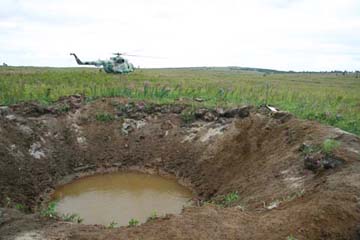
Warhead Impact Crater (photo: Novaya gazeta)

Being practically the eve of Victory Day, news is hard to come by.  

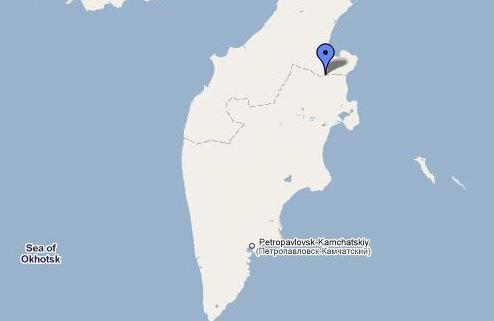
Novaya gazeta, however, was nice enough to print an interesting article about Russia’s strategic shooting gallery — Kamchatka’s Kura test range.

The author says, from the air, this 13,206 square kilometer patch of taiga looks like an unattractive golf course with a great quantity of holes.  In Kura’s 55-year history, more than 5,500 “items” have landed here.

Kura was called Kama at the time of its establishment in 1955, and two years later, the first missile, an R-7 (SS-6 / Sapwood) — the world’s first ICBM, landed here.

Why this site?  An old hand at the Independent Scientific-Testing Station of Space Forces explains:

“There are several reasons for this.  Firstly, this is one of the most remote regions, that is it’s possible to test missiles here not only for firing accuracy, but for range.  Secondly, the trajectory of all flights was conducted only over the USSR’s territory.  Thirdly, the range was laid out at a great distance from populated points and airline routes.”

So, the military’s calculations were correct.  No aircraft or people ever suffered from a stray missile, but not every “item” landed as intended.  They cut into mountains, or splashed in the ocean.  In the early 1980s, one caused casualties in a Koryak reindeer herd.
Kura Test Range

“Items” land here less frequently now, not more than 20 per year.  In the past, there were up to 250 per year.  The old hand continues:

“In the Soviet years, warheads poured from the sky like off a conveyor belt.  Not just military here, but scientific life was also cooking here.  Groups from scientific-research institutes who were creating the Soviet ‘star’ program as a counterweight to the American SDI constantly came here.  But after perestroyka, most scientific research was rolled up.”

He says the range’s helicopter pilots are marvelous fliers, but it’s often the bears who first find what’s fallen from the heavens.  All the oxidized metal is bad for the environment, of course.

The local garrison is just tens of kilometers from the Klyuchevskaya Sopka volcano, and its ash and sulfuric acid takes a toll on equipment.

The author says the locals say the warhead flights are spectacular.  At first, there’s a bright star in the night sky, rapidly approaching the ground.  Then a flash so powerful the street’s lit like daytime, but doomsday lasts not more than a second.  In an instant, the big star separates into several smaller ones.  Up to 10 warheads separate from the platform and fly at their own targets.  Cooler than any fireworks.

V / ch 25522 has 200 conscripts, about the same number of contractees, and 500 officers.  Life in the garrison town is generally good.  Soldiers preferred the old “Afghan” uniforms to the new ones from Yudashkin.  The barracks are warm, and there’s been no violence or hazing in recent years, but there’s not much free time (or much to do) either.  Soldiers can use their cell phones on days off.

For Space Troops officers, service here is considered prestigious, and the pay is almost three times that in units in Central Russia.  A year of service here counts double for hardship.  The stores are significantly better stocked here than on the “mainland,” but the prices are also 2-3 times higher.

Like everywhere, officers are being retired or put in civilian billets.  Engineer pay at the range, with supplements and coefficients, is 25-30 thousand rubles a month.  A lieutenant colonel gets 50-60 thousand.

Winter is seven months, and earthquakes a daily occurrence.  The volcanic ash isn’t good for people, but it isn’t deadly, they say.

Many officers have served at Kura since the early or mid-1990s, and they don’t complain.  The work is interesting, and the surroundings beautiful.  Things are better than 10 years ago when personnel didn’t get paid, and pilots had to buy their own spares for their helicopters.  Now equipment gets repaired, and the pay’s on time.

RVSN’s Fourth Generation ASBU Being Introduced

The press this morning says a fourth generation automated command and control system for Russia’s land-based strategic missiles is being fielded.  It describes a more net-centric, skip-echelon capability with a central commander able to communicate directly with launchers in the field.

It’s not clear, however, how much in the fourth generation system is different from its immediate predecessor.

RIA Novosti writes . . .

MOSCOW, 27 Apr — RIA Novosti.  The fourth generation automated combat command and control system (ASBU) has started introduction into Russia’s Missile Troops of Strategic Designation (RVSN), official RVSN representative Vadim Koval told RIA Novosti on Wednesday.”

“‘In the RVSN and jointly in cooperation with industry, work continues on improving the system of combat troop command and control.  In particular, presently, development is complete and introduction of the fourth generation ASBU into troop echelons has begun,’ Colonel Koval said.”

“The new system supports automated exchange of employment plans and operational retargeting of missiles, along with the resolution of traditional missions of transmitting orders, gathering reports and monitoring the combat readiness of launchers.”

“‘And the transmission of combat command and control orders directly to launchers, without intermediate echelons, is supported, including under nuclear effects and radioelectronic suppression,’ Koval noted.”

“He noted that each of the system’s stations, which are made using a new domestic component base, is provided with triple reserve communications and data transmission systems and malfunction scanning which precisely identifies the individual element needing replacement.”

“Further improvement of the ASBU is connected, first and foremost, with improving the RF Armed Forces command and control system as a whole, and also with the command and control requirements of new generation nuclear missile weaponry.”

“From 2010, rearmament with the new missile system ‘Yars’ has been conducted in the RVSN.  Rearming of the Tatishchevo division with the silo-based ‘Topol-M’ missile system is also occurring.”

To RIA Novosti’s account, ITAR-TASS adds only that:

“The system’s paths for transmitting orders and gathering reports are established by land-line, radio, and satellite communications channels and possess the required survivability and jam-resistance.”

“Earlier orders issued by one of the central command posts came to launchers through army, division, regiment (battalion for mobile launchers) command posts.”

The new ASBU’s capabilities aren’t described much beyond what former RVSN Commander Solovtsov outlined in 2009.  See also RIA Novosti.

However, in late 2007, Solovtsov told Rossiyskoye voyennoye obozreniye (p. 21) that the RVSN was completing introduction of the third generation ASBU, and he described capabilities that sound much like what’s being advertised as fourth generation today.

So the issue may be, is this really something new, or the continuation of an earlier upgrade presented like major progress on an important modernization front?

Careful How You Read

Be careful what you read, but be even more careful how you read it (or who translates it).

The Russians won’t put both SLBMs and SLCMs on their fifth generation submarines.  Would that really make military sense?  What they apparently intend is to build a multipurpose hull to fit out as either SSBN or SSN.  Now does that raise interesting arms control verification issues?

Several days ago, in advance of March 19 – the 105th anniversary of Nikolay II’s designation of the submarine as an Imperial Navy ship class (i.e. Submariner’s Day since 1996) – a “highly-placed RF Navy Main Staff representative” elected to tell RIA Novosti about work on Russia’s fifth generation submarine.

Production of the fourth generation proyekt 955 SSBNs and proyekt 885 SSNs is just really now reaching the ramp-up stage.  But design and development of fifth generation submarines is included in the State Program of Armaments, 2011-2020, according to RIA Novosti’s Navy Main Staff source.

When you Google “Russian fifth generation submarine,” you get a string of English-language news and blog items that say things like:

“. . . a high-level Russian navy insider said a future ballistic-missile submarine would also carry cruise missiles.”

“Russia is planning to equip its fifth-generation nuclear submarines with both ballistic and cruise missiles, a media report said.”

Even RIA Novosti’s own English-language site bollixed it:

“Russia’s proposed fifth-generation nuclear submarines will be armed with both ballistic and cruise missiles, a senior Navy source told RIA Novosti on Saturday.”

RIA Novosti actually wrote:

“The fifth generation submarine will be standardized for ballistic as well as for cruise missiles.” 

And RIA Novosti’s unnamed admiral actually said:

“The concept for creating a new nuclear submarine (APL or АПЛ) envisages a unified hull both for multirole [i.e. attack] as well as for strategic submarines, therefore design bureaus Rubin and Malakhit which today specialize in designing strategic and multirole submarines respectively are working on its development.” 

Rusnavy.com got it right.  

As always said about new submarines, the unknown admiral said the fifth generation will be distinguished for its lowered noise, automated control systems, reactor safety, and long-range weapons.  But he added:

“I’m not talking about ballistic missiles, we’re talking long-range cruise missiles and torpedoes.”

Yuriy Dolgorukiy Headed for Pacific Fleet

In Vladivostok yesterday, Defense Minister Anatoliy Serdyukov made the surprising announcement that the first Borey-class SSBN, Yuriy Dolgorukiy, will deploy to Russia’s Pacific Fleet, once it becomes operational with its complement of Bulava SLBMs. 

To be precise, Serdyukov said:

“The first Borey will enter the TOF [Pacific Ocean Fleet].  This is how it is in our plans.  . . . new barracks are already built for crews of new submarines.  Since 2007, we’ve been taking down old barracks and building new ones, renovating the social infrastructure 100 percent.”

Serdyukov made the comments while inspecting new construction in Vilyuchinsk for Pacific Fleet contractees.

Basing the first Borey away from where it was built, and away from Russia’s Northern Fleet, is a sharp break from the Soviet / Russian Navy tradition of keeping the first units of new classes — especially SSBNs — close to their point of origin at Sevmash.  A Pacific Fleet deployment could complicate service and support not only for Yuriy Dolgorukiy, but for its new missile system as well, and make this more costly too. 

The Defense Ministry seems to have decided it needs to retain a two-fleet naval strategic nuclear deterrent.  And putting the first Borey there seems essential given that the Pacific Fleet has only a handful of 30-year-old Delta III-class SSBNs at this point.  This decision may also reflect what’s been presented several times as an increased Russian military focus on the Asia-Pacific region.