Category Archives: Strategic Forces Modernization

Solomonov on Need for Increased Missile Production

MIT General Designer Yuriy Solomonov told Interfaks yesterday Russia needs to increase intercontinental ballistic missile production in the coming years to preserve its strategic nuclear forces (SYaS or СЯС).  See a more complete version of his remarks at Arms-expo.ru.  He said:

“We have two years at our disposition to be in a condition, proceeding from implementation of the production preparation program, to get all cooperation ready for the possibility of manufacturing a large quantity of products.  Many times more than have been made previously.”

He said Russia has produced 6-10 missiles per year over the last ten years.  And he acknowledged that plans for increased production volume may not be fulfilled:

“All this rests, with respect to corporate enterprises, on resolving the task of allocating them investment.  And the regulatory-technical base — the way officials interpret it — doesn’t allow for resolving this task.  If it isn’t resolved, it’s possible to say unequivocally that the task of significantly increasing the volume of products delivered by 2013 won’t be fulfilled either.”

So he’s saying the reluctant state will need to invest in Votkinsk and its component suppliers?

Solomonov notes that the Votkinsk plant, manufacturer of the Topol-M and RS-24 ICBMs, produced up to 120 Pioner (SS-20) medium-range missiles a year between 1980 and 1987.  He says:

“It follows from this that the production capabilities of the factory undoubtedly allow it to realize, proceeding from this potential, production of a substantially larger quantity of missiles than in the preceding ten years.”
I’m Good Until 2026

Happy 51st RVSN Day . . . Commander General-Lieutenant Sergey Karakayev indicated that service life extension can keep Voyevoda, Stiletto, and Topol in the strategic missile inventory until 2026.  The RVSN is working on ICBM modernization, and has RDT&E in the GPV to deal with new challenges and threats to its missile force.

According to ITAR-TASS, Karakayev said:

“Nevertheless, the service life of the RS-18 ICBM (U.S. and NATO classification Stiletto) has already reached 33 years.  For the RS-20V missile (Voyevoda) and RS-12M (Topol), this term is 23 and 24 years respectively.  And the initial warranty period was defined as 10-15 years.  Practice has shown that the service life of the systems considerably exceeds the established warranty term of use.  It is quite difficult now to determine definitely what kind of safety margin there is.  A series of experimental-design work is being conducted with this goal.”

“The economic expedience of such work is obvious.  For example, extending the service life of the RS-20V (Voyevoda) missile system will allow us to keep the world’s most powerful missiles in the RVSN force until 2026.  Such possibilities also exist for RS-18 and RS-12M missiles.”

“Replacing them with new missiles would require financial outlays far exceeding expenditures on this work.  At present, there are no unresolved technical problems to the further extension of the service lives of the missile systems.”

“Together with the general designers from a whole row of domestic industrial enterprises and organizations, the missile troops are conducting work not only to support the condition and the improvement of existing missile armament, but also their significant modernization, with a constant goal:  under any conditions, to provide a guaranteed resolution of the missions of nuclear deterrence.  Everything is subordinate to this, including measures to modernize the combat equipment of missile systems, which are fully adequate for both the emerging and forecasted military-strategic environment.”

“The scientific-technical and design pool of domestic military missile building will allow us to react flexibly to rising challenges and threats to Russia’s security.  The RDT&E laid out in the State Program of Armaments for 2011-2020 is directed at this.”

Bulava Launch Postponed by Ice

A Belomorsk Naval Base representative told RIA Novosti this morning that the planned third and final Bulava test for 2010 has been postponed until early next summer:

“The freezing White Sea ice interfered with the conduct of testing, which was planned for 17 December from onboard nuclear submarine ‘Yuriy Dolgorukiy’.”

The next test will likely occur in June when the pack ice thaws.

Solomonov and Bulava

Bulava designer Yuriy Solomonov seems to have come out from underground now that the Bulava SLBM has some successes under its belt.

Yesterday the Russian media carried excerpts from a soon-to-be-published interview with Igor Korotchenko’s Natsionalnaya oborona

Solomonov already has a book about his adventures in missile design to his credit.  The only thing that’s changed is the Bulava program seems to be righting itself.

Solomonov said, not surprisingly, that the Bulava’s warheads are ready, and he expects the missile to stay in the inventory until 2050.

He expects Votkinsk to ramp up for Bulava production.  He noted that, for a facility that produced 100 missiles a year in Soviet times, “Now there isn’t any kind of problem from the point of view of organizing the technological process and organizing people for this task.”

Solomonov said Borey-class SSBN Yuriy Dolgorukiy will begin (like Dmitriy Donskoy did) with a surface test launch.  But he doesn’t rule out that this could be changed to a submerged launch.  The tentative date is 17 December. 

He forecasts 4 tests in 2011, the start of serial Bulava production, and possibly the missile’s acceptance into the Navy arsenal, if it achieves a “high reliability coefficient.”

In the interview, Solomonov apparently will talk about how Bulava could be adapted into a ground-launched missile.  This brings back the whole issue of “inter-service unification,” which led to some of the excitement with Bulava.

Svpressa.ru and Anatoliy Tsyganok have a good time lambasting Solomonov for this (again) if you want to take a look.

Karakayev on ICBMs

On Tuesday (30 November), RVSN Commander, General-Lieutenant Sergey Karakayev had his first encounter with the media since taking over the land-based strategic missile force in June.  Krasnaya zvezda covered it, of course. 

Karakayev said all newly deployed mobile Topol-Ms will be the MIRVed (RS-24 / Yars) variant rather than single-warhead missiles.  He said a sixth silo-based Topol-M regiment will go on combat duty at Tatishchevo this month, and more silo-based deployments will occur next year.

Karakayev also said:

“To support the required balance of forces in carrying out the mission of nuclear deterrence, qualitative improvement of the components of Russia’s strategic nuclear forces [SYaS or СЯС] is required.  Russia’s missile industry will continue development of new missile systems, including new technical solutions incorporated within missile systems of the ‘Topol-M’ type.”

The media repeated ITAR-TASS to the effect that most experts think this means Moscow will develop a heavy silo-based ICBM to replace Russia’s remaining ‘heavies’ — UR-100NUTTKh (SS-19 / Stiletto) and R-36M2 (RS-20V or Voyevoda, SS-18 / Satan Mod 6).

Rossiyskaya gazeta added that 10,000 military and 8,000 civilian posts in the RVSN had been cut over the past 5 years.  But further cuts in RVSN armies, divisions, and regiments aren’t anticipated.

Dolgorukiy, Bulava, Severodvinsk

Submarine-related news notes . . .

Russian press services have announced that the state commission on the Bulava has finished analyzing the results of the last two launches.  The next test will be in the second half of December, and the exact date will depend on White Sea weather conditions.

It’s pretty, but not absolutely, certain that new Borey-class SSBN Yuriy Dolgorukiy will be the launch platform.  The final decision on this will be made in the first ten days of December.  One supposes another shot from Dmitriy Donskoy remains a remote possibility.

If the pending launch is a success, the next phase of testing will begin in May 2011.

Regarding fourth generation (proyekt 885, Yasen) SSN Severodvinsk, the boat is still fitting out, and the Navy expects it to join the fleet in 2011.  Like DolgorukiySeverodvinsk was under construction for many years.  ITAR-TASS said this morning 6 of these submarines are now planned.

Short Takes

A Navy Main Staff source has told Interfaks that Borey-class SSBN Yuriy Dolgorukiy will launch its first Bulava SLBM on 17 December.

The RVSN has decided to implement testing for narcotics use among its personnel, according to ITAR-TASS.  It will begin next year.  The RVSN spokesman provided no explanation why his branch will institute drug testing. 

RIA Novosti reports Russia will have contract reservists from 2016.  GOMU Chief Vasiliy Smirnov tells the wire service conscripts will be asked if they want to stay in the reserves for pay.  Russia’s requirement for reserves should be lower in the future given the recent shift to smaller, higher readiness forces and away from cadre units that would need fleshing out with mobilized reservists.  This story’s been around for a while.  It’s not clear how much reservists would be paid, or what their commitment would be.  It hasn’t been easy for military commissariats to mobilize reservists even for infrequent exercises and training assemblies in the past.

Lenta.ua is reporting a Defense Aerospace story that the Indians have moved acceptance of the Admiral Gorshkov (Vikramaditya) carrier off from the beginning to the end of 2012 because the ship will need more work.

RIA Novosti cites military medical sources saying VDV Commander, General-Lieutenant Shamanov may not be discharged from the hospital until after 1 January.

IA Regnum reports the Chelyabinsk governor has complained to Defense Minister Serdyukov about the resumption of explosive ammunition disposal at Chebarkul, and also about Su-24 flights over Chelyabinsk.

RIA Novosti and Lifenews.ru report that a document creating a Russian DARPA may soon be put before President Medvedev.  The agency would be independent of the Defense Ministry, but conduct ‘breakthrough research in the interests of national security.’  The idea was first raised back in September.

Aleksandr Nevskiy Launch Planned

According to ITAR-TASS, Sevmash shipbuilders have announced they’ll launch the second proyekt 955 Borey-class SSBN Aleksandr Nevskiy at the end of November.  Nevskiy was laid down on 19 March 2004.  Lead unit Yuriy Dolgorukiy is preparing for a test launch of the Bulava SLBM likely in December.

ITAR-TASS says Borey unit 3 Vladimir Monomakh (laid down in 2006) is on a buildingway at Sevmash.  Nevskiy and Monomakh were not identified as proyekt 955A boats.  The wire service also didn’t mention anything about an official lay down for hull 4 (Sv. Nikolay).  Plans are for not less than 8 of the Borey SSBNs.

Another Bulava Success

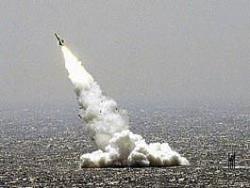
Bulava Launch (photo: ITAR-TASS)

At 0510 MSK today, Dmitriy Donskoy successfully launched the second Bulava SLBM of 2010 while submerged in the White Sea.  That makes two in a row, and 7 successes in 14 attempts overall. 

A government Military-Industrial Commission (VPK) source told ITAR-TASS the 15th test could occur in early December and will be the first from new Borey-class SSBN Yuriy Dolgorukiy.  The source attributed the successes to a tightening of control over the production and state acceptance processes.  He also warned it’s too early to relax:

“Two successful launches don’t signify that it’s possible to accept ‘Bulava’ into the arsenal.  A great deal will depend on testing in 2011.”

A member of the state commission that investigated the Bulava failures told RIA Novosti that these successes show Bulava had assembly problems.  And he said testing will continue in 2011.

RIA Novosti noted that, perhaps most significantly, this year’s Bulava tests came from a submerged boat.  In 12 tests prior to 2010, there had not been a single successful underwater launch.

Popovkin on OPK, IVECO, Mistral, and Bulava

Speaking to journalists at Euronaval-2010 today, First Deputy Defense Minister Vladimir Popovkin said the Russian Navy needs modernization more than the other armed services.  And defense industry needs modernization badly.  Popovkin noted:

“Many industry representatives came to the exhibition with the military.  At the exhibition we always need to examine what’s best in the world, have talks, and look at where we aren’t up-to-date.”

 “Without reequipping the Russian defense industrial complex it’s impossible to produce modern equipment.”

 “Our task is not to buy foreign equipment, but technologies on the basis of which we would be capable of organizing production in Russia.  We, unlike some other countries, are not secretly copying examples, but openly we say we’re prepared to pay for technologies, to buy licenses for production of this or that equipment.  The main condition is the transfer of production to Russian territory and the transfer of technologies.”

Is Popovkin slamming China?  Is China copying secretly or actually quite brazenly?

On the joint venture (JV) with Italy’s IVECO, Popovkin said:

“A JV for producing these armored vehicles on RF territory has been created.  Next year it will begin production.  The first vehicle will come out at the end of 2011.”

“Essentially, this is final assembly.  Nevertheless, we are planning that more than 50 percent of the components in this vehicle should be of Russian manufacture.”

Popovkin said Russia is now in talks on the specific model:

“We’ve presented specific requirements.  Why?  We have our own weather conditions, different employment tactics, therefore the base model will be developed taking Russian conditions into account.”

 ITAR-TASS noted the JV will put out vehicles needed for both the Defense Ministry and the MVD.  Licensed assembly of several hundred units of IVECO’s LMV M65 annually could occur at one of Russia’s automotive factories.

Popovkin also said Russia’s tender for amphibious assault ships has been announced:

“We’ve announced the tender for the purchase of amphibious assault ships.  Two ships will be built abroad.  Technology transfer for the construction of the rest is planned.”

It sounds like Popovkin’s decided a Russian shipyard can’t win the competition for the first two units.  Are Russian builders just competing for units 3 and 4?

Asked about the number of Bulava launches in 2010, Popovkin said:

“We’re acting sequentially, step by step, therefore it’s impossible to say now the exact number of launches in 2010.  The main task now is to conduct the next launch.  Based on it, we’ll determine our future plans.  Until we get reliability of 98-99 percent, we won’t put this missile on combat duty.  The missile’s reliability is determined not just by launches, but also by a whole series of testing work.”

Meanwhile, a Defense Ministry source has told ITAR-TASS the second Bulava launch of 2010 will occur on 29 October.