Category Archives: Training and Exercises

The Sound of Managed Democracy?

The classic dilemma of civil-military relations . . . is jet noise the sound of freedom — or in this case, of managed democracy?

Or is jet noise a dangerous nuisance?

Last Sunday, Svpressa.ru ran an article on complaints about a major expansion of Baltimor Air Base on the outskirts of Voronezh.  Baltimor also goes by the name Voronezh-B.  This is just the most recent article on local concerns about Baltimor.  Novaya gazeta published on the situation in the middle of last year.

By year’s end, Baltimor is supposed to be Russia’s largest air base, with 200 aircraft, according to Svpressa.  A second, 3,500-meter runway is being built there to accommodate all aircraft types.  Takeoffs and landings at Baltimor occur just a few hundred meters away from apartment blocks.  Residents expect the jet noise to double along with the number of aircraft.  Here’s a video of local aircraft operations.  And another

Svpressa notes the air base was used little after 1990, except for spikes during the Chechen wars.  And from about 4 years ago, it was all but abandoned, overgrown, and broken down.  At the same time,  apartment construction grew outward toward the base.

The resumption and expansion of activity at Baltimor put nearby residents into action.  They believe, with 200 aircraft, flights will be virtually constant.  And a former serviceman told Svpressa he expects the base to have 200 flight days (and nights) a year, with as many as 10 aircraft up simultaneously.

Not surprisingly, residents worry about crashes, about fuel and munitions storage depots, about airport-level noise and vibration, and its effect on young children and infants.  Svpressa reprints their long petition to Voronezh officials asking who and how the air base’s expansion was approved:

“How was such a document signed?  Who was responsible for preparing it?  Why is the population’s opinion supplanted by the conclusions of some ‘experts’ and the silent consent of the oblast administration?”

The website also publishes Air Forces CINC Aleksandr Zelin’s answer.  He asserts they illegally built too close to the airfield, and emphasizes the state’s interest in expanding an existing air base rather than building a new one for “several billion rubles.”

The case of Baltimor Air Base is interesting in its own right, but it’s significant on two other levels.

On the first, the Baltimor situation is evolving in the context of debate over the Air Forces’ force structure and base structure.

Defense Minister Serdyukov’s major reforms pointed immediately at concentrating the Air Forces at fewer bases.  The exact number, however, has shifted constantly downward from 55 at first.  Recall at the 1 April Security Council session on the aviation sector, Medvedev told ministers and officials:

“Now the airfield network of military aviation does not correspond to the basing requirements of aviation groupings.  At the Defense Ministry collegium which took place recently [18 March], I gave orders to establish several large air bases.  Taking into account the deployment of troops, they will be situated on the main strategic axes.”

At the collegium, Serdyukov in fact announced, instead of 33 air bases, there will be eight army aviation bases subordinate to the four military districts / OSKs, and the number of aircraft at each will increase 2.5 or 3 times.  Of course, saying that and getting to that point are two different things entirely. 

Gazeta.ru printed a nice summary of the VVS ground infrastructure issue.  It concluded fewer bases would make things cheaper, but also easier for a potential enemy.  It said a similar effort to resubordinate air and air defense forces to MD commanders in the early 1980s failed.  Rossiyskaya gazeta said experts think the number of air bases should be different for different MDs, as should the mix of aircraft.

It seems, for economic reasons, these large air bases will be picked from the list of existing ones, they won’t necessarily take advantage of vast swaths of unpopulated territory, and they’re likely to irritate the civilian population.

Abandoning old bases and airfields leads to another, longstanding but growing problem of late — the archipelago of unneeded garrisons and military towns.  The Defense Ministry would like to shuffle them off to someone else’s responsibility, and resettling retired military, dependents, and civilian workers elsewhere has been problematic.  BRAC-like processes are especially painful in Russia. 

On the second level, Baltimor could become politically and socially significant.  It’s rare in Russia these days for a military problem to have that kind of potential.  

If politicians ignore or downplay what the locals feel is their basic right to health and environmental protection for the sake of an intangible state interest, there’s a chance Baltimor could become a more serious regional, or even national, issue.  Especially if similar circumstances arise in other cities.

This may seem a stretch, but remember ordinary Russians tend to be galvanized by the local impact of things like auto import tariffs, immigration, building roads through forests, etc.  And concern about the impact of air bases would come on top of other civil-military issues.

In Chelyabinsk, and several other places, the locals are protesting explosive ammunition destruction that is rocking parts of their cities.  Prosecutors already found that the military lied about the size and power of demolition activities not far from Chelyabinsk.  Chelyabinsk residents are also angry about overflights of the city from nearby military airfields.

VDV on Amphibs

By way of follow-up . . . late last May, VDV Commander, General-Lieutenant Vladimir Shamanov told the press his forces have embarked in Black Sea Fleet ships for joint training since the Georgian conflict.  Yesterday RIA Novosti reported on such a joint exercise.

More than 1,500 airborne troops and nearly 100 pieces of equipment are participating in tactical exercises with BSF ships near Novorossiysk.  The VDV are from the 108th Guards Airborne-Assault Regiment, 7th Airborne-Assault Division.

Specifically, the VDV spokesman said:

“On Wednesday nearly 30 airborne combat vehicles and other combat equipment loaded onto large landing ships of the Black Sea Fleet and debarked in a designated coastal area at the Rayevskiy range near Novorossiysk.”

Exercises will continue until tomorrow.  Reconnaissance company personnel will airdrop near Rayevskiy today.  The drop was delayed by bad weather, according to the VDV spokesman.  Two battalions conducted mountain combat training yesterday, and will conduct night firings today.

RIA Novosti didn’t indicate which BSF ships are carrying the VDV.  But Ropucha II-class LST Azov and Alligator-class LST Nikolay Filchenkov were active in the first days of this month during an inspection by Navy CINC, Admiral Vladimir Vysotskiy.  The ships worked with the BSF’s Naval Infantry Brigade at the Opuk training range.

“New Profile” in Transbaykal

Nezavisimoye voyennoye obozreniye’s Viktor Litovkin wrote recently about his Defenders’ Day press pool visit to the 212th District Training Center (OUTs or ОУЦ) in Peschanka, and to the 29th Combined Arms Army in Chita.  Formerly part of the Siberian MD, they’re now in the Eastern MD or OSK East.  Litovkin set out to see how the military’s “new profile” has been implemented in the four years since he last traveled to Transbaykal.

Litovkin said the army’s future “junior specialists,” i.e. better trained conscript sergeants, aren’t just using simulators, and there’s lots of live action on OUTs ranges and training grounds.

Simulators at Peschanka (photo: V. Litovkin)

The majority of trainees were in training for a minimum of 8 hours a day, not including individual training and PT time.

OUTs Chief, General-Major Sergey Sudakov is new himself, but says much has changed at the center.  He says they’ve gotten new simulators, training buildings and barracks have been renovated, and the mess hall’s been outsourced so conscript-trainees no longer have to pull KP.

Four years ago, the Siberian MD listed 5,970 personnel without housing, but now only 120.  Those without apartments have been taken off the local books, and all their data’s been sent to the Defense Ministry’s Housing Support Department in Moscow. 

Now, however, there are rasporyazhentsy (распоряженцы), those officers, warrants, or sergeants at their commanders’ disposition, in all, more than 200 waiting for permanent apartments outside Transbaykal.  But only 2-3 per month are getting a “letter of happiness” from Moscow saying they’ve been allocated housing, and, in many cases, it’s not in the location they wanted.

The rasporyazhentsy were once commanders and chiefs but now they muster every morning to get orders from their former subordinates.  They don’t get anything serious to do.  They pull assistant duty officer for a unit once a week, or carry out a major’s orders for less than half their old pay.

Medic Senior Sergeant Zhanna Litvinenko is a rasporyazhenitsa who’s waited two years for an apartment in Rostov-na-Donu or Krasnodar Kray.  While waiting to return to “mainland” Russia, she lives on “bare pay,” without supplements, of 16,900 rubles, of which 3,200 pays for her dorm room.

Litovkin visited the officers’ dormitory to see what’s changed since 2007.  He describes familiar noisy corridors with common toilets, showers, and kitchens for officers and their families.  The building’s been renovated, old wooden window frames and the boiler have been replaced, kitchens updated, and showers divided so men and women don’t have to use them on alternating days.

One Captain Rinat Abubekirov and his wife say the load on officers has grown sharply now that there are fewer of them.  The tank training regiment had 140 officers previously, now 98, in a company, there were 7, now 5, and the number of additional duties is unchanged.  A company commander is now a captain, rather than a major as in the past.  Abubekirov has been an O-3 for five years, and no one can tell him when he might make O-4.

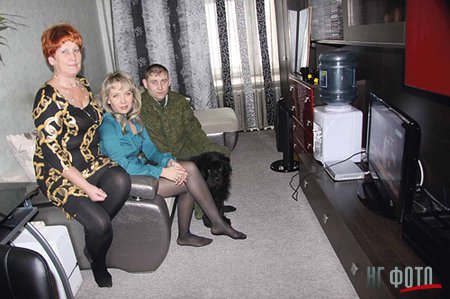
Litvinenko and the Abubekirovs in the Officers' Dorm (photo: V. Litovkin)

Training their conscript charges has changed.  Instead of six months, they now have three to do it.  The trainees’ education level varies greatly now — from higher education to some who didn’t finish high school.  Many conscripts arrived in poor health, and the severe Transbaykal winter doesn’t help either.  Minus forty isn’t rare, and -30° (-22° F) is the norm.  They are just not physically or psychologically prepared.  Nevertheless, OUTs Commander Sudakov says fewer are sick this winter than last.

Then, Litovkin turns to the Chita-based 29th Combined Arms Army commanded by General-Major Aleksandr Romanchuk, where the NVO editor says he sees “solid changes.”  All its units are fully manned and permanently combat ready.  In what’s become a fairly common refrain, Romanchuk believes his army’s combat potential exceeds that of its predecessor [the Siberian MD]. He said he and his deputy spent a month at the General Staff Academy learning the new automated command and control system.  He said his best subordinates can earn 100,000 rubles per month in bonuses.

Litovkin says there are questions about the introduction of new equipment in Romanchuk’s command.  It would be good if its tanks and combat vehicles could be replaced quicker.  There are no UAVs or PGMs.  The army relies on T-72B1, BMP-2, Strela-10 and towed air defense guns, and self-propelled Akatsiya and Msta-B artillery.

Litovkin concludes that, while no one believes Mongolia or China will threaten Russia’s borders today or tomorrow, this army needs to train in a real way, with equipment from the 21st century, not the last one.

But this, he continues, is not even the greatest problem.  He was told at every level that it’s simply not possible to make yesterday’s schoolboy into a good specialist in a year.  The commander of the 29th CAA’s 200th Artillery Brigade, Colonel Dmitriy Kozlovskiy, told Litovkin this spring he’ll lose 70 percent of his personnel.  New gun commanders, gunners, radiomen, and reconnaissance, topographic, and meteorological specialists will arrive and in less than a month they’ll need to work like crews, platoons, and batteries, like a unified combat mechanism.  They will learn and leave the army, and the process will begin again.

Sounds like a Russian O-6’s plea for professional enlisted and NCOs . . . .

Litovkin finishes with a story from Romanchuk.  He tells of a tank gunner conscript who hit his target [a 1 — an excellent in Russian training terms] on his 39th day of service.  He said he just did everything as he was taught, and as he did on the simulators.  In times past, according to Romanchuk, tank gunners got to fire live rounds only after serving six months, and this guy scored a 1 on his 39th day.  But Litovkin asked how his buddies did.  Romanchuk answered 2s and 3s.

New Deputy Defense Minister

Antonov with Medvedev and Serdyukov (photo: Kremlin.ru)

Today President Medvedev made Anatoliy Ivanovich Antonov Deputy Defense Minister for International Military Cooperation.  He’ll bear responsibility for organizing and conducting the Ministry’s contacts with foreign military departments.  Kremlin.ru notes Antonov was one of the negotiators for the new Treaty on Strategic Offensive Arms.  Medvedev said Antonov’s experience in this successful negotiating process will enable him to fulfill his new duties effectively.

Anatoliy Antonov

PIR-Tsentr’s short biography of Ambassador Antonov says he’s been serving as Director of the Foreign Ministry’s Security and Disarmament Issues Department.  He was born in 1955.  In 1978, he graduated the USSR Foreign Ministry’s Moscow State Institute of International Relations (MGIMO or МГИМО).  In 1983, he completed graduate study at the same institution.  Antonov’s worked in the Foreign Ministry since 1978.  He’s headed government delegations in G8, NPT, Inhumane Weapons Convention, and multilateral export control negotiations.  He’s a member of the U.N. Secretary General’s Consultative Council on Disarmament.

In mid-2007, Antonov helped then-President Putin unveil his offer to use Russia’s Gabala and Armavir radars in NATO missile defense, according to Novosti KM.RU.

Antonov makes nine deputies to Serdyukov; a tenth deputy slot for finance-economic work has been vacant since Vera Chistova’s departure in the fall.

Antonov’s quite different from his predecessors in this job.

International military cooperation seemed to fall off the Defense Ministry’s radar for a while after Anatoliy Serdyukov took over.  You may recall, former Main Directorate for International Military Cooperation (GU MVS) Chief, General-Colonel Anatoliy Mazurkevich fled the Defense Ministry when Serdyukov arrived.  GU MVS essentially disappeared from the military department’s organizational chart.

GU MVS’ roots stretch back to the General Staff’s old 10th Main Directorate, which had a long history of involvement in arranging arms sales and providing military advisors and training to Soviet client states in the bad old days.

Trainer-in-Chief

Mil.ru made it official today.  General-Lieutenant Nikolay Bogdanovskiy, late of the Leningrad MD, is now the military’s trainer-in-chief.  According to the Defense Ministry website:

“On 1 December 2010, the Combat Training Directorate of the Ground Troops was transformed into the Main Combat Training Directorate (GUBP or ГУБП) of the Ground Troops, and given the function of coordinating the training of the RF Armed Forces services and troop branches.”

And Bogdanovskiy is now a Deputy Ground Troops CINC heading the new GUBP, according to the latest personnel decree.

General-Lieutenant Bogdanovskiy

We’re left wondering how far his new writ extends . . . just combined arms training, or to the VDV, RVSN, and Space Troops?  Recall also there was speculation that new Deputy General Staff Chief, General-Colonel Gerasimov, late of the Moscow MD, might be the main training supervisor.

A little background on Bogdanovskiy as long as it’s here. 

He was born in 1957.  He’s a graduate of the Moscow Higher Combined Arms Command School, the Frunze Military Academy, and the General Staff Academy.

He’s served as commander of a reconnaissance platoon, a company, chief of staff, then commander of a motorized rifle battalion in the Southern Group of Forces [i.e. Hungary], chief of staff of a fortified region, commander of a motorized rifle regiment, chief of staff of a motorized division, chief of a district junior specialist training center, chief of staff and commander of the 35th Army, Deputy Commander of the Far East MD, Chief of the Main Staff and First Deputy CINC of the Ground Troops, and Commander, Leningrad MD.

GUBP Retirees Against Reform

 A belated post-script to the Colonel Krasov, Seltsy, SDR flare-up against Defense Minister Anatoliy Serdyukov and his reforms . . . .

On the first of this month, Life.ru reported that officers of the now-disbanded Main Directorate of Combat Training and Troop Service (ГУБП or GUBP for short) established a public organization to oppose military reform.

The organizing assembly occurred right after the directorate furled its standard (marking the unit’s dissolution) on 26 November.  Life.ru says 60 men attended.  This new, as yet unnamed organization is apparently seeking official registration.  It expects support from the LDPR faction in the Duma, and from large veterans organizations that have come out against reform.

Its executive secretary, Andrey Serdyuk, said:

“Ill-conceived reform has left the Russian Army without a central combat training methodology – that is, now no one knows what and how we teach soldiers and officers on the battlefield.  Nevertheless, we intend to conduct meetings and demonstrations like our colleagues from the Union of Airborne Troops.  We plan to achieve our goals in three ways – media appearances, organizing public monitoring over the course of reform, and cooperation with public veterans’ organizations.”

Retirees will be the backbone of this organization.  It won’t accept serving military men out of concern for their welfare.

A former chief of the main directorate, General-Colonel Aleksandr Skorodumov will head the group.  He retired in late 2004 after complaining publicly about personnel decisions and reorganizations that look minor compared with Serdyukov’s tenure.  He created a mini-scandal by saying the army had collapsed at that time.

Viktor Ozerov – Chairman of Federation Council’s Defense Committee and an uncritical functionary – admitted:

“There was and undoubtedly will be resistance to reform.  Remember when the General Staff apparatus was cut, how many dissatisfied people there were:  people occupied specific duties, had pay, and then they’re deprived of all this.  But in any instance, there are people standing behind every such decision and their legal rights should be guaranteed upon dismissal.”

Ozerov also said responsibility for combat training will go to the individual services and branches, and inter-service training will be supervised by the military districts / unified strategic commands (OSKs).

Serdyukov himself told the Defense Ministry’s official Public Council on Friday that combat training will be the purview of services, armies, and brigades, and operational training will be under the Genshtab, MDs, and brigades (but apparently not armies?).

The GUBP’s fate was decided in June and sealed in September.  See Moskovskiy komsomolets, Argumenty.ru, and Gazeta.ru for more.  They claim former Moscow MD Commander, General-Colonel Valeriy Gerasimov – newly retooled as a deputy chief of the General Staff – will oversee inter-service training for the Genshtab.  And, by 1 February, a new Directorate of Troop Service and Military Service Security will stand up.  This will actually be a new / old directorate.  It existed several years ago and supervised safety issues, and grappled with crime and dedovshchina among the troops. 

MK presented two opposing opinions on GUBP’s fate. 

Leonid Ivashov said:

“The most experienced officers and generals serve in the GUBP, they develop and monitor combat training.  The Genshtab has several other functions – strategic ones.  No one there will take evaluation trips to far-off garrisons.  Especially since the Genstab’s combat training directorate will be a very truncated version.  Its elimination means our troops won’t be prepared for combat actions.

A Genshtab source gave this view:

“This is simply the latest course of reform which we have going on.  The information about the GUBP’s elimination appeared long ago.  The directorate has a highly inflated number of personnel, and its work has been evaluated as, to put it mildly, ineffective.  No new methods, no training ground equipment, no simulators in recent decades.

Makarov’s Year-Ender

On Tuesday, General Staff Chief Nikolay Makarov provided his year-end wrap-up on the ‘new profile’ of the Armed Forces in the form of a press-conference featuring a videolink with the four new MD / OSK commanders.

It was pretty much a self-congratulatory celebration of how Makarov and company have turned everything in the Russian military around for the better.  As Moskovskiy komsomolets put it, “Nikolay Makarov told the media how bad it was in the army in the past, and how good it will be in the future.”

Rossiyskaya gazeta paraphrased Makarov’s remarks, giving only a couple direct quotes.  First up was President Medvedev’s call for unified aerospace defense (VKO) before the end of 2011.

RG says Makarov said VKO will be fully operational in 2020 when new reconnaissance and weapons systems have been deployed.  He said its purpose is to defend the state [interestingly the state, not the country] from ballistic and cruise missiles.  It needs to be an umbrella against any kind of threat, including low-altitude ones.

Makarov said different military structures have been occupied with the security of the skies.  Space Troops do orbital reconnaissance and ground-based missile early warning.  The air forces and air defense armies (АВВСиПВО or АВВСПВО) and radar troops monitor air space for approaching hostile aircraft.  The Special Designation Command (КСпН) covers the Moscow air defense zone [didn’t this long ago change its name to the OSK VKO?].  Air defense troops (ЗРВ) and fighter aviation cover other important facilities.  The system was set-up on a service (видовой) basis and that’s why it was uncoordinated.  It needs to be made integrated and put under the command of the General Staff [of course – this sounds like Olga Bozhyeva in MK].  In the Defense Ministry, they understand unification won’t be quick and will require a lot of resources, but there’s simply no other way.

Izvestiya proffered a quotation on this one:

“If we look at how this system was built earlier, then it’s possible to see that it acted separately by services and branches of troops, and also by regions.  So, Space Troops answered for space reconnaissance, the work of missile attack warning stations.  The Ground Troops for the activity of radar units.  Now we are uniting all these separate organizations in a unitary whole.  We need to establish the foundation of this system in 2011.  To finish its formation completely by 2020.”

According to RG, Makarov said a modern army would be useless without a new command and control system for the Armed Forces.  Russia’s move to a unified information environment will cost 300 billion rubles, and will be phased, with the initial phase being the replacement of all analog equipment with digital systems by 2012.  Command and control systems will be developed and produced in Russia, but other weapons will be bought abroad.  This is when he broke the news about Mistral winning the amphibious command ship tender.

RG concludes Makarov called for a fully professional Armed Forces, but the words it quoted aren’t particularly convincing:

“Now we can’t do them like this.  But year by year we’ll increase the selection of contract servicemen with commensurate pay.”

However, Moskovskiy komsomolets quoted the General Staff Chief this way:

“We are aiming for a contract army.  Now we can’t make it so instantly, but year by year the number of contract servicemen, with commensurate pay, will increase.”

Olga Bozhyeva viewed this as a total reversal of Makarov’s earlier rejection of contractees and insistence on conscripts as the backbone of the army.

Makarov also talked about efforts to create ‘human’ service and living conditions.  He referred, as always, to outsourcing and civilianizing mess hall and other housekeeping duties.  He repeated that, starting in 2012, officer pay will increase by several times.  According to Krasnaya zvezda, Makarov said 50 percent of officers now receive higher pay through premiums and incentives.  Officers and their families will be moved from remote garrison towns to oblast centers where their children can get a better education and wives can find work.  About the large cut in military towns, he said:

“We had about 22 thousand of them, approximately 5,500 remain, but in all, we’re taking the number of military towns to 180.”

Of course, he didn’t mention who will take care of large numbers of retirees left behind in that archipelago of abandoned military towns.

KZ gave its own recap of Makarov’s press-conference, and it’s interesting to hear his rehash of why the army needed a ‘new profile.’  His remarks blow up any lingering myth about the 2000s, at least the Putin years, as the time of the Russian military’s rejuvenation.  He said:

“Before 2009, 87 percent of the Armed Forces consisted of formations and military units with abbreviated personnel and cadres, practically not having personnel.  They almost didn’t conduct operational and combat training.  The army didn’t just degrade.  During this time, we grew an entire generation of officers and generals who ceased to understand the very essence of military service, they didn’t have experience in training and educating personnel.”

KZ paraphrases more of Makarov.  The personnel training system caused complaints.  VVUZy were teaching the Great Patriotic War.  Low pay and poor prospects for housing made the officer’s profession a low-prestige one.  In units, personnel weren’t occupied with combat training, but serving themselves, and military discipline fell as a result.  On the whole, the Armed Forces stopped fulfilling the missions for which they are intended, and could scarcely react to threats and challenges beyond the state’s borders and inside the country.

Makarov addressed how the MDs were changed to meet future threats and challenges:

“Planning and troop employment happened with significant difficulties, since each of six military districts had a series of missions where one often contradicted another.  Moreover, four air forces and air defense armies were established, as a result, the zones of responsibility of the military districts and these armies didn’t coincide at all.  This led to confusion in employing air defense forces.  At the same time, experience showed that military actions in recent decades are conducted, as a rule, by unified force groupings and forces under a unitary command.  Each of our districts and each of our four fleets existed independently. Each had its own zone of responsibility, not matching the others.  In order to organize any kind of joint actions, it was necessary to establish temporary commands, temporary structures, which, as a rule, were poorly prepared, didn’t have corresponding experience.  All this led to unsatisfactory results.”

Izvestiya quoted him:

“In the bounds of the ongoing transformations, full-blooded troop groupings have been established on all strategic axes.  Four full-blooded commands have appeared for us which, having in their composition and immediately subordinate to them all forces and means, can react adequately to all challenges and threats to the borders of our districts.  Changes in the Armed Forces command and control structure are a necessary occurrence since the old administrative-territorial division had stopped answering the challenges and threats of the time.”

New MDs (photo: ITAR-TASS)

Then Makarov brought in MD commanders over the video so they could attest to how it’s going.  They remarked on how cutting intermediate, redundant command levels has made their jobs easier.  Western MD Commander, General-Colonel Arkadiy Bakhin said 40 percent of his formations and units have outsourced some support functions. 

KZ says earlier MD commanders answered only for Ground Troops, and when they needed forces from another service or branch, they had to get permission from above.  Southern MD Commander, General-Lieutenant Aleksandr Galkin claims making these requests cost the commander time, but now all forces and means are in one command, the fundamentally new unified strategic command (OSK).  Galkin also says freeing soldiers from support tasks means there are now 20-22 training days per month instead of 15-16.

Medvedev Calls for Unified Aerospace Defense

Yesterday President Dmitriy Medvedev delivered the annual Federal Assembly address.  It was rather brief, uninspiring, and contained relatively little on the military, except his call for work on a unified aerospace (air-space) defense (VKO or ВКО).  This could be a death knell for independent Space Troops.  He also repeated his warning that an agreement on missile defense is needed, or another round of the arms race will ensue.

But let’s look from the beginning . . . Medvedev suggested the army’s modernization might help jumpstart the scientific and technical modernization of the economy.  He said the 20 trillion rubles for the State Program of Armaments will be doubly effective if they give Russia dual-use technologies that can help modernize production processes and develop both fundamental and applied research.  And Medvedev again mentioned creation of a Russian DARPA:

“Therefore we are creating a special structure which will research and develop breakthrough technologies for the defense sector.  There are such structures, you know, in other countries.  We are expecting many of them will find application in everyday life.”

There seems to be a huge disconnect between Medvedev’s almost offhand comments here and what military men expect out of that 20 trillion.  One doubts many in the armed forces see any of this funding going to R&D.  They see it going almost entirely toward procurement of existing weapons and equipment woefully lacking in today’s military inventory.  Perhaps it’s Medvedev’s way of selling (as if he needs to) these expenditures to the average citizen.  

At any rate, Medvedev then gets down to brief comments on the armed forces:

“The development of our state and society is impossible without effective support of national security and defense.  We have taken a course for a deep modernization of the Armed Forces, for conducting systemic, meaningful transformations in them.  The combat component of the Armed Forces, the combat readiness system, command and control, and material-technical support of troops have already been updated.  Our combat exercises have again become regular and, what’s of no small importance, large-scale.  Four military districts have been formed instead of six.  In the framework of the State Program of Armaments to 2020, troops are being outfitted with modern equipment.”

“What tasks still have to be resolved?  First.  In the next year, particular attention needs to be given to strengthening the country’s aerospace defense, to unify existing air and missile defense systems, missile attack warning, and space monitoring.  They should act under the unitary command and control of a strategic command.”

“Second.  Today’s Russia, it goes without saying, also needs a modern army and fleet, compact and mobile troops manned with high-class specialists and the newest weapons.  This requires both serious resources (I just stated the volumes of these resources), and new, sometimes complex, decisions.  At the same time, it is necessary to fulfill all obligations to people who chose army service for themselves, first and foremost to resolve the housing question within the planned time.”

“Third.  The army should free itself from ancillary tasks and noncore functions.  These functions need to be transferred to civilian organizations, to concentrate attention, most of all, on real combat training.  A young man only goes to the army for one year, and the program of training in military affairs is not becoming easier.  It is essential that every young man assimilate the program in full measure.”

Medvedev goes on to describe his discussions about European missile defense with NATO in Lisbon.  He repeats his warning that, if an agreement on missile defense isn’t reached and a full-fledged joint cooperation mechanism isn’t created over the next decade, another round of the arms race will begin:

“And we will be forced to make a decision on the deployment of new strike means.  It is perfectly obvious that this would be a very grave scenario.”

Short Takes

A Navy Main Staff source has told Interfaks that Borey-class SSBN Yuriy Dolgorukiy will launch its first Bulava SLBM on 17 December.

The RVSN has decided to implement testing for narcotics use among its personnel, according to ITAR-TASS.  It will begin next year.  The RVSN spokesman provided no explanation why his branch will institute drug testing. 

RIA Novosti reports Russia will have contract reservists from 2016.  GOMU Chief Vasiliy Smirnov tells the wire service conscripts will be asked if they want to stay in the reserves for pay.  Russia’s requirement for reserves should be lower in the future given the recent shift to smaller, higher readiness forces and away from cadre units that would need fleshing out with mobilized reservists.  This story’s been around for a while.  It’s not clear how much reservists would be paid, or what their commitment would be.  It hasn’t been easy for military commissariats to mobilize reservists even for infrequent exercises and training assemblies in the past.

Lenta.ua is reporting a Defense Aerospace story that the Indians have moved acceptance of the Admiral Gorshkov (Vikramaditya) carrier off from the beginning to the end of 2012 because the ship will need more work.

RIA Novosti cites military medical sources saying VDV Commander, General-Lieutenant Shamanov may not be discharged from the hospital until after 1 January.

IA Regnum reports the Chelyabinsk governor has complained to Defense Minister Serdyukov about the resumption of explosive ammunition disposal at Chebarkul, and also about Su-24 flights over Chelyabinsk.

RIA Novosti and Lifenews.ru report that a document creating a Russian DARPA may soon be put before President Medvedev.  The agency would be independent of the Defense Ministry, but conduct ‘breakthrough research in the interests of national security.’  The idea was first raised back in September.

Medvedev Talks to Brigade Commanders

Medvedev Speaks at Brigade Commanders' Assembly

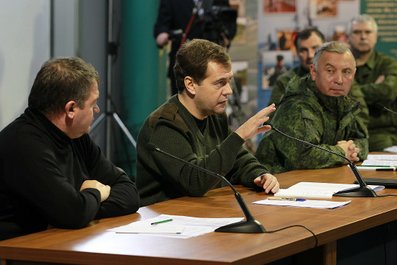
According to Kremlin.ru, President Dmitriy Medvedev traveled to the Gorokhovets training ground near Nizhniy Novgorod today to observe battalion-level ground and air maneuvers.  It’s a modern twist on an old tradition of presidential speeches before end-of-training-year assemblies in Moscow. 

Medvedev inspected a new field camp, different weapons and equipment, and watched a Tunguska demonstration.

Afterward he met brigade commanders observing the exercise, and addressed them about the process of reforming the armed forces.

Medvedev said for two years Russia has been actively modernizing its armed forces to make them more compact, effective, and better equipped, and completing ‘org-shtat’ measures [i.e. TO&E changes] to achieve a ‘new profile.’  Flanked by Defense Minister Serdyukov and General Staff Chief Makarov, he promised the assembled commanders a defense budget worth 2.8 percent of Russia’s GDP every year until 2020, but he said getting this level of spending will not be easy, and it requires adjustments and cuts elsewhere.

He particularly emphasized establishing the new system of higher pay to replace earlier ad hoc measures like premium pay.  He seemed to say extra money will be squeezed out for this, but people will be watching how it’s spent.  Kremlin.ru posted some of Medvedev’s opening remarks:

“This is creating the conditions to equip the troops with new equipment in accordance with the current edition of the State Program of Armaments and, what is a no less important task and really no less complex, to resolve all social issues which exist for servicemen.  This issues are also well-known.”

 “First and foremost is the indexation of pay which we are already now conducting, and implementation of the housing construction program.  From 2012, the planned reform of the military pay system not according to those fragmentary pieces which exist at present, not according to those selective approaches which exist, but a full reform of pay.”

“In the final accounting, we should get so that base salary, monetary salary of servicemen will be increased practically three times. And in the process to preserve and to extend to all the Armed Forces that which we talked about in the past, that which we did according to groundwork laid in bounds of order 400 and some other Defense Ministry documents.”

“All planned measures, reform measures should be calculated and materially supported in the most rigorous way.  An adjustment in the military budget is being conducted and oversight of the use of resources is being organized for this.  I promise the attention of all Defense Ministry leaders on this:  all these processes need to be completed in coordination with other government structures in order that we should have absolute precision here.”

“A high level of financial support for the Armed Forces allows, I hope, for freeing servicemen from noncore housekeeping functions – that, in fact, was done long ago in the armies of other countries.  The troops need first and foremost to put their attention on operational training, combat exercises, to concentrate exclusively on these issues.  Security duties (firstly, perhaps not even security, but cleaning), everyday support, food preparation should be transferred to civilian organizations.”

Medvedev told the commanders their brigades should be self-sufficient, modern, balanced, and capable of fulfilling missions given them, and he invited their feedback because, as he said, the success of the military’s transformation depends on it.

“It would also be useful for me to know your opinion on the quality of the reform, on the organizational changes, what, in your view, has proven itself useful, and where there are problems.”

Despite soliciting their honest opinions, one doubts the Supreme CINC will hear many complaints from this audience.  They are, after all, winners in the reform process since they managed to continue serving in command positions.