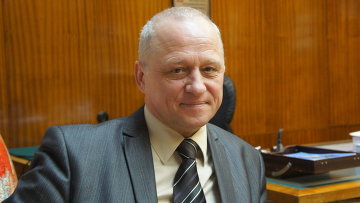
Dyachkov’s Interview

Andrey Dyachkov (photo: RIA Novosti / Sergey Safronov)

As General Director of both Sevmash and TsKB MT Rubin, Andrey Dyachkov’s a pretty significant individual when it comes to submarines.  What follows are highlights from his RIA Novosti interview last Friday.

Some blurbs have been published, but one frankly hasn’t had time to see if they captured the importance of what Dyachkov said.  Hence this summary.  It has less elegance (or perhaps fluff) than you may be accustomed to reading on these pages.

Dyachkov said the following:

  • Sevmash and the Defense Ministry signed a contract for the modernized Yasen, or Yasen-M this year.  It will be five units; Severodvinsk plus five.  Severodvinsk will be delivered next year; there were problems with some components obtained from suppliers and the Kalibr missile system needs to complete state testing.  About six months are needed for all this.
  • This year’s huge contract problems were a result of a changed Defense Ministry approach toward price formation Sevmash wasn’t ready for.  But times have changed, and Sevmash recognizes money has to be used more effectively, and ways have to be found to cut production expenditures.
  • Rubin has a contract to design the modernized proyekt 955, Borey, the Borey-A.  The contract should be signed by early 2012.  The lay-down of the first improved Borey will happen next year, and Saint Nikolay is still the working name for the first unit.  No word from the Sevmash chief on the final number of boats until after the contract is signed.  They’ve started laying down Saint Nikolay, but the official ceremony’s still to come.
  • Seventy percent of sub costs are reportedly to pay suppliers.  The main thing is getting them to reduce the cost of their products.  The Defense Ministry might even consider foreign component suppliers for some SSBN components.
  • Sevmash will take on construction of two diesel-electric proyekt 636 from Admiralty Wharves.  This will lighten the workload of the latter, and use excess capacity at the former.
  • Severnoye PKB has a contract to figure out how to modernize Kirov-class CGN Admiral Nakhimov (proyekt 1164, Orlan).  First and foremost, it needs new missiles (Kalibr and Oniks) to replace its Granit.  They are talking only about Nakhimov at this point.
  • Sevmash won’t be repairing CV Admiral Kuznetsov in 2012.  The shipyard is prepared to build a future carrier.
  • Modified Typhoon-class SSBN Dmitriy Donskoy will be kept active at the White Sea Naval Base for sub-on-sub trials of new boats.  Northern Fleet subs won’t be diverted for this task.
  • KB Malakhit has developed repair and modernization plans for the Akula-class (Proyekt 971, Bars).  Money’s been allocated and Zvezdochka will do the work. 
  • Russia may offer up the Amur-1650 diesel sub in next year’s Indian tender.  It could have air-independent propulsion, but Russia doesn’t seem really high on the idea.
  • They want to test Proyekt 677 Lada and its sonar in deeper waters next year.

Perhaps the Borey and Yasen mods reflect the problems of restarting construction that had been dormant (or at least very slow) for a long time and of using newly-made components rather than older ones.
Where’s the Logic? (Addendum)

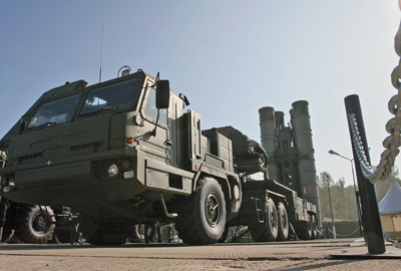
S-400 Launcher (photo: ITAR-TASS)

One shouldn’t ignore what doesn’t make sense . . . last week the Russian press reported again that the Baltic Fleet’s PVO units (Kaliningrad’s 3rd Aerospace Defense Brigade?) will receive their first S-400 launchers before year’s end.  The first report came in August.  ITAR-TASS cited a source this time – Baltic Fleet Commander, Vice-Admiral Viktor Chirkov.

Chirkov didn’t say how many the fleet will get, but he said the S-400 will replace old S-200 (SA-5 / Gammon) surface-to-air missiles.  He says his crews are currently conducting “acceptance-handover” launches, presumably at Ashuluk.

It doesn’t seem logical.  SAM brigades around Moscow can’t get S-400s on time and Chirkov is talking about putting them in Kaliningrad.  And his assertion he’ll get them this month seems odd given the loose schedules and passed deadlines associated with the program.

President Medvedev just finished saying one measure against European missile defense would be deploying the S-400 to protect SYaS.  But SYaS aren’t based in the Russian exclave.  It seems Medvedev would’ve announced it if the military intended to put the new SAMs in Kaliningrad.  Are S-400s going to intercept    SM-3s launched from Poland?  Are they going to protect Iskanders in Kaliningrad?

We’re left waiting to see the logic (and truth) in these reports.  Of course, there doesn’t necessarily have to be a logic compelling or sensible to outsiders.

“New Profile” Brigades

Representative "New Profile" Brigade

Not long ago someone asked what Russia’s “new profile” brigades look like.  There’s a good bit available on this. 

General Staff Chief Makarov signed off on the TO&E (org-shtat) as far back as three years ago, just a couple months after Defense Minister Serdyukov’s reforms were launched. 

The org chart for a typical motorized rifle brigade shown above is inelegant.  Some elements aren’t represented due to your author’s lack of graphic skills.  Among important missing items are the artillery command recce battery and air defense radar platoon.

The sniper platoon has been part of the new TO&E, but its existence was only emphasized by the media of late.

And this post doesn’t delve into precisely how postulated Russian light, medium, and heavy brigades might differ.

The manpower looks to be under 4,400 officers and men, 327 officers and 4,066 soldiers (including 1,005 sergeants) to be exact.  Russia’s officer corps bloat doesn’t seem to apply to serving out here “in the troops,” as they say.  Officers are only 8 percent of the brigade’s personnel. 

However, this representative brigade is (or was) commanded by a general-major (O-7), and had 5 full colonels, and 29 O-5s.  There are almost as many majors (43) as captains (68), and a fairly low number of senior lieutenants (181).

In terms of equipment, battalions remain battalions — 40 tanks or armored vehicles per.  The SP howitzers are 152mm 2S19 Msta-S or 2S3M Akatsiya and/or 122mm 2S1 Gvozdika.  MRLs are the venerable BM-21 Grad, in a battalion of three batteries with six launchers per.  Antitank artillery is towed and ATGMs are Konkurs (AT-5 / Spandrel) and Shturm-S (AT-6A / Spiral).  Air defense isn’t particularly modern consisting of batteries of 2S6 Tunguska (SA-19 / Grison), Strela-10 (SA-13 / Gopher), and Osa (SA-8B / Gecko). 

Other English-language observers have looked at the same data.  This one shows the organization and manpower distribution for a brigade’s sub-units (battalion-level and lower).  This one does much the same with some guessing at tactical organization and equipment.

P.S.  One forgotten thing here is how logistics and maintenance may, or may not, have changed at the brigade level with Serdyukov’s outsourcing, Oboronservis, and taking soldiers off noncore (i.e. non-combat) duties.  But the supply and repair battalions still appear on the org charts.

Military Apartments Becoming an Issue

First Deputy Prime Minister Shuvalov

Wednesday First Deputy Prime Minister Igor Shuvalov criticized a Primorskiy Kray deputy governor for the low quality of new housing for military men in Vladivostok’s Snegovaya Pad microrayon.  Shuvalov said the housing is cold, damp, and moldy.  According to RIA Novosti, Shuvalov heard complaints from a worker at Dalpribor, and rerouted his visit to inspect his building.

Shuvalov said:

“The builders have performed badly — cold air blows from the window frames and receptacles, from the registers of the radiator mountings.  The plastic windows throughout the apartment constantly “cry,” the wall in one of the rooms was quickly covered with mold.  The temperature in the apartment didn’t rise above 9ºC  degrees (48ºF).”

The press agency added that the walls of the apartment block’s service floor are cracked.

Shuvalov said the worker’s complaints are fully justified.  The kray’s deputy governor promised, of course, to sort out the situation.  But Shuvalov concluded the quality of completed construction needs a serious look, and added it’s impermissible that residents of new housing should have to make repairs.

Unusually frank comments from an unexpected source.  But it’s interesting Shuvalov didn’t hear other serious complaints about “Snegpa” . . . the files are full of 34 press articles about the microrayon’s problems in the past three years, though there hasn’t been time to write on them.  Most articles describe how this military housing was erected on Defense Ministry property, a former naval arms depot which exploded in 1992, without properly clearing and cleaning up old munitions and hazardous substances.

Newsru.com pointed this out.  Snegpa, it says, is a densely populated area of 50,000 retired and active servicemen and family members that has only one daycare (детсад) facility and one secondary school.  NVO (Sergey Konovalov) has written that Snegpa is one place where servicemen are refusing proferred apartments.

NVO doesn’t think anyone will be held responsible for the military housing mess.  Interesting that Shuvalov was willing to blame a regional official, but not fellow Team Putin member Defense Minister Serdyukov and his deputies. 

NVO also cited General Staff Chief Makarov at the OP on housing numbers.  He said, by the end of 2011, the military will have obtained 134,700 apartments for the military since 2009, but there were still 63,800 in line on October 1.

Colonel Sergey Zavarzin, writing for KP, counted a Defense Ministry claim of 175,600 obtained, or due to be, between 2009 and the end of 2012.  That number would be enough to close out the permanent apartment problem, if the military’s other numbers are accurate.  And only if ex-military men are actually willing to move their families into them.

According to ITAR-TASS, President Medvedev and Prime Minister Putin addressed military apartments at last weekend’s United Russia conclave.  The former reiterated his refusal to put servicemen out of the army without presenting them with permanent housing, if they are entitled to it (an easy call since it remains illegal to do so, and the military can also just warehouse them outside the org-shtadt)

Putin said the military housing program has to be seen through to the end:

“But, to this time, there are still many violations and much callousness, and these problems have to be brought to zero, to be fully eradicated.”

Pardon if these words have appeared previously, but the Russian approach toward military housing has been and is still a Soviet one — numerical targets, “storming,” poor quality, no life cycle or support planning, etc.

First Get Some Rockets

Iskander

How do you rattle your rockets?  First get some rockets. 

President Dmitriy Medvedev’s address last week underscored the extent to which Russian foreign and defense policies are hampered by the condition of the OPK and its shortage of production capacity.

Medvedev’s description of Russian steps in response to U.S. and NATO missile defense in Europe certainly didn’t surprise anyone, though it may have forced them to conclude the U.S.-Russian “reset” is wearing thin.

To refresh the memory, the first four were (1) put the Kaliningrad BMEW radar into service; (2) reinforce the defense of SYaS with VVKO; (3) equip strategic ballistic missile warheads with capabilities to overcome MD; and (4) develop measures to disrupt MD command and control.

Then fifth, repeating several previous assertions to this effect, Medvedev said:

“If the enumerated measures are insufficient, the Russian Federation will deploy in the country’s west and south modern strike weapons systems which guarantee the destruction of MD’s European component.  One such step will be deployment of the ‘Iskander’ missile system in the Kaliningrad special region.”

And, ultimately, of course, Medvedev also noted the dispute over MD could lead Russia to withdraw from new START.

Russianforces.org was first to write that Medvedev’s enumerated steps represented nothing more militarily than what Moscow already intends to do, with or without U.S. missile defense in Europe.

Kommersant recalled the difficulty of making threats with the Iskanders:

“The problem is by virtue of its limited range (several hundred kilometers) ‘Iskander’ missiles can only threaten [Russia’s] neighboring states, but in no way the U.S. MD system as a whole, and on this plane, they have little influence on the strategic balance as such.  Moreover, the Russian military has promised to begin deploying ‘Iskanders’ massively since 2007, but since then the deadlines for their delivery to the army has been postponed more than once.  The army now has a single brigade of ‘Iskanders’ – the 26th Neman [Brigade], which is deployed near Luga.  This is 12 launchers.  There is also a 630th Independent Battalion in the Southern Military District.  In GPV-2020, ten brigades more are promised.”

So, Iskander deployments, including probably in Kaliningrad, will happen anyway, regardless of MD, when Moscow is able to produce the missiles.

Interfaks-AVN quoted Ruslan Pukhov on the missile production capacity issue.  If Russia wants to deploy Iskander in Kaliningrad or Belarus or Krasnodar Kray as a response to European MD, then:

“. . . it’s essential to build a new factory to produce these missiles since the factory in Votkinsk can’t handle an extra mission.”

“Productivity suffers because of the great ‘heterogeneity’ of missiles [Iskander, Bulava, Topol-M, Yars].  Therefore, if we want our response to MD on our borders to be done expeditiously, and not delayed, we need a new factory.”

Vesti FM also covered his remarks:

“’Iskander’ is produced at the Votkinsk plant.  The ‘Bulava,’ and ‘Topol-M,’ and multi-headed ‘Yars,’ are also produced there.  Therefore, such heterogeneity in missiles leads to the fact that they are produced at an extremely low tempo.”

The 500-km Iskander (SS-26 / STONE), always advertised with significant capabilities to defeat MD, was accepted in 2006.  But the Russian Army didn’t  complete formation of the Western MD Iskander brigade or Southern MD battalion until the middle of last month, according to ITAR-TASS.  The army expects to get a full brigade of 12 launchers each year until 2020. 

But Iskanders still aren’t rolling off the line like sausages.  This spring Prime Minister Putin promised to double missile output, including from Votkinsk, starting in 2013, and pledged billions of rubles to support producers.  In early 2010, Kommersant wrote about Votkinsk overloaded with orders, trying to modernize shops to produce Iskander.

Votkinsk and Iskander are, by the way, not the only defense-industrial problem relative to countering MD.  Nezavisimaya gazeta pointed out VVKO will need lots of new S-400 and S-500 systems (and factories to produce them) to protect Russia’s SYaS.  But we digress . . . .

What do defense commentators think about Medvedev’s statement and Iskanders? 

Vladimir Dvorkin calls them a far-fetched threat:

“There are no scenarios in which they could be used.  If Russia used them in an initial preventative strike, then this would signify the beginning of a war with NATO on which Russia would never embark.”

Aleksey Arbatov says relatively short-range missiles don’t scare the Americans, but could spoil relations with Poland and Romania.

Aleksandr Golts says the slow pace of Iskander production makes it not a very serious threat.  He notes Putin’s restraint on threats over MD:

“Being a rational man, he perfectly understands that an attempt to create such a threat will get an immediate response, which, considering the West’s potential, will create a much bigger problem for Russia.  That is, there’ll be a repetition on another scale of the history with the deployment of Soviet medium-range missiles in Europe.”

One supposes rather than driving a wedge between the U.S. and MD-host countries, Russian threats might reaffirm the wisdom of having a tangible U.S. presence on their territory.

Lastly, Leonid Ivashov reacts to Medvedev’s reminder that Russia could withdraw from new START:

“When President Medvedev says that we will withdraw from SNV [START], the Americans just smile.  They know perfectly well the state of our defense-industrial complex.”

Bulava Postponed?

A Bulava Test

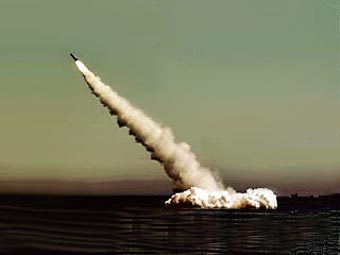
Interfaks reports an expected salvo launch of two Bulava SLBMs has been put off until next year, as Defense Minister Serdyukov said it might.  The press agency cites a well-placed Navy Main Staff source.  RIA Novosti, however, citing its own Navy Main Staff source, says the test was delayed by weather, but will occur today or tomorrow.  For its part, ITAR-TASS cites an OPK source who says the Bulava test firings are off until June because of White Sea ice.

The last Bulava test, a success, took place on October 28.  The Bulava / Yuriy Dolgorukiy weapons system might have been accepted into the inventory before year’s end following a successful salvo launch of two missiles.

BFM.ru talked recently to Aleksandr Golts and Vladimir Yevseyev about Bulava.  It notes the last planned launch of 2010 was also put off for ice.

Golts believes there’s a political motive for postponement.  He thinks the Defense Ministry can’t allow another failure and blow to its reputation and the image of Russian weapons.  And, by the time of the next test, the elections will be over, and Serdyukov may no longer be at the Defense Ministry.

Golts attributes Bulava’s problems to problems in the component base and the collapse of the Soviet sub-contractor chain.  The lack of serial production has made it impossible to guarantee quality component manufacturing.  Hence, something different seemed to go wrong in every test failure.

Golts doesn’t rule out the possibility that there simply aren’t enough missiles for testing (or for picking ones to test) because of the GOZ-2011 contracting dispute between the Defense Ministry and Bulava’s producer.

Yevseyev is a suspicious about postponing a shot for weather.  He calls the situation around Bulava ambiguous and unclear.  He says defects in the missiles might have been identified, and poor weather could be an excuse.

Like Golts, Yevseyev sees Bulava’s problems as symptomatic of larger defense industrial ones, and he doesn’t exclude a political motive:

“There’s a sharp decline in the quality of production, a partial loss of specific producers, technologies.  There’s aging of the machinery itself, the lack of qualified specialists who can work on it.  When the OPK’s been collapsing for so much time, it’s strange to hope it can produce such a complex technological product like a missile system.”

“It’s possible there’s a danger that, if there are unsuccessful tests in the period when we’re beginning Duma and presidential election campaigns, they’ll spoil the scene.  This is one of the possible reasons for the postponement.”

It seems understandable risk tolerance would be pretty low at this point given the history of the Bulava program, the bad publicity and angst generated by recent high-profile space failures, and the political season.  Perhaps it’s a case of better late, but better.

Innovation Locomotive or Brake?

Maksim Blant

Newsru.com economics commentator Maksim Blant wrote on an interesting subject this week:  is spending on the OPK an engine or drag for Russia’s innovation economy?

Blant has two primary arguments against military Keynesianism in Russia’s context.  First, more money for the OPK will further tighten an already taut market for certain labor.  Second, OPK spending’s multiplier effect will benefit raw materials producers more than consumers.

His article appears against a backdrop of questions about Russia’s ability to meet increasing pension obligations over the next 2-3 years without raising taxes, and former Finance Minister Kudrin’s contention that it could, but for the 20 trillion rubles going to the military’s rearmament program.

The problem, Blant concludes, is not that President Medvedev intends to rearm by depriving pensioners of their last bread crusts.  No, Medvedev defends rearmament as a means of stimulating growth in manufacturing, and turning the defense sector into an innovation development “locomotive.”

Blant allows that a majority of experts are inclined to agree that increased military spending can stimulate economic growth, and large defense industry orders can have a multiplier effect causing expansion in other sectors.  The argument is familiar.  State orders lead to job creation and greater consumer demand.  Defense enterprise orders to suppliers spur the process in other sectors.  The jolt causes the economy to turn around.

Blant says there are cases where military spending has brought an economy out of crisis, but asks will it work in Russia? 

He doubts creating jobs in the defense sector will increase consumer demand.  Even discounting how much procurement money will be stolen in the military or OPK, he says relatively little of the trillions will go for wages.  It would be easier to increase consumer demand by raising pensions.

Blant says this job creation effort will occur in the midst of a demographic crisis — not an excess, but rather a relative shortage of labor.  With state orders in hand, defense enterprises will compete against private businesses for engineers and skilled workers.  Faced with this, civilian producers can either raise wages and lose competitiveness, or “escape” to countries where the labor market isn’t so tight.  This, concludes Blant, makes the OPK not a “locomotive” of innovation development but rather its gravedigger.

Blant turns to the multiplier effect in adjacent sectors.  Yes, OPK money supports them, but raw materials suppliers and processors most of all.  Together the two sectors form a “closed loop,” only weakly connected to other industries.  In the end, he foresees a repeat of the 1980s, where the USSR’s defense sector, heavy machinebuilding, and raw materials producers sucked up the lion’s share of labor and other resources, leaving nothing for the consumer sector.

Thirteen VKO Brigades

Thirteen VKO Brigades

A little additional on that westward-leaning VVKO . . . the 13 VKO brigades are only a part of VVKO, but here’s how they’re laid out. 

They’re numbered 1-12 and 14. Six are in the Western MD. One in the Southern. Three in the Central. And three in the Far East MD.
 
  • 1st Aerospace Defense Brigade, Severomorsk, Western MD.
  • 2nd Aerospace Defense Brigade, Khvoynyy, Western MD.
  • 3rd Aerospace Defense Brigade, Kaliningrad, Western MD.
  • 4th Aerospace Defense Brigade, Dolgoprudnyy, Western MD.
  • 5th Aerospace Defense Brigade, Petrovskoye, Western MD.
  • 6th Aerospace Defense Brigade, Rzhev, Western MD.
  • 7th Aerospace Defense Brigade, Rostov-na-Donu, Southern MD.
  • 8th Aerospace Defense Brigade, Samara, Central MD.
  • 9th Aerospace Defense Brigade, Ob, Central MD.
  • 10th Aerospace Defense Brigade, Chita, Central MD.
  • 11th Aerospace Defense Brigade, Komsomolsk-na-Amure, Far East MD.
  • 12th Aerospace Defense Brigade, Vladivostok, Far East MD.
  • 14th Aerospace Defense Brigade, Yelizovo, Far East MD.

Defense Ministry Collegium

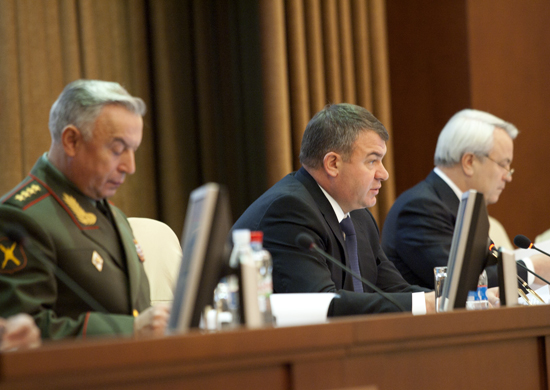
Serdyukov Flanked by Makarov and Pankov

November’s the time for year-end evaluations in the Russian military, and the Defense Ministry had its collegium yesterday.  Mil.ru printed Defense Minister Serdyukov’s introductory remarks.

First on his mind was complete fulfillment of the State Defense Order next year, and signing all GOZ-2012 contracts next month.  He said all responsibility for ordering will be transferred to a “Federal Procurement Agency.”

Some media sources assumed this means Rosoboronpostavka.  This author thinks it could be something new.  It’s important, so here’s exactly what Mil.ru says he said:

“Next year the functions of the ordering organ are being fully transferred to the Federal Procurement Agency.”

If that means Rosoboronpostavka, why not just say Rosoboronpostavka?  ITAR-TASS actually replaced Serdyukov’s words “Federal Procurement Agency” with Rosoboronpostavka.  At the very least, not everyone’s working from the same sheet of music.  But continuing with Serdyukov’s remarks . . .

Unlike large-scale strategic exercises of recent years, the coming year will stress tactical-level training.  But Southern MD exercises will test the new Armed Forces command and control system.

He noted establishment of VVKO by December 1, and said it will “intercept any targets right up to hypersonic speeds, both in the air and in space.”

Military police will start working in the troops in 2012, according to Serdyukov.  They are still occupied at present with selecting personnel, writing regs, etc.  Serdyukov earlier said they’d be functioning in 2011.

The Defense Minister indicated all service functions in the Armed Forces will be outsourced next year.

Without much fanfare, he said the new system of enlisted contract service will start in 2012.

Serdyukov said stimulus pay for officers will continue alongside their newly-approved higher pay.

First Deputy Defense Minister, Chief of the General Staff Nikolay Makarov delivered the collegium’s main report, but the press wasn’t invited to stay.

Meanwhile, today NG sources “don’t exclude” that Anatoliy Serdyukov could soon leave the Defense Ministry to become Finance Minister.  There’s talk Russia’s NATO Permrep Dmitriy Rogozin could succeed him as Defense Minister [because he toured the 58th Army with Medvedev this week].

There are always rumors like these.  Recently it was said Makarov would be “sacrificed” as an electoral offering to military men who don’t like him.  Sometimes the rumors bear out, sometimes not.  More important are the reasons behind any personnel changes. 

Is Putin or Medvedev likely to find a more effective steward of the military than Serdyukov?  Probably not.  The fiery politician Rogozin would be a dramatic change from the retiring technocrat Serdyukov.  The former would inspire and appeal to the troops more than the latter, but not do a better job.  Of course, we shouldn’t assume capability is the leadership’s most important criterion in picking a Defense Minister.

PAK FA Update

PAK FA

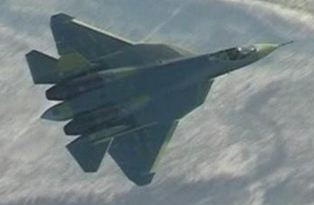
Sukhoy announced that its third PAK FA prototype conducted its first test flight today.  Operating from KnAAPO’s factory runway, the aircraft flew for more than an hour.

To run back a few milestones, the first PAK FA flew on January 29, 2010.  A second prototype joined it in March of this year.  PAK FA’s first public flight was August 17 at MAKS-2011.  And Sukhoy says the PAK FA has completed more than 100 test flights to date.  The hundredth flight apparently occurred early this month or in late October.

On November 11, ARMS-TASS reported that the third prototype will test the onboard phased array radar (AFAR)  system designed by the Tikhomirov NII of Instrument-building (NIIP).  Nezavisimoye voyennoye obozreniye published the same news, citing a Sukhoy spokesman.