VVKO Faces West

How Will They Represent VKO on the Space Troops Flag?

VVKO faces west.  And north . . . ok, northwest.  Makes sense, that’s the direction those hypersonic missiles are coming from, right?  Maybe, maybe not.

Mil.ru, as is its wont, printed a little item on military preparations for the December 4 Duma election.

It indicates 80 percent of 53,000 servicemen and civilian personnel of the new Troops of Aerospace Defense (VVKO) will vote [i.e. are based] in the Western MD (ZVO). 

The press-release says more than 150 of 171 polling places (88 percent) for VVKO bases, garrisons, and military towns are located in the ZVO.

Space Troops weren’t very big, and they’ve gotten much bigger by swallowing as-yet unclear parts of the OSK VKO (the former KSpN or Moscow PVO District) and other Air Forces’ PVO units into the new VVKO.  OSK VKO, in particular, was a large, westward-leaning formation.

Still it’s surprising VVKO’s center of gravity has shifted so drastically to the west.  One would have thought there’d be a substantial chunk of VVKO-controlled PVO in the Far East, or northeast, too.

More on the Unwanted Apartments

Microrayon for Ex-Servicemen (photo: Podolsk.ru)

A Defense Ministry source tells Interfaks nearly 800 former officers and generals who served in the military’s central command and control organs are suing the department over its failure to allocate them housing in Moscow.

The news agency’s source says these men have a right to apartments in Moscow and are refusing the Defense Ministry’s offer of housing in the capital’s suburbs.  He says new buildings in Moscow Oblast lack infrastructure, schools, and medical services, and it’s difficult to find work. 

In particular, he notes more than 21,000 apartments are being finished in the close-in suburbs of Podolsk and Balashikha.  But many remain unoccupied.  The military department decided to build housing there in 2008 because the cost per square meter was 35,000 rubles — less than half the prevailing cost in Moscow.

The agency’s interlocutor says, in Podolsk, the military is building an entire microrayon with more than 14,000 apartments, and Balashikha will have more than 7,000.

President Medvedev and Defense Minister Serdyukov Toured Podolsk Military Housing in January

Interfaks added that Deputy Defense Minister Tatyana Shevtsova, who holds the housing portfolio, acknowledged in September that there are 8,000 officers awaiting housing in Moscow, and indicated apartment blocks might be erected on Defense Ministry property in the city.  At the time, she also suggested that many of those who wanted apartments sooner were accepting ones in the nearby suburbs. 

Exactly a year ago, Defense Minister Serdyukov said the military could not afford to, and would not provide servicemen permanent apartments in Moscow, according to RIA NovostiMoskovskiy komsomolets at the time noted that the Defense Minister’s order clearly contradicted the Law “On the Status of Servicemen.”  As this NVO editorial indicates, Shevtsova’s September statements on Moscow housing came in the context of the flap over 160 generals and colonels who retired, probably in the hope of privatizing a service apartment, rather than obey orders to rotate to duties outside the capital. 

Guns and Money (Part II)

Returning to KP, Baranets, and Pukhov on Russia’s defense budget . . . Pukhov continues trying to put Moscow’s spending in perspective.

The journalist says readers want to know how it is that the U.S. spends $600-700 billion a year on its army and Russia spends only $40-50 billion.

Pukhov says look at spending per soldier.  The figures work out neatly and they are dramatic.  Per soldier, the U.S. defense budget is $400,000.  Per soldier, Russia’s is $40,000 [probably much, much less in reality].  Pukhov concludes:

 “And it’s completely clear that it’s necessary to reduce this gap to a less dramatic magnitude.  Otherwise our Armed Forces will remain the poor army of a poor country.”

Pukhov tells Baranets and his audience that Russia occupies fifth place in world military expenditures after the U.S., China, U.K., and Japan.  But, Pukhov says Russia isn’t the U.K. or Japan:

“The problem is the defense missions facing Russia are much larger scale . . . .”

He points to Russia’s size and a nuclear arsenal comparable only to the United States.  So, according to him, it’s obvious Moscow’s military spending is insufficient and its army underfinanced.  

Baranets asks, are the condition of Russia’s economy and its defense expenditures properly correlated?  Or has it gone overboard with money for the army?  Pukhov responds:

“Russia’s current military expenditures and plans for increasing them in the next 10 years, including the State Program of Armaments to 2020 (GPV-2020) aren’t excessive, on the other hand, they represent the most essential minimum.  I recall that, according to the Defense Ministry’s own calculations, a minimum of 36 trillion rubles were needed for an optimal technical reequipping of the troops by 2020.  But the adopted GPV-2020 promises a sum smaller by almost half.  This really allows us to patch only the most obvious holes in the army’s technical equipping.”

Baranets finishes up asking if European MD is affecting the military budget.  Pukhov replies that development of Russian strat forces is already in the budget and GPV-2020, and MD doesn’t present a threat to them until after 2020.

Less argument with the end of Pukhov’s interview.  Just a couple points.  Look back here to see what General-Lieutenant Frolov said 36 trillion would do.  “Optimal” must mean complete rearmament.  But others claim they can’t do it for even that amount.  Still, Putin, Medvedev, Serdyukov, and Makarov are consistently saying they are buying 70 percent rearmament by 2020 for 19 trillion.

Its Own Duma Election

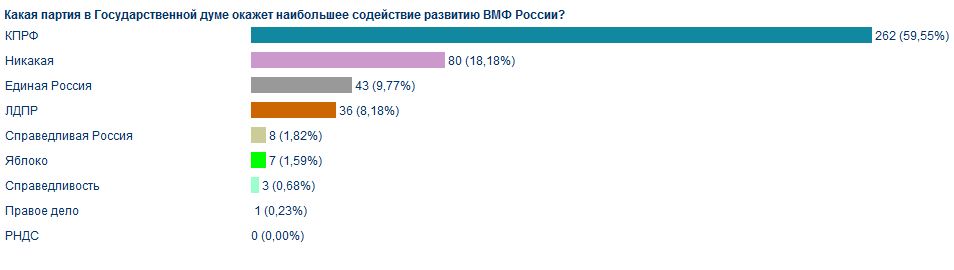
A site dedicated to all things Russian Navy called Flot.com has an interesting Internet poll.

The site asks visitors to vote for the party they feel will provide the greatest assistance in developing the Russian Navy.  Click the image below to see the results as of today.

Looking for the Pro-Navy Party

Pardon one for concluding this is pretty compelling.
 
Sixty percent of those responding say the KPRF will be most supportive of the Navy’s development.
 
Bucking Russia’s electoral law, Flot.com still permits an “against all” option.  So 18 percent say no party will provide the greatest assistance in the development of the VMF.
 
United Russia comes in third at about 10 percent.
 
And to think the “party of power” organized a GPV in which the largest portion will go to the Navy.
 
A pretty damning indictment.
 
Yes, it’s an Internet poll, and it’s influenced by its clientele.
 
No offense to a good site is intended, but Flot.com’s visitors could be older, and still more Soviet than Russian.  Who knows?  But they’re also knowledgable and interested in their subject.  Hence, they represent an elite, tough, and skeptical audience. 
 
The GPV notwithstanding, the yedinorossy have failed to convince them they’ll fix the Navy’s problems.
 

Makarov Reports to Public Chamber

Makarov Briefs the Public Chamber

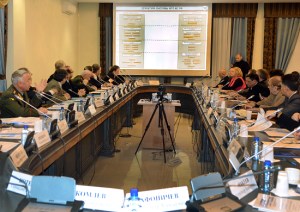
According to Mil.ru, General Staff Chief, Army General Nikolay Makarov reported to the Public Chamber today as part of its hearings on “The New Profile of the Russian Army:  Results, Problems, Prospects.”  Here’s a sampling of what he discussed.

According to ITAR-TASS, Makarov said there are 186,400 contract servicemen today, and there will be 425,000 in 2016.  Recruiters will work throughout Russia starting next year.  Prospective contractees will train for three months before signing contracts.  Minimum pay will be 23,000 rubles.  Makarov said 2012 will be a test year, and from 2013, 50,000 contractees will be signed up each year.

RIA Novosti printed Makarov’s stark assessment of Russia’s conscript manpower.  The General Staff Chief said, of all men liable to conscription, only 11.7 percent can be called up, and 60 percent of them are excluded for health reasons.  So, he concludes:

“Therefore we are practically faced with the fact that there is almost no one to callup into the Armed Forces.”

He said Russia’s current mobilization reserve consists of 700,000 ex-conscripts. 

Makarov suggested increasing the prestige of military service through a veteran’s preference system.  Former soldiers and officers would enjoy a priority in hiring for government service, according to RIA Novosti.

ITAR-TASS quoted Makarov on cuts in military command and control organs.  He indicated they’ve been cut by a factor of four — from 51,000 to 13,435 personnel, and this process continues.  One-third of C2 organs were disbanded, and the rest reduced in size several times. 

He indicated that, when the Defense Ministry’s central apparatus numbered 51,000, it occupied more than 20 buildings in Moscow.  The apparat is now in a single building.  Other buildings were sold off.  But Makarov assured his audience the effectiveness of C2 hasn’t declined because of the reductions.

Regarding the new pay system for officers, RIA Novosti wrote that Makarov said higher pay basically implements the old Order No. 400 on premium pay, but officers will still have the chance to receive extra “stimulus” pay under the new system.

ITAR-TASS printed Makarov’s figures on efforts to get rid of old ammunition.  According to the General Staff Chief, at the start of the year, Russia had 119.5 million tons of old munitions to destroy, but now only 7 million.  Less than one percent could be dismantled; the vast majority had to be blown up.  Makarov indicated the number of ammunition storage sites will drop from 161 at present to about 30.

Makarov defended his past criticism of domestic weapons and equipment by giving more examples where foreign systems are superior to Russian ones (i.e. tanks, MLRS, satellites), according to ITAR-TASS.  The general argued for increasing the range and service life of systems as well as providing better protection for soldiers operating them.

RIA Novosti reported Makarov intends to continue pushing for lower prices on arms and equipment the military’s buying.  He intimated there will be a “specialized department” for negotiating with producers.  He claimed shipbuilding contracts with OSK were concluded on the Defense Ministry’s terms.  He added that the military has given Almaz-Antey two years to build two new factories to produce the S-500, according to RIA Novosti.

ITAR-TASS relayed Makarov’s remarks on Russia’s airfields.  Makarov indicated Russia has cut from 357 military airfields down to 26 that he describes as meeting world standards.  Russia has eight air bases. 

He said pilot flight hours are at 90 per year.  He said it’s planned to increase them to 130 next year, and then to 220 at some point.

ITAR-TASS and RIA Novosti carried the General Staff Chief’s comments about threats on Russia’s borders: 

“Under certain conditions, local and regional conflicts can grow into mass ones with the employment of nuclear weapons.”

“The conflict which could occur in connection with the withdrawal of American troops [from Afghanistan] could lead to a local, regional and even large-scale one.  And we have to be ready for it.”

Guns and Money (Part I)

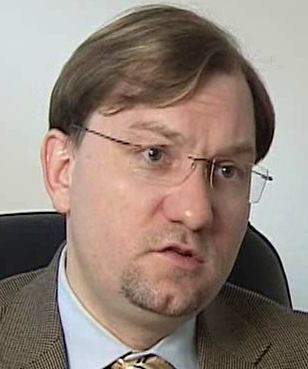
Ruslan Pukhov

What does Russia need to spend on defense?  Komsomolskaya pravda’s Viktor Baranets engaged Center for the Analysis of Strategies and Technologies Director Ruslan Pukhov on the issue recently.

It takes a bit, but the interview gets interesting, and it’s worth hearing, one thinks.

Baranets asks, do military expenditures depend first and foremost on the economy?  On government policy?  On the treasury?  On the military power of one’s enemies?  Pukhov replies:

“In the first place, on the requirements for guaranteeing national security, and secondly on economic possibilities.  But if the country faces serious threats, then maintaining adequate military power becomes an absolute priority.  And then the resources for these purposes are allocated without looking at the economy.”

OK, that’s standard, but the big question is if . . . if it faces threats and if those threats are really serious.  And one might quibble, you can’t allocate what you don’t have (at least most countries can’t).

Baranets probes further.  People want to understand the 30% jump in military spending.  Have external threats grown?  Pukhov answers: 

“We have to maintain large Armed Forces because of the country’s huge size and its borders with military giants, like NATO and China.  Here the correlation of our military potentials has significance first and foremost.  That’s one.”

“And two.  The most important mission for Russia will remain the preservation of powerful, but expensive strategic nuclear forces and advisably — nuclear parity with the U.S.  It’s clear nuclear arms are the main guarantee of our security.  They make a big war between contemporary world powers impossible.  I’m convinced that, if not for the nuclear shield, the fate of Yugoslavia would have awaited Russia in the 1990s.  That is forcible dismemberment with the support of a NATO intervention.”

“Yet another factor:  Russia is faced with real threats to its security in the form of terrorism in the North Caucasus where an ethnic separatist rebellion has transformed into a general Caucasus Salafist underground, but also in the post-Soviet space — in the first place, in view of Georgia’s aggressive actions.”

“Going further:  our Armed Forces are extremely obsolete technically, they lag the current level of military technology development and need renewal.  For almost two decades after 1991 our Armed Forces were totally and chronically underfinanced, didn’t receive new armaments.  After this almost 20-year ‘buying holiday’ it’s necessary now to pay up, trying in the most compressed time to overcome the accumulated lag.”

“And, finally, everything enumerated above has to be overcome in conditions of the fact, unpleasant for the national self-consciousness, but, alas, indisputable, that Russia is a poor country.”

Baranets asks, how can Russia be poor?  Pukhov’s answer:

“We actually have many natural resources.  And this, incidentally, is yet another argument for having effective Armed Forces.  Natural riches have to be protected.  But by the size of the economy we aren’t even in the top five countries in the world, and the main thing is we seriously lag behind developed states.”

“So we have to conduct military organizational development under conditions of a shortage of resources and significantly bowing before many other countries of the world according to our level of economic development and national wealth.”

“All types of resources enumerated by you [Baranets] are in short supply for us.  Industry requires serious modernization, the scientific-technical base, established in the USSR, is practically used up, the quality of human resources is also not at a high point — the technical training school system has collapsed, so finding qualified workers is an integral problem.  Now we can already talk even about the collapse of secondary education — more often illiterate conscripts are coming into the army, and how can you trust them with complex equipment?”

Baranets says some experts think 1.5 or 2 trillion rubles as foreseen for defense in 2012 is too much when compared with what will be spent on science, education, and health.  One can even hear pronouncements like “the army is stripping the people.”  Pukhov reacts:

“I repeat:  Russia’s in a situation where it’s forced to hurry to catch up and reestablish that which dissipated, was squandered and left adrift in the area of national defense in the 1990s.  Essentially, we didn’t develop, but, to the contrary, we collapsed the army.  Now we need to reestablish the army, buy new equipment and armaments.  This isn’t the army ‘stripping the people.’  This is them ‘stripping’ the army for long years.  But there is generally an old true formula — people who don’t want to feed their own army will feed a foreign one.  Education, medicine and other sectors can be self-financed to a significant degree.  The Armed Forces can’t be self-financed in principle.”

Pukhov covers a lot of ground.  And he makes sense of some stuff.  But some points are debatable.  He’s one who wants to blame the 1990s for everything when then-President Putin was also guilty of neglecting the army in the 2000s.  Yugoslavia did a good job of “dismembering” itself before NATO and Russia intervened.  Instruments other than force exist for managing Russia’s problems in the North Caucasus and Georgia.  Is there a realistic threat of having to feed someone else’s army?  Wouldn’t a slower paced military build-up be more sustainable?   

Part II tomorrow.

New Poll on Conscription

FOM's Poll on Conscription

The Public Opinion Foundation (FOM) just published a major poll looking at Russian attitudes toward the callup and obligatory military service.  It’s 48 pages, but here are some highlights.

The poll was conducted in July, with 3,000 respondents in 204 populated places in 64 of Russia’s regions.

Fifty-two percent of respondents favor a mixed manning system combining conscription with contract service, and 23 percent favor the callup only.

Sixty-four percent support the announced plan to cut conscripts and increase contract soldiers, although only 22 percent would support taking money from education and health care to pay for them.  Survey participants on average thought 34,500 rubles was worthy pay for contractees.

Fifty-five percent liked reducing conscript service from two years to one while 37 percent did not.  In the 18-30 age group, 65% supported the shorter service term.

In the population as a whole, 29% believe one-year service has reduced dedovshchina and “nonregulation relations” against 46 percent who feel nothing’s changed by it.  There were fewer of the former and more of the latter among respondents claiming intimate knowledge of army life.

The FOM poll showed strong support for a number of Defense Ministry initiatives to “humanize” conscript service.

Fifty-four percent were critical of draft evaders, but 34% were sympathetic toward them.

Finally, buried deep in the results, participants were asked for their views on the state of affairs in the Russian Army in coming years:

  • 19% said it will improve.
  • 19% said it will worsen.
  • 35% said it will stay the same.
  • 26% said hard to answer.

However, when asked to compare military service conditions today against those 10-15 years ago, more respondents said they are easier (39%), and many fewer said they are harder (14%), by comparison with Russians asked the same question in 2002 (just 6% and a whopping 64% respectively).

A Rock and a Hard Place

Russians in Tajikistan (photo: RIA Novosti / Vladimir Fedorenko)

Conscripts or contractees?  It’s difficult for the Russian Army to get the right kind of conscripts, where it needs them.  But, over time, it hasn’t been any easier to obtain long-term contract enlisted either. 

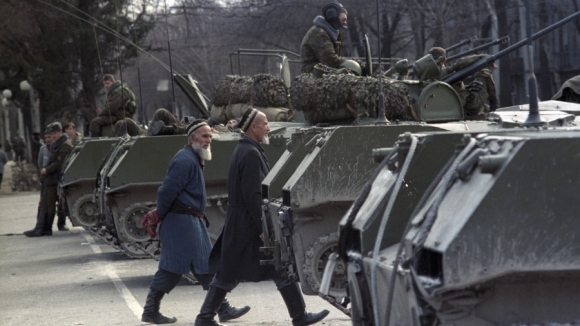
Last week, Izvestiya wrote about army plans to replace conscripts currently serving in its 201st Military Base in Tajikistan with contractees. 

An officer in the formation told the paper it’s too costly to keep 3,000 conscripts in Tajikistan, and, by the end of 2012, the Russian Army will replace half with contractees.  A GOMU source tells the paper replacing all 3,000 at once is “unrealistic.”  Contractees will reportedly serve on three-year deals getting 30,000 rubles per month.

The situation for Russians in Tajikistan, the officer says, is strained, and Tajik authorities regularly detain conscripts for one reason or another.  As an example, he cites the case of a conscript driver who killed three Tajiks last January.  Thus, he concludes, it would be easier with “professionals” – contractees —  who “know what they’re doing, and can be responsible for their actions.”

But there’s no reason to think contractees will avoid trouble any better than conscripts.  The first contract experiment proved that.  Contractees are more costly and just as difficult to control, if not more than their conscripted brother-soldiers.

According to Izvestiya, the 201st now has 5,500 personnel, including the 3,000 conscripts.

An old Krasnaya zvezda report says, in early 2007 – at the height of the first, failed attempt at introducing contract service – the military base had 7,000 servicemen in all, about 60 or 65 percent contractees.  Its two maneuver units had 50 percent or fewer in their ranks.

Back then, the Defense Ministry daily said the military was all set to send conscripts in place of hired soldiers.  It was hard to convince older, experienced men to go to Tajikistan because of the difficult living conditions and prospects for serving on contract in Russia.

As Izvestiya’s interlocutor intimated, relations between Moscow and Dushanbe are a bit strained right now, prompting some to wonder out loud if manning the 201st won’t become a moot issue.

33,000 Unfinished or Unwanted Military Apartments

General-Major Chvarkov

Candor is a quirky thing.  It has a way of showing up in places you expect it least.  So it was yesterday when RIA Novosti covered General-Major Sergey Chvarkov’s meeting with members of the Federation Council’s Defense and Security Committee.

Chvarkov is the relatively new head of the relatively new Main Directorate for Personnel Work.  The new name replaced an old one — Main Directorate for Socialization Work, GUVR for short.  Chvarkov and his charges are inheritors of the long tradition of zampolits and the Main Political Directorate.

According to Chvarkov, over the past year, military investigators have initiated 20 criminal cases involving the construction of thousands of unfinished and unwanted apartments intended for Defense Ministry servicemen.  But he declined to give specific details about the cases.

Deputy Committee Chairman Nikolay Sidoryak, however, said at present there are 33,000 apartments in various regions which are unwanted by servicemen.  He called this a “nightmarish figure.”  He wants those who ordered these apartments and financed their construction brought to account.  It’ll be interesting to see when or if this happens.

Early this year, a figure of only 20,000 was cited.

RIA Novosti gives a couple clipped Chvarkov phrases — the housing “isn’t fully ready,” and “a great number of refusals are happening.”  Then:

“I’ve personally seen buildings which stand in an empty field with absolutely no infrastructure.  Servicemen getting notifications that they’ve been granted housing go there, say the housing’s magnificent, good, but we don’t want to live there — we’re tired of garrisons.”

Committee Chairman Viktor Ozerov, for his part, says it’s all just a misunderstanding, and the Defense Ministry’s requirements for builders are just too tough.

RIA Novosti notes former Deputy Defense Minister Grigoriy Naginskiy claimed nearly two years ago that apartment construction was following detailed information on where servicemen want to live.

It would be easy to see the military housing issue as all but over and done with if one listened only to official political or military pronouncements, but reality just keeps coming back.  It smacks of a Soviet approach – fulfilling the plan and meeting the quota is what matters, how [i.e. quality] is secondary.  It makes one ask if this is more broadly indicative of how other decisions and policies are implemented.

Now permanent military apartments are supposed to be provided in 2013 (three years later than Putin’s original deadline).  And Putin himself said not long ago that there are only 77,000 apartments remaining to be built.

These unwanted apartments are exactly why some veterans have gone out for public demonstrations lately.  

It’s been clear for some time that the Defense Ministry builds apartments where it wants to, not where former servicemen want to live.  And it wants to build where it’s less expensive.  Paperwork problems have kept half of new military apartments empty each year.  And the problem of incomplete construction has also been around.  Not much about this situation’s changed in recent years.  But here’s one more recent article detailing the problems of permanent apartments built for the military.

It’s 60-40 for Serdyukov

Serdyukov and Ivanov (photo: Komsomolskaya pravda)

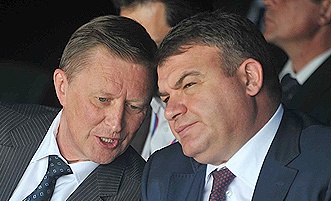
After a couple months and 50 votes, Defense Minister Anatoliy Serdyukov got past his predecessor Sergey Ivanov by a margin of 30 votes to 20 for the title of better defense minister.

It was interesting.  Serdyukov (your author’s choice) jumped out to a big lead, and Ivanov spent the rest of the time trying hard to catch up, but never quite making it.  Every time Ivanov started to, Serdyukov supporters came out and boosted his numbers.

It was surprising though.  Your author thought Serdyukov would crush Ivanov.

Of course, none of this was scientific.  And it was a fallacious comparison.  The men arrived in different circumstances and experienced different situations.

For this author’s money, though, Serdyukov has done a much better job with the hand he was dealt.  Primarily because he’s actually done some things.  And he broke the uniformed military’s grip on defense policymaking.  Granted, the results haven’t been exactly perfect.  And, over time, views of Serdyukov will be influenced by what comes after him.  But 60 percent in this little poll isn’t a bad showing for a guy who encountered and tamed a lot of resistance along the way.

Ivanov, by contrast, was timid, tentative, and generally ineffective, in this writer’s view.  To be fair, he held less favorable cards by comparison, especially early on.

It may possible, of course, that the 20 votes for Ivanov are anti-Serdyukov votes rather than pro-Ivanov.

If you voted and would like to comment about your thinking either way, others would be interested to read it.