Medvedev Signs Pay Law

Medvedev's Meeting on Pay Law

Monday President Medvedev met an unusual group — the Defense Minister, General Staff Chief, and MD / OSK commanders (but no service CINCs or branch commanders) — to announce he signed the long-discussed law on military pay that becomes effective on January 1, 2012.

The increased military pay in this law was a key goal for Anatoliy Serdyukov when he arrived at the Defense Ministry nearly five years ago.  Premium pay was just a stopgap.  So this is a success for his reform program.  His idea was to cut half (or more) of the officer corps and raise the pay of those remaining.  Of course, he had to back off somewhat on cutting down to 150,000 officers.

Why did it take so long to enact an increase in military pay?  Was it hard to find the money?  Maybe, given the global financial crisis of the late 2000s.  Was it hard to overcome former Finance Minister Kudrin’s resistance to higher defense outlays?  

Newsru.com, Svpressa.ru, and others see the pay increase as timed to coincide with Duma and presidential elections, and designed to engender the military’s goodwill toward the current leadership at the ballot box.  It’s worth noting the reduction in conscription from two years to one came in the context of the last national elections in 2008.

According to Kremlin.ru’s account, Medvedev indicated he wanted to congratulate those assembled on their long, hard effort to raise military pay to its new level, on average 2.5 or 3 times above today’s pay.  RIA Novosti provides the standard example of lieutenants rising from 19 to 50 thousand a month. 

In addition to higher base pay, the usual supplements will remain in effect, including additional pay for special duties, class qualifications, and difficult service conditions.  Premiums of up to three times base pay for outstanding performance will also continue.  Military pensions will increase at least 50 percent to 17,000 on average.  Read more about pay calculations here.

Addressing his small audience, Medvedev said:

“In such a way, servicemen have a very serious stimulus to carry out their service duties well and improve their professional training.”

He was careful to say those without duty posts (the so-called распоряженцы) won’t be left behind:

“It also includes important provisions, which, in principle, allow us to prevent worsening of the material situation of different categories of servicemen, citizens, dismissed from military service, their family members, if the amount of pay given them is reduced in connection with introducing the new system, then here there is an established mechanism of compensation and balancing out of these payments that is also an important guarantee of financial stability for our servicemen.”

Not reassuring.  But those guys won’t vote for United Russia and Putin anyway. 

The president continued:

“I won’t conceal that many drafts were ripped up around it, there were many discussions about whether we were prepared to raise pay to such a degree, whether the state had the resources for this, whether this wouldn’t drain our budget, wouldn’t create some kind of problems in the future?”

“I want to tell those present and, naturally, all servicemen of the Armed Force to hear me:  it won’t drain us, everything will be normal, and all required payments by the government will be made because this is the most important guarantee of raising the professional preparation of servicemen and improving the quality and effectiveness of the Armed Forces.  Therefore, the decisions, proposed several years ago, are being executed and put into action by this law.”

Thanking Medvedev, Serdyukov said:

“For us, in a complete sense, this resolves all earlier problems:  this is manning with both officers and contractees; this is serving; this is the attractiveness of military service, the fact is this is the entire complex of issues which weren’t practically resolved for us.”

Medvedev completed his remarks with this:

“But the main thing the state, by adopting this law, its signing and, accordingly, its entry into force, shows is that decisions once given voice are subject to unconditional fulfillment, whether someone likes them or not, if depending on them is the social condition of a huge number of people:  these are servicemen and their family members.”

“And further, we will do this so that our Armed Forces will be highly effective, and service in them will be prestigious and highly professional.”

So Medvedev declared it a test of governmental capability, and swiped at dear departed Kudrin who opposed the extent of defense budget increases in view of priorities like education and health (not to mention the pension fund).

It takes capability to implement a decision, yes, but it takes even more to stick with it over the long term.  Will the Russian government be able to continue the new level of military pay when the elections are over, economic conditions less favorable, oil prices and revenues lower, and budgets tighter?  That’ll be the true test of capability.

P.S.  We shouldn’t forget that the Defense Ministry has also semi-obligated itself to paying 425,000 professional enlisted contractees 25,000 rubles or more a month in the future.  That will probably equal the bill for paying officers.  Let’s estimate this total cost at 500 billion rubles a year.  The non-procurement defense budget in 2009 was only 670 billion.
VKO Cadre Changes

Didn’t have to wait long for this.  This morning President Medvedev signed out the ukaz with appointments to command positions in the VKO Troops (VVKO).

Kommersant’s source was mostly, but not completely, right.  Valeriy Ivanov will be chief of staff, and Sergey Popov, the chief of air defense for the Air Forces, will move to VVKO to command its Air and Missile Defense Command.

Appoint:

  • General-Lieutenant Valeriy Mikhaylovich Ivanov, Chief of Staff, First Deputy Commander, Troops of Aerospace Defense, relieved as Commander, Operational-Strategic Command of Aerospace Defense.
  • General-Lieutenant Sergey Aleksandrovich Lobov, Deputy Commander, Troops of Aerospace Defense, relieved as Deputy Commander, Space Troops.
  • General-Major Oleg Vladimirovich Maydanovich, Commander, Space Command, relieved as Chief, 153rd Main Test Center for Testing and Control of Space Systems.
  • Colonel Konstantin Aleksandrovich Ogiyenko, Commander, 5th Air Defense Brigade.
  • General-Lieutenant Oleg Nikolayevich Ostapenko, Commander, Troops of Aerospace Defense, relieved as Commander, Space Troops.
  • General-Major Sergey Vladimirovich Popov, Commander, Air and Missile Defense Command, relieved as Chief, Air Defense, Deputy CINC of the Air Forces for Air Defense.

There you have it.  What looks like it will be a new service — VVKO — is born, and an old branch — KV — apparently will go away.  More presidential paperwork on that is likely forthcoming.  But today we’ve learned who’s in VVKO’s head shed, and that its two major components will be, not surprisingly, the Space Command and Air and Missile Defense Command.

Team VKO Taking Shape

Team VKO is taking shape according to Kommersant.  Last fall, President Medvedev, of course, ordered the establishment of a unified VKO.  Since then, it’s become clear that Space Troops (KV) Commander, General-Lieutenant Oleg Ostapenko would head it.

And KV will be the base for the new service [vid or вид].  According to the Genshtab plan, VKO will unite all PVO and PRO systems.  And it will control the current KV, Moscow-based OSK VKO, and PVO units from the Air Forces.

The paper’s Defense Ministry source says VKO’s top officers have been identified, and paperwork was sent for Medvedev’s signature last month.  So expect a decree soon.

General-Lieutenant Valeriy Ivanov will be in charge of PVO and PRO for VKO.  He’s a 50-year-old career SAM officer, who commanded PVO divisions or corps in the Far East, Volga, and Moscow MDs.  From 2007-10, he commanded the Far East’s 11th AVVSPVO.  He became commander of the OSK VKO about this time last year.

General-Major Oleg Maydanovich is a 47-year-old KV missile engineer who will head VKO’s space monitoring.  He has long service at Plesetsk and Baykonur, and has been chief of both.  He’s now chief of Russia’s space systems testing and control center.

Colonel Andrey Ilin will be chief of the VKO’s command and control post at Krasnoznamensk.  He served many years at the space tracking post in Shchelkovo.  He’s been chief of staff at Plesetsk since last year.

70 Years Ago

It was an event that sparked our interest in the USSR, in Russia.  Red Army troops marched heroically from the November 7, 1941 parade marking the 24th anniversary of the October Revolution straight into battle on Moscow’s outskirts.  Here’s how RT covered today’s reenactment.

Here’s the grainy film showing the actual event.

One can’t help imagining what these young men faced, and what must have happened to them.

Here’s Stalin’s speech.

Stalin, who was paralyzed for days after German invasion, tells the Soviet people that, although conditions are difficult, they aren’t as bad as what the country faced in 1918.  And he declares the German Army has not gained the quick victory it expected, and is not invincible.  But Stalin also promises an early defeat of the invaders that wasn’t in the cards either.

Nyet Means “Not Yet”

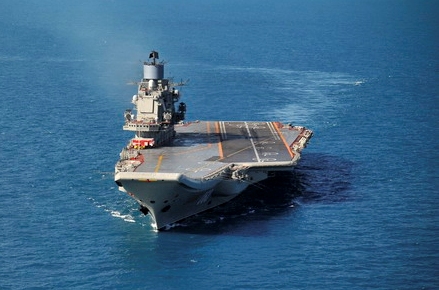
Fleet Admiral of the Soviet Union Kuznetsov (photo: Denis Abramov)

Russian aircraft carrier lobbyists — admirals and shipbuilders — define persistence.  To them, nyet means “not yet” or “keep trying.”

Izvestiya’s Denis Telmanov reported this week on future plans to build two new nuclear-powered aircraft carriers by 2027 — one for the Pacific Fleet and one for the Northern Fleet — along with 15-ship battle groups to surround them.

After years of arguing, the admirals reportedly decided they need carriers (not just nuclear subs and cruisers) to “broaden the Russian Navy’s zone of influence in the Pacific Ocean and North Atlantic.”

The Navy is reportedly completing the “technical tasks” for a new carrier, with a first design due next year, and the final one by 2017.  The first hull is supposed to be launched in 2023.  According to Izvestiya, sections and components will be built in several shipyards, but final assembly will be at Sevmash to save resources instead of building a new yard large enough to put a carrier together.

The article might be as much about where carriers would be built as if they will be.  There has been talk that the nascent New-Admiralty Wharves could get this work.

Izvestiya says land-based carrier trainers at Yeysk and Saki (NITKA) in Crimea will be used.  The paper also notes the new carriers will need new support bases because the lack of them “killed” or complicated the service lives of Soviet “heavy aircraft-carrying cruisers,” including the Kuznetsov.

One surmises that Russia’s coming experience with building, basing, and operating Mistrals will affect all this too.

But let’s rewind a bit . . . Navy CINC, Admiral Vysotskiy said in early 2010 that Russia plans to launch a carrier by 2020.  Defense Minister Serdyukov, however, has said twice in the last year that Russia has no plans to build carriers in the near future [by 2020].  On July 1, he emphasized that the Genshtab and Navy will decide on the need for an aircraft carrier after a “preliminary design” is complete.

No matter how much some say “Russia must have aircraft carriers,” it ain’t necessarily so. 

It ain’t so because (1) Russia may have more important requirements to fill with its limited resources, and (2) the people talking about carriers ain’t the same people who ultimately decide which requirements get met. 

Telmanov’s article is full of this:

“Strategists insist . . . .  The Navy has decided . . . .  The admirals have selected . . . .  In the military’s opinion . . . .  A Navy Main Staff representative explained . . . .  The military is deciding . . . .”

Not this:

“The president has decided . . . .  The government has selected . . . .  The VPK insists . . . .  The defense minister explained . . . .  In the General Staff’s opinion . . . .”

When we read that these types of people have decided to build carriers, it might really happen.

Farewell Russian Arms and Russian Army

Does it matter what old soldiers think?  It doesn’t seem to right now.  Maybe they’re just bitter old dudes whose time has passed. 

But they certainly provide interesting and frank commentary on the state of the OPK, the Armed Forces, and Serdyukov’s reforms at odds with official pronouncements from the Kremlin, White House, and Defense Ministry.

Former 58th Army Commander, retired General-Lieutenant Viktor Sobolev wrote recently for Pravda.  He reacted to a program on the army on NTV from October 9.  It apparently wasn’t posted on NTV’s site. 

Sobolev says this right up front:

“On the eve of elections, our president and Supreme Commander-in-Chief Dmitriy Medvedev and ‘national leader’ Vladimir Putin have been worried in turn by the condition of the country’s army and military-industrial complex and are assuring gullible Russian citizens that they will do everything so that our Armed Forces meet modern requirements and receive new types of armaments and military equipment in a timely manner.”

“The Russian mass media [SMI] under the government’s and president’s control have been actively used in making these assurances.”

The ex-general-lieutenant is critical of just about everyone:  Serdyukov and his “effective” managers, people who haven’t served in the army, former First Deputy Defense Minister Popovkin who wanted to buy more arms abroad, his successor Sukhorukov who dares insist that defense enterprises substantiate their prices, independent defense commentators like Litovkin and Pukhov, interest-hungry banks, corrupt middlemen.

He points only to Tactical Missile Armaments Corporation General Director Boris Obnosov in a positive light for recognizing that other countries won’t sell Russia their best weaponry. 

Still, Sobolev’s under a bit of a misimpression thinking that Moscow is really buying lots abroad.  In fact, a cynical observer might conclude the whole situation over the last year was designed to let Putin be the champion of the domestic defense sector vs. Medvedev the Westernizer.  But we digress . . . 

For Sobolev, this all sums to an OPK with a broken GOZ, that’s chronically underfinanced and losing its capability to produce modern arms and equipment. 

Again, the cynic might say this was already lost a number of years ago.

But, says Sobolev, when compared with the OPK:

“Even worse is the situation in the Armed Forces.  It’s believed we have a million-man army which Mr. Sukhorukov recalled on this program.  Let’s calculate it together.  According to TO&E, there are 150 thousand officers in the army, no warrants at all, they were liquidated.  According to civilian [but he still wears his uniform] GOMU Chief V. Smirnov, 184 thousand contractees are serving in the army and navy.  In all 334 thousand, the remaining 666 thousand are conscript servicemen.  But they simply couldn’t have called up so many.  Moreover, conscripts serve not only in the army and navy, of the number called up, up to 30% serve in the Internal Troops, Border Guards, MChS units, presidential regiment, and so forth.  This means in the army and navy huge undermanning exists, and it will only get bigger.  It’s planned to reduce the fall callup by 2 times.  More than 200 thousand citizens, according to Smirnov, are evading military service.  The spring callup stretches out to September, and the fall until March.  In the troops, they’re occupied with it constantly, in the course of the entire year, they take young soldiers into their ranks in small groups, organize individual training for them and try to man sub-units.  At the same time, the process of dismissal also goes on without interruption.  In these conditions, you can’t talk about any kind of quality manning of sub-units.  What kind of units of permanent combat readiness are these?”

“Therefore NATO’s military analysts note with satisfaction that, as a result of the reforms conducted, Russia’s Armed Forces aren’t capable of completing missions even in local conflicts, ‘The Russian Army does not have a sufficient quantity of transport resources for redeploying troops over great distances, does not have a sufficient quantity of aircraft and pilots who know how to fly in any weather, no unified information system.  There are not enough soldiers in the army . . .’”

“In NATO, they understand the Russian Army’s fallen apart, but how about our country’s leadership?”

Whoa. 

Sobolev’s no crank, and he’s not to be taken lightly.  Born and schooled in southern Russia, he probably has combat experience whereas the current General Staff Chief and Ground Troops CINC probably don’t.  Sobolev served as Deputy Commander of the OGV(s) in Chechnya in 2002, before taking over the NCMD’s 58th Army in 2003.  He ended his career as the chief military advisor in Russia’s Indian embassy in late 2010.

General-Lieutenant Sobolev

A more recent photo shows him looking just about as fit in retirement at age 61.

One wonders if a conservative like Sobolev realizes how much his thinking coincides with that of more liberal critics he seems to detest.

The GRU’s Smiling Face

General-Colonel Aleksandr Shlyakhturov

One would like to get off the GRU topic, but we have to follow the news to some extent.  General-Colonel Shlyakhturov not only spoke in advance of the November 5 military intelligence anniversary, but actually posed for a photo sporting a smile and his third star.

We don’t learn much here.  There are confirmations of what we’d already heard and read recently, or even long ago.  The GRU’s adapted for new missions, but keeps the old ones.  The threat from Georgia is emphasized as in previous years.  Military intelligence still falls under the Genshtab.  Shlyakhturov admits to restructuring and reducing, but insists the GRU’s still a “full-service” intelligence agency.  Spetsnaz has gone to the MDs, but the GRU still has a train and equip role.  Shlyakhturov hints that military intelligence is still very interested in foreign technology.

Interviewed in Rossiyskaya gazeta, the GRU Chief tells the paper how much times have changed, and the military intelligence agency now talks in terms of many-sided and multivector threats, rather than the “probable enemy.”

Shlyakhturov expounds on how terrorists and extremists pose the “greatest danger,” and the GRU monitors the situation in regions, like Georgia, from which this danger may emanate.  He’s quick, however, to deny that Russian special services have engaged in any subversive activity whatsoever against sovereign Georgia.  But, he says, the GRU will provide timely warning to the country’s military-political leadership if Tbilisi prepares “new military provocations against Russia and its regional allies.”  Changing tack, Shlyakhturov stresses that the GRU puts great stock in cooperating with special services of other countries to get threat information.

The GRU Chief says the agency is focused on “new” issues like economics, natural resources, and nuclear proliferation.  But it hasn’t lost focus on the disposition of foreign armies and armaments in different theaters of military operations and other issues that affect the employment and development of Russia’s Armed Forces.

Asked about reporting to the president, Shlyakhturov emphasizes that, as always, the GRU reports directly to the Defense Minister and Genshtab.  But the GRU’s most important documents still reach the president, prime minister, and Security Council, and influence Russia’s foreign and defense policies.

Shlyakhturov says the GRU has redistributed its efforts to focus on regions posing a threat to Russia’s interests and security, “hot spots” where terrorists and extremists operate, and crisis zones where international stability is threatened.

The GRU Chief admits there has been a reorganization and reduction in his agency.  As he puts it:

“Here’s the main thing you need to understand:   the changed world situation objectively required adjustments in intelligence priorities and their implementation mechanism.”

He notes, however, that the GRU still has operational, technical, information-analytical, and support sub-units as well as what he claims is a very spartan central apparatus, or headquarters staff.

Spetsnaz has, Shlyakhturov admits, gone to the MDs, fleets, and VDV, but he says they’re still part of operational intelligence, and the GRU provides their doctrine, training, and equipment.

Finally, he says the GRU remains interested in foreign technology developments, and its work here supports R&D efforts, the OPK, and the state program of armaments.

The Ayderkhanov Case (Part II)

According to Newsru.com, Aleksandr Vlasov concluded the traumas on Ayderkhanov’s body were inflicted while he was still alive, and the GVP’s statements about hitting the tree are a fiction without objective confirmation. 

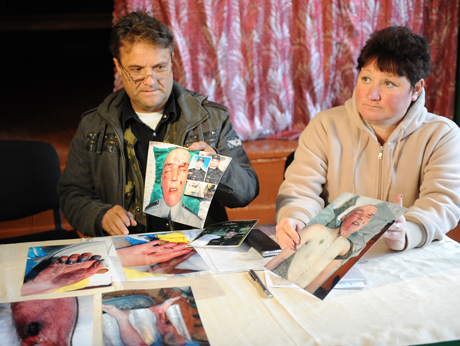
Meanwhile, Ayderkhanov’s relatives organized a round-the-clock vigil at his grave to prevent anyone from stealing his body [i.e. the evidence].  Apparently, some people came looking for his grave on October 18, according to IA Rosbalt.

Ayderkhanov’s aunt told Radio Svoboda that he was full of life and not the type to commit suicide.  Nor was he likely to have conflicts with other soldiers.  She described what happened to her nephew as not just a beating,  but torture.  She said she knew the Yelan garrison had a bad record of conscript abuse.

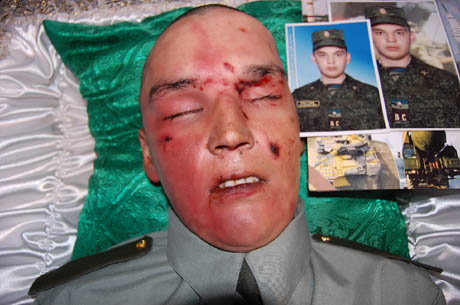
Post-Mortem Photos

Ura.ru writes that this is the third army tragedy in the last six years for Ayderkhanov’s home village Araslanovo and its 800 inhabitants.  The grandson of a local reportedly hung himself while serving in 2005, and another boy ran away from his unit and was found frozen to death in 2008.

In late September, 500 people from Araslanovo (as well as nearby Shemakha, Mezhevaya, Tashkinovo and Skaz) signed an appeal asking President Medvedev to get to bottom of Ayderkhanov’s murder, and accusing his officers of concealing it.  The appeal asks if someone can really commit suicide after such savage punishment?  It notes Ayderkhanov wanted to serve, and even considered staying in the army as a contractee. 

The appeal asks when disorder in the Armed Forces will end, and claims everyone knows such a state of affairs exists not just in Ayderkhanov’s unit but in many others as well.  Finally, the appeal says the people of these villages are stopping the fall draft until order’s established in Ayderkhanov’s unit, and those guilty of beating and killing him are punished.

Despite some sympathy with the cause, the local military commissar has warned that draft evaders will be punished.

According to Ura, some locals believe Ayderkhanov was killed because he was Tatar.  Others who previously served in V / Ch 55062 say the unit was rife with nationalism, dedovshchina, and extortion.

It’s interesting and sad (perhaps not surprising though) that no wider social or political outrage — similar to what occurred in 2006 after the Andrey Sychev case — has developed over Ayderkhanov.

The Ayderkhanov Case (Part I)

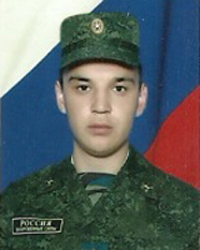
Ruslan Ayderkhanov

Here’s what looks like a case where the beating death of a conscript is being passed off as another suicide in the ranks.  We addressed this here, and the tragic Ayderkhanov case broke into the news just 11 days later.  This sad story deserved attention sooner than your author was able to give it.

Thursday Newsru.com reported Ayderkhanov’s body has been exhumed for additional medical examination to determine the cause and circumstances of his death.  Official examiners as well as one independent expert, Aleksandr Vlasov, will take part in the process which, according to RIA Novosti, should take two weeks.

Newsru recapped the basic facts.  On August 31, the 20-year-old Ayderkhanov went missing from V / Ch 55062, part of the Yelan garrison, located in Poroshino, Chelyabinsk Oblast.  His body was found hanging from a tree in nearby woods on September 3.

The military authorities were quick to label this an obvious suicide, but his relatives were suspicious about injuries all over Ayderkhanov’s body.  He had teeth knocked out, a broken leg, a missing eye, a knife wound in his chest, and burns, bruises, and abrasions.

The Yelan garrison’s military prosecutor opened an Article 110 “Incitement to Suicide” investigation, but just as quickly announced there were no facts indicating violence or the “violation of the regulations on mutual relations” [i.e. abuse] against Ayderkhanov.  The prosecutor concluded the soldier was simply depressed about the death of his mother last winter. 

The Main Military Prosecutor stated categorically there was no evidence of a beating, and any injuries on Ayderkhanov’s body were from banging against the tree on which he hung himself.  The GVP categorically rejected the idea of exhuming and examining the body again.

Radio Svoboda quoted GVP directorate chief Aleksandr Nikitin:

“There is evidence that his death was not a result of violent actions.”

RIA Novosti continued from Nikitin:

“A close examination of the place of death and Ayderkhanov’s body was conducted.  The investigation established that there are not any traces of violence which could have caused the serviceman’s death on the body.”

Ruslan Ayderkhanov

Nakanune.ru quoted a Central MD spokesman:

“According to preliminary data, no facts of nonregulation relations have appeared.  But if the guilt of officials is proven, they will be punished in the most strict way.”

According to Radio Svoboda, after the GVP proved no help, Chelyabinsk’s human rights ombudsman approached Aleksandr Vlasov.  Vlasov has stated his professional opinion that Ayderkhanov was struck at least 18 times while he was still alive.

Part II tomorrow.

GRU Rumors

Moskovskiy komsomolets reported some rumors about the GRU yesterday.  But one may or may not want to put stock in them. 

MK reports that the country’s leadership is still working over a candidate for chief of the GRU.  General-Colonel Shlyakhturov’s request for retirement was given a month ago, and the president has signed it.  But MK claims the issue of GRU reform is also being decided.

The media’s widely reported that the retiring Shlyakhturov will become Chairman of the Board of the Defense Ministry’s Oboronservis corporation, which is consolidating, civilianizing, and outsourcing most of the military’s logistics and support services.  More recently, it’s been said he’ll occupy the same position with Russia’s lead ballistic missile design bureau, MIT.

MK claims Shlyakhturov isn’t retiring for failing to fulfill his mission, or for disputes with the leadership, or for age reasons (since he was already too old), or for poor health.  According to the paper’s Genshtab source, it’s because a reform awaits the GRU.

MK’s source reports there’s a plan to unify the GRU and SVR into one powerful intelligence center.  The GRU would be cut down to just an intelligence directorate with Russia’s military attaches and intelligence posts around the country, etc.

MK also reports a key appointment.  One general Vladimir Stepanovich Alekseyev has reportedly become First Deputy Chief of the GRU.  He was chief of intelligence for the former Moscow MD, then for the Far East MD.  He returned to Moscow to be chief of the GRU’s 14th Directorate (Spetsnaz), according to MK’s GRU source.  The paper says he could be chief of the GRU in the future.  Alekseyev is from GRU operational agent intelligence inside Russia and the “near abroad.”  Shlyakhturov was from strategic agent intelligence, that is, spies and operations in the “far abroad.”

OK, some of the odd stuff here . . . for one, there’s already been reform in the GRU, so wouldn’t this be more reform, or more radical reform?  MK makes the good point that it’s not clear why Shlyakhturov’s retiring — he’s been too old for a long time, so why now?  Maybe it is a much bigger restructuring that eliminates the “G” in GRU.  There’s long been talk of merging GRU and SVR, but the paper strangely refers to SVR being formally within the FSB’s structure (?!).  Now about Alekseyev . . . perhaps he’s the guy who would head an RU focused on Russia’s strategic approaches and the CIS (i.e. military opintel), while the GRU’s remaining “far abroad” assets chop to the SVR.  This makes some sense since RU-type work and opintel seems to be where the GRU failed in Georgia.  And then SVR gets swallowed by an even bigger fish, the FSB, in a grand reanimation of the KGB for Putin’s third presidential term.  But, as said at the top, one may not want to see too much in all this.