Extending the SS-25

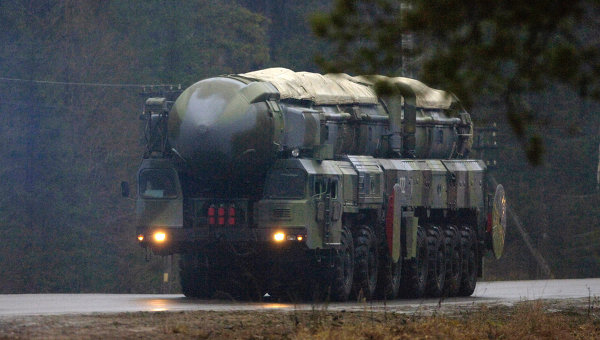
SS-25 / Topol (photo: RIA Novosti / Sergey Guneyev)

Strat forces aren’t this author’s favorite or best subject.  Unlike some other Russian military issues, there are many places to turn for info on ICBMs, SLBMs, ALCMs, and their launchers.  Yet one still can’t resist a whack at yesterday’s story.

RVSN Commander General-Lieutenant Sergey Karakayev told the RVSN Veterans’ Union that Russia intends to, once again, extend the service life of its single-warhead mobile SS-25 / Topol ICBM force:

“Ongoing work to extend the service life of the Topol missile system to 25 years allows for keeping missile regiments with mobile launchers of this type on combat duty until 2019, until the start of their rearming with the new Yars mobile missile system.”

So, SS-25 regiments will gradually be rearmed with the MIRVed RS-24 / Yars.  Media outlets noted Russia is currently rearming its second RS-24 regiment, and its sixth silo-based SS-27 / Topol-M regiment.

This isn’t the first, and probably won’t be the last, service life extension for the SS-25, which had an original warranty of ten years.  Its life was extended to 20 years with a test in 2005, to 21 years in 2007, and 23 years, or until 2015 according to an RVSN spokesman, with a firing last October 28.

What caught one’s eye was Russianforces.org’s attention to the fact that the Russians say they’ll extend the service life by two more years (25), but the missiles will stay in the force four more years (2019).  Russianforces concludes Moscow must’ve been making SS-25s as late as 1994 rather than 1992.

In any event, it’s a cheap way to keep deployed ICBM numbers up, as long as the SS-25 performs.  A 25-year SS-25 lets them stretch RS-24 and SS-27 deployment timelines, find SS-18 and SS-19 replacements, and produce Bulava SLBMs at a time when there are many other demands on the defense budget.

Maybe it gets the RVSN to 2014 or 2015 before they have to deploy the RS-24 more quickly to replace retired SS-25s.  If they further extend the SS-25’s life, maybe they get close to 2018 or 2019 before the RS-24 deployments really pick up.

At any rate, it was notable that Karakayev put his stamp on the SS-25’s life extension.

Bulava Success

Interfaks and ITAR-TASS report Borey-class SSBN Yuriy Dolgorukiy successfully launched its third Bulava SLBM today, that’s the 17th overall test and the 10th success (including five in a row).

The earlier-reported launch window was missed due to bad weather, according to Flotprom.ru.

ITAR-TASS quoted the VPK this week regarding Borey unit 2 Aleksandr Nevskiy.  The VPK says Nevskiy won’t fire a Bulava before the summer of 2012.  After finishing its factory underway testing (ZKhI or ЗХИ) and several successful single Bulava launches, Nevskiy might be accepted into service by the end of 2012, according to the VPK.

Nevskiy’s now on a two-week phase of ZKhI and will be back in Severodvinsk by early December to rectify any problems identified.  ITAR-TASS says underway testing will continue as the weather permits.

Rossiyskaya gazeta Wednesday also noted that Nevskiy’s schedule has moved to the right, and it can’t be accepted until 2012.  RG covered how the first two Boreys used unused proyekt 971 Akula components, but some are talking about Borey unit three Vladimir Monomakh as a “modernized variant” and its builders will no longer be forced to stuff their “new contents” into a “different” hull.  Others have cited the lack of leftover parts as a problem that will increase the cost and difficulty of building the third new SSBN.

The paper says Nevskiy’s crew trained at Obninsk, and also aboard Dolgorukiy.  Like Dolgorukiy, Nevskiy will head for the Pacific Fleet, according to RG.  OSK and the Defense Ministry remain in difficult negotiations over the Borey’s reported 23-billion-ruble price tag.

Updating a related story, ITAR-TASS says new Yasen-class SSN Severodvinsk is now in its second underway period.  Its first (September until early October) was deemed successful; 80 percent of tasks were completed and only minor problems identified.

Worth recalling here that two Boreys, Bulava, and one Yasen were all on President Medvedev’s list of weapons systems to be procured in GOZ-2010.

Death of Mikoyan

On October 21, the labor union of the Engineering Center of the Experimental-Design Bureau (OKB) named for A. I. Mikoyan went public with its claim that  well-known aircraft maker RSK MiG is in a catastrophic state.  Metronews.ru published part of the union’s open appeal as well as MiG’s official reaction.  The union’s letter is addressed to the president, prime minister, and heads of political parties, and dated October 11.

Union chairman Yuriy Malakhov says:

“The situation taking shape in our engineering center forced me to write this letter.  We’ve always been the brain of the company, it’s right here that new aircraft models were developed.  For a long time, we’ve had no new orders.  In the past five years, six general directors have been replaced, they all come from the Sukhoy company, and the impression’s created that they are strangling us, they want to close our company.  All the best orders go there [Sukhoy].  For example, we aren’t even allowed to participate in developing unmanned aerial vehicles.  Sukhoy is working on them, but this aircraft company doesn’t have our experience.  They focused on heavy fighters.  The pay of our colleagues is lower than in the trolleybus yard next door.  Lead engineers get 8-10 thousand rubles [per month].  Sometimes with occasional bonuses they get 30 thousand.  Talented young specialists leave for other firms, for example, Boeing, where they get two-three times more.  Now 10 percent of orders come from Russia, the rest from abroad.  In the course of several years we tried to get a response from our leadership, but no one wanted to start negotiations with us.  And the engineering center’s director decided to meet with employees only after this letter.  We are very much hoping for this meeting.  We expect new orders and increased wages.”

 MiG’s press-secretary offered this response:

“The absence of the Gosoboronzakaz in the 1990s was a serious blow to the country’s defense industry, including to RSK MiG.  Only those companies that had large export contracts could develop successfully, for example in that period the Sukhoy company managed to conclude contracts with India and China.  At that moment, MiG had only a contract with Malaysia.  In recent years, RSK MiG’s been headed by directors from Sukhoy corporation – Nikitin, Fedorov, Pogosyan, Korotkov.  From outside this could look like a raider’s seizure of MiG.  But who needs to seize debts and problems?  A positive dynamic began precisely with the arrival of these people – large foreign contracts were signed, the contract with the Defense Ministry to supply MiG-SMT.  Aircraft were supplied against this contract and they’re being successfully employed in the RF VVS.  Presently, a contract with the Defense Ministry to supply the MiG-29K is being discussed.”

“Today RSK MiG’s order portfolio is more than $4 billion, serial production of new aircraft is unfolding. There is a positive dynamic, maybe it’s not as quick and wages not as high as all of us would like.  Some young specialists come and stay, some leave.  But on the whole the company has good prospects.”

A couple points on these claims.  We know raiders take and sell what’s good, and leave “debts and problems” behind.  The Defense Ministry’s acceptance of the Algerian MiG-SMTs was more a financial bailout for the company and face-saving maneuver for Russia writ large than a real contract.  Not mentioned is Aleksandr Sukhorukov’s October 11 statement that MiG-29K procurement won’t come until 2013-2015.

The text of the union’s letter says MiG is simply dying.  It cites many problems and complaints, including a 48-billion-ruble debt, losses and delays in contracts, moving engineers to Zhukovskiy, closing MAPO, etc.  It says crucial pay bonuses can’t always be paid, and MiG is just supplying skilled people to Sukhoy and Irkut.  The letter calls OAK an incomprehensible middle layer blocking competition, but allowing personal lobbying.  Finally, it blames Mikhail Pogosyan for closing MiG’s promising future projects.

Scanning other recent MiG headlines – the Indian tender wasn’t the only blow to the MiG-35, its chances with the Russian Air Forces didn’t look too rosy anyway, and the early September MiG-31 crash indicated again what dire straits that old airframe is in.

Izvestiya’s Ilya Kramnik published recently on the MiG-29’s fate.  He wrote that (unlike the Su-27 or Su-24) the Defense Ministry doesn’t plan to modernize the MiG-29.  His military source says replacement of these worn-out aircraft in the future is deemed more cost-effective.

Kramnik’s source describes production of the generation “4+++” (?!) MiG-35 as an unavoidable but not yet decided step.  He sees the MiG-29 variant line ending since it’s outclassed by updated Su-27s.

Kramnik’s OPK source sees 20 or 24 MiG-35s being produced each year, for about 25 billion, to replace 150 or 160 MiG-29s in Russia’s inventory.

He cites Konstantin Makiyenko who sees the MiG-35 as important not just as a MiG-29 replacement, but also to keep Russia in the light- to medium-, $60-million-range fighter export market and not leave this industry segment to China and its J-10.

But Konstantin Bogdanov tells Kramnik he thinks the MiG-35’s loss in the Indian tender hurt its chances at home because it raises questions about MiG’s ability to support a production program for the Russian Air Forces.

One also wonders how much MiG-35 and MiG-29 will be needed with T-50 / PAK FA, with Su-35, and with Su-27 upgrades out there.

It’s hard to see the MiG story as anything but another chapter in the painful and necessary process of post-Cold War industrial downsizing and restructuring.  After all, the U.S. is down basically to Boeing and Lockheed Martin.  In MiG’s case, one can question whether the selection is really natural and the fittest are truly surviving.  The answer is probably yes.  However they managed it, Sukhoy and Irkut played their post-Soviet hand better, and it shows today.  The Russian aviation sector will be better off with further consolidation.  Still it doesn’t need Sukhoy to be a monopolist.  Managing that outcome will be tricky.

Cadre Changes

President Medvedev’s decree yesterday dismissed Russia’s senior military representative to NATO, Army General Aleksey Maslov, who was once Ground Troops CINC.  Fifty-eight-year-old Maslov leaves a little early for a four-star general.  No word on whether he requested to retire.  At any rate, other generals might be shuffled about to fill the NATO milrep spot, or it might be gapped for a time.

But on to the decree.

Appoint:

  • Captain 1st Rank Igor Valentinovich Grachev, Chief, Missile-Artillery Armaments Directorate, Northern Fleet.
  • Colonel Sergey Semenovich Nyrkov, Commander, 9th Independent Motorized Rifle Brigade.

Relieve:

  • Colonel Sergey Faatovich Akhmetshin, Deputy Chief, Main Staff, Air Forces.
  • Colonel Dmitriy Valeryevich Laptev, Commander, 9th Aerospace Defense Brigade.

Relieve and dismiss from military service:

  • Rear-Admiral Yuriy Prokopyevich Yeremin, Chief, Navy Military Training-Scientific Center “Naval Academy” (1st Branch, St. Petersburg).
  • General-Major Aleksandr Viktorovich Shapekin, Chief of Staff, First Deputy Commander, Operational-Strategic Command of Aerospace Defense.

Dismiss from military service:

  • Army General Aleksey Fedorovich Maslov.

Not Proud

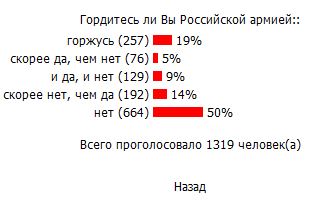
Another telling, albeit unscientific, Internet poll from Krasnaya zvezda . . . the Defense Ministry daily asks, “Are you proud of the Russian Army?”

Not Proud

The results current as of today:

  • Proud, or most likely proud — 24%.
  • Yes and no — 9%.
  • Most likely no, or not proud — 64%.

Based on more than 1,300 responses.

It’d be really interesting to see the results of an open question on what exactly leaves respondents feeling proud or not proud of the armed forces.
 
We can only guess who answers KZ’s electronic surveys.  They could be serving military men, ex-servicemen, or dependents who want to gripe, and clicking the appropriate radio button allows them to record their unhappiness.  But it’s particularly interesting that KZ and the Defense Ministry are either unconscious of these somewhat embarrassing results, or are willing to leave them out there as is.  It’d be pretty easy for them to stuff this virtual ballot box.
 

Army’s Protest Mood (Follow Up)

You may recall Prime Minister Putin’s February trip to Kaliningrad, where he heard complaints about the lack of apartments and low pensions for ex-servicemen.  Today Besttoday.ru publicized video of the once-and-future president’s meeting with Kaliningrad veterans’ organization representative General-Major Kosenkov. 

Who knows where this clip’s been until now.  But, at the time, Putin’s handlers apparently decided it wouldn’t be good PR, and kept it under wraps.

The video’s become a minor sensation because it shows Putin dismissively ripping an appeal from former officers and soldiers.  Besttoday shows both a more inflammatory short clip, ending with Putin tearing the paper, and the longer clip above where Putin talks about raising pensions this year. 

As one blogger sees it:

“For the edification of those still expecting something from Putin.  You think someone is reading your complaint letters, petitions, etc.?  Then watch the video closely once more.”

“Enough with sitting by the TV and listening to cheap stories!!!”

A little context is needed . . . Kosenkov doesn’t associate himself with the paper he shows Putin.  It’s just an example, a warning about what’s being said and circulated.  We don’t even know exactly what it said.

Kosenkov represents a domesticated, acceptable group deserving of an audience with the prime minister.  Hence, the former general-major doesn’t bat an eye when Putin tears the paper.  But perhaps Putin’s just a little too quick to take offense at this appeal.  He didn’t have to look at it, or he could’ve just put it down without reacting.

At any rate, the Russian blogosphere is abuzz today because tearing the paper exemplifies and personifies Putin’s disdain for his uncontrolled, noncompliant opponents who are impudent enough to offend him with their manifestoes, placards, demonstrations, and disobedience.

But back to the army writ large . . . yes, parts of it are oozing some discontent, but they still generally don’t fall into the same category as political opponents of Putin’s quasi-authoritarian regime.  They just don’t have much in common with anti-Putin forces.

And Putin’s delivering on his promise to raise military pensions.  The new pay law just passed its third Duma reading.  It reportedly contains, on average, a 60 percent increase for retired servicemen.  This is supposed to take the average military pension from about 10,000 rubles per month (about the same as the average labor pension) to about 17,000.  And retirees have been promised semiannual indexation for inflation in the new pay law.

But one could point out that the new pay system will increase active duty pay by 200 and 300 percent, and will divide former and current servicemen financially, socially, and politically.  But suffice it to say that Vladimir Mukhin’s original article on “candy for the military electorate” was on-the-money.  

Parts of a couple quotes he provided bear repeating:

“‘In 2000, when Vladimir Putin became President, military pensions were on average three times more than civilian ones.  Now they are much lower.  Who stopped the current authorities from keeping our pensions at the previous level?'”

“‘[Increased defense expenditures] will lead to increased problems in the economy.  Or is there a possibility that militarization [i.e. rearmament] simply won’t occur, and this means the military’s negative attitude in society will exacerbate further.'”

Bulava Launch Plans

This week Izvestiya reported on coming launches of the Bulava SLBM.  The paper’s sources say the military and industry want two single test firings before trying a salvo launch test.  They suggest Bulava’s early problems were due to testbed Dmitriy Donskoy.  They also report complaints about the new Borey-class SSBN Yuriy Dolgorukiy.

A Navy staff source tells Izvestiya two single Bulava launches are planned before a salvo launch of three [not two as previously reported] missiles is attempted.  An industry source confirms this plan, and adds that Bulava testing is on schedule.

The industry source says Bulavas produced more than two years ago – before the military leadership ordered production inspections – will be used in the test launches.  A specialist tells Izvestiya mod Typhoon-class SSBN Dmitriy Donskoy is now viewed more often as the problem in Bulava’s early failures than the missile itself.

The Navy staff source says:

“It was initially planned to conduct the salvo of three missiles in an October launch.  However, they refused this idea at the last moment to check all the missile’s and boat’s systems again.  It’s possible the December salvo will be put off to 2012 if any bugs are observed during the two launches.”

Commentator Konstantin Sivkov told Izvestiya the military and industry delayed the salvo test because of uncertainty about the missile system’s reliability:

“Water disturbance from the preceding missile plays a big role in a salvo launch.  Unstable water could knock the missile off during its exit.  Therefore, all systems have to work perfectly.  And there’s the ‘Yars’ accident in Plesetsk which sowed some doubts.  Only successful launches can dispel them.”

The launch window for Yuriy Dolgorukiy is October 20-22.  According to Izvestiya’s interlocutor, the success of all Dolgorukiy launches supports suspicions that Donskoy might be to blame. 

This seems somewhat flawed logically if the Bulavas themselves were assembled and inspected differently . . . unless they never found any real problem with the missiles.

If the October launch is successful, Izvestiya reports the next will be November 18-19 and the salvo launch of three missiles will be in December.  Success in the latter would finally confirm that the Bulava is ready for combat duty, and the Bulava / Borey weapons system could be accepted.

But Izvestiya also reports the Borey’s radioelectronic, hydraulic, and hydroacoustic [sonar] systems still don’t satisfy the Defense Ministry.  The command and control systems aren’t properly configured yet either.  In short, the SSBN hasn’t fully completed its development. 

And it’s certain the lack of an agreed purchase price and a contract isn’t helping this process.

Cadre Changes

In yesterday’s decree, President Medvedev retired General-Lieutenant Sadofyev, Deputy CINC of the Air Forces and Aviation Chief.  As you’ve read, he was sometimes the service’s spokesman, especially on modernization issues.  Sadofyev turned 55 (normal age limit for two-stars) in January.  At one time,  he looked like a candidate to replace Air Forces CINC, General-Colonel Zelin, who continues to serve. 

Medvedev made General-Major Vladimir Gradusov Deputy CINC of the Air Forces.  He wasn’t given the Aviation Chief title to replace Sadofyev directly.  But he has the background for it.

General-Major Gradusov

As the decree said, Gradusov comes from the 185th Combat Training and Combat Employment Center in Ashuluk.  Krasnaya zvezda recently profiled him. 

He’s 53 (maybe 52).  Native of Moscow Oblast.  Trained at the Kharkov Higher Military Aviation School for Pilots.  Served as pilot-instructor at Kharkov.  Commanded the training squadron at the Krasnodar Higher Aviation School,  training foreign students on the L-39 and MiG-21. 

He’s commanded fighter regiments, and served in the former Kiev, North Caucasus, Transbaykal, and Siberian MDs.  In 2003, he left the post of aviation chief of the Siberian MD’s air and air defense army for the training center job in Ashuluk. 

He’s mastered the L-29, L-39, MiG-21 (all mods), MiG-29, MiG-31, and An-26.  Apparently not a Sukhoy guy.  KZ notes without elaboration that Gradusov has been in combat.

But on with the decree . . .

Appoint:

  • Colonel Andrey Mikhaylovich Bulyga, Chief, Material-Technical Support Planning and Coordination Directorate, Central MD.
  • General-Major Vladimir Yuryevich Gradusov, Deputy CINC, Air Forces, relieved as Chief, 185th Combat Training and Combat Employment Center.
  • Lieutenant Colonel Andrey Borisovich Yefimov, Chief, Missile-Artillery Armament Service, Southern MD.
  • General-Major Fraiz Fazlyakhmetovich Salyyev, Chief, Technical Support Directorate, Central MD, relieved as Chief, Technical Support Directorate, Southern MD.
  • Colonel Mikhail Anatolyevich Khvostenkov, Chief, Missile-Artillery Armament Service, Eastern MD.

Relieve and dismiss from military service:

  • Rear-Admiral Vitaliy Nikolayevich Ivanov, Chief of Fleet Communications, Deputy Chief of Staff for Communications, Pacific Fleet.
  • General-Lieutenant Igor Vasilyevich Sadofyev, Chief of Aviation, Deputy CINC of the Air Forces for Aviation.

Suit, Countersuit Over GOZ

Kurganmashzavod (photo: Nakanune.ru)

This story should be of particular interest to those following the VDV, Ground Troops, and their combat vehicles.  The specific problems of KMZ illustrate general dilemmas of the GOZ.  The GOZ money trail is slippery.  And it explains why modern, or at least new, weapons and equipment aren’t produced or delivered, and the GOZ is only partially fulfilled. 

RIA Novosti (via Vedomosti) reports the Defense Ministry filed suits against Kurganmashzavod (KMZ), of “Tractor Plants” Concern, for breaking GOZ contracts.  KMZ, in turn, entered three countersuits seeking 1.5 billion rubles from the Defense Ministry for violating its contracts.

KMZ claims the Defense Ministry stopped accepting its products in fall 2010, causing the factory to fail to meet its obligations.  RIA Novosti reports First Deputy Defense Minister Aleksandr Sukhorukov said KMZ would be fined 3 billion rubles for breaking its 2010 contract to produce the BMP-3.  Two billion has also been cited.  The first hearing will be next week.

Nakanune.ru indicates KMZ had no GOZ contracts for 2011, during which the plant counted on 12 billion rubles worth of production.  Instead, it produced only 4.7 billion worth for the first eight months of the year.

In May, Main Military Prosecutor Sergey Fridinskiy pointed to KMZ as a prototypical failure of the GOZ.  The factory got an advance of 350 million rubles but, instead of sending money to its sub-contractors, it used it on internal needs.

Academy of Military Sciences Professor and PIR-Center Conventional Arms Program Director Vadim Kozyulin says:

“I understand that the enterprise’s leadership could have its own reasons.  The plant has many problems which could look more important and pressing from a local viewpoint.  But some way or other the resources to fill the order for the supply of armored equipment for the VDV came in, but went for something else.”

Kozyulin says they have the same problem in other enterprises, “but ‘Kurganmashzavod’ fell right under the chop.”  He says it won’t go well for KMZ, and the Defense Ministry may refuse to give the factory future orders. 

Nakanune also cites CAST analyst Dmitriy Vasiliyev who agrees this isn’t just KMZ’s problem, but a problem of the Gosoboronzakaz as a whole.  Igor Korotchenko suggests KMZ has little chance of winning its case, and needs to seek an out-of-court settlement.  But perhaps it’s too late already. 

It may be that KMZ is being made into a convenient example because others want to take it over.  It is an area of the OPK that could stand some consolidation.

Kozyulin suggests troubled KMZ should merge with Uralvagonzavod (UVZ).  UVZ and Russian Machines are apparently after KMZ parent “Tractor Plants” Concern.  They’ve approached Vnezhekonombank, which owns 100 percent of its shares, about managing “Tractor Plants” Concern, but the choice of a managing firm has been put off until 2012.

It certainly sounds like KMZ is headed downhill.  The dueling law suits, the untangling of KMZ’s management, and, at some point, the reorganization and restoration of its production capability will take time.  This means possibly years of delays in filling armored vehicle orders for the VDV and Ground Troops.

You may recall United Russia member Igor Barinov excoriated KMZ earlier this year for its poor handling of GOZ funds.  VDV Commander, General-Lieutenant Vladimir Shamanov also blamed KMZ for delays in getting the first BMD-4Ms for his troops. 

Pukhov’s Perspective

Thanks to VPK.name’s retransmission of Interfaks-AVN, we can look at Ruslan Pukhov’s latest comments on the State Program of Armaments, 2011-2020 (GPV-2020).  Recall he’s director of the Center of the Analysis of Strategies and Technologies.

In a nutshell, AVN concludes Pukhov believes the Russian Army’s rearmament requires much greater resources than provided in GPV-2020, but the country’s economic possibilities don’t allow for spending more:

“Twenty trillion rubles which were proposed to allocate for the purchase of armaments and military equipment by 2020 — this is the minimum amount essential for rearming the army, but at the same time it’s the maximum possible volume of resources which can be spent on armaments, proceeding from the possibilities of the country’s budget and economy as a whole.”

Pukhov goes on to say some experts have said 36 or even 50 trillion rubles would be required to rearm all Russia’s armed services and branches completely.  That, of course, is beyond the economy’s capabilities:

“Even the current plans are highly ambitious and entail very high macroeconomic risks.  In the event of the actual fulfillment of the plans for financing GPV-2020, the average annual expenditures on purchases of arms and military equipment will come to 2 trillion rubles a year, that is nearly €47 billion at the current rate.” 

For comparison, Pukhov told AVN Britain and France, with economic potential similar to Russia’s, each spend less than €20 billion annually on new weapons.

Pukhov sees military spending of 4 percent of GDP when the Armed Forces’ other needs are considered:

“Accounting for the need to realize not just the rearmament of the Russian Army, but also to increase significantly the number of contractees, to improve soldiers’ food, clothing, and pay, to resolve the housing problem for servicemen, it’s impossible to exclude that at some time military spending could reach four percent of GDP.” 

He sees it as a very high share of GDP for a country facing the modernization of health care and education, and also the renewal of all its infrastructure.  Still, he concludes:

“But considering the country’s defense was underfinanced for fifteen years and the high probability of the aggravation of the military-political situation in the post-Soviet space, especially in Central Asia, the military expenditures provided are not only acceptable, but even absolutely essential.”

In these sound bites, Ruslan Pukhov’s views sound reasonable, independent, and nuanced given that he tends to reflect defense sector interests.  He recognizes Moscow’s at the limit of what it can spend on new weapons, and he cites figures you read here or here early this year.  He could have noted that the goal is only to renew 70 percent of the Armed Forces’ inventory by 2020.  He acknowledged it’s a lot of money for a country, and a military, facing other expensive challenges, but he maintains it’s necessary by pointing to the neighborhood Russia lives in. 

It’d be interesting, however, to see an interview or article exploring the possibility that Russia can meet its most likely, most realistic military threats and requirements more efficiently and effectively than envisaged under GPV-2020.  Perhaps some services, branches, and unified strategic commands need more money and modernization than they will get, and maybe others need less.  One doesn’t read much about relative priorities within the Armed Forces beyond the fact that the Navy will be emphasized and the Ground Troops won’t.  The rest of the military apparently will move forward on a very broad front.  It’s probably not the best force modernization approach.