Grinyayev and Fomin’s Conclusion

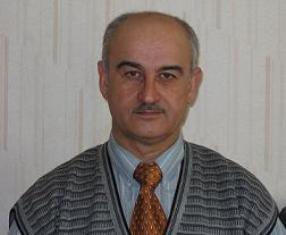
This is a downpayment on Russia’s Armed Forces:  Year 2010.  You can read about the authors here.  The report’s not great, but it has interesting information not printed elsewhere.

This picks up on Fomin’s earlier interview.  Next look for their chapter on the OPK.

The gist of the conclusion is this.  There’s been no rebirth of the armed forces, in fact, many negative trends are now irreversible.  There’s been no real rearmament despite higher budgets.  The military doesn’t know how to set clear goals, and is planning to fight abstract threats like terrorism, instead of real ones like the U.S.  Russia has money, but has invested it in currency reserves instead of its armed forces.

Here’s a translation of their conclusion:

Conclusion

There’s a myth that in the last ten years an incredible militarization of the country and rebirth of military power not quite to the level of the Soviet Union has occurred.  As the analysis conducted showed, this does not correspond to reality – in reality a degradation of the Russian VS [Armed Forces] has taken place.

Negative processes which began in the 1990s have reached their apogee today and are close to completion, because many negative tendencies in army development have taken on an irreversible character.  Numerous reforms are confirmation of this:  when everything is normal, reforms are not required.  With growing expenditures, real rearmament is not happening and new equipment is not entering the forces as a practical matter.  The defense-industrial complex is still relying on developments from Soviet times and no substantially new developments in post-Soviet times have been made that could even go into experimental, much less into production use.

The analysis showed that the degradation of the Russian VS is conditioned on two main causes.

  1. The absence of a distinct system of goal establishment for the functioning and development of the VS.  The affair has gone to the point that many military experts and analysts (not speaking of officials) are completely ashamed to clearly designate possible military enemies, and are trying to implement military organizational development under abstract sources of danger and threats.  Any ordinary person understands that today and in the near future, there are only three such enemies:  the U.S., NATO, and China.  International terrorism is not an independent force, but only an instrument in the hands of the mentioned groups of countries.  It should be clearly understood that ambiguity in goal establishment is just as ruinous for the condition and development of a system as a lack of resources.
  2. Nor is everything right when it comes to resources.  More precisely, it is obvious they are insufficient even to hold a steady position.  Miracles do not happen in program planning:  if the amount of allocated resources drops to such a critical level, no improvement in the command and control system or reforms can make up for this.

One does not need to speak of the country’s difficult financial problems.  The country has money.  In 2006 and 2007, $125-175 billion was transferred to the country’s hard currency reserves, respectively.  $175 billion is, at the year average rate of 25 rubles/$, approximately 4.36 trillion rubles, that is 5 times more than all MO [Ministry of Defense] expenditures in 2007.  This money was transferred into long-term, low-interest, and ‘highly reliable’ U.S. securities.  So they assert.  It is simpler to say an unreimbursed investment in the American economy.  For this money, it would have been possible to maintain another five armies like the current Russian one.  Even in the crisis of 2009, when we experienced a federal budget deficit, from the middle of March until the end of the year, nearly $60  billion was transferred into hard currency reserves, i.e. nearly 2 trillion is the volume of financing for another 1.5 such armies like Russia’s. 

But the financing of the Russian VS is not happening on the necessary scale.  As a result, the real possibilities of Russia are being cut by leaps and bounds.  This affects both military power and political influence abroad.

PAK FA Update

PAK FA (photo: RIA Novosti / Aleksey Druzhinin)

RIA Novosti reports the second T-50 (PAK FA) testbed will begin flight tests before the end of the year, according to Sukhoy chief Mikhail Pogosyan.  He said the first testbed has performed 40 flights.  Sukhoy is satisfied with the course of testing which has gone faster than expected.

Pogosyan added that negotiations with India on its entry into the fifth generation fighter program should be completed this year.  Russia and India will roughly split the development expenses for one- and two-seat versions.  The PAK FA will start to enter the Russian inventory in 2015, and Indian forces around 2020.

A Thoroughly Modern CINC

You have to like Air Forces CINC, General-Colonel Aleksandr Zelin. 

He’s open and candid about what Defense Minister Anatoliy Serdyukov’s ‘new profile’ reforms mean for him and his service.  He’s talked earlier, more often, and longer about it than his Ground Troops or Navy counterparts.  He’s matter of fact and accepting of the entire process. 

Serdyukov’s changes turned General-Colonel into a trainer and force provider, and he nonchalantly admits as much. 

At 57, Zelin understands he can be replaced at any time, or allowed to serve three more years or even longer. 

If he were a tad younger, he would have been the right kind of general to command one of the new military districts / unified strategic commands (OSK / ОСК), say the Western or Central.  An air or air defense officer would have been just the right choice for a potential future war on those axes.  Instead, the Kremlin has three Ground Troops generals and one admiral (a step in the right direction).  It’s hard to argue against Ground Troops leadership in Russia’s restive south.  But Air Forces (VVS or ВВС) would have been a really good choice in the Western or Central Military Districts . . . a missed opportunity for now.

But back to Zelin.  On Tuesday, he addressed a foreign military attaché audience (and the Russian media) about the future of the VVS.

According to Gzt.ru, Zelin said the VVS will be reduced by a third and spread among the four new  OSKs.  And its Main Command (Glavkomat) will be responsible only for combat training.  The OSKs are in charge of employing the VVS in their theaters.

The VVS now consist of the Glavkomat, 7 operational commands, 7 first-rank air bases, 8 second-rank air bases, and 13 aerospace defense (VKO) brigades.  Before the ‘new profile,’ the Air Forces consisted of 72 regiments, 14 air bases, and 12 independent squadrons and detachments, with a third more aircraft than the VVS now have.

Four of today’s 7 operational commands are subordinate to the new OSKs.  Army Aviation also falls under them.

According to Zelin, in the future, the VVS Main Command (Glavkomat or Главкомат) could become a “branch department” of the General Staff responsible for the combat training of the Air Forces and Air Defense, while the OSKs employ the trained forces.

Zelin says VVS personnel will number 170,000 with 40,000 officers, nearly 30,000 sergeants, and the balance conscripts or civilian specialists.  He says today’s personnel training system doesn’t satisfy him, and so he’ll probably change the system of flight schools.  Only four remain today.  Voronezh will be the main training center.  Flight training will also be conducted in Krasnodar and Lipetsk.  Yaroslavl will remain home to air defense officer training.

According to the CINC, the VVS airfield network won’t change.  Base airfields will be first priority for reconstruction and modernization.  Zelin says civilian airfields could be used for operational purposes in the future.

He noted the VVS plans to go to a fully automated command and control system in the future, and, of course, develop its VKO forces.

Lenta.ua quoted Zelin’s remarks to Interfaks.  Zelin said the VVS will renew 30 percent of its inventory by 2015, and 100 percent new in some areas and 80 percent new overall by 2020.  He doesn’t say where the VVS are today in this regard, but recall Defense Minister Serdyukov has said only 10 percent of equipment in the Armed Forces is modern.

Zelin said the VVS will get new aircraft, air defense, reconnaissance, and electronic warfare systems, but modernization of some existing systems is still part of the plan.  Although the State Armaments Program 2011-2020 and its 19 or 20 trillion rubles have to be finalized, Zelin repeated that 10 T-50 (PAK FA) will be acquired in 2013-2015, and 60 more from 2016.  He mentioned Military-Transport Aviation (VTA or ВТА) is a priority – including the An-124 Ruslan, Il-112, Il-476, Il-76M, and An-70 – but he doesn’t venture any numbers or dates for new production.  Zelin does give a target of 400 new and modernized helicopters in the inventory by 2015.

Who knows what was or wasn’t covered in these media contacts, but it seems odd there’s still no mention of more S-400 deliveries.  Zelin was still talking about getting 5-6 more battalions in 2010 earlier this year.  But no sign of them.  It’ll be a big deal when or if they appear.  Also, no mention of S-500 development.

Shamanov Doing Well, His Staff Not So Well

Interfaks reports the VDV’s spokesman says Airborne Commander, General-Lieutenant Vladimir Shamanov is doing well enough to receive visitors and work from his hospital bed, though doctors won’t say at this point when he might be discharged.

Tuesday’s Argumenty.ru reported bad news for Shamanov’s staff.  A Defense Ministry commission working in the VDV will soon issue its decision on cutting the airborne staff.  A military source says it’s only a formality since a decision, not favorable to the VDV, has already been made.

The officer said the commission arrived immediately after Defense Minister Serdyukov’s 30 September dust-up with VDV Colonel Krasov at the Seltsy training center near Ryazan.  It had mainly finance and personnel people.  Scheduled to work for two weeks, the commission needed more than a month, and didn’t finish until after Shamanov’s car accident on 30 October.

According to Argumenty.ru’s source, the report will consider it expedient to cut the VDV’s Main Staff by two times, transfer its headquarters from Moscow to Ryazan or Tula, and sell its current premises in Sokolniki.

Short Stories

There aren’t enough hours in the day . . . quick takes on some stories of interest.

Rossiyskaya gazeta . . . Minregion again sternly warns of problems in heating military towns due to Defense Ministry debts . . . the Far East is the most serious case.

Nezavisimaya gazeta . . . Ukrainian Defense Ministry may not be able to cooperate on An-70 transport for financial reasons.

Argumenty nedeli . . . long expose on the death of Russian military medicine, and the consequences, as a result of Serdyukov’s cuts and reforms.

ITAR-TASS . . . the interdepartmental commission met at Sevmash today with Vladimir Popovkin leading a review of Yuriy Dolgorukiy’s readiness to test fire the Bulava.

ITAR-TASS . . . on Tuesday, Chelyabinsk’s governor called on Serdyukov to stop explosions at Chebarkul.  This mini-scandal’s been evolving since they started in early October.  Expired munitions are being destroyed, but locals are complaining of damage from tremors.  Serdyukov was supposed to go to Chelyabinsk, but sent logistics deputy Bulgakov in his place.  Bulgakov supervised an elaborate demonstration to show that the explosions aren’t powerful enough to shake Chelyabinsk.  Residents say they can feel them in the city’s high-rise buildings.  The military doesn’t get much credit for trying to get rid of old bombs like those that nearly leveled one of Ulyanovsk’s rayons last November.  See Novyy region or Moskovskiy komsomolets.

There is growing media attention to the military housing problem — will Medvedev, Putin, and the Defense Ministry keep their promise to solve the permanent housing problem by the end of 2010, or are they just changing the rules and extending their own deadline?  See IA Rosbalt, Svpressa.ru, or Nezavisimaya gazeta.

Dollar’s Inevitable Collapse Threatens Russia

Segodnia.ru recently publicized a report entitled Armed Forces:  Year 2010, prepared by the Center for Strategic Assessments and Forecasts (TsSOiP or ЦСОиП).  It interviewed one of the report’s authors – retired Colonel and Doctor of Technical Sciences, Aleksandr Fomin – about the state of Russia’s military and threats to Russia.

How does one characterize Colonel Fomin?  In this interview, his thoughts range from a little far right to far left / neo-Marxist.  Yet he sounds like President Medvedev in 2009 calling for a new world financial order to break the dollar’s hold on the international economy.  But that resemblance disappears once he starts excoriating Russia’s elite — co-conspirator in U.S. domination of Russia.

He generally argues the dollar’s inevitable collapse will lead to conflict or war, for which Russia is poorly prepared.  His arguments will appeal to some, but they represent a somewhat simplistic view of international economics and finance.  The rest is a short geopolitical treatise we’ve heard many times about how Russia arrived in its current condition.

Take heart, however, the analytical report is more interesting and original, but it’s 40-odd pages, so some patience on your part will be required.

By way of foretaste, on with Fomin’s interview . . .

Asked simply what’s going on in the Russian Army, Fomin answers:

“There’s a myth that the incredible militarization of the country and rebirth of its military might almost to the level of the Soviet Union has happened in recent years.  This doesn’t correspond to reality – in reality, as the analysis shows, the Russian Armed Forces have degraded.”  

“If we look at the trend of general financing of the Armed Forces for the last 10 years , adjusted for inflation, then we get as a true expression of the financing volume are 4% increases per annum on average.  At such a growth rate, it’s possible only to offset depreciation, but not guarantee the development of the armaments system.  Now recall corruption, and you find that in reality the Armed Forces didn’t develop, but degraded.”

“Today, in the spirit of political correctness, it’s believed that Russia’s main military enemy is international terrorism. They’re ashamed to identify the U.S., NATO, and China as the real potential enemies.  But if we call things by their names, then today Russia is inferior to these probable enemies in the size of its Armed Forces by 20 times in the West and 35 times in the East.”

We’ll have to read his full report to figure out how he came up with these numbers. 

Fomin goes on to say that Russia’s nuclear weapons won’t save it either, since Moscow’s elite keep its money, and educates its children, in the West.  He concludes flatly:

“It is very probable that Russian nuclear weapons will never be employed.”

Next Fomin constructs his scenarios for future wars and threats to Russia:

“In the coming decades, and possibly, years the U.S. and EU’s problems with China will inevitably sharpen, the cause of them is the struggle for energy resources.  Iran, Pakistan and . . . Russia will be drawn into this confrontation.  They will start to use our country as a buffer in the military resolution of the China problem.”

The interviewer asks Fomin what threatens Russia externally, what geopolitical positions has it lost, which ones does it still hold?

“The main threat not just to Russia, but also the world as a whole comes from the virtual world financial system, based on the American dollar, which for a long time already hasn’t been supported by real assets and is held up only by U.S. military might, the potential of which allows them to oppose everyone else in the world.  But sooner or later this system will collapse, for internal reasons.  But however the collapse occurs, its agony (possibly the current financial crisis is the beginning of this agony) could plunge the world into the Third World War.”

“As already said above, today Russia is practically undefended.  Its political leadership, like the appanage princes of Rus in the 12th -13th centuries, are trying to hold off threats  by means of multibillion tribute payments allegedly into international reserves.  However, in Russia the easily accessible oil, could soon be gone:  according to expert evaluations, 30% of wells are already unprofitable.  Then Russia will simply be of no interest to the rest of the world . . . .”

“If we talk about Russia’s lost geopolitical positions, then of course – this is NATO’s expansion to the East, the reinforced U.S. role to Russia’s south (Afghanistan, Iran, Pakistan, Georgia).  It’s possible to add the real threat of losing the Far East and Siberia to this.  They [NATO and U.S.] managed to spoil [Russia’s] relations with Ukraine, Belorussia, and Iran.”

Asked about the threat that Russia is becoming ensnared in U.S. “anti-Iran” policy, Fomin responds:

“. . . the U.S., economy of which is based on proliferating the dollar throughout the world and managing oil prices, has a very painful relationship to [Iran’s] nuclear energy development – to oil’s energy competitiveness.  Especially in the Near East.  In its relationship with Iran, Russia turns out to be hostage to its own financial system:  if the country holds its reserves in other countries’ hard currency, then it can’t oppose them on their main positions in the military-political sphere.  Some disagreements are possible, but there can’t be a lengthy tendency toward the complication of relations – in the case of a sharp worsening it would be easy to block hard currency accounts.”

“And, Russia for 20 years already has been unable to conduct an independent foreign policy, since it is tightly integrated into the world economic system dominated by the U.S.”

“Russia risks losing the remains of its authority among Muslim countries, after abrogating its earlier agreed supply of defensive weapons (in the first place, S-300 surface-to-air missile systems) to Iran.” 

Asked again about threats, Fomin says:

“External threats have been discussed above.  To this it’s possible to add that, as a result of the actions of the financial authorities of the G20 countries, the fundamental bases of the current crisis haven’t been eliminated.  Because of the fact that some paper (toxic assets) has been traded for others (newly printed dollars, euros, and pounds), the situation hasn’t changed principally.  The disease has been driven inside and its symptoms are still appearing to a lesser degree.  But it definitely will crawl outside again.  Therefore, the financial-economic crises will continue further.  Sooner or later the American dollar unsupported by real assets, as a world currency, must collapse.  Several types of dollar exist already now — for internal and external demand.  The Americans are trying to do everything possible meanwhile to ‘save face.’  Provoking situations to create the objective appearance of a reason for the collapse of the dollar are possible:  a terrorist attack on the U.S., war in the Near East, aggravation of the situation in the Far East.  A new world war which will be catastrophic for Russia as an extreme case.”

“Now about internal threats.  For clarity, in every case, we are distinguishing two understandings:  country and state.  It’s possible to love your country while being critical toward the state, which imagines itself as society’s management apparatus.”

“If we talk about the country as a whole, then the main internal threats are well-known:  complex demographic situation, a lopsided well-developed raw materials economy, low labor productivity, conditioned by the low wage level of labor, proliferation of narcotics, brain drain abroad, degradation of science, culture, education, health care, pensions, national defense, law and order, agricultural economy, neglected transportation and ecological problems, corruption.  In the coming decade, the aggravation of energy problems, connected with the exhaustion of easily accessible supplies of Russian oil.”

“But there is still one more serious problem which is the source of all the rest.  This is the multibillion outflow of capital from Russia, including into so-called international reserves (it’s simpler to say into the financial systems of Western countries).  It bleeds the entire economy, and doesn’t allow for moving off a dead stop in solving the majority of urgent problems.  If there were no capital outflow, many internal Russian threats would be eliminated in some time.”

Fomin goes on to argue that current capital outflow (legal and otherwise) is more burdensome and damaging to Russia’s economy than tribute paid to the Mongols centuries ago.  He says international reserves accumulated in 2010 could have plugged the gap in Russia’s pension fund.

Fomin now turns to internal threats to the state.  Number one is the populace’s increased protest activity.  He says the average Russian understands clearly that the state exists not to improve his welfare, but only the quality of life of 1 percent of Russians, without, of course, provoking large-scale protests from the other 99 percent. 

Among other threats, he cites hypertrophic centralization and underdeveloped local government, inflation caused by capital outflow, low wages, and unemployment all leading back to protest activity.

Fomin notes that Russia dropped to 154th (from 146th) on TI’s international corruption index this year.

He observes that the Russian government failed the test of August’s forest fires, causing a mortality spike equal to the number of men lost by the USSR in Afghanistan.  He calls Prime Minister Putin’s web cameras for monitoring the rebuilding of housing a symptom of the level of Russia’s corruption and ungovernability.

Fomin goes on to label major internal problems — education, health care, agriculture, housing, national defense, culture, science, ecology — the first four he notes are ‘national projects.’  Agriculture he puts on the level of military security in importance.  But rather than develop it, the country’s elite chooses to buy food abroad with oil and gas profits.  Agricultural imports support the livelihood of many middlemen in the process.

Fomin has one last assessment of Russia’s current elite class:

“At present, Russian state authorities and the so-called ‘elite’ view the country as a private firm working solely to get profits and the sooner, the better.  Profit is the main goal of the private firm.  It’s not for the realization of long-term goals.  Its main mission:  collect capital, send money abroad, make itself comfortable, and invest the money in a profitable business.” 

Tsyganok on the GPV and the OPK

Anatoliy Tsyganok

Interviewed in yesterday’s Svpressa.ru, defense analyst Anatoliy Tsyganok expressed his doubts that trillions of rubles can save Russia’s OPK, its defense-industrial complex.

A quick summary.  Tsyganok seems to make the point that, while there’s an armaments plan, the OPK is still in a woeful state of neglect, i.e. the Bulava’s producers may actually be better off than many defense enterprises.  Much of what is leaving the factory gates still heads for foreign buyers or requires expensive repairs because quality is lacking.  Perhaps the OPK development (or maybe rescue) program needs attention before the GPV.  Tsyganok takes fewer Indian and Chinese purchases as a sign of quality problems.  Lastly, he says Moscow needs to rethink how it’s most likely to fight before picking what to make and who will make it.

But back to the article, Tsyganok gives his views on what might be bought with 20 trillion rubles in State Armaments Program (GPV) 2011-2020.  He mentions (sometimes without specific numbers or costs):

  • An-124 Ruslan — 20.
  • An-70.
  • Il-112.
  • Il-476.
  • Il-76MD.
  • Combat and transport helicopters — 1,000.
  • PAK FA — 70.
  • Yak-130 combat trainers.
  • Su-35 and Su-30 — 60 (80 billion rubles).
  • MiG-29K — 26 (25 billion rubles).
  • Su-34 — 32 (35 billion rubles).
  • Proyekt 885 Yasen SSNs.
  • Proyekt 955 Borey SSBNs.
  • Bulava SLBMs.
  • Proyekt 11356M frigates — 3.
  • Proyekt 636 diesel-electric submarines — 3.
  • T-90 tanks — 261.

There are, of course, lots of systems required that he doesn’t take time to mention.  New ICBMs, advanced conventional munitions, communications systems, satellites, etc.  He notes that the Navy’s needs alone come to several hundred billion rubles, and several ships and submarines he mentions are for the Black Sea Fleet.  The Ground Troops don’t get too much attention from Tsyganok.

Asked whether the OPK can produce modern combat equipment of the necessary quality and quantity even with sufficient financing, Tsyganok responds:

“Unfortunately, it has to be recognized:  many OPK enterprises are already incapable of series production of high-technology weapons systems.  The woes of the unfortunate strategic missile ‘Bulava’ are proof of this.  The picture is generally nightmarish.  A fourth of Russia’s strategic enterprises are on the verge of bankruptcy.  The tax organs have already issued liens for the recovery of debts against 150 defense plants and organizations.  Baliffs have already been sent there.  Who can work on the state armaments program there?”

“And don’t let the fact that in the first half of 2010 fully respectable growth of 14.1% in production was registered in the defense-industrial complex deceive you.  Mainly, as before, everything put out went for export.  Let’s say, over six months, our country produced 54 helicopters.  Of them, 31 went abroad.”

Asked if the poor state of defense plants is affecting the quality of their products, Tsyganok says:

“It affects it in the most immediate way.  Expenditures on eliminating defects in the course of production, testing, and use of our military products today goes up to 50% of the general volume of expenditures on the corresponding defense budget article.  In economically developed countries, this indicator does not exceed 20%.  The main reason is monstrous equipment depreciation.  And there’s no ray of hope visible there.  The rate of renewing the production base in the Russian defense sector, despite growing financial inputs of recent years, is not more than one percent a year.  In order somehow to get out of this hole in which we find ourselves, we would need to increase this rate by 8-10 times.  Incidentally, the reduction in quality of arms and military equipment produced is already noticeably reflected even in Russia’s military-technical cooperation with our traditional partners in this area.  With India and China most of all.  They are already not so intently signing contracts with us as before.”

What about design bureaus and scientific-research institutes?

“Also nothing to brag about here.  The fact is what the Russian defense-industrial complex can offer the Armed Forces in the near future, with a few exceptions, is already no longer the world’s best models.  And all this is because in the USSR’s time our country allocated up to 4.7% of GDP to basic research.  In today’s Russia, in all 0.16% goes to this business.  At the same time, in China, for example, annually ten times more is spent on scientific-research and experimental-design work.  And, as expected, next year it will catch up with the U.S.  As a result, in many military technologies, Russia is currently at a 1970s-1980s level.”

Finally, Tsyganok’s interviewer asks if there’s any way out of these dilemmas:

“There’s always a way out.  First of all, it’s essential to promptly review the goals and missions of the weapons complex.  We really have to understand whom we intend to fight, and what types of armaments are necessary for this.  Then the state defense order [GOZ] will take on more accurate contours.  As long as we don’t have this understanding, the situation will only get worse.”

Mending Fences with the Church?

Serdyukov and the Patriarch

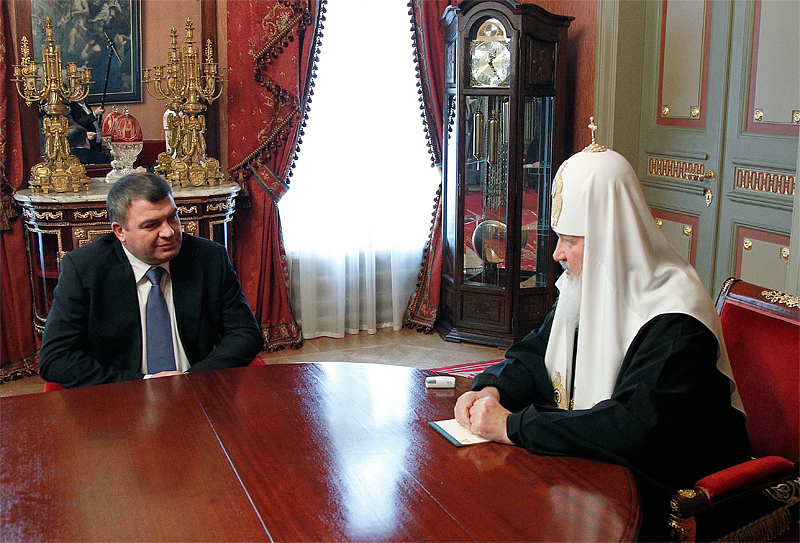
Defense Minister Anatoliy Serdyukov met Patriarch Kirill yesterday, and only Rossiyskaya gazeta alluded to the possibility it might be a fence-mending effort following the Seltsy incident several weeks ago.  Serdyukov had met Kirill previously, but the timing of this meeting sure looks like an effort to repair  army-church ties.

Patriarchia.ru, Krasnaya zvezda, and Komsomolskaya pravda reprinted portions of the Patriarch’s comments:

“The Armed Forces are now undergoing a very important phase of reform, and we are attentively following what is happening.” 

“The army in Russia was always a powerful patriotic force influencing the mood of society, and the well-being of people.  The army was always an elite of our society, including intellectual and cultural.  Therefore I am deeply convinced the Armed Forces reform, which assumes an entire series of very important organizational decisions, scientific-technical and simply technical, must include both spiritual and cultural dimensions.”

Defense Minister Serdyukov told the Patriarch: 

“It’s always pleasant for me when there’s a chance to meet with you, to discuss these or other issues connected with reform.”

“This reorganization now being conducted is a deliberate, calculated process and, as the initial results already show, quite effective.”

According to RG and KP, Serdyukov told Kirill about plans to open a center for regimental priest training on the base of one of the military academies, most likely in Moscow.  Alluding to the Seltsy problem, Serdyukov also noted the Defense Ministry now has a working group on the issue of constructing Orthodox Churches in military units.  And Serdyukov repeated yesterday he never gave anyone an order to take down the church on the VDV’s Seltsy training grounds.

Shurygin on the VDV’s Discontent

Writing in Zavtra, Vladislav Shurygin has added his take on Sunday’s VDV protest.  As usual, it’s a different cut with different details, but a unique one that shouldn’t be ignored.

Here’s the gist.  Shurygin says it’s not just the VDV’s discontent, but the military’s.  He enumerates the VDV’s specific grievances.  He claims the airborne has lost its status as the Supreme CINC’s strategic reserve and been placed operationally under OSKs West, South, Central, and East. 

Much of Shurygin’s article comes down to the VDV’s alleged loss of elite status.  Others, however, would say Serdyukov’s handled the airborne with kid gloves compared to how other services have suffered.  They might also say it’s high time the VDV got knocked down a notch or two.  

Shurygin seems to want to say that vlasti are more worried, or should be more worried, about discontent in the army than they appear.  He says Serdyukov can’t be dislodged from the Defense Ministry by his opponents, only the internal imperatives of vlasti will move him to another job; then he’ll be replaced by someone who’ll begin his own reform.

Shurygin quotes one Russian Airborne Union (SDR or СДР) official on how servicemen are left socially unprotected:

“In the framework of this reform which is destructive for the country, the overwhelming majority of servicemen have been dismissed without serving the term enabling them to get a pension.  Half of them don’t have housing.  Our country already has a sad experience of dismantling troops.  In the distant 1950s, the Defense Ministry decided to eliminate Naval Infantry under the pretext of missile-nuclear weapons development, saying that, if necessary, conventional infantry could fully replace it.  Nearly 50 years later history’s repeating itself.  Only now the VDV and Spetsnaz ended up in the role of unneeded forces.”

Shurygin continues:

“Meanwhile, the attitude of high state officials toward the VDV has been drawing criticism for a long time already.  In July, when the VDV observed its 80th anniversary, neither the Supreme CINC, nor the Prime Minister appeared at a ceremonial concert in the Kremlin palace and they didn’t even send the nominal greeting customary in such instances.  Then a directive according to which the VDV command would become subordinate to the Main Command of the Ground Troops was prepared, and VDV formations and units are in fact being transferred into operational subordination to the commands of strategic axes ‘North,’ [sic] ‘West,’ ‘South,’ and ‘East.’  That is, they’re being taken from the reserve of and immediate subordination to the Supreme CINC of the RF Armed Forces.  Add to this the estrangement of the VDV from work with premilitary youth in DOSAAF and the elimination of the Ryazan Airborne Higher Military Command School, which has been dropped into the Ground Troops training center (Combined Arms Academy), and the elimination of the VDV Personnel Directorate, which will put a final end to the elite status of the VDV, traditionally proud of its own unique personnel school.  In fact, a quiet destruction of the troops is going on.”

Shurygin says VDV Commander Shamanov’s doctors say confidentially that, in intensive care, he was in no condition for paperwork, and his right hand was immobilized when he supposedly authored his message urging VDV on Poklonnaya Gora to avoid confronting the Defense Ministry.   

So Shurygin doubts Shamanov wrote this, but he doesn’t allow for the possibility that the general dictated words to be issued in his name.

Shurygin adds that sources close to the Defense Ministry say the Shamanov document turned up in the hands of Deputy Defense Minister Nikolay Pankov, was edited by his people, and sent to the hospital for Shamanov’s signature as he was being wheeled into surgery. 

Shurygin shifts gears reprinting part of an interview he gave Baltinform prior to the Poklonnaya Gora demonstration.  Asked about Serdyukov, he says:

“The reform Serdyukov is conducting causes confusion in specialists.  The opposition to the pogrom he’s conducted in the army is very great.  Tens of thousands of people are opposed — they really see what is happening in the troops, and are trying to get this information to the public.”

“The fact that this [Seltsy] scandal received publicity is not evidence of conspiracy, but evidence of the crudest error in Serdyukov’s judgment, who left himself open, conducting himself rudely and offending an honored officer, a Hero of Russia.  And this outrageous incident only became the latest reason again to raise the theme of reform.  If the main reformer conducts himself in such an unworthy manner, then this automatically calls forth questions about the entire reform he’s conducted.  I think that opposition to Serdyukov is located not at the Kremlin level or any mysterious officials, but at the level of those whom military reform has literally ‘run over like a tank.'”

 I relate to [Serdyukov] as an absolutely incompetent person who occupies a job that is not his.  And for three years already he’s been learning the completely new business of managing the army at the cost of huge damage to the latter.  First they constantly destroy army structures like a house of cards, then they try to ‘sculpt’ and create something out of them.”

  “Some directives are suspended, others are given out and then are suspended.  The army leadership is feverishly searching as if trying to get a careening wagon down a hill in the necessary direction, but still just increasing the chaos and disintegration.  Massive break-ups were undertaken in place of approaching reforms from a scientific viewpoint and working out experiments on specially selected parts.”

“The Armed Forces have been ‘cut to the bone.’  They’ve broken everything in them, both the bad, and the good.  They broke it, then observed the mistakes, and are now trying to correct them.”

Asked if Serdyukov will finish his reforms or be replaced because of complaints from his opponents, Shurygin concludes:

“It seems to me he’ll go to that phase when it’ll be officially acknowledged that the reform has taken place.  Then a moment will come when it’s necessary to make a change in the official hierarchy, and Serdyukov will be transferred to another position.  The one who comes into his place, will begin his own reform anew, perhaps, a more ‘quiet’ one.  But he won’t avoid long work analyzing the mess of forest cut down by Serdyukov.”

Latest on Su-34 Deliveries

ITAR-TASS reports today that Sukhoy will transfer the next part of its serial order of Su-34 fighter-bombers from the Novosibirsk Aviation Production Association (APO) to the Air Forces before the end of this year.

A Sukhoy spokesman told ITAR-TASS the Su-34 is being produced under the 2008 state contract for 32 aircraft.  And the Air Forces have already received five, according to this report.  Completion of this contract will reportedly give them ‘nearly 40.’

One notes, however, there have been many plans for Su-34 deliveries over the years that were not realized.

The wire service item reminds readers the ‘4+ generation’ Su-34s participated in Vostok-2010, refueling in air as they flew non-stop to airfields in the east.  The Sukhoy spokesman stressed the Su-34’s combat radius ‘approaching the ranges of strategic bomber flights.’