Serdyukov’s Carte Blanche

In an editorial Monday, Vedomosti supported the carte blanche President Dmitriy Medvedev has apparently given Defense Minister Anatoliy Serdyukov and his military reforms.  The paper likes the reforms enough that it wants the President to think about the possible effectiveness of the ‘army method’ in reforming the MVD.  Here’s what Vedomosti had to say:

“Renaming the Army”

“Dmitriy Medvedev’s and Anatoliy Serdykov’s joint trip to a model Moscow suburban military unit went beyond the protocol of the visit.  The President’s speech in awarding outstanding military men became a new signal to officers, the army, and society:  ‘Despite the fact that all changes are difficult, they are necessary…  Everything that is now being done is directed at establishing modern and effective armed forces.  Here there are both problems and good decisions, I am following this personally as Supreme CINC.’  The Kremlin demonstrated that, despite the recent media scandal, it trusts the civilian Defense Minister, won’t bow to the generals’ and veterans’ opposition, and intends to continue its planned military reform.”

“The new carte blanche for Serdyukov for further transformation is important for many reasons.  The current minister is not the first civilian director of the military department.  However, he specifically replaced a campaign of reforming with systematic transformations.  In his inheritance from Sergey Ivanov, Serdyukov received a much truncated army of the Soviet type, not answering modern requirements.  Dedovshchina, obsolete armaments (modern equipment is not much more than 10% of the general inventory) and command and control, and manning were its main problems.  Add to this corruption among the generals which prevented equipping the army with new types of armaments and communications.  The victorious August war of 2008 showed that the victors couldn’t suppress the enemy’s aviation and artillery and were inferior to the vanquished in modern communications and reconnaissance means.”

“Serdyukov’s attempts to establish control over expenditures on purchases for the army met severe resistance from rear services officers and generals.  Not long ago he acknowledged to journalists:  ‘When I came to the Defense Ministry, speaking plainly, I was surrounded by large amounts of thievery.  Financial licentiousness, the impunity of people whom no one had checked out (…) was so deeply ingrained that it had already become a way of thinking.’  The minister confirms that the transparency of the defense order is a ways off.  The unnecessary secrecy of the military budget is interfering with this.  Meanwhile, progress in the struggle against traders in shoulderboards is obvious.  In 2006, corruption cases were started against seven generals, in 2007, when Serdyukov became minister, — against 16, in 2008 — against 20, in the first half of this year — against eight more.”

“Besides this, the Defense Ministry put up for sale unneeded property and facilities which were being illegally rented out to enrich a few people, and didn’t allow for building apartment blocks for officers needing housing on these grounds.”

“On the whole, it’s possible also to consider organizational transformations a success:  the transition to a more modern system of command and control and the reduction in the excess number of generals and higher officers.  In 2008, of 249 generals and admirals who underwent certification [аттестация], 50 were dismissed, and 130 sent to new places of service.  One can’t avoid mistakes in cutting and dismissing officers, but those deprived of a sinecure cried loudest of all about the collapse of the army and treason.”

“The struggle with barracks hooliganism goes on with varying success.  According to the Main Military Prosecutor’s data, in 2006, more than 5,800 people suffered beatings from fellow servicemen, in 2009 — 3,000.  And for the first five months of 2010, 1,167 soldiers suffered from dedovshchina — 1.5 times more than the analogous period of 2009, of them, four died.  The cause is not only in the growth — because of the cut in the service term — the number of new conscripts went from 123,000 in the fall of 2006 to the current 270,600.  Generals, having botched the program costing 84 billion rubles to transfer to contract, now are forced to call up those with criminal records.  Military police will remain a paper tiger for ‘dedy’ and ethnic clans.  We note that Serdyukov hasn’t forsaken a professional army, but put off its creation until the time when the Defense Ministry will be able to select and not collect contractees through deception and duress.”

“Nevertheless, it’s notable that over 3 and 1/2 years, the reform, being conducted by independent managers without legal changes and loud renamings, has really moved forward.  It’s possible it’s worth the President considering the effectiveness of the army method in reforming the MVD.”

Shamanov Update

This morning’s press says VDV Commander, General-Lieutenant Vladimir Shamanov had a complex but successful four-hour surgery yesterday to repair hip and elbow joints damaged in Saturday’s head-on collision near Tula.  A spokesman for the Burdenko Main Military Clinical Hospital said Shamanov was feeling ‘normal’ after his operation.

Acting 106th Division Commander, Colonel Naumets’ condition remains serious and his surgery hasn’t been scheduled.  Colonel Chernous has improved, and he’s been moved out of intensive care.

Medvedev Inspects Strategic Forces

In Friday’s Nezavisimoye voyennoye obozreniye, Viktor Litovkin claimed, the day before, President Dmitriy Medvedev visited the inner sanctum of Russia’s Aerospace Defense (VKO or ВКО) – the Central Command Post (ЦКП) of the 3rd Independent Air Defense (Missile Warning) Army in Solnechnogorsk.  Now Litovkin admits VKO doesn’t technically exist yet.  But preparations are underway, and he suggests, besides PVO, SPRN, PRO, space monitoring, etc., it will even include the RVSN.  Litovkin maintains tests of this system are ongoing, and Medvedev came to inspect it.  He watched troops track all three of Thursday’s SLBM and ICBM launches, and saw the missiles’ warheads land on their respective targets.  And, according to Litovkin, the point was to demonstrate the reliability of Russia’s nuclear missile capability to Medvedev as new SNV treaty limits loom.

Could the shrinking RVSN be subsumed under VKO as a new service or branch?  Could this explain the fairly rapid command shifts from Solovtsov to Shvaychenko to Karakayev?

Shamanov Update

Shamanov's BMW 525 (photo: Lifenews.ru)

If we needed reminding, the extent of media coverage of Shamanov’s narrow escape from Saturday’s horrific head-on collision proves again that this two-star general is a national figure.

So what happened?  Shamanov’s warrant officer driver was killed; some press is saying he turned the car to take the blow himself and protect the boss.

Shamanov was in serious, but stable condition, and was moved from Tula to Moscow’s Burdenko Main Military Clinical Hospital.  Also injured were the acting commander of the VDV’s 106th Division, Colonel Aleksey Naumets, and Shamanov’s assistant Colonel Oleg Chernous.  Naumets’ condition is serious, but Chernous has improved a little. 

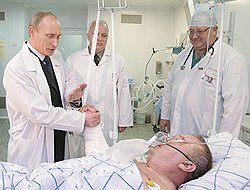
Putin Visits Shamanov (photo: RIA Novosti)

Prime Minister Putin and Defense Minister Serdyukov visited his bedside.  Izvestiya reported Putin said Shamanov was in a good mood despite what happened to him.  Serdyukov said:

“Vladimir Shamanov is real airborne, and airborne, as is well-known, are spiritually strong and physically powerful people.  Therefore I’m sure that he’ll get right and return to the line.”

Shamanov was in satisfactory condition this morning, and he went into surgery at 1200 MSK.  The focus of today’s operation was the general’s left leg.  Reports say Shamanov suffered a concussion and unspecified fractures to his arms and legs.

One has to wonder if Shamanov can rebound from this.  He might, but he might not be the same.  It would be surprising if he’s able to resume his regimen of jumping with the troops, etc.  He’s 53 and faces retirement on age grounds in a couple years unless he adds another star.  If he emerges from this accident with any kind of disability, he could be put out for that reason.  Of course, it all comes down to whether the powers-that-be want him in or out.

And this story wouldn’t be complete without possible conspiracy.  More than a couple commentators wonder if someone isn’t out to eliminate Shamanov . . . could be his son-in-law Glyba’s enemies . . . could be airborne veterans who might object to his slavish support for Serdyukov.  The Defense Ministry denies that anyone was out to get the VDV Commander.  It might just be an accident.

A Base By Any Other Name?

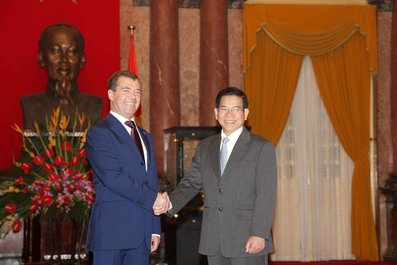
Medvedev with Vietnamese Counterpart Nguyen Minh Triet (photo: Kremlin.ru)

Cam Ranh was sure to be a topic for President Dmitriy Medvedev’s Vietnam trip.  But not a major one if Medvedev foreign policy assistant Sergey Prikhodko is to be believed.  Nevertheless, Prikhodko kept alive the idea of renewing some kind of Russian naval presence in Vietnam, whether called a base or a ‘material-technical support point.’  Prikhodko intimates the latter wouldn’t be anything like the former since times have changed so much.  Others will say the name it’s given is less signficant than what it actually turns out to be (if anything).

On Friday RIA Novosti quoted Prikhodko by name, on the eve of the Vietnam trip, saying:

“I don’t think we need to reestablish (in its old form) a base at Cam Ranh.”

And he claimed there was nothing concerning Cam Ranh in the documents  prepared for the visit.

Today ITAR-TASS coyly cited a Presidential Administration source (using Prikhodko’s exact words) who said Moscow is not tabling the issue of fully reestablishing a naval base at Cam Ranh:   

“Russia has material-technical support points for its Navy in many countries, you undoubtedly know them – from the Maldives on an occasional basis to Syria.  Naturally, the Vietnamese are interested in maximum capitalization on what was done by them and us.  But I don’t think we need to raise the issue of reestablishing the base.”

“It’s logical that in the framework of regular Russian Navy exercises, particularly in recent times, given our increased cooperation with European Union and NATO on antipiracy problems, this is an acute issue.  There’s nothing supernatural here.  And the fact is, in order for our ships to resupply with food and replenish in an efficient manner, they need infrastructure capabilities.”

“The idea of the base belongs to the Vietnamese side, it involves using the good groundwork and experience which Vietnam and Russia had earlier in supporting the security of navigation, supplying ships with food, with refueling.  It’s likely we’re talking about the possibilities of material-technical support of Russian ship cruises.”

“This is not the central subject (in the high-level talks), we have no enemies in this region as in past times, but to have the possibility to visit ports on regular and standard conditions wouldn’t be bad.”

“I don’t know the military’s plans in relation to this base and suppose that they don’t have any.  We’re talking about supporting the reliable functioning of our ships, including those fulfilling functions of various types of our cooperation with international organizations.”

Comparing the possibility of Cam Ranh with the existing situation with Syria, he said:

“This [Cam Ranh] is even better than the Syrian variant.  When it comes to Syria, we are always looking around at the reaction of neighbors, Israel, for example.  Here [Cam Ranh] it’s a much softer and more transparent variant.”

“There are complexities connected with ships passing the Strait of Malacca.  Therefore, on the level of public announcements, all countries in the region are interested that we should send military vessels there.”

It all seems like an awful lot of talk for something that ain’t goin’ happen . . .

Medvedev in Solnechnogorsk

President Medvedev (photo: Izvestiya / Yekaterina Shtukina)

Thursday President Dmitriy Medvedev made his most recent foray among the troops, and expressed what sounds something like a defense of his somewhat embattled Defense Minister, and his military reforms.

At Solnechnogorsk’s Center for Retraining and Improving Rifleman Qualifications, the President decorated some officers.  According to Kremlin.ru, he said:

“Our army is changing now.  And despite the fact that all changes are difficult, they are necessary. Because we understand:  if we can’t make our armed forces modern and effective, more combat capable, better armed, if officers receive pay that doesn’t motivate them to work properly, then we won’t have a proper defense.  Therefore, everything now being done is directed at creating modern and effective armed forces.  There are both problems and good decisions here, I am following them personally as Supreme CINC and I intend to continue to do so.”

He also congratulated General-Colonel Arkadiy Bakhin and Admiral Konstantin Sidenko after appointing them to be permanent commanders of the new Western and Eastern MDs respectively.

At the center, Medvedev inspected the school where Russia’s snipers are trained, and inspected the weapons they use.  The school has practically every type of infantry weapon, including NATO ones.

Izvestiya and Kommersant reported that officers there still venerate the Kalashnikov’s reliability and simplicity, but lament its ergonomics and low single shot density.  A new Kalashnikov will begin testing next year, and Izvestiya imagines the officers told the President what requirements for the new weapon will be, since today’s Russian Army can afford to buy the best.  Kommersant and RIA Novosti both noted that Kalashnikov lags behind Western manufacturers, so this all sounded a little like a rerun of recent domestic production vs. foreign procurement debates.

Medvedev visited the nearby military town of Timonovo, and viewed newly built apartment blocks for Space Troops officers.  Officers already in their apartments told Medvedev they are happy with the quality of the construction.  The President also met several dozen residents, families, and military retirees.  Some of the latter who served at Baykonur but received permanent apartments in Moscow Oblast complained of losing their higher pension ‘coefficient’ when they returned to Russia, and Medvedev promised to look into this.

He talked with representatives of the management company contracted to maintain these buildings for the Defense Ministry.  They said residents complain mostly about poor drinking water, and Governor Boris Gromov said this was because of old pipes that he promised to replace.  Medvedev gave Timonovo a positive evaluation, calling it: 

“A good town, normal level of support.”

This was Medvedev’s first trip to see the troops in a while, and he seems like he generally doesn’t go too often or too far to observe them.  He watched the naval portion of Vostok-2010 in July, and visited Alabino in May.

Another Bulava Success

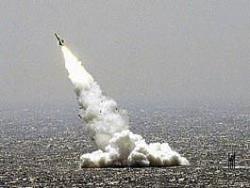
Bulava Launch (photo: ITAR-TASS)

At 0510 MSK today, Dmitriy Donskoy successfully launched the second Bulava SLBM of 2010 while submerged in the White Sea.  That makes two in a row, and 7 successes in 14 attempts overall. 

A government Military-Industrial Commission (VPK) source told ITAR-TASS the 15th test could occur in early December and will be the first from new Borey-class SSBN Yuriy Dolgorukiy.  The source attributed the successes to a tightening of control over the production and state acceptance processes.  He also warned it’s too early to relax:

“Two successful launches don’t signify that it’s possible to accept ‘Bulava’ into the arsenal.  A great deal will depend on testing in 2011.”

A member of the state commission that investigated the Bulava failures told RIA Novosti that these successes show Bulava had assembly problems.  And he said testing will continue in 2011.

RIA Novosti noted that, perhaps most significantly, this year’s Bulava tests came from a submerged boat.  In 12 tests prior to 2010, there had not been a single successful underwater launch.

Strategic Forces Training

Russia fired two SLBMs and an ICBM today.  Pacific Fleet Delta III SSBN Saint Georgiy Pobedonosets launched an SS-N-18 (RSM-50) SLBM from the Sea of Okhotsk.  Northern Fleet Delta IV SSBN Bryansk fired a Sineva (RSM-54) SLBM from the Barents Sea. 

And a crew from the Vladimir Missile Army’s Bologoye Division launched an SS-25 (RS-12M/Topol) ICBM from Plesetsk.

An RVSN spokesman said this launch allows Russia to extend the service life of this grouping of SS-25s to 23 years or until about 2015, and to conduct a planned replacement of these missiles without overburdening the military’s budget.

Yesterday Tu-95MS and Tu-22M3 bombers launched weapons on ranges in Irkutsk and Komi as part of an Air Forces exercise.

According to some reports, the Navy may test fire the Bulava SLBM for the second time in 2010 tomorrow.

Goodbye GRU Spetsnaz, Hello Army Spetsnaz

Writing in last Friday’s Stoletiye.ru, Rossiyskaya gazeta correspondent Sergey Ptichkin says that, practically on its 60th anniversary, GRU Spetsnaz have landed in a most unexpected place – the Ground Troops.  His piece is full of bitter sarcasm.

Ptichkin concludes:

“The GRU Spetsnaz brigades have transferred into the Ground Troops structure.  Several units have disbanded altogether.  Ranks for duties have been lowered.  Now a senior lieutenant will command a reconnaissance group, and that’s the ceiling.  All warrant officers have been dismissed – there’s no longer such a rank in the army.  And it’s strange that professional sergeants haven’t magically appeared in place of full-grown warrants.  The issue of halting parachute training for reconnaissance men is on the agenda.  Really, why parachutes if they’ve become ‘pure infantrymen?’  They can deliver them to any rebellious village in the mountains or forests on trains or in KamAZes.”

According to Ptichkin, professional Spetsnaz believe:

“. . . it’s simply impossible to train an eighteen-year-old boy into a genuine reconnaissance man-saboteur in one year.  In Afghanistan, Spetsnaz soldiers were sent out only after a year of intensive combat training.  That is real service, when a professional military reconnaissance man was born even at the very lowest level, began a year after callup, but now they’re dismissed into the reserves where they forget everything they learned after a few months.”

Ptichkin recalls the GRU Spetsnaz’ anniversary ten years ago.  Even though their relations with the Spetsnaz were tense, the Defense Minister and General Staff Chief came and paid their respects.

But this year:

“Neither the Defense Minister, nor the Chief of the General Staff, not even their current chief – the Ground Troops CINC came.”

“Many veterans and even serving officers consider this day a quiet farewell to the GRU Spetsnaz, born 60 years ago.  It’s possible something more mobile, combat ready, and effective will take its place.”

So he’s thrown Putin and Medvedev’s own description of the kind of army they want back at them.  Of course, the Spetsnaz have always considered themselves the ultimate fighting force.

Ptichkin says the Defense Minister didn’t even issue a traditional order of recognition for the day of Spetsnaz troops.

“There is still the symbol of military reconnaissance – the bat [literally, ‘flying mouse’].  But very soon it’ll be possible to boldly replace this silent night hunter on the emblem with a grey field mouse.  A sweet and inoffensive ground-pounder.”

ITAR-TASS’ coverage of the Spetsnaz anniversary also clearly identified them as subordinate to the Ground Troops, CINC General-Colonel Aleksandr Postnikov, and his Chief of Reconnaissance, Deputy Chief of Staff for Reconnaissance, Colonel Vladimir Mardusin.

The press service said Mardusin indicated that:

“. . . at present, army Spetsnaz are organized in independent brigades of special designation, which exist in every military district, and battalions in several combined arms formations of the Southern Military District.  Within the formation of the new profile of the armed forces, independent brigades of special designation were transferred to the Ground Troops and are in direct subordination to military district commanders / unified strategic commands.”

Izvestiya’s Dmitriy Litovkin predicted the GRU Spetsnaz’ transfer from the General Staff’s Main Intelligence Directorate (GRU) to the Ground Troops last November on the day of military intelligence (6 November).  This was after the 67th, 12th, and 3rd Spetsnaz brigades were disbanded, and even the 16th was in danger of the same.

Igor Korotchenko told Litovkin:

“It’s possible to judge what’s happening in the GRU only through open information.  For example, one of the results of the reform is taking the force component from the GRU and resubordinating Spetsnaz to the military district commanders.  Only space, radioelectronic, and agent reconnaissance, and also the analytic service remain in today’s ‘Aquarium.’”

Just a reminder, this would mean they were taken even before the six old MDs were reformed into 4 MDs / OSKs.  The poor performance of the GRU generally and the Spetsnaz specifically in the 2008 Georgian conflict may have provided impetus for the change.  Litovkin and others have reported that the GRU and Spetsnaz received an ‘unsatisfactory’ for their efforts in that brief war.   Meanwhile, subordinating Spetsnaz to warfighting MD CINCs on different strategic directions would seem to make sense, the angst of the GRU, its officers, and veterans notwithstanding.

We should, however, get back to the original Ptichkin article.  It has a lot of interesting stuff you might want to peruse.  Some is hyperbolic though, so take it with a grain of salt . . .

He describes all details of their formation from 24 October 1950.  The Spetsnaz were subordinate to the General Staff (GRU) because they were first and foremost strategic, and strategic nuclear, warfighting assets designed to disrupt U.S. and NATO capabilities – nuclear weapons, logistics, transport, communications, etc. – in deep rear areas, including even North America.

And, according to Ptichkin, they were supermen capable of singly accomplishing missions not even combined arms sub-units could handle.  And the Spetsnaz were more secret than Soviet nuclear weapons; not even all generals or marshals knew about more than their general outlines.

Everything changed with Afghanistan and glasnost.  Every power structure wanted its own special forces.  And the GRU Spetsnaz were thrust into the forefront of a war they weren’t created for.  But through the skill of their commanders they adapted and were successful.  Ptichkin claims a single Spetsnaz detachment could pacify an entire province.  And, according to him, if the Spetsnaz had been unleashed fully, the Afghan war would have been won and the country under Soviet control by the mid-1980s.

He says Tajikistan in 1992 proves this isn’t a fantasy.  The 15th Spetsnaz brigade under Colonel Vladimir Kvachkov, one of the accused in the Chubays’ assassination attempt, was given a free hand there and pacified the country. 

Ptichkin says Spetsnaz weren’t so involved in the First Chechen War, and the results were bad of course.  But they were used more extensively in the Second Chechen.  And he claims the Chechen Spetsnaz battalion under Sulim Yamadayev prevented Georgian saboteurs from blowing the Roki tunnel in August 2008.

And so, says Ptichkin, for 30 years, Spetsnaz have fought in places they weren’t intended to be, but have fought beautifully anyway.  Instead of landing in he main enemy’s rear areas, they are sitting on their own territory prepared, in extreme circumstances, to be sent to the next hot spot in the CIS, and not further afield.

As proof of how they’ve been used, it’s interesting to note the holiday press which says 8 Spetsnaz became Heroes of the Soviet Union in 40 years, but 44 have become Heroes of the Russian Federation in less than 20 years.

Popovkin on OPK, IVECO, Mistral, and Bulava

Speaking to journalists at Euronaval-2010 today, First Deputy Defense Minister Vladimir Popovkin said the Russian Navy needs modernization more than the other armed services.  And defense industry needs modernization badly.  Popovkin noted:

“Many industry representatives came to the exhibition with the military.  At the exhibition we always need to examine what’s best in the world, have talks, and look at where we aren’t up-to-date.”

 “Without reequipping the Russian defense industrial complex it’s impossible to produce modern equipment.”

 “Our task is not to buy foreign equipment, but technologies on the basis of which we would be capable of organizing production in Russia.  We, unlike some other countries, are not secretly copying examples, but openly we say we’re prepared to pay for technologies, to buy licenses for production of this or that equipment.  The main condition is the transfer of production to Russian territory and the transfer of technologies.”

Is Popovkin slamming China?  Is China copying secretly or actually quite brazenly?

On the joint venture (JV) with Italy’s IVECO, Popovkin said:

“A JV for producing these armored vehicles on RF territory has been created.  Next year it will begin production.  The first vehicle will come out at the end of 2011.”

“Essentially, this is final assembly.  Nevertheless, we are planning that more than 50 percent of the components in this vehicle should be of Russian manufacture.”

Popovkin said Russia is now in talks on the specific model:

“We’ve presented specific requirements.  Why?  We have our own weather conditions, different employment tactics, therefore the base model will be developed taking Russian conditions into account.”

 ITAR-TASS noted the JV will put out vehicles needed for both the Defense Ministry and the MVD.  Licensed assembly of several hundred units of IVECO’s LMV M65 annually could occur at one of Russia’s automotive factories.

Popovkin also said Russia’s tender for amphibious assault ships has been announced:

“We’ve announced the tender for the purchase of amphibious assault ships.  Two ships will be built abroad.  Technology transfer for the construction of the rest is planned.”

It sounds like Popovkin’s decided a Russian shipyard can’t win the competition for the first two units.  Are Russian builders just competing for units 3 and 4?

Asked about the number of Bulava launches in 2010, Popovkin said:

“We’re acting sequentially, step by step, therefore it’s impossible to say now the exact number of launches in 2010.  The main task now is to conduct the next launch.  Based on it, we’ll determine our future plans.  Until we get reliability of 98-99 percent, we won’t put this missile on combat duty.  The missile’s reliability is determined not just by launches, but also by a whole series of testing work.”

Meanwhile, a Defense Ministry source has told ITAR-TASS the second Bulava launch of 2010 will occur on 29 October.