Tag Archives: Borey

Sub Numbers

Admiral Vladimir Vysotskiy

Let’s look a bit closer at what’s been said recently about future Russian submarine production.

On February 2, at the Navy development session in Severodvinsk, Deputy Prime Minister Dmitriy Rogozin got the media worked up when he talked [or was, he claims, misquoted] about producing an aircraft carrier and six submarines every year. 

The Rogozin flap had scarcely settled when Kommersant wrote that its Defense Ministry source indicated the Navy now plans to procure ten Borey-class SSBNs, ten Yasen-class SSNs, and some non-nuclear submarines including six Proyekt 636 or Kilo-class diesel-electric boats. 

The paper referenced former First Deputy Defense Minister Vladimir Popovkin’s rather non-specific early 2011 comment about acquiring 20 submarines (apparently separate and apart from SSBNs) under GPV 2011-2020.

Unfortunately, Kommersant’s failure to clarify this prompted others (e.g. Lenta) to conclude the Navy will get 10 SSBNs, 10 SSNs, and 20 other submarines.

Nevertheless, most observers focused on a still robust number like 30 new submarines in the GPV (e.g. Novyye izvestiya).  Eight or ten Borey units, and the rest Yasen or diesels.  As long ago as late 2010, Trud’s Lukanin wrote about 8 Borey and 22 other subs (though he also mentioned a total of 36 new subs).

Now we’re fortunate that Krasnaya zvezda provided a summary of Navy CINC, Admiral Vysotskiy’s remarks in Pushkin.  He flatly said the Navy plans on obtaining ten new diesel-electric submarines by 2020.  And, in early January, Mil.ru ran a press-release saying 8-10 diesel subs are coming.  According to Vysotskiy and Rear-Admiral Aleksandr Fedotenkov, six will be Proyekt 636 boats for the BSF.

But, interestingly enough, in his recent interview, Vysotskiy wasn’t asked and didn’t talk about sub numbers.

It’s also interesting Yasen and SSNs aren’t the focus of more discussion and speculation given Rogozin’s announcement at Severodvinsk that Moscow would put resources into extra overhauls for third generation nuclear submarines (Akula-, Victor III-, and Oscar II-classes).  This could ease the pressure for new SSNs.

Still, the task set for the Russian Navy and submarine builders will be extremely daunting.  They’re looking at reviving their force by launching between 20 and 30 new boats in much less than a decade.

Special Steel

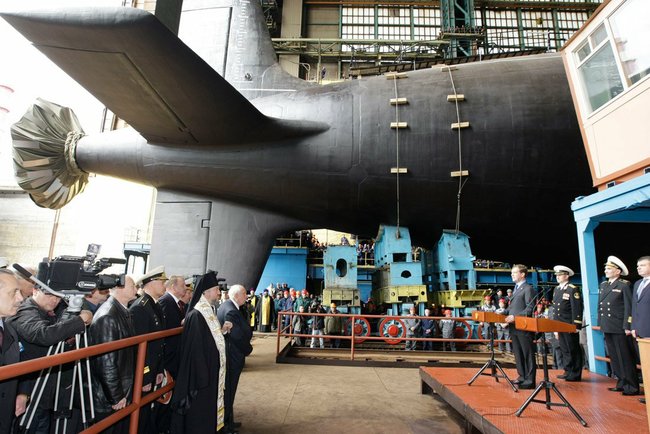
Yasen Rollout in June 2010

On Thursday, Argumenty nedeli published a short article citing a source claiming Russia’s specialty steel makers aren’t very interested in supplying metal for new submarines planned for the Navy.

Argumenty’s record is interesting.  Sometimes they go out on a limb and don’t quite get a story right; other times they nail it or catch the gist of what seems to be happening.  Can’t say which it is this time.  But the paper has a tradition of looking closely at different parts of defense industry.

The story maintains Sevmash is trying to scrape together the specialty steel needed for new boats, and is short of what it needs for Borey– and Yasen-class hulls.  The paper’s OPK source notes, of course, that those boats already launched were assembled from existing sections of older submarine classes.

The source concludes rather direly:

“If the issue of steel isn’t resolved, then you have to forget about further production of our missile-carrying submarines.”

He continues:

“. . . it’s unprofitable for suppliers to produce.  Their own cost is high, but the Defense Ministry is buying a miserly quantity and trying to drive down the price on the finished item and, accordingly, on the components.”

Argumenty ends its short piece by reminding readers about the conflict between the Defense Ministry and United Shipbuilding Corporation (OSK) on the one hand and Sevmash on the other over pricing and contracts which lasted most of 2011.

That year-long battle ended in mid-November when Prime Minister Putin supervised the signing of seven submarine contracts worth more than 280 billion rubles in Severodvinsk.  There aren’t precise details on what the deal covered except nuclear-powered submarines — the modernized proyekt 955 Borey and proyekt 885 Yasen (or 955A and Yasen-M).

If Argumenty’s story is accurate, it suggests future disputes over submarine production and profit margins for Sevmash’s sub-contractors and suppliers.  Perhaps Putin’s deal was only a temporary end to the government-industry conflict.

Medvedev Talks Bulava Acceptance

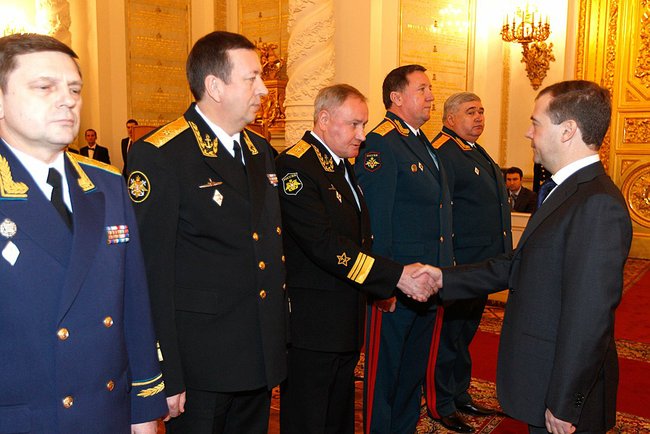
Medvedev Shakes Korolev's Hand

This post is admittedly as much about using a good photo and video as relaying something you haven’t heard.  But the visuals bring the subject to life a little.  At any rate, the lengthy Russian holiday season is upon us, so any post (even one with fluff) is better than none. 

Tuesday Russia’s lame duck President and Supreme CINC Dmitriy Medvedev greeted a group of military men — Armed Forces, MVD, FSB, SVR, and MChS officers — in the Grand Kremlin Palace’s St. George’s Hall to congratulate them on their new command positions or promotions to higher ranks.

Shown above are (from right) Southern MD Commander Aleksandr Galkin, Central MD Commander Vladimir Chirkin, Northern Fleet Commander Vladimir Korolev, Black Sea Fleet Commander Aleksandr Fedotenkov, and VVKO Commander Oleg Ostapenko.

Galkin and Chirkin are apparently there to mark their elevation to three-star general-colonel rank, while the latter three are now at new posts.  And Ostapenko’s sporting a blue uniform.  Didn’t the ex-Space Troops wear green reflecting their RVSN roots?

Kremlin.ru published some of Medvedev’s remarks to his senior officer audience:

“In recent years, we have modernized the Armed Forces in the most substantial way, optimized the structure and manning of the army and navy, improved the combat command and control system, and strengthened the strategic nuclear deterrent forces.  From 1 December of this year, new troops –Aerospace Defense Troops began combat duty, and in November a new radar station for monitoring air space in the western direction was brought into operation.”

“The army and navy have to resolve an entire series of missions relative to supporting the national development strategy and, accordingly, military organizational development during the period of the coming 10 years.  One of the most important goals is the technical reequipping of troops.  Our key priority remains further reequipping of the troops, and weapons and equipment of the most modern and next generation.  And of course, this task also demands the preparation of specialists, demands the preparation of personnel who will be fully capable of using this equipment as intended.  Therefore, it is important to guarantee the proper level of professional knowledge in cadets and young officers.”

“We are continuing the improvement of our armament, and our equipment.  In this context, I would like to note specifically that despite the problems currently remaining in the missile-space sector, nevertheless, we have just made a very important step:  we completed the flight testing cycle of a naval strategic nuclear forces system, I have ‘Bulava’ in mind.  This cycle, I remind you, was not simple, and went forward with certain problems.  Still our industry proved it can develop new, modern, and highly efficient types of strategic weapons.  One of them is the ‘Bulava’ system, which now, after all this testing, will be accepted into the arms inventory.”

Pervyy kanal covered the ceremony, showing Medvedev, three VVKO and/or Air Forces general-majors, a Bulava launch, and assorted siloviki, including Sergey Ivanov, Nikolay Patrushev, Rashid Nurgaliyev, and Aleksandr Bortnikov.

The first general-major wearing the blue uniform is Sergey Popov, late chief of air defense for VVS, now Commander of VVKO’s Air and Missile Defense Command.  The second couldn’t be identified by your author.  The third is Igor Makushev, Commander, 1st Air Forces and Air Defense Command (perhaps just the 1st Air Forces Command since the advent of VVKO).

But returning to Medvedev and Bulava . . . the Supreme CINC’s words unleashed minor euphoria about the SLBM’s imminent acceptance. 

For example, on December 28, RIA Novosti reported its highly-placed Defense Ministry source claimed a decision on accepting the Bulava-Borey weapons system is before the country’s political leadership.

But Medvedev didn’t say the missile is now ready to be accepted.  He just said it would be, and we already knew that.  Also, he never mentioned Borey-class SSBN Yuriy Dolgorukiy which must be accepted in tandem with Bulava for this strategic weapons system to achieve IOC.

Vedomosti’s Defense Ministry source was more on the mark saying Bulava “practice” launches could continue for some time. 

Going slow would seem to track with Defense Minister Serdyukov’s apparently unhurried approach toward Bulava at this point.  There have been reports that Dolgorukiy isn’t ready, and launches next spring and summer could come from Borey unit 2 Aleksandr Nevskiy by then.

At any rate, the Bulava program’s come a long way from the nadir of its December 2009 failure.  But this isn’t exactly the end of the road either.  Moscow still has to work out a reliable and well-controlled production run of some 128 missiles (and 768 warheads) plus spares.  Not to mention ramping up construction and completion of eight Borey-class boats.

Thank you for reading this meandering post, as well as others this year.  Your author wishes you a happy 2012.

С новым годом!

Dyachkov’s Interview

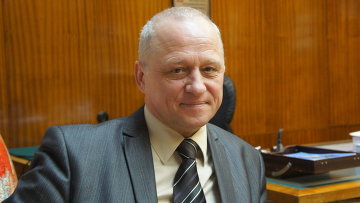
Andrey Dyachkov (photo: RIA Novosti / Sergey Safronov)

As General Director of both Sevmash and TsKB MT Rubin, Andrey Dyachkov’s a pretty significant individual when it comes to submarines.  What follows are highlights from his RIA Novosti interview last Friday.

Some blurbs have been published, but one frankly hasn’t had time to see if they captured the importance of what Dyachkov said.  Hence this summary.  It has less elegance (or perhaps fluff) than you may be accustomed to reading on these pages.

Dyachkov said the following:

  • Sevmash and the Defense Ministry signed a contract for the modernized Yasen, or Yasen-M this year.  It will be five units; Severodvinsk plus five.  Severodvinsk will be delivered next year; there were problems with some components obtained from suppliers and the Kalibr missile system needs to complete state testing.  About six months are needed for all this.
  • This year’s huge contract problems were a result of a changed Defense Ministry approach toward price formation Sevmash wasn’t ready for.  But times have changed, and Sevmash recognizes money has to be used more effectively, and ways have to be found to cut production expenditures.
  • Rubin has a contract to design the modernized proyekt 955, Borey, the Borey-A.  The contract should be signed by early 2012.  The lay-down of the first improved Borey will happen next year, and Saint Nikolay is still the working name for the first unit.  No word from the Sevmash chief on the final number of boats until after the contract is signed.  They’ve started laying down Saint Nikolay, but the official ceremony’s still to come.
  • Seventy percent of sub costs are reportedly to pay suppliers.  The main thing is getting them to reduce the cost of their products.  The Defense Ministry might even consider foreign component suppliers for some SSBN components.
  • Sevmash will take on construction of two diesel-electric proyekt 636 from Admiralty Wharves.  This will lighten the workload of the latter, and use excess capacity at the former.
  • Severnoye PKB has a contract to figure out how to modernize Kirov-class CGN Admiral Nakhimov (proyekt 1164, Orlan).  First and foremost, it needs new missiles (Kalibr and Oniks) to replace its Granit.  They are talking only about Nakhimov at this point.
  • Sevmash won’t be repairing CV Admiral Kuznetsov in 2012.  The shipyard is prepared to build a future carrier.
  • Modified Typhoon-class SSBN Dmitriy Donskoy will be kept active at the White Sea Naval Base for sub-on-sub trials of new boats.  Northern Fleet subs won’t be diverted for this task.
  • KB Malakhit has developed repair and modernization plans for the Akula-class (Proyekt 971, Bars).  Money’s been allocated and Zvezdochka will do the work. 
  • Russia may offer up the Amur-1650 diesel sub in next year’s Indian tender.  It could have air-independent propulsion, but Russia doesn’t seem really high on the idea.
  • They want to test Proyekt 677 Lada and its sonar in deeper waters next year.

Perhaps the Borey and Yasen mods reflect the problems of restarting construction that had been dormant (or at least very slow) for a long time and of using newly-made components rather than older ones.

Bulava Success

Interfaks and ITAR-TASS report Borey-class SSBN Yuriy Dolgorukiy successfully launched its third Bulava SLBM today, that’s the 17th overall test and the 10th success (including five in a row).

The earlier-reported launch window was missed due to bad weather, according to Flotprom.ru.

ITAR-TASS quoted the VPK this week regarding Borey unit 2 Aleksandr Nevskiy.  The VPK says Nevskiy won’t fire a Bulava before the summer of 2012.  After finishing its factory underway testing (ZKhI or ЗХИ) and several successful single Bulava launches, Nevskiy might be accepted into service by the end of 2012, according to the VPK.

Nevskiy’s now on a two-week phase of ZKhI and will be back in Severodvinsk by early December to rectify any problems identified.  ITAR-TASS says underway testing will continue as the weather permits.

Rossiyskaya gazeta Wednesday also noted that Nevskiy’s schedule has moved to the right, and it can’t be accepted until 2012.  RG covered how the first two Boreys used unused proyekt 971 Akula components, but some are talking about Borey unit three Vladimir Monomakh as a “modernized variant” and its builders will no longer be forced to stuff their “new contents” into a “different” hull.  Others have cited the lack of leftover parts as a problem that will increase the cost and difficulty of building the third new SSBN.

The paper says Nevskiy’s crew trained at Obninsk, and also aboard Dolgorukiy.  Like Dolgorukiy, Nevskiy will head for the Pacific Fleet, according to RG.  OSK and the Defense Ministry remain in difficult negotiations over the Borey’s reported 23-billion-ruble price tag.

Updating a related story, ITAR-TASS says new Yasen-class SSN Severodvinsk is now in its second underway period.  Its first (September until early October) was deemed successful; 80 percent of tasks were completed and only minor problems identified.

Worth recalling here that two Boreys, Bulava, and one Yasen were all on President Medvedev’s list of weapons systems to be procured in GOZ-2010.

Bulava Launch Plans

This week Izvestiya reported on coming launches of the Bulava SLBM.  The paper’s sources say the military and industry want two single test firings before trying a salvo launch test.  They suggest Bulava’s early problems were due to testbed Dmitriy Donskoy.  They also report complaints about the new Borey-class SSBN Yuriy Dolgorukiy.

A Navy staff source tells Izvestiya two single Bulava launches are planned before a salvo launch of three [not two as previously reported] missiles is attempted.  An industry source confirms this plan, and adds that Bulava testing is on schedule.

The industry source says Bulavas produced more than two years ago – before the military leadership ordered production inspections – will be used in the test launches.  A specialist tells Izvestiya mod Typhoon-class SSBN Dmitriy Donskoy is now viewed more often as the problem in Bulava’s early failures than the missile itself.

The Navy staff source says:

“It was initially planned to conduct the salvo of three missiles in an October launch.  However, they refused this idea at the last moment to check all the missile’s and boat’s systems again.  It’s possible the December salvo will be put off to 2012 if any bugs are observed during the two launches.”

Commentator Konstantin Sivkov told Izvestiya the military and industry delayed the salvo test because of uncertainty about the missile system’s reliability:

“Water disturbance from the preceding missile plays a big role in a salvo launch.  Unstable water could knock the missile off during its exit.  Therefore, all systems have to work perfectly.  And there’s the ‘Yars’ accident in Plesetsk which sowed some doubts.  Only successful launches can dispel them.”

The launch window for Yuriy Dolgorukiy is October 20-22.  According to Izvestiya’s interlocutor, the success of all Dolgorukiy launches supports suspicions that Donskoy might be to blame. 

This seems somewhat flawed logically if the Bulavas themselves were assembled and inspected differently . . . unless they never found any real problem with the missiles.

If the October launch is successful, Izvestiya reports the next will be November 18-19 and the salvo launch of three missiles will be in December.  Success in the latter would finally confirm that the Bulava is ready for combat duty, and the Bulava / Borey weapons system could be accepted.

But Izvestiya also reports the Borey’s radioelectronic, hydraulic, and hydroacoustic [sonar] systems still don’t satisfy the Defense Ministry.  The command and control systems aren’t properly configured yet either.  In short, the SSBN hasn’t fully completed its development. 

And it’s certain the lack of an agreed purchase price and a contract isn’t helping this process.

Difficult Course to a Grand Fleet

Konstantin Bogdanov sees reason for pessimism when looking at the course ahead for rebuilding Russia’s fleet.  Writing in Friday’s Nezavisimoye voyennoye obozreniye, he says, despite an intention to spend 4.7 trillion rubles of the ten-year GPV on the Navy, there are technical challenges, clearly impractical schemes, and failures in what he calls the “organization-financial plan” ahead. 

Bogdanov provides us a handy review of the state of Russian shipbuilding.

He points first to OSK’s insistence on seeing new aircraft carriers (with nuclear-powered destroyers in their battle groups) on the Russian Navy’s horizon.  But Defense Minister Serdyukov has only a cold rebuff for the idea.  Early R&D into what a new carrier might look like is as far as he’s being willing to go.  It was made pretty clear that a carrier isn’t part of this GPV.

Bogdanov says OSK may be looking for work for the New-Admiralty Wharves it sees on Kotlin Island in the future.  The 30- to 60-billion-ruble shipyard could be ready in 2016.  An aircraft carrier project would help launch this idea.

Then Bogdanov turns to the Navy’s more immediate needs — frigates and corvettes.  

Proyekt 22350 frigates are needed by tens, if not 30, or even 40, of them.  But Northern Wharf is having trouble building them.  Lead unit Admiral of the Fleet of the Soviet Union Gorshkov was five years in construction, and its underway testing isn’t complete.  Fleet Admiral Kasatonov was laid down just about two years ago.  Its SAM system, Poliment-Redut with 9M96 missiles isn’t ready, and will have to be fitted right to finished frigates.  But Bogdanov sees the frigates’ VLS — the Multipurpose Ship Fire System (UKSK or УКСК) as a positive step.  It could fire antiship, antisubmarine, land-attack cruise missiles, torpedoes, and possibly SAMs.

When proyekt 22350 didn’t come along quickly, Bogdanov says, the Navy went for its own proyekt 11356M frigates like those being built for India.  But, he notes, Baltic Shipbuilding Plant “Yantar” in Kaliningrad isn’t having an easy time constructing them for its Indian and Russian customers.  There are delays in the Indian units, but Admiral Grigorovich and Admiral Essen have been laid down for Russia, and Admiral Makarov should join them soon.  The contract for a second batch of three was just signed.  They’re supposed to be “localized,” but may actually be more like the Indian versions.  They’re slightly cheaper than the proyekt 22350 at 10 billion vs. 16 billion rubles per ship.

Northern Wharf has the order for nine proyekt 20380 Steregushchiy-class corvettes (with the proyekt 22350 frigates this comes to more than 220 billion rubles).  Soobrazitelnyy (proyekt 20381) began sea trials this year, Boykiy was launched, Stoykiy is under construction, and Provornyy (proyekt 20385) was laid down.  Sovershennyy (proyekt 20380) remains under construction at Komsomolsk-na-Amure.  Bogdanov says the proyekt 20385 ships will have an eight-cell UKSK.

Bogdanov notes, however, that Northern Wharf’s production won’t be steady until its ownership issue is finally resolved.  If OSK takes over, this could have a good or bad effect on fulfilling defense orders, but the current financial questions around Northern Wharf are even worse.

Turning to submarines, Bogdanov believes the situation is more transparent, but there are still questions.

The SSBN picture is pretty clear.  Proyekt 955 Borey-class SSBNs finally have a missile that looks like it works.  Yuriy Dolgorukiy has fired it, and Aleksandr Nevskiy might this year.  Vladimir Monomakh is under construction, and they’re preparing production materials for Saint Nikolay.

The problem, he notes, is units 1 and 2 used sections and components of proyekt 971 and 949A submarines never built.  Units 3 and 4 will be built from scratch, and it’s too early to say how this will be reflected in their cost.  Bogdanov concludes another battle over inflated prices awaits, and there is, of course, still no 2011 contract with Sevmash.

It’s less clear with the multipurpose proyekt 885, Yasen-class, of which the Navy wants ten by 2020.  But these boats have been the focus of the Defense Ministry’s familiar complaint about unjustified price increases.  Unit 1 Severodvinsk was built from materials and resources on hand, and its rising price was frozen at 47 billion rubles in 2005.  The Defense Ministry says Sevmash wants 112 billion for unit 2 Kazan

Bogdanov thinks it’s hard to tell who’s justified here.  There is structural industrial inflation, and a higher costs could be the result of the frozen handover price on Severodvinsk.

Bogdanov mentions the thought given to cheaper attack boats like the Victor III or Akula, or proyekt 957 Kedr which never left the design phase.  The Yasen is intended to replace Soviet-era SSNs and SSGNs, but Bogdanov thinks it’s too complex and expensive to be built in the numbers Russia may need.  Twenty years ago the Russian Navy was planning for not less than 30 [sized of course against the U.S. fleet], and currently it has not more than 30 SSNs and SSGNs, and this is considered insufficient. 

Despite the uncertainty above, Bogdanov says one still hears talk about the need to develop a fifth generation submarine, but it’s unknown if there will be any development work on one.
 

GOZ War Winding Down?

Vedomosti’s Aleksey Nikolskiy sees a possible end to the conflict between the Defense Ministry and industry over the production of strategic nuclear systems.  His OSK source claims a multiyear Defense Ministry contract with Sevmash for proyekt 955 Borey-class SSBNs will be concluded in the coming week.  This would reportedly leave OSK with just one contract remaining to be completed.

Conclusion of a 40-billion-ruble contract for three proyekt 11356M frigates was announced Wednesday.

Vedomosti’s source said the Defense Ministry and OSK also finished a deal for proyekt 885 Yasen-class SSNs several days ago.  The paper once again cites Konstantin Makiyenko’s 500 billion ruble price tag for the new SSBNs and SSNs.

An industry source tells Vedomosti that all MIT’s ballistic missile contracts are complete.

While deals for renovating Russia’s strategic forces are apparently done at last, not all contracts for conventional armaments are finished, particularly those involving Rostekhnologii and its enterprises, according to the director of one of them.

What’s this mean?

The conclusion of submarine / SLBM / ICBM production contracts would be a relief to both sides since their absence has been the biggest GOZ news story.  If all this is done, or almost done, one would expect a major government or Defense Ministry press announcement soon.

If the submarine deals are worth 500 billion rubles, that is, once again, apparently closer to Defense Minister Serdyukov’s price than to OSK’s.

The proyekt 11356M frigates are updated Krivaks (or Talwars for India), and they aren’t exactly cheap.

The issue of incomplete contracts with Rostekhnologii’s enterprises is significant given the size and breadth of their work on weapons and military equipment.  People will ask which enterprises and systems are in question.  It also contradicts Serdyukov’s recent claims that only OSK deals needed to be inked, and implies there are lingering problems and issues in areas other than shipbuilding.

The GOZ Last Week (Part I)

Let’s start with the news.  In short, Defense Minister Serdyukov told the press all GOZ-2011 contracts, except ones with OSK, were signed.  But most news outlets concluded he failed to meet Prime Minister Putin’s August 31 deadline for finishing the contracting process.

ITAR-TASS reported the Defense Ministry signed its fourth contract with OSK on August 29.  It was with Baltic Shipbuilding Factory “Yantar” for three Proyekt 11356M frigates.  Kommersant reported others are with Admiralty for three Proyekt 636 diesel-electric submarines and with Zvezda Shipyard in the Far East for nuclear submarine (probably OSCAR II-class) repairs and modernization.

But the largest and most important contracts with Sevmash for Proyekt 955 Borey-class SSBN and Proyekt 885 Yasen-class SSN production are still not signed.  The contract is supposed to cover two of the former and one of the latter that are already (or almost) complete.  Kommersant says the contracting delay means a fourth 955 and second 885 won’t be laid down until sometime in 2012.

ITAR-TASS concluded there are still differences over pricing although there is progress in the negotiations.  The wire service writes that Sevmash refuses to make concessions taking below a minimum profitability level, while the Defense Ministry calls price increases unjustifiable, and says it will only pay for concrete items regardless of the producer’s profitability.

On September 1, ITAR-TASS reported Serdyukov’s announcement that, on the whole, the Prime Minister’s order to conclude all GOZ contracts had been fulfilled.  It provided some choppy, weaseling quotes from Serdyukov:

“We are reprogramming for other requirements – precision weapons mainly, aviation, air defense . . . some suppliers because of some obstacles can’t provide their products.  . . . now we’re making changes – on the order of 30 billion [rubles].  . . . in essence, this is a formality  . . . .  Essentially, we’ve been through the entire agreed part.  The signing itself occurred yesterday-day before yesterday.  Only the United Shipbuilding Corporation contract remains.  Perhaps that’s all.”

Kommersant added Serdyukov’s comment that:

“We, unfortunately, can’t accept the figures which industry gives us.  For the most part, they are simply unjustified.”

Kommersant’s sources maintain, in addition to OSK, contracting with OAK and MIT remains incomplete, and no one’s willing to guess when this still-difficult process will end.

On September 2, Kommersant’s source said part of MIT’s contracts are done, but it would be premature to say the process is complete.

ITAR-TASS added that Sevmash’s contract is now supposed to be signed in mid-September.  The factory reportedly will agree to current prices for its submarines in exchange for some kind of “coefficient” to offset their rising costs starting in 2013.  The wire service also claimed there are now 6 of 13 OSK contracts signed.  And it put the cost of a Borey-class SSBN at a somewhat hard-to-believe 23 billion rubles.  OAK and MIT sources also told ITAR-TASS their contracts aren’t complete.

Vedomosti cited Konstantin Makiyenko on long-term submarine production costing 500 billion rubles.  If that’s eight Borey– and eight Yasen-class boats, it’s a $17 billion contract, basically $1 billion per submarine.  Thirty billion rubles a boat is a lot closer to 23 billion than the 47 or 112 billion that Serdyukov complained about in July.

Despite indications to the contrary, one has to wonder if Serdyukov isn’t very slowly winning his battle with the OPK.  But ultimately, it’s hard to say before we see what gets delivered, when, and how good it is.

Bulava Success

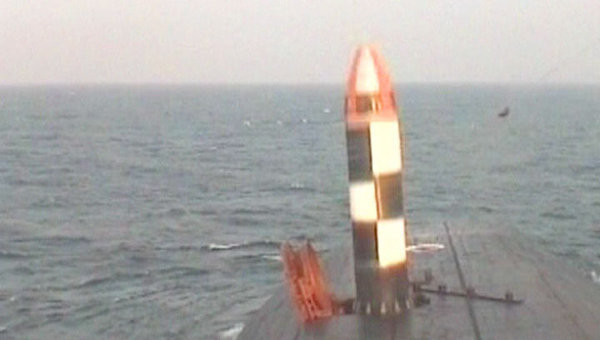
Bulava Launch (photo: RIA Novosti / Avrora)

Cheap post with a pretty picture thanks to RIA Novosti.  This was a maximum range test, from the White Sea to a target area in the Pacific Ocean.  It was the 16th test overall, and the second this year.  It makes nine announced successes out of 16.  And that’s four in a row.

If, as it appears, the designers and manufacturers have finally slicked the Bulava’s earlier problems, now Moscow will have to crank up the Bulava SLBM and Borey-class SSBN production lines.

That is a different kind of problem, a problem of the GOZ and the OPK.