Tag Archives: Mistral

Is the Helicopter Carrier Tender for Real?

Speaking in Yerevan today, Defense Minister Serdyukov told journalists:

“We have announced an international tender for construction of a helicopter-carrying ship.”

He indicated Russia is talking about two ships.  He also welcomed the French builders of the Mistral to join in the tender.

The tender will take place next month, and the winning bid will be selected before year’s end.

After months of negotiations with France on building Mistral-class amphibious assault ships, the Russians couldn’t reach agreement on the terms of a deal.

The two sides may have agreed on building two ships in France’s STX shipyard.  French President Sarkozy told its workers last month they’d be building two ships with the Russians.

Maybe the Russians wanted to buy one and build three, but Serdyukov says the international tender is for two ships, so it seems likely Paris and Moscow had agreed on a ‘2+2’ formula.  So something else is probably the sticking point.

RIA Novosti suggests talks with Paris stalled over its unwillingness to sell Moscow the NATO standard tactical communications system aboard Mistral, according to an unnamed expert who spoke to Ouest-France.

The expert said the comms system is tied to the SENIT 9 tactical combat information system.  It’s described as an important node NATO isn’t prepared to share with Russia.  The French expert says the Russians “don’t have a very good command of military computers and are trying to fill the gap.” 

Officially, the Elysee says negotiations with Russia continue, it’s confident of a successful outcome, and it isn’t worried about the Russian tender.  It hasn’t commented on participating in it either.  Meanwhile, the French media claims Moscow has stopped its exclusive talks with Paris.

Tender for Helicopter Carriers May Just Be Formality

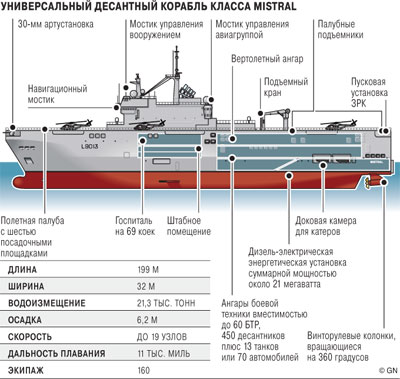
Mistral Schematic

Kommersant reports today that United Shipbuilding Corporation (OSK) has gotten the Defense Ministry’s permission to hold an open tender for procurement of helicopter carriers.  The paper concludes the Defense Ministry is refraining from a sole-source purchase of the French Mistral, and will consider similar proposals from OSK’s shipyards.  But the military [at least some military officials] haven’t hidden the fact that they prefer Mistral [but Defense Minister Serdyukov has always maintained they’ve been talking to other suppliers], so the tender could just be a formality. 

OSK President Roman Trotsenko says a special commission from the Ministry of Industry and Trade will conduct the tender, but details are sketchy.  A Defense Ministry source told Kommersant that, without a tender, a deal to buy a helicopter carrier [presumably Mistral] would be considered illegal.  So there won’t be a sole-source buy despite a year of government-to-government talks.

The paper reminds readers of OSK’s recent unsuccessful antimonopoly complaint in regard to the government’s consideration of Mistral.  Although the complaint was not reviewed, it must have had some impact on the decision to compete the helicopter carrier purchase.  Kommersant sources say OSK Board Chairman Igor Sechin also had something to do with it.

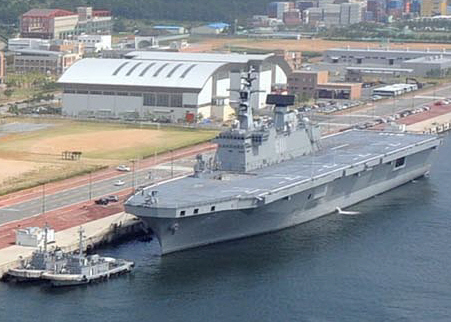
Trotsenko says far east shipbuilding plant ‘Zvezda,’ Petersburg’s ‘Admiralty Wharves,’ and Kaliningrad’s ‘Yantar’ will bid for the ships.  ‘Zvezda’ already has a joint venture in place with South Korea’s Daewoo – builder of the Dokdo helicopter carrier.  The OSK President says ‘Admiralty’ and ‘Yantar’ might work with ‘Northern’ shipyard or a foreign builder. 

Kommersant has a letter sent from Sechin to Prime Minister Putin this spring saying not only is Dokdo an alternative to Mistral, but Dutch and Spanish helicopter carriers are as well.

Trotsenko says OSK yards can build a helicopter carrier in 30 months for $500-700 million against a Mistral pricetag of €420-680 million.

Kommersant concludes the tender won’t end the conflict between OSK and the Defense Ministry.  Mistral will remain the latter’s priority.  The paper’s sources don’t know if the military wants to buy Mistral itself or place an order for a new unit in a French shipyard (STX).  OSK hasn’t been able to arrange a cooperative agreement with STX.

Mezhprombank-controlled ‘Northern’ and ‘Baltic’ shipyards will participate in the tender according to a representative of the bank. Kommersant’s sources think Mezhprombank, its owner Sergey Pugachev, and shipyards are the favorites among Russian contenders.  Pugachev was an early supporter of buying French, then building other units in his shipyards.  And, according to Kommersant, the Defense Ministry supports Pugachev.

Alongside Pugachev and Mezhprombank, OSK feels its chances to win the tender aren’t great.  Moscow Defense Brief analyst Mikhail Barabanov also says Mezhprombank yards are the favorites to build Mistral in Russia.  Such a deal’s been reached at a political level between Paris and Moscow, so the tender might just be a formality.  CAST’s Konstantin Makiyenko agrees.  But he thinks Mistral orders will go to ‘Baltic,’ since ‘Northern’ is loaded with frigate and corvette orders.  Meanwhile, OSK would like to buy both yards from Mezhprombank, but the sides haven’t reached agreement on a price.

Buy Two, Build Two

RIA Novosti reported yesterday that the purchase format for Mistral helicopter carriers hasn’t been determined, but a Russian Navy source says a ‘2+2’ variant is possible.

A highly-placed Navy Main Staff representative told the news agency that Russia could buy two and build two of the ships, and such a ‘2+2’ scheme is being discussed in negotiations in Paris.  

Initially, Moscow wanted to buy one and build three under license in Russian shipyards.  But French President Sarkozy mentioned a ‘2+2’ format earlier this year.

RIA Novosti’s source said the two Russian-made ships might be built at Sevmash, Baltic, Yantar, or Northern Wharf.

Pressing the French on Mistral

Vladimir Socor has a good piece describing Russian shipbuilders’ complaints to the Federal Antimonopoly Service (FAS) about the Mistral purchase as another way to press Paris to finalize the deal on Moscow’s terms.  Socor says: 

“In line with the Russian government’s tactics, [Deputy PM and OSK Board Chairman] Sechin is signaling that Moscow could turn to other international shipbuilders, or ultimately to Russian shipbuilders, if France does not sweeten the terms of the Mistral deal for Russia.” 

“Thus, Sechin’s subsidiaries [Yantar and Admiralty] ostensibly seek anti-monopoly action in a case handled by Sechin himself for the Russian government.” 

This points up the bizarre circumstance in which Sechin is negotiating with the French, while his OSK subsidiaries complain about the potential deal. 

But, as Interfaks wrote on Wednesday, FAS says it lacks jurisdiction over the complaint from Yantar and Admiralty.  FAS also says there’s no basis for a complaint since no deal for Mistral has been reached. 

The shipyards argue they’ve been excluded from bidding to build amphibious assault ships for the Navy, and the terms of the competition weren’t publicly announced.  Their complaint seems to have merit since, from the outset, the Defense Ministry went directly after a specific ship and supplier, without issuing general requirements for a ship class. 

According to Interfaks, OSK supports Yantar and Admiralty, and calls the Defense Ministry’s actions ‘obscure.’ Its representatives periodically speak of Mistral like a done deal, but how the deal will proceed remains unclear.  An OSK source says, “And every time such statements deliver a blow to the self-esteem of domestic shipbuilders who know how to make these ships.”  

And, as Socor notes, talks continue also with the Dutch and Spanish [as Defense Minister Serdyukov has always pointed out] and now the possibility of a deal with the South Koreans has been thrown in, further roiling the waters. 

Izvestiya yesterday said OSK President Roman Trotsenko sent a letter to Defense Minister Serdyukov proposing a review of the military’s plans to acquire Mistral.  In its place, Trotsenko suggests building the South Korean Dokdo under license in a Russian shipyard.  He says he can build it in three years, and more cheaply than Mistral by one-third.  OSK has a joint production agreement with Dokdo builder Daewoo. 

Dokdo

The Defense Ministry insists Russian builders demurred when asked if they could build these ships.  Izvestiya doubts Trotsenko’s offer is realistic given the lack of available Russian buildingways.  But the paper concludes the appearance of the letter shows the struggle for the amphibious carrier contract isn’t over.

Pulling Back on Buying Abroad?

Is the Defense Ministry pulling back the reins on efforts to purchase foreign-made weapons and other military equipment?

Late last month, armaments chief Vladimir Popovkin said that Moscow would put German armor on its combat vehicles, perhaps laying to rest rumors that Russia might buy entire vehicles abroad.

Last Thursday, Popovkin and others seemed to put limits on buying more UAVs from Israel, calling the process more of a learning experience to improve Russia’s domestic models.

Then Friday, the press says OSK may have started a formal antimonopoly complaint against Defense Ministry efforts to buy the French Mistral helicopter carrier.  But OSK Board Chairman, Deputy Prime Minister, and Putin confidant Igor Sechin is in charge of negotiating Mistral’s purchase from Paris.

It certainly seems that the reins have been pulled back on foreign procurement somewhat.  But there’s a lot to these threads and not enough time to run them down.

Shamanov’s Press Conference

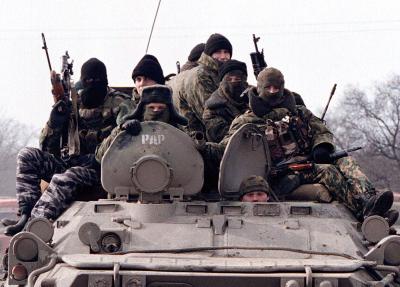
General-Lieutenant Shamanov

Ever-loquacious VDV Commander, General-Lieutenant Vladimir Shamanov held a wide-ranging press conference on Wednesday.  The Defense Ministry web site covered it hereITAR-TASS also published a number of short items on it. 

Shamanov detailed the work of five immediate deployment VDV battalions, lobbied again for a helicopter regiment, and discussed training issues and his procurement desires.  He joined the dogpile on top of the Russian OPK although he once seemed to defend it, and he credited Putin alone for the initiative to modernize the military’s arms and equipment.

He described his forces as combat ready, and manned and equipped at 100 percent.

Relative to combat readiness, Shamanov announced that the VDV has dedicated five battalions for immediate deployment which, if necessary, will be its first units sent into combat.  He said:

“By agreement with the General Staff, in the VDV we’ve dedicated five battalions for immediate deployment.  The uniqueness of service in these battalions is such that personnel from each of the battalions goes on leave for 45 days as a complete unit.  Therefore, at a minimum four battalions are always ready for combat deployment.  Today one of the sub-units of such a battalion from the 31st Airborne-Assault Brigade (Ulyanovsk) is fulfilling missions in Kyrgyzia [sic].”

Shamanov also gave voice to his desire, more modestly expressed than in April, for some aviation assets for VDV.  Speaking about the VDV’s future development, he said his troops must become airmobile.  To this end, he’s “given the Genshtab’s Main Operations Directorate [GOU] a request on the issue of forming a helicopter regiment in one of the three airborne-assault divisions [DShD or ДШД].”

Shamanov discussed VDV training at great length.  He started, of course, by speaking about jump training.  The parachute jump training plan was 70 percent fulfilled during the winter training period.  He blamed poor weather, saying troops often jumped in minus 30 degrees Celsius—the lowest acceptable temperature.  The plan for jumps from An-2 aircraft was fulfilled, but only 70 percent fulfilled from Il-76 aircraft.  He noted the VDV conducted its first-ever drop of a BMD-2 with its crew on-board, and said this hasn’t been done in 7 years, and then it was a BMD-1.  Use of the BMD-2 was significant, he said, because the BMD-2 represents 80 percent of VDV’s combat vehicle inventory.

Shamanov talked about large Spetsnaz assault group jump training in guided parachutes.  He said the use of guided parachutes allows reconnaissance troops to complete a horizontal flight of 20 kilometers, and:

“Our goal is to get so that such movements reach 40 kilometers, as they do in the Israeli Army.”

The VDV Commander noted that the multi-component Polet-K command and control system was tested for the first time in winter training.  He said: 

“It still isn’t the full suite envisioned in the future.  We are one-third through its introduction into the forces.  This process won’t happen in a year.”

Also for the first time, an artillery sub-unit of the 98th Airborne-Assault Division used Russian-made ‘Eleron’ UAVs for target designation on the Luga training grounds.  Shamanov said five ‘Eleron’ UAVs were employed in the training, and they conducted supplemental reconnaissance to a range of 10 kilometers in advance of fire missions.  This summer, 12 VDV crews will train on Israeli-made UAVs in Moscow Oblast.  Shamanov said:

“Unfortunately, our representatives did not go to Israel where they produce the ‘Hermes’ UAV which has been bought by Russia.”

Shamanov noted more attention to air defense training in the VDV this winter.  There were 40 firings of manportable ‘Strela-10’ and ‘Igla’ SAMs.

For the summer training period, Shamanov noted the VDV has 9,300 conscripts to get through three jumps in the course of 1.5 months.  The VDV will participate in ‘Vostok-2010’ and the CSTO’s ‘Cooperation-2010.’  There will be a VDV-level CSX (КШУ), as well as a CSX involving the 98th VDD (or ВДД).

Following the lessons of the Georgian war, the VDV is periodically training on the Navy’s large assault ships (BDK or БДК).  Shamanov says:

“In the winter training period we transported the 108th Regiment on large assault ships three times.  The exercises ended with a naval assault landing by a reinforced assault-landing battalion (ДШБ).

Last but not least, Shamanov commented on VDV procurement, and transport aircraft in particular:

“Work on the State Armaments Program for 2011-2020 is being completed.  According to our requests, in it there is the modernization of Il-76 aircraft, renewal of production and modernization of An-124 aircraft, the purchase of 30-40 An-70 aircraft.”

An-70

But the VDV Commander stressed these were his requests, and the final say isn’t his.  Utro.ru quoted him:

“In the development of the state [armaments] program, we gave our proposals, whether they’ll be realized in the confirmed version of the state program, I can’t say yet.”

Gzt.ru and Lenta.ru covered the An-70 and An-124 story in detail.

Shamanov said troop testing of the ‘Shakhin’ thermal sight for infantry weapons is complete.  He said:

“There has to be one approach for weapons—they have to be all-weather.  Not long ago the thermal sight ‘Shakhin’ went through troop testing.  After the testing we returned it to the designers for reworking.  We’ve given the task that our weapons work according to the aviation principle—turn your head and firing systems turn after it.”

He commented on air-dropping the BMD-4M, and added that, “The BMD-4M has every chance in the future, owing to its qualities, to be the forces’ main infantry combat vehicle.”

Although he seemed more like a supporter of Russian-made weapons six months ago, Shamanov now applauds Prime Minister Putin [not President Medvedev?] for searching for good weapons and equipment abroad.  Shamanov said the prospect of foreign competitors has forced “the domestic OPK to move,” as reported by Utro.ru.  He continued:

“Last year when industry was told that we’d look for alternatives abroad, they began to move.  In particular, the atmosphere around Mistral is creating a significant context for the domestic OPK.  When people declare that they’re ready to produce 21st century weapons but their equipment is from the 30s and 40s [of the 20th century], how can you talk about the 21st century?  Therefore, every official supports Vladimir Vladimirovich Putin’s initiative on the requirement to renew our armaments.  As long as this doesn’t happen, we’ll being shifting in place, and this won’t be just a lament of Yaroslav’s daughter [reference to the Prince Igor’s wife in the Lay of the Host of Igor after his defeat by the Turkic Polovtsy in 1185].”

At the same time, Shamanov concluded that GAZ and Izhevsk vehicles perform better for the VDV in the snow that equivalent Italian and Canadian ones.

Shamanov also said it’s essential to decide what to buy without any kind of lobbying, and for his part, he bases his decisions on saving soldiers’ lives and fulfilling missions.

Serdyukov on Mistral

Defense Minister Serdyukov today said Moscow still plans on acquiring four Mistral amphibious assault ships.  He said Russia is talking not just with France, but also Spain and the Netherlands, about Mistral

According to RIA Novosti, Serdyukov said:

“At present, we’re in pre-contract negotiations on this type of ship with three governments.  They are Spain, the Netherlands, and France.  We plan to sign a contract for four of these ships.”

He also said one ship would be completely foreign-made, but Russian shipbuilders would participate in building the other three.  And the fourth ship will be built, to the maximum extent, in Russia.  

Serdyukov reiterated that the Defense Ministry is working on this acquisition according to President Medvedev’s decision.  And the Defense Minister added: 

“We are now occupied with the issue very seriously.” 

He concluded that the issue of buying the ships will be resolved positively “if there aren’t any revisions, including in the financing question.”  And finally Serdyukov noted:

“We understand now that the Northern and Pacific Fleets need these ships.”

Meanwhile, Baltic Shipbuilding Plant ‘Yantar’ is trying to tout its proyekt 11711 large amphibious ship Ivan Gren as an alternative to buying or building foreign ships.  VPK.name published a version of this story based on an earlier Interfaks report.

Fifth Generation Helicopter

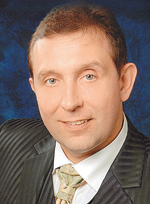
Andrey Shibitov

In a 13 May news conference, OAO Helicopters of Russia Executive Director Andrey Shibitov described the company’s work on a concept for a fifth generation helicopter.  His comments to the press came in advance of HeliRussia-2010 beginning today in Moscow. 

Shibitov said:

“We are actively working on the concept of a fifth generation combat helicopter.  Wind tunnel testing of two aerodynamic designs coaxial [Kamov] and traditional [Mil] has begun.  Initial results have been received.  Which of the two designs we’ll pick will become clear in the first quarter of 2011.”

According to Gzt.ru, Shibitov claimed OAO Helicopters is willing to invest $1 billion in its development, and is looking for state investment beyond that amount.

Neither OAO Helicopters nor the Defense Ministry is talking specifics about the new helicopter, but former VVS CINC Aleksandr Kornukov stated the obvious when he told Gzt.ru a fifth generation helicopter needs to be quiet and stealthy.  According to Newsru.com, Kornukov also stated a preference for two pilots in a side-by-side configuration.

In Gzt.ru, former army aviation commander, retired General-Colonel Vitaliy Pavlov said noise isn’t so significant since Mil’s X-shaped tail rotor already reduced noise on the Mi-28 by 15 percent (in comparison with its Mi-24 predecessor), but he added that reworking the engine could further reduce noise.  Pavlov doesn’t see great importance in increasing flight speed.  He sees the coaxial Kamov design as more reliable, but Mil’s traditional rotor system as more stable.  He also likes the maneuverability of Kamov’s helicopters, but he still thinks it’ll be a difficult choice between the two producers.

Also in Gzt.ru, Defense Ministry critic, retired General-Colonel Leonid Ivashov said the fifth generation helicopter could be stillborn:

“If there isn’t a state order for this aircraft, it will wither.  We’re grasping at all fifth generation aircraft, fifth generation helicopters, but for some reason none of this is coming to the troops, today we have helicopters from the 1970s in the army.  So the country’s leadership shouldn’t just rejoice at new equipment in various air shows, but also buy it for the troops.”

Then Ivashov’s deputy at the Academy of Geopolitical Problems, Konstantin Sivkov, takes over, citing his definition of a fifth generation helicopter—increased range, ‘fire and forget’ weapons, capability to engage fixed-wing aircraft, low radar detectability, and speed up to 500-600 km/h.  Sivkov sees noise reduction as secondary since radar can detect helicopters at a 150-200 km range.

Sivkov thinks, under favorable conditions—steady financing, cooperative work by the design bureaus and factories—a new helicopter could be developed in 5 years, but, absent those conditions, development could take 20 or 30 years.

Dmitriy Litovkin in Izvestiya covers a lot of the same information on the pre-design research and wind tunnel blowdown of the prototypes.  He says the so-called Ka-90’s ‘dual-contour’ jet engine could develop speeds over 800 km/h, and he cites a system development timeframe of 5-8 years.  According to him, work is focusing on canted blades with thrust vectoring as well as a new blade design.

He believes one of the designs will win out, but there could be a third hybrid design.  But he thinks there’s little time to waste since the U.S. is already testing new designs, albeit unsuccessfully thus far. 

Writing in Nezavisimoye voyennoye obozreniye, Viktor Litovkin notes three named prototypes–Mi-X1, Ka-90, and Ka-92. 

Shibitov also talked to the press about OAO Helicopters’ record state defense order from army aviation in 2010.  He said:

“A year ago I said it was a shame the Defense Minister wasn’t buying new helicopters.  Beginning this year, I can’t say this.  Finally conscious, sensible purchases of military equipment have begun.”

“We got a record order from the Defense Ministry for purchases of combat, strike, and reconnaissance helicopters in the basic and supplementary order.  Unfortunately, we can’t fulfill the supplementary order because other commercial projects are being completed.”

“From this year, we’re delivering volume for the Defense Ministry comparable with all export deliveries of combat and strike helicopters.  In the course of the coming five years this tempo will continue, and in the period to 2017-2020 the Russian Air Forces will renew its complement of combat, strike, and reconnaissance helicopters by 85-90 percent.”

Aviaport.ru indicated the armed forces will also receive their first Mi-35D, Mi-24D, and Ka-226T helicopters, previously produced only for foreign customers.  OAO Helicopters is reportedly looking at modernizing Ka-29 or Ka-32 helicopters for Mistral, but Ka-52 is another candidate for shipboard helicopter.

CAST’s Konstantin Makiyenko puts the armed forces helicopter inventory at 850, of which 90 percent is obsolete.  He estimates it’ll cost $8 billion to renew this force.

There is evidence of life in Russian military helicopter procurement.  Talking about the GOZ, President Medvedev said 30 would be bought this year, and Defense Minister Serdyukov claimed the army got 41 during 2009.  In late 2008, VVS CINC Zelin said the plan was to obtain 100 new helicopters over 4 years, so these numbers would be in that range.

German Armor

Serdyukov Wants Troops to Ride Inside

Reports about Russia looking abroad for light armored vehicles and not buying BTR-80s and BMP-3s in GVP 2011-2020 came into better focus this week . . .

On Tuesday Defense Minister Serdyukov announced Russia will buy armor for vehicles and light armored equipment from Germany.  In his meeting with representatives of public organizations, he said:

“The RF Defense Ministry will proceed from the need to guarantee the protection of personnel.”

“We have forced KamAZ and other Russian companies to enter into contacts with foreign firms.  They’ve already begun to make contact in order to buy light armor and use it in reconnaissance vehicles, BTRs, BMPs and other transport means.”

Kommersant talked to KamAZ officials who didn’t know anything about buying armor for vehicles abroad.

Serdyukov said, in particular, they were talking about purchasing light armor from one German company (reportedly Rheinmetall).

ITAR-TASS said Serdyukov was referring to poor protection of personnel inside Russian armored vehicles when he warned:

“We, of course, won’t buy Russian vehicles and armored equipment in the condition they are in.”

“We want Russian industry to produce what we need and what the times demand, so that they (OPK enterprises) will modernize their production and create quality equipment.”

In Stoletiye.ru, Sergey Ptichkin writes that Rostekhnologiya’s Sergey Chemezov and FSVTS’ Mikhail Dmitriyev have concluded that the purchase of foreign arms for the Russian Army is a ‘done deal’ at this point.  Dmitriyev said in particular that the political decision to buy Mistral has been made, and the contract will be signed this fall.

Ptichkin concludes:

“In connection with this, by all appearances, a large number of domestic military programs are being rolled up.  Billions are needed to support the import of ships and weapons.”

Chemezov also said, reluctantly, that Russian armor really doesn’t meet the Defense Ministry’s sharply increased requirements, therefore purchases from Germany are justified.  Ptichkin wonders what Rostekhnologiya’s [Chemezov’s] specialty steel holding will do if Germany supplies Russia’s defense industries.

Media sources alluded to past statements by Deputy Defense Minister, Chief of Armaments, Vladimir Popovkin to the effect that foreign purchases would only be to ‘patch holes’ in the Russian Army and OPK.  They imply that either arms imports have expanded beyond ‘hole patching,’ or the ‘holes’ are bigger than originally thought.

Nezavisimaya gazeta writes that buying armor abroad will be catastrophic for Russian metallurgy.  Without part of the GOZ, they reportedly won’t be able to modernize.  Uralsib metals analyst Nikolay Sosnovskiy said, without state orders, enterprises which still produce something won’t be able to survive.  He said buying foreign armor for BTRs and BMPs will lead to buying it for tanks, which is much more costly.  Sosnovskiy says armor orders were ‘second tier’ for the past 20 years, so no one was working on new types.  On the other hand, Aleksandr Khramchikhin thinks the competition posed by foreign armor will force the Russian industry to improve.

Despite this little uproar, it seems unlikely that the Defense Ministry or Russian government are suddenly ardent fans of free trade in all things.  Moscow’s economic management remains more paternalistic and state-directed than that.  Rather purchases abroad are probably viewed as the only way to:  (a) rearm Russian forces quickly with badly needed high-quality arms and equipment; and (b) shake the OPK enough to get it started on the road to competitiveness.

Second Half of General Staff Chief’s Interview

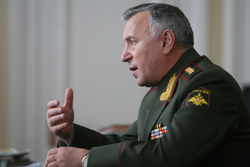
General Staff Chief Makarov (photo: Viktor Vasenin)

Rossiyskaya gazeta published the second, less substantial, half of Nikolay Makarov’s interview yesterday.

On speculation that the one-year conscription term will be raised, Makarov said:

“No one intends to increase the conscript service term.  But in the Defense Ministry they are thinking of measures to tighten accountability for evading military service.  Today no serious sanctions are applied against evaders.”

Regarding the supply of young men for the army:

“. . . after the transition to 12-month conscript service the callup increased about two times.  But from 2012 the complex demographic situation in the country will add to the problem of manning the armed forces.”

So this is why the military is thinking about clamping down on evasion, which Makarov puts at about 200,000 for all draft-age men.

Asked about measures to make the life of military school and institute cadets more like that of other students, Makarov said changes in the order of the day will have cadets go to classes and exercises in the mornings, and they will be free in the afternoons.  He continues:

“Why do we have to lock cadets in the barracks?  We understand if a person consciously picked the military profession, this means he will study.  If he’s not sure of his choice, he’ll simply get filtered out.”

Makarov indicated the Defense Ministry is looking at having its new state-owned rear services corporation Oboronservis supply militarized security guards for garrisons.  Privatized security companies would relieve servicemen of all guard duty functions and allow them to stop taking personnel away from combat training.  He cites U.S. and Israeli experience in using hired security for these purposes.

Makarov reaffirmed that only professional contract soldiers will serve in Abkhazia and South Ossetia.  He added:

“Even brigades in immediate proximity to the borders will be manned by professional soldiers to the greatest degree.”

That’s a lot of confidence to express in a professional contract service program that he’s deemed a failure.

Makarov indicated the ranks of generals have been trimmed from 1,200 to about 700, but he insisted all combined arms brigades with 3,000 personnel would be led by general-majors, not colonels.  He said generals had been cut in the Defense Ministry’s central apparatus, its main and central directorates, including the Genshtab, and the main commands of the services.  He concluded, “Now to become general, you need to serve with the troops.”

Makarov discussed the evolving training and promotion system for officers:

“Now a system has been built out where an officer after [commissioning] school can occupy at most a company commander position without supplementary training.  They can only be appointed higher through specialized courses.  Candidates for promotion need to complete them, take corresponding examinations.  And then they will pick the best on a competitive basis.  They will appoint them to higher positions.”

Under the old Soviet and Russian system, mid-career education and training didn’t usually come into play until an officer had commanded a battalion and was preparing to move into regimental command or staff positions.

Makarov said the new specialized courses might run 3 weeks for battalion chief of staff positions, or maybe several months for other positions.  He said the army would not be looking at keeping officers in certain posts for obligatory periods.  Some might master their duties in one year, others might not in five, he said.

Asked about whether Russia would accept French helicopter carrier Mistral as a ‘shell’ without weapons and electronics, Makarov said:

“The country’s leadership and the Defense Ministry have an absolutely clear position on this subject.  If a final decision on Mistral is made, then we’ll accept this ship only in a fully equipped form–with all command and control systems, navigation, and armaments.  The only exception is helicopters.  They will be ours.  Everything else must be done to their standards in full form.”

Asked whether the army would conduct reservist assemblies and even callup reservists for short periods, Makarov said no, conscripts are covering Russia’s manpower requirements, and reservist training assemblies would be kept at the level of about 10-15,000 men for the whole country.