Tag Archives: Nikolay Makarov

Makarov Talks to Duma Defense Committee

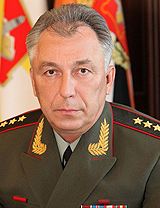
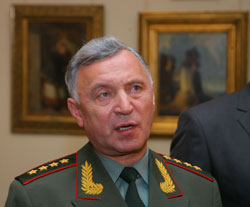
Nikolay Makarov (photo: Rossiyskaya gazeta)

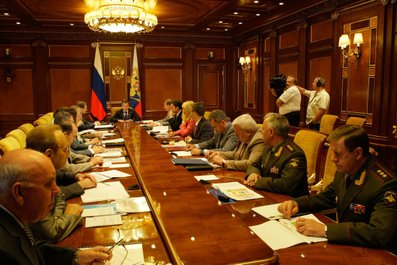
Last Thursday, General Staff Chief, Army General Nikolay Makarov spoke to a closed session of the Duma’s Defense Committee about the situation in the armed forces.  A few committee members were kind enough to inform the press about some of the discussion.

Rossiyskaya gazeta said it’s no secret the Defense Ministry wants more money in its 2011 budget.  And the generals’ arguments are well-known — the army needs to reequip, relocate, and raise officer pay.  Additional financial means are needed for this.  Makarov didn’t avoid this issue, and he had a lot of supporters.  Deputy committee chairman Yuriy Savenko had this to say on the issue of budget and rearmament:

“Today there isn’t just not enough money for this.  We have to recognize that our military industry has sagged a lot over the last two decades.”

Makarov apparently commented on Bulava, seeing the recent successful launch as opening the way for its quickest acceptance into the Navy arsenal.  But he said first it has to complete three [not two] more tests.  The next won’t come earlier than November, and the first from Yuriy Dolgorukiy possibly before year’s end.

The General Staff Chief talked about the country’s new military-administrative divisions, claiming the reduction to 4 MDs isn’t causing major troop relocations, but rather allowing the army to stand-up additional combined arms, reconnaissance, and airborne brigades on its strategic axes.

He apparently mentioned the introduction of information management systems into the troops is a priority.

Nezavisimaya gazeta’s Viktor Litovkin reports Makarov said Russia will hold just one operational-strategic exercise, Tsentr-2011, next year, and, after it, the focus will be on tactical platoon and company exercises.  Litovkin says the issue isn’t money, but the time it takes to train units from platoon to brigade in what they need to demonstrate in a big exercise.  And training time is too short with one-year soldiers.  He reports the army’s decided to put all officers from new lieutenants to generals through tactical retraining and improvement courses.

KPRF Deputy, Vladimir Komoyedov — former Black Sea Fleet commander — commented a little on what he heard.  He said Makarov mainly touted what’s been achieved the last two years.  Komoyedov said he heard about conventional forces, but not much about strategic ones, and when he asked specifically about naval strategic forces, Makarov’s answer didn’t satisfy him.  Komoyedov spoke to Tverskaya, 13, but he quickly spun off into his own commentary, rather than Makarov’s.

Perhaps the most press went to Makarov’s announcement that the Defense Ministry will go forward with military police units in the armed forces after all.  They’ll reportedly number about 20,000 personnel.  MP sub-units will be present from brigade to military district, and they could be manned by servicemen dismissed in the course of Serdyukov’s reforms.

Finally, Komsomolskaya pravda says Makarov has told it about various changes in the army coming in the next five years.  Some are not all together surprising, but there are new twists on others:

  1. A two-pipe Defense Ministry — military and civilian, with the latter handling money, personnel, and support.
  2. Hired cleaners, maintenance people, and security guards for the barracks.
  3. Military pay via bank cards to make it more difficult for older soldiers to extort money from new conscripts.
  4. Contractees will get 30-35 thousand rubles per month.
  5. Conscription will stay at one year (there are 156,000 men with deferments and 130,000 evaders).
  6. Specialty training time for soldiers needs to be cut from 6 to 2-3 months.
  7. Tsentr-2011 will occur, but other exercises will focus on the company-level and lower.
  8. There will be 8 aviation centers [bases?], but 4 would be ideal.  Air defense aviation will have 2 months on duty, and 2 months at home.
  9. Glavkomaty of services and branches will be cut from 1,000 personnel to about 150 or 200.  Generals’ duties will go out to the new MDs.  All the ‘glavki’ will relocate into the Ground Troop headquarters on the Frunzenskaya embankment.
  10. The Genshtab will keep its hands on strategic submarines, bombers, and the RVSN.
  11. The VDV will not be cut, and will continue to report through the Genshtab.  They are likely to be reinforced with new brigades.
  12. The Navy will get 1-2 nuclear-powered submarines each year.  New aircraft carriers are in development.  The fleet gets 23% of the defense budget, the RVSN 25%.
Collegium on MDs and Antiterrorism

Last Thursday, Defense Minister Serdyukov conducted an extramural ‘board of directors’ meeting in St. Petersburg.  The agenda had two publicized items — forming the new Western Military District (MD) and antiterrorism.

Deputy Defense Minister, General-Colonel Dmitriy Bulgakov (effectively chief of material-technical support) and acting commander of the new Western MD (ZVO or ЗВО), General-Colonel Arkadiy Bakhin reported on the new district.  Genshtab GOU Chief, General-Lieutenant Andrey Tretyak reported “On the Condition of Antiterrorist Work in the RF Armed Forces and Measures to Neutralize Terrorist Threats.”

In its coverage, ITAR-TASS noted that recommendations from forming the ZVO will be applied to the new Southern, Central, and Eastern MDs. 

After the collegium, General Staff Chief Nikolay Makarov told journalists that work on the ZVO was being closely analyzed, and all issues had been resolved in the main.  But its command doesn’t fully recognize the importance of its tasks, and its combat training demands higher quality work.  Makarov called this a consequence of the fact that, for 15 to 20 years, almost 85 percent of officers in command and control organs didn’t command troops. 

Of course, Makarov considers himself a ‘troop general’ and that 85 percent figure makes it easy for him to oversee cutting the officer corps by 50 percent.

Makarov said the terrorist attack near Buynaksk was being closely analyzed, and noted that commanders didn’t take measures necessary to protect their people.  But the tasks essential to countering terrorist threats have been identified.

Krasnaya zvezda reported that Serdyukov met human rights organization representatives during a break in the collegium.  More on this later.

The Military Elite

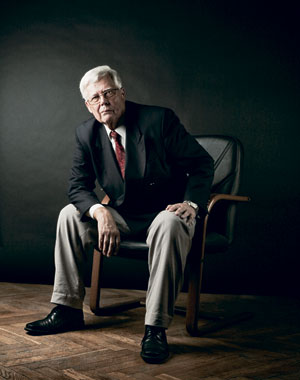
Vitaliy Shlykov (photo: Sergey Melikhov)

This is something sure to be overlooked, but it’s fun, interesting, and worth considering.

Every year Russkiy reporter selects its 100-person elite of Russia in various categories — artists, educators, journalists, doctors, businessmen, social activists, scholars, lawyers, bureaucrats, and military men.

The magazine touts its selections as people the country needs to know and listen to.  It calls them authoritative and influential people; they aren’t necessarily the most powerful or widely known.

It’s worth knowing who the magazine believes is influencing military thinking and men in uniform.  You read what many of them write on these very pages.  Picking only ten had to be hard.  One can think of dozens of others.

The article also has a short interview with one of the ten, Vitaliy ShlykovRusskiy reporter asked him what it means to be authoritative in the military, what society thinks of the military, and whether the military influences the authorities.  It’s worth reading.

Without further ado, the military elite are:

  • Makhmut Gareyev
  • Vladimir Dvorkin
  • Vladimir Shamanov
  • Vladimir Popovkin
  • Vitaliy Shlykov
  • Vladimir Bakin
  • Vladimir Boldyrev
  • Mikhail Pogosyan
  • Leonid Ivashov
  • Nikolay Makarov

Contract Service Not Quite Abandoned

In St. Petersburg Thursday, Anatoliy Serdyukov explained that the Defense Ministry is cutting the number of contractees due to a lack of funding:

“We don’t have the resources to maintain contractees in the amount we want, therefore a reduction in contractees and an increase in conscripts are occurring.”

He made the remarks in response to complaints about higher draft numbers in a meeting with human rights activists.  

Serdyukov said the transition to permanent combat readiness units requires the Defense Ministry to take a full draft contingent, meaning that an increased number of those with an unfulfilled military obligation are being conscripted. 

But he repeated past statements that the armed forces will drop by 134,000 at some point to a level of one million personnel.

According to Svpressa.ru, at the March Defense Ministry collegium Serdyukov admitted:

“We are not satisfied with the results of this [contract service] program.  We somewhat underestimated the situation in units – who should transfer to contract, on what conditions, with what kind of pay.”

RIA Novosti cited GOMU Chief Vasiliy Smirnov from the end of July when he said that contractees will man more than 100,000 soldier and sergeant billets in the Russian military.  This press item added Smirnov’s comments that contractees will be 20 percent of the armed forces, and currently number 210,000.  And money freed up by the reduction in contractees will go to increased pay for other unidentified servicemen.

Some of this reporting – especially Smirnov’s 100,000 and 20 percent figures – seems garbled, but it’s just that some key background’s been left out.  Let’s rebuild some context around last week’s statements, so they make more sense.

Looking back on what was said officially last winter, General Staff Chief Nikolay Makarov had a much harder edge on his pronouncements about the failure of contract service.  Serdyukov was much less categorical; he emphasized that contract service was being cut, not abandoned.

Makarov and Serdyukov offered different figures on contractees; the former said 190,000 and the latter 150,000.  And Smirnov said 210,000.  Recall all three figures probably included 79,000 or less recruited in the 2004-2007 program.

Serdyukov said first the contract service program will be cut – perhaps down to Smirnov’s 100,000 – then eventually expanded to 200,000 or 250,000.  In his March interview, even Makarov said ideally a motorized rifle brigade should have about 20 percent professional enlisted personnel. 

At Alabino in May, Serdyukov said contract service is being reworked.  The key thing is he’s yet to explain exactly how he’ll do it.  For the time being, he’s saying there’s no money for it, but it remains on the agenda.

For now, contractees will or may be cut to Smirnov’s 100,000 level, but if they expand back to 200,000 somehow in the future, they would be 20 percent of Serdyukov’s million-man army.  For now, they’re going to be 18 or 13 percent of the army, and drop maybe as low as 10 percent before increasing (maybe).

We should also recall Valentina Melnikova’s admonition not to believe Russian generals (or defense ministers) when they say they can’t afford a professional army.  They just have other priorities right now.

Makarov on Iran, Lasers, Deferments, and Bulava

Attending today’s OPK modernization meeting in Ramenskoye, General Staff Chief, Army General Nikolay Makarov talked to the press, and said:

“A decision not to supply Iran with the S-300 was made, it, of course, falls under the sanctions.  The leadership made a decision to stop the supply process, we are fulfilling it.”   

He wouldn’t say the contract to supply them has been broken.  Apparently asked if the missiles could be provided in the future, Makarov said:

“We’ll see, this will depend on Iran’s conduct.”

Unnamed official sources put the price of the Iranian S-300 contract at hundreds of millions of dollars.

ITAR-TASS reiterated Defense Minister Serdyukov’s 20 August comment on providing Iran the S-300:

“We aren’t supplying anything.  There’s no decision on supplying them.”

Makarov’s comments coincided with President Medvedev’s ukaz implementing UNSCR 1929 from 9 June.  The ukaz expressly listed the S-300 as an item not to be transferred from Russia to Iran. 

Asked about Russia’s military laser program, Army General Makarov said development is on-going:

“Work on a combat laser goes on throughout the world, including here.”

He added that it was premature to talk about the characteristics of Russia’s laser system.

Answering another question, Makarov said student draft deferments won’t be abolished:

“The possibility of ending deferments for students is not being considered.  This issue is too socially significant.”

“There are many other measures which will allow us to resolve the situation [with the draft].”

He added that he expects Serdyukov to talk about the draft at Friday’s Defense Ministry collegium.

Asked if compulsory military service will be increased from 12 months, he said, “I don’t know if there’s sense in this.”

But Makarov went on to vent his frustration about conscription:

“Today not more than 13 percent of young people are called up, the rest aren’t called up for health reasons.  We need to understand what is happening .  It can’t be that only 13 percent of our young people are healthy.  Among people getting a deferment or exemption from the army on health grounds, 40 percent of them had documents either purchased or manufactured in some way.  In other words, there’s an issue, and we need to toughen monitoring in this area.”

Thirteen percent is really low.  And the corruption rate when it comes to health exams in commissariats is at least 40 percent.  We need to explore his numbers and math.  These are startling figures.

Makarov paid a little respect to Serdyukov’s fledgling effort to ‘humanize’ conscript service:

“A number of measures to reduce the load on prospective conscripts are being reviewed.”

Finally, press questions turned to the pending Bulava SLBM tests.  Makarov said:

“The missiles which we’re preparing to launch were produced from beginning to end under strict monitoring by military acceptance, the Defense Ministry, and the Military-Industrial Commission.  A great deal will depend on these launches.  If the launches are unsuccessful, then we have to shake up fundamentally the entire cycle of missile production.”

On the timing of the next Bulava test, Makarov contradicted Serdyukov’s last statement by saying:

“It’s doubtful this will happen in September.”

Creating ‘New Profile’ Army Not Easy in Far East

A variety of press reports indicate establishing a ‘new profile’ army in the Far East is a difficult and increasingly protracted process.

On 7 September, ITAR-TASS said General Staff Chief, Army General Nikolay Makarov was in Chita to resolve a number of army problems.  The press service noted Makarov was accompanied by new Eastern Military District (MD) Commander, Vice-Admiral Konstantin Sidenko.

Specifically, Makarov was in eastern Siberia (now part of the Eastern MD) working on ‘military organizational development [строительство]’ – a Russian euphemism for TO&E changes and force restructuring – and development of base military towns and their social infrastructure.  In plain English, the General Staff Chief was in the Transbaykal sticks sorting out which units go into this or that brigade, or get disbanded, and how to provide housing and a modicum of other basic services for their soldiers, officers, and families.

But Makarov and Sidenko may have worse problems further east.

On 8 September, ITAR-TASS published a small, but significant report claiming that Khabarovsk Kray’s military garrisons and towns are not ready for winter.

Preparation for heating season in the majority of military buildings in Khabarovsk Kray is breaking down, according to the Kray’s emergency situations commission.  The poor state of preparation of communal infrastructure (i.e. boilers, coal supplies, steam pipes, etc.) and apartment blocks in Lazo, Bikin, and Vanino Rayons is alarming.

A Kray official said, “. . . supplies of winter fuel haven’t been established, boiler equipment hasn’t been repaired, facilities don’t have personnel.”  In Vanino, workers repairing a major boiler received layoff notices.  Days before the start of heating season, several boilers have been completely dismantled and there are no supplies of coal, according to the news agency.

 The emergency situations commission noted that:

“The Defense Ministry has begun transferring housing-communal servicing functions for its garrisons to private organizations, but this process has bogged down.”

The military’s Housing Management Directorate (KEU) representatives in the Far East didn’t deny the problems, but blamed them on a catastrophic lack of financing.  The military’s indebtedness to Far East communal services providers over the first 7 months of the year is 181.6 million rubles, and Khabarovsk Kray accounts for more than 88 million of this amount.

The first deputy chairman of the Khabarovsk Kray government has asked military prosecutors to intervene and force the army to prepare the region’s military towns and villages adequately and forestall emergency situations this winter.

All this comes on top of reports of similar problems last fall.  

Half of Russia’s 85 new army brigades had to move units and construct new barracks, housing, and other essential infrastructure for them, and this was proving especially difficult in the Far East. 

Almost a year ago, Vladivostok’s largest newspaper Zolotoy rog reported that officers in two newly organized brigades in the Far East were in danger of being stranded in ‘open fields,’ or field conditions, because they lacked materials and funding to prepare their garrisons.  However, the deputy commander of 5th Combined Arms Army assured the media that barracks and other buildings were being repaired for brigades at Barabash and Sibirtsevo.

Zolotoy rog reported that one battalion commander took out a private loan to repair barracks for his men.  Some officers who arrived at Barabash left after seeing the condition of their new garrison, and the brigade also had trouble keeping battalion commanders for the same reason.  The brigades reportedly turned to Primorskiy Kray’s governor for help.

So what are we to make of all this?

First, having Makarov travel out east to straighten up a mess is something of a no-confidence vote in new Eastern MD Commander Sidenko.  It’s a particularly inauspicious start since many eyes are on Sidenko to see how he performs as the first naval officer to lead this major ground-oriented command.

Second, Khabarovsk Kray had some pretty stark criticism for Defense Minister Serdyukov’s policy of privatizing logistics support functions for the army.  What might work in the new Western or Southern MDs may not work well in the remote reaches of the Eastern MD.

Third, this early warning of problems may be an attempt to prevent another ‘Steppe’ garrison crisis in Transbaykal this winter.  And the problems are not confined to active military garrisons.  Lots of remote former garrisons – with real living retirees – are caught in limbo between military and civilian municipal services.  Pereyaslavka’s problems last winter are just one case of this.  Pereyaslavka happens to be the administrative center of Lazo Rayon, cited this year as the scene of potential problems this winter.

So while the Defense Ministry and media focus almost exclusively on the attractive leading edge of the army’s ‘new profile,’ it pays to remember that Russian military reform has a large, messy trailing edge that’s found in places like Lazo, Bikin, Vanino, Barabash, Sibirtsevo, and Pereyaslavka.

Disappearing Deputy Defense Minister Portfolios

Or who will answer for what?

On Tuesday, Kommersant and Rossiyskaya gazeta described, even if they can’t explain, Deputy Defense Minister portfolio changes.  The shuffling began in early July, when Grigoriy Naginskiy was ‘freed’ from his responsibilities as Chief of Housing and Construction but remained a Deputy Defense Minister.

According to a decree known, but not published, Medvedev removed General-Colonel Dmitriy Bulgakov from his post as Chief of Rear Services, while retaining him as a Deputy Defense Minister without specific duties.  It’s widely believed, of course, Bulgakov has taken charge of a new Material-Technical Support (MTO) empire that will encompass not only logistics but also arms and equipment supplies.

For his part, Defense Ministry Apparatus Chief Mikhail Mokretsov formally became a Deputy Defense Minister (no longer holding just informal ‘Deputy Minister status’).

Kommersant points out there are still eight Deputy Ministers (six are civilians).  A Defense Ministry source told the paper, however, that Bulgakov might be civilianized.  And his MTO organization will be part of the Defense Ministry’s ‘civilian component’ as opposed to its ‘military component.’  Kommersant says the ‘military component’ (planning and operational troop command and control) will just be the General Staff when the current Defense Ministry reorganization is complete.

Bulgakov has apparently indicated that MTO will have a planning and coordination department, a resource and transportation support department, Main Automotive-Armor Directorate (GABTU), and also repair-refurbishment and metrological directorates.  As announced elsewhere, ten new MTO brigades are to be established in the four new OSKs.  Recall that, in the same presidential decree on Naginskiy, Bulgakov’s rear services chief of staff Sergey Zhirov became Chief of the Planning and Coordination Department (read staff).

One should really look at Mil.ru’s ‘Leadership Structure’ page here.  In it, you’ll see Vera Chistova retains her clear responsibility for finance-economic work.  Bulgakov’s biography notes he became simply Deputy Defense Minister in July.  Naginskiy’s contains no similar notation though it could.  Then comes the oft-forgotten Dmitriy Chushkin who followed Defense Minister Serdyukov from the Federal Tax Service in late 2008.  He has no portfolio spelled out in his title, but his bio reads:

“Responsible for forming and conducting the Defense Ministry’s united military-technical policy in the information and telecommunications technology area which aims to increase the effectiveness of the command and control system, as well as supporting and developing its foundations.”

Mokretsov’s bio has a note that he added Deputy Defense Minister to his title in July.

The ultimate plan behind these moves isn’t clear yet.  But it does seem to go back to late June’s replacement of Kolmakov with Popovkin in one of the Defense Ministry’s two First Deputy slots.  More support functions were and are being consolidated under civilians, while purely military training, planning, and operations may now be more solidly under General Staff Chief, First Deputy Defense Minister Nikolay Makarov.

Interim OSK Commanders Named

Late Thursday Interfaks learned that Defense Minister Anatoliy Serdyukov signed an order naming acting commanders of Russia’s four new military districts, or operational-strategic commands (OSKs).

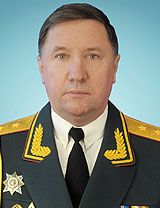
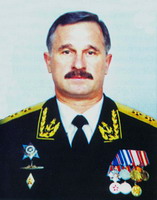
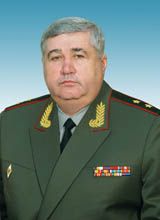
Volga-Ural MD Commander, General-Colonel Arkadiy Bakhin will be the interim commander of the new Western MD.  Siberian MD Commander, General-Lieutenant Vladimir Chirkin will temporarily head the new Central MD.  Pacific Fleet Commander, Admiral Konstantin Sidenko will command the new Far East MD for now.  And North Caucasus MD Commander, General-Lieutenant Aleksandr Galkin will head the the new Southern MD. 

General-Colonel Bakhin

General-Lieutenant Chirkin

Admiral Sidenko

General-Lieutenant Galkin

Serdyukov wants the new command and control scheme operating from the start of the new training year on 1 December.

Kommersant noted general surprise that a naval officer was picked to head the Far East MD.  Ground Troops generals have always commanded the army-dominated MDs.  But a Navy Main Staff source said Sidenko is not new to commanding army units; he once commanded the combined Navy-Ground Troops force on Kamchatka.

Kommersant also said extramural Defense Ministry collegiums will evaluate the effectiveness of these reorganizations before the end of the year.

Makarov’s Guys Take Key Posts

Bakhin, Chirkin, and Galkin prospered under General Staff Chief Nikolay Makarov when he was Siberian MD Commander from 2002-2007.  Each of them served as an army commander, deputy MD commander, and chief of staff, first deputy MD commander under Makarov in Siberia (or immediately after his departure for Moscow).  Chirkin served as Bakhin’s chief of staff, first deputy commander of the Volga-Ural MD, before becoming Siberian MD Commander this year.

Sidenko is a submariner, and most of his career has been in the Pacific Fleet.  His experience as ‘Commander of Troops and Forces in the North-East’ is, interestingly enough, a little similar to Makarov’s late 1990s time as ‘Commander of Ground and Coastal Troops, Deputy Commander of the Baltic Fleet for Ground and Coastal Troops.’

Medvedev Opens Discussion on Conscription Changes

Presidential Meeting on Conscription (photo: Kremlin.ru)

Talk of military conscription changes has swirled in recent months.  Many potential changes have been attributed to General Staff Chief Makarov or his deputy, GOMU Chief Vasiliy Smirnov.  

While they talked about extending the draft age to 30, or tightening deferments, Defense Minister Serdyukov played ‘good cop,’ launching initiatives to ‘humanize’ military service, and make more men willing to serve.

In the last week, the press has published favorable reports on the just-concluded spring draft campaign.  But, meeting with PA officials and ministers in Gorki yesterday, President Medvedev sounded a different note, indicating that a deeper look at Russia’s military manpower resources and policies is needed. 

The meeting included relevant ministers, but not Prime Minister Putin.  Along with Makarov and Smirnov, Defense Minister Serdyukov and ROSTO / DOSAAF Chief Sergey Mayev attended.  Smirnov appears in uniform (bottom right of the picture), though it’s been thought he retired and put on civilian clothes.  He’s already 60, so he’s beyond the age limit for a general-colonel.  He’s served in the General Staff since 1982.  He was a GOMU directorate chief in the mid-1990s, then Deputy Chief, and Chief since August 2002.  Few Russian military officials should know their issues as well as Smirnov.

The key points in Medvedev’s meeting kickoff are that (a) Armed Forces’ manpower requirements are not being met; (b) no decisions on conscription changes have yet been taken; and (c) the public is supposed to get at least some kind of input on the issue.

Kremlin.ru’s coverage of the beginning of the meeting follows.

“Dmitriy Medvedev spoke of the need to conduct a rigorous analysis of the situation with military conscription and draw up proposals for its improvement.”

* * *

“D. MEDVEDEV:  Good day, colleagues!”

“We have an important issue for the life of our state — the issue of military conscription.  It’s clear that the overall effectiveness of the state, and ensuring security in the country depends on how we man our Armed Forces, and our law enforcement organs.”

“It’s clear that now there are complications:  army and navy requirements for conscripts are not being fully met.  This is connected to the demographic component, to demographic problems; this is connected to the health problems of young people.  All these issues have been discussed more than once both in meetings, and in the mass media.  We have to talk conceptually about what to do next.”

“There’s a range of proposals.  I want to say right off that all these proposals are still just proposals.  They need careful analysis.  Not a single one has any kind of preliminary approval, and we need to discuss them.”

“At first we’ll discuss them with the participation of the leadership of the Government, Presidential Administration, Armed Forces leaders, law enforcement structures, and special services.  Subsequent to such a type of decision all the same it needs to be discussed with the broader circle of society.  It’s essential to take public opinion into account in any case  because this concerns a sufficiently significant number of people in our country.”

General Staff Chief Makarov’s Press Conference

Sound bites from General Staff Chief Nikolay Makarov’s press conference today dribbled out one at a time, as usual.

Makarov told reporters President Medvedev signed a decree establishing four operational-strategic commands (OSK) to replace the existing military districts on 6 July, but the text hasn’t been published.  Makarov also said arrangements putting the OSKs in place would be complete on 1 December.

Makarov talked more about the new “unified system of material-technical support (MTO)” also apparently covered in Medvedev’s decree.

Rear Services Chief, Deputy Defense Minister, General-Colonel Dmitriy Bulgakov, as expected, will head the unified MTO system, and new First Deputy Defense Minister Vladimir Popovkin will supervise the new state armaments program, 2011-2020, as well as coordination with military industries. 

Makarov stressed uniting transportation and supply functions under Bulgakov:

“We had a disconnect when all transport for supplies of material means to the troops was at the disposal of the Deputy Defense Minister for Rear Services, but he didn’t have anything he needed to move with this transport.  The other Deputy Defense Minister, on the other hand, had armaments, but no means for transporting them to the troops.”

“This is very important because now the management of transportation and armaments is concentrated in the hands of one man.  The correctness of the decision was confirmed by the recently completed ‘Vostok-2010’ operational-strategic exercise in the Far East.”

 “Now one official serving as a Deputy Defense Minister heads a unified system of material-technical support which has united rear services and armaments.  He alone personally answer for both the transport of supplies of material-technical means, and for these means themselves.  Now one man answers for the state of affairs with armaments and for their supply to the troops, who will also now be responsible for that.”

The way Makarov puts it, Popovkin be on the hook for product quality:

“He will work with defense-industrial complex enterprises to control their production of armaments and military equipment for the Armed Forces.”

Popovkin’s old job of Chief of Armaments, Deputy Defense Minister will disappear most likely.

Makarov told reporters Russia plans to move to netcentric command and control by 2015, once it equips its troops with new C3 systems united in one information space.  Such systems are now scarce, but he says, they are working hard so to install digital equipment everywhere.  Makarov calls this the main renovation that he’s giving all structures and troops starting in the fall of this year.  He says Russia’s new command posts unite reconnaissance, target designation, and troops and weapons to execute combat missions in real time.

It’s interesting that RIA Novosti took time to explain that the netcentric concept is an American creation more than 10 years old, and one not loved by those used to strictly centralized command and control.

Makarov told the press the army will begin forming light brigades, which it currently doesn’t have, this year.  They’ll have light combat vehicles of some type.  While not providing details, Makarov emphasized that light brigades will be built around a standard vehicle, so that, as in Vostok-2010, a brigade can fly in and its personnel can marry up with their normal vehicles in their place of deployment. 

Answering a question, Makarov said Russia will buy more Il-78 tankers in GPV 2011-2020, but he didn’t specify a number.

Makarov announced an intention to equip all Russian combat aircraft with new targeting-navigation systems over the next three years.  He said the new equipment will increase the accuracy of air strikes and allow the Air Forces to “abandon the previous practice of area bombing.”  He said the new system was tried on a Su-24M2 during Vostok-2010.  Installation of the targeting equipment on the Su-24M2 began in 2007.  Makarov said the VVS has nearly 300 Su-24 of all variants, and naval aviation about 60.

Stoletiye.ru had an interesting observation on Makarov and efforts to streamline command and control in the Russian Army.  It said the move to 4 OSKs and other steps are intended to reduce duplication of officer responsibilities and make 2-3 officers responsible for the fulfillment of combat missions.  It quoted Makarov, “We’ve eliminated the system of spreading responsibility throughout the Defense Ministry.”