Tag Archives: OPK

Rastopshin on OPK’s Problems

In yesterday’s Vremya novostey, Mikhail Rastopshin recalled how President Medvedev reproached the OPK last year for lagging in the production of new types of weapons to rearm Russia’s military. Medvedev said, if Moscow’s enemies possess superior weapons, no strategy or tactics will help Russia.

Rastopshin asks why the rearmament tasks laid down in documents like the National Security Concept and Military Doctrine remain unfulfilled? These documents seem like they did nothing to slow the degradation of the OPK and the army.

Among other basic state documents, Rastopshin mentions the Federal Goal Program (FTsP or ФЦП) Reform and Development of the Defense-Industrial Complex (2002-2006), but it didn’t bring the desired results. The first Russian State Armaments Program for 1996-2005 (GPV-2005) was in ruins a year after it was adopted. The second, the GPV for 2001-2010 (GPV-2010), and the current GPV for 2007-2015 (GVP-2015) are coming to naught.

According to Rastopshin, this attests to an inability to forecast arms and equipment development tens year out. There’s not only a lag of technological generations in traditional armaments, but an absence of entire classes of new weapons based on different physical principles.

After the Georgian war, Medvedev apparently ordered Serdyukov to prepared proposals on outfitting the army with modern combat support equipment. This amounted to ‘reloading’ the GVP. One can suppose that serious proposals didn’t ensue since Medvedev had to return to this problem in late 2009.

Weapons from yesterday are not infrequently put forth as our modern armaments. But there’s no other place to get them since military science and design bureaus are in a steep decline. The insolvency of the domestic defense system can be followed in the munitions sector, which hasn’t produced artillery shells since 2005. Russia lacks war reserves of ammunition, and an army without munitions is no longer an army. The sector has been producing poor quality powder, making it likely that fragmentation shells won’t reach their targets and armor-piercing ones will lose their penetration capability.

Taken as a whole, the existing armaments development system can’t provide a high tempo of rearmament, nor quality which continues to drop in both domestic and export orders. Complaints from foreign buyers are increasing, but domestic complaints are concealed. The fall in quality places doubt over future weapons. And there’s a huge divergence between the army’s demand for new weapons and the OPK’s ability to provide them, according to Rastopshin.

The quality problem won’t be resolved because OPK management is so complicated. The OPK has been reformed 8 times in the past 15 years. The lack of quality restructuring at the top exacerbated problems at the bottom. Management could not bring order to NIIs, KBs, or factories, failure above gave birth to technical breakdowns below. Rastopshin says in today’s RF Government, the Department for OPK Industries has the same status as the Communal Services Department, a situation tantamount to simply ignoring the country’s defense capability.

The creation of industrial holdings was chosen as the path to improved OPK management. Uniting in these holdings enterprises that use old production equipment, lack sufficiently qualified personnel, have eliminated quality control, testing, standardization, and military acceptance offices cannot bring the desired results.  It results only in old weapons unsuited for combat in today’s conflicts.  Rastopshin recommends returning to a Ministry of Defense Industry [sounds a little like one more reform at the top that doesn’t influence the situation below].

Rastopshin sees a gulf between the army’s ‘new profile’ structure and supplying it with new arms.  For this reason, he says, the combat readiness of the new TO&E brigade with old armaments remains extremely low.

He points to NATO’s superiority in conventional arms to say that Russia couldn’t hold out two weeks.  Russia would have to resort not only to strategic, but also tactical nuclear weapons.  So Rastopshin concludes Russia needs to revisit the issue of producing nuclear-armed intermediate and shorter range missiles, and leaving the INF Treaty.  He sees Moscow as having little choice since it’s left choosing between conventional defeat or strategic nuclear conflict.

Rastopshin sums up, it’s time to stop giving the army old, ‘modernized’ weapons, the life cycle of which was long ago used up.  Medvedev himself has said this more than once.

Sadly, Rastopshin offers more criticism than solid answers (except for seeing an INF withdrawal as one path for Russia).  Science and applied science need to be improved as does personnel training for the OPK.  New requirements need to be put on the OPK.  He’d also like to see some of those who have reorganized the OPK punished for irresponsible actions that have damaged the country’s defense capability.
Golts Looks Under the Hood of PAK FA

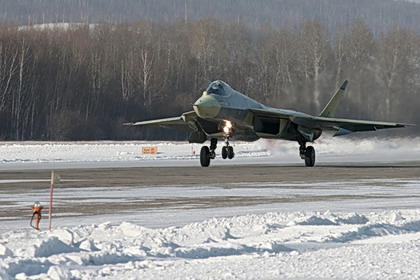
PAK FA in First Test Flight (photo: RIA Novosti)

In today’s Yezhednevnyy zhurnal, Aleksandr Golts turns his skeptical eye toward the PAK FA, Russia’s 5th generation fighter aircraft which just took its first test flight.

Golts says, looking a little like the F-22 and even more than the Su-27, PAK FA called forth a storm, a waterfall of success reports.  He notes that Prime Minister Putin cited it as proof of the wisdom of creating the United Aircraft-building Corporation [UAC or OAK] four years ago. 

Those in charge of the project are breathing easier.  After the Bulava SLBM failures, getting the new fighter off the ground was a matter of principle, especially since the leadership promised that it would fly every year since 2005.  Golts believes the Bulava failures combined with the 5th gen fighter delays caused people to discuss whether Russia could modernize, and whether it could develop high-tech products.  One thing Bulava and PAK FA have in common is that both are truly Russian projects, ones that are being implemented without dependence on significant leftover Soviet-era resources.  Their results could enable observers to question whether the OPK is being managed correctly, whether it was smart for Putin, [Sergey] Ivanov, and Chemezov to herd hundreds of enterprises into several gigantic OPK kolkhozy. 

Golts says some aviation industry leaders worried that OAK was created, not to concentrate resources to build PAK FA, but for Moscow bureaucrats to get their hands on profits from foreign aircraft orders [doesn’t ROE do this already?].  And Golts reminds that around 2000 then-Minister of Industry Ilya Klebanov said PAK FA development would cost $1.5 billion, but as we’ve learned the pricetag was closer to $10 billion over ten years. 

And it had to fly no matter what, and so it did.  But what actually flew, Golts asks.  One thing for sure, the first new airframe in 25 years.  And that’s it.  Everything else–speed, max and min ceilings, radars, weapons systems–all remain to be seen. 

As for the engines, Golts says we just don’t know.  Years ago the engine producers fought it out to be the designer and builder.  NPO ‘Saturn’ won out.  And, according to Golts, its director started to lie.  Putin and Ivanov both recognize that the engine problems will take some time to work out.  But on the day of PAK FA’s first test, the managing director of ‘Saturn,’ who directs the PAK FA program for the United Engine-building Corporation [ODK], claimed the new fighter has the newest engine, not an improved version of the Su-35’s engine, as the press and specialists have written. 

So what Putin and Ivanov worried about was secretly resolved by NPO ‘Saturn’ and the new engine is ready.  This is great news for Air Forces CINC Zelin.  Just four months ago he said that the PAK FA engine couldn’t be foreseen in the near future.  He said it would fly with a ‘Saturn’ engine, the 117S, a ‘deeply modernized’ version of the AL-31F. 

So, according to Golts, either ‘Saturn’ decided to pawn off on the Motherland an engine it demonstrated four years ago or, worse, having pocketed the contract, it simply decided to put old engines in a new aircraft. 

Golts concludes honestly that he can’t say whether PAK FA will be a true 5th generation aircraft, but it has taken off in a thick fog of lies.  And here’s the distinction between it and Bulava; there’s no way to hide Bulava’s failures since the U.S. gets the telemetry and people in other countries can see evidence of an unsuccessful test launch.  There aren’t the same limits on lying about PAK FA. 

So PAK FA is a “cat in a sack.”  You can’t say much for sure about the cat, but don’t worry, it’s a 5th generation sack.

Putin’s Voronezh Trip and Military C3

It takes a while to digest the press devoted to Prime Minister Vladimir Putin’s 18 January trip to Voronezh and Sozvezdiye, or the state-owned communications conglomerate based on the Voronezh Scientific-Research Institute of Military Communications.  Sozvezdiye is the holding which encompasses 16 other enterprises involved in C3, radio, and electronics.

Watch this NTV coverage of Putin at Sozvezdiye.

Sozvezdiye had a big demo set up outside for Putin.  But as the video shows, Putin was wearing his supremely bored look.  Moskovskiy komsomolets picked up on this, noting that Putin gave a cursory look at everything, and inside the display tent, he apparently picked up the mic on a video link system and tried to use it, but the soldier on the other end couldn’t hear the Prime Minister.

The Voronezh trip was the latest in a series of meetings on the state of the OPK.  Putin started by stating the obvious, noting that C3I is a decisive factor in the combat capability of a modern army, and a precondition for the use of highly accurate weapons.  He said it’s difficult to imagine an effective transition to a modern organizational structure without the right C3.  He called C3 a key priority for defense and noted that significant budget money will be spent on them.

Putin proceeded to chide his C3 producer audience, saying that Russia can’t modernize what it’s got; it needs an entirely new generation of systems.  He said C3 producers suffered from poor leadership, organization, and coordination of efforts.  Finally, he had to admit that they basically ignored his 2000 presidential decree on development of a new C3 system.

Specifically, Putin said:

“…we need not only to conduct a fundamental modernization of existing complexes and systems.  We have to say plainly that they unfortunately have already aged greatly.  And become obsolete, and even their technical condition often leaves much to be desired.  Therefore our focus for the coming years is to give the troops new generation equipment, to take a qualitative step forward.  It is precisely on this that I ask you to focus.”

“Our enterprises have a good scientific-technical pool for resolving this task, we need to use it wisely.”

Noting that dozens of OPK organizations work on C3I, he said:

“I ask that you turn attention to precise coordination of their activity, and also concentrate on working out agreed approaches and requirements for product development.”

“Besides this, I would like to turn attention to this, to this time a number of decisions adopted earlier have not been carried out.  So, to the present day, a general designer for development of an automated C2 system for the armed forces has not been appointed.  An integrated structure which would develop and implement a unified scientific-technical policy in this sphere has not been formed.  A special comprehensive program which would allow us to concentrate resources, to reduce and to optimize, to increase the effectiveness of budget expenditures has not been developed.”

Find the text of Putin’s address here.

Different media outlets reached the same conclusion about Putin’s Sozvezdiye visit and whether his words can fix the OPK’s problems and increase the sluggish pace of military modernization.  Segodnya.ru concluded:

“…the fact that Vladimir Putin directly participates in the problem of modernizing the technical outfitting of the army and promises to give the troops new generation equipment in coming years, inspires some optimisim.  Although the sensation remains that loud pronouncements about modernization traditionally hang in the air.”

Writing in Nezavisimaya gazeta, Viktor Myasnikov called it Putin’s “latest attempt to mobilize the military-industrial complex to equip the armed forces with quality modern products.”  Making note of Putin’s exhortations to the C3 producers, Tribuna said, “We’d like to believe they heard him.”  Newsru.com summed it up simply, Putin demanded that they modernize C3, but how to do it is not clear to anyone.

What exactly did Putin order in 2000?  According to Denis Telmanov writing for Gzt.ru before the Voronezh visit, Putin ordered the development of the Unified Tactical Level Command and Control System [ЕСУ ТЗ or YeSU TZ]. 

What’s it supposed to do?  It is supposed to be a large part of a system tying the armed forces together in one modern C2 network, and enabling them operate in a netcentric fashion.  Several media items reported that the Defense Ministry believes YeSU TZ will provide 2 or 3 times the capability of its predecessor. 

Tribuna noted that the Russians have the individual pieces of equipment, bought with a considerable allocation of money, but they haven’t managed to pull them together into one, integrated and modern C2 system.  According to Segodnya.ru, experts believe only Russia’s strategic forces possess a functioning, albeit increasingly obsolete, C2 system.  The armed services and branches, MDs, fleets, and armies have local automated C2 that isn’t necessarily integrated or compatible with other commands.

At the operational-tactical (battalion-brigade) level, Russia has reportedly fallen 20 years behind Western armies in C2.

Testing of YeSU TZ began in 2006 and continues.  In December, troops at Alabino used the equipment in a battalion tactical exercise.  But Telmanov concludes the military is in no hurry to adopt the system because it’s problem plagued and has obsolete elements.  It’s also hard to integrate with the army’s old comms gear. 

Izvestiya on 20 January reported that the system may be too complex for soldiers and sergeants, but even for some officers.  Myasnikov noted that the equipment suffered a lot of breakdowns at Alabino. 

But Sozvezdiye denies the criticism, saying YeSU TZ is reliable and no more difficult to use than a mobile phone.

Nikolay Khorunzhiy writing in Vremya novostey had said back in November that the Akatsiya system was tested during Kavkaz-2009 but could not be fully employed because operator training was deficient.  Combat situation data had to be input by hand and orders sent out by voice radio, defeating the purpose of automation.  Myasnikov also wrote that Akatsiya isn’t working out.

A little nomenclature is in order here.  It’s difficult to square all the press, but it seems Akatsiya is a name for YeSU TZ, but it’s also known by the name Sozvezdiye, a little confusing since this is the C3 production conglomerate’s name as well.  Apparently, Akatsiya is either based on or relies on the Akveduk satellite radio [?] system as one of its component parts.  These in turn evolved out of Polet-K and Manevr before them.  A couple press pieces said one problem with the system is what was basically a radio comms enterprise was put in charge of the broader C2 system effort which required other expertise as well.

A few other issues from the Voronezh visit bear mentioning…

Many press items cited the 2008 five-day war with Georgia as putting attention on C3 weaknesses.  Vremya novostey recalled the image of a wounded 58th Army commander, the recently dismissed, Khrulev borrowing a satellite phone from a journalist to communicate with Moscow.  Several papers cited a Sozvezdiye deputy director saying the holding ‘got raked over the coals’ for South Ossetia and Abkhazia.  He noted that Georgian forces used Harris equipment from the U.S. and it was better than Russian analogues in a number of ways.

Regarding this technological lag, there’s some dispute.  Moskovskiy komsomolets indicated Putin was told “we’ve approached NATO standards” in computerized C2.  Izvestiya, however, cited an industry source saying that there’s no appreciable lag between Russian and U.S. and Israeli systems.

Nezavisimaya gazeta and Izvestiya tackled the cost issue.  First Deputy Sozvezdiye Director Vasiliy Borisov was widely quoted to the effect that equipping one brigade with the new C2 system will cost 8 billion rubles.  Nezavisimaya multiplied this by 85 ‘new profile’ brigades for a price of 680 billion rubles, or when higher echelons have to outfitted as well, the total cost is probably more like 1 trillion rubles, or the price of one complete year of the State Defense Order (GOZ).  Izvestiya quoted Borisov saying the price to outfit a company commander would be 150,000 rubles, and 50,000 for individual soldiers.  The paper concluded that the new equipment won’t be replacing mobile phones any time soon at these prices.

Nezavisimaya also noted that one can’t do C2 properly without the right navigation system, and GLONASS is not up to the job.  It cited 17 operational GLONASS satellites, but press services today noted that 18 are now functioning.  Still, not enough.  Nezavisimaya compares work on C2 to Bulava and GLONASS–other military programs that defense industry is having a hard time bringing to fruition.  Tribuna makes the same point that a fully functioning and reliable GLONASS system is a ‘sine qua non’ for effective C2.

You’ll Be Missed, Mr. Kanshin

Aleksandr Kanshin

Press reports yesterday and today say that Mr. Kanshin and his commission have been dropped from the composition of Russia’s Public Chamber (OP) in 2010.

Kanshin is the ex-zampolit and board chairman of the MEGAPIR empire–the National Association of Armed Forces Reserve Officer Organizations, who for several years chaired the OP’s Commission on the Affairs of Veterans, Servicemen, and Family Members.

Kanshin and his commission served as a loyal, but objective and critical, voice when it came to the Defense Ministry and its policies.  His loss, and especially the loss of the commission altogether, is quite a blow against independent information on what’s occurring inside the armed forces.  It means one less critic the Arbat military district will have to fend off.

It will be interesting to see who and why someone got rid of them.  Also, what will come of Kanshin; he’ll probably stay engaged on military and defense issues, but probably without the same kind of access and platform for his views.

Mr. Kanshin particularly followed premilitary fitness and training, manpower, conscription, ‘social protection’ issues, the OPK, and dedovshchina and hazing problems.  He frequently visited the MDs.

Leadership Looking at the OPK’s Problems

Since fall, Putin, Medvedev, and Serdyukov have focused on the problems of Russia’s defense-industrial complex (OPK) and whether it will be up to the job of rearming the armed forces by 2020.

At an OPK conference in Nizhniy Novgorod on 24 December, Serdyukov noted that the oblast has nearly 16 billion rubles worth of state contracts for arms and equipment.  Defense Ministry armaments chief Vladimir Popovkin said, however, that the region’s producers who fail to supply weapons on time will be subject to millions of rubles in fines.

Conference participants also discussed necessary measures to organize timely placement of tasks and financing with contractors.  In particular, the Defense and Finance Ministries are reportedly trying to make production advances available in January 2010 for next year’s contracts.

In Vremya novostey, some Nizhniy Novgorod producers gave their own views on their problems.  They call the state’s pricing policy one of their main problems.  Despite the government constant statements about an increasing State Defense Order (GOZ), defense enterprises are not being paid on time or fully.  The oblast’s production grew in 2009, but the Defense Ministry has not hurried to pay for it.  Advances range from 30-70 percent, but firms often wait a long time for the balance and may have to take out expensive loans in the interim.  The profitability of the region’s defense producers was low in 2009 in part because of higher prices for natural gas and electricity.  Enterprises shaved some personnel to improve their bottom lines.  They’ve asked for tenders in December, rather than in spring or summer for the 2010 GOZ, and for higher advance payments.  They say they cannot cut prices as the government has asked because they work within the real economy where inflation is a factor.

On 22 December, Putin discussed the 1.17 trillion ruble 2010 GOZ (8 percent higher than this year’s) with the government’s presidium.  He said the GOZ can’t “be limited only to modernization,” the forces need to receive “large shipments of modern equipment, not just individual samples.”  Putin noted the recent series of conferences on the OPK and said, “We’ll be seriously occupied with these problems.  However it’s already now obvious:  it’s necessary not simply to increase financing for the state defense order, that’s necessary itself, but it doesn’t solve all problems.  It’s necessary to seriously increase the demands for quality in production, reestablish effective cooperation links, to work on personnel support for the OPK.”  He also said long-term rearmament programs need to be formed and they need to be closely linked to the missions facing the armed forces.   Defense industry needs to make its technological development and modernization plans, conduct RDT&E and organize series production of equipment for the troops under these programs.  Putin promised to concentrate the work of the government’s Military-Industrial Commission (VPK), the Defense Ministry, and other core ministries on this in 2010.

On 18 December, Putin visited St. Petersburg to have a conference on shipbuilding.  He called for naval shipbuilding to develop a minimum 30-year plan of development.  He said there’s nothing wrong with buying foreign equipment if, in the future, Russian ships are built with 100 percent domestic materials and equipment.  He called on naval shipbuilding to have clear priorities and not shift between projects.  Writing in Nezavisimoye voyennoye obozreniye a week later, Vladimir Shcherbakov noted that Putin’s words don’t square with the government’s actions.  Shcherbakov doesn’t believe buying the French Mistral amphibious landing ship will do much to move Russian shipbuilding forward.  He contrasts the government’s willingness to send money to the Amur Shipbuilding Factory working on the Akula-class SSN Nerpa for lease to India and its inability to help save smaller shipyards like Avangard in Petrozavodsk from bankruptcy.  He suspects Mistral may be a special deal just for Mezhprombank’s United Industrial Corporation (OPK) and its shipyards.  Whereas Putin had praise for civilian shipbuilding, he criticized the quality of naval construction.  Putin called for military shipbuilding to reestablish its technological and production links among enterprises, but he didn’t say anything about the state’s United Shipbuilding Corporation (OSK) which is supposed to perform this function.  To Shcherbakov, the government, Defense Ministry, and Navy just aren’t prepared to provide proper financing and orders to shipbuilders.

On 12 December, TV Tsentr’s Postscriptum featured independent views on rearmament from Leonid Ivashov and Ruslan Pukhov.  They talked about the role of corruption in high prices for defense production.  Pukhov said, “Of course, there is monstrous corruption and ineffective management, which exists in an entire range of defense enterprises, and then this collusion between the purchasing authorities of the armed forces branches and services and military-industrial complex enterprises, when under the cover of secrecy a huge quantity of resources are doled out, and it is practically stolen.  In the opinion of many high officials and directors of the Defense Ministry, kickbacks often go up to 50 percent.”  Ivashov said, “There are many causes for high prices.  Which of them is first, I don’t know, however there is pervasive corruption, Putin recognized this, and Medvedev recognizes this, it exists and, it means a system of kickbacks exists.  And for a defense enterprise director or even a group of enterprises to receive a defense order, they openly demand a kickback, this raises the price.

On 9 December, Viktor Litovkin reviewed Putin’s recent activity on OPK issues, noting that his 8 December visit to Uralmashzavod and other Sverdlovsk Oblast enterprises was his third trip to OPK plants in two months.  He earlier visited missile producers in Kolomna, and liquid-fueled rocket engine maker Energomash in Khimki.  Litovkin noted that Russian tank production is now more important to India than Moscow.  In Nizhniy Tagil, Putin called for a unified plan of future design work for armored systems.  Putin said Uralvagonzavod would receive 10 billion rubles in early 2010 to establish and run armor “service centers” for the Defense Ministry, relieving troops of this noncore function.

In early December, Air Forces Commander-in-Chief indicated he is not happy with the development of Russia’s new S-500 air defense system.  He doesn’t want a continuation of the S-400, but a system to counter missiles in “near space.”  Sergey Ivanov once called for it to be a 5th generation anti-air, anti-missile or aerospace defense system.