Tag Archives: State Program of Armaments

Quoting Tolya

Tolya’s remarks to the press today made quite a few headlines, and left a few useful benchmarks for the future.  Defense Minister Serdyukov addressed procurement and manpower issues.  Here are his quotes from RIA Novosti and ITAR-TASS.

Tanks for Nothin’

“We met the designers who proposed their preliminary work to us.  60 percent of what was proposed is old work.  Therefore, we still declined these proposals.”

“Now it’s more expedient to modernize our country’s tank inventory than to buy new ones, for example the T-90.”

Cold Water on Carriers

“We have no plans to build aircraft carriers.”

“Only after this [a preliminary design of what this ship might look like], the Genshtab together with the Navy will make a decision on the need for such a ship.”

SSBNs Aren’t Automobiles

“‘Bulava’ flew, this is good news.  We understand precisely that it’s possible to launch serial production of the missile on this variant.”

“We got the result, now it’s possible to load SSBN ‘Yuriy Dolgorukiy’ with ‘Bulava.'”

“We’d like to do this [test Bulava from Aleksandr Nevskiy], but we understand that to plan this precisely is impossible.  A nuclear submarine isn’t an automobile.”

Bullish on Arms Deliveries

“Deliveries of strategic missiles ‘Topol-M,’ ‘Yars,’ ‘Avangard’ will increase three times, ‘Bulava’ and ‘Sineva’ missiles for strategic submarines one and a half times, aircraft four times, helicopters almost five times, air defense systems almost two and a half times [in 2011-2015 compared with 2006-2010].”

Not Going Below a Million Men

“There are no such plans, there are no questions of cutting manpower.  We’re striving for the entire army under the million number, and it isn’t planned to cut this figure.”

“On account of this [increasing contractees from 2014], we’ll manage without fail to get through the demographic hole which is anticipated in 2014.”

Two Arctic Brigades

“The Genshtab is now developing plans to establish two of these formations.  In the plans, deployment places, armaments, manning, and the infrastructure of these brigades need to be specified.”

“It’s possible this will be Murmansk, Arkhangelsk, or another place.”

Kicking the Defense Ministry and OPK

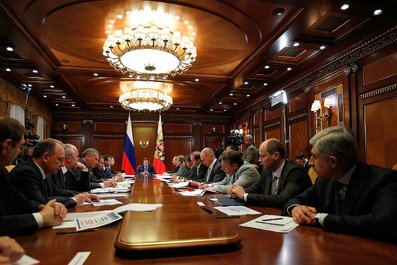
President's Meeting on the OPK

President Medvedev is irritated as ever that the Defense Ministry and OPK aren’t moving out smartly to rearm and reequip the Armed Forces.  He’s trying to kick them into gear, but can he get results where his predecessors either didn’t care or simply failed?

According to Kremlin.ru, Medvedev met this afternoon in Gorki with a host of government officials and industrial chiefs.  They included, inter alia, Sergey Ivanov, Anatoliy Serdyukov, Vladimir Popovkin, Nikolay Makarov, Denis Manturov, Yuriy Borisov, Sergey Chemezov, Sergey Nikulin, Mikhail Pogosyan, and Roman Trotsenko.

Medvedev’s opening monologue enumerated what’s been done for defense industry — providing a full state defense order and financial support, creating integrated development and production structures [OSK, OAK], etc..

Then the President says:

“However, despite all adopted measures, the state of defense production cannot be called good, all attending understand this.  There are objective reasons:  the deterioration of enterprises’ basic capital is nearly 70 percent (on average), in some enterprises it’s all much worse.  We still have not even managed to establish effective mechanisms to attract innovation and off-budget resources to the defense-industrial complex.”

Medvedev goes on to say that all relevant documents, including the GPV 2011-2020, have been signed, but the assembled group still needs to think about how to implement the GPV.  He reviews how he talked at the Defense Ministry Collegium in March about balancing producer and buyer interests, about justifiable and understandable prices.

But in many areas, says Medvedev, this has already become moot, and he intends to increase responsibility for the fulfillment of these obligations.

First, he wants a Federal Goal Program for OPK Development in 2011-2020.  Its focus is to be “real readiness” of the OPK to produce actual weapons and equipment.

Second, he wants the Defense Ministry to finish placing GOZ-2011 completely by the end of May, and advance payments issued to producers in accordance with the 2011 and 2012-2013 plans.

Work to date, he says, is going poorly and slowly.  He reminds the assembled that he told them about the failure of previous state armament programs:

“Today I want to hear from all present why this happened:  both from government leaders, and from industry leaders, who was punished for this and how.  Report proposals to me, if they still aren’t implemented, with positions, with the types of responsibility, completely concretely.  If such  proposals aren’t reported, it means [industrial] sector leaders and government leaders have to answer for it.”

It’s unacceptable, he says, that high-level decisions have been made, money allocated, but a product isn’t supplied.  He recalls his late 2009 Poslaniye in which he said 30 land- and sea-based ballistic missiles, 5 Iskander missile systems, nearly 300 armored vehicles, 30 helicopters, 28 combat aircraft, 3 nuclear submarines, one corvette, and 11 satellites would be delivered in 2010.  

Everyone here, says Medvedev, agreed with this, so why wasn’t it done.  He is, he says, waiting for an answer, and:

“. . . we have to answer for the duties we’ve taken on ourselves, we look simply in this sense absolutely unacceptable.”

Medvedev finishes by saying he knows military production is profitable, and it’s possible to attract strategic investors.  He says he wants to talk about how to stimulate investment.  The goal for the day is concrete reports on what’s been done on the level of those responsible for organizing work and correcting the situation in defense industry.

Where’s this leave things?

Not exactly throwing down the gauntlet, just another warning that he’s getting serious.  But it’s doubtful the government or defense industry will take Medvedev seriously until he fires a minister, other high-ranking official, or an important enterprise director.  And it’ll probably take more than a couple dismissals to get anyone’s attention.  Medvedev is running out of time on this account (as well as others).  Those he’d like to make responsible or punish will just take the tongue-lashings and wait him out.

Corruption and the GPV

This morning’s press included various accounts of statements from Igor Korotchenko or in the name of the Defense Ministry’s Public Council, on which Korotchenko serves, about mitigating the impact of corruption on the State Program of Armaments (GPV), 2011-2020.

RIA Novosti quoted Korotchenko to the effect that the rearmament program will only be successful with strict financial accounting and effective measures against corruption in the State Defense Order (GOZ or гособоронзаказ).

He said Defense Minister Serdyukov is taking steps to ensure that resources are used as intended, including the establishment of a Military Products Price Formation Department and the resubordination of the Federal Arms, Military, Special Equipment and Material Resources Supply Agency (Rosoboronpostavka) to the Defense Ministry.  But the latter step was done over six months ago, and not much has been heard about it since.

Novyye izvestiya and Novyy region quoted the Public Council’s statement:

“But for the army to receive all this [equipment in the GPV], money is simply not enough – it’s necessary to make things so that Defense Ministry generals, who to this point were occupied simultaneously with orders and purchases of weapons, don’t get access to money, are occupied only with formulating lists of everything needed for the conduct of modern war, but the function of monitoring prices and purchases should be transferred to other departments.  Otherwise, government resources allocated to the GPV will get ‘sawed off,’ placing this program in jeopardy.”

Those are, of course, the jobs of the new Price Formation Department and Rosoboronpostavka.  Serdyukov’s tax service veterans are supposed to free the payments system from graft, and use their experience to uncover complex theft schemes.  Military prosecutors are also expected to be more active here.  Main Military Prosecutor (GVP) Sergey Fridinskiy told Novyy region about prosecutors’ work in uncovering the theft of 6.5 billion rubles’ worth of military budget.  He claimed his prosecutors have stopped 240,000 violations, suspended 12,000 illegal actions, held 40,000 people to account, and returned 4 billion rubles to the treasury.  But it’s not clear what time period he’s talking about.

RIA Novosti recounted Korotchenko’s comments about preventing corruption in military RDT&E:

“Special control needs to be provided on scientific-research work and justification of expenditures on it, but also on the development of new types of armaments, since it’s precisely here that opportunities for different types of financial machinations and abuse exist.”

Of course, reminds RIA Novosti, RDT&E only amounts to 10 percent of the GPV.  Bigger chances for theft exist in procurement, which is supposed to be 78-80 percent of the rearmament plan.

According to Novyye izvestiya, on the procurement side, Korotchenko says, in past years, a minimum of 45-50 percent of money for arms simply ended up in someone’s pocket.  For this reason:

“For the very same money, Russia buys 14 tanks a year, and India 100.  This led the country’s leadership to the kind of thinking reflected in the Defense Minister’s authority to reorganize the entire purchasing scheme.  This time [the new GPV] 19 trillion rubles are at stake.  Can you imagine with what interest the ‘market players’ are waiting for them?  But the state machinery is running: many OPK directors are already being removed, in the case of the director of one of the system-forming design bureaus, suspected of stealing money from a state order through offshore shell companies, an investigation is being conducted, and other criminal cases in orders-purchases from previous years are also possible.”

The nongovernmental National Anticorruption Committee says the average kickback in civilian contracting is 30 percent, but, in defense, it’s 60 to 70 percent.  Because arms prices are secret [and hard to determine anyway], no one knows how much this is.  But common sense says this makes everything cost nearly twice what it should.

Popovkin Details the GPV

Yesterday First Deputy Defense Minister Vladimir Popovkin gave RIA Novosti more details on Russia’s procurement plans under the State Program of Armaments (GPV), 2011-2020.  He said 78-80 percent of the 19-trillion-ruble Armed Forces portion of the GPV will go to procurement.   

Popovkin said Russia plans to develop a new liquid-fueled heavy ICBM to carry up to ten warheads, and having a service life of up to 35 years.  Former RVSN Commander General-Lieutenant Andrey Shvaychenko talked about a new liquid heavy as far back as late 2009, and the issue’s been debated in the Russian military press since. 

Popovkin said the Defense Ministry plans to accept the Bulava SLBM and the first two Borey-class SSBNs this year.  There will be 4-5 Bulava launches this year.  Recall to date only 7 of 14 Bulava tests have been successful.  Addressing the missile’s past failures, Popovkin said there were many deviations from the design documentation during production.  He also said Russia plans to build eight SSBNs to carry Bulava by 2020.  He was unclear if this includes the first two Borey-class boats.

Popovkin said work on a new strategic bomber is ongoing, and he claimed a technical design will be complete in 2015.  He said this work isn’t being rushed.

Popovkin told RIA Novosti  the Air Forces will receive more than 600 new aircraft and 1,000 new helicopters by 2020.  In 2011, Su-27SM, Su-30M2, Su-35S, Yak-130, and Su-34 aircraft are to be procured.  More than 100 helicopters, including Mi-26 transports and Mi-28N and Ka-52 combat helicopters will be acquired this year, according to Popovkin. 

Popovkin said a contract for the first ten experimental PAK FA (T-50) aircraft will be signed in 2013, with serial production of 60 aircraft beginning in 2016.

The GPV includes the purchase of ten S-500 air defense systems.  Popovkin said this system will begin testing in 2015, initially with missiles from the S-400.  Fifty-six S-400 units will also be purchased by 2020.  This sounds like seven 8-launcher battalions.   

Popovkin said the GPV will buy 100 ships – including 20 submarines, 35 corvettes, and 15 frigates – for the Navy.  He didn’t specify types for the other 30 ships, and it’s unclear if new SSBNs are included in these numbers.  Popovkin reconfirmed Russia’s plan to buy two and build two Mistral amphibious ships.  Recall also the Black Sea Fleet alone is supposed to get 18 new ships including proyekt 636 diesel-electric submarines, proyekt 11356 and 22350 frigates, and proyekt 11711 LSTs.

Popovkin also mentioned plans to buy a limited number of French FELIN soldier systems, with the intent of Russia producing its own version by 2020.  He looks for it to equal the advertised capabilities of U.S. and German equivalents.

The Foggy Goal of the GPV (Part II)

Sovershenno sekretno’s Vladimir Spasibo describes the early post-Cold War process of mergers and consolidations in the Western defense industries, and then asks:

“And how are our integration processes going?  By altogether different schemes.  Mainly by creating industrial ‘kolkhozy.’”

His example is the United Aircraft Corporation (UAC or OAK) which conglomerated most Russian aircraft designers and producers.

Spasibo says this consolidation should have eliminated problems with skilled personnel shortages, technology losses, obsolete production lines, low labor productivity, product quality, duplicative development, and excess capacity.  But it didn’t.

Spasibo examines the labor force in the OPK’s aircraft industry.  He claims with VVS purchases of 380 billion rubles per year, and productivity of 6 million rubles per worker (three times less than Boeing’s rate), there should be 66,000 workers in Russia’s industry, but its 6 lead plants have more than 100,000 workers, and the aviation industry overall has more than half a million.

He looks then at the labor force for the entire OPK.  With purchases totaling 19 trillion rubles, with modest productivity of 3 million rubles per worker over ten years, the OPK should have 630,000 workers, but Rostekhnologii General Director Sergey Chemezov says there are now 1.2 million.  And Spasibo concludes good specialists won’t work for what companies are able to pay as a result.

Chemezov has pointed out that only 36 percent of Russia’s “strategic enterprises” are financially stable; at the same time, 30 percent show all the signs of bankruptcy.  The situation is particularly bad in the munitions and special chemicals sector, where nearly 50 percent of companies look like potential bankruptcies.

Spasibo adds that only 15 percent of the OPK’s technologies meet world standards, 70 percent of basic production assets are outdated, and the equipment renewal rate is only 3-4 percent.  He says:

“To count on these companies being able to produce the weapons required is laughable.  But they will absorb the money they receive.  Naturally, without any particular result for the reforming Armed Forces.”

Spasibo concludes:

“The ‘estimated expenditures’ of the Defense Ministry obviously demonstrate that we’re again being dragged into a senseless and dangerous arms race which in no way increases our military security.  On the contrary, it increases the risk of creeping into military conflicts.”

“NATO and the U.S. absolutely don’t need a war with Russia.  China doesn’t either.  Even despite periodic rumors that it has territorial claims on us.”

“But it’s impossible to make these claims by military means.  Especially if Russia will have a modern high-tech army.  But once again no one is building it.  And doing this is impossible, scattering resources on strategic arms, VKO, an ocean-going fleet, whose role in the hypothetical case of war is completely incomprehensible.  The situation’s exacerbated by the lack of an entire series of experimental models fit for production and supply to the Armed Forces, an obsolete technological and organizational structure of OPK enterprises which, most likely, will turn the money into dead metal.”

“During perestroyka, we learned that the USSR lost the ‘Cold War’ to the U.S. and that the arms race killed the Soviet economy.  Scholars and commentators talked about this with figures and facts.  In those days, there were many suggestions about what to do with the Armed Forces and VPK.  But all this ended in empty talk.  In fact, they simply killed the VPK.  They practically didn’t invest money in the Armed Forces.  There was neither an army, nor a defense industry to arm the army.”

“And here a time has come when the Kremlin and the White House have decided to modernize the army and, using the financial possibilities that have appeared, to pour 20 trillion rubles into it before 2020.  But won’t we now be stepping on the very same rake as in the eighties, won’t the president and premier be repeating the mistakes of the Politburo, initiating a thoughtless and dangerous arms race?  The key word here is thoughtless.”

“Of course, the draft State Program of Armaments, 2011-2020 is a document under the top secret seal.  Does this mean the public shouldn’t discuss and understand what trillions will be spent for.  Or is it the prerogative of a narrow circle of interested officials — lobbyists for the VPK and the military?”

“The trouble is old and familiar.  Recently deceased  Academician Georgiy Arbatov wrote about it in 1990:  ‘An affair most important for the country and the people — defense, security, fantastically large military spending — was monopolized by a narrow group of generals and general designers from military industry.’  And further:  ‘I think the military shouldn’t be given a monopoly on assessing the threat of war.  Just the same it’s reasonable not to make this assessment without accounting for its opinion.’  It just shouldn’t dominate this.”

Thank you Mr. Spasibo.  A good article.  He has a clear point of view on the issue of the GPV and where the Russian military might or might not be headed.  But where does it leave us?

Just a little commentary . . . Spasibo says Russia aims to match NATO, the U.S., and maybe China too.  This raises the issue of whether it should aim for this and whether it can achieve this.  The answer to both is no.

That is, however, not the same thing as saying the Russian Armed Forces don’t need to modernize.  If they were smart, they’d aim for capabilities to offset the advantages of their stronger potential enemies.

That means difficult picking and choosing, something we haven’t seen much of in the GPV, where it looks like every service is at the table awaiting a full meal.

Russia is definitely not France, but this doesn’t mean Moscow has to defend everywhere.  Perhaps it should prioritize and worry more about Vladivostok and China than about Iturup and Japan.

Spasibo does a good job of pointing out that there are at least as many problems in the VPK, the OPK as in the military itself.  And yet there’s no real effort yet to remedy them.  All of this goes to whether Russia can reach whatever aim it sets for military modernization.  As Spasibo says, they might just be sending good money after bad.  They may be risking a repetition of past mistakes by overspending on arms, but, of course, they may not even get a chance to repeat these mistakes if money isn’t allocated.  Remember that previous GPVs died of financial starvation in their infancy.

One’s not sure about Spasibo’s argument on Moscow’s promotion of an arms race.  Right now, only the Russians need to ‘race’ — and the race is to catch up after years of falling behind.  And it doesn’t necessarily need to catch up to the extent that it duplicates U.S. capabilities.

And yes Spasibo’s right in saying these defense expenditures should be debated and decided more widely and publicly, but unfortunately Russian citizens have even more basic and important political and social issues that need that kind of scrutiny first before they get down the list to military procurement.

The Foggy Goal of the GPV (Part I)

In its February issue, Sovershenno sekretno’s Vladimir Spasibo examines the State Program of Armaments, 2011-2020, and tries to say if Russia can afford it.  Or more importantly, whether the new GPV makes sense given that Russia is unlikely to go to war with NATO, the U.S. or China.  Spasibo also casts a critical eye at whether the OPK is up to the task of fulfilling the GPV.  This author doesn’t vouch for Mr. Spasibo’s numbers and math; they are relayed as in the original.  But his arguments are interesting and useful.

Spasibo says, after 2013, the GPV’s 22 trillion rubles [19 trillion for the Armed Forces] will amount to almost 4 trillion annually for the military, or 8 percent of Russia’s GDP as compared with 5 percent in the U.S. and 2-3 percent in other NATO countries.  Buried a little down in the text, he cites Deputy Prime Minister Sergey Ivanov on the 1.2 trillion ruble State Defense Order for 2010, and Prime Minister Putin’s assertion that this amount will triple in 2013.

And the military actually wanted more — 36 trillion, which Spasibo claims would be 15 percent of GDP, an amount equal to the Soviet defense burden before the USSR’s collapse.  He asks if this isn’t too much for a country just emerged from an economic crisis.  And what threat is this colossal military budget directed against?

He turns to Defense Minister Serdyukov’s explanation to Der Spiegel:  terrorism, proliferation, and NATO expansion.

Spasibo suggests the thrifty French defense reform which, for less than Russia’s 22 trillion rubles, “Created a small, balanced grouping with modern equipment.  Capable of instant reaction and an adequate response to any threat to France’s interests.”  He continues:

“The approach of the current Russian military, more precisely civil-military, leadership toward reform of the Armed Forces is somewhat similar.  The preconditions, it’s true, are different, and the goals are foggier.”

Who, asks Spasibo, are Russia’s enemies, and against whom is it supposed to fight?  The Military Doctrine and other pronouncements make it sound like the answer is the U.S. and NATO, as well as nonstate irregular armed forces inside and outside Russian Federation borders . . . leaving Moscow to prepare both VKO against a high-tech enemy with highly accurate long-range weapons, and low-tech enemies conducting guerrilla warfare and sabotage-terrorist actions.

Spasibo then turns to thinking about which services and defense enterprises will get GPV money:

  • According to its commander, the RVSN will replace 80 percent of its ICBM inventory (roughly 300 missiles) by the end of 2016 for a price that Spasibo puts at 1.9 trillion rubles.
  • Spasibo thinks VKO and PRO might cost 3 trillion by 2020.
  • The Air Forces are looking to renew 70 percent of their aircraft, 1,500 aircraft in all including 350 new combat aircraft for 3.8 trillion.
  • Spasibo believes the Ground Troops will get 7.6 trillion to replace combat vehicles including 60 percent of their tanks and BMPs, and 40 percent of their BTRs, that are over 10 years old.
  • And the Navy, as reported elsewhere, will get 4.7 trillion.

That all adds to 21 trillion rubles.

Inflation, GOZ, and GPV

RIA Novosti military commentator Ilya Kramnik has some thoughts on this issue.  Inflation has disrupted Russian rearmament efforts for years, and this year it’s likely to remain in the 9 percent range, or higher.  But, besides inflation, Kramnik notes, the way arms prices are formed and tenders are conducted also create higher prices and complicate the process of obtaining new weapons and equipment.

Kramnik attributes delay in adopting the GPV to the problem of reaching agreement on constantly rising prices for arms and military equipment.  These price increases, he notes, actually outstrip the official inflation rate and devalue the much-touted growth in the military’s budget.

A just-signed law (402-FZ) modifies the budget code and the law on the State Defense Order (GOZ), allowing this year’s GOZ to be financed without an adopted State Program of Armaments (GPV).  The law is also supposed to limit price increases on the OPK’s products.

According to Kramnik, in 2007, the Russian government ordered a 25 percent limit on profits from arms production, based on prices registered with the Federal Tariff Service.  This didn’t work too well.  The T-90 tank’s price tag increased from 42 to more than 70 million rubles, and the cost of the Steregushchiy (proyekt 20380) corvette rose from 1.8 to 5 billion rubles during its construction.

However, increased costs aren’t always attributable to more complex and expensive systems, or to inflation, or to small production runs.  Prices for military equipment are formed through “informal means” or personal ties between those who order and those who produce it.  Kramnik doesn’t utter the word corruption, but that’s what these informal ties lead to. 

At any rate, this is why the Defense Ministry’s been divided into military and civilian parts — to break the link between uniformed buyers and factory directors.  But who’s to say civilians can’t take the military’s place in a corrupt relationship?  To his credit, Kramnik concludes:

“We’ll see soon enough how much this series of measures will slow the growth of prices for military equipment in Russia.”

Kramnik also notes serious problems with GOZ tenders and the government procurement law.  Competitive tenders have to be conducted even when there’s only one supplier, leading to time wasted, and to the rise of middle-man firms that pass orders to sub-contractors who actually do the work.  To fix this, changes in the state purchase law (94-FZ) are needed, but haven’t come in many years.

And the problem of funding multi-year work still hasn’t been solved, and long-term, science-intensive project and RDT&E prices have to be renegotiated annually.

Kramnik sums up:

“All these ‘holes’ lead to budget money too often accumulating in vain in treasury accounts, or else too actively being ‘turned’ and ‘sawed off’ — the ineffective expenditure of state defense order resources in recent times has reached many tens of billions of rubles.  The coming year will become a real test for the reformed Defense Ministry — the degree of effectiveness of military budget expenditure will demonstrate how much Anatoliy Serdyukov and his team have managed to fulfill the tasks set before them.”

Is the GPV Doable?

This post is dedicated to a friend and mentor who highlighted the source material . . . .
 

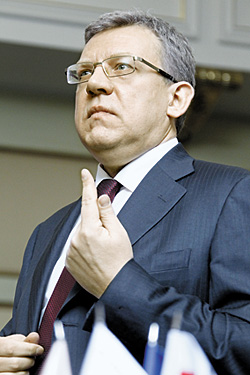
Do I Look Happy About the GPV? (photo: RIA Novosti)

Is Russian Finance Minister Aleksey Kudrin on-board with plans for increased military spending contained in the State Program of Armaments, 2011-2020?  The economic press seems to think he’s not, and his reticence leads one to ask if the new GPV will fit Russia’s economic and budgetary realities in coming years.  One thing’s certain (if you read on), 2011 is the first year of this GPV, and already, for a variety of reasons, many new arms will be bought with state-backed credits and loans.

The GPV came into the headlines last spring when Kudrin and his ministry offered 13 trillion rubles, and the uniformed military replied that 36 trillion would be about right.  Not much was heard about negotiations over the GPV until mid-July, when First Deputy Defense Minister Popovkin announced the figure would be about 20 trillion.

Then, President Medvedev described the GPV in his annual Federal Assembly address (Poslaniye) on 30 November:

“Today the fundamental task of creating a new high-technology mobile army stands before us.  We are setting out to spend more than 20 trillion rubles on these aims.”

The same day, Moskovskiy komsomolets published Kudrin’s reaction from RIA Novosti:

“The country is living with a deficit . . . .  The redistribution of expenditures from other areas is required.”

And from a television interview:

“The task of strengthening defense capability was set down very seriously, and a figure of 20 trillion rubles was named, and it will need to be directed at strengthening defense capability over the course of 10 years.  This is a new task, financial sources still haven’t been considered sufficiently, this could be an additional burden for the economy.  In this case, the president believes it’s essential.”

Kudrin didn’t mean new as in news to him, but in the sense that it hasn’t been factored into the federal budget. 

On 3 December, in MK, Nikolay Vardul critiqued Medvedev’s explanation of the GPV.

Vardul said we’ve heard about the high-technology army and using defense industry as an economic locomotive before, but this no longer fools anyone.  Large military expenditures ruined the Soviet economy, although falling oil prices were the coup de grace.  He continues:

“And here again is Medvedev talking about how investments in military technology will pay for themselves in the production of ‘dual-use products.’  Stepping on the same rake, as if we didn’t have sad experience.  The army passage in the Poslaniye is generally contradictory.  Medvedev drew an alternative:  either Russia and NATO manage to agree on joint missile defense, or a new arms race.  And then how do expenditures of 20 trillion rubles on military-technological needs by 2020 present themselves?  Is this just a running start?  In order to understand the scale of the spending, the entire Russian GDP in 2010 is on the order of 51 trillion rubles, and all federal budget expenditures for 2011 should be 10.8 trillion. There you have it.  But the questions continue:  who is now the potential enemy?  Can it be NATO again?  Too many questions and very few answers.”

“There is, by the way, one clear answer.  From the point of view of the economy, the main threat to its relative equilibrium is precisely inflated military, not social expenditures.”

“And there’s no doubt:  the higher the state expenditures, the greater the chances of inflation.  But military expenditures are distinct from investments in education or health care by the fact that the path to recouping them is more thorny and tortuous, if it’s even possible.  On the other hand, the road leading from them to inflation is as straight as a pipe.”

He concludes it’s true Russia’s economy needs a more modern engine to replace oil and gas revenues, but: 

“Instead of this, huge resources  are diverted to military spending, even though armaments not only won’t lift the economy, but drain it further.”

On 10 December, Nezavisimaya gazeta’s Anatasiya Bashkatova addressed Kudrin’s comments that redistributing federal budget to the regions and increasing the country’s defense capabilities will be very difficult to do simultaneously.  As Bashkatova put it, “there isn’t enough money for everything,” and “a high-technology defense sector interferes with regional development.”

Kudrin also said: 

“This program [GPV] is now being prepared.  It will soon be adopted, and the main expenditures will fall not in 2011, but in subsequent years.”

NG chief military correspondent Viktor Litovkin explained that it was simply too late for changes in the defense budget for 2011 with expenditures already starting according to the adopted budget law.

Then President Medvedev met with Kudrin meeting on 13 December.

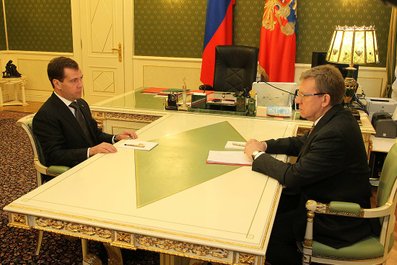
Medvedev and Kudrin (photo: Kremlin.ru)

Medvedev told him his priorities are economic modernization and social spending, and regarding the latter:

“I consider that this is very important for preserving social peace and stability in our country.”

But with his very next breath, Medvedev said:

“And, of course, we must devote attention to issues of guaranteeing the security and defense of our state.”

And, of course, after wishing it weren’t necessary, he said:

“Therefore, the corresponding state program of armaments, and the Armed Forces modernization program need to be fulfilled in the specified parameters.”

The same day, Prime Minister Putin conducted a government conference in the submarine-building capital Severodvinsk to review the GPV, and even he confessed:

“For me it’s terrible even to say this amount [20 trillion rubles].”

Later in December, Vedomosti quoted one of Kudrin’s deputies who said, many expenditures which have “already been announced – and first and foremost these are defense expenditures” have not been figured into the 2011-2013 budgets, and it’s “still unknown” how these obligations will be financed.

Dmitriy Butrin in Kommersant quoted Duma Defense Committee Chairman Zavarzin to the effect that, in 2011, 30 percent (about 500 billion of 1.5 trillion rubles) will be financed by state-guaranteed credits rather than by budget funds.  Butrin went on to repeat Kudrin’s warning that the GPV can’t be covered by the projected budget income level, and the 20 trillion could make increased taxes unavoidable.

The Kudrin deputy also said that, without growth in the income portion of the budget, new budget obligations – like the APEC summit, Sochi Olympics in 2014, Skolkovo, World Cup soccer in 2018, and the State Program of Armaments – appear unrealizable.  He concludes, “We’ve set out on a trajectory for higher taxes.”

So where does this leave the GPV.  These economic commentators describe the same general picture . . . the GPV is extra spending for which financing has not been identified, at a time when key categories of budget income (i.e. oil and gas revenues) will decline (from 17 percent in 2009 to 13 percent by 2020) and the prospect of higher deficits already looms.

Russia also faces lower receipts and more payouts for pensions and health care over this period.

Kudrin and company are looking at possibilities, mainly increasing some taxes, but also maybe raising the retirement age.  None of this will help economic growth or make people happy.

No wonder the Finance Minister has resisted extra military spending to the extent that he can.

This GPV, if implemented, will impede the economic modernization President Medvedev wants.

But history says this GPV’s not likely to happen.  Even its most recent predecessor, started under favorable economic conditions, was superceded rather than completed.  And now is definitely not a favorable time like that.

New Year’s Peep Show (Part I)

Yes, the season of little or no news continues . . . but there’s always something to write. 

On 29 December, Krasnaya zvezda provided a little holiday treat — a year-ending issue filled with official views on a variety of topics:

  • Priorities of Armed Forces Organizational Development.
  • Armed Forces Manning.
  • State Program of Armaments.
  • Global Political-Military Situation.
  • Improving the Military VUZ System.
  • State of Military Discipline.
  • Transition to a Unitary System of Armed Forces Material-Technical Support.
  • Provision of Housing to Servicemen.

A cornucopia of data for discerning and careful readers.

Caught up in the joy of the holidays, many probably overlooked these articles.

Let’s have a look at the first one — Priorities of Armed Forces Organizational Development.

What’s interesting is we’re given a little peep show into a much more interesting, detailed, and lengthy document — “The Concept of Organizational and Force Development of the Armed Forces of the Russian Federation in the Period to 2020” — approved by President Dmitriy Medvedev on 19 April 2010, with absolutely no fanfare.

What we don’t know is how this little peek inside the document was edited.  We don’t know what was emphasized, or left out, and why.

A couple preliminaries.  First, the title in the vernacular is “строительства и развития Вооружённых Сил.”  We really don’t want to say “Construction and Development” or “Building and Development” or something like that.  We’re not talking a suburban Moscow water park here.  By the same token, “Organizational Development and Development” sounds dumb. 

What we’re really talking here is force structure planning and force development.  The emergence of this planning document isn’t surprising given that they got a new national security concept in 2009, and a new military doctrine in early 2010.  This article also makes the point that, besides this ten-year military organizational development plan, there are also five- and one-year plans.

We’re going to move quickly today.  So pay attention.

The priorities are:  strategic deterrence (SYaS and VKO); building inter-service groupings on strategic axes (as in OSKs); building a new command and control system; reequipping in line with GPV-2020; a new education and training system for officers and sergeants; and resolving ever-present issues of social defense [i.e. pay and benefits] of servicemen.

What does it mean for each service?

  • For the Ground Troops, get organized on the axes and prepare to be mobile. 
  • For the Air Forces, emphasize supporting the Ground Troops and Navy.  Improve VTA and airfields for strategic mobility.
  • For Navy, support personnel and combat readiness of naval SYaS.  Series construction of multipurpose nuclear submarines and surface ships.
  • For RVSN, preserve the structure of ground SYaS.  Complete rearmament with fifth generation missiles.
  • For Space Troops, deploy formations with future missile attack warning and space monitoring systems.  Complete the full orbital grouping with future satellite systems.
  • For VDV, improve training, especially inter-service training.  Reequip with armaments, military equipment, and specialized equipment.

Sounds like Ground Troops have to make do with the weapons and equipment they have.

Stay tuned for Part II.

Medvedev Calls for Unified Aerospace Defense

Yesterday President Dmitriy Medvedev delivered the annual Federal Assembly address.  It was rather brief, uninspiring, and contained relatively little on the military, except his call for work on a unified aerospace (air-space) defense (VKO or ВКО).  This could be a death knell for independent Space Troops.  He also repeated his warning that an agreement on missile defense is needed, or another round of the arms race will ensue.

But let’s look from the beginning . . . Medvedev suggested the army’s modernization might help jumpstart the scientific and technical modernization of the economy.  He said the 20 trillion rubles for the State Program of Armaments will be doubly effective if they give Russia dual-use technologies that can help modernize production processes and develop both fundamental and applied research.  And Medvedev again mentioned creation of a Russian DARPA:

“Therefore we are creating a special structure which will research and develop breakthrough technologies for the defense sector.  There are such structures, you know, in other countries.  We are expecting many of them will find application in everyday life.”

There seems to be a huge disconnect between Medvedev’s almost offhand comments here and what military men expect out of that 20 trillion.  One doubts many in the armed forces see any of this funding going to R&D.  They see it going almost entirely toward procurement of existing weapons and equipment woefully lacking in today’s military inventory.  Perhaps it’s Medvedev’s way of selling (as if he needs to) these expenditures to the average citizen.  

At any rate, Medvedev then gets down to brief comments on the armed forces:

“The development of our state and society is impossible without effective support of national security and defense.  We have taken a course for a deep modernization of the Armed Forces, for conducting systemic, meaningful transformations in them.  The combat component of the Armed Forces, the combat readiness system, command and control, and material-technical support of troops have already been updated.  Our combat exercises have again become regular and, what’s of no small importance, large-scale.  Four military districts have been formed instead of six.  In the framework of the State Program of Armaments to 2020, troops are being outfitted with modern equipment.”

“What tasks still have to be resolved?  First.  In the next year, particular attention needs to be given to strengthening the country’s aerospace defense, to unify existing air and missile defense systems, missile attack warning, and space monitoring.  They should act under the unitary command and control of a strategic command.”

“Second.  Today’s Russia, it goes without saying, also needs a modern army and fleet, compact and mobile troops manned with high-class specialists and the newest weapons.  This requires both serious resources (I just stated the volumes of these resources), and new, sometimes complex, decisions.  At the same time, it is necessary to fulfill all obligations to people who chose army service for themselves, first and foremost to resolve the housing question within the planned time.”

“Third.  The army should free itself from ancillary tasks and noncore functions.  These functions need to be transferred to civilian organizations, to concentrate attention, most of all, on real combat training.  A young man only goes to the army for one year, and the program of training in military affairs is not becoming easier.  It is essential that every young man assimilate the program in full measure.”

Medvedev goes on to describe his discussions about European missile defense with NATO in Lisbon.  He repeats his warning that, if an agreement on missile defense isn’t reached and a full-fledged joint cooperation mechanism isn’t created over the next decade, another round of the arms race will begin:

“And we will be forced to make a decision on the deployment of new strike means.  It is perfectly obvious that this would be a very grave scenario.”