Tag Archives: VKO

A Thoroughly Modern CINC

You have to like Air Forces CINC, General-Colonel Aleksandr Zelin. 

He’s open and candid about what Defense Minister Anatoliy Serdyukov’s ‘new profile’ reforms mean for him and his service.  He’s talked earlier, more often, and longer about it than his Ground Troops or Navy counterparts.  He’s matter of fact and accepting of the entire process. 

Serdyukov’s changes turned General-Colonel into a trainer and force provider, and he nonchalantly admits as much. 

At 57, Zelin understands he can be replaced at any time, or allowed to serve three more years or even longer. 

If he were a tad younger, he would have been the right kind of general to command one of the new military districts / unified strategic commands (OSK / ОСК), say the Western or Central.  An air or air defense officer would have been just the right choice for a potential future war on those axes.  Instead, the Kremlin has three Ground Troops generals and one admiral (a step in the right direction).  It’s hard to argue against Ground Troops leadership in Russia’s restive south.  But Air Forces (VVS or ВВС) would have been a really good choice in the Western or Central Military Districts . . . a missed opportunity for now.

But back to Zelin.  On Tuesday, he addressed a foreign military attaché audience (and the Russian media) about the future of the VVS.

According to Gzt.ru, Zelin said the VVS will be reduced by a third and spread among the four new  OSKs.  And its Main Command (Glavkomat) will be responsible only for combat training.  The OSKs are in charge of employing the VVS in their theaters.

The VVS now consist of the Glavkomat, 7 operational commands, 7 first-rank air bases, 8 second-rank air bases, and 13 aerospace defense (VKO) brigades.  Before the ‘new profile,’ the Air Forces consisted of 72 regiments, 14 air bases, and 12 independent squadrons and detachments, with a third more aircraft than the VVS now have.

Four of today’s 7 operational commands are subordinate to the new OSKs.  Army Aviation also falls under them.

According to Zelin, in the future, the VVS Main Command (Glavkomat or Главкомат) could become a “branch department” of the General Staff responsible for the combat training of the Air Forces and Air Defense, while the OSKs employ the trained forces.

Zelin says VVS personnel will number 170,000 with 40,000 officers, nearly 30,000 sergeants, and the balance conscripts or civilian specialists.  He says today’s personnel training system doesn’t satisfy him, and so he’ll probably change the system of flight schools.  Only four remain today.  Voronezh will be the main training center.  Flight training will also be conducted in Krasnodar and Lipetsk.  Yaroslavl will remain home to air defense officer training.

According to the CINC, the VVS airfield network won’t change.  Base airfields will be first priority for reconstruction and modernization.  Zelin says civilian airfields could be used for operational purposes in the future.

He noted the VVS plans to go to a fully automated command and control system in the future, and, of course, develop its VKO forces.

Lenta.ua quoted Zelin’s remarks to Interfaks.  Zelin said the VVS will renew 30 percent of its inventory by 2015, and 100 percent new in some areas and 80 percent new overall by 2020.  He doesn’t say where the VVS are today in this regard, but recall Defense Minister Serdyukov has said only 10 percent of equipment in the Armed Forces is modern.

Zelin said the VVS will get new aircraft, air defense, reconnaissance, and electronic warfare systems, but modernization of some existing systems is still part of the plan.  Although the State Armaments Program 2011-2020 and its 19 or 20 trillion rubles have to be finalized, Zelin repeated that 10 T-50 (PAK FA) will be acquired in 2013-2015, and 60 more from 2016.  He mentioned Military-Transport Aviation (VTA or ВТА) is a priority – including the An-124 Ruslan, Il-112, Il-476, Il-76M, and An-70 – but he doesn’t venture any numbers or dates for new production.  Zelin does give a target of 400 new and modernized helicopters in the inventory by 2015.

Who knows what was or wasn’t covered in these media contacts, but it seems odd there’s still no mention of more S-400 deliveries.  Zelin was still talking about getting 5-6 more battalions in 2010 earlier this year.  But no sign of them.  It’ll be a big deal when or if they appear.  Also, no mention of S-500 development.
Medvedev Inspects Strategic Forces

In Friday’s Nezavisimoye voyennoye obozreniye, Viktor Litovkin claimed, the day before, President Dmitriy Medvedev visited the inner sanctum of Russia’s Aerospace Defense (VKO or ВКО) – the Central Command Post (ЦКП) of the 3rd Independent Air Defense (Missile Warning) Army in Solnechnogorsk.  Now Litovkin admits VKO doesn’t technically exist yet.  But preparations are underway, and he suggests, besides PVO, SPRN, PRO, space monitoring, etc., it will even include the RVSN.  Litovkin maintains tests of this system are ongoing, and Medvedev came to inspect it.  He watched troops track all three of Thursday’s SLBM and ICBM launches, and saw the missiles’ warheads land on their respective targets.  And, according to Litovkin, the point was to demonstrate the reliability of Russia’s nuclear missile capability to Medvedev as new SNV treaty limits loom.

Could the shrinking RVSN be subsumed under VKO as a new service or branch?  Could this explain the fairly rapid command shifts from Solovtsov to Shvaychenko to Karakayev?

Litovkin on What the GPV Will Buy

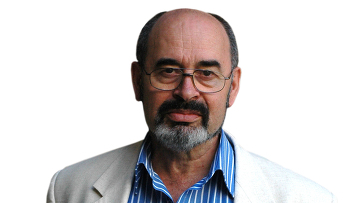
Viktor Litovkin (photo: RIA Novosti)

Returning to procurement and the GPV . . . in this week’s Delovoy vtornik, NVO’s Viktor Litovkin also asks what will 19 trillion rubles be spent on. 

He says the answer isn’t simple.  During the last 20 years of ‘starvation rations,’ the armed forces got handfuls of essential combat equipment, and, meanwhile, a dangerous imbalance between strike and combat support systems was created.  And this was obvious against Georgia in 2008. 

Litovkin says this imbalance has to be corrected, meanwhile priorities like strategic nuclear forces can’t be forgotten – not just the offensive triad, but also the missile attack early warning system (SPRN), missile defense (PRO), and aerospace defense (VKO). 

Like Viktor Yesin of late, Litovkin asks how Russia will replace its aging strategic offensive arms to stay up to the limits of the Prague / New START agreement.  Half the Russian force is SS-18, SS-19, and SS-25 ICBMs which will be retired in 7-10 years.  Moscow needs to build 400 strategic systems to replace them.  He doesn’t even mention Delta III and IV SSBNs and their aging SLBMS.  And Russia has only the SS-27, RS-24 Yars, Sineva, and Bulava to replace them. 

Litovkin expects a very large amount of money to be spent not just on replacing strategic systems, but also reequipping the enterprises that produce them. 

He turns to his second priority – also demonstrated by the Georgian war – precision-guided weapons, which in turn depend on reconnaissance-information support and equipment in space, on long-range surveillance aircraft [AWACS], and UAVs. 

Priority three – automated command and control systems (ASU).  He cites Popovkin on linking all service C2 systems into one system over 2-3 years. 

Litovkin says you can’t forget about the Navy, but he mentions just the Borey-class SSBNs, and the need for a wide range of surface ships.  And he makes the point [made by many] that Mistral is all well and good, but it’ll have to have multipurpose combatants operating in its battle group.  They need to be built, and they won’t cost a small amount of money. 

One can’t forget aviation either.  Litovkin cites a $100 million per copy cost for 60 fifth generation fighters [that’s a significant 180-billion-ruble bite out of the GPV].  He notes Vega is working on an updated Russian AWACS (A-100).  And, like Korotchenko, he mentions transport aircraft, but also combat and support helicopters. 

And so, says Litovkin, the question arises – isn’t the country putting out a lot of money to rearm its army? 

Viktor Litovkin (photo: Ekho Moskvy)

Being bold, he says, not really.  He actually uses that accursed 22 trillion figure, which is procurement for all power ministries.  If he used 19 trillion, it would be 1.9 trillion or $63 billion per year for Russia against $636 billion for the U.S., $78 billion for China, $58 billion for the U.K., and $51 billion for Japan.  But he doesn’t say this is annual procurement, the GPV, against the total annual defense budget for these other countries.  A bit of comparing one piece of pie to a whole pie.  Nevertheless, he concludes this makes Russia far from champion when it comes to military expenditures. 

Litovkin’s last word is Russia will remain one of the G8 with a powerful, combat capable, and effective army, but without it, only a raw materials appendage of either the West or East. 

But one wonders, hasn’t Russia long been in the G8 without that kind of armed forces?  Doesn’t breaking away from the raw materials supplier role have more to do with developing an open, attractive, innovative, value-added, and competitive economy (and a political system and society to match) than with military power? 

Kornukov’s VKO Concept

In Izvestiya yesterday, Dmitriy Litovkin wrote that today Defense Minister Anatoliy Serdyukov will receive a new, large-scale concept for establishing Russia’s global aerospace defense system for his review. 

According to Litovkin, the concept’s drafters picked 9 August because it’s the 60th anniversary of the USSR Council of Ministers decision to create the Soviet strategic air defense system.  He adds that Izvestiya is the first to study this just now declassified seven-page document.  It called for Soviet designers to develop an air defense system for Moscow codenamed ‘Berkut,’ in an improbably short period of two and a half years.

Litovkin quotes former Air Forces CINC Anatoliy Kornukov:

“Today we’ve developed and given the Defense Ministry an analogous document, setting down goals and tasks in the area of developing the country’s VKO system – this is a draft of a presidential decree on establishing VKO.”

In this case, the ‘we’ is the Extradepartmental Expert Council for Air-Space Defense (VKO) Problems, which Kornukov chairs.

Of course, Kornukov is a well-known critic of the state of Russia’s current aerospace defenses, who also advises air defense system producer Almaz-Antey.  One might, therefore, logically conclude that Kornukov’s concept will accord with Almaz-Antey’s current plans.

Litovkin goes on to relate stories of Laventiy Beria’s and his son’s involvement in those early air defense development efforts, and the prize money offered to the designers and their teams.

He tells about the Soviet / Russian A-35 and A-135 nuclear-armed ABM interceptors made obsolete by the S-400.  The S-400 he describes as a direct successor to the S-300, but with modern electronics:

“The tactical-technical characteristics of the S-400 were confirmed in the course of large-scale exercises ‘Combat Commonwealth-2009’ and ‘West-2009.’  S-400 combat crews successfully destroyed targets analogous to modern and future air attack systems.  The correctness of the Defense Ministry’s decision on creating air-space defense brigades was confirmed at the same time.”

Litovkin quotes Almaz-Antey Chief Igor Ashurbeyli:

“In modern conditions even the S-400, if you go the way of endless modernization, will end up in a technical dead end.  The system is indisputably effective, it will be modernized in the future, but up to a certain reasonable limit.  Its combat potential will be raised, but it won’t go beyond the bounds of ‘conventional’ PVO-PRO systems.  Today we have the mission of covering the country from the greatest number of potential threats.  On the Defense Ministry’s order, we’ve started development of the fundamentally new S-500 system.”

As stated many times, Litovkin notes the S-500 is to complete development by 2015, but its characteristics haven’t been disclosed, beyond it having a new active X-band phased array radar.  Supplemental short- and medium-range SAMs (Morfey and Vityaz) will be developed.  The S-400, S-500, and these systems are supposed to cover ranges from 5 to 400 kilometers, at heights from 5 meters to near space.

Is Alarm About Aerospace Defense Warranted?

In today’s Nezavisimaya gazeta, Viktor Litovkin tries to reconcile Kornukov’s and Sitnov’s extremely pessimistic views on the state and future of Russian aerospace defense with the optimistic ones of Colonel Sigalov, whom Ekho Moskvy interviewed on Saturday.  He’s commander of the 5th VKO Brigade based in Moscow Oblast, responsible for defending the capital.

Litovkin notes the retired generals’ roles as defense industry lobbyists, their defense of business interests, and efforts to acquire new orders.  And for his part, the colonel could never imagine or admit a chance that his troops won’t be able to carry out their missions.  What kind of commander would he be?

But the situation in the realm of air defense, and even more in anti-missile defense, is very complicated.  Yes, the troops of Sigalov’s brigade are ready to open fire on air-breathing enemy forces with 10 minutes warning.  But repulsing strikes from space is much more complex.  The troops simply lack the weapons systems to do it.  And this threat doesn’t exist yet.

So is there a contradiction or not?  Litovkin reminds that military men judge not just the current potential of probable enemies, but their ‘technical-technological possibilities’ as well.  And these are alarming.  According to Litovkin, many leading countries are working on ‘the problems of space weapons’ (although he mentions just China’s ASAT capability and the U.S. X-37B orbiter). 

And Russia has no response yet beyond the much talked about S-500 system, which, says Litovkin, lives now on paper only, and two (and maybe six more by some time in 2011) S-400 battalions around Moscow.  Litovkin claims the Defense Ministry will not order more S-400s after that.  Recall Almaz-Antey chief Ashurbeyli complaining on 30 April that the Defense Ministry has not signed contracts for S-400 production in 2012.

Litovkin says this might have caused genuine alarm in the two retired generals.  He speculates there could be more delays in producing missiles for the S-400 as well as for the S-500, which will need to operate against targets in near space.  Finally, he notes that, although the military doctrine contains an understanding of VKO, there’s still no Defense Ministry organization responsible for it.

On balance, it sounds like Litovkin believes Kornukov’s and Sitnov’s concerns are genuine, rather than commercially motivated.

Yuriy Gavrilov, writing in Rossiyskaya gazeta, concludes that recent talk about VKO means that Russia has to take immediate measures, or allow the distance between itself and the U.S. to increase each year.  He gives a little useful history.  Yeltsin’s 1993 decree said to create VKO, but the establishment of OSK VKO and VKO brigades amounted to little beyond changing the names of existing units, without changing their command, control, subordination, or weapons systems. 

Kornukov mentioned VKO relies on S-300s, MiG-29s, and Su-27s, and the few deployed S-400s, which still need work and rely on a single suitable missile.  All of which means, while waiting for the S-500, Russia has no real system for intercepting medium- and short-range ballistic missiles at an altitude up to 200 kilometers, or hypersonic cruise missiles.

Gavrilov quotes Sitnov:

“To develop modern systems that cover air and space, to develop new satellites for reconnaissance, and comms relay, missile attack warning, a super-modern component base, new materials, powders, new developments in the area of command and control are required.”

But that’s not all.  Gavrilov says VKO also needs one master, but aviation and PVO belong to the Air Forces, while anti-missile defense, missile attack warning systems, and control of Russia’s orbital grouping belong to the Space Troops.  Kornukov and Sitnov argue for giving it all to the VVS.

And Gavrilov says time is short.  By 2030, hypersonic and air-space vehicles, sixth generation UAVs, as well as weapons ‘based on new physical principles’ will already be in foreign inventories.

Aerospace Defense in Disarray

Retired Army General Kornukov

While Russian air and aerospace defenders were meeting in Tver last week, former Air Forces (VVS) CINC, Army General Anatoliy Kornukov gave Interfaks his opinions in a Moscow news conference.  

Kornukov is a member of a group calling themselves the ‘Extradepartmental Expert Council on the Problems of RF Aerospace Defense.’  He also advises the General Director of Almaz-Antey. 

He called aerospace threats the greatest danger for Russia’s security.  He said: 

“An attack from space decides everything now, strikes from space can be delivered to any point on Earth.” 

Kornukov thinks Russia’s aerospace defense (VKO or ВКО) concept’s been thought over long enough, and: 

“Unfortunately, there are still few practical decisions and concrete results.  New air defense systems are being developed very slowly.” 

“We, unfortunately, created a time lag of 20-30 years behind our possible enemy.” 

The ex-CINC says, although the VKO concept was approved in 2006, little has changed: 

“Years pass, but everything stays the same.  And to say that we’re ready for something now would be an exaggeration.  We can now resist an air attack from the standpoint of remaining S-300 systems.  As well as with those residual Su-27 and MiG-29 aircraft, the majority of which lack engines and spare parts.  The picture is simply terrible.” 

He also noted that new systems are progressing slowly, and are entering the armed forces’ inventory even more slowly.  He believes the Operational-Strategic Command of Aerospace Defense (OSK VKO or ОСК ВКО–the old Moscow Air and Air Defense District) can only destroy 1 in 5 targets: 

“If the reliability earlier was 96 or 98 percent, then now the effectiveness [of systems in the inventory] is in the range of 15-20 percent.  What’s meant is how many aircraft of 100 could get through without being countered.  Now about 80.” 

Kornukov recommends establishing VKO under the VVS, and under PVO specifically.  For example, he’d like the Moscow-based OSK VKO to control its own missile-space defense (RKO or РКО) formations and units.  He says: 

“Once all missile-space defense was in one set of hands–the PVO CINC.  He answered for PVO and for RKO.  Now the thinking is inexplicable:  each is dying by itself.  There’s not a person defined as responsible even for air defense.” 

“I think the correct decision would be for everything  to be located in one set of hands, and one person answering for the condition, training, employment [of PVO means]. 

He reminded the audience that, once the province of PVO, control of anti-missile defense went first to the RVSN, and now resides with the Space Troops.  Olga Bozhyeva reported that Kornukov wants RKO, specifically the 3rd Missile Attack Warning System Army to come to the Air Forces, and the latter should change its name to reflect its aerospace orientation.  He doesn’t like the idea of creating a new armed service called aerospace troops that would control PVO.  

Asked about Russia’s ability to defend against potential missile attacks from North Korea or Iran, Kornukov called the country’s capability to counter these threats ‘limited.’  He said, although the S-400 can cope with air-breathing threats, Moscow has no means for countering ‘operational’ (i.e. intermediate-range) missiles. 

Other members of the ‘Extradepartmental Expert Council’ had their say as well.  Former chief of PVO’s equipment ordering directorate General-Major Kolganov said: 

“. . . the VKO concept developed several years ago is not supported today organizationally or financially.  There is no targeted program for its realization.” 

Former Armaments Chief General-Colonel Anatoliy Sitnov says: 

“. . . in Russia they remembered about VKO only after the U.S. began to test the X-37 orbital glider.   . . . everyone’s occupied with a general assimilation of budget resources, and not at all with the development of new strategic technologies for modern space systems, reconnaissance, [and] missile attack warning satellites . . . .  This can’t come from a private businessman.  He comes to grab some budget money and sell what’s been made for scrap.” 

“We lost 300 super-technologies, primarily in aviation and air defense.  In particular, in the production of supergraphite, which is used in nose cones for missiles . . . .” 

Sitnov also criticizes poor organization for VKO: 

“There is no one to be in command, no one to command and control forces and means, no one to commission new air defense systems.” 

“It is time to move from words to deeds, to take purposeful directions and targeted programs for developing new aerospace defense systems.” 

“But we are waiting for someone to come and help us.  No one will.” 

Kornukov is an old PVO guy–albeit an Air Defense Aviation pilot; he was the first CINC of the VVS after it subsumed PVO.  Maybe he, and the others, are just shilling for Almaz-Antey to get even more from the State Defense Order.  Or perhaps their assessments are sincere.