Monthly Archives: June 2011

Dolgorukiy Returns to Sea

This morning ITAR-TASS reports that fourth generation Borey-class SSBN Yuriy Dolgorukiy is at sea for testing.  This is the boat’s first underway period of 2011. 

At the close of last year’s Arctic navigation season, Dolgorukiy returned to the hall at Sevmash, where it was prepared for the concluding phases of its state underway testing.  Sevmash says the submarine should be officially handed over to the Navy within the next few months.

Recall the Russian press reports that modified Typhoon SSBN Dmitriy Donskoy will be the launch platform for this year’s first Bulava SLBM test.

Off With Their Pogonies!

Friday's Security Council Session

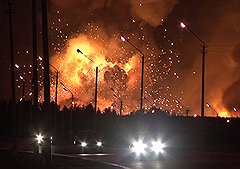
Dmitriy Medvedev’s asked again for the heads (or pogonies) of the guilty.  A couple weeks after his government delivered several of those allegedly responsible for breaking the GOZ, he’s ordered Defense Minister Serdyukov to tear the pogonies (officer’s shoulderboards or погоны) off those to blame for massive munitions depot explosions in Udmurtia and Bashkortostan.

It is, of course, quite a presidential thing to do.

Let’s look at how the fairly one-sided conversation went.

In the published opening moments of Friday’s Security Council session at Gorki, Medvedev had to forego mentioning anything about the G8, missile defense, and Libya in order to focus instead on the depot explosions:

“. . . I would like to turn the Defense Minister’s attention to the fact that we are for the second time recently experiencing ‘doomsday’:  shells exploding, there are injured, missing.  We conducted a special meeting on this issue the year before last I think.”

“Afterwards the situation was on the whole, in my view, under control:  we succeeded in arranging the work of supervisory structures, naturally, after dismissing a whole row of Defense Ministry colleagues.  But everything’s come loose again, some problems have arisen again.”

“Two times — this is already systemic, Anatoliy Eduardovich.  Prepare a proposal for me on who should answer for this and how.  They still don’t understand well — for two years everything was OK, — this means we have to take somebody’s shoulderboards off again.”

“Conduct an investigation.  Naturally, the Investigative Committee [under the General Prosecutor] and other units [FSB] are conducting an independent investigation, and together present me with proposals and organizational conclusions.”

For its part, the Defense Ministry insists it’s not being hasty.  Its spokesman told ITAR-TASS:

“Aiming for a full and objective investigation of the circumstances which have occurred in the TsVO, a Defense Ministry commission under the leadership of Deputy Chief of the RF VS General Staff, General-Colonel Valeriy Gerasimov has been sent.” 

“Based on the results of the conduct of the entire complex of verification measures by the military department’s commission jointly with investigative organ representatives and the military prosecutor, the causes of what happened will be established and the responsibility of officials will be determined.  Only after the checks are finished will concrete decisions, including personnel ones, regarding the guilty be adopted.”

Explosions at the 102nd Arsenal (photo: NTV)

Of course, today’s papers were full of speculation about who might get the blame and the boot for these disasters.  But, as usual, it’s not likely any dismissals will reach highly-placed officers and officials who are truly responsible for the sloppy, breakneck campaign to destroy Russia’s massive stockpiles of old shells and ammunition.

There’s lots more interesting commentary relevant to these most recent arsenal explosions.  Unfortunately, your patience will be required.

Korotchenko’s Spin on Military Reform

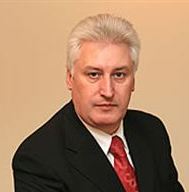
Igor Korotchenko

Yesterday Radio Svoboda’s Andrey Shariy interviewed Igor Korotchenko about the course of military reform against the backdrop of two huge ammo depot explosions, a major corruption scandal involving the chief of Russian military medicine, and Major Matveyev’s video address alleging MVD VV troops are being fed dog food.

First, Korotchenko gives his take on the backdrop:

“First and foremost, we have to sort out the facts you mentioned.  First on the explosions.  This is really a quite large-scale problem.  Unfortunately, we are encountering the fact that arsenal fires and explosions repeat again and again.  The munition storage and dismantlement system in the RF doesn’t withstand criticism.  Fundamental decisions are essential.”

“Now – about the arrest of the Chief of the Main Military-Medical Directorate.  I propose this fact shows again that they are fighting corruption in the Armed Forces.  In today’s Defense Ministry, these issues are resolved on a fundamentally different level than before:  there are no untouchables.  Stars and broad stripes notwithstanding, any official in the Defense Ministry system, for whom there is concrete evidence indicating corruptibility, is being held to account.  Of course, the ministry is conducting this work jointly with the FSB’s military counterintelligence department.”

“Finally, as concerns feeding soldiers dog food.  This fact doesn’t have a connection to the Defense Ministry since we’re talking about the MVD’s internal troops units.  This is Rashid Nurgaliyev’s jurisdiction.”

Then, specifically regarding progress on military reform, Korotchenko points to the four unified strategic commands (OSKs).  They will have operational control over forces in wartime, and this conforms to modern military principles, including in the West.

The task of building a modern army and C2 system, he says, is being fulfilled.  He repeats the usual words on how fully manned and equipped brigades have replaced the Soviet mobilization army, and a focus on low intensity, irregular warfare has replaced preparations for “mythical wars with NATO.”

But, he admits, the low level of modern arms and equipment is an obstacle.  Hence, Korotchenko continues, the new GPV is supposed to bring the amount of new weaponry in Russia’s forces close to 70 percent over the next ten years.  And he claims today’s soldiers have more rights and no longer function like a slave labor force.

He sums his view up this way:

“Of course, there are many problems with military reform, but the trend is important.  Movement toward qualitatively changing the Russian Army is noticeable.”

Shariy asks Korotchenko if we can say that military reform is going successfully: 

“We can say that in a number of areas there are substantial results.  But reform is going in a complicated way.”

And how does he square the successes he sees with unpleasant news that attracts society’s attention:

“There are successes, and there are problems.  There’s a lot negative.  We need to overcome it.  The army isn’t located in a sterile environment.  If there’s corruption in the country which has a systemic, large-scale character, of course, all this also comes into the Armed Forces.  If there’s crime in the streets, then young men coming to the barracks bring a certain mentality – from here comes nonregulation relations, fighting, sometimes more serious military crimes.”

Korotchenko rejects suggestions that the army’s on the verge of collapse, and military reform is a failure:

“. . . the Armed Forces are changing, it’s important to see this.”

Korotchenko’s a fairly articulate and dogged proponent of Defense Minister Serdyukov’s reforms.  But he typically doesn’t marshal many facts or examples to support his views.  He usually just relies on his own assertions.  But granted, this was a short interview.

A couple things are disturbing though. 

Korotchenko’s argument that ferreting out high-level corruption is a good thing is a tad specious.  It might be a positive trend if there were any evidence that investigators and prosecutors are actually reducing or deterring some military crime.  But thus far, there aren’t any signs of this.

His argument that an army can’t be better than the society from which it draws has been disproven in advance by the armed forces of many countries.  Former Defense Minister Sergey Ivanov is the past master of blaming the army’s ills on prevailing social conditions.  But setting the bar so low inevitably devolves into a justification for a state of affairs in the military that never improves.  But Korotchenko himself says it is changing for the better.  So which is it really?

Kachalkin on VTA Prospects

General-Lieutenant Viktor Kachalkin

This week marked Military-Transport Aviation’s 80th anniversary, and VTA (or ВТА) Commander, General-Lieutenant Viktor Kachalkin made a variety of comments regarding the branch’s future.

Now relatively little’s been said about this subject.  VVS CINC, General-Colonel Zelin insists VTA’s a priority, but hasn’t ventured numbers or dates for new aircraft.  His deputy, General-Lieutenant Sadofyev’s alluded vaguely to modernization of existing aircraft and acquisition of 50 percent new aircraft.  But nothing more specific.  If VTA is the red-haired stepchild of the Air Forces, at least the VDV loves VTA – loves to hate it, that is.  General-Lieutenant Shamanov and other VDV officers never tire of saying that shortfalls and shortcomings in air transport are turning their branch into no more than elite ground troops.

At any rate, on to what Kachalkin said . . . he hopes new An-70 and deeply modernized Il-76MD90A transport aircraft will enter the VTA inventory starting in 2014.  The latter is an updated Il-76MD with new PS-90A-76 engines.  It also goes by the name Il-476.  In the more distant future, VTA looks toward buying a new An-124-300 variant.  The VTA commander believes all this will translate into “dozens” of new aircraft by 2020.

Kachalkin also plans on the “deep modernization” of existing transports into Il-76MDM and An-124-100 variants.

In a Krasnaya zvezda interview, he sums it up this way:

“If the volumes of new aircraft and deep modernization of the existing aircraft inventory announced in the program [GPV-2020] are assessed, then the growth in VTA capabilities is obvious.”

Later he adds:

“Despite the fact that the service life of the greater part of the current VTA aviation inventory is figured at 2020-2030s, the percentage share of new aircraft will grow steadily.  In this context, the mobility of the Armed Forces will increase overall.”

In his KZ interview, Kachalkin mentioned the impact of the “new profile” on his base structure.  VTA now has only one first rank air base at Tver, which is home to multiple aviation groups using basing locations at Pskov, Orenburg, and Taganrog.  As recently as late 2009, the VTA commander spoke of first rank bases at Tver and Orenburg, and second rank ones at Pskov and Taganrog.

Kachalkin indicated an aviation group of not less than 15-20 VTA aircraft will take part in the upcoming Tsentr-2011 operational-strategic exercise.

A couple contradictory points worth noting were also made this week . . .

Deputy Air Forces CINC, General-Major Viktor Bondarev predicted An-70 purchases in 2012-2013, according to RIA Novosti.  The wire service also reminded readers that Defense Minister Serdyukov has said not before 2015-2016.  One guesses Kachalkin split the difference with 2014.

A Third S-400 Regiment

According to Interfaks, Air Forces Deputy CINC, General-Major Viktor Bondarev told journalists yesterday that another air defense regiment will be reequipped with the S-400 this fall. 

He didn’t mention a deployment location, or exactly when the regiment would go on combat duty.  This would be Russia’s third operational S-400 regiment.

The second regiment reportedly started combat duty on 15 May at Dmitrov, north of Moscow.

The first two regiments have four battalions between them, each battalion with 8 or more launchers.

In 2010, the Defense Ministry said it was buying 5 battalions of S-400s.  This seems to make sense with two battalions entering service in the first half of 2011, and two more possibly in the second half.  The first two S-400 battalions – at Elektrostal – were likely bought in 2006-2007. 

The plan is to buy 56 battalions worth of S-400s under GPV-2020.

It’s interesting to note that the previous, abandoned GPV-2015 (designed by Defense Minister, then Deputy Prime Minister, Sergey Ivanov) called for  acquiring 23 S-400 battalions by 2015.  The press often reports these 23 battalions as a pared-down 18, but the original goal was in fact 23.

So who’s really responsible for breaking the GPV (and GOZ)?

Today’s Appointments, Dismissals

President Medvedev’s Armed Forces personnel decree from today.

Appoint:

  • Colonel Vadim Anatolyevich Shamarin, Chief of Communications, Deputy Chief of Staff for Communications, Eastern MD.

Relieve of duty:

  • Colonel Aleksandr Mikhaylovich Galaktionov, Commander, 7th Missile Division.
  • Colonel Yuriy Gennadyevich Kashlev, Commander, 62nd Missile Division.
  • Rear-Admiral Yuriy Nikolayevich Lichkatyy, Chief of Staff, Rear Services, First Deputy Chief of Rear Services, Northern Fleet.

Relieve and dismiss from military service:

  • General-Major Sergey Viktorovich Goman, Chief of Rear Services, Deputy Commander of the Operational-Strategic Command Aerospace Defense for Rear Services.

Dismiss from military service:

  • Rear-Admiral Yuriy Stanislavovich Rebenok.

Trying to keep score on the RVSN command changes, it looks like we’re now seeing changes of command in half of Russia’s missile divisions — 14th, 8th, 60th, 7th, and 62nd.  You can add that to new commanders, and new deputy commanders, in the 31st and 33rd Missile Armies.