Category Archives: Air Forces

Litovkin on What the GPV Will Buy

Viktor Litovkin (photo: RIA Novosti)

Returning to procurement and the GPV . . . in this week’s Delovoy vtornik, NVO’s Viktor Litovkin also asks what will 19 trillion rubles be spent on. 

He says the answer isn’t simple.  During the last 20 years of ‘starvation rations,’ the armed forces got handfuls of essential combat equipment, and, meanwhile, a dangerous imbalance between strike and combat support systems was created.  And this was obvious against Georgia in 2008. 

Litovkin says this imbalance has to be corrected, meanwhile priorities like strategic nuclear forces can’t be forgotten – not just the offensive triad, but also the missile attack early warning system (SPRN), missile defense (PRO), and aerospace defense (VKO). 

Like Viktor Yesin of late, Litovkin asks how Russia will replace its aging strategic offensive arms to stay up to the limits of the Prague / New START agreement.  Half the Russian force is SS-18, SS-19, and SS-25 ICBMs which will be retired in 7-10 years.  Moscow needs to build 400 strategic systems to replace them.  He doesn’t even mention Delta III and IV SSBNs and their aging SLBMS.  And Russia has only the SS-27, RS-24 Yars, Sineva, and Bulava to replace them. 

Litovkin expects a very large amount of money to be spent not just on replacing strategic systems, but also reequipping the enterprises that produce them. 

He turns to his second priority – also demonstrated by the Georgian war – precision-guided weapons, which in turn depend on reconnaissance-information support and equipment in space, on long-range surveillance aircraft [AWACS], and UAVs. 

Priority three – automated command and control systems (ASU).  He cites Popovkin on linking all service C2 systems into one system over 2-3 years. 

Litovkin says you can’t forget about the Navy, but he mentions just the Borey-class SSBNs, and the need for a wide range of surface ships.  And he makes the point [made by many] that Mistral is all well and good, but it’ll have to have multipurpose combatants operating in its battle group.  They need to be built, and they won’t cost a small amount of money. 

One can’t forget aviation either.  Litovkin cites a $100 million per copy cost for 60 fifth generation fighters [that’s a significant 180-billion-ruble bite out of the GPV].  He notes Vega is working on an updated Russian AWACS (A-100).  And, like Korotchenko, he mentions transport aircraft, but also combat and support helicopters. 

And so, says Litovkin, the question arises – isn’t the country putting out a lot of money to rearm its army? 
Viktor Litovkin (photo: Ekho Moskvy)

Being bold, he says, not really.  He actually uses that accursed 22 trillion figure, which is procurement for all power ministries.  If he used 19 trillion, it would be 1.9 trillion or $63 billion per year for Russia against $636 billion for the U.S., $78 billion for China, $58 billion for the U.K., and $51 billion for Japan.  But he doesn’t say this is annual procurement, the GPV, against the total annual defense budget for these other countries.  A bit of comparing one piece of pie to a whole pie.  Nevertheless, he concludes this makes Russia far from champion when it comes to military expenditures. 

Litovkin’s last word is Russia will remain one of the G8 with a powerful, combat capable, and effective army, but without it, only a raw materials appendage of either the West or East. 

But one wonders, hasn’t Russia long been in the G8 without that kind of armed forces?  Doesn’t breaking away from the raw materials supplier role have more to do with developing an open, attractive, innovative, value-added, and competitive economy (and a political system and society to match) than with military power? 
What Will GPV 2011-2020 Buy?

Russian military procurement policy is an obvious focus of what you read here, and there’s lots to write about on this score lately – the GPV, defense budget, OPK modernization and innovation, etc.  It’s not possible to capture it all at once.  Here’s a start, and hopefully it will lead to broader insights later.

Writing for his latest project – the Center for the Analysis of the World Arms Trade (TsAMTO or ЦАМТО), Igor Korotchenko addressed what the new GPV might buy.  His article was picked up by VPK.name, and then a somewhat truncated version ran in Nezavisimoye voyennoye obozreniye.  He uses the 22 trillion ruble figure rather than the 19 trillion for the armed forces specifically.  Not that it matters since it’s a wag at best anyway.

In his first broad swipe, Korotchenko forecasts that Russia will buy 500 new aircraft, 1,000 helicopters, and 200 air defense systems among other arms and equipment over the 2011-2020 period.  He admits, even with a fairly generous procurement budget [if approved and fully disbursed every year], it will be impossible to buy everything each service and branch will need after 20 years of very small-scale procurement.

And this is exactly, of course, the point that Popovkin’s deputy, General-Lieutenant Oleg Frolov was making when he argued for 36 trillion . . . .

So, they can’t have everything and will have to prioritize.  Korotchenko gives it a whack, maybe not satisfactory, but it’s a start:

  • Strategic nuclear forces;
  • Precision-guided weapons;
  • Automated command and control systems (ASU);
  • Aircraft;
  • Air and missile defense (PVO / PRO).

Korotchenko doesn’t talk specifics about his first two priorities. On the third, he calls for a unitary military C2 system to enable Russian netcentric warfare.  On aircraft, he somewhat surprisingly emphasizes transport aircraft to move Russia’s million-man army between strategic axes as needed.  And Korotchenko lists PVO / PRO without further commentary.

He supports efforts to overcome Russia’s lag in UAVs, ships, individual protective equipment and soldier systems, and armored vehicles through cooperation with Israel, France, Germany, and Italy.

Then Korotchenko turns back to aircraft, saying they are the thing that will indicate what kind of armed forces Russia will have in 2020.  Based on what’s been said publicly, he counts:

  • An-124 Ruslan — 20
  • An-70 — 50
  • Il-476 — 50
  • Il-112B — ??
  • Su-35S — 48  
  • Su-27SM — 12
  • Su-30MK2 — 4
  • PAK FA — 60
  • Su-34 — 32, possibly 60-80 more
  • Su-25UBM / Su-25TM — 10, possibly 20 more
  • MiG-35 — 30
  • MiG-29SMT / MiG-29UB — 20-30
  • MiG-29K / MiG-29KUB –26, possibly 22 more
  • Yak-130UBS — 120
  • New airborne early warning aircraft — 2-3
  • Be-200PS — 8-10

In all, he summarizes, about 500-600 aircraft by 2020.

Korotchenko doesn’t talk money, so we’ll have to think about what this would cost.  In terms of what’s covered, he’s only talked only about RVSN and Air Forces’ requirements.  You can be sure the Ground Troops, Navy, VDV, and Space Troops have their own lists.  Maybe Korotchenko will address them.

Beyond what they say they need, there are two issues.  Can they buy it all, or at least how much of it?  And, second, can the OPK produce it?  Korotchenko doesn’t get us too far into any of this.

Russia is Priority for Mi-28N Deliveries

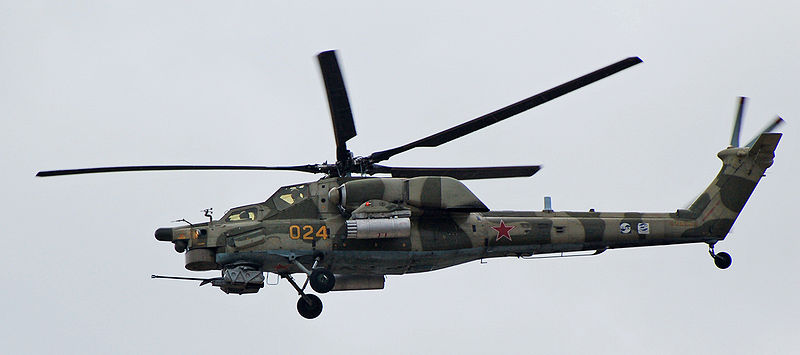
Mi-28N (photo: Denis Rossin)

Yesterday Rostov Helicopter Plant (‘Rosvertol’) General Director Boris Slyusar said the Russian Armed Forces are the priority for Mi-28N ‘Night Hunter’ deliveries, despite what he claims are many profitable offers from abroad.  According to ITAR-TASS, he said:

“We have many requests for the Mi-28N, but the RF Defense Ministry still doesn’t have these systems in sufficient quantity, and we will take its interests into account first.”

Slyusar didn’t give the number of Mi-28N helicopters in Russian forces, but he said the North Caucasus Military District (NCMD) has about 20 ‘Night Hunters,’ and there will be more.  He added:

“Our task is to create in the district’s [NCMD’s] troops in 2011 two groupings of Mi-28N.”

Who knows what he means by groupings.  Squadrons?  A second squadron or two additional squadrons?  The information on the number of Mi-28N delivered is unclear and contradictory.  In late 2009, Deputy Prime Minister Sergey Ivanov rather dubiously claimed Russia had already procured 27.

In May, a ‘Rosvertol’ marketing official said Russia would receive two squadrons of Mi-28N helicopters before 2011.  She said two Mi-28N went to the pilot training center at Torzhok in early 2008, and ten more — apparently for the NCMD’s Budennovsk-based 487th Helicopter Regiment — were delivered in 2009.  In mid-2009, ‘Helicopters of Russia’ General Director Andrey Shibitov also told Interfaks-AVN the Russian military had 12 Mi-28N helicopters.

So the question still stands:  a second squadron of maybe 10 helicopters, or two additional squadrons?  One thing’s certain, this goal’s been pushed from 2010 to 2011.

‘Rosvertol’ General Director Slyusar indicated his company sold 10 billion rubles of products in 2009,  and this year sales are more than 15 billion rubles.  Receipts from domestic and export sales are about equal.  By 2015, the company has an ambitious goal of $1 billion in sales.  Slyusar says the company is moving on this plan with modernization, equipment purchases, and people.

Air Forces News

A couple Air Forces items of interest today . . . .

A major live-fire exercise is taking place in the Far East today and tomorrow.  According to RIA Novosti, about 20 aircraft from the Far East Air Forces and Air Defense Army will fire more than 30 air-to-air missiles over the ‘Endurance Bay’ range on Sakhalin Island. 

A Defense Ministry spokesman said the aircraft are Dzemgi-based Su-27 fighters, and they’ll perform both day and night firings.  He emphasized that junior pilots will participate in the exercise.

There’s no readily available indication of the last time the Russian Air Forces conducted live-fire air-to-air training on this scale, so one presumes it’s been a while. 

Visiting Voronezh today, Air Forces CINC, General-Colonel Zelin said the city’s air base — soon to be one of Russia’s largest — will get four Su-34 bombers by year’s end.  The air base will be a first rank one, with 100 or more aircraft.

RIA Novosti reports the base’s expansion isn’t making nearby residents happy.  Those who object to it say its noise exceeds permissible levels, and causes headaches and sleeplessness.

On the Su-34s, Zelin said:

“I was recently at Novosibirsk aircraft plant.  One aircraft was already in flight test status.  The remainder are already in final assembly.”

State Tests of Su-35 Pending

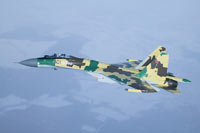
Su-35

Krasnaya zvezda on 13 August ran a brief item updating Su-35 developments.

Sukhoy is completing its preliminary testing of the Su-35 multirole fighter, and plans to present it for state testing this fall.  Sukhoy chief designer Igor Demin [Dyomin or Дёмин] told Interfaks-AVN to expect this in September or October.  He said there are two Su-35 prototypes currently in flight testing, and this number will increase to 6 for state testing.  The third Su-35 will reportedly fly at some point in the fourth quarter of this year.

Demin says the Su-35 is receiving lots of testing because it has many new systems and components.  Preliminary testing substantiated its advertised characteristics — low and high altitude maximum speeds of 1,400 and 2,500 kph respectively, and a ceiling of 19,000 meters.

Sukhoy has a mid-2009 state order for 48 Su-35 for delivery by 2015, and serial production of the fighter has been arranged at Sukhoy’s KnAAPO.  The first aircraft might be delivered in late 2010, and serial production will start next year.  Export deliveries are planned for 2012, according to this report.

The Su-35’s designers say this fighter will allow for a partial rearmament of the Air Forces, and facilitate assimilation of ‘new generation equipment.’  They describe the Su-35 as a deeply modernized, highly-maneuverable ‘4++’ generation aircraft, which already uses some 5th generation technologies.

According to this article, the Su-35 sports digital avionics and instrumentation, a new phased array radar capable of long-range target detection and tracking and engaging more targets simultaneously, and new engines with greater thrust and variable thrust vectoring.  Its radar signature has been reduced several times over 4th generation aircraft by using an electroconductive coverings for cabin lighting,  radar-absorbent materials, and a reduced number of antennas.

The Su-35 is reportedly designed for a service life of 6,000 flying hours, and its controllable-nozzle engines 4,000 hours.

According to ITAR-TASS, Sukhoy reported in July that Air Forces pilots were beginning to prepare to fly the Su-35S [supposedly the nomenclature for the domestic version] in state trials.

Infomercials aside, the Su-35 is intended to be a gap-filler for PAK FA, but no one can say how long the gap will be.  Long in development and repeated modernizations, it will likely be a solid aircraft, evolved as it is from pretty good stock.  There’s foreign interest, but, of course, no firm purchases yet.

Renewed Talk of Airborne Laser

Russian Airborne Laser Testbed (photo: testpilot.ru)

Work on the U.S. airborne laser has gotten the Russians talking again. 

On 19 August, an OPK source told Interfaks a laser system mounted on an Il-76 is under development, specifically to counter enemy reconnaissance systems.  It’s supposed to disrupt optoelectronic equipment operating in the infrared range in space, at sea, and on land.  The Interfaks source said this work’s been continuing for some time using a modified Il-76 (A-60), and the laser’s gone through a series of successful tests. 

Vesti.ru picked up the story from here.  It says Russia’s flying airborne laser laboratory took flight in 1981, and fired against an aerial target in April 1984.  However, work ceased in the early 1990s for lack of funds.  But now, Vesti.ru claims financing is going “according to plan.” 

Defense commentator Igor Korotchenko told Vesti.ru he doesn’t see the sense in the airborne laser, and doesn’t think it could be used in practice: 

“From a practical point of view, realization of such a program under conditions of defense budget limitations will look absolutely unwarranted and wasteful for the Russian budget.  Even if Russia gave itself such a task as developing an air-based laser, we have to understand that we’d have to fly this laser into U.S. airspace.  And try to destroy ballistic missiles there in the launch phase when they fire them at us.  It’s completely obvious that all our aircraft would be shot down.” 

Korotchenko goes on to say only the U.S. can afford a program like the airborne laser.  But regarding Russia: 

“. . . theoretically, of course, it’s possible to allow that such a flying laser system could be built, but if it’s senseless in a practical plan of combat employment, why take away resources from really important and necessary programs?” 

While reading Korotchenko, one needs to bear his long and close association with Almaz-Antey in mind.  Perhaps there’s fear lasers might detract from funding for more conventional air defense weapons.

According to Vesti.ru, many specialists think it’s just a matter of Russian prestige in keeping up with the Americans.  CAST’s Ruslan Pukhov doesn’t consider it a waste, however, saying that even the U.S. recognized Russian laser successes, and it would be stupid not to pursue more research.  Still others say it’d be better to spend money protecting Russian missiles from laser strikes during launch and boost phases. 

Newsru.com provided Pukhov’s comment:

“Several types of weapons need to fulfill the same function so that your system is more stable.  If suddenly the enemy found some kind of countermeasure to one type of weapon, or you didn’t manage to employ it for this or that reason, it’s always better to have a substitute.  Therefore, in my view, it’s stupid to renounce those types of weapons and those technologies where even your potential enemy assesses you extremely highly.”

Lenta.ru also added to this story.  According to it, the laser system will be for Russian forces; there’s no talk of exporting yet.  It says Russian Academy of Engineering Sciences official Yuriy Zaytsev first mentioned renewed work on an airborne laser in August 2009.  It provides some background on the Soviet laser weapons program in the 1960s and 1970s, through the A-60’s successful destruction of an aerial target in 1984.  It says, though there was no money in the 1990s, the design bureau continued to work on the laser program on an initiative basis.

Training Helo Pilots at Syzran


SVVAUL Cadet in a Simulator

Krasnaya zvezda often profiles parts of the Russian military, and on 30 July, it interviewed the Chief of the Syzran Higher Military Aviation School for Pilots (SVVAUL or СВВАУЛ), Colonel Nikolay Yartsev.  Yartsev is a 1984 graduate of the school, a Hero of the Russian Federation, an Honored Military Pilot of the RF, and Pilot-Sniper.

SVVAUL is Russia’s sole higher military educational institution for helicopter pilot training.  In its various incarnations, it’s existed for 70 years.  It trains helicopter pilots for the Air Forces, Navy, and other ‘power’ ministries and departments.  It’s a 5-year commissioning school, so some of the initial two years isn’t particularly specific to helicopter training. 

Asked if the current level of cadet training in the school meets the demands of the time, Yartsev points out that SVVAUL is accredited through 2012 and fulfills the ‘state order’ for military specialists in helicopter aviation.  It is fully staffed with professors and instructors; more than half have scholarly credentials.  All have great teaching experience, and many have not only years of service in operational forces, but also long combat experience.

Yartsev goes on to say SVVAUL can train 1,500 cadets simultaneously.  Its faculties have displays, mock-ups, and examples of weapons and equipment that support the practical direction of student training.

Yartsev says, thanks to the Air Forces, two years ago the school got a modern Mi-24 simulator, and this year an even more modern one.  It’s supposed to get two more simulators, a KT-24P and Mi-8.

The school has an 8-hectare field training base including 3 airfields for its 3 training-helicopter regiments.  In their third year, cadets learn to fly the Mi-2U, and SVVAUL is preparing to switch to the Ansat-U for primary training.

In their fourth and fifth years, students fly Mi-24 and Mi-8 helicopters.  They get 35 hours as pilot and 10 as pilot-navigator (operator) in this phase of training.  Yartsev says in 2009 the average cadet graduated with 135 flight hours, but a few got about 250 hours along with their third class pilot’s qualification.

Yartsev describes the Russian helicopter pilots’ experience in the Afghan war.  He says the USSR lost 333 helicopters and hundreds of pilots and crew members.  Twelve SVVAUL graduates became Heroes of the Soviet Union.  Thirty became Heroes of the Russian Federation while in combat in the North Caucasus.

Information available about Fort Rucker, home of the U.S. Army’s helicopter school, provides an interesting contrast.  Fort Rucker trains current officers and warrants to become rotary-wing pilots in as little as 9 months.  The program may train as many as 4,000 student pilots every year.  It looks like each student gets over 200 hours flying a TH-67 trainer and 70 hours in simulators, before even beginning many hours of advanced flight training in whichever specific combat helicopter they’ll eventually fly.  U.S. Army aviation has over 100 simulators in use and dozens in procurement.

Frontal, Army Aviation to OSK Commanders

Air Forces CINC, General-Colonel Aleksandr Zelin had many announcements yesterday on the eve of his service’s holiday, but none more interesting than the not-completely-surprising news that frontal and army aviation will transfer from the Air Forces to be directly subordinate to Russia’s four new ‘operational-strategic commands.’

Zelin said:

“The Air Forces will remain a service of the Armed Forces, its Main Command [Glavkomat or Главкомат] will continue functioning, the transfer of four Air Forces and Air Defense commands [i.e. armies] to the commanders of the new military districts — Western, Southern, Central and Eastern is planned.”

“Frontal and army aviation is transferring to the commanders of these districts and, accordingly, to the unified strategic commands.  As regards the aviation component of the RF strategic nuclear triad — Long-Range Aviation, it, like Military-Transport Aviation and the Operational-Strategic Command of Aerospace Defense [ОСК ВКО] will remain immediately subordinate to the Air Forces CINC.”

So what’s happened?

After years of lobbying, army aviation is leaving the Air Forces, but not exactly returning to the Ground Troops.  It is, however, returning to a Ground Troops-dominated environment in the OSKs.

The OSKs look more and more like U.S.-style unified, combatant commands, and the RF armed services like force providers.  

One supposes that the Air Forces, like the Navy, will have to continue playing a very large role in developing doctrine, tactics, acquisition, training, and operations and maintenance of frontal aviation at least, and probably army aviation as well. 

Zelin had more fragmentary comments on this subject.  The Air Forces CINC will retain:

“. . . immediate authority to direct combat training of all aviation and air defense forces, development of all directive documents, and also material-technical support.”

“This entire system is arranged just to optimize command and control and concentrate the main forces and means in the troops [i.e. OSKs].”

He added that these measures must:

“. . . prevent theft and waste of material and financial means and guarantee their strict centralization.”

One wonders how aspects of this ‘material-technical support’ (MTO) role for the Air Forces CINC will track with General-Colonel Bulgakov’s new MTO empire in the increasingly civilian Defense Ministry.

Kornukov’s VKO Concept

In Izvestiya yesterday, Dmitriy Litovkin wrote that today Defense Minister Anatoliy Serdyukov will receive a new, large-scale concept for establishing Russia’s global aerospace defense system for his review. 

According to Litovkin, the concept’s drafters picked 9 August because it’s the 60th anniversary of the USSR Council of Ministers decision to create the Soviet strategic air defense system.  He adds that Izvestiya is the first to study this just now declassified seven-page document.  It called for Soviet designers to develop an air defense system for Moscow codenamed ‘Berkut,’ in an improbably short period of two and a half years.

Litovkin quotes former Air Forces CINC Anatoliy Kornukov:

“Today we’ve developed and given the Defense Ministry an analogous document, setting down goals and tasks in the area of developing the country’s VKO system – this is a draft of a presidential decree on establishing VKO.”

In this case, the ‘we’ is the Extradepartmental Expert Council for Air-Space Defense (VKO) Problems, which Kornukov chairs.

Of course, Kornukov is a well-known critic of the state of Russia’s current aerospace defenses, who also advises air defense system producer Almaz-Antey.  One might, therefore, logically conclude that Kornukov’s concept will accord with Almaz-Antey’s current plans.

Litovkin goes on to relate stories of Laventiy Beria’s and his son’s involvement in those early air defense development efforts, and the prize money offered to the designers and their teams.

He tells about the Soviet / Russian A-35 and A-135 nuclear-armed ABM interceptors made obsolete by the S-400.  The S-400 he describes as a direct successor to the S-300, but with modern electronics:

“The tactical-technical characteristics of the S-400 were confirmed in the course of large-scale exercises ‘Combat Commonwealth-2009’ and ‘West-2009.’  S-400 combat crews successfully destroyed targets analogous to modern and future air attack systems.  The correctness of the Defense Ministry’s decision on creating air-space defense brigades was confirmed at the same time.”

Litovkin quotes Almaz-Antey Chief Igor Ashurbeyli:

“In modern conditions even the S-400, if you go the way of endless modernization, will end up in a technical dead end.  The system is indisputably effective, it will be modernized in the future, but up to a certain reasonable limit.  Its combat potential will be raised, but it won’t go beyond the bounds of ‘conventional’ PVO-PRO systems.  Today we have the mission of covering the country from the greatest number of potential threats.  On the Defense Ministry’s order, we’ve started development of the fundamentally new S-500 system.”

As stated many times, Litovkin notes the S-500 is to complete development by 2015, but its characteristics haven’t been disclosed, beyond it having a new active X-band phased array radar.  Supplemental short- and medium-range SAMs (Morfey and Vityaz) will be developed.  The S-400, S-500, and these systems are supposed to cover ranges from 5 to 400 kilometers, at heights from 5 meters to near space.

General Staff Chief Makarov’s Press Conference

Sound bites from General Staff Chief Nikolay Makarov’s press conference today dribbled out one at a time, as usual.

Makarov told reporters President Medvedev signed a decree establishing four operational-strategic commands (OSK) to replace the existing military districts on 6 July, but the text hasn’t been published.  Makarov also said arrangements putting the OSKs in place would be complete on 1 December.

Makarov talked more about the new “unified system of material-technical support (MTO)” also apparently covered in Medvedev’s decree.

Rear Services Chief, Deputy Defense Minister, General-Colonel Dmitriy Bulgakov, as expected, will head the unified MTO system, and new First Deputy Defense Minister Vladimir Popovkin will supervise the new state armaments program, 2011-2020, as well as coordination with military industries. 

Makarov stressed uniting transportation and supply functions under Bulgakov:

“We had a disconnect when all transport for supplies of material means to the troops was at the disposal of the Deputy Defense Minister for Rear Services, but he didn’t have anything he needed to move with this transport.  The other Deputy Defense Minister, on the other hand, had armaments, but no means for transporting them to the troops.”

“This is very important because now the management of transportation and armaments is concentrated in the hands of one man.  The correctness of the decision was confirmed by the recently completed ‘Vostok-2010’ operational-strategic exercise in the Far East.”

 “Now one official serving as a Deputy Defense Minister heads a unified system of material-technical support which has united rear services and armaments.  He alone personally answer for both the transport of supplies of material-technical means, and for these means themselves.  Now one man answers for the state of affairs with armaments and for their supply to the troops, who will also now be responsible for that.”

The way Makarov puts it, Popovkin be on the hook for product quality:

“He will work with defense-industrial complex enterprises to control their production of armaments and military equipment for the Armed Forces.”

Popovkin’s old job of Chief of Armaments, Deputy Defense Minister will disappear most likely.

Makarov told reporters Russia plans to move to netcentric command and control by 2015, once it equips its troops with new C3 systems united in one information space.  Such systems are now scarce, but he says, they are working hard so to install digital equipment everywhere.  Makarov calls this the main renovation that he’s giving all structures and troops starting in the fall of this year.  He says Russia’s new command posts unite reconnaissance, target designation, and troops and weapons to execute combat missions in real time.

It’s interesting that RIA Novosti took time to explain that the netcentric concept is an American creation more than 10 years old, and one not loved by those used to strictly centralized command and control.

Makarov told the press the army will begin forming light brigades, which it currently doesn’t have, this year.  They’ll have light combat vehicles of some type.  While not providing details, Makarov emphasized that light brigades will be built around a standard vehicle, so that, as in Vostok-2010, a brigade can fly in and its personnel can marry up with their normal vehicles in their place of deployment. 

Answering a question, Makarov said Russia will buy more Il-78 tankers in GPV 2011-2020, but he didn’t specify a number.

Makarov announced an intention to equip all Russian combat aircraft with new targeting-navigation systems over the next three years.  He said the new equipment will increase the accuracy of air strikes and allow the Air Forces to “abandon the previous practice of area bombing.”  He said the new system was tried on a Su-24M2 during Vostok-2010.  Installation of the targeting equipment on the Su-24M2 began in 2007.  Makarov said the VVS has nearly 300 Su-24 of all variants, and naval aviation about 60.

Stoletiye.ru had an interesting observation on Makarov and efforts to streamline command and control in the Russian Army.  It said the move to 4 OSKs and other steps are intended to reduce duplication of officer responsibilities and make 2-3 officers responsible for the fulfillment of combat missions.  It quoted Makarov, “We’ve eliminated the system of spreading responsibility throughout the Defense Ministry.”