On Sunday, RIA Novosti interviewed Naval Aviation Chief, General-Major Igor Kozhin on his branch’s 95th anniversary.
The news agency’s recap reminded that Naval Aviation lost its strike assets to the Air Forces on 1 April. And, by year’s end, all remaining Su-27, MiG-31, Tu-22 and part of its transport aircraft will move to the VVS. Only land-based ASW and carrier aviation will remain.
Asked about training, General-Major Kozhin focused on cost and retention. He claimed training a pilot costs a rather exorbitant $1.5 to 2 million annually. He indicated the need to keep older, experienced personnel — even in a civilian capacity — to train his younger pilots.
On upcoming training, Kozhin said his one regiment of 20 carrier-qualified pilots will conduct 100 takeoffs and landings from the Fleet Admiral of the Soviet Union Kuznetsov in August and September.
Kozhin said Kuznetsov is currently preparing for sea, and there’s no plan for capital repairs even though a replacement isn’t foreseen at this time.
He gave no hint of any impending carrier deployment as rumored earlier this year.
RIA Novosti asked about renting the NITKA carrier trainer in Ukraine. Kozhin answered by updating the construction of a similar facility at Yeysk, in Krasnodar Kray. He said toward fall the takeoff and landing strip will be complete, then landing systems will be installed, and the ground-based carrier simulator will be functional in 2013. He said the entire Naval Aviation training complex will be finished in 2015.
Finally, on new aircraft, Kozhin said the first four MiG-29K for Naval Aviation could apppear in 2012, but the Defense Ministry will have to sign the contract before mid-August. Otherwise, the first delivery will be in 2013. In all, a Navy buy of 20 is planned, but the factory is busy now filling India’s order for fighters for the ex-Gorshkov being renovated at Sevmash.
The second S-400 regiment, or “regimental set,” hasn’t commenced combat duty at Dmitrov after all.
This was supposed to happen on May 15, but didn’t. According to RIA Novosti, a VVS spokesman said the official commencement of combat duty was postponed [again] from July 17 until the last ten days of this month.
The news agency says the ceremony will take place on Peremilovskaya Height, outside Dmitrov.
Newly-minted VVS Main Staff Chief and First Deputy CINC, General-Major Viktor Bondarev said in June that a third S-400 regiment will become operational this fall.
The story of Igor Sulim and the premium pay scandal is like the 19th century one about Russian society’s generation gap. With liberals and nihilists reversed.
In Sulim’s story, the fathers are old senior and mid-grade officers who span Soviet and Russian worlds. They have no problem taking whatever’s not nailed down. The sons are post-Soviet junior officers, reared on the Internet, familiar with Western-style justice and rule-of-law, and ready to demand an end to corruption (that costs them money).
Perhaps your author reads too much into this. Or just maybe there’s some truth in this description. Let’s review some new details first.
The investigation into Senior Lieutenant Sulim’s accusations is a very slow roll. Rolling the victims. Here’s an update on the action (or inaction?).
Sulim posted his first video on May 31. Gorod48.ru wrote about it.
Sulim explained why he felt he had to complain to Defense Minister Serdyukov and go public about corruption in his unit despite the military’s “corporate ethic” against it. He said he exhausted other avenues and had no other resource at his disposal. He didn’t intend to be a one-man campaign against corruption but he’s getting support, and hearing similar stories, from others. And he thanks his fellow officers supporting him despite the difficulties and pressure they face.
He concludes speaking out is his civic duty. Russians should unite around one idea and struggle together so Russia doesn’t lose its greatness and remains a great power. And so the next generation doesn’t hate the current one for being silent and patient, believing nothing will ever change. It’s not revolution or spilled blood he wants, but the path of civilized development.
On June 2, Moskovskiye novosti wrote that Sulim predicted a disciplinary reprimand and deprivation of his premium pay would come his way for going over his superior officers (and, in fact, both came pretty quickly). The “army Navalnyy” and other officers are being pressured in every way by the authorities, and the entire Lipetsk center’s been deprived of premium pay to turn other officers against Sulim. He was removed from flight status. Public Chamber member Anatoliy Kucherena reported over half of 150 personnel he met said they were aware of the corrupt pay scheme at the base.
“Here is the misfortune — the essentially socialist army was not ready for these market relations. Indoctrinated on the principle that everyone in the line is equal before the commander and in battle, before life and death, everyone to an equal degree responsible for his country and its security, officers became accustomed to distinguishing one from another only by stars on the shoulderboards and by position, where the difference in pay between lieutenant and colonel, a general even, was minimal: a couple — four thousand rubles. And here suddenly it became colossal — several times. And, of course, when not everyone started receiving such premiums for the very same service-work, but just those chosen by still incomprehensible principles, a Bolshevist idea immediately arose — take it and divide it up.”
“But it was impossible not to understand to what the revolutionary introduction of market relations and big money for different categories of servicemen could lead. But has pay become a schism in combat units? There’s no unambiguous answer.”
“What’s the result? To what is the Senior Lieutenant Sulim phenomenon leading? Most likely just to changes in the various fates of various officers and various military units. But over some kind of time everything will remain as before. If Orders No. 400, 400A and 155 aren’t be suspended and changed. If from 1 January next year, the difference in pay and premiums for the very same service-work aren’t so monstrously striking. It’s not worth destroying the monolithic army line with the almighty ruble. This could bring serious consequences in a real battle.”
Sulim gave Ogonek an interview. Sulim said his father was not happy about him going public, but Sulim stressed it was his own personal decision. General-Major Sulim’s being pressed to keep his son’s mouth shut.
Ogonek asked Sulim if he isn’t afraid of sharing MVD Major Dymovskiy’s fate:
“His colleagues, as I understand it, didn’t support Dymovskiy. There are more and more of us now. If I had been alone, perhaps, I would have repeated his fate. But my colleagues are supporting me so, everyone is ready to go only forward.”
By mid-June, Sulim’s antagonists — Colonels Kovalskiy and Sidorenko — were both relieved of duty, but his supporters — Majors Kubarev and Smirnov — had been hauled before an Air Forces attestation commission in Moscow, called cowards for not refusing to pay kickbacks, and all but told they would be transferred from their elite Lipetsk duty, according to Komsomolskaya pravda. The paper points out Kubarev is a Su-34 pilot qualified for aerial refueling, and Smirnov was regiment’s top pilot last year.
In Moskovskiy komsomolets, Olga Bozhyeva wrote that Sulim’s reprimand was for violating the law’s prohibition on “discussing and criticizing the orders of a commander.” The authorities apparently didn’t go after him for revealing some of the stupid things said and written by Deputy VVS CINC General-Major Viktor Bondarev. Instead, they focused on his criticism of the Defense Ministry’s anticorruption orders posted on his blog. For its part, MK posted new audio clips indicating that the even the local FSB is in on getting kickbacks at Lipetsk, and this didn’t happen just in the 3rd Squadron, but all over the center. Bozhyeva asks, if this happens in an elite formation like Lipetsk, what happens in less prestigious units?
Senior Lieutenant Igor Sulim
There is lots on Sulim’s blog. Most recently, he wrote about meeting with VVS Deputy CINC, General-Lieutenant Sadofyev, who asked him why he had to “create a scandal.” Of course, Sulim’s made the point many times that he tried to go through the chain, through channels, and to do it without blood, and quietly. But Sadofyev and the older generation really don’t get it.
The new Russian generation of sons might make even congenitally pessimistic observers of Russia a little hopeful. The authorities could be playing an ultimately futile game of whack a mole with an entire generation of Dymovskiys and Matveyevs and Sulims.
RIA Novosti reports a highly-placed OPK representative says development of Russian UAVs hasn’t been financed for two years. According to him, this is connected with the drawn-out work of Defense Ministry experts considering Israeli drones purchased two years ago. The source continues:
“It’s obvious Russia’s Defense Ministry can’t figure out its future actions: either continue to buy UAVs abroad, or finance our own development.”
It seems pretty clear to this author it’s the former, especially considering the following figures.
TsAMTO gave the news agency a rundown on Russia’s 2009 contract for Israeli UAVS: two Bird Eye-400 ($4 million), eight I-View Mk150 ($37 million), and two Searcher Mk.2 ($12 million). TsAMTO also says a $100 million contract for 36 unspecified UAVs was signed later.
RIA Novosti also notes, this March, the Defense-Industrial Corporation (Oboronprom) agreed on a $400 million contract with IAI to assemble Israeli UAVs in Russia. Oboronprom’s Helicopters of Russia sub-unit is responsible for the Russian side of this joint venture. At the time, Russian experts argued that comparable domestic UAVs were several times cheaper. But Russian designers also acknowledged lagging in some technologies, particularly optical-infrared sensors and data transmission.
More than a year ago, then-Armaments Chief Vladimir Popovkin said 5 billion rubles had been spent on domestic UAV development without result. Then months of comparing foreign and domestic models followed. And now the money trail makes it pretty obvious the Defense Ministry (and big OPK players themselves) are intent on buying abroad. Small Russian UAV makers are the short-run losers.
This seems a smart choice for now. It will be some time before Russia successfully integrates foreign-designed UAVs into its military operations. There doesn’t seem a compelling reason to aim for self-sufficiency in something that’s still a niche mission.
What will happen depends on how Moscow handles its domestic developers. Will they be able to apply foreign UAVs to their own work and make competitive models of their own? Falling behind on pilotless technology is not exactly a negligible risk in the coming unmanned age.
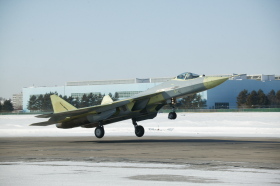
According to ARMS-TASS, Deputy Chief of Rostekhnologii Dmitriy Shugayev told the assembled press corps at the Paris Air Show that Russia’s PAK FA will need about eight years to reach serial production.
This sounds like a very different story from what we’ve heard thus far. Most official pronouncements have talked about starting serial production in 2015 or 2016, and pretty much completing the run by 2020.
No reason or context was given for what seems a pessimistic appraisal of PAK FA’s timeline. However, it might be connected to the challenge of getting “second phase” engines on the aircraft.
This week marked Military-Transport Aviation’s 80th anniversary, and VTA (or ВТА) Commander, General-Lieutenant Viktor Kachalkin made a variety of comments regarding the branch’s future.
Now relatively little’s been said about this subject. VVS CINC, General-Colonel Zelin insists VTA’s a priority, but hasn’t ventured numbers or dates for new aircraft. His deputy, General-Lieutenant Sadofyev’s alluded vaguely to modernization of existing aircraft and acquisition of 50 percent new aircraft. But nothing more specific. If VTA is the red-haired stepchild of the Air Forces, at least the VDV loves VTA – loves to hate it, that is. General-Lieutenant Shamanov and other VDV officers never tire of saying that shortfalls and shortcomings in air transport are turning their branch into no more than elite ground troops.
At any rate, on to what Kachalkin said . . . he hopes new An-70 and deeply modernized Il-76MD90A transport aircraft will enter the VTA inventory starting in 2014. The latter is an updated Il-76MD with new PS-90A-76 engines. It also goes by the name Il-476. In the more distant future, VTA looks toward buying a new An-124-300 variant. The VTA commander believes all this will translate into “dozens” of new aircraft by 2020.
Kachalkin also plans on the “deep modernization” of existing transports into Il-76MDM and An-124-100 variants.
“If the volumes of new aircraft and deep modernization of the existing aircraft inventory announced in the program [GPV-2020] are assessed, then the growth in VTA capabilities is obvious.”
Later he adds:
“Despite the fact that the service life of the greater part of the current VTA aviation inventory is figured at 2020-2030s, the percentage share of new aircraft will grow steadily. In this context, the mobility of the Armed Forces will increase overall.”
In his KZ interview, Kachalkin mentioned the impact of the “new profile” on his base structure. VTA now has only one first rank air base at Tver, which is home to multiple aviation groups using basing locations at Pskov, Orenburg, and Taganrog. As recently as late 2009, the VTA commander spoke of first rank bases at Tver and Orenburg, and second rank ones at Pskov and Taganrog.
Kachalkin indicated an aviation group of not less than 15-20 VTA aircraft will take part in the upcoming Tsentr-2011 operational-strategic exercise.
A couple contradictory points worth noting were also made this week . . .
Deputy Air Forces CINC, General-Major Viktor Bondarev predicted An-70 purchases in 2012-2013, according to RIA Novosti. The wire service also reminded readers that Defense Minister Serdyukov has said not before 2015-2016. One guesses Kachalkin split the difference with 2014.
According to Interfaks, Air Forces Deputy CINC, General-Major Viktor Bondarev told journalists yesterday that another air defense regiment will be reequipped with the S-400 this fall.
He didn’t mention a deployment location, or exactly when the regiment would go on combat duty. This would be Russia’s third operational S-400 regiment.
The second regiment reportedly started combat duty on 15 May at Dmitrov, north of Moscow.
The first two regiments have four battalions between them, each battalion with 8 or more launchers.
In 2010, the Defense Ministry said it was buying 5 battalions of S-400s. This seems to make sense with two battalions entering service in the first half of 2011, and two more possibly in the second half. The first two S-400 battalions – at Elektrostal – were likely bought in 2006-2007.
The plan is to buy 56 battalions worth of S-400s under GPV-2020.
It’s interesting to note that the previous, abandoned GPV-2015 (designed by Defense Minister, then Deputy Prime Minister, Sergey Ivanov) called for acquiring 23 S-400 battalions by 2015. The press often reports these 23 battalions as a pared-down 18, but the original goal was in fact 23.
So who’s really responsible for breaking the GPV (and GOZ)?
It’s rare when a single incident like Lipetsk is deemed serious enough to warrant a quick public response. But that’s what’s happening.
Defense Minister Anatoliy Serdyukov has ordered checks for corruption in large formations, formations, and units [i.e. army-level down]. His press-service says they’ll look specifically for premium pay kickback schemes. And servicemen and their families are urged to fill out electronic complaint forms on Mil.ru if they know about extortion rackets. They don’t need to observe the chain of command either.
Newsru.com has a good recap. VVS Deputy CINC, General-Major Bondarev has confirmed the existence of a kickback scheme at Lipetsk. But he also called Sulim and others cowards for not refusing to pay. He also denied putting any pressure on the men.
As Newsru notes, MK has audio of Bondarev indicating otherwise. Talking to Sulim, Bondarev claims he’s just angry he wasn’t promoted, his father illegally got him into the elite Lipetsk unit, and warns him that his fellow servicemen will kill him when they lose their premium pay. The tape also showed that Sulim only wants to resign because of the corruption, not for personal reasons, as Bondarev claims.
In fact, Sulim hopes to continue serving.
Gazeta.ru focused on Bondarev’s comment that it’s possible violations at Lipetsk are administrative rather than criminal [which would make Kovalskiy no more guilty than Smirnov or Sulim]. Bondarev claims Major Kubarev retracted his support for Sulim [Kubarev’s also being reported as Kubyrev].
Gazeta then talked to Sulim, who points out Bondarev only investigated in the 3rd squadron, not in the 1st or 4th squadrons, because the leadership is trying to limit the damage, and to make it look like it’s one squadron’s problem, and not a base-wide scheme.
You can see Bondarev’s own words in his 24 May interview with Ekho moskvy.
The RVSN actually moved out on this scandal before the Defense Ministry:
“Taking into account the recent events in one of the RF Defense Ministry’s units, connected with the illegal collection of money from servicemen, and to preclude the occurrence of similar situations in RVSN units, RVSN Commander, General-Lieutenant Sergey Karakayev has decided to establish permanently functioning commissions in every missile army to prevent similar legal violations.”
The press release said commissions will conduct anonymous surveys of officers and their families, and also look for this during inspections. But there might already be a lot of work to do.
Look at the impassioned comment a retired RVSN lieutenant colonel left on the webpage for Olga Bozhyeva’s interview with Sulim and Smirnov:
“Such kickbacks go on THROUGHOUT Russia’s VS [Armed Forces]!! It would be possible to jail ALL commanders of ALL units in Russia in good conscience!!”
“I live in the military town of an RVSN division. Many of my acquaintances are still serving. Previously they included ONLY SELECTED ‘RELIABLE’ officers in the order for the annual receipt of this mad money (extra MONTHLY pay up to 160-200 thousand rubles!!!) — but not more than 30% of the unit’s officers. EVERYONE knows that they collect ‘tribute’ from this money paid according to MO RF Order № 400: and who gets it, and who doesn’t, and their wives, and the osobisty (FSB), and the prosecutors, and even conscript soldiers [know who gets it]!! And such corruption arranges EVERYTHING — it’s clear that both prosecutors and osobisty get it! And it also arranges the officers who give the most ‘tribute’ — refuse to pay, they find a reason and deprive you of this mad, undeserved money!!!”
“Of course there’s hostility among officers, and their wives because of the payment of this money! You bet! Of two similar officers fulfilling similar duties, one gets SEVERAL TIMES more!! Not 2, 3, 5, 10, or 20 thousand rubles a months more, but several times more!!! Meanwhile, it’s usually not the best, but the ‘reliable’ one who will ‘kickback’ money without a fuss!!”
“THIS UNDERMINES ALL FOUNDATIONS of the Russian Army and its COMBAT READINESS!! ONLY AN ENEMY OF RUSSIA could think up such a thing!!”
Olga Bozhyeva has a great interview with the protagonists of the Lipetsk premium pay extortion scandal. Essentially, Major Smirnov and Senior Lieutenant Sulim detail a farcical investigation, and what looks like a wider-ranging criminal conspiracy. The entire Air Forces, not just the Lipetsk center, are in serious damage-control mode.
Bozhyeva introduces the piece as showing that even elite units suffer from corruption, and points out the center’s chief, General-Major Aleksandr Kharchevskiy, gave Vladimir Putin a test flight, and led combat aircraft that overflew Red Square on Victory Day 2010. The two young aviators told her they had to talk immediately because time is against them.
Smirnov described his experience with the extortion scheme. He said those refusing to pay got reprimands that could be used to force them out, and, with many officers being cut already, this threat was especially serious. Or, he says, higher-ups would simply take away their “400” pay, and give it to someone willing to pay tribute. Smirnov says the extortionists also collected as much as 240,000 rubles a year from conscripts. He also recalled seeing Sulim’s draft complaint about corruption, and agreeing to support the younger officer. Their ex-squadron commander, Major Yevgeniy Kubarev, joined them.
The VVS sent Deputy CINC, General-Major Viktor Bondarev to investigate, but, as Smirnov says, everyone who wanted to see him had to talk to the center’s Chief of Staff, Colonel Eduard Kovalskiy (the scheme’s ostensible organizer), Kharchevskiy, the new squadron commander (a Kovalskiy crony), zampolit (and bag man) Colonel Sergey Sidorenko, and FSB man Major Zatsepin first. Afterwards, Kovalskiy already knew all details of what they told the VVS investigator. Kovalskiy apparently talked to the father of one officer in an attempt to pressure him against supporting Sulim and Smirnov. The squadron CO reportedly told one officer, if he talked openly, he’d be the first dismissed.
Sulim confirmed that his father is a VVS one-star general. Bondarenko asked Sulim, don’t you think they’ll dismiss your father after this? Then Sulim sums it up:
“So it’s hardly possible to talk about any real observance of legality. Now you understand why we came to you [Bozhyeva].”
Sulim and Smirnov don’t accuse Kharchevskiy, but Smirnov says he’s afraid the extortion scheme goes higher, up to the VVS Glavkomat, because, if this involved just one colonel and one air group, it would’ve been cleared up quickly.
Smirnov says he and Kubarev have sent their families away from Lipetsk, as a precaution.
At the end, Bozhyeva asks Sulim and Smirnov what results they want from the interview.
Smirnov says:
“Our goal is for a fair, independent commission, a fair prosecutor to come.”
Sulim adds:
“Not from Tambov, but from Moscow. That is, those people to whom I, in essence, wrote on the Internet. Otherwise, they’ll choke all of us here with these kinds of investigations. We’re standing before such a precedent now!”
Smirnov then says, “All the Armed Forces are watching us.”
Then with the wisdom of someone twice his age, Sulim concludes:
“If they manage to strangle us now, then those men that rob officers will lose their fear completely, and those they rob, — they will finally lose their faith in their commanders. The consequences will be terrible.”
A Defense Ministry commission has established some facts of extortion and kickbacks alleged by Air Forces Senior Lieutenant Sulim, according to Interfaks. The military prosecutor also says the investigation thus far confirms what Sulim charged in his Internet address, and cases are being brought against some officers.
RIA Novosti identifies Colonel Eduard Kovalskiy as a “unit” commander, and Colonel Sergey Sidorenko as his deputy for socialization work. Yesterday, it looked like Kovalskiy was Sidorenko’s deputy. But both men are too senior in rank for a squadron. The two made 2 million rubles off the premium pay extortion scheme since 2010, and will be prosecuted for exceeding their authority.
RIA Novosti cited officials saying Sulim continues to serve, and has not resigned as other media sources claimed.
Lifenews.ru reported five officers from Sulim’s squadron have given statements confirming his allegations.
Yesterday various sources provided excerpts from a long Moskovskiy komsomolets interview with Sulim, and with his deputy squadron commander, Major Anton Smirnov, who’s supporting him.
Smirnov says he was told he had to participate in the collection of tribute, or his career was over. He anticipates criminal charges against himself since he had to handle kickbacks.
Of the official investigation thus far, Smirnov says the Defense Ministry and VVS commission was no more than a “fire brigade” sent to “extinguish the scandal.”
The two officers say officials from all power ministries, the military prosecutor and counterintelligence, have come to their unit, and pressured officers to contradict Sulim’s charges.
According to the MK interview, Sulim tried to resign, but his request lacked all necessary signatures.
We have to look closely at Sulim’s and Smirnov’s long interview, but one issue is salient . . . in this particular scheme to extort premium pay from subordinates, and funnel it upwards, where’s the head of the snake? And how many schemes like it exist in other units and formations?




 Russian Defense Policy