Category Archives: Command and Control

More on the Unified Tactical Level Command and Control System

On 7 March, Russkiy Newsweek spent some time on Sozvezdiye [Constellation], aka the Unified Tactical Level Command and Control System (YeSU TZ).  The system is sometimes called by the name of its manufacturer–Sozvezdiye.  General Staff Chief Makarov in February said the system would be ready by November.

Russkiy Newsweek concludes, if it actually appears, it will be a technological revolution.  One Defense Ministry interlocutor said it now takes a day for orders to reach field commands from Moscow, but they will go practically in real time with this system.

The author, Viktor Poltavtsev, says NATO already operates in a netcentric fashion, and Makarov is quoted about how an Iraqi Army superior in tanks and artillery was defeated by smaller coalition forces that could see and forecast events, calculate variants, and receive possible solutions in real time.  Poltavtsev says, in the Genshtab, they believe the U.S. Army was 80 times more powerful than its opponent as a result of this information advantage.

But back to Sozvezdiye, Anatoliy Tsyganok thinks this not-yet-fielded system is already obsolete.  He says:

“Every Defense Minister picks his toy.  Igor Sergeyev–Bulava, Sergey Ivanov–GLONASS.  The current minister–the command and control system.”

Despite willingness to entertain possible arms imports in many areas, there is a fear of imports when it comes to command and control systems. Aleksandr Golts notes that Russia lacks a component base–it can’t produce chips or circuit boards, but doesn’t want to buy them abroad either.

The Georgians’ U.S.-made Harris system reportedly performed magnificently in 2008.  One Sozvezdiye associate said that, when the smoke of that little war cleared, it was obvious the Russian Army had no communications, old or new, and things began to stir in the Genshtab.  But Sozvezdiye’s testing has brought mixed results.  YeSU TZ was tested last summer during Kavkaz-2009.

Poltavtsev gives a little explanatory background.  Akatsiya, around since the mid-1990s, is a Genshtab-Military District level comms system that was produced by Sistemprom.  But it didn’t make too much sense without a tactical system to reach brigades-battalions-companies and individual soldiers.

Enter Sozvezdiye.  The Voronezh NII of Communications (aka Sozvezdiye) has worked since 2000 on a tactical level system.  Its specialty heretofore had been satellite radio comms.

Sistemprom awaits the completion of Sozvezdiye’s system so it can connect the two, to create a single command and control system.  As Poltavtsev describes it, generals will sit at Akatsiya stations and command divisions or brigades that have Akveduk.  Brigade commanders will use Akveduk to command their battalions and companies in real time using fast, well-protected channels.

So YeSU TZ is supposed to be the computer network that unites the battlefield–people, equipment, artillery, etc., like a computer game.

Battalion and company commanders are supposed to be able to use digital channels to get reconnaissance photos, video, and other data, to give commands to troops, and to connect to higher staff elements.  Today the commander still has to scream into the radio, but tomorrow he might send soldiers orders to their hand-held devices.

But this is still theoretical.  Everything will depend on the reliability of the equipment and comms channels.  And the system can be blocked if the RF spectrum is suppressed.  The system might not work against a modern, well-equipped enemy that can do this.

Poltavtsev says Russian EW (or REC) systems were used against Sozvezdiye during testing in December at Alabino.  And mobile phones, Internet, radios, and even some hospital equipment in the area stopped working as a result.  A Sozvezdiye rep says their system was jammed on the Taman brigade’s range, but they can get around this by changing transmitters.

The main thing, according to him, is developing algorithms for use in combat that everyone understands.  Users say Sozvezdiye is complex and difficult to use, and it will take a while for commanders to sort out its arrows and symbology.

The Defense Ministry has acknowledged that YeSU TZ needs significant reworking, but there’s no other way.  General Staff Chief Makarov said everyone built their own C2 systems in the past; there were 16 military C2 systems in Soviet days.  Now a common one is being built.  However, Poltavtsev asked a PAK FA developer if his system is already integrated into Sozvezdiye, and he asked what it was, he’d never heard of it.

An interesting account of Sozvezdiye . . . it sounds a little like the story of Bulava, i.e. ‘we have to unify our different systems,’ ‘there’s no other way but to make it work,’ etc.  These are understandable, even commendable at times, goals and sentiments, but they don’t always lead to development of successful military systems.  Sometimes the primary goal has to be a system that works.  And sometimes designers and builders even have to start over.
Serdyukov’s Post-Collegium TV Interview

After last Friday’s Defense Ministry collegium, Serdyukov was interviewed on Rossiya 24.

He probably fielded more pointed questions than normal, but he easily navigated them.  At times, he answered partially and the interviewer didn’t follow up with the next logical question.

Asked about officers dismissed in 2009, he said the armed forces shed 65,000 of them, who retired on age or health grounds, requested dismissal, or violated their contracts.  There was no mention of those put in limbo outside the TO&E, without duty posts and only their rank pay to live on.  These are the officers who can’t formally be dismissed because they don’t have housing, and are living at their ‘commander’s disposal.’  There was also no mention of how many warrant officers were put out in 2009.

Serdyukov said some officers accepted civilianized posts, and 4,000 received job retraining–a pretty small number against the large need for it.

The Defense Minister said dedovshchina was officially down 15 percent, and he doesn’t want only platoon and company commanders punished when it happens in their units.  He wants to see all levels of command take more responsibility for the problem.  Not sure what he’s insinuating, but it could be a warning to higher ups that they could suffer too when big time violence cases hit the news and make the Arbat military district look bad.

Serdyukov talked about higher officer training and appraisals, mentioning the assembly for 550 officers from the military districts and army commands.  He said we tried to make them understand what it is we’re trying to do.  But many lacked the knowledge and necessary skills–presumably to continue in the service.  See today’s Nezavisimaya gazeta.  Viktor Litovkin writes about generals and senior officers dismissed under Serdyukov.  Military district and fleet staffs which used to number 500-700 officers have been cut to 300.  Trimming the ‘bloated egg’ is generally a good idea, but as Litovkin says, it really depends on the quality of those left behind.

Back to Serdyukov’s interview . . . in cutting the military educational establishment from 65 to 10 mega-institutions, he said fewer officers will be needed but the quality of their training must be improved.  The 10 left standing have or will have their faculty members assessed for fitness to serve and they’ll get facility improvements.

On contract service which General Staff Chief Makarov has pronounced dead, Serdyukov said:

“The results of the program were not satisfactory.  In reality, we underestimated the situation somewhat, as regards who should switch to contract service and on what terms, or with what pay.”

“. . . the next program should be revised in an attempt after all to think it out regarding what specific positions should be filled by contract service personnel.  Of course, this applies to complex skills, where expensive equipment is operated.”

Nevertheless, he noted that he expects the contract sergeant program [albeit small-scale and apparently no longer funded] to succeed.

He said the army borrowed from foreign military experience in deciding on the shift from divisions to brigades.  He said the latter’s potential is virtually the same or even greater in some cases than that of the former.

Serdyukov said the Defense Ministry has reported to the Supreme CINC on its view of how it would like to reequip over the next 5-10 years.  He repeated that cuts to R&D and maintenance had allowed for bigger buys of new arms in 2008 and 2009.

He admitted Bulava hasn’t been successful, but he expects this system to be put right and completed.

He addressed possible foreign arms purchases:

“. . . in some areas we are lagging behind quite badly.  This relates not just to the Navy but also other services.  We are buying things in single numbers right now.  They are things like UAVs, all kinds of sights, night vision equipment–it is a very broad spectrum where we are specifically lagging.”

Despite reports that Moscow would be negotiating only with Paris on Mistral, Serdyukov claimed Russia is talking to the Netherlands and Spain.  He denied it was no more than a glorified cruise ship, saying it could perform many roles and had many different capabilities.

Medvedev Speaks at Defense Ministry Collegium

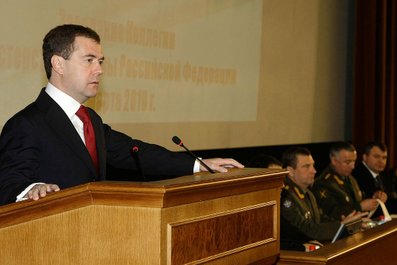
President Medvedev (photo: kremlin.ru)

In his remarks [text and video], President Dmitriy Medvedev reviewed the results of 2009 and talked about future plans for the armed forces.

He focused first on the international situation, noting that, “. . . today we have no requirement to increase further our strategic deterrence potential,” although it remains a determining factor in Russia’s conduct of independent policies and the preservation of its sovereignty.

He noted Moscow’s new law authorizing the use of force to protect Russian citizens abroad, and he pointed to unresolved conflicts on Russia’s borders [where presumably the new law could be used].

Medvedev acknowledged some positive tendencies such as work on a new strategic arms control agreement and renewed Russia-NATO contacts.  But he called the West’s reaction to Russia’s draft treaty on European security a barometer of relations with the U.S. and NATO.  He said it could prevent conflicts like Georgia-South Ossetia.  Medvedev asserted that, unfortunately, far from all countries and politicians drew the correct lessons from the August 2008 events.  And, unfortunately, he said the reestablishment of Georgia’s military potential continues with external assistance.

Then Medvedev turned more to the exact points of his speech.

He said the main goal is the qualitative improvement of the armed forces, the creation of a modern army and fleet equipped with the newest weapons.  He said last year the organizational base for this was established, as planned, without expending additonal resources.

In 2009, Moscow got its authorized personnel down to 1 million, and, according to the President, the Defense Ministry largely achieved its task of getting to the military’s future combat composition.  Medvedev said the results of Osen-2009 confrmed this, and more exercises like it are needed and need to have a ‘systematic character.’  Because, “Without this there simply are no armed forces.”

Medvedev called the training of officers the ‘most important task. Motivated, high-class specialists are needed, but the recently degraded military educational system and its material base need improvement. Medvedev said particular attention also needs to go to sergeants.  They need to be capable of replacing front-line officers when needed, according to the Supreme CINC.

On to rearmament . . .

Medvedev called the task of reequipping the troops with new armaments ‘extremely complex and very important.’  He said last year Russia stabilized the condition of its arms and equipment, despite the financial crisis, and fulfilled the GOZ, although not without problems.

He called the contracting mechanism for arms purchases ‘not effective enough,’ and said we are  working on this, but it’s slow.  This year the State Armaments Program, 2011-2020 will be written.  Medvedev gave the government the task of renewing arms and equipment at an average rate of 9-11 percent annually to allow Moscow to reach 70 percent modern armaments by 2020.  Reequipping has to be supported by full and timely financing.  He referred to his Poslaniye list of  priority systems and arms to be acquired.  He said this task will not be adjusted, and old weapons need to be decommissioned [He seems to have gotten it into his head that new means good and old bad which is not necessarily the case with Russian weapons.  What happens if you scrap lots of stuff, but you don’t succeed in producing new stuff?]. 

Medvedev said, as he’s already said more than once, steps are needed to bring order to the use, storage, and upkeep of missiles, ammunition, and explosives.  The events of the last year have shown there are problems here [alluding to Ulyanovsk, Karabash, etc.].

Medvedev noted another issue, providing the armed forces with automated command and control, and information systems, and transferring the military to digital comms by 2012, as put forth in the Poslaniye.  He said Zapad-2009 worked on mobile automated C2, but this was only a beginning to the work, which needs to be intensified, because “the communications situation is problematic.”

The President said forces will increase their combat readiness in their new TO&E structures [aren’t they 95 or 98 percent combat ready already?].  The main effort will be forming and training inter-service troop and force groupings, and supporting nuclear deterrence forces.  Medvedev said he’ll attend the main, key phases the coming Vostok-2010 operational-strategic exercise.

Medvedev obligatorily cited increasing the prestige of military service and improving the social defense of servicemen as a priority task.  

“I’d like to note that all obligations of the state to current and released servicemen will be fulfilled unconditionally, I will not accept any amendments for budget changes, or for other reasons.”

Medvedev said the government has the clear task to guarantee that all servicemen needing permanent housing have it by the end of this year, and service housing by the end of 2012.

“The realization of this task is not going badly, I will also take this under my personal control.”

Finally, Medvedev spoke for a moment to pay issues.  Increasing pay, and instituting a new pay system for active duty troops from the beginning of 2012, and increasing pensions to retired military men [but nothing specific promised].

He said he thinks premium pay or the well-known Order 400 brought respectable results, and it will be important to preserve ways of rewarding servicemen with extra money under the new pay system, and he expects proposals on doing this.

Defense Minister Serdyukov had some comments after Medvedev’s speech, but they’ll have to wait until tomorrow.

Makarov Meets the Press

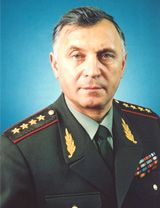
Chief of the General Staff Nikolay Makarov

General Staff Chief Nikolay Makarov spoke at length to the press yesterday. In no particular order, here are some of the impressions and reports that followed in his wake.

RBCdaily quoted Makarov on the possible Mistral purchase:  “Ships of the Mistral type have very great multifunctionality, and they surpass our ships in all parameters by three times.”  He went on to say that Russian shipbuilders would only be able to produce helicopter carriers of this quality in 5-10 years.  Aleksandr Khramchikhin commented that, in the first place, Russia doesn’t currently have comparable ships and, in the second, it will take 50 years.

Makarov said the final decision on buying the Mistral had not been made.

According to Rossiyskaya gazeta, Makarov said the Russian Army went to brigades vice divisions to avoid the previous need to flesh out units with reservists and take days to bring them to combat readiness.  ‘Modular’ battalions by contrast are permanently ready for battle in an hour.

Makarov didn’t rule out establishment of some type of ‘rapid reaction forces,’ though these are closest in nature to today’s VDV.  And this wouldn’t mean VDV would simply change its name. And other services need rapid reaction capabilities too for action in the air, on the sea, etc.  Aren’t permanently ready brigades rapid reaction forces already?

On the Navy headquarters move to St. Petersburg, Makarov claimed Moscow is overflowing with army and navy leadership [but haven’t they just cut 200,000 officers and lots of excess command structures to create a personnel pyramid?].  And with today’s networks the fleet can be commanded from thousands of kilometers away from the Genshtab and other main commands.

Makarov doesn’t foresee any change to the one-year conscription policy, but there may be changes in NCO acquisition.  Instead of six months training in MD training centers, they may only get 3, so they can serve 9 months in troop units.  Makarov thinks they’ll cut back on conscript sergeants once their professional ones start to appear.

Moskovskiy komsomolets quoted Makarov on the new strategic arms agreement with the U.S. to the effect that it’s 97 percent complete, and it only remains to agree on the relationship between offensive and defensive weapons, and there will not be anything in the treaty to Russia’s detriment in this regard.

On Mistral, Makarov said, after study, we’ve concluded we need this type of ship, which can be an amphibious assault ship, hospital, command ship, and helicopter carrier.

On the Navy and Piter, MK notes Makarov wanted to avoid Baluyevskiy’s fate and didn’t contradict his superiors.  He expounded on his vision (perhaps dream) of Russian netcentric warfare:

“Earlier it was like this:  the closer to subordinates, the more reliable the command and control.  Now all leading countries, including us also, are going to netcentric command and control systems.  This allows completely remote means of reconnaissance, command and control, electronic warfare, fire, command posts–all spread over an enormous distance, but located in a single information-communications space and capable of solving tasks in real time.”

On a related note, Makarov said the new Sozvezdiye tactical level command and control system will be part of the netcentric structure toward the end of the year.

Gazeta’s coverage focused on Makarov’s comments about establishing the personnel pyramid, i.e. going from armed forces with about 500,000 officers and warrants to one of 150,000 officers and 720,000 soldiers in the space of a year.  It also noted Makarov’s remark that brigade commanders in their training assembly at the General Staff Academy are learning new warfare and command and control principles.

Izvestiya quoted Makarov at length on the Navy Main Staff’s move to Piter.

“Presently all command and control organs are concentrated in Moscow, but we want these command and control organs to be as close as possible to the troops they control [didn’t he also call this the old way of doing business?].  The dispersal of command and control and fire means at great distances doesn’t have any great significance, what’s important is maintaining uninterrupted and clear command and control of troops and weapons.  Therefore, the transfer of the Navy Main Staff to St. Petersburg won’t place any kind of extra burden on the command and control system, with the exception perhaps, only in the initial period of its functioning in a new place.”

Viktor Baranets in Komsomolskaya pravda focused on Makarov’s words on the U.S. and Iran, noting his statements that the U.S. has a plan to strike Iran, and, if it occurs, it’ll be terrible for Iran, the region, and the U.S.

Krasnaya zvezda covered the Iran issue.  It noted that Russia’s need for ready units forced the shift to brigades.  It also covered Makarov’s comment that the Voronezh conference agreed on changes needed in the Sozvezdiye C2 system, and that it would be received this July and fielded in November.  KZ also quoted Makarov at length on the capabilities of the 5th generation fighter aircraft.

KZ also indicated that Makarov noted the U.S. as an example where units and commands are often separated by great distances when he talked about the Navy Main Staff and Piter.

Generally, it seems those invited to this press availability only asked Makarov ‘soft ball’ questions.

GOU Chief Tretyak Speaks, A Little

General-Lieutenant Andrey Tretyak

In today’s Krasnaya zvezda, the new Main Operations Directorate (GOU) chief speaks on the anniversary of his organization.  On 20 February, the GOU will trace its lineage back 308 years to Prince Shakovskoy.  Shakovskoy was general-quartermaster in 1702 (early in Petr Velikiy’s Great Northern War) and he began the establishment of organs of operational command and control with the basic missions of preparing proposals for planning troop employment and providing command and control during combat.

Tretyak says the missions standing before the GOU today are imposing and large-scale.  The GOU has to help transition the armed forces to a new level, and create a modern, combat-capable, and mobile army that won’t allow anyone the chance to threaten Russia or its allies.

He continues saying the deep transformation of the army was objectively necessary and the short period for the transition was dictated by the development of ‘leading armies’ and the threats facing Russia.  In 2009, the shift to a three-layer command system and permanent readiness formations and units was completed.  Tretyak says the tasks today are to complete their combat coordination (слаживание) and installations (обустройство).

Addressing the world geopolitical situation, Tretyak says, although a large-scale war is a low-probability event, many other threats have appeared.  For instance, the widening of conflict zones into areas that affect Russia’s vital interests.  He cites South Ossetia as an example.

So the General Staff constantly analyzes and evaluates the world’s military-political situation and develops practical measures to keep the armed forces ready to carry out their missions to guarantee Russia’s military security.  The main part of this job falls on the General Staff, responsible as it is for strategic planning, military organizational development, armed forces development, and the military organization of the state overall, as well as for coordinating the activity of all troops and military formations in the area of defense.  

The General Staff works with the country’s military-political leadership, federal executive organs, other state and military structures, and with the defense-industrial complex.  According to Tretyak, the most important role in this connection goes to the GOU, the history of which is inseparable from that of the Russian Army and the General Staff.

All this sounds a bit doctrinal and it is, but it gives the new top man’s view on how and where his people fit in.  It’s a bit like the new boss issuing a mission statement.

After a longish history lesson, Tretyak reminds that great military leaders have come from the post he now occupies.

Of course there’s nothing about his most recent predecessors Rukshin and Surovikin.  They didn’t fare terribly well.  And there’s the near-debacle in the five-day August 2008 war, i.e. many press reports saying that the GOU had been moved out of its spaces and just dismissed Rukshin had to be begged to run a lot of the war effort.  Afterwards, many have claimed it was the planning previously done by Rukshin that kept the war from becoming a total fiasco for Moscow.  And there’s nothing about cutting the GOU from 550 officers to 150 while its workload is unchanged, or perhaps even increased.  See Segodnya.ru for reporting on this.  Tretyak’s got his work cut out for him.

More details from his bio:  born 11 March 1959, so he’ll soon be 51, in Magdeburg, East Germany.  Graduated from the Kiev Higher Combined Arms Command School in 1980.  Platoon and company commander in the GSFG, then battalion chief of staff, and battalion commander in the Belorussian MD.  After graduating the mid-career Frunze Military Academy in 1991, he became deputy chief of the operations section for a division staff, chief of staff-deputy commander for a regiment, commander of a regiment, commander of a brigade, and division chief of staff in the Far East MD.  He completed the General Staff Academy in 2001, and commanded a division in the Siberian MD.  Here he was also chief of staff-first deputy commander of a corps and an army.  Then he commanded an army (probably 22 CAA)  in the Moscow MD.  From April 2008, he was chief of staff-first deputy commander of the Leningrad MD before taking up his current duties in January 2010.

Navy Main Staff Move to Piter Back On

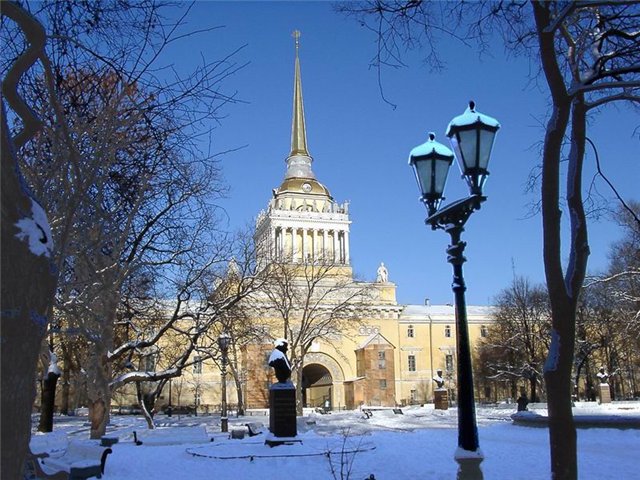
Admiralty

Unnamed Navy sources told the media this week that the Navy Main Staff’s postponed transfer to Admiralty in St. Petersburg is back on, and will begin in July.  But the Navy has not commented officially.  

The Leningrad Naval Base left Admiralty for Kronshtadt, leaving space for the Navy Main Staff in the former.  The Naval Engineering Institute may or may not have left Admiralty for Pushkin. 

The first elements to move could be administrative elements not bearing on the fleet’s combat readiness, while the Navy’s ‘operational services’ remain on Bolshoy Kozlovskiy Lane providing uninterrupted command and control of the fleet, and naval strategic forces in particular.  Some press pieces have said the transfer process could stretch out into 2012. 

A radical ‘optimization’ [i.e. personnel cut] in the Navy’s command and control structures, beginning 1 March, will reportedly precede the move to Admiralty.  Some press sources say the cut will focus on the Navy’s Central Command Post (ЦКП).   

Cutting Navy headquarters personnel may not be all that hard.  Izvestiya notes that, according to some sources, 300 Navy staff officers came out against the transfer to Petersburg when the story first broke in 2007.  Nezavisimaya gazeta has repeated the rumor that  only 10-15 percent of current staff officers will move to Piter and Grani.ru claims most are already looking for other work in Moscow. 

Recall that Duma Speaker Boris Gryzlov first ‘suggested’ the move to Defense Minister Serdyukov in fall 2007, saying that the Navy should return to Russia’s ‘naval capital’ already replete with naval educational institutions and shipbuilding enterprises, and lighten Moscow’s heavy load of governmental organs.  

The plan called forth the late 2007 protest letter signed by many retired admirals, asserting that moving the Navy Main Staff  would “not only lack common sense, but actually undermine the country’s defense capability.”  

Former General Staff Chief Yuriy Baluyevskiy was publicly ambivalent about the wisdom of the transfer.  In early 2009, Navy CINC Vysotskiy told the press he had no orders on the move.  However, new General Staff Chief Nikolay Makarov was quick to remind Vysotskiy: 

“Now command and control organs of the armed forces can be located anywhere.  The main thing is a reliable command and control system should be created which allows for carrying out missions in peace and wartime.” 

But can it really be located anywhere?  

Retired General-Major Vladimir Belous of IMEMO’s International Security Center has been quoted everywhere saying that, in St. Petersburg, the Navy headquarters could come under a devastating enemy air attack in as little as 15-20 minutes. 

Some have guessed the price tag for relocating to Piter at between 26 and 50 billion rubles, Grani.ru guesses 80 billion, and still others say completely rebuilding the Navy’s Moscow infrastructure in the country’s second capital would cost up to 1 trillion rubles.  In any event, a gigantic sum forcing the Defense Ministry to forego lots of other good uses for its money.   

Many experts believe the Navy’s command posts, comms, and underground bunkers will remain in Moscow and Moscow suburbs, since relocating them to Piter will be physically or financially impossible.  Former First Deputy Navy CINC Igor Kasatonov has been widely quoted saying that Piter will be no more than an alternate headquarters for the Navy CINC, from which it will be possible only to exert tactical control over the fleet. 

IA Regnum concludes that, although military experts unanimously believe a Moscow-to-Petersburg move will undermine the Navy’s combat readiness, it’s not clear it matters given the other things [i.e. political considerations, business interests] that are in play. 

Vladimir Temnyy writing for Grani.ru makes the point that old admirals’ alarmist rumblings about disrupting the Navy’s command and control are unimportant to those who want to build a business center and expensive apartments in place of the Navy Main Staff building near the Krasnyye Vorota metro station. 

In Stoletie.ru, Sergey Ptichkin calls the possible move ‘administrative caprice,’ adding that there’s profit motive in this caprice since the Navy headquarter’s building is valuable central Moscow property.  He says not a single expert or Navy leader can justify the move, and brands Gryzlov’s talk of returning the Navy to Russia’s ‘naval capital’ the height of naivete.  He makes the point that the Navy was only in Piter because Piter was the capital of the Russian Empire.  Otherwise, the Navy’s headquarters should be with the rest of the nation’s leadership.  Ptichkin concludes the modern Russian Navy can only be commanded from Moscow’s infrastructure and to replicate it in Piter is, if not impossible, then insanely expensive, especially at a time when there are questions about what kind of Navy will remains to be commanded.

An editorial in Friday’s Nezavisimoye voyennoye obozreniye concluded that the “ambitions of the powers-that-be trump common sense” and “the fact that arguments ‘against’ are clearly superior doesn’t bother them.”

Putin’s Voronezh Trip and Military C3

It takes a while to digest the press devoted to Prime Minister Vladimir Putin’s 18 January trip to Voronezh and Sozvezdiye, or the state-owned communications conglomerate based on the Voronezh Scientific-Research Institute of Military Communications.  Sozvezdiye is the holding which encompasses 16 other enterprises involved in C3, radio, and electronics.

Watch this NTV coverage of Putin at Sozvezdiye.

Sozvezdiye had a big demo set up outside for Putin.  But as the video shows, Putin was wearing his supremely bored look.  Moskovskiy komsomolets picked up on this, noting that Putin gave a cursory look at everything, and inside the display tent, he apparently picked up the mic on a video link system and tried to use it, but the soldier on the other end couldn’t hear the Prime Minister.

The Voronezh trip was the latest in a series of meetings on the state of the OPK.  Putin started by stating the obvious, noting that C3I is a decisive factor in the combat capability of a modern army, and a precondition for the use of highly accurate weapons.  He said it’s difficult to imagine an effective transition to a modern organizational structure without the right C3.  He called C3 a key priority for defense and noted that significant budget money will be spent on them.

Putin proceeded to chide his C3 producer audience, saying that Russia can’t modernize what it’s got; it needs an entirely new generation of systems.  He said C3 producers suffered from poor leadership, organization, and coordination of efforts.  Finally, he had to admit that they basically ignored his 2000 presidential decree on development of a new C3 system.

Specifically, Putin said:

“…we need not only to conduct a fundamental modernization of existing complexes and systems.  We have to say plainly that they unfortunately have already aged greatly.  And become obsolete, and even their technical condition often leaves much to be desired.  Therefore our focus for the coming years is to give the troops new generation equipment, to take a qualitative step forward.  It is precisely on this that I ask you to focus.”

“Our enterprises have a good scientific-technical pool for resolving this task, we need to use it wisely.”

Noting that dozens of OPK organizations work on C3I, he said:

“I ask that you turn attention to precise coordination of their activity, and also concentrate on working out agreed approaches and requirements for product development.”

“Besides this, I would like to turn attention to this, to this time a number of decisions adopted earlier have not been carried out.  So, to the present day, a general designer for development of an automated C2 system for the armed forces has not been appointed.  An integrated structure which would develop and implement a unified scientific-technical policy in this sphere has not been formed.  A special comprehensive program which would allow us to concentrate resources, to reduce and to optimize, to increase the effectiveness of budget expenditures has not been developed.”

Find the text of Putin’s address here.

Different media outlets reached the same conclusion about Putin’s Sozvezdiye visit and whether his words can fix the OPK’s problems and increase the sluggish pace of military modernization.  Segodnya.ru concluded:

“…the fact that Vladimir Putin directly participates in the problem of modernizing the technical outfitting of the army and promises to give the troops new generation equipment in coming years, inspires some optimisim.  Although the sensation remains that loud pronouncements about modernization traditionally hang in the air.”

Writing in Nezavisimaya gazeta, Viktor Myasnikov called it Putin’s “latest attempt to mobilize the military-industrial complex to equip the armed forces with quality modern products.”  Making note of Putin’s exhortations to the C3 producers, Tribuna said, “We’d like to believe they heard him.”  Newsru.com summed it up simply, Putin demanded that they modernize C3, but how to do it is not clear to anyone.

What exactly did Putin order in 2000?  According to Denis Telmanov writing for Gzt.ru before the Voronezh visit, Putin ordered the development of the Unified Tactical Level Command and Control System [ЕСУ ТЗ or YeSU TZ]. 

What’s it supposed to do?  It is supposed to be a large part of a system tying the armed forces together in one modern C2 network, and enabling them operate in a netcentric fashion.  Several media items reported that the Defense Ministry believes YeSU TZ will provide 2 or 3 times the capability of its predecessor. 

Tribuna noted that the Russians have the individual pieces of equipment, bought with a considerable allocation of money, but they haven’t managed to pull them together into one, integrated and modern C2 system.  According to Segodnya.ru, experts believe only Russia’s strategic forces possess a functioning, albeit increasingly obsolete, C2 system.  The armed services and branches, MDs, fleets, and armies have local automated C2 that isn’t necessarily integrated or compatible with other commands.

At the operational-tactical (battalion-brigade) level, Russia has reportedly fallen 20 years behind Western armies in C2.

Testing of YeSU TZ began in 2006 and continues.  In December, troops at Alabino used the equipment in a battalion tactical exercise.  But Telmanov concludes the military is in no hurry to adopt the system because it’s problem plagued and has obsolete elements.  It’s also hard to integrate with the army’s old comms gear. 

Izvestiya on 20 January reported that the system may be too complex for soldiers and sergeants, but even for some officers.  Myasnikov noted that the equipment suffered a lot of breakdowns at Alabino. 

But Sozvezdiye denies the criticism, saying YeSU TZ is reliable and no more difficult to use than a mobile phone.

Nikolay Khorunzhiy writing in Vremya novostey had said back in November that the Akatsiya system was tested during Kavkaz-2009 but could not be fully employed because operator training was deficient.  Combat situation data had to be input by hand and orders sent out by voice radio, defeating the purpose of automation.  Myasnikov also wrote that Akatsiya isn’t working out.

A little nomenclature is in order here.  It’s difficult to square all the press, but it seems Akatsiya is a name for YeSU TZ, but it’s also known by the name Sozvezdiye, a little confusing since this is the C3 production conglomerate’s name as well.  Apparently, Akatsiya is either based on or relies on the Akveduk satellite radio [?] system as one of its component parts.  These in turn evolved out of Polet-K and Manevr before them.  A couple press pieces said one problem with the system is what was basically a radio comms enterprise was put in charge of the broader C2 system effort which required other expertise as well.

A few other issues from the Voronezh visit bear mentioning…

Many press items cited the 2008 five-day war with Georgia as putting attention on C3 weaknesses.  Vremya novostey recalled the image of a wounded 58th Army commander, the recently dismissed, Khrulev borrowing a satellite phone from a journalist to communicate with Moscow.  Several papers cited a Sozvezdiye deputy director saying the holding ‘got raked over the coals’ for South Ossetia and Abkhazia.  He noted that Georgian forces used Harris equipment from the U.S. and it was better than Russian analogues in a number of ways.

Regarding this technological lag, there’s some dispute.  Moskovskiy komsomolets indicated Putin was told “we’ve approached NATO standards” in computerized C2.  Izvestiya, however, cited an industry source saying that there’s no appreciable lag between Russian and U.S. and Israeli systems.

Nezavisimaya gazeta and Izvestiya tackled the cost issue.  First Deputy Sozvezdiye Director Vasiliy Borisov was widely quoted to the effect that equipping one brigade with the new C2 system will cost 8 billion rubles.  Nezavisimaya multiplied this by 85 ‘new profile’ brigades for a price of 680 billion rubles, or when higher echelons have to outfitted as well, the total cost is probably more like 1 trillion rubles, or the price of one complete year of the State Defense Order (GOZ).  Izvestiya quoted Borisov saying the price to outfit a company commander would be 150,000 rubles, and 50,000 for individual soldiers.  The paper concluded that the new equipment won’t be replacing mobile phones any time soon at these prices.

Nezavisimaya also noted that one can’t do C2 properly without the right navigation system, and GLONASS is not up to the job.  It cited 17 operational GLONASS satellites, but press services today noted that 18 are now functioning.  Still, not enough.  Nezavisimaya compares work on C2 to Bulava and GLONASS–other military programs that defense industry is having a hard time bringing to fruition.  Tribuna makes the same point that a fully functioning and reliable GLONASS system is a ‘sine qua non’ for effective C2.

Training Session for High-Level Commanders

The Defense Ministry’s Press Service and Information Directorate reports that leadership personnel from the MDs, fleets, and combined formations [armies] of the armed services have assembled at the General Staff Academy for days of ‘practical study’ of new forms and capabilities for employing the armed forces in today’s conditions in the framework of operational-strategic commands (OSK).

In the course of the exercises, these high-ranking officers will “work out issues touching on the most acute aspects of the army and navy’s life and activities–from organizing combat training and troop service in formations [divisions and brigades] and military units [regiment and lower] within the new organizational structure of the armed forces to their effective employment in possible military conflicts and operations.”

Their study and exercises will include lectures, seminars, ’round tables,’ group operational meetings, etc.  They will be tested and quizzed on the results.  The assemblies will end with demonstration exercises in mobilization preparation which will occur in SibVO military units.  The training session ends on 5 February.

Wonder if they’ll talk about the new service regulations and combat documents that were in the works last year?

The press service renderings of this Defense Ministry announcement didn’t really do it justice, so perhaps this provides a closer reading on what’s going on.

Will the Army Survive the Reforms of 2009?

Military commentator Anatoliy Tsyganok gives some of his familiar answers to this question in Polit.ru.

He lists three important factors that will determine the state of Russia’s defenses over the next 10-15 years (without necessarily fully exploring each):  information security, demographics, and weapons development.

He’d like to see “information troops” as a branch of the armed forces.  Not sure he could write his columns if they existed the way he describes them.  More interestingly, he asserts, by 2011-2012, the number of 18-year-old Russian males will be less than the number of conscript billets in the armed forces.  So something has to give.

Then Tsyganok spins off into a variety of interesting and familiar directions.

Regarding the shift to 3 levels of command, Tsyganok maintains it doesn’t improve the control over forces and it actually reduces combat readiness.  He questions whether the MD can transform itself from an administrative command into a warfighting front under modern conditions when it will have little time and may already be under attack.  Later he gives officer manning figures for the old regiments vs. the new brigades.  The former had 252 officers and more than 100 warrants against 900-1,800 soldiers and sergeants.  The latter has 135 officers against as many as 3,800 troops, so control is worse.

On the issue of tanks, Tsyganok says the reduced reliance on tanks might be right for a small war in the Caucasus, but a larger tank force remains useful elsewhere since not every war will be of the local variety.  With only 2,000 tanks, Russia would have only 285 for each MD and the KSDR, or 2 brigades and an independent battalion’s worth for each.

Tsyganok says the U.S. Army’s ratio of combat to combat support brigades is 1:3 and Russia’s is 1:0.88, leaving the latter deficient in combat support.  Without adequate combat support, the Russian brigade can’t cover the same kind of territory as its American counterpart, according to him.

Nor is the Russian brigade terribly mobile.  Tsyganok says, in Zapad-2009, one brigade rail marched 450 km in 7 days, while he claims a Chinese regiment exercising at the same time covered 2,400 km in 5 days.

Tsyganok is not impressed by Russia’s armaments program.  He asks why Russia should build new ships when it can’t maintain what it’s got.  He claims Russia’s ‘new’ corvettes will be outfitted with 20-year-old weapons.  Tsyganok complains that updating the electronics on 30-year-old Su-24, Su-25, and Su-27 aircraft doesn’t produce sufficiently combat capable platforms for today.

Turning to training and education, he runs through the familiar and modest results for 2009 (60 percent of the ‘new profile’ brigades got satisfactory evaluations) and reductions in the number of officers studying at the Combined Arms and General Staff Academies.

Tsyganok then tackles the formation of OAO Oboronservis to replace most of the army’s rear services.  According to him, it is quite a behemoth valued at perhaps more than a trillion rubles or 2-3 percent of Russia’s GDP.  He cites VVS CINC Zelin’s criticism of the high cost of capital aircraft repairs by its Aviaremont holding.

On military housing, Tsyganok says, the Defense Ministry’s claims notwithstanding, servicemen received less than 30,000 apartments in 2009.

He ends by discussing military corruption, which he describes as theft which knows no limits.  Officially, losses from economic crimes in the armed forces amounted to 2.5 billion rubles in 2009, adding to the 2.2 billion in 2008.

Tsyganok says:

“The prosecutor and other law enforcement mainly fight against low-level corruption, but they don’t touch its ‘apex.’  To increase the number of cases uncovered, they seize on rank and file corruption, but they don’t conduct a systematic fight against corruption in the ranks of the highest leadership.  Attempts to create special control organs still haven’t brought success:  in a thoroughly corrupt system, uncorrupted structures either don’t work or else quickly become corrupted themselves.  To ‘purge’ the main corrupt people, political will is needed, and we still don’t have it.”

It will be interesting to see if there is some kind of move against corruption in the Defense Ministry and other high places in the armed forces, as rumored during last week’s command changes.  The rumor probably shouldn’t be believed until some solid evidence appears.

Is Russia Ready for Netcentric Warfare?

Is It Really This Simple?

Dmitriy Litovkin addressed this recently in Izvestiya.  He defines netcentric war as generals in the Arbat controlling not only armies but individual soldiers in real time via a military Internet.  He calls the U.S. concept as gathering all forces into one information space and turning the armed forces into one huge reconnaissance-strike system. 

Litovkin cites one Robert Nikolayev, who worked in an NII, probably the Voronezh Scientific-Research Institute of Communications, now known as OAO Sozvezdiye [Constellation].  Nikolayev worked on the Manevr [Maneuver] system from 1983, which was to unite all fire means in one communications system and tell field commanders what the staff wanted, where friendly forces and targets were, and what weapons to use on them.  But Nikolayev indicates the Armed Forces Communications Directorate viewed the system as a threat and killed it.  He says it was a good system and it supposedly helped the Warsaw Pact defeat Western forces in a NATO war game.  In the early 1990s, Nikolayev worked on Polet-K for the VDV and it went through testing, but wasn’t fielded.

Litovkin says a new tactical C2 system called Sozvezdiye [isn’t this the firm’s name] is in the works, but no one wants to talk about it since it’s a state secret.  He describes it as an Internet-based computer network with secure email.

Litovkin thinks buying Israeli UAVs or French ships will make Russia’s task harder since it surely won’t get SENIT-9 or SIC-21 that give Mistral its automated C3 capability.  Russia will have to provide its own.

Litovkin adds comments from Mikhail Barabanov.  He says the USSR’s lag in electronics and computing equipment during the 1980s hurt the early efforts and then its collapse stopped the development of these sectors for a while.  He thinks Russia will not only have to overcome the continuing lag in information systems, but also change its military organization, manning, and training to become netcentric.

Rossiyskaya gazeta’s Sergey Ptichkin published a similar article not long ago.  Also see this for more on Russian netcentric warfare efforts in the 2009 exercises.  It covers the comms chief’s promises about individual soldier comms by 2011.  The VDV chief of staff also talked about this for his troops in his year-ender.