Category Archives: Command and Control

More Cadre Changes

As part of fairly wholesale turnover in command personnel, on 24 December, Kremlin.ru published two more presidential decrees with changes in a series of military posts. 

Commanders at four first-rank air bases (Budennovsk, Orenburg,  Shaykovka, and Belaya) are relieved of duty.  12th GUMO three-star Verkhovstev is replaced by a colonel who commanded a missile regiment just five years ago.  And there’s what sounds like a change at a national nuclear weapons storage site.  General-Colonel Gerasimov officially becomes a Deputy Chief of the General Staff.  And there’s more unwinding of personnel from former MDs.

Relieve of current duties:

  • Colonel Dmitriy Anatolyevich Voloshin, Commander, 6956th Air Base (1st rank).
  • Colonel Oleg Vladimirovich Makovetskiy, Commander, 6971st Air Base (1st rank).
  • Colonel Andrey Nikolayevich Medvedkov, Deputy Chief of Armaments, Air Forces.
  • Colonel Aleksandr Viktorovich Tsylev, Commander, 6951st Guards Aviation Base (1st rank).
  • Colonel Villington Vladimirovich Tsyrengarmayev, Commander, 6953rd Guards Aviation Base (1st rank).

Relieve of current duties and dismiss:

  • General-Colonel Vladimir Nikolayevich Verkhovtsev, Chief, 12th Main Directorate, Defense Ministry.
  • General-Major Andrey Yuryevich Glinskiy, Chief, Missile Troops and Artillery, Far East MD.
  • General-Major Anatoliy Yuryevich Razmakhnin, Chief, Personnel Directorate, Far East MD.

Appoint:

  • General-Colonel Valeriy Vasilyevich Gerasimov, Deputy Chief, General Staff, relieved of duty as Commander, Moscow MD.
  • Colonel Yuriy Grigoryevich Sych, Chief, 12th Main Directorate, Defense Ministry.

Dismiss from military service:

  • General-Major Aleksandr Anatolyevich Kukushkin.
  • General-Major of Justice Vladimir Polikarpovich Sviderskiy.

* * *

Appoint:

  • General-Major Sergey Valeryevich Kostarev, Chief, Military Communications Academy, relieve of duty as Chief of Communications, Deputy Chief of Staff, Siberian MD.
  • General-Major Vladimir Anatolyevich Fedorov, Chief, 1201st Facility “S” – Regional Nuclear Security Center, relieve of duty as Chief, 957th Facility “S” – Regional Nuclear Security Center.

Relieve of current duties:

  • Colonel Aleksey Alekseyevich Ivannikov, Chief, Armor Service, Siberian MD.
  • Colonel Vladimir Vladimirovich Morev, Chief of Inspections, Personnel Inspectorate, Defense Ministry.
  • Captain First Rank Aleksandr Veniaminovich Pepin, Chief of Inspections, Personnel Inspectorate, Defense Ministry.

Dismiss from military service:

  • General-Major Nikolay Vladimirovich Gorchakov.
  • General-Major Leonid Eduardovich Tishkevich.

Southern MD and Black Sea Fleet

BSF Commander Vladimir Korolev told IA Rosbalt today he thinks resubordinating the BSF to the Southern MD will allow for resolving a large number of missions:

“The South-Western Axis which existed in Soviet times allowed us to coordinate the efforts of various services and troop branches.  This experience is extremely opportune today.”

Korolev acknowledged that military reform may progress painfully:

“Fundamental changes in any structure aren’t coped with easily, naturally, they can’t proceed painlessly in an organism as complex as the fleet.  The strategic command isn’t swallowing the fleet, the BSF will become an integral part of it with its specific sphere of missions.  Adjusting the synchronization of the work of structures, processes, mutual adaptation, delineation of authorities — all this is not simple at all, but it’s very important because such large-scale changes are happening for the first time in the history of our Armed Forces.  But we have to go for this in order for the fleet to develop, to get stronger in accordance with modern requirements.”

He called ‘synergistic cooperation’ the main benefit of establishing the common command uniting the fleet and army:

“The fleet, aviation, and ground units won’t compete among themselves, but organically supplement and support each other.  The events of August 2008 showed how important it is to have a powerful grouping of varied forces which have to act according to a single plan, dispose of an entire arsenal of forces and means, including modern communications systems, on the Southern, as well as on any other axis.”

Rosbalt said the BSF and Caspian Flotilla will transform into the Operational Command of Naval Forces (OKMS or ОКМС) within the Southern MD.

Now it seems Korolev’s putting a happy face on this; it won’t be easy.  Establishing real unified commands is just as hard as it is necessary.  Like it or not, the BSF is getting swallowed and subordinated.  It will operate according to plans made largely by green uniforms in Rostov-na-Donu.

If true, what Rosbalt says about the naval ‘Operational Command’ is very significant.  Remember the much-ballyhooed shift to a three-tier command structure?  The tiers are military district, operational command, and brigade.  The name sounds like the fleet’s being reduced from equal of the MD to equivalent of an army, another operational-level command.  Quite a come down.

GUBP Retirees Against Reform

 A belated post-script to the Colonel Krasov, Seltsy, SDR flare-up against Defense Minister Anatoliy Serdyukov and his reforms . . . .

On the first of this month, Life.ru reported that officers of the now-disbanded Main Directorate of Combat Training and Troop Service (ГУБП or GUBP for short) established a public organization to oppose military reform.

The organizing assembly occurred right after the directorate furled its standard (marking the unit’s dissolution) on 26 November.  Life.ru says 60 men attended.  This new, as yet unnamed organization is apparently seeking official registration.  It expects support from the LDPR faction in the Duma, and from large veterans organizations that have come out against reform.

Its executive secretary, Andrey Serdyuk, said:

“Ill-conceived reform has left the Russian Army without a central combat training methodology – that is, now no one knows what and how we teach soldiers and officers on the battlefield.  Nevertheless, we intend to conduct meetings and demonstrations like our colleagues from the Union of Airborne Troops.  We plan to achieve our goals in three ways – media appearances, organizing public monitoring over the course of reform, and cooperation with public veterans’ organizations.”

Retirees will be the backbone of this organization.  It won’t accept serving military men out of concern for their welfare.

A former chief of the main directorate, General-Colonel Aleksandr Skorodumov will head the group.  He retired in late 2004 after complaining publicly about personnel decisions and reorganizations that look minor compared with Serdyukov’s tenure.  He created a mini-scandal by saying the army had collapsed at that time.

Viktor Ozerov – Chairman of Federation Council’s Defense Committee and an uncritical functionary – admitted:

“There was and undoubtedly will be resistance to reform.  Remember when the General Staff apparatus was cut, how many dissatisfied people there were:  people occupied specific duties, had pay, and then they’re deprived of all this.  But in any instance, there are people standing behind every such decision and their legal rights should be guaranteed upon dismissal.”

Ozerov also said responsibility for combat training will go to the individual services and branches, and inter-service training will be supervised by the military districts / unified strategic commands (OSKs).

Serdyukov himself told the Defense Ministry’s official Public Council on Friday that combat training will be the purview of services, armies, and brigades, and operational training will be under the Genshtab, MDs, and brigades (but apparently not armies?).

The GUBP’s fate was decided in June and sealed in September.  See Moskovskiy komsomolets, Argumenty.ru, and Gazeta.ru for more.  They claim former Moscow MD Commander, General-Colonel Valeriy Gerasimov – newly retooled as a deputy chief of the General Staff – will oversee inter-service training for the Genshtab.  And, by 1 February, a new Directorate of Troop Service and Military Service Security will stand up.  This will actually be a new / old directorate.  It existed several years ago and supervised safety issues, and grappled with crime and dedovshchina among the troops. 

MK presented two opposing opinions on GUBP’s fate. 

Leonid Ivashov said:

“The most experienced officers and generals serve in the GUBP, they develop and monitor combat training.  The Genshtab has several other functions – strategic ones.  No one there will take evaluation trips to far-off garrisons.  Especially since the Genstab’s combat training directorate will be a very truncated version.  Its elimination means our troops won’t be prepared for combat actions.

A Genshtab source gave this view:

“This is simply the latest course of reform which we have going on.  The information about the GUBP’s elimination appeared long ago.  The directorate has a highly inflated number of personnel, and its work has been evaluated as, to put it mildly, ineffective.  No new methods, no training ground equipment, no simulators in recent decades.

Makarov’s Year-Ender

On Tuesday, General Staff Chief Nikolay Makarov provided his year-end wrap-up on the ‘new profile’ of the Armed Forces in the form of a press-conference featuring a videolink with the four new MD / OSK commanders.

It was pretty much a self-congratulatory celebration of how Makarov and company have turned everything in the Russian military around for the better.  As Moskovskiy komsomolets put it, “Nikolay Makarov told the media how bad it was in the army in the past, and how good it will be in the future.”

Rossiyskaya gazeta paraphrased Makarov’s remarks, giving only a couple direct quotes.  First up was President Medvedev’s call for unified aerospace defense (VKO) before the end of 2011.

RG says Makarov said VKO will be fully operational in 2020 when new reconnaissance and weapons systems have been deployed.  He said its purpose is to defend the state [interestingly the state, not the country] from ballistic and cruise missiles.  It needs to be an umbrella against any kind of threat, including low-altitude ones.

Makarov said different military structures have been occupied with the security of the skies.  Space Troops do orbital reconnaissance and ground-based missile early warning.  The air forces and air defense armies (АВВСиПВО or АВВСПВО) and radar troops monitor air space for approaching hostile aircraft.  The Special Designation Command (КСпН) covers the Moscow air defense zone [didn’t this long ago change its name to the OSK VKO?].  Air defense troops (ЗРВ) and fighter aviation cover other important facilities.  The system was set-up on a service (видовой) basis and that’s why it was uncoordinated.  It needs to be made integrated and put under the command of the General Staff [of course – this sounds like Olga Bozhyeva in MK].  In the Defense Ministry, they understand unification won’t be quick and will require a lot of resources, but there’s simply no other way.

Izvestiya proffered a quotation on this one:

“If we look at how this system was built earlier, then it’s possible to see that it acted separately by services and branches of troops, and also by regions.  So, Space Troops answered for space reconnaissance, the work of missile attack warning stations.  The Ground Troops for the activity of radar units.  Now we are uniting all these separate organizations in a unitary whole.  We need to establish the foundation of this system in 2011.  To finish its formation completely by 2020.”

According to RG, Makarov said a modern army would be useless without a new command and control system for the Armed Forces.  Russia’s move to a unified information environment will cost 300 billion rubles, and will be phased, with the initial phase being the replacement of all analog equipment with digital systems by 2012.  Command and control systems will be developed and produced in Russia, but other weapons will be bought abroad.  This is when he broke the news about Mistral winning the amphibious command ship tender.

RG concludes Makarov called for a fully professional Armed Forces, but the words it quoted aren’t particularly convincing:

“Now we can’t do them like this.  But year by year we’ll increase the selection of contract servicemen with commensurate pay.”

However, Moskovskiy komsomolets quoted the General Staff Chief this way:

“We are aiming for a contract army.  Now we can’t make it so instantly, but year by year the number of contract servicemen, with commensurate pay, will increase.”

Olga Bozhyeva viewed this as a total reversal of Makarov’s earlier rejection of contractees and insistence on conscripts as the backbone of the army.

Makarov also talked about efforts to create ‘human’ service and living conditions.  He referred, as always, to outsourcing and civilianizing mess hall and other housekeeping duties.  He repeated that, starting in 2012, officer pay will increase by several times.  According to Krasnaya zvezda, Makarov said 50 percent of officers now receive higher pay through premiums and incentives.  Officers and their families will be moved from remote garrison towns to oblast centers where their children can get a better education and wives can find work.  About the large cut in military towns, he said:

“We had about 22 thousand of them, approximately 5,500 remain, but in all, we’re taking the number of military towns to 180.”

Of course, he didn’t mention who will take care of large numbers of retirees left behind in that archipelago of abandoned military towns.

KZ gave its own recap of Makarov’s press-conference, and it’s interesting to hear his rehash of why the army needed a ‘new profile.’  His remarks blow up any lingering myth about the 2000s, at least the Putin years, as the time of the Russian military’s rejuvenation.  He said:

“Before 2009, 87 percent of the Armed Forces consisted of formations and military units with abbreviated personnel and cadres, practically not having personnel.  They almost didn’t conduct operational and combat training.  The army didn’t just degrade.  During this time, we grew an entire generation of officers and generals who ceased to understand the very essence of military service, they didn’t have experience in training and educating personnel.”

KZ paraphrases more of Makarov.  The personnel training system caused complaints.  VVUZy were teaching the Great Patriotic War.  Low pay and poor prospects for housing made the officer’s profession a low-prestige one.  In units, personnel weren’t occupied with combat training, but serving themselves, and military discipline fell as a result.  On the whole, the Armed Forces stopped fulfilling the missions for which they are intended, and could scarcely react to threats and challenges beyond the state’s borders and inside the country.

Makarov addressed how the MDs were changed to meet future threats and challenges:

“Planning and troop employment happened with significant difficulties, since each of six military districts had a series of missions where one often contradicted another.  Moreover, four air forces and air defense armies were established, as a result, the zones of responsibility of the military districts and these armies didn’t coincide at all.  This led to confusion in employing air defense forces.  At the same time, experience showed that military actions in recent decades are conducted, as a rule, by unified force groupings and forces under a unitary command.  Each of our districts and each of our four fleets existed independently. Each had its own zone of responsibility, not matching the others.  In order to organize any kind of joint actions, it was necessary to establish temporary commands, temporary structures, which, as a rule, were poorly prepared, didn’t have corresponding experience.  All this led to unsatisfactory results.”

Izvestiya quoted him:

“In the bounds of the ongoing transformations, full-blooded troop groupings have been established on all strategic axes.  Four full-blooded commands have appeared for us which, having in their composition and immediately subordinate to them all forces and means, can react adequately to all challenges and threats to the borders of our districts.  Changes in the Armed Forces command and control structure are a necessary occurrence since the old administrative-territorial division had stopped answering the challenges and threats of the time.”

New MDs (photo: ITAR-TASS)

Then Makarov brought in MD commanders over the video so they could attest to how it’s going.  They remarked on how cutting intermediate, redundant command levels has made their jobs easier.  Western MD Commander, General-Colonel Arkadiy Bakhin said 40 percent of his formations and units have outsourced some support functions. 

KZ says earlier MD commanders answered only for Ground Troops, and when they needed forces from another service or branch, they had to get permission from above.  Southern MD Commander, General-Lieutenant Aleksandr Galkin claims making these requests cost the commander time, but now all forces and means are in one command, the fundamentally new unified strategic command (OSK).  Galkin also says freeing soldiers from support tasks means there are now 20-22 training days per month instead of 15-16.

Early Bidding on VKO

2011 should be interesting on the Aerospace Defense (VKO or ВКО) front. 

The President’s poslaniye has been turned into orders, including Medvedev’s directive to unify missile defense (PRO), air defense (PVO), missile attack warning (PRN), and space monitoring systems under the command and control of a single strategic command before next December.

This issue will likely take more than a year to come to any kind of resolution.  Moreover, it’s likely to be a bruising bureaucratic battle royale over control and organization that does nothing to improve Russia’s military capabilities, certainly in the near-term and possibly longer. 

Both Deynekin and Svpressa.ru below make the point that there are real live officers who’ll get jerked around (again) by major moves in aerospace-related branches.  Konovalov wonders whether the Kremlin won’t spend too much effort against the wrong threat.

According to RIA Novosti, a Defense Ministry source says the issue of establishing this command by taking PVO from the Air Forces (VVS) and giving it to the Space Troops (KV) is being worked.  And he doesn’t rule out that “significant organizational and structural changes” could occur in the KV.  But, of course, the final decision on this strategic command lies with the Supreme CINC.

RIA Novosti interviewed former VVS CINC, Army General Petr Deynekin, who said:

“. . . the new structure [VKO] shouldn’t be subordinate to some new command.  It should go under the Air Forces, since they are the most modern service of the armed forces.”

He also warned the Defense Ministry against a reorganization which creates more tension in the officer corps.

Olga Bozhyeva in Moskovskiy komsomolets reviews the past history of transformations involving PVO and Missile-Space Defense (RKO), and concludes the VVS and KV will both end up subordinate to a new command under the General Staff.

Interviewed for Novyy region, Leonid Ivashov sees nothing new in Medvedev’s order on a unitary VKO command.  But it will be an uphill task.  He says Russia currently has practically no missile defense system.  The PVO system’s been reduced to point defense, and it doesn’t cover much of Russia’s territory.  More than anything, he sees it as a defense-industrial issue – can the OPK provide the military with new air and space defense systems?

Svpressa.ru concludes there’s no doubt aerospace attack is Russia’s biggest threat, but over the last two decades armed forces reformers have just played their favorite game of putting services and branches together and taking them apart again, and:

“No one considers the money and material resources expended, or even the fates of thousands of officers who’ve fallen under the chariot wheel of organizational-personnel measures.”

Svpressa.ru describes how RKO and the Military-Space Forces (VKS) went to the RVSN under Defense Minister Sergeyev in 1997, then PVO went to the VVS, and they had to create the KV as a home for elements the RVSN no longer wanted in 2001.  The article concludes that this kept VKO divided in half.  Now VVS and KV generals are already hotly debating how Medvedev’s new order on VKO will be implemented.

Svpressa.ru asked Aleksandr Konovalov what he thinks.  Konovalov says VKO is being created against the U.S., when Russia faces more immediate threats from countries without any space capabilities.

In terms of how a unitary strategic command of VKO might be established, Konovalov concludes:

“It’s still impossible to judge this.  I think Serdyukov doesn’t know the answer to this question yet.  Another thing worries me more.  Here we’ve created four operational-strategic [sic] commands – ‘East,’ ‘Center,’ ‘South,’ and ‘West’ – in the Armed Forces in the event of war.  And in peacetime on these borders four military districts remain.  I can’t understand how they will interact.  And it’s all right if I don’t understand.  It’s worse if the Defense Ministry itself is also ignorant.  Judging by everything, it’s impossible to rule this out.  And there are much more real enemies than the U.S. against these newly-minted operational-strategic [sic] commands and districts.  That’s something to think about.  But VKO . . .  If there’s extra money, VKO could also be created.  It could be useful some time.”

The Air Forces and the GPV

General-Lieutenant Sadofyev

Last week, General-Lieutenant Igor Sadofyev – Chief of Aviation, Deputy CINC of the Air Forces (VVS) for Aviation – spoke to the press about his service’s ambitious plans for procurement under State Armaments Program (GPV), 2011-2020.

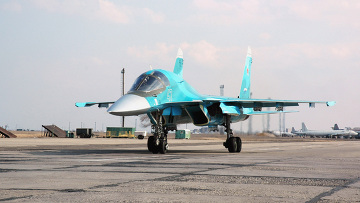
General-Lieutenant Sadofyev told RIA Novosti the VVS will receive 1,500 new, and 400 modernized aircraft by 2020.  The Chief of Aviation said the State Defense Order (GOZ or ГОЗ) for 2011 includes acquisition of Su-27SM, Su-30M2, Su-34, Su-35S, and Yak-130 aircraft for the VVS, as well as Ka-52, Mi-28N, Mi-8AMTSh (MTV-5-1), Ka-226, Ansat-U helicopters for Army Aviation.  But he provided no specific procurement numbers for next year.

Su-34 (photo: RIA Novosti / Igor Rumyantsev)

For Long-Range Aviation (LRA or ДА), he said the VVS will modernize existing Tu-160, Tu-95MS, Tu-22M3, and Il-78M aircraft.  The goal is to update 80 percent of this inventory in what he calls the medium-term future – defined by him as 2020.  What he has in mind here is service life extension and the replacement of some electronics and other systems.

For Military-Transport Aviation (VTA or ВТА), Sadofyev says the VVS will modernize its existing aircraft, and purchase more than 50 percent new ones.  He doesn’t break it down by particular types of transports.

For Frontal Aviation, some existing aircraft will be modernized, and over that medium-term future (2020) more than half the order-of-battle will be replaced with new aircraft, and 14 percent of the inventory will be ‘perspektivnyy’ (перспективный) aircraft.  One supposes that means PAK FA.  If that 14 percent is 70 PAK FAs, that would put Frontal Aviation at about 500 aircraft total.

Army Aviation, according to Sadofyev, will get 70 percent new aircraft by 2020, and 100 percent sometime afterward.  He said the VVS will begin getting the Ка-52 / Alligator next year.  And he made a point of noting that Army Aviation will remain within the VVS, despite rumors it might return to the Ground Troops.

He said serial deliveries of the Yak-130 trainer will begin next year to replace 1970s-vintage L-39 jets.  Flight instructors and technical personnel will learn the Yak-130 at Lipetsk before using it to train young pilots at Krasnodar.

Sadofyev also told RIA Novosti the number of VVS day-night, all-weather aircraft will increase 4.5 times, and this will lower aircraft losses by a factor of 10-12.  According to him, the share of precision weapons in the VVS will increase 18 times, taking it to 70 percent of the inventory by 2020.  So less than 4 percent of current air-delivered munitions qualify as precision weapons.  UAVs will be increased 6 times, taking them to 30 percent of the aircraft inventory.  So they are about 5 percent at present.  Sadofyev adds that money will go to providing a common reconnaissance-information environment for the VVS.

Defense Ministry spokesman Colonel Vladimir Drik also talked about VVS procurement last week.  He said the VVS got new and modernized aircraft this year, including Su-27SM and Su-25SM, and Mi-24PM and Ansat-U helicopters.  But he had to admit only the Ansat-U is new, and he didn’t provide numbers.

There was a major garble over the Su-27SM.  RIA Novosti quoted Drik as saying the VVS “received four squadrons of modernized Su-27SM” this year.  In fact, the transfer of the final 4 of 48 Su-27SM happened in late November 2009.

Drik said Russia’s air defenses will be 100 percent new by 2020, with the VVS operating the S-400, S-500, and Pantsir-S.  Once again, no one seems to want to talk about what’s going on with SAM production.

Igor Korotchenko’s take on VVS procurement from October looks pretty on-target in light of this latest press.  He said the priorities were precision weapons, automated C2, aircraft, and air defense systems.  And, at that time, he put the acquisition numbers at 500 new aircraft, 1,000 helicopters, and 200 air defense systems.

All in all, an extremely ambitious plan.  Fulfilling it will demand complete and timely funding, and even then it will be a challenge for Russia’s aviation industry.  Also, Sergey Ivanov says the GPV has gone to the government today, so maybe we’ll learn how VVS requirements fare.  VVS will be a priority, but we’ll have to see how high.

A Thoroughly Modern CINC

You have to like Air Forces CINC, General-Colonel Aleksandr Zelin. 

He’s open and candid about what Defense Minister Anatoliy Serdyukov’s ‘new profile’ reforms mean for him and his service.  He’s talked earlier, more often, and longer about it than his Ground Troops or Navy counterparts.  He’s matter of fact and accepting of the entire process. 

Serdyukov’s changes turned General-Colonel into a trainer and force provider, and he nonchalantly admits as much. 

At 57, Zelin understands he can be replaced at any time, or allowed to serve three more years or even longer. 

If he were a tad younger, he would have been the right kind of general to command one of the new military districts / unified strategic commands (OSK / ОСК), say the Western or Central.  An air or air defense officer would have been just the right choice for a potential future war on those axes.  Instead, the Kremlin has three Ground Troops generals and one admiral (a step in the right direction).  It’s hard to argue against Ground Troops leadership in Russia’s restive south.  But Air Forces (VVS or ВВС) would have been a really good choice in the Western or Central Military Districts . . . a missed opportunity for now.

But back to Zelin.  On Tuesday, he addressed a foreign military attaché audience (and the Russian media) about the future of the VVS.

According to Gzt.ru, Zelin said the VVS will be reduced by a third and spread among the four new  OSKs.  And its Main Command (Glavkomat) will be responsible only for combat training.  The OSKs are in charge of employing the VVS in their theaters.

The VVS now consist of the Glavkomat, 7 operational commands, 7 first-rank air bases, 8 second-rank air bases, and 13 aerospace defense (VKO) brigades.  Before the ‘new profile,’ the Air Forces consisted of 72 regiments, 14 air bases, and 12 independent squadrons and detachments, with a third more aircraft than the VVS now have.

Four of today’s 7 operational commands are subordinate to the new OSKs.  Army Aviation also falls under them.

According to Zelin, in the future, the VVS Main Command (Glavkomat or Главкомат) could become a “branch department” of the General Staff responsible for the combat training of the Air Forces and Air Defense, while the OSKs employ the trained forces.

Zelin says VVS personnel will number 170,000 with 40,000 officers, nearly 30,000 sergeants, and the balance conscripts or civilian specialists.  He says today’s personnel training system doesn’t satisfy him, and so he’ll probably change the system of flight schools.  Only four remain today.  Voronezh will be the main training center.  Flight training will also be conducted in Krasnodar and Lipetsk.  Yaroslavl will remain home to air defense officer training.

According to the CINC, the VVS airfield network won’t change.  Base airfields will be first priority for reconstruction and modernization.  Zelin says civilian airfields could be used for operational purposes in the future.

He noted the VVS plans to go to a fully automated command and control system in the future, and, of course, develop its VKO forces.

Lenta.ua quoted Zelin’s remarks to Interfaks.  Zelin said the VVS will renew 30 percent of its inventory by 2015, and 100 percent new in some areas and 80 percent new overall by 2020.  He doesn’t say where the VVS are today in this regard, but recall Defense Minister Serdyukov has said only 10 percent of equipment in the Armed Forces is modern.

Zelin said the VVS will get new aircraft, air defense, reconnaissance, and electronic warfare systems, but modernization of some existing systems is still part of the plan.  Although the State Armaments Program 2011-2020 and its 19 or 20 trillion rubles have to be finalized, Zelin repeated that 10 T-50 (PAK FA) will be acquired in 2013-2015, and 60 more from 2016.  He mentioned Military-Transport Aviation (VTA or ВТА) is a priority – including the An-124 Ruslan, Il-112, Il-476, Il-76M, and An-70 – but he doesn’t venture any numbers or dates for new production.  Zelin does give a target of 400 new and modernized helicopters in the inventory by 2015.

Who knows what was or wasn’t covered in these media contacts, but it seems odd there’s still no mention of more S-400 deliveries.  Zelin was still talking about getting 5-6 more battalions in 2010 earlier this year.  But no sign of them.  It’ll be a big deal when or if they appear.  Also, no mention of S-500 development.

Shamanov Doing Well, His Staff Not So Well

Interfaks reports the VDV’s spokesman says Airborne Commander, General-Lieutenant Vladimir Shamanov is doing well enough to receive visitors and work from his hospital bed, though doctors won’t say at this point when he might be discharged.

Tuesday’s Argumenty.ru reported bad news for Shamanov’s staff.  A Defense Ministry commission working in the VDV will soon issue its decision on cutting the airborne staff.  A military source says it’s only a formality since a decision, not favorable to the VDV, has already been made.

The officer said the commission arrived immediately after Defense Minister Serdyukov’s 30 September dust-up with VDV Colonel Krasov at the Seltsy training center near Ryazan.  It had mainly finance and personnel people.  Scheduled to work for two weeks, the commission needed more than a month, and didn’t finish until after Shamanov’s car accident on 30 October.

According to Argumenty.ru’s source, the report will consider it expedient to cut the VDV’s Main Staff by two times, transfer its headquarters from Moscow to Ryazan or Tula, and sell its current premises in Sokolniki.

Serdyukov’s Carte Blanche

In an editorial Monday, Vedomosti supported the carte blanche President Dmitriy Medvedev has apparently given Defense Minister Anatoliy Serdyukov and his military reforms.  The paper likes the reforms enough that it wants the President to think about the possible effectiveness of the ‘army method’ in reforming the MVD.  Here’s what Vedomosti had to say:

“Renaming the Army”

“Dmitriy Medvedev’s and Anatoliy Serdykov’s joint trip to a model Moscow suburban military unit went beyond the protocol of the visit.  The President’s speech in awarding outstanding military men became a new signal to officers, the army, and society:  ‘Despite the fact that all changes are difficult, they are necessary…  Everything that is now being done is directed at establishing modern and effective armed forces.  Here there are both problems and good decisions, I am following this personally as Supreme CINC.’  The Kremlin demonstrated that, despite the recent media scandal, it trusts the civilian Defense Minister, won’t bow to the generals’ and veterans’ opposition, and intends to continue its planned military reform.”

“The new carte blanche for Serdyukov for further transformation is important for many reasons.  The current minister is not the first civilian director of the military department.  However, he specifically replaced a campaign of reforming with systematic transformations.  In his inheritance from Sergey Ivanov, Serdyukov received a much truncated army of the Soviet type, not answering modern requirements.  Dedovshchina, obsolete armaments (modern equipment is not much more than 10% of the general inventory) and command and control, and manning were its main problems.  Add to this corruption among the generals which prevented equipping the army with new types of armaments and communications.  The victorious August war of 2008 showed that the victors couldn’t suppress the enemy’s aviation and artillery and were inferior to the vanquished in modern communications and reconnaissance means.”

“Serdyukov’s attempts to establish control over expenditures on purchases for the army met severe resistance from rear services officers and generals.  Not long ago he acknowledged to journalists:  ‘When I came to the Defense Ministry, speaking plainly, I was surrounded by large amounts of thievery.  Financial licentiousness, the impunity of people whom no one had checked out (…) was so deeply ingrained that it had already become a way of thinking.’  The minister confirms that the transparency of the defense order is a ways off.  The unnecessary secrecy of the military budget is interfering with this.  Meanwhile, progress in the struggle against traders in shoulderboards is obvious.  In 2006, corruption cases were started against seven generals, in 2007, when Serdyukov became minister, — against 16, in 2008 — against 20, in the first half of this year — against eight more.”

“Besides this, the Defense Ministry put up for sale unneeded property and facilities which were being illegally rented out to enrich a few people, and didn’t allow for building apartment blocks for officers needing housing on these grounds.”

“On the whole, it’s possible also to consider organizational transformations a success:  the transition to a more modern system of command and control and the reduction in the excess number of generals and higher officers.  In 2008, of 249 generals and admirals who underwent certification [аттестация], 50 were dismissed, and 130 sent to new places of service.  One can’t avoid mistakes in cutting and dismissing officers, but those deprived of a sinecure cried loudest of all about the collapse of the army and treason.”

“The struggle with barracks hooliganism goes on with varying success.  According to the Main Military Prosecutor’s data, in 2006, more than 5,800 people suffered beatings from fellow servicemen, in 2009 — 3,000.  And for the first five months of 2010, 1,167 soldiers suffered from dedovshchina — 1.5 times more than the analogous period of 2009, of them, four died.  The cause is not only in the growth — because of the cut in the service term — the number of new conscripts went from 123,000 in the fall of 2006 to the current 270,600.  Generals, having botched the program costing 84 billion rubles to transfer to contract, now are forced to call up those with criminal records.  Military police will remain a paper tiger for ‘dedy’ and ethnic clans.  We note that Serdyukov hasn’t forsaken a professional army, but put off its creation until the time when the Defense Ministry will be able to select and not collect contractees through deception and duress.”

“Nevertheless, it’s notable that over 3 and 1/2 years, the reform, being conducted by independent managers without legal changes and loud renamings, has really moved forward.  It’s possible it’s worth the President considering the effectiveness of the army method in reforming the MVD.”

Medvedev Inspects Strategic Forces

In Friday’s Nezavisimoye voyennoye obozreniye, Viktor Litovkin claimed, the day before, President Dmitriy Medvedev visited the inner sanctum of Russia’s Aerospace Defense (VKO or ВКО) – the Central Command Post (ЦКП) of the 3rd Independent Air Defense (Missile Warning) Army in Solnechnogorsk.  Now Litovkin admits VKO doesn’t technically exist yet.  But preparations are underway, and he suggests, besides PVO, SPRN, PRO, space monitoring, etc., it will even include the RVSN.  Litovkin maintains tests of this system are ongoing, and Medvedev came to inspect it.  He watched troops track all three of Thursday’s SLBM and ICBM launches, and saw the missiles’ warheads land on their respective targets.  And, according to Litovkin, the point was to demonstrate the reliability of Russia’s nuclear missile capability to Medvedev as new SNV treaty limits loom.

Could the shrinking RVSN be subsumed under VKO as a new service or branch?  Could this explain the fairly rapid command shifts from Solovtsov to Shvaychenko to Karakayev?