Category Archives: Conscription

Serdyukov Offers Access to Military Units

Varying media accounts of Defense Minister Serdyukov’s meeting Thursday with defenders of conscript rights lead one to think they attended different meetings.

But the Defense Minister deserves praise for facing some of the army’s sharpest critics.  And for apparently saying he wants to meet them routinely, according to Krasnaya zvezda.  His predecessors rarely did.

The headline story from the meeting was Serdyukov’s offer for civilian activists to accompany conscripts through the induction process until they reach their place of service, and settle into their units.  He also offered fuller access to the military’s bases.

RIA Novosti  quoted him:

“We want to propose an option for accompanying conscripts:  take part in the callup commission, and then go with them to units and see how they are billeted.” 

He added that he is prepared to let civilian representatives into all military units, with the exception of an unknown number of secret ones.

According to ITAR-TASS, he said:

“The Defense Ministry on the whole is interested in public organizations having access to military units.”

So Serdyukov bowed to greater civilian involvement, if not control or oversight, and also stumped for his efforts to ‘humanize’ conscript service in the armed forces.

His offer was interesting for the catch it included . . . these civil society representatives have to participate in the callup commission before they can go with new soldiers to their units. 

Maybe Serdyukov thinks they won’t take up the offer.  Maybe he thinks, if they do, they’ll dirty their hands in the difficult work of deciding who has to serve, or doesn’t, and where.  Maybe sorting through far-from-ideal candidates and still trying to meet manpower quotas will temper their criticism.

But it may give conscript rights activists even better insight into induction process problems and abuses than they already have.   We’ll see.

Serdyukov touted efforts to enable conscripts, especially those with dependent parents and children, to serve as close to home as possible, rather than sending them as far away as possible like in the past.

But Valentina Melnikova of the Union of Committees of Soldiers’ Mothers (SKSM or СКСМ) believes no one is fulfilling Serdyukov’s order to assign draftees closer to home:

“In military commissariats no one pays attention to this.”

According to Lenta.ru, Serdyukov cited his other innovations – introducing a rest hour after lunch, lifting virtually all restrictions on the use of cell phones by conscripts, giving them a chance to earn a weekend pass, and freeing them from all housekeeping and maintenance chores in their barracks, units, and garrisons.  But neither Serdyukov nor the media could say how widely these initiatives have been implemented. 

According to Krasnaya zvezda, Serdyukov wants to revive moribund parents’ committees introduced several years ago, but found impractical when young men served in remote areas far from home.  If they’re closer to home, their parents might be able to visit their units.  Serdyukov also mentioned the 4-year-old Defense Ministry Public Council.  Krasnaya zvezda reported that Melnikova is heading its working group to coordinate its activities with other public and human rights organizations.  Serdyukov expressed the hope that such a unification of efforts will be beneficial.

IA Regnum reports that Petersburg’s Ella Polyakova gave Serdyukov a detailed report on violations of conscript rights complete with statistics, concrete examples, and proposals to better protect them.

Polyakova would like to remove examining physicians from the callup commission, and from the control of the voyenkomat.  She said their qualifications need improvement also.  She objected to Serdyukov’s cuts in military medicine and called for better psychiatric assistance for conscripts in their units.

Polyakova says Serdyukov’s officer cuts have worsened the situation in the barracks.  Sergeants who were supposed to replace officers are ill-prepared for greater responsibility, and barracks violence has spiked as a result.  The Main Military Prosecutor’s figures support her.  Sergey Fridinskiy recently reported that hazing and other barracks violence increased 50 percent in the first five months of 2010.

Newsru.com reported Tatyana Kuznetsova’s concern about the army stretching its definition of fitness and taking men who should be deferred or exempt for health reasons:

“But, as we know, right away, having just reached the troops, many guys turned up in hospitals which were overflowing.  Like in a war, they laid in three rows, on the floor, in corridors.  These boys were called up sick, with chronic illnesses that weren’t discovered during the callup.  They weren’t discovered on purpose.”

All in all, it’s clear that, no matter how often they get together, Defense Minister Serdyukov and human rights activists will continue to disagree about the state of the army and how to change it.

According to IA Regnum, when Serdyukov said there’s no money for contract service, the activists asked him to explain:

“. . . how much money is being expended from budgets at all levels to fulfill the conscription plan in the ranks of the armed forces, as a result of which young men who are sick, invalids, and psychologically unstable end up in the army.  And next compare this with the amounts of expenditures to dismiss conscripts from the army after several months for health reasons, and to pay compensation to the families of those who have died or become invalids in peacetime.”

Contract Service Not Quite Abandoned

In St. Petersburg Thursday, Anatoliy Serdyukov explained that the Defense Ministry is cutting the number of contractees due to a lack of funding:

“We don’t have the resources to maintain contractees in the amount we want, therefore a reduction in contractees and an increase in conscripts are occurring.”

He made the remarks in response to complaints about higher draft numbers in a meeting with human rights activists.  

Serdyukov said the transition to permanent combat readiness units requires the Defense Ministry to take a full draft contingent, meaning that an increased number of those with an unfulfilled military obligation are being conscripted. 

But he repeated past statements that the armed forces will drop by 134,000 at some point to a level of one million personnel.

According to Svpressa.ru, at the March Defense Ministry collegium Serdyukov admitted:

“We are not satisfied with the results of this [contract service] program.  We somewhat underestimated the situation in units – who should transfer to contract, on what conditions, with what kind of pay.”

RIA Novosti cited GOMU Chief Vasiliy Smirnov from the end of July when he said that contractees will man more than 100,000 soldier and sergeant billets in the Russian military.  This press item added Smirnov’s comments that contractees will be 20 percent of the armed forces, and currently number 210,000.  And money freed up by the reduction in contractees will go to increased pay for other unidentified servicemen.

Some of this reporting – especially Smirnov’s 100,000 and 20 percent figures – seems garbled, but it’s just that some key background’s been left out.  Let’s rebuild some context around last week’s statements, so they make more sense.

Looking back on what was said officially last winter, General Staff Chief Nikolay Makarov had a much harder edge on his pronouncements about the failure of contract service.  Serdyukov was much less categorical; he emphasized that contract service was being cut, not abandoned.

Makarov and Serdyukov offered different figures on contractees; the former said 190,000 and the latter 150,000.  And Smirnov said 210,000.  Recall all three figures probably included 79,000 or less recruited in the 2004-2007 program.

Serdyukov said first the contract service program will be cut – perhaps down to Smirnov’s 100,000 – then eventually expanded to 200,000 or 250,000.  In his March interview, even Makarov said ideally a motorized rifle brigade should have about 20 percent professional enlisted personnel. 

At Alabino in May, Serdyukov said contract service is being reworked.  The key thing is he’s yet to explain exactly how he’ll do it.  For the time being, he’s saying there’s no money for it, but it remains on the agenda.

For now, contractees will or may be cut to Smirnov’s 100,000 level, but if they expand back to 200,000 somehow in the future, they would be 20 percent of Serdyukov’s million-man army.  For now, they’re going to be 18 or 13 percent of the army, and drop maybe as low as 10 percent before increasing (maybe).

We should also recall Valentina Melnikova’s admonition not to believe Russian generals (or defense ministers) when they say they can’t afford a professional army.  They just have other priorities right now.

Makarov on Iran, Lasers, Deferments, and Bulava

Attending today’s OPK modernization meeting in Ramenskoye, General Staff Chief, Army General Nikolay Makarov talked to the press, and said:

“A decision not to supply Iran with the S-300 was made, it, of course, falls under the sanctions.  The leadership made a decision to stop the supply process, we are fulfilling it.”   

He wouldn’t say the contract to supply them has been broken.  Apparently asked if the missiles could be provided in the future, Makarov said:

“We’ll see, this will depend on Iran’s conduct.”

Unnamed official sources put the price of the Iranian S-300 contract at hundreds of millions of dollars.

ITAR-TASS reiterated Defense Minister Serdyukov’s 20 August comment on providing Iran the S-300:

“We aren’t supplying anything.  There’s no decision on supplying them.”

Makarov’s comments coincided with President Medvedev’s ukaz implementing UNSCR 1929 from 9 June.  The ukaz expressly listed the S-300 as an item not to be transferred from Russia to Iran. 

Asked about Russia’s military laser program, Army General Makarov said development is on-going:

“Work on a combat laser goes on throughout the world, including here.”

He added that it was premature to talk about the characteristics of Russia’s laser system.

Answering another question, Makarov said student draft deferments won’t be abolished:

“The possibility of ending deferments for students is not being considered.  This issue is too socially significant.”

“There are many other measures which will allow us to resolve the situation [with the draft].”

He added that he expects Serdyukov to talk about the draft at Friday’s Defense Ministry collegium.

Asked if compulsory military service will be increased from 12 months, he said, “I don’t know if there’s sense in this.”

But Makarov went on to vent his frustration about conscription:

“Today not more than 13 percent of young people are called up, the rest aren’t called up for health reasons.  We need to understand what is happening .  It can’t be that only 13 percent of our young people are healthy.  Among people getting a deferment or exemption from the army on health grounds, 40 percent of them had documents either purchased or manufactured in some way.  In other words, there’s an issue, and we need to toughen monitoring in this area.”

Thirteen percent is really low.  And the corruption rate when it comes to health exams in commissariats is at least 40 percent.  We need to explore his numbers and math.  These are startling figures.

Makarov paid a little respect to Serdyukov’s fledgling effort to ‘humanize’ conscript service:

“A number of measures to reduce the load on prospective conscripts are being reviewed.”

Finally, press questions turned to the pending Bulava SLBM tests.  Makarov said:

“The missiles which we’re preparing to launch were produced from beginning to end under strict monitoring by military acceptance, the Defense Ministry, and the Military-Industrial Commission.  A great deal will depend on these launches.  If the launches are unsuccessful, then we have to shake up fundamentally the entire cycle of missile production.”

On the timing of the next Bulava test, Makarov contradicted Serdyukov’s last statement by saying:

“It’s doubtful this will happen in September.”

More Talk of Raising Draft Age to 30

Appearing on Thursday’s RIA Novosti talk show ‘Civil Defense,’ Deputy Defense Minister, State Secretary Nikolay Pankov claimed raising the upper age limit for conscription would benefit the army, and Russian society as a whole.

Under Russian law, men aged 18 to 27 are subject to the draft.  In April, GOMU Chief Vasiliy Smirnov floated the possibility of increasing the age to 30 as a way to help fill the army’s ranks at a time when 270,000 new conscripts are needed every six months, and contract service has failed to produce sufficient numbers of professional soldiers.

Pankov told his interviewer:

“I think this question [of raising the draft age limit] is very productive, and I wouldn’t reject this idea.”

But he admitted it needs more study.

After Smirnov’s April trial balloon, Defense Minister Serdyukov and General Staff Chief Makarov backed awayfrom raising the draft age, saying they were only ‘reviewing options.’

The issue really boils down to this:  how many 27-year-olds are the Russians currently drafting, and how much would drafting 28-, 29-, and 30-year-olds really help fill gaps in the ranks?

One has to conclude the return on conscription greatly diminishes at the outer edge, while resistance to it increases.  Forum.msk editor Anatoliy Baranov commented that raising the draft age limit to 30 is unpopular because average life expectancy for men is less than 60.  He continues:

“Of course, against the background of a general decline in the draft contingent by almost 2 times for social and demographic reasons, there are no and can’t be solutions fully compensating for this ‘demographic hole.’”

“How do you keep general military training and not draft everyone into the army at the same time?  There are, of course, solutions, but the current Defense Ministry leadership, it seems, consciously ‘overlooks’ them.”

Baranov seems to be saying, if the military wants a million-man army, with 600,000-700,000 conscripts, it’ll have to increase, not the draft age, but the draft term from one year back to 18-months or two years.

Story of a Noncombat Loss

Albert Kiyamov (photo: Chita.ru)

A recent case illustrates why most Russians don’t want their sons – especially talented, well-educated ones – to serve in the army.  It’s a tale of senseless violence and abuse going beyond dedovshchina , bullying, or hazing.  And it highlights how contract service makes sadistic riff-raff into unprofessional NCOs, and tormentors of the conscripts they’re intended to lead.  

For their part, more VUZ graduates are ending up in the army given the military’s need for higher numbers of draftees and its tighter enforcement of conscription rules.  The army believes more educated conscripts will make service safer, but it may just make them the victims of violence in the ranks. 

The investigation into the May death of a conscript named Albert Kiyamov in Transbaykal Kray recently ended with the filing of criminal charges against company sergeant Sergey Lugovets. 

Kiyamov was a promising graduate with a degree in nuclear physics, who’d been picked for a job in the Scientific-Research Institute of Nuclear Reactors.  But he got called-up in April.  According to Newsru.com, his family thinks his poor vision should have made him unfit to serve. 

Lugovets enlisted in the army despite a suspended sentence for theft in Volgograd Oblast, and became a sergeant in the headquarters company of the 36th Independent Motorized Rifle Brigade in Borzya (v/ch 06705).  According to Utro.ru, he quickly established ‘his order’ in the company.  And he picked Kiyamov to be his main victim. 

Kiyamov endured days of beatings and humiliation from Lugovets before jumping to his death from a fourth-story barracks window on May 14. 

According to Newsru.com, the command told Kiyamov’s family it was a simple suicide, but they refused to accept this, believing – based on the number of bruises and abrasions on his body – he’d been beaten, then thrown from the window.  The SibVO military prosecutor at first denied observing evidence of prior beatings on Kiyamov’s body.  But an investigation ensued. 

Sergeant Lugovets didn’t deny his guilt, but claimed he was trying to ‘teach’ Kiyamov how to conduct himself around his ‘seniors.’  He faces a possible 10-year sentence for “violating regulation rules of relations between servicemen, entailing serious consequences.” 

The unit’s officers were attending an exercise at the time of this incident, and military investigators gave them a warning to eliminate the kinds of violations that led to Lugovets’ abuse of Kiyamov.  

Vitaliy Cherkasov, Director of the Transbaykal Legal Defense Center, told Newsru.com about a similar incident in Borzya more recently, but, in this case, the soldier sustained serious injuries, and survived to be discharged from the army.  A legal defense group told Utro.ru the Kiyamov tragedy was possible because the Defense Ministry allows men with criminal records to sign up for contract service [of course, it drafts some with criminal records too]. 

Units in Borzya, and the Transbaykal generally, have a substantial history of problems with violence and abuse in the ranks.  On the positive side, investigators are getting to the truth in some cases, but too late for kids like Albert Kiyamov.

Medvedev Opens Discussion on Conscription Changes

Presidential Meeting on Conscription (photo: Kremlin.ru)

Talk of military conscription changes has swirled in recent months.  Many potential changes have been attributed to General Staff Chief Makarov or his deputy, GOMU Chief Vasiliy Smirnov.  

While they talked about extending the draft age to 30, or tightening deferments, Defense Minister Serdyukov played ‘good cop,’ launching initiatives to ‘humanize’ military service, and make more men willing to serve.

In the last week, the press has published favorable reports on the just-concluded spring draft campaign.  But, meeting with PA officials and ministers in Gorki yesterday, President Medvedev sounded a different note, indicating that a deeper look at Russia’s military manpower resources and policies is needed. 

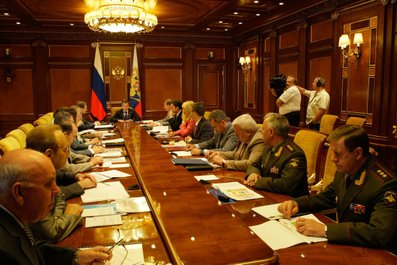
The meeting included relevant ministers, but not Prime Minister Putin.  Along with Makarov and Smirnov, Defense Minister Serdyukov and ROSTO / DOSAAF Chief Sergey Mayev attended.  Smirnov appears in uniform (bottom right of the picture), though it’s been thought he retired and put on civilian clothes.  He’s already 60, so he’s beyond the age limit for a general-colonel.  He’s served in the General Staff since 1982.  He was a GOMU directorate chief in the mid-1990s, then Deputy Chief, and Chief since August 2002.  Few Russian military officials should know their issues as well as Smirnov.

The key points in Medvedev’s meeting kickoff are that (a) Armed Forces’ manpower requirements are not being met; (b) no decisions on conscription changes have yet been taken; and (c) the public is supposed to get at least some kind of input on the issue.

Kremlin.ru’s coverage of the beginning of the meeting follows.

“Dmitriy Medvedev spoke of the need to conduct a rigorous analysis of the situation with military conscription and draw up proposals for its improvement.”

* * *

“D. MEDVEDEV:  Good day, colleagues!”

“We have an important issue for the life of our state — the issue of military conscription.  It’s clear that the overall effectiveness of the state, and ensuring security in the country depends on how we man our Armed Forces, and our law enforcement organs.”

“It’s clear that now there are complications:  army and navy requirements for conscripts are not being fully met.  This is connected to the demographic component, to demographic problems; this is connected to the health problems of young people.  All these issues have been discussed more than once both in meetings, and in the mass media.  We have to talk conceptually about what to do next.”

“There’s a range of proposals.  I want to say right off that all these proposals are still just proposals.  They need careful analysis.  Not a single one has any kind of preliminary approval, and we need to discuss them.”

“At first we’ll discuss them with the participation of the leadership of the Government, Presidential Administration, Armed Forces leaders, law enforcement structures, and special services.  Subsequent to such a type of decision all the same it needs to be discussed with the broader circle of society.  It’s essential to take public opinion into account in any case  because this concerns a sufficiently significant number of people in our country.”

Kramnik on Vostok-2010 and Military Reform

This is complete finally.

Ilya Kramnik’s RIA Novosti piece about the exercise has been quoted by others, but it hasn’t gotten attention as a whole on its own.

So what does Kramnik think?  He cites Makiyenko to the effect that Vostok-2010 showed that reform has been positive for the army, but there are, of course, problems.  Troops aren’t uniformly well-trained, and the failure of contract service has really hurt.  But Kramnik gives Defense Minister Serdyukov a lot of credit, on the order of being a 21st century Milyutin.  But back to the problems again.  Things like contract service, tension over officer cuts and premium pay, military education cuts, and the failure to deliver new weapons have to be fixed.  But Kramnik believes Serdyukov is the kind of guy who’ll go back and fix what he didn’t get right or get done.  Then Kramnik shifts to the type of conflict the military reform is preparing the Russian Army to fight.  Obviously [?] not a nuclear one, but rather, again turning to Makiyenko, a Central Asian local war scenario that might threaten the RF’s internal stability.  The conclusion is that, if reform stays on track and occurs quickly, the army will be able to meet this challenge.  Some, however, might well argue that even a properly and rapidly reformed Russian Army might not be enough to contain and damp down the kind of conflagration Makiyenko describes.  Finally, Kramnik concludes that even the U.S. front isn’t secure; an American regime in 2012 or 2016 might take to renewed active support of new ‘color revolutions’ in Moscow’s back (or front) yard.

Here’s a verbatim text:

“The official results of the just ended ‘Vostok-2010’ exercise are still being reckoned, and this will be done by the Defense Ministry.  Meanwhile, it’s already possible to make some conclusions.” 

“‘Vostok-2010’ was the largest of all in the post-Soviet period of Russian history.  More than 20 thousand men, 75 aircraft, 40 combat and auxiliary ships took part on the ground, in the air, and at sea in maneuvers conducted from Altay Kray to Vladivostok.”

“The aim of the exercise was to check the three-level command structure — operational-strategic command – operational command – brigade, and other new elements in the Armed Forces command and control and support system, and to uncover deficiencies needing correction.  An expert of the Russian Center for the Analysis of Strategies and Technologies Konstantin Makiyenko expressed his opinion on the recent maneuvers:  ‘The recent maneuvers fully refuted the propagated myth about how the army is being destroyed as a result of the actions of the current Defense Ministry leadership.  It’s obvious the army is alive and developing.  Units participating in the exercise demonstrated their combat capability, despite the fact that they are not in the ranks of the best military districts, and scarcely armed with the most modern equipment.'”

“‘It’s especially worth focusing on the good morale of the officer personnel — it’s not possible to speak of general enthusiasm, of course, but I didn’t see dim eyes among the officers.  As a group, they are interested in the success of the current reform and hope for its success.'”

“While agreeing with this point of view, one has to note that the situation with soldiers looks a little different, both RIA Novosti’s reviewer [Kramnik] and Konstantin Makiyenko have also noted this.  Very much depends on the branch of troops and the basic training of the soldiers themselves.  Contract-servicemen in a ‘Tochka-U’ operational-tactical missile launch battery look and are trained much better than conscript-soldiers in motorized rifle units.  In the words of motorized rifle officers up to the battalion commander level, the reduction in the number of contractees has negatively affected platoon and company training.  Ideally, the service term of a specialist-soldier (mechanic-driver, weapons system operator, etc.) needs to be three years, that is achievable only on the contract manning principle for these positions.”

“Speaking about the attainability of the announced goals of the reform, one can say the following:   the will of the military leadership which certainly exists, is the main component of success, a firm understanding of the goal is also obvious, and the possession of authority — it’s not possible to doubt this.  As a result, the current Defense Ministry leadership needs only time to realize its ideas.  Overall, the military reform being conducted is the most significant event of Russian history in the last ten years — since the suppression of the separatist rebellion in the North Caucasus.  The Serdyukov-Makarov reform in the military sphere is the most radical and deepest since the time of Mikhail Frunze’s reforms in the 1920s, if not since Dmitriy Milyutin in the 1860s and 1870s.”

“As proof, it’s possible to note the fact that the Defense Ministry leadership is constantly searching and ready to correct those steps which, when checked, turn out to be incorrect or unattainable in real political-economic conditions.  So, the current principles of manning the army will undergo a serious correction:  it’s obvious that neither the organization of contract service, nor, even more, the existing format of conscript service corresponds to the demands of the time.”

“Evaluating the correspondence of the Defense Ministry leadership to its missions, it’s possible to say, that at present Russia has the most appropriate military leadership since the collapse of the USSR.  At the same time, it’s obvious that the radicalism of the reform, the compressed time of its implementation, unavoidable resistance in the environment and hard economic conditions didn’t allow for avoiding a large number of mistakes and excesses.  Among the most fundamental failures it’s possible to name the collapse of the army’s transition to the contract manning principle, serious social tension arising in connection with the rapid reduction of officer personnel, the ambiguous situation with the scale of servicemen’s complaints after the introduction of the differential pay system [premium pay or Serdyukov’s Order No. 400?], the hurried and not completely thought out reform of military education and many, many other things.  It’s  particularly worth focusing on the implementation of the state armaments programs which fail one after another, not being executed in a significant part.  As a result, the lag of Russia’s Armed Forces behind the most developed countries in the level of  technical equipping continues to grow such that in conditions of a quantitative lag it could become very dangerous.  All these mistakes have to be corrected, since they impact on rudiments of the army’s combat capability.”

“For what type of wars does Russia’s new army need to prepare?  Obviously, the time of long wars between the great powers has gone into the past — nuclear weapons haven’t left chances for such a development of events.  The most probable type of conflict in which the Russian Army will be involved is a local conflict on Russia’s borders and the territory of the former USSR, in the course of which there could be clashes with the most varied enemy:  from a regular army to many bandit formations and terrorist groups.”

“In Konstantin Makiyenko’s opinion, Central Asia presents the greatest danger in the future of a possible hot conflict with Russia’s direct participation:  ‘The U.S. and NATO, obviously, are less and less controlling the Afghanistan situation, and it’s not excluded that in the foreseeable future they may have to abandon this country.  The return to power in Afghanistan of the ‘Taliban’ movement looks most realistic in the event of such a development of events.  The arrival of Islamic radicals in power would unavoidably be a catalyst for conflicts on the territory of former Soviet republics of the region already riven by contradictions.  Weak authoritarian regimes in Tajikistan, Turkmenistan and Uzbekistan, not to mention what’s become the ‘failed government’ in Kyrgyzstan, could be easy prey for the Taliban.  As a result, Russia might be forced to consider the likelihood of a large Asian conflagration which it would have to prevent, or if it didn’t succeed — extinguish, at a minimum with the aim of preserving its own internal stability.  One very much wants to believe that the reform will bear fruit before the described situation becomes a reality.'”

“Besides the described scenario it follows to study also the probability of another development of events:  as experience has shown, on the territory of former USSR republics, the rise of openly anti-Russian regimes with external support at their disposal can’t be excluded.  For today, such a situation is a low probability due to the fact that the current administration in the U.S. — the main sponsor of ‘colored revolutions,’ is clearly not inclined to continue the policy of George Bush.  However by 2012, if President Obama loses the election, the situation could change, and this risk is even greater in 2016 when the administration will change in any case.  Meanwhile, you have to note that even the Democrats remaining in power in the U.S. is not a guarantee of a peaceful life:  Obama’s point of view on a coexistence format with Russia is hardly shared by all his fellow party members.  In the worst case, a return to the next variant of Cold War and new spiral of the arms race isn’t excluded.”

“The coming decade isn’t promising Russia an easy life.  The success of military reform is all the more important.”

More on the Military Manpower Dilemma

Social Portrait of SibVO Conscripts (Photo: Trud)

Mikhail Lukanin wrote in Trud this week about the Defense Ministry’s unending manpower woes. 

He concluded that the first two months of this spring’s draft campaign showed there’ll be almost no way to avoid conscription.  Experts he talked to believe the Defense Ministry’s conscription plan is unrealistically high, and the armed forces will turn to inducting every student. 

The callup is supposed to run 1 April to 15 July, and take in 270,000 new soldiers.  Voyenkomaty have already sent 100,000 men—mostly from the Volga-Ural region and Siberia—to their units.  One-third of callup-aged men were screened out due to health problems, most of which were diagnosed initially when the men appeared before the military-medical commission. 

Experts consider the early part of the draft campaign the easy part.  Voyenkomaty have been dealing with young men not in school who go pretty willingly to the army, according to human rights advocate Sergey Krivenko.  

But he says in the last weeks of the draft the voyenkomaty have to meet their quotas mainly with VUZ graduates who don’t have any desire to serve.  Valentina Melnikova of the Soldiers’ Mothers’ Committee says: 

“Mass roundups in student dormitories have already begun.  They traditionally conduct them mostly in Moscow and St. Petersburg.” 

In the fall, 43,000 university and institute graduates found themselves in the army—that’s 15 percent of all conscripts. 

Demographers indicate that the number of 18-year-old men will fall, and not exceed 600,000 for the next two years.  That number equals the number of places available in higher education institutions.  Independent military-economic analyst Vitaliy Tsymbal concludes: 

“The Defense Ministry can fully meet its draft plan only by means of total conscription of students.” 

And it has done little to hide its appetite for students, according to Lukanin. 

GOMU Chief Vasiliy Smirnov already talked to the Federation Council about drafting students after one or two years in a VUZ, and the Education Ministry reportedly didn’t object.  The extension of the current draft until 31 August means that those finishing school at 18 can now fall directly into the army, rather than taking their VUZ entrance exams.  Similarly, the ‘nonstop draft’ means VUZ graduates hoping to start their graduate studies will now fall subject to the draft. 

Of course, Smirnov has also raised cutting sharply the number of VUZy that can provide students a draft deferment.  He talks about a 50 percent cut, expanded later to a 70 percent cut in qualified VUZy.  Trud has been told all nongovernmental institutions will lose the right to provide deferments. 

Sergey Krivenko believes in every draft about 130,000-150,000 conscripts are ready to serve [his number may be high since it wasn’t so long ago that 133,000 were drafted every six months, and surely not every one of them was happy to go].  If, according to Krivenko, the Defense Ministry stuck with this number, it wouldn’t have any problem with conscription [it would certainly have fewer problems].  He continues: 

“However, the whole point is that beginning with spring 2009 the plan jumped to almost 300,000 in one callup.  Troop commanders themselves say that half of this number is simply ballast for the army.  Mainly these are guys in poor health, with a low level of education, and also inveterate hooligans.” 

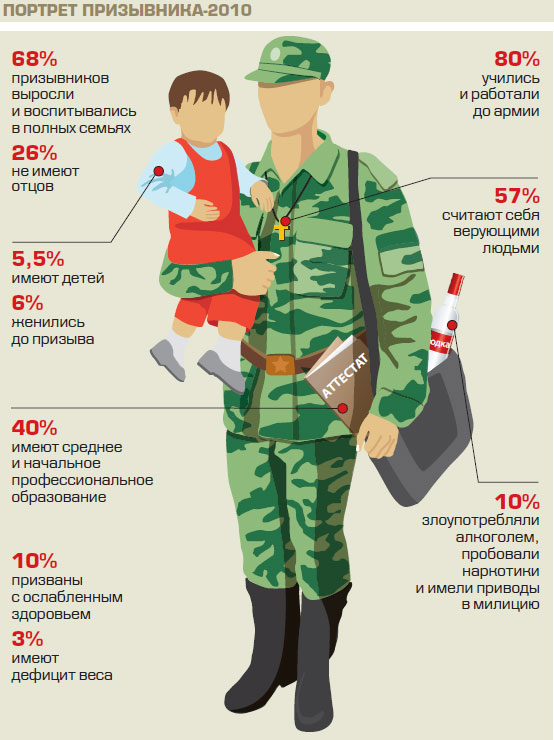
Lukanin had a second article reviewing data from a survey of 7,800 conscripts in the SibVO.  Every third conscript considers serving a burden.  Only 40 percent had a secondary school (high school) or initial professional (post-secondary technical training) education; 4.5 percent had a complete higher education.  A third of the men grew up without fathers.  One in ten admitted either misusing alcohol, trying narcotics, or having a run-in with the police before coming to the army. 

More than 30 percent said they came to the army just to avoid trouble with the authorities.  Two percent said they have a negative attitude toward the army [this represents the small number of young men willing to tell the army’s pollsters what they really think to their faces]. 

Experts tell Lukanin the poll results will change as conscripts from Moscow, St. Petersburg, and other large cities begin to arrive.  A figure of 15 percent with negative attitudes toward the army is about the norm. 

Ten percent of the conscripts have health problems.  Three percent are underweight. 

The medical condition of conscripts may be worsening.  Official data say half of conscripts have health-related restrictions on their service.  And army commanders confirm that it’s hard to find draftees without some kind of defect.  ‘Ideal’ soldiers (from a physical and social standpoint) are found only in honor guards.  The deputy commander of the Moscow honor guard battalion said last fall he traveled all over Kostroma Oblast and, of 1,000 candidates presented by local voyenkomaty, he accepted only 30. 

Finally, one last story of draft-related problems . . . Nezavisimaya gazeta ran an editorial this week describing how some conscripts finishing their year of service in the DVO, Pacific Fleet, and SibVO are not being demobbed on time.  According to this report, they are being held because the DVO doesn’t have trained soldiers to take their places and participate in the operational-strategic Vostok-2010 exercise starting at the end of June.  The editorial concludes that the spring conscripts don’t even know how to handle their weapons yet, much less find a target on radar.  NG calls it a symptom of the fact that the Russian Army never has, and never has had, enough specialists.  The editors could hark back to the need for a professional army, but instead they recommend a better system of reserve mobilization.

Sharp Cut in Contract Soldiers Coming

In the wake of General Staff Chief Makarov’s February admission that professional contract service had failed, a Defense Ministry source told Interfaks last week that contractees in noncombat positions will be sharply cut.  According to Newsru.com:

“It’s planned that by 1 July of this year only those specialists affecting combat readiness of military sub-units will remain in contract positions.”

He said this means combat vehicle commanders, driver-mechanics, gunner-operators, and other specialists, and civilians or conscripts will fill other contractee posts.  Lenta.ua noted the source didn’t specify how many contractees would be released or how many would remain.

Some of data cited referred back to a Vedomosti editorial about two weeks ago.  It said, under the 2003 Federal Targeted Program “Transition to Manning by Servicemen Conducting Military Service on Contract in Some Formations and Military Units” for 2004-2007, professional contract soldiers in permanent readiness units were to increase from 22,000 to 147,000 by 2008, and from 80,000 to 400,000 in the armed forces overall.  But in reality, there were only 100,000 in permanent readiness units by 2008, and only 200,000 in the Defense Ministry overall.  Meanwhile, the effort cost 84 billion rubles.  Vedomosti concluded:

“It seems the generals could not fulfill (or sabotaged) the directives of the country’s highest political leadership in peacetime.  Who will guarantee that the generals’ disobedience won’t be repeated in an emergency situation?”

“The Defense Ministry could not organize or make professional service in the army attractive and it sees as a way out stuffing the developing hole with a growing number of conscripts.  It’s understandable that the quality of these one-year draftee soldiers will be lower than that of contractees.”

“The abandonment of the move to a professional army promises many dismal consequences for Russia’s future.  Drafting 27-29-year-old higher educational institution graduates, who are in professional demand, could deliver significant damage to the economy and scratch the country’s modernization.”

So what is to be done?

This spring the Defense Ministry floated several trial balloons to answer its manpower problems.  As Parlamentskaya gazeta reported, the chief of the Genshtab’s GOMU, Vasiliy Smirnov told the Federation Council last month that he wants to increase his conscription base by reducing student deferments, raising the upper limit of the call-up age from 27 to 30, lengthening the semiannual callup until it becomes almost perpetual, and requiring young men to report to voyenkomaty without a summons.  Reportedly, the Kremlin has approved some or all of these proposals.

The Genshtab has proposed cutting the number of VUZy with the right to provide students deferments.  Even though deferments were trimmed in the recent past, Russians still have 21 legal ways to postpone their military service.  Smirnov claimed over 2 million draftees, more than 60 percent of the overall number, legally ‘dodge’ the army with deferments, the vast majority of which are educational deferments.  He continued:

“The number of higher educational institutions in which study is a basis for the right to a draft deferment from military service has to be reduced in stages.  Already this year it would be advisable to cut the number of VUZy having the right to a deferment in half or even by 70 percent, keeping that right only for educational institutions having a state order.  An alternative option could be having students perform conscripted service after the first or second year of studies.  The Education Ministry made this study and sees no negative consequences.”

Noting that voyenkomaty have been unable to notify 200,000 men to report, Smirnov concluded:

“Thus, the existing system of holding citizens liable who for some reason are not fulfilling military service obligation is ineffective today.  We have to change the system of notifying citizens.  In case a person does not receive the notice from the military commissariat, it is proposed that he go to the induction center on his own on the date indicated in the certificate of a citizen subject to call-up for military service.  This procedure functions in many states.”

Summing up, Smirnov said:

“A General Staff analysis of capabilities for manning the state’s military organization with conscripted servicemen showed that the needs of the state’s military organization for a draft contingent will not be supported as early as the end of 2010.”

In other words, the ‘demographic hole’ created by the sharp reduction in male births during the early 1990s is beginning to have its inevitable effect.

Deputy Defense Minister, State Secretary Nikolay Pankov and Main Directorate for Socialization Work Chief Yuriy Dashkin appeared at a Duma roundtable on 31 May to discuss conscription and conscript life.  According to RIA Novosti, Dashkin told Duma members, “Today the armed forces, dealing with a large number of tasks, are forced by the state’s economic condition, by resource provision, to rely still on a conscript army.”  Pankov said he could not give percentage figures on the future mix of conscripts and contractees in the Russian Army.  Soldiers’ Mothers Committee chair Svetlana Kuznetsova expressed doubt that the army will be able to induct 270,000 men as planned this spring.

Trud recently published a number of open letters to President Dmitriy Medvedev, one of which came from Soldiers’ Mothers’ founder Valentina Melnikova.  She asked Medvedev to end conscription, writing:

“Dear Dmitriy Anatolyevich, explain, please, why the Defense Ministry buried the idea of creating a professional army in Russia.   Back in 2003 the government adopted a special Federal Targeted Program on the full manning of all permanent readiness units with contractees.  All together, it was proposed by 2008 to bring into the forces 147,000 professional sergeants, for this 79 billion rubles was allocated.  The Defense Ministry reported that it was managing the task, and promised to increase the number of contractees in the army, and reduce the share of conscripts.  But in the end everything turned out exactly opposite.  At the beginning of this year the military officially stated that the task of building a professional army is being put off for indefinite long term.  As regards conscription into army units, the Defense Ministry intends to take it to 700,000 per year.  It’s simply impossible in Russia to find so many boys fit for military service according to the state of their health.  Almost a third of all conscripts that end up in the army have serious illnesses.  They’ll make just as many young citizens serve who have parents who can’t work.  End conscription and force the generals to create an army not of boys, but of professionals.  And don’t believe the generals when they say Russia doesn’t have the money for a professional army.  Independent experts believe that the state, if all expenditures are considered (pay for voyenkomat doctors, medical evaluation in hospitals, transporting conscripts to their service locations, assistance to soldiers’ wives, etc.), spends 150 billion rubles every year on conscription.  It seems to me that for this money it would be fully possible to maintain a fully contract army in a worthy condition.”

Poor Health of Potential Conscripts

The Defense Ministry press service today revealed some scarcely concealed official irritation with the poor health of its pool of potential conscripts.

ITAR-TASS reported that almost half the men called to draft commissions have been sent for medical observation.  The press service source told ITAR-TASS:

“As of 21 May draft commissions have made decisions on 155,300 of those called up, more than 70,800 men have been sent to places of service.  Since the beginning of the call-up, military commissariats have sent nearly 67,000 young men for medical observation.”

The draft campaign which began 1 April will call 270,000 men into the armed forces and other militarized structures.  The largest numbers of conscripts thus far have come from the Volga-Ural region and Siberia.  In last year’s competition for citizens best prepared for military service, Tatarstan was first, Stavropol second, and Arkhangelsk third.

ITAR-TASS concludes, in the Defense Ministry, they remained worried as before by the weak health of Russian conscripts.  In the 2009 call-up [not clear if this means spring, fall, or both draft campaigns taken together], 68 percent of those appearing at draft commissions were found fit for military service without limitations or with insignificant limitations, but of the number actually inducted into the service, more than half had various limitations because of their health.  This prevented sending them to military units with high demands on servicemen–the VDV, VMF, MVD VV, and others.

ITAR-TASS reports doctors were forced [spring, fall, all of 2009?] to send nearly 86,400 of those called-up to ambulatory or in-patient observation in medical facilities because of unsatisfactory health indicators.  And their fitness for service can only be determined once they complete medical observation.  The item notes that, over time, 1-3 percent of young guys go ‘AWOL’ from observation and don’t complete it.  The fact that young men manifest health problems for the first time when they’re in front of the draft commission shows the weaknesses of the health care system.  The Defense Ministry also believes this shows that medical prophylactic measures for young people are poorly organized in the regions.