Category Archives: Defense Industry

Quoting Tolya

Tolya’s remarks to the press today made quite a few headlines, and left a few useful benchmarks for the future.  Defense Minister Serdyukov addressed procurement and manpower issues.  Here are his quotes from RIA Novosti and ITAR-TASS.

Tanks for Nothin’

“We met the designers who proposed their preliminary work to us.  60 percent of what was proposed is old work.  Therefore, we still declined these proposals.”

“Now it’s more expedient to modernize our country’s tank inventory than to buy new ones, for example the T-90.”

Cold Water on Carriers

“We have no plans to build aircraft carriers.”

“Only after this [a preliminary design of what this ship might look like], the Genshtab together with the Navy will make a decision on the need for such a ship.”

SSBNs Aren’t Automobiles

“‘Bulava’ flew, this is good news.  We understand precisely that it’s possible to launch serial production of the missile on this variant.”

“We got the result, now it’s possible to load SSBN ‘Yuriy Dolgorukiy’ with ‘Bulava.'”

“We’d like to do this [test Bulava from Aleksandr Nevskiy], but we understand that to plan this precisely is impossible.  A nuclear submarine isn’t an automobile.”

Bullish on Arms Deliveries

“Deliveries of strategic missiles ‘Topol-M,’ ‘Yars,’ ‘Avangard’ will increase three times, ‘Bulava’ and ‘Sineva’ missiles for strategic submarines one and a half times, aircraft four times, helicopters almost five times, air defense systems almost two and a half times [in 2011-2015 compared with 2006-2010].”

Not Going Below a Million Men

“There are no such plans, there are no questions of cutting manpower.  We’re striving for the entire army under the million number, and it isn’t planned to cut this figure.”

“On account of this [increasing contractees from 2014], we’ll manage without fail to get through the demographic hole which is anticipated in 2014.”

Two Arctic Brigades

“The Genshtab is now developing plans to establish two of these formations.  In the plans, deployment places, armaments, manning, and the infrastructure of these brigades need to be specified.”

“It’s possible this will be Murmansk, Arkhangelsk, or another place.”

Bulava Launch Window

An OPK source told RIA Novosti yesterday a state commission on experimental flight testing has identified June 28-30 as the window for this year’s first Bulava SLBM test.  The commission will select a precise date within the next two days.  The source says Borey-class SSBN Yuriy Dolgorukiy will be the platform for the launch.

No Funding for Domestic UAVs

Israeli Searcher Mk.2

RIA Novosti reports a highly-placed OPK representative says development of Russian UAVs hasn’t been financed for two years.  According to him, this is connected with the drawn-out work of Defense Ministry experts considering Israeli drones purchased two years ago.  The source continues:

“It’s obvious Russia’s Defense Ministry can’t figure out its future actions:  either continue to buy UAVs abroad, or finance our own development.”

It seems pretty clear to this author it’s the former, especially considering the following figures.

TsAMTO gave the news agency a rundown on Russia’s 2009 contract for Israeli UAVS:  two Bird Eye-400 ($4 million), eight I-View Mk150 ($37 million), and two Searcher Mk.2 ($12 million).  TsAMTO also says a $100 million contract for 36 unspecified UAVs was signed later.

RIA Novosti also notes, this March, the Defense-Industrial Corporation (Oboronprom) agreed on a $400 million contract with IAI to assemble Israeli UAVs in Russia.  Oboronprom’s Helicopters of Russia sub-unit is responsible for the Russian side of this joint venture.  At the time, Russian experts argued that comparable domestic UAVs were several times cheaper.  But Russian designers also acknowledged lagging in some technologies, particularly optical-infrared sensors and data transmission.

More than a year ago, then-Armaments Chief Vladimir Popovkin said 5 billion rubles had been spent on domestic UAV development without result.  Then months of comparing foreign and domestic models followed.  And now the money trail makes it pretty obvious the Defense Ministry (and big OPK players themselves) are intent on buying abroad.  Small Russian UAV makers are the short-run losers. 

This seems a smart choice for now.  It will be some time before  Russia successfully integrates foreign-designed UAVs into its military operations.  There doesn’t seem a compelling reason to aim for self-sufficiency in something that’s still a niche mission. 

What will happen depends on how Moscow handles its domestic developers.  Will they be able to apply foreign UAVs to their own work and make competitive models of their own?  Falling behind on pilotless technology is not exactly a negligible risk in the coming unmanned age.

PAK FA in 2019?

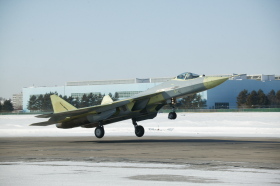
PAK FA

According to ARMS-TASS, Deputy Chief of Rostekhnologii Dmitriy Shugayev told the assembled press corps at the Paris Air Show that Russia’s PAK FA will need about eight years to reach serial production.

This sounds like a very different story from what we’ve heard thus far.  Most official pronouncements have talked about starting serial production in 2015 or 2016, and pretty much completing the run by 2020.

No reason or context was given for what seems a pessimistic appraisal of PAK FA’s timeline.  However, it might be connected to the challenge of getting “second phase” engines on the aircraft.

Government Hour (Part II)

There was plenty of interesting media coverage of the Defense Minister’s meeting with the Duma on Wednesday, and plenty of criticism of what he said or didn’t say.  Plenty worth covering in a Part II, especially regarding Serdyukov’s effort to shift the blame for another failing GOZ.

Radio Svoboda quoted KPRF deputy Vladimir Ulas putting all the blame for the army’s current state right at Anatoliy Serdyukov’s feet:

“The public clearly understands that the situation in the Armed Forces is far from favorable.  Constant scandals which rock this department, the morale-psychological situation in which personnel, first and foremost, the officer corps, find themselves, both the material condition, and the lack of modern armaments – all these problems are completely real.  I also hoped to hear answers to questions, how the Defense Ministry intends to solve them, from the minister.  But, to my greatest regret, the biggest, in my view, problem of today’s Armed Forces is the absolutely dense incompetence of the military leadership.  With people like Serdyukov still heading our Armed Forces, and he, unfortunately, is far from the only one, hoping for some kind of positive shifts is absolutely senseless.”

There was plenty more to be said about problems with the GOZ, the OPK, and the VPK and Defense Ministry blaming each other for what looks like a failing GOZ-2011.

KPRF deputy Anatoliy Lokot told Nakanune.ru:

“I have the impression that these sessions are ‘closed’ to hide the bitterness of the questions and negative results of the work of Military-Industrial Commission (VPK) and Defense Ministry leaders.”

United Russia’s Igor Barinov reiterated what he said he told President Medvedev a year ago:

“I noted then that the lack of competition and incomprehensible system of price formation in the VPK is a deadend path.  We’re reaping the fruits of this now.  Judge yourself:  one, well, a maximum of two enterprises produce this or that type of our armament or military equipment.  Meanwhile, enterprises getting money from the federal budget dispose of it as they wish.  Prices simply come from the ceiling.  No one bears any responsibility for quality.  No one invests money in improving types of military equipment, in the end it goes that even in infantry weapons we’ve fallen behind.  Our legendary automatic weapon Kalashnikov, the value of which everyone recognized before, now lags the best Western types in tactical-technical characteristics.  And so it is in almost every area, with rare exceptions in the areas of missiles and some aircraft.”

“The Defense Ministry announced it won’t buy airborne combat vehicles [BMDs] and infantry combat vehicles [BMPs] from ‘Kurganmashzavod.’  This enterprise was one of the guilty in breaking the Gosoboronzakaz.  And here’s the thing in this.  ‘Kurganmashzavod’ is part of the United ‘Tractor Plants’ Corporation.  Budget money is shared out with ‘Kurganmashzavod’ in a targeted way for the purchase of equipment, but the corporation’s directors dispose of it according to their discretion, and, naturally, BMP and BMD production is the last thing of concern for the owners of this holding company.”

“If they understand that they can be deprived of budget resources, then this enterprise will be forced to invest in quality, and in cutting defects, and in the improvement of product types.  In addition, strict supervision is needed.  Money was allocated but no one asked anyone about this money, and the result was zero.”

The KPRF’s Lokot also dwelled on the GOZ:

“It’s obvious that if the Gosoboronzakaz isn’t formed in the first half of the year, then nothing will be accomplished in the remaining part of the time since money will only begin coming in at the end of the year.  Serdyukov acknowledged that today 13.4% of all contracts in the plan have been formed.  Some time ago, Sergey Ivanov gave us other numbers.  But I think that this number juggling was caused by competition between the Defense Minister and the Military-Industrial Commission.  Ivanov lumps all the blame on the Defense Ministry, Serdyukov – on the defense-industrial complex.  He even began his [Duma] speech with this, saying that the military-industrial complex is guilty of everything.  They have poor qualifications, technology losses, poor production and so forth.  But really at a minimum the Defense Ministry itself bears 50% percent of the responsibility for such a situation.”

“I have given the example of Novosibirsk proving the obvious guilt of the Defense Ministry in breaking the order.  One of the enterprises – the Lenin Factory, which puts out very important products for infantry weapons, became a victim of Defense Ministry officials.  In January this year, Serdyukov opened a state order tender with his signature, but closed it in March.  Now half the year is gone, and there are no results.  The enterprise isn’t working, products aren’t coming out, 211 million rubles spent on reequipping won’t bring any returns, and now they’re generally talking about cutting part of the work force.

“Right in Novosibirsk at the Comintern Factory the S-400 surface-to-air missile system is being produced on the enterprise’s own money, and not with government resources.  Serdyukov says:  ‘I don’t see anything terrible in this, let the enterprise do it on its own money.’  But where does it get its capital resources?  What world is Serdyukov living in?”

Vedomosti talked to a former Defense Ministry official who basically said the threat of arms purchases abroad really didn’t scare anyone.  And, according to him, although Serdyukov considers defense industry leaders lazy and prone to stealing, everyone understands imports can never replace domestic production.  Finally, a source close to the PA told the business daily that Serdyukov himself opposes the Mistral acquisition because of the large expenditures required to build its base infrastructure.

Mistral Endgame?

Mistral (photo: ITAR-TASS)

Maybe.  Maybe not. 

The Mistral contract endgame may in fact be upon us.  But some major players have warned (more than once) of a protracted negotiating process.

Kommersant reports Rosoboroneksport and DCNS signed a “contract” on June 10 for the first two Mistral units, according to a source familiar with the course of negotiations. 

After meeting President Medvedev at the G8 summit on May 26, French President Sarkozy said a “contract” would be signed in 15 days [that would have been June 10].  Now Sarkozy also said in late May that a Mistral “contract” would be signed on June 21 when Prime Minister Putin visits France.  Kommersant suggests this could be an official unveiling of whatever was signed on June 10.  But an RF government source said this isn’t planned, according to ITAR-TASS

As for the terms and price . . . the Russians were insisting that the Mistral come equipped with the SENIT 9 tactical combat information system and licensed rights for €980 million, but the French were saying no such tech transfer for €1.15 billion.  Also according to this story, the French don’t intend to provide SIC-21 in the Mistral package.

In contrast to Kommersant, RIA Novosti says what was signed last week was no more than a “protocol of intent” to sign a “contract.”  The news agency said the date and place for the “contract” signing remains up in the air, but it could be the international naval exhibition in St. Petersburg from June 29 to July 3.

It also says the price will be between €1 and €1.2 billion, and the French military still opposes giving SENIT 9 to Russia.

Rosoboroneksport’s press-service denied that a “contract” has been signed, and told media outlets the negotiations are in their concluding phase, and a Mistral contract is in the process of “technical formation.”

Utro.ru sums up what many may think about acquiring four units of Mistral:

“Military experts still don’t know precisely why Russian sailors need them, since all of two [sic] ships will scarcely substantially change the situation in the fleet.  It’s not excluded that Russia, first and foremost, wants the technologies the French use in constructing ‘Mistrals.’”

It’s also not excluded that perhaps some involved want the deal itself, commissions, bribes, and kickbacks, more than they want the ships.

Not Utopia

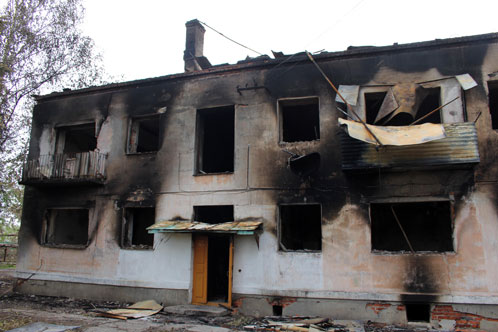
Burned Out Building in Urman Near the 99th Arsenal (photo: Komsomolskaya pravda / Timur Sharipkulov)

Yes, it’s definitely not utopia.

Sometimes it seems Anatoliy Serdyukov resides in a special dystopia reserved for reformers.  In an interview at the very end of last year, Serdyukov said as much.  He admitted his reform of the military isn’t solving every problem.

Addressing munitions dismantlement on December 31, the Defense Minister said:

“The problem is very serious.  For long years, munitions were stockpiled to excess, calculated for a multimillion-man army.  Besides, in the last twenty years, virtually no attention was given to combat training and firings, but the norms of munitions stockpiling remained as before.  As a result, so much ended up in excess that we have work for several years.  To dismantle them by industrial methods is quite complex – there aren’t enough enterprises.  Besides, this is very expensive and not safer than destruction.”

“Therefore, we’re now preparing special teams, certifying equipment, and selecting officers.  They mainly need to be combat engineers.  We’re picking ranges.  We’ve figured where, in what volume, and what we need to blow up, and worked out safe techniques.  We need at a minimum two, maybe three years of such work.  Yes, this will create some temporary discomfort and difficulties.  But it’s impossible to not do this.  If the entire arsenal at Ulyanovsk had blown up, the trouble would have been much more serious.”

Well, he’s right.  It’s a huge problem that has to be resolved. 

There was lots of good (albeit repetitive) news reporting on the two arsenal explosions, and the news analyses and op-eds had a lot of common themes we’ll summarize below.  Many of the same points were made at the time of the 31st Arsenal disaster in 2009.  The major shared ideas are:

  • Russia’s munitions depot problem is enormous, and massive resources are required to resolve it.  The current effort is very belated, and probably grossly underfinanced.  And now the dismantlement and destruction of excess ammunition is being rushed with tragic consequences.
  • Conscripts and crude methods are being employed in place of professional military specialists, civilian experts, and modern equipment.  There’s a willingness to ignore basic safety regulations since draftees are still considered expendable.
  • Military district commanders were not appropriately prepared to supervise storage depots and the dangerous work of eliminating explosives when they took control of them from the Defense Ministry’s Main Missile-Artillery Directorate (GRAU). 
  • The three criticisms above all add to blaming Serdyukov’s reforms for the exploding arsenals.  Critics say he’s rushed the process, forced now sorely-needed ordnance officers out of the army, and taken the situation out of the GRAU’s experienced hands.

Now, to be fair, some of the conditions listed above existed before Serdyukov arrived, and some he created or exacerbated.  And arsenals exploded before.  But these disasters seem to occur more frequently now.

A few other points made by commentators:

  • Trying to destroy munitions on the cheap is leading to even greater losses for the state when it has to compensate injured civilians.
  • Other countries have eliminated huge munitions stockpiles safely, but Russia seems to have a peculiar national tradition of technological carelessness that keeps it from doing the same.
  • The Kremlin and the Defense Ministry won’t find the guilty in these explosions, but some officers and, possibly, officials, will be appointed to fill the role.

Moreover, the MChS says wildfires already cover an area three times larger than this time last year.  Another terrible fire season might threaten many military facilities, including arsenals.

To sum this all up, it’s worth reprinting how Vladislav Shurygin was recapped on these pages 18 months ago:

“He cites the catastrophic state of Russia’s overflowing arsenals and munitions depots.  This summer Serdyukov transferred responsibility for them from the GRAU to the MDs and fleets who aren’t technically prepared to manage them.  Shurygin notes it was GRAU personnel who were punished for the November blasts at the Navy’s arsenal in Ulyanovsk.  Convenient people are punished rather than those who are truly guilty, according to him.”

Dolgorukiy Returns to Sea

This morning ITAR-TASS reports that fourth generation Borey-class SSBN Yuriy Dolgorukiy is at sea for testing.  This is the boat’s first underway period of 2011. 

At the close of last year’s Arctic navigation season, Dolgorukiy returned to the hall at Sevmash, where it was prepared for the concluding phases of its state underway testing.  Sevmash says the submarine should be officially handed over to the Navy within the next few months.

Recall the Russian press reports that modified Typhoon SSBN Dmitriy Donskoy will be the launch platform for this year’s first Bulava SLBM test.

Fateful Season for Bulava Begins

A Defense Ministry source tells RIA Novosti that Bulava SLBM testing will resume between 15 and 17 June.  The test launch will come from modified Proyekt 941U SSBN Dmitriy Donskoy, though the source claims Borey-class SSBN Yuriy Dolgorukiy is ready to fire the missile.

Recall that Proyekt 955 Dolgorukiy was back at Sevmash for work this winter.

The source says the first launch from Dolgorukiy will come after two successful firings from Donskoy.

Bulava now has 7 reported successes in 14 tries.  There will be 4-5 tests in 2011.

If they are successful (and at least a couple come from Dolgorukiy), the SLBM and its intended submarine will be accepted into the Navy inventory.  And serial production of Bulava will ramp up. 

If they aren’t, the naval strategic modernization effort will find itself back where it was prior to two successful launches last October.

But the Russians seem pretty confident this time around.

Kicking the Defense Ministry and OPK

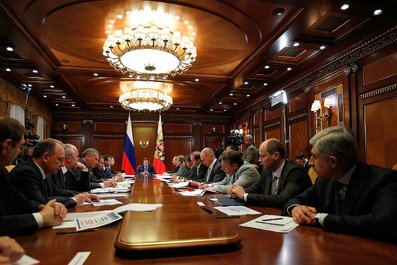
President's Meeting on the OPK

President Medvedev is irritated as ever that the Defense Ministry and OPK aren’t moving out smartly to rearm and reequip the Armed Forces.  He’s trying to kick them into gear, but can he get results where his predecessors either didn’t care or simply failed?

According to Kremlin.ru, Medvedev met this afternoon in Gorki with a host of government officials and industrial chiefs.  They included, inter alia, Sergey Ivanov, Anatoliy Serdyukov, Vladimir Popovkin, Nikolay Makarov, Denis Manturov, Yuriy Borisov, Sergey Chemezov, Sergey Nikulin, Mikhail Pogosyan, and Roman Trotsenko.

Medvedev’s opening monologue enumerated what’s been done for defense industry — providing a full state defense order and financial support, creating integrated development and production structures [OSK, OAK], etc..

Then the President says:

“However, despite all adopted measures, the state of defense production cannot be called good, all attending understand this.  There are objective reasons:  the deterioration of enterprises’ basic capital is nearly 70 percent (on average), in some enterprises it’s all much worse.  We still have not even managed to establish effective mechanisms to attract innovation and off-budget resources to the defense-industrial complex.”

Medvedev goes on to say that all relevant documents, including the GPV 2011-2020, have been signed, but the assembled group still needs to think about how to implement the GPV.  He reviews how he talked at the Defense Ministry Collegium in March about balancing producer and buyer interests, about justifiable and understandable prices.

But in many areas, says Medvedev, this has already become moot, and he intends to increase responsibility for the fulfillment of these obligations.

First, he wants a Federal Goal Program for OPK Development in 2011-2020.  Its focus is to be “real readiness” of the OPK to produce actual weapons and equipment.

Second, he wants the Defense Ministry to finish placing GOZ-2011 completely by the end of May, and advance payments issued to producers in accordance with the 2011 and 2012-2013 plans.

Work to date, he says, is going poorly and slowly.  He reminds the assembled that he told them about the failure of previous state armament programs:

“Today I want to hear from all present why this happened:  both from government leaders, and from industry leaders, who was punished for this and how.  Report proposals to me, if they still aren’t implemented, with positions, with the types of responsibility, completely concretely.  If such  proposals aren’t reported, it means [industrial] sector leaders and government leaders have to answer for it.”

It’s unacceptable, he says, that high-level decisions have been made, money allocated, but a product isn’t supplied.  He recalls his late 2009 Poslaniye in which he said 30 land- and sea-based ballistic missiles, 5 Iskander missile systems, nearly 300 armored vehicles, 30 helicopters, 28 combat aircraft, 3 nuclear submarines, one corvette, and 11 satellites would be delivered in 2010.  

Everyone here, says Medvedev, agreed with this, so why wasn’t it done.  He is, he says, waiting for an answer, and:

“. . . we have to answer for the duties we’ve taken on ourselves, we look simply in this sense absolutely unacceptable.”

Medvedev finishes by saying he knows military production is profitable, and it’s possible to attract strategic investors.  He says he wants to talk about how to stimulate investment.  The goal for the day is concrete reports on what’s been done on the level of those responsible for organizing work and correcting the situation in defense industry.

Where’s this leave things?

Not exactly throwing down the gauntlet, just another warning that he’s getting serious.  But it’s doubtful the government or defense industry will take Medvedev seriously until he fires a minister, other high-ranking official, or an important enterprise director.  And it’ll probably take more than a couple dismissals to get anyone’s attention.  Medvedev is running out of time on this account (as well as others).  Those he’d like to make responsible or punish will just take the tongue-lashings and wait him out.