Category Archives: Defense Industry

Su-35S to Start State Testing

In their excitement about new armaments, many observers have a hard time keeping book on the latest weapons, forcing yours truly to follow a few important systems like the Su-35S.  Some even say the Su-35S is already in the inventory, but a close look at press reporting shows otherwise.

The media reported the first series production Su-35S flew at KnAAPO in Komsomolsk-na-Amure yesterday.  After these factory trials, this aircraft will be delivered to the Defense Ministry.

Sukhoy has successfully completed preliminary testing on the Su-35S prototype.  Preliminary testing confirmed that its on-board systems meet technical requirements, checked its reliability and controllability, its engines, and navigation system.

According to ITAR-TASS, a Sukhoy spokesman said:

“The Su-35S has been presented for state joint testing [ГСИ or GSI].  The first step in the framework of the fighter’s state joint testing will be receipt of the preliminary finding of the customer – Russia’s Air Forces on the aircraft’s correspondence to main requirements with the aim of providing it to Air Forces’ operational units.”

Now recall that late last August Sukhoy said the Su-35S was completing preliminary testing and would start state testing in the fall.  Fall has become the following spring, and Sukhoy announces again that the Su-35S is ready to start GSI.

The Russians advertise the Su-35S as a 4++ generation fighter, using fifth generation technologies to give it an advantage over similar aircraft.

The Defense Ministry gave Sukhoy a contract to deliver 48 Su-35S by 2015, but Voyenno-promyshlennyy kuryer, among others, says the military department will probably buy 48 more in 2015-2020.  VPK goes further:

“According to some assessments, the Russian Air Forces need 150-200 Su-35S.  The Defense Ministry now intends to buy 60 fifth generation T-50 fighters in all.”

So VPK suggests some think the Su-35S should be a primary fighter rather than just a gap filler for PAK FA.

More Mistral Negotiations

Mistral in Piter (photo: RIA Novosti / Aleksey Danichev)

Might as well start the week with Mistral news.  An informed RIA Novosti source in the OPK suggests this week could be decisive for negotiations on the sale of Mistral to Russia.  But can anything really be decisive in a drawn-out process like this?

The news agency’s interlocutor, much like Anatoliy Antonov, says:

“The situation is not very simple, the negotiating process is going with difficulty.”

“The stumbling block remains the ship’s outfitting, disagreement concerns two NATO standard command and control systems — combat information-command system Senit 9 and battle group (fleet) command and control system SIC-21.”

“The French agreed to transfer Senit 9 to Russia without a production license, they don’t want to transfer SIC-21 with the ship at all.”

RIA Novosti reminds that Russia has insisted on Mistral’s transfer with all  its systems and equipment.

Ruslan Pukhov bravely tells RIA Novosti, when it comes to amphibious command ships, it’s a buyer’s market, so Russia will find another country to sell it if France declines.  That’s at least half true, but it’s also true that France is something of a special case.  The Dutch, Spanish, or South Koreans might not be willing to give everything Moscow wants either.

Does That Box Come With Electronics?

The latest Mistral story is more complex than what you’ve probably read so far.

Russian press services report a highly-placed military source claims Paris has “registered” Moscow’s demand for systems and equipment on Mistral that fully satisfy the Russian Navy’s requirements.

Media sources also say the negotiations foresee a state contract for the provision of two Mistrals, spare parts, instrumentation, and essential operator documentation, as well as equipment, services, and construction documentation needed to build two more Mistrals in Russia.

A source also told the wire services preparation for the acquisition of Mistral “is going logically and systematically” within the bounds of the negotiating process with the French side.

Newsru.com, by contrast, claims this is the Defense Ministry’s way of countering reports that Moscow has decided not to buy Mistral since France is trying sell Russia “empty boxes” for a billion euros. 

Newsru is referring to Vedomosti’s story from earlier this week saying the entire Mistral deal is under threat because the ships’ outfitting is unacceptable to Russia since it doesn’t include modern command, control, and communications systems, and is only a “basic variant” of the ship, a “box without electronics” essentially.

Newsru recaps Tuesday’s Vedomosti:

“. . . the preliminary agreement actually didn’t include the construction of two more ships in Russia, or crew training and the transfer of shipbuilding technologies.  As “Vedomosti” stated with reference to sources in the Presidential Administration and the RF Defense Ministry, the negotiations with the French have reached a dead end, and now resolution of the problem is being sought at the political level.”

On the issue of providing C3 systems (specifically, Senit 9 and SIC-21) on-board Mistral, Vedomosti implies it’s more about money than technology transfer.  Russia can either pay an extra 200 million euros for a full electronics fit, or try to argue at the political level for the ships at the price of 890 million euros which was supposedly on the protocol signed late last year by now-retired Vice-Admiral Nikolay Borisov and Deputy PM Igor Sechin.  Other sources have said Borisov and Sechin exceeded their mandate in agreeing to a price well over 1 billion euros.  We don’t really know what was on that protocol.

The point – overlooked by many including yours truly – is that there’s no real contract for Mistral yet, and it’s a long way off.  All there are so far are protocols, agreements, and understandings.  What was signed in January at Saint-Nazaire was an “intergovernmental agreement” for the possible construction of two Mistrals, not a specific contract covering that and the construction of two more in Russia.

Wednesday Interfaks.ru ran its review of the Mistral story concluding that the negotiating process is difficult, but the French have decided to meet Russia’s requirements.

Interfaks also published something else that might be useful when thinking about Mistral:

“Meanwhile in mid-March, Deputy Defense Minister Anatoliy Antonov, who’s overseeing international cooperation issues, told journalists in Paris that Russia doesn’t intend to force the signing of the contract for the purchase of the French ‘Mistral’ helicopter carriers until it’s determined that all technical parameters won’t impinge on the Defense Ministry’s interests.  ‘It’s early to talk about dates, too many technical details have to be decided.  The contract has to be adapted to our conditions.  Complex expert professional work in the verification of all parameters of a future agreement is going on,’ said the Deputy Minister.  And he noted talk about how all technical nuances are reflected and have been laid down in the contract.  ‘The negotiating process is complex, I would say difficult,’ said Antonov.  He added that, essentially, the negotiations have just begun.  ‘We have to discuss the entire complex of issues.  The task of acquiring ships and their technologies has been given to us.  That’s the most important thing,’ said the Deputy Minister.  In his opinion, an important part of the negotiating process is ‘the contract’s price.’  ‘It’s important to understand that on the issue of buying Mistral type ships agreements were reached at the level of the presidents of the two countries, and negotiators have all necessary authorities and instructions.  We have to work calmly and implement all agreements,’ said Antonov.  He noted that now it’s essential that all agreements ‘be put on paper and to reflect the political agreements of the two presidents in figures so that they meet the interests of the two countries.’”

A professional diplomat and negotiator is never going to say a process is easy, and this one isn’t.  But it does sound like there’s a draft contract, while price and exactly what the presidents agreed remains at issue.

More on the “Second Phase” Engine

Lenta.ru had an informative piece on the PAK FA’s “second phase” engine yesterday. 

It calls the “second phase” engine “Item 129” [Изделие 129].  Lenta also says the provision of the first “Item 129” engines will coincide with the first PAK FA or T-50 fighters entering the force in 2015.

It notes the “first phase” engine is “Item 117” or AL-41F1 [АЛ-41Ф1].

The AL-41F1 will be used in the prototypes and the first series models which will enter the Air Forces’ inventory in 2015.  It has 19,334 lb. dry thrust, and 33,047 lb. with afterburners.  It is equipped with a plasma ignition system, all-aspect thrust-vectoring control, and digital controls.

The Lenta piece says a less powerful variant of the AL-41F1 – the AL-41F1S or “Item 117S” – will be put on the Su-35S fighter.  The AL-41F1S has an older digital control system and a little less thrust.  

According to Lenta, not much is known yet about “Item 129.”  It was announced earlier it will have increased thrust and greater fuel efficiency than the AL-41F1.  “Item 129” will reportedly have 24,054 lb. dry thrust, and 39,566 lb. with afterburners.  The newer engine’s also likely to have a longer service life.  

Lenta adds a report from Sukhoy that it expects to finish prototype airframe testing either this year or next.  In 2013, the Defense Ministry’s supposed to get 10 experimental aircraft for combat employment testing.

“Second Phase” Engine for PAK FA

More on the “second phase” engine saga . . . managing director of NPO Saturn, Ilya Fedorov has told ITAR-TASS development of the so-called “second phase” engine for the PAK FA is running ahead of schedule.  

The completion of R&D [ОКР] and provision of the engine to Sukhoy and the Defense Ministry is planned for 2015.  Fedorov says:

“NPO Saturn entities and cooperating structures are now working on a rough draft of the engine.  Everything’s been agreed.  Work’s being conducted in Moscow, Rybinsk, and in other places.  We have firm certainty that the second phase engine will be done earlier than everyone expects.”

“Work on the future engine model is in a very advanced stage . . . .”

Fedorov adds it wouldn’t be profitable to drag out development and continue putting out “first phase” engines which are being used on the T-50 test aircraft.

What’d we learn?

Fedorov emphasized what’s out there now is definitely still “first phase.”  The “second phase” team is working from a “rough,” but agreed draft, and there’s advanced work on the model.  One supposes that’s possible.  Finally, Fedorov says he’s ahead of schedule, but makes no big promises, and the story emphasizes that the delivery plan is 2015.

GPV, Exports, and OPK Capacity

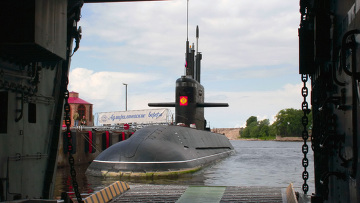
New Sub at Admiralty (photo: RIA Novosti)

This morning RIA Novosti reported on a familiar topic — the conflict between planned acquisition embodied in the State Program of Armaments, 2011-2020, and the Russian OPK’s capacity and capability to deliver it.  In this case, new diesel-electric submarines from St. Petersburg’s Admiralty Wharves.  Also familiar is one reason for the bind — a lingering priority on production for sale abroad.

A highly-placed OPK source tells the news agency that the GPV’s plan for conventional submarine deliveries might not be fulfilled due to Admiralty’s heavy load of orders.  The Russian Navy is reportedly supposed to get 20 new diesel-electric boats by 2020, and Russia also has ten foreign deliveries scheduled.  The OPK source notes that Admiralty has become a sole source for conventional subs, and he calls for shifting some sub production to Nizhniy Novgorod and Komsomolsk:

“In view of the large volume of new submarine construction for the Navy, and also for export, it’s essential to diversify production, utilizing, for example, the capacity of ‘Krasnoye Sormovo’ Shipbuilding Plant in Nizhniy Novgorod and the Amur Shipbuilding Plant in Komsomolsk-na-Amure.  Otherwise the state program in the diesel submarine construction area could be disrupted.”

RIA Novosti notes “Krasnoye Sormovo” built plenty of Soviet submarines, 280 in all, including 25 nuclear-powered ones.  Its last boat was a diesel-electric for China in 2005.  The plant also outfits Russian Navy and export subs with torpedo- and mast-related equipment.

The article also speculates that construction of French-designed Mistral helicopter carriers could be problematic if Admiralty is selected.  The shipyard is reportedly planning on new construction space on Kronshtadt for this reason.  The OPK source says Mistral would be Admiralty’s main concern, and occupy its main capacity and personnel.  So, he continues, it’s logical to send some orders (i.e. submarines) to other factories that have the capabilities.

Igor Korotchenko tells RIA Novosti “Krasnoye Sormovo” could provide extra buildingways if Admiralty can’t meet all its export contracts.  He says Admiralty is now building five subs under the GOZ, six for Vietnam, and:

“In the event new contracts are signed for sub construction with Venezuela and Indonesia there will be an obvious problem with inadequate buildingway space, and then a backup could be required.”

RIA Novosti notes rather dryly along the way that no Russian GPV has been fulfilled completely because of the country’s insufficient modern industrial capacity.

One wonders what, if any, work and investment would be required to bring “Krasnoye Sormovo” and Amur back into the sub-building business.

Popovkin to Roskosmos?

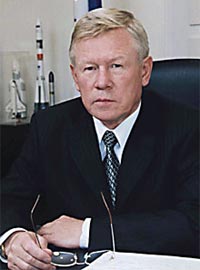
Vladimir Popovkin (photo: Sobakidendy-news.ru)

Friday Marker.ru reported rumors from its sources saying First Deputy Defense Minister, and GPV 2011-2020 architect, Vladimir Popovkin will relieve Anatoliy Perminov as Director of Roskosmos.  This is interesting because it supposedly features a little tandem tension between President Medvedev and Prime Minister Putin.

Marker.ru’s Ivan Cheberko writes that Perminov will resign at “his own request,” and become a presidential adviser for space issues.  For his part, Popovkin had hoped to replace Sergey Ivanov as Deputy Prime Minister with responsibility for the defense-industrial sector.  But Medvedev and Putin couldn’t agree on Ivanov’s fate, according to Cheberko’s report, and they proposed that Popovkin should head Roskosmos.

A source close to Perminov told Cheberko the Popovkin decision was made last week:

“The president and prime minister couldn’t determine Ivanov’s future, and they proposed Popovkin to head Roskosmos.  The Defense Minister has already signed the corresponding paperwork.”

Cheberko’s two independent missile-space sector sources say there have been three candidates for the Roskosmos job — Popovkin, Popovkin ally and deputy General-Lieutenant Oleg Frolov, and Roskosmos Deputy Director Vitaliy Davydov.  Frolov reportedly would have gotten the job if Popovkin took Ivanov’s spot.  Roskosmos rank-and-file lobbied for Davydov in hopes of avoiding changes Popovkin would make.  His views diverge from those of the agency’s current leadership, and he’s expected to make many personnel and organizational changes.  Among other things, Cheberko highlights Popovkin’s strong support for a new liquid-fueled heavy ICBM versus missile designer Yuriy Solomonov’s vocal public opposition to such a plan.

Unfortunately, Mr. Cheberko only dug so deep.  There’s a bit more to this story.

On the eve of the 18 March expanded collegium, Sergey Ivanov told the Federation Council the Defense Ministry was to blame for late placement of the State Defense Order (Гособоронзаказ, ГОЗ, or GOZ) this year.  Even prior, he had lots of sharp public criticism for Perminov, Roskosmos, and their failures.  Of course, Ivanov himself has long suffered at Putin’s hands over GLONASS, so he’s just letting stuff roll downhill, so to speak.

In his collegium speech, President Medvedev railed about problems with the GOZ last year, and demanded a “post-flight debriefing” to identify which industry and state officials are to blame.

Prime Minister Putin followed the collegium with a March 21 government session on the defense order at the Votkinsk missile plant.  Ivanov and Perminov were there, and probably Popovkin too.  The latter was very much on the defensive afterwards, asserting that GOZ-2010 was fulfilled “on the whole.”  And he blamed last summer’s heat wave and forest fires for disrupting defense production.

So where’s it leave us?

As Marker.ru implies, it appears Popovkin’s position isn’t too strong, and he could be headed out of the Defense Ministry after only 8 months on the job.  This would take away one of the louder proponents of buying arms and equipment abroad if necessary.  It begs the question who replaces Popovkin, and what does it mean.  Possibly someone closer to Serdyukov.  Never known for his skill as a political infighter, Sergey Ivanov actually comes out of this looking like a semi-adept bureaucratic warrior.  It’s interesting to imagine Medvedev and Putin discussing Ivanov’s fate when he was once thought the frontrunner in Operation Successor 2008.

Russia Not Likely to Buy Ukraina

Slava-class CG Ukraina

Will Russia buy the aging, semi-finished Slava-class CG Ukraina?  Probably not, unless the price is really right, i.e. basically zero.  It’s unlikely Russia will pay Ukraine to complete the cruiser because Russian shipyards have suggested towing it to Russia, refurbishing, and updating there. 

The questions are compelling only because of a recent video, varying reports about the ship and a possible deal, and what this all says about Moscow’s military procurement.

Military parity highlighted Podrobnosti.ua’s video.  Like the photo above, the video shows a major combatant in declining condition.

Nevertheless, according to recent ITAR-TASS, Ukraine’s Defense Minister is optimistic Kyiv and Moscow will finish Ukraina together.  And he claims the ship is 95 percent complete.

By way of review, Ukraina is a 1970s- or 1980s-vintage design being constructed as Fleet Admiral Lobov at Nikolayev’s [Mykolayiv’s] 61 Communards Shipbuilding Plant when the USSR collapsed.  Kyiv failed to find a foreign buyer for the ship, and reportedly spends $1 million every year maintaining it.  So that doesn’t mean a plethora of options or a very strong negotiating position for the Ukrainian side.

Talk of Russia buying Ukraina peaked last year in the wake of the base agreement extension between Moscow and Kyiv.  News outlets noted that the acting chief of the Russian Navy’s Technical Directorate inspected the cruiser and declared it 50 percent ready.  He said Ukraina would need 15 billion rubles for repairs and 35 billion for modernization — $1.7 billion in all.  The Navy’s 50 percent sounds a lot more like the 70 or 75 percent we’ve been hearing for many years than the Ukrainian Defense Minister’s 95 percent.

Reported pricetags for Ukraina, in its current shape, start at $70 or $80 million and run to ridiculous numbers.  In January, Argumenti.ru reported the Russian Defense Ministry would not pay scrap metal prices for Ukraina, but commented that Moscow would accept the ship as a gift.

Then there’s also the issue of whether the Russian Navy really needs it.  It’s an issue often forgotten in procurement debates.  Granted Ukraina is a something of a special case.  But it should also be a pretty easy decision.

Novyy region quoted a couple opinions last May.  Former Black Sea Fleet Commander Vladimir Komoyedov said:

“The ship hasn’t aged 15-20 years yet according to its capabilities.  However, it needs, of course, to be deployed in the ocean, in open theaters, and not in the Black Sea, not in the Baltic — there just isn’t sufficient space for it there.  The ships [Slava-class] are very good, not at all badly designed.  It can’t be said this cruiser belongs just to Ukraine alone.  Ukraine’s share of it, as far as I remember, is 17, a maximum of 20 percent.  Therefore the question’s about the purchase not of a full ship, but of a share — all the rest belongs to Russia.  The purchase issue has stood for a long time, and it needs to be resolved once and for all.  If such a decision is made, it’ll be the right one.  It’s better than the tin can Mistral by a factor of two.”

Defense analyst Aleksandr Khramchikhin, on the other hand, said:

“It’s very hard to understand who needs this ship now.  Undoubtedly, for our fleet which is shrinking into nothing, now such a cruiser has already become pointless.  We have to begin, so to speak, from below, and not from above, not with cruisers, but with frigates at least.  Moreover, these cruisers have a very narrow anti-aircraft carrier mission.  They were built exclusively for war with American carrier battle groups.  It doesn’t seem to me that this mission is all that acute for us now.  Therefore, it’s hard for me to comprehend why we need this ship, and where to put it if it is finished.”

All that said, the Russians might buy Ukraina anyway.  If they do, it’ll indicate a new State Program of Armaments gone awry in its first year.

Careful How You Read

Be careful what you read, but be even more careful how you read it (or who translates it).

The Russians won’t put both SLBMs and SLCMs on their fifth generation submarines.  Would that really make military sense?  What they apparently intend is to build a multipurpose hull to fit out as either SSBN or SSN.  Now does that raise interesting arms control verification issues?

Several days ago, in advance of March 19 – the 105th anniversary of Nikolay II’s designation of the submarine as an Imperial Navy ship class (i.e. Submariner’s Day since 1996) – a “highly-placed RF Navy Main Staff representative” elected to tell RIA Novosti about work on Russia’s fifth generation submarine.

Production of the fourth generation proyekt 955 SSBNs and proyekt 885 SSNs is just really now reaching the ramp-up stage.  But design and development of fifth generation submarines is included in the State Program of Armaments, 2011-2020, according to RIA Novosti’s Navy Main Staff source.

When you Google “Russian fifth generation submarine,” you get a string of English-language news and blog items that say things like:

“. . . a high-level Russian navy insider said a future ballistic-missile submarine would also carry cruise missiles.”

“Russia is planning to equip its fifth-generation nuclear submarines with both ballistic and cruise missiles, a media report said.”

Even RIA Novosti’s own English-language site bollixed it:

“Russia’s proposed fifth-generation nuclear submarines will be armed with both ballistic and cruise missiles, a senior Navy source told RIA Novosti on Saturday.”

RIA Novosti actually wrote:

“The fifth generation submarine will be standardized for ballistic as well as for cruise missiles.” 

And RIA Novosti’s unnamed admiral actually said:

“The concept for creating a new nuclear submarine (APL or АПЛ) envisages a unified hull both for multirole [i.e. attack] as well as for strategic submarines, therefore design bureaus Rubin and Malakhit which today specialize in designing strategic and multirole submarines respectively are working on its development.” 

Rusnavy.com got it right.  

As always said about new submarines, the unknown admiral said the fifth generation will be distinguished for its lowered noise, automated control systems, reactor safety, and long-range weapons.  But he added:

“I’m not talking about ballistic missiles, we’re talking long-range cruise missiles and torpedoes.”

Symbol of How Things Work (or Don’t)

Is Perminov About to Surrender This Chair?

Your author couldn’t be accused of following military space issues and news too closely.  However, this piece from Ogonek [Огонёк] is pretty compelling stuff,  examining whether Anatoliy Perminov has been, or is about to be, “knocked out of orbit” as Chief of Roskosmos.

Ogonek is part of Kommersant, and has the same standards of quality and independence.  Much of what the article highlights is interesting and significant beyond the confines of space.  It is more widely illustrative of the way things work, or don’t, in Russia generally.  It makes Perminov sound somewhat symbolic of this.

Author Vladimir Tikhomirov begins by concluding the loss of four satellites recently isn’t the only reason for retiring Perminov, but Tikhomirov wants to look at the man and why he causes such controversy in the upper echelons of power.

As recently as 11 March, Perminov said his bosses will let him know when his time is up, but presumably they haven’t yet.  RIA Novosti also apparently published word from a “Kremlin source” who said Perminov’s contract won’t be renewed in April.  It’s said the 50th anniversary of Gagarin’s flight on 12 April might be celebrated with someone else heading Russia’s space agency.

Tikhomirov explores who Perminov is . . . a missile-general trained early to keep his mouth shut . . . to keep the dirt inside the RVSN or military izba . . . he doesn’t talk about extraneous or personal matters.  Born in Kirov Oblast in 1945, his father died early and he worked on a collective farm.  He was excited by Gagarin’s flight and practically his entire class went to military schools . . . he went to the Perm Higher Military Command-Engineering School.  He went from missile unit to missile unit with his wife and son.  The Soviet collapse found him finishing up at the General Staff Academy, and he became Chief of the Plesetsk Cosmodrome.  When Sergey Ivanov created Space Troops in 2001, Perminov became their first commander.  President Putin put him in charge of the entire space sector in 2004.

Then Tikhomirov talks about Roskosmos and Perminov’s predecessor.  In 1992, President Yeltsin civilianized a lot of the space industry, and he put Yuriy Koptev — a missile and rocket builder — in charge.  Koptev held his seat for 12 years until Putin became dissatisfied that Russia hadn’t built a single new satellite in 10 years (1994-2004).  Putin was upset when Roskosmos couldn’t support ground operations in Chechnya, and also when plans for the Angara rocket (that was supposed to free Russia from depending on Baykonur) didn’t pan out.

Perminov studied Koptev’s failures, and he pushed through a Federal Targeted Program (FTsP) on Space, 2006-2015.  A steady military hand was supposed to right things messed by civilians like Koptev, and others like RKK Energiya Director Nikolay Sevastyanov who reportedly dreamed of space shuttles, moon bases, and “air launching” rockets from An-124s.  Space research was pushed to the back.  It wasn’t Perminov’s style to risk such things.

Tikhomirov looks at Perminov’s record on fulfilling the Space FTsP.  Eleven of 13 planned fixed comms and broadcasting satellites are in orbit.  Under him, Roskosmos pretty much fulfilled its plan for mobile comms and satellite search-and-rescue, but various scientific launches were pushed off.  Tikhomirov gives him credit for making successful space launch deals for the Europeans and Americans.  Using Soyuz to ferry astronauts to the ISS brought in $753 million.

Then Tikhomirov points out the obvious.  Perminov’s other difficulties and failings are minor compared with GLONASS, which he’s described as Russian cosmonautics’ main achievement over the past 30 years.  Tikhomirov says the constellation has 22 functioning satellites with four in technical reserve and the last 3 launched at the bottom of the Pacific along with the Proton launch vehicle that carried them.  The Proton failure, says Tikhomirov, was especially embarrassing; it broke President Medvedev’s Poslaniye promise to have a fully functioning GLONASS grouping before the end of 2010.  And that’s when the rumors of Perminov’s imminent retirement started.

This wasn’t the first time for this rumor.  There was talk of his retirement in 2006 when there were launch failures and an out-of-order satellite cut central TV broadcasting to the Russian Far East.  These were losses costing billions of dollars.  But the Kremlin cut off the rumors; Perminov was needed.  Today, however, Tikhomirov says the Kremlin is sending different signals.

He says Medvedev’s assistant Sergey Prikhodko basically accused Perminov of failing to appreciate the gravity of the recent space failures.  A Perminov deputy and a chief designer at RKK Energiya were both fired.  Perminov himself got a reprimand.  Medvedev also instructed prosecutors to investigate the state of affairs, and the accounting books, at Roskosmos.

Tikhomirov says Roskosmos blames new products which weren’t tested sufficiently, but some employees say the agency tried to save by using Taiwanese microchips not intended for use in space.

Other interesting things turned up.  As reported elsewhere, Tikhomirov says sons of Roskosmos deputy chiefs are in the business of insuring its satellite launches.  GLONASS’ main designer has sent 40 percent of its state financing to various “pocket” firms.

Tikhomirov says Perminov might have survived all this, but the loss of dual-use Geo-IK-2 may have been the last straw.  And Medvedev recently talked with scientists about their thoughts on outer space research, something Tikhomirov views as a blow to Perminov and the military space priorities he represents.

So who would be the replacement?

Tikhomirov thinks the Kremlin must have a list of candidates . . . some people think First Deputy Defense Minister Vladimir Popovkin, who’s in charge of procuring armaments, he was also Space Troops Commander in his time.  Others say RKK Energiya General Director Vitaliy Lopota.  Still others say none other than Nikolay Sevastyanov — now heading Gazprom Space Systems.  Tikhomirov concludes:

“But all this devolves into one thing:  the new Chief of Roskosmos could be either military or a highly-skilled designer.  But to put the space sector in order, a new Korolev is needed.  Just where can one be gotten?”