Category Archives: Defense Industry

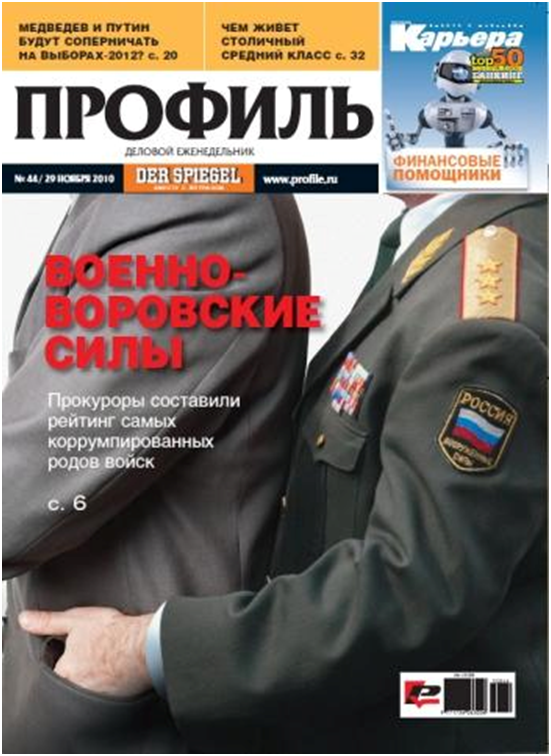
Military-Theft Forces

Prosecutors Rate the Most Corrupt Service Branches

40-50 Percent of State Defense Order Simply Stolen in Recent Years . . . no wonder large-scale procurement hasn’t happened.  Serdyukov supporter Korotchenko tries to paint opponents of military reforms as people trying to protect their corrupt schemes.  This surely goes on, but there also have to be people opposing them for reasons other than greed.  Finally, it’s at least conceivable that, if Serdyukov doesn’t make progress against corruption, it could cost him his job (if he stays that long, he is approaching the four-year mark).  Thus endeth the precis for this post . . .

This week Profil investigates military corruption.  The magazine notes the number and scale of Defense Ministry corruption cases is growing by leaps and bounds, reaching losses of 2.2 billion rubles for the first ten months of 2010.  It concludes, despite a significant cut in the officer corps and Defense Minister Anatoliy Serdyukov’s battle against “thieves in broad stripes [generals],” the number of corruption crimes is not only not declining, but has substantially increased.  Profil obtained an analytical report compiled by the Main Military Prosecutor (GVP) showing who has stolen how much this year.

The GVP presented its report to a closed session of the Duma Defense Committee.  It says its analysis shows “efforts to counteract corruption in the troops are insufficiently effective.”

Profil’s first graphic . . .

Growth of Corruption Crimes in the Army (First 10 Months of 2010)

Troops/Military District/Fleet                     2009       2010       Growth (%)

North Caucasus MD                                             184          311                 69

Moscow MD                                                              94           152                61.7

Air-Assault Troops (VDV)                                 34            119                250

Siberian MD                                                             76            117                 54

Strategic Missile Troops (RVSN)                  59              93                 57.6       

Northern Fleet                                                      50              59                 18

Space Troops                                                        27              44                 63

Caspian Flotilla                                                      5                  7                 40

Black Sea Fleet                                                      2                  6                 200

Profil suggests the recent wave of military retirements signed off by President Dmitriy Medvedev could have been sparked by corruption charges.  While possible, there’s no evidence to support this thesis. 

A Profil source in the Defense Ministry says, not surprisingly, officials responsible for the State Defense Order (GOZ or ГОЗ), capital construction, and the disposition of military property (first and foremost real estate) inflict the greatest losses on the budget.  The article quotes Igor Korotchenko:

“In the course of recent years, 40-50% of resources allocated for the State Defense Order were simply stolen.  This happened, for example, when money was directed at the fulfillment of some concrete work, but there were no real results.  Write-offs appeared in the end or a weapons system was developed that simply didn’t meet its technical requirements.”

Profil suggests that many officers are rushing to get one last bite of military money before Serdyukov’s reforms completely derail their schemes.  It cites Ruslan Pukhov offering two different explanations for rising military corruption:

“Feeling an impending dismissal, officials are probably trying to take the maximum from their positions.  However, it can’t be ruled out that the prosecutor has really reinforced his work in different areas.  Corruption is an acute issue for the prosecutor.”

Pukhov thinks that, although the percentage increase in corruption looks really bad for the VDV, “corruption in the armed forces is spread equally and the growth in corruption crimes in separate branches or districts is connected only with where they are being investigated.”

A very good point, Mr. Pukhov.  Yes, the results of this little anticorruption experiment are very much influenced by where and how it is being conducted.  One should also pay much more attention to the absolute numbers of corruption cases than the percentage changes, and nothing has been said about the relative size of the various parts of the armed forces . . . no per capita figures are provided.  Are 44 crimes in the relatively small Space Troops more significant than 152 in the larger Moscow MD?

Korotchenko, a fairly strong Serdyukov proponent, says the Defense Minister and his tax service colleagues are beginning to break existing corrupt ties, institute financial transparency, and deprive the generals of the right to conclude any contracts.  Dividing the Ministry into military and civilian halves will keep military men out of financial expenditures, and this “process of shifting generals out of the feeding trough” will continue until 2012.  The generals will provide requirements, and civilians will allocate the financing.

A second graphic with some absolute figures on losses due to corruption . . .

Growth of Corruption Crimes in the Army (First 10 Months of 2010)

Troops                                                                  Loss Amount                      Annual Growth

                                                                           (millions of rubles)                        (times)

Strategic Missile Troops (RVSN)                      59.8                                            15          

Air-Assault Troops (VDV)                                   57.5                                            12.2

Space Troops                                                            47.6                                              2.2

Korotchenko claims:

“The campaign against Serdyukov is mainly heated up by those people who’ve been deprived of the feeding trough.  So, the director of a large defense enterprise has for many years sawed off rubles by the billion every year in the transfer of money that comes to fulfill the Gosoboronzakaz.  When Serdyukov deprived this director of such a trough, he began to finance any actions directed at discrediting and, possibly, even removing the Defense Minister.”

So, Korotchenko asserts most conflicts over army reform are banal conflicts of interest for those who can’t steal like they used to.  But didn’t the GVP just say they’re doing a better job of stealing than ever before?

Korotchenko continues:

“Of course, Serdyukov is not an angel, and many of his actions on the military reform plane call forth questions, but it’s another thing that before he arrived, corruption in the Defense Ministry had achieved such a level that he was forced to cut to the bone.  Many scandals proceed only because their financial-economic interests were affected:  the meetings of the airborne guys is just one in this series.”

Then Profil turns to Vitaliy Shlykov, who says:

“Broad publicity for corruption scandals in the Defense Ministry cannot but affect the minister.”

But he believes the Kremlin knows no one can fight corruption like Serdyukov, therefore the GVP report isn’t a real blow to him.

Profil concludes, so far, Serdyukov hasn’t squandered the trust placed in him, but the struggle against corruption only strengthens him as long as it’s a success.  If corruption keeps growing, it’s possible the Defense Minister himself could wind up on the “shot list.”

Dolgorukiy, Bulava, Severodvinsk

Submarine-related news notes . . .

Russian press services have announced that the state commission on the Bulava has finished analyzing the results of the last two launches.  The next test will be in the second half of December, and the exact date will depend on White Sea weather conditions.

It’s pretty, but not absolutely, certain that new Borey-class SSBN Yuriy Dolgorukiy will be the launch platform.  The final decision on this will be made in the first ten days of December.  One supposes another shot from Dmitriy Donskoy remains a remote possibility.

If the pending launch is a success, the next phase of testing will begin in May 2011.

Regarding fourth generation (proyekt 885, Yasen) SSN Severodvinsk, the boat is still fitting out, and the Navy expects it to join the fleet in 2011.  Like DolgorukiySeverodvinsk was under construction for many years.  ITAR-TASS said this morning 6 of these submarines are now planned.

PAK FA Update

PAK FA (photo: RIA Novosti / Aleksey Druzhinin)

RIA Novosti reports the second T-50 (PAK FA) testbed will begin flight tests before the end of the year, according to Sukhoy chief Mikhail Pogosyan.  He said the first testbed has performed 40 flights.  Sukhoy is satisfied with the course of testing which has gone faster than expected.

Pogosyan added that negotiations with India on its entry into the fifth generation fighter program should be completed this year.  Russia and India will roughly split the development expenses for one- and two-seat versions.  The PAK FA will start to enter the Russian inventory in 2015, and Indian forces around 2020.

Short Stories

There aren’t enough hours in the day . . . quick takes on some stories of interest.

Rossiyskaya gazeta . . . Minregion again sternly warns of problems in heating military towns due to Defense Ministry debts . . . the Far East is the most serious case.

Nezavisimaya gazeta . . . Ukrainian Defense Ministry may not be able to cooperate on An-70 transport for financial reasons.

Argumenty nedeli . . . long expose on the death of Russian military medicine, and the consequences, as a result of Serdyukov’s cuts and reforms.

ITAR-TASS . . . the interdepartmental commission met at Sevmash today with Vladimir Popovkin leading a review of Yuriy Dolgorukiy’s readiness to test fire the Bulava.

ITAR-TASS . . . on Tuesday, Chelyabinsk’s governor called on Serdyukov to stop explosions at Chebarkul.  This mini-scandal’s been evolving since they started in early October.  Expired munitions are being destroyed, but locals are complaining of damage from tremors.  Serdyukov was supposed to go to Chelyabinsk, but sent logistics deputy Bulgakov in his place.  Bulgakov supervised an elaborate demonstration to show that the explosions aren’t powerful enough to shake Chelyabinsk.  Residents say they can feel them in the city’s high-rise buildings.  The military doesn’t get much credit for trying to get rid of old bombs like those that nearly leveled one of Ulyanovsk’s rayons last November.  See Novyy region or Moskovskiy komsomolets.

There is growing media attention to the military housing problem — will Medvedev, Putin, and the Defense Ministry keep their promise to solve the permanent housing problem by the end of 2010, or are they just changing the rules and extending their own deadline?  See IA Rosbalt, Svpressa.ru, or Nezavisimaya gazeta.

Tsyganok on the GPV and the OPK

Anatoliy Tsyganok

Interviewed in yesterday’s Svpressa.ru, defense analyst Anatoliy Tsyganok expressed his doubts that trillions of rubles can save Russia’s OPK, its defense-industrial complex.

A quick summary.  Tsyganok seems to make the point that, while there’s an armaments plan, the OPK is still in a woeful state of neglect, i.e. the Bulava’s producers may actually be better off than many defense enterprises.  Much of what is leaving the factory gates still heads for foreign buyers or requires expensive repairs because quality is lacking.  Perhaps the OPK development (or maybe rescue) program needs attention before the GPV.  Tsyganok takes fewer Indian and Chinese purchases as a sign of quality problems.  Lastly, he says Moscow needs to rethink how it’s most likely to fight before picking what to make and who will make it.

But back to the article, Tsyganok gives his views on what might be bought with 20 trillion rubles in State Armaments Program (GPV) 2011-2020.  He mentions (sometimes without specific numbers or costs):

  • An-124 Ruslan — 20.
  • An-70.
  • Il-112.
  • Il-476.
  • Il-76MD.
  • Combat and transport helicopters — 1,000.
  • PAK FA — 70.
  • Yak-130 combat trainers.
  • Su-35 and Su-30 — 60 (80 billion rubles).
  • MiG-29K — 26 (25 billion rubles).
  • Su-34 — 32 (35 billion rubles).
  • Proyekt 885 Yasen SSNs.
  • Proyekt 955 Borey SSBNs.
  • Bulava SLBMs.
  • Proyekt 11356M frigates — 3.
  • Proyekt 636 diesel-electric submarines — 3.
  • T-90 tanks — 261.

There are, of course, lots of systems required that he doesn’t take time to mention.  New ICBMs, advanced conventional munitions, communications systems, satellites, etc.  He notes that the Navy’s needs alone come to several hundred billion rubles, and several ships and submarines he mentions are for the Black Sea Fleet.  The Ground Troops don’t get too much attention from Tsyganok.

Asked whether the OPK can produce modern combat equipment of the necessary quality and quantity even with sufficient financing, Tsyganok responds:

“Unfortunately, it has to be recognized:  many OPK enterprises are already incapable of series production of high-technology weapons systems.  The woes of the unfortunate strategic missile ‘Bulava’ are proof of this.  The picture is generally nightmarish.  A fourth of Russia’s strategic enterprises are on the verge of bankruptcy.  The tax organs have already issued liens for the recovery of debts against 150 defense plants and organizations.  Baliffs have already been sent there.  Who can work on the state armaments program there?”

“And don’t let the fact that in the first half of 2010 fully respectable growth of 14.1% in production was registered in the defense-industrial complex deceive you.  Mainly, as before, everything put out went for export.  Let’s say, over six months, our country produced 54 helicopters.  Of them, 31 went abroad.”

Asked if the poor state of defense plants is affecting the quality of their products, Tsyganok says:

“It affects it in the most immediate way.  Expenditures on eliminating defects in the course of production, testing, and use of our military products today goes up to 50% of the general volume of expenditures on the corresponding defense budget article.  In economically developed countries, this indicator does not exceed 20%.  The main reason is monstrous equipment depreciation.  And there’s no ray of hope visible there.  The rate of renewing the production base in the Russian defense sector, despite growing financial inputs of recent years, is not more than one percent a year.  In order somehow to get out of this hole in which we find ourselves, we would need to increase this rate by 8-10 times.  Incidentally, the reduction in quality of arms and military equipment produced is already noticeably reflected even in Russia’s military-technical cooperation with our traditional partners in this area.  With India and China most of all.  They are already not so intently signing contracts with us as before.”

What about design bureaus and scientific-research institutes?

“Also nothing to brag about here.  The fact is what the Russian defense-industrial complex can offer the Armed Forces in the near future, with a few exceptions, is already no longer the world’s best models.  And all this is because in the USSR’s time our country allocated up to 4.7% of GDP to basic research.  In today’s Russia, in all 0.16% goes to this business.  At the same time, in China, for example, annually ten times more is spent on scientific-research and experimental-design work.  And, as expected, next year it will catch up with the U.S.  As a result, in many military technologies, Russia is currently at a 1970s-1980s level.”

Finally, Tsyganok’s interviewer asks if there’s any way out of these dilemmas:

“There’s always a way out.  First of all, it’s essential to promptly review the goals and missions of the weapons complex.  We really have to understand whom we intend to fight, and what types of armaments are necessary for this.  Then the state defense order [GOZ] will take on more accurate contours.  As long as we don’t have this understanding, the situation will only get worse.”

Aleksandr Nevskiy Launch Planned

According to ITAR-TASS, Sevmash shipbuilders have announced they’ll launch the second proyekt 955 Borey-class SSBN Aleksandr Nevskiy at the end of November.  Nevskiy was laid down on 19 March 2004.  Lead unit Yuriy Dolgorukiy is preparing for a test launch of the Bulava SLBM likely in December.

ITAR-TASS says Borey unit 3 Vladimir Monomakh (laid down in 2006) is on a buildingway at Sevmash.  Nevskiy and Monomakh were not identified as proyekt 955A boats.  The wire service also didn’t mention anything about an official lay down for hull 4 (Sv. Nikolay).  Plans are for not less than 8 of the Borey SSBNs.

More Money Needed for Admiral Nakhimov

According to ITAR-TASS, Sevmash Director Nikolay Kalistratov says his plant will begin modernizing Kirov-class CGN Admiral Nakhimov (ex-Kalinin) next year.  Kalistratov also indicated the state is allocating money for Nakhimov’s large-scale repair:

“But the given volume is insufficient, an increase in the state defense order is required, and on this issue I’ve gotten the support of the board of directors.”

So Sevmash can’t or won’t do it for what the state is paying.  It’s something of an annual rite for Kalistratov.  He said the same thing last year, and even put the price tag at 20 billion rubles.  And it’s been proposed that Nakhimov could return to the Navy in 2012.  Not likely.

ITAR-TASS adds that Nakhimov’s been in this condition since 1999, waiting at the pier for repairs that haven’t been done for want of financing.  

Your present author’s no naval engineer, but common sense raises some serious issues. 

Not only would the ship’s two nuclear power plants need serious attention, but its once-impressive host of weapons systems would require extensive updating — new cruise missiles, ASW systems, SAMs, just for a start.  All the ship’s support systems would need renovation or replacement.  This would be great work not just for Sevmash, but for Russian system suppliers.  

But the Russian government, Defense Ministry, and Navy have to decide if the cost is worth taking money from other new naval construction, not to mention from higher priority military procurement efforts.  The answer to this question lies in how Nakhimov would be employed and, particularly, for how long.  The U.S. experience with modernizing and recommissioning the USS Iowa and USS New Jersey comes to mind.

There are lots of articles on what to do with Russian CGNs, but your author hasn’t waded through them.  Speak up if you’re interested in them.

Another Bulava Success

Bulava Launch (photo: ITAR-TASS)

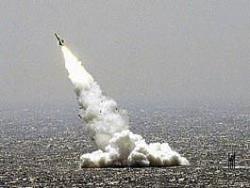
At 0510 MSK today, Dmitriy Donskoy successfully launched the second Bulava SLBM of 2010 while submerged in the White Sea.  That makes two in a row, and 7 successes in 14 attempts overall. 

A government Military-Industrial Commission (VPK) source told ITAR-TASS the 15th test could occur in early December and will be the first from new Borey-class SSBN Yuriy Dolgorukiy.  The source attributed the successes to a tightening of control over the production and state acceptance processes.  He also warned it’s too early to relax:

“Two successful launches don’t signify that it’s possible to accept ‘Bulava’ into the arsenal.  A great deal will depend on testing in 2011.”

A member of the state commission that investigated the Bulava failures told RIA Novosti that these successes show Bulava had assembly problems.  And he said testing will continue in 2011.

RIA Novosti noted that, perhaps most significantly, this year’s Bulava tests came from a submerged boat.  In 12 tests prior to 2010, there had not been a single successful underwater launch.

Popovkin on OPK, IVECO, Mistral, and Bulava

Speaking to journalists at Euronaval-2010 today, First Deputy Defense Minister Vladimir Popovkin said the Russian Navy needs modernization more than the other armed services.  And defense industry needs modernization badly.  Popovkin noted:

“Many industry representatives came to the exhibition with the military.  At the exhibition we always need to examine what’s best in the world, have talks, and look at where we aren’t up-to-date.”

 “Without reequipping the Russian defense industrial complex it’s impossible to produce modern equipment.”

 “Our task is not to buy foreign equipment, but technologies on the basis of which we would be capable of organizing production in Russia.  We, unlike some other countries, are not secretly copying examples, but openly we say we’re prepared to pay for technologies, to buy licenses for production of this or that equipment.  The main condition is the transfer of production to Russian territory and the transfer of technologies.”

Is Popovkin slamming China?  Is China copying secretly or actually quite brazenly?

On the joint venture (JV) with Italy’s IVECO, Popovkin said:

“A JV for producing these armored vehicles on RF territory has been created.  Next year it will begin production.  The first vehicle will come out at the end of 2011.”

“Essentially, this is final assembly.  Nevertheless, we are planning that more than 50 percent of the components in this vehicle should be of Russian manufacture.”

Popovkin said Russia is now in talks on the specific model:

“We’ve presented specific requirements.  Why?  We have our own weather conditions, different employment tactics, therefore the base model will be developed taking Russian conditions into account.”

 ITAR-TASS noted the JV will put out vehicles needed for both the Defense Ministry and the MVD.  Licensed assembly of several hundred units of IVECO’s LMV M65 annually could occur at one of Russia’s automotive factories.

Popovkin also said Russia’s tender for amphibious assault ships has been announced:

“We’ve announced the tender for the purchase of amphibious assault ships.  Two ships will be built abroad.  Technology transfer for the construction of the rest is planned.”

It sounds like Popovkin’s decided a Russian shipyard can’t win the competition for the first two units.  Are Russian builders just competing for units 3 and 4?

Asked about the number of Bulava launches in 2010, Popovkin said:

“We’re acting sequentially, step by step, therefore it’s impossible to say now the exact number of launches in 2010.  The main task now is to conduct the next launch.  Based on it, we’ll determine our future plans.  Until we get reliability of 98-99 percent, we won’t put this missile on combat duty.  The missile’s reliability is determined not just by launches, but also by a whole series of testing work.”

Meanwhile, a Defense Ministry source has told ITAR-TASS the second Bulava launch of 2010 will occur on 29 October.

Makarov Talks to Duma Defense Committee

Nikolay Makarov (photo: Rossiyskaya gazeta)

Last Thursday, General Staff Chief, Army General Nikolay Makarov spoke to a closed session of the Duma’s Defense Committee about the situation in the armed forces.  A few committee members were kind enough to inform the press about some of the discussion.

Rossiyskaya gazeta said it’s no secret the Defense Ministry wants more money in its 2011 budget.  And the generals’ arguments are well-known — the army needs to reequip, relocate, and raise officer pay.  Additional financial means are needed for this.  Makarov didn’t avoid this issue, and he had a lot of supporters.  Deputy committee chairman Yuriy Savenko had this to say on the issue of budget and rearmament:

“Today there isn’t just not enough money for this.  We have to recognize that our military industry has sagged a lot over the last two decades.”

Makarov apparently commented on Bulava, seeing the recent successful launch as opening the way for its quickest acceptance into the Navy arsenal.  But he said first it has to complete three [not two] more tests.  The next won’t come earlier than November, and the first from Yuriy Dolgorukiy possibly before year’s end.

The General Staff Chief talked about the country’s new military-administrative divisions, claiming the reduction to 4 MDs isn’t causing major troop relocations, but rather allowing the army to stand-up additional combined arms, reconnaissance, and airborne brigades on its strategic axes.

He apparently mentioned the introduction of information management systems into the troops is a priority.

Nezavisimaya gazeta’s Viktor Litovkin reports Makarov said Russia will hold just one operational-strategic exercise, Tsentr-2011, next year, and, after it, the focus will be on tactical platoon and company exercises.  Litovkin says the issue isn’t money, but the time it takes to train units from platoon to brigade in what they need to demonstrate in a big exercise.  And training time is too short with one-year soldiers.  He reports the army’s decided to put all officers from new lieutenants to generals through tactical retraining and improvement courses.

KPRF Deputy, Vladimir Komoyedov — former Black Sea Fleet commander — commented a little on what he heard.  He said Makarov mainly touted what’s been achieved the last two years.  Komoyedov said he heard about conventional forces, but not much about strategic ones, and when he asked specifically about naval strategic forces, Makarov’s answer didn’t satisfy him.  Komoyedov spoke to Tverskaya, 13, but he quickly spun off into his own commentary, rather than Makarov’s.

Perhaps the most press went to Makarov’s announcement that the Defense Ministry will go forward with military police units in the armed forces after all.  They’ll reportedly number about 20,000 personnel.  MP sub-units will be present from brigade to military district, and they could be manned by servicemen dismissed in the course of Serdyukov’s reforms.

Finally, Komsomolskaya pravda says Makarov has told it about various changes in the army coming in the next five years.  Some are not all together surprising, but there are new twists on others:

  1. A two-pipe Defense Ministry — military and civilian, with the latter handling money, personnel, and support.
  2. Hired cleaners, maintenance people, and security guards for the barracks.
  3. Military pay via bank cards to make it more difficult for older soldiers to extort money from new conscripts.
  4. Contractees will get 30-35 thousand rubles per month.
  5. Conscription will stay at one year (there are 156,000 men with deferments and 130,000 evaders).
  6. Specialty training time for soldiers needs to be cut from 6 to 2-3 months.
  7. Tsentr-2011 will occur, but other exercises will focus on the company-level and lower.
  8. There will be 8 aviation centers [bases?], but 4 would be ideal.  Air defense aviation will have 2 months on duty, and 2 months at home.
  9. Glavkomaty of services and branches will be cut from 1,000 personnel to about 150 or 200.  Generals’ duties will go out to the new MDs.  All the ‘glavki’ will relocate into the Ground Troop headquarters on the Frunzenskaya embankment.
  10. The Genshtab will keep its hands on strategic submarines, bombers, and the RVSN.
  11. The VDV will not be cut, and will continue to report through the Genshtab.  They are likely to be reinforced with new brigades.
  12. The Navy will get 1-2 nuclear-powered submarines each year.  New aircraft carriers are in development.  The fleet gets 23% of the defense budget, the RVSN 25%.