Category Archives: Defense Industry

State Tests of Su-35 Pending

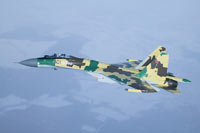
Su-35

Krasnaya zvezda on 13 August ran a brief item updating Su-35 developments.

Sukhoy is completing its preliminary testing of the Su-35 multirole fighter, and plans to present it for state testing this fall.  Sukhoy chief designer Igor Demin [Dyomin or Дёмин] told Interfaks-AVN to expect this in September or October.  He said there are two Su-35 prototypes currently in flight testing, and this number will increase to 6 for state testing.  The third Su-35 will reportedly fly at some point in the fourth quarter of this year.

Demin says the Su-35 is receiving lots of testing because it has many new systems and components.  Preliminary testing substantiated its advertised characteristics — low and high altitude maximum speeds of 1,400 and 2,500 kph respectively, and a ceiling of 19,000 meters.

Sukhoy has a mid-2009 state order for 48 Su-35 for delivery by 2015, and serial production of the fighter has been arranged at Sukhoy’s KnAAPO.  The first aircraft might be delivered in late 2010, and serial production will start next year.  Export deliveries are planned for 2012, according to this report.

The Su-35’s designers say this fighter will allow for a partial rearmament of the Air Forces, and facilitate assimilation of ‘new generation equipment.’  They describe the Su-35 as a deeply modernized, highly-maneuverable ‘4++’ generation aircraft, which already uses some 5th generation technologies.

According to this article, the Su-35 sports digital avionics and instrumentation, a new phased array radar capable of long-range target detection and tracking and engaging more targets simultaneously, and new engines with greater thrust and variable thrust vectoring.  Its radar signature has been reduced several times over 4th generation aircraft by using an electroconductive coverings for cabin lighting,  radar-absorbent materials, and a reduced number of antennas.

The Su-35 is reportedly designed for a service life of 6,000 flying hours, and its controllable-nozzle engines 4,000 hours.

According to ITAR-TASS, Sukhoy reported in July that Air Forces pilots were beginning to prepare to fly the Su-35S [supposedly the nomenclature for the domestic version] in state trials.

Infomercials aside, the Su-35 is intended to be a gap-filler for PAK FA, but no one can say how long the gap will be.  Long in development and repeated modernizations, it will likely be a solid aircraft, evolved as it is from pretty good stock.  There’s foreign interest, but, of course, no firm purchases yet.
Emblem of Procurement Problems

On Friday, amidst Krasnaya zvezda’s usual fare, there was interesting coverage of a high-level meeting to review the military’s UAV (BPLA or БПЛА) procurement program.

Technically, it was a session of the collegium of the Federal Service for the Defense Order (Rosoboronzakaz or Рособоронзаказ) with the agenda item “Results of Inspecting the Placement and Fulfillment of the State Defense Order (GOZ) in the Area of Development and Supply of Unmanned Aerial Vehicles.”

Rosoboronzakaz Director Aleksandr Sukhorukov, a former Serdyukov tax service deputy, conducted the session.  Also participating were newly-minted Deputy Defense Minister Tatyana Shevtsova, also a former Serdyukov tax service deputy, and Director of the Federal Agency for Supplies of Armaments, Military and Special Equipment, and Material Resources (Rosoboronpostavka), Nadezhda Sinikova, another of the Defense Minister’s long-time proteges.

The military paper noted that representatives of the government, ministries, and other federal executive organs, state customers from the Defense Ministry, FSB, FSO, MVD, and MChS, representatives of the Main Military Prosecutor, and OPK officials also attended.

One Yu. Stolyarov gave the main report.  He’s Chief of the Directorate of Oversight of the State Defense Order in the Area of General Armaments and Military Equipment, Aviation Equipment, Aerospace Defense Means and Armaments, Ships, and Naval Armaments and Military Equipment.  Quite a broad portfolio.  Krasnaya zvezda didn’t elaborate on what Mr. Stolyarov said, however.

Ground Troops CINC, General-Colonel Aleksandr Postnikov, VDV Chief of Staff and First Deputy Commander, General-Lieutenant Nikolay Ignatov, an OAO Tupolev deputy chief designer, and OAO ‘Vega’ Radiobuilding Concern General Director, V. Verba also spoke at the session.  Their remarks weren’t reported either.

Krasnaya zvezda reported that all presentations were thorough and constructive, and the collegium adopted some draft directive, but we don’t know what it said.  The paper, however, says the main theme of all presentations was the same:

“. . . in their TTKh (ТТХ – tactical-technical characteristics) domestic UAVs must not lag behind foreign ones and it’s essential to do everything to achieve this.  State money has to be spent with maximum effectiveness.  Troops and power structures need to be supplied with those UAVs that will be most effective on the battlefield, and in conducting special operations.”

What should we conclude from this?  Firstly, the meeting highlighted Shevtsova’s new oversight and auditing role in procurement.

Secondly, the Defense Ministry’s leaving the door open for domestic UAV producers, and so this seems to amount to just another warning to them.  It doesn’t seem to be anything like a decision to include Russian firms or exclude foreign ones, or vice versa.

It’s not surprising the Defense Ministry highlighted this particular program review.  Few procurement issues have caused Russia as much angst recently as UAVs. 

Georgia’s Israeli-supplied UAV capabilities, and Russia’s relative lack of them, highlighted this issue in 2008.  Moscow had to risk manned aircraft instead of employing unmanned ones on reconnaissance missions.  What’s worse, two years after the five-day war, there’s still no fix to the UAV problem.  And it will become more acute should unmanned aircraft become the backbone of future air power for the world’s leading militaries.  Russia’s clearly behind on UAVs, and questions remain about whether it should catch up, and whether it can.

The Russian defense establishment has spent months debating buying from foreign manufacturers, purchasing sample quantities abroad, or producing jointly to jumpstart or pressure domestic producers.  In late 2009, Air Forces CINC, General-Colonel Zelin flatly stated it would be ‘criminal’ to accept inferior Russian UAVs into the arms inventory.  The FSB reportedly said it would buy Israeli UAVs.  In March, Defense Minister Serdyukov admitted domestic UAVs ‘seriously lag’ behind world standards, and, in April, then Armaments Chief, now First Deputy Defense Minister Popovkin reported that Russia had spent 5 billion rubles on UAVs without result.

So UAVs joined the list of other systems – helicopter carriers, soldier systems, light armored vehicles, etc. – that could be bought abroad, but it doesn’t look like Moscow is ready to rely, at least entirely, on foreign producers for any of them.

Possible Bulava Test By Mid-September

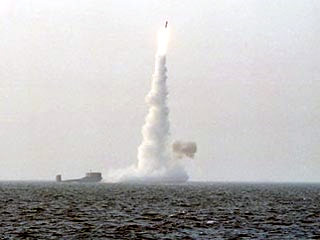
Bulava (photo: Newsru.com)

An OPK source has told ITAR-TASS the next Bulava SLBM test is expected in the first half of September.  The source said the state commission investigating the last Bulava failure is scheduled to meet 6 September, and the launch window for the next test opens on 9 September.

A missile industry source told Interfaks the commission will meet in the 5-7 September timeframe, and it could fix a launch date sometime at the end of the first ten days of September.

Newsru.com recalled that three tests are planned for 2010:  two from Dmitriy Donskoy and one from Borey-class SSBN Yuriy Dolgorukiy.  The website’s Defense Ministry source unofficially repeated claims that, if all three firings are successful, the Bulava will be accepted into the armaments inventory next year.

ITAR-TASS also reported today that Dolgorukiy successfully completed its latest phase of factory underway trials, and is preparing to go sea again next month.  Sevmash reports the new SSBN completed its cruise program, showing “good performance characteristics and reliable working of all onboard systems.”

Proyekt 636 Subs Being Laid Down for BSF

On 17 August, Russian news agencies reported that Admiralty will build a proyekt 636 diesel-electric submarine for the Black Sea Fleet (BSF).  The keel-laying was scheduled for 20 August.  Navy CINC Admiral Vladimir Vysotskiy says, in all, three proyekt 636 submarines will be laid down for the BSF before year’s end. 

Krasnaya zvezda writes that, although Admiralty has produced export submarines since 1983, Novorossiysk will be its first proyekt 636 for the Russian Navy.

Ocean TV reports Novorossiysk will be complete in 2013, and the other two in 2014.

The Rubin Central Design Bureau of Naval Technology has made changes in the construction of systems and equipment of the proyekt 636 for its use in the Russian Navy.  RIA Novosti said the new BSF submarines will be armed with the Klab-S antiship cruise missiles.

The Navy Main Staff calls Novorossiysk the start of its long-term plan to restore the BSF’s combat readiness.  The fleet is also slated to receive the Sevastopol, the third unit of new fourth generation proyekt 677 submarines.  According to Krasnaya zvezda, the transfer of Baltic Fleet Neustrashimyy and Yaroslav Mudryy frigates to the BSF is still being worked, and could take place in the next year.

A related aside . . . it’s been almost four months and there’s no mention of the BSF basing report that, on 1 May, President Medvedev ordered Defense Minister Serdyukov to present in a month.

Renewed Talk of Airborne Laser

Russian Airborne Laser Testbed (photo: testpilot.ru)

Work on the U.S. airborne laser has gotten the Russians talking again. 

On 19 August, an OPK source told Interfaks a laser system mounted on an Il-76 is under development, specifically to counter enemy reconnaissance systems.  It’s supposed to disrupt optoelectronic equipment operating in the infrared range in space, at sea, and on land.  The Interfaks source said this work’s been continuing for some time using a modified Il-76 (A-60), and the laser’s gone through a series of successful tests. 

Vesti.ru picked up the story from here.  It says Russia’s flying airborne laser laboratory took flight in 1981, and fired against an aerial target in April 1984.  However, work ceased in the early 1990s for lack of funds.  But now, Vesti.ru claims financing is going “according to plan.” 

Defense commentator Igor Korotchenko told Vesti.ru he doesn’t see the sense in the airborne laser, and doesn’t think it could be used in practice: 

“From a practical point of view, realization of such a program under conditions of defense budget limitations will look absolutely unwarranted and wasteful for the Russian budget.  Even if Russia gave itself such a task as developing an air-based laser, we have to understand that we’d have to fly this laser into U.S. airspace.  And try to destroy ballistic missiles there in the launch phase when they fire them at us.  It’s completely obvious that all our aircraft would be shot down.” 

Korotchenko goes on to say only the U.S. can afford a program like the airborne laser.  But regarding Russia: 

“. . . theoretically, of course, it’s possible to allow that such a flying laser system could be built, but if it’s senseless in a practical plan of combat employment, why take away resources from really important and necessary programs?” 

While reading Korotchenko, one needs to bear his long and close association with Almaz-Antey in mind.  Perhaps there’s fear lasers might detract from funding for more conventional air defense weapons.

According to Vesti.ru, many specialists think it’s just a matter of Russian prestige in keeping up with the Americans.  CAST’s Ruslan Pukhov doesn’t consider it a waste, however, saying that even the U.S. recognized Russian laser successes, and it would be stupid not to pursue more research.  Still others say it’d be better to spend money protecting Russian missiles from laser strikes during launch and boost phases. 

Newsru.com provided Pukhov’s comment:

“Several types of weapons need to fulfill the same function so that your system is more stable.  If suddenly the enemy found some kind of countermeasure to one type of weapon, or you didn’t manage to employ it for this or that reason, it’s always better to have a substitute.  Therefore, in my view, it’s stupid to renounce those types of weapons and those technologies where even your potential enemy assesses you extremely highly.”

Lenta.ru also added to this story.  According to it, the laser system will be for Russian forces; there’s no talk of exporting yet.  It says Russian Academy of Engineering Sciences official Yuriy Zaytsev first mentioned renewed work on an airborne laser in August 2009.  It provides some background on the Soviet laser weapons program in the 1960s and 1970s, through the A-60’s successful destruction of an aerial target in 1984.  It says, though there was no money in the 1990s, the design bureau continued to work on the laser program on an initiative basis.

Is the Helicopter Carrier Tender for Real?

Speaking in Yerevan today, Defense Minister Serdyukov told journalists:

“We have announced an international tender for construction of a helicopter-carrying ship.”

He indicated Russia is talking about two ships.  He also welcomed the French builders of the Mistral to join in the tender.

The tender will take place next month, and the winning bid will be selected before year’s end.

After months of negotiations with France on building Mistral-class amphibious assault ships, the Russians couldn’t reach agreement on the terms of a deal.

The two sides may have agreed on building two ships in France’s STX shipyard.  French President Sarkozy told its workers last month they’d be building two ships with the Russians.

Maybe the Russians wanted to buy one and build three, but Serdyukov says the international tender is for two ships, so it seems likely Paris and Moscow had agreed on a ‘2+2’ formula.  So something else is probably the sticking point.

RIA Novosti suggests talks with Paris stalled over its unwillingness to sell Moscow the NATO standard tactical communications system aboard Mistral, according to an unnamed expert who spoke to Ouest-France.

The expert said the comms system is tied to the SENIT 9 tactical combat information system.  It’s described as an important node NATO isn’t prepared to share with Russia.  The French expert says the Russians “don’t have a very good command of military computers and are trying to fill the gap.” 

Officially, the Elysee says negotiations with Russia continue, it’s confident of a successful outcome, and it isn’t worried about the Russian tender.  It hasn’t commented on participating in it either.  Meanwhile, the French media claims Moscow has stopped its exclusive talks with Paris.

Tender for Helicopter Carriers May Just Be Formality

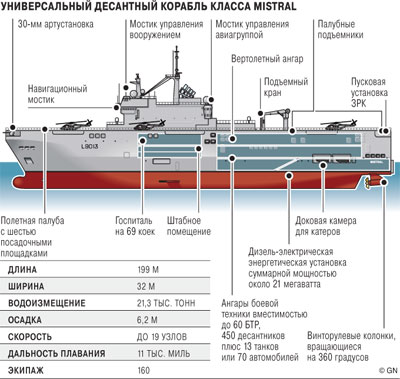
Mistral Schematic

Kommersant reports today that United Shipbuilding Corporation (OSK) has gotten the Defense Ministry’s permission to hold an open tender for procurement of helicopter carriers.  The paper concludes the Defense Ministry is refraining from a sole-source purchase of the French Mistral, and will consider similar proposals from OSK’s shipyards.  But the military [at least some military officials] haven’t hidden the fact that they prefer Mistral [but Defense Minister Serdyukov has always maintained they’ve been talking to other suppliers], so the tender could just be a formality. 

OSK President Roman Trotsenko says a special commission from the Ministry of Industry and Trade will conduct the tender, but details are sketchy.  A Defense Ministry source told Kommersant that, without a tender, a deal to buy a helicopter carrier [presumably Mistral] would be considered illegal.  So there won’t be a sole-source buy despite a year of government-to-government talks.

The paper reminds readers of OSK’s recent unsuccessful antimonopoly complaint in regard to the government’s consideration of Mistral.  Although the complaint was not reviewed, it must have had some impact on the decision to compete the helicopter carrier purchase.  Kommersant sources say OSK Board Chairman Igor Sechin also had something to do with it.

Trotsenko says far east shipbuilding plant ‘Zvezda,’ Petersburg’s ‘Admiralty Wharves,’ and Kaliningrad’s ‘Yantar’ will bid for the ships.  ‘Zvezda’ already has a joint venture in place with South Korea’s Daewoo – builder of the Dokdo helicopter carrier.  The OSK President says ‘Admiralty’ and ‘Yantar’ might work with ‘Northern’ shipyard or a foreign builder. 

Kommersant has a letter sent from Sechin to Prime Minister Putin this spring saying not only is Dokdo an alternative to Mistral, but Dutch and Spanish helicopter carriers are as well.

Trotsenko says OSK yards can build a helicopter carrier in 30 months for $500-700 million against a Mistral pricetag of €420-680 million.

Kommersant concludes the tender won’t end the conflict between OSK and the Defense Ministry.  Mistral will remain the latter’s priority.  The paper’s sources don’t know if the military wants to buy Mistral itself or place an order for a new unit in a French shipyard (STX).  OSK hasn’t been able to arrange a cooperative agreement with STX.

Mezhprombank-controlled ‘Northern’ and ‘Baltic’ shipyards will participate in the tender according to a representative of the bank. Kommersant’s sources think Mezhprombank, its owner Sergey Pugachev, and shipyards are the favorites among Russian contenders.  Pugachev was an early supporter of buying French, then building other units in his shipyards.  And, according to Kommersant, the Defense Ministry supports Pugachev.

Alongside Pugachev and Mezhprombank, OSK feels its chances to win the tender aren’t great.  Moscow Defense Brief analyst Mikhail Barabanov also says Mezhprombank yards are the favorites to build Mistral in Russia.  Such a deal’s been reached at a political level between Paris and Moscow, so the tender might just be a formality.  CAST’s Konstantin Makiyenko agrees.  But he thinks Mistral orders will go to ‘Baltic,’ since ‘Northern’ is loaded with frigate and corvette orders.  Meanwhile, OSK would like to buy both yards from Mezhprombank, but the sides haven’t reached agreement on a price.

BMD-4M Update

BMD-4M

An item on pending troop testing of the BMD-4M for VDV . . . .  No, they aren’t in the force yet.  Despite the optimism expressed below, it remains to be seen if the Defense Ministry will actually order the system upon completion of troop testing.  It sounds like the designers and builders have footed the bill — 200 million rubles — for the system’s development thus far.

From this week’s Voyenno-promyshlennyy kuryer:

“Troop testing of the modernized airborne combat vehicle BMD-4M is being conducted in the course of the 98th Airborne-Assault Division’s command-staff exercise (KShU), which will take place from 23 to 28 August near Ivanovo.”

“During the airdrop of military equipment, seven BMD crews will be inside the combat compartment of these vehicles.  Immediately on landing, the crews will move out to fulfill combat missions on unfamiliar terrain in the notional enemy’s rear area.”

“An airdrop of parachute troops and military equipment from aircraft of Military-Transport Aviation will occur in the course of the divisional KShU, which will be directed by VDV Commander General-Lieutenant Vladimir Shamanov.  In all, it’s planned to airdrop 15 pallets with military equipment, including the BMD-4M.”

“After the completion of troop testing of the modernized combat vehicle, development of which Kurganmashzavod, the Volgograd Tractor Plant and other enterprises of the ‘Tractor Plants’ Concern are engaged in, it will be accepted into the arms inventory of the ‘winged infantry’ and included in the state defense order.”

“Development and production of the BMD-4M is being conducted with the agreement of the Defense Ministry at the concern’s expense.  Expenditures on the first test models amounted to nearly 200 million rubles.”

Update on Next Bulava Test

Today’s Kommersant cites Interfaks saying a session of the state commission deciding on the next Bulava SLBM test will happen during the next week.  Kommersant’s own OPK source confirmed this, calling the session a formality since the commission’s already announced that testing needs to continue in the near future.  The source says, after the commission meets, another week is needed to prepare for a launch, so look for the next test in late August or early September.

Kommersant quotes an unnamed OPK official who said the planned launch in the 11-13 August timeframe was postponed because “additional stand tests of the system were conducted with the goal of more rigorous preparation for the launches.”

Kommersant reminds readers three launches are planned before year’s end — two from Dmitriy Donskoy (proyekt 941U Akula) and one from Yuriy Dolgorukiy (proyekt 955 Borey).

The paper’s OPK source claims, in view of Bulava’s failures, “this strategic missile system will only be accepted into the inventory after a minimum of five consecutive successful tests.”

Kornukov’s VKO Concept

In Izvestiya yesterday, Dmitriy Litovkin wrote that today Defense Minister Anatoliy Serdyukov will receive a new, large-scale concept for establishing Russia’s global aerospace defense system for his review. 

According to Litovkin, the concept’s drafters picked 9 August because it’s the 60th anniversary of the USSR Council of Ministers decision to create the Soviet strategic air defense system.  He adds that Izvestiya is the first to study this just now declassified seven-page document.  It called for Soviet designers to develop an air defense system for Moscow codenamed ‘Berkut,’ in an improbably short period of two and a half years.

Litovkin quotes former Air Forces CINC Anatoliy Kornukov:

“Today we’ve developed and given the Defense Ministry an analogous document, setting down goals and tasks in the area of developing the country’s VKO system – this is a draft of a presidential decree on establishing VKO.”

In this case, the ‘we’ is the Extradepartmental Expert Council for Air-Space Defense (VKO) Problems, which Kornukov chairs.

Of course, Kornukov is a well-known critic of the state of Russia’s current aerospace defenses, who also advises air defense system producer Almaz-Antey.  One might, therefore, logically conclude that Kornukov’s concept will accord with Almaz-Antey’s current plans.

Litovkin goes on to relate stories of Laventiy Beria’s and his son’s involvement in those early air defense development efforts, and the prize money offered to the designers and their teams.

He tells about the Soviet / Russian A-35 and A-135 nuclear-armed ABM interceptors made obsolete by the S-400.  The S-400 he describes as a direct successor to the S-300, but with modern electronics:

“The tactical-technical characteristics of the S-400 were confirmed in the course of large-scale exercises ‘Combat Commonwealth-2009’ and ‘West-2009.’  S-400 combat crews successfully destroyed targets analogous to modern and future air attack systems.  The correctness of the Defense Ministry’s decision on creating air-space defense brigades was confirmed at the same time.”

Litovkin quotes Almaz-Antey Chief Igor Ashurbeyli:

“In modern conditions even the S-400, if you go the way of endless modernization, will end up in a technical dead end.  The system is indisputably effective, it will be modernized in the future, but up to a certain reasonable limit.  Its combat potential will be raised, but it won’t go beyond the bounds of ‘conventional’ PVO-PRO systems.  Today we have the mission of covering the country from the greatest number of potential threats.  On the Defense Ministry’s order, we’ve started development of the fundamentally new S-500 system.”

As stated many times, Litovkin notes the S-500 is to complete development by 2015, but its characteristics haven’t been disclosed, beyond it having a new active X-band phased array radar.  Supplemental short- and medium-range SAMs (Morfey and Vityaz) will be developed.  The S-400, S-500, and these systems are supposed to cover ranges from 5 to 400 kilometers, at heights from 5 meters to near space.