Category Archives: Defense Industry

Popovkin for Kolmakov

A long-swirling rumor that First Deputy Defense Minister, General-Colonel Aleksandr Kolmakov would be forced into retirement became a fact this week.  Talk of this dated to March.  Defense Minister Serdyukov didn’t want both of his first deputies [Kolmakov and General Staff Chief Makarov] occupied with combat training and readiness, reportedly wanting to end this unnecessary division and competition.  More recently, Aleksandr Golts said Kolmakov’s and Makarov’s activities with operational troops intersected, even though nothing was ever heard about tensions between the two generals. 

Argumenty nedeli indicates Kolmakov more than once firmly, but tactfully, expressed his disagreement with Serdyukov’s reforms, specifically the elimination of warrant officers and the posting of excess officers in sergeant’s duties.

It’s not precisely clear who will benefit from Kolmakov’s departure.  The press largely assumes it’s the Genshtab and the main commands of the armed services and branches, but it’s no longer as easy as that.  Golts linked the Kolmakov change with the move to 4 military districts or operational-strategic commands (OSK or ОСК).  He argues that putting all ground, air, and naval forces under 4 operational commands would weaken all central supervisory organs, including the Genshtab and main commands.  As for Kolmakov’s Main Combat Training Directorate, it might move somewhere else, morph into something else, or simply disband.

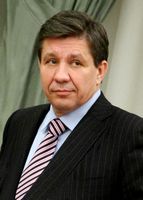
Deputy Defense Minister and Armaments Chief Vladimir Popovkin takes his old portfolio and responsibilities to his new post as First Deputy Defense Minister.  So as much of the Russian media has noted, rearmament is an entirely new priority and job description for the First Deputy.  One wonders if Popovkin will even have a successor in his old position. 

All observers seem to agree, however, that the swap of Popovkin for Kolmakov and rearmament for troop training focuses the Defense Ministry on providing the troops what they need and the Genshtab and uniformed commanders on training them.  Read Kommersant and Rossiyskaya gazeta for more on this.

Popovkin himself told Rossiyskaya gazeta

“We decided to divide the Defense Ministry’s administrative and operational functions.  A civilian  channel is being created which will support the troops.  A second channel will conduct combat training, all troop activities connected with the operation and use of armaments and military equipment.  It’s been decided to withdraw purchases of armaments and everything else from the duties of the Chief of Rear Services and the Chief of Armaments and to appoint a responsible person who will order and purchase all this.”

This would all seem to connect in the person of Nadezhda Sinikova, whom Medvedev and Serdyukov recently appointed to head and invigorate Rosoboronpostavka.  Military men will continue to make their own orders and requests, but Sinikova’s organization will deal directly with suppliers.

Here’s what President Dmitriy Medvedev said to Popovkin on 22 June:

“Naturally I wish you success and hope that the sector you will coordinate, – this is, first of all, the armaments sector and military equipment and the resolution of a series of issues connected with the civilian component  in the Defense Ministry, – will develop successfully, and we will be able to realize this state armaments program which we are now coordinating.”

“This is a large-scale program, complex, intense, however, at this time, it is directed at establishing on the current foundation a modern, effective armaments system for our army, to reequip, and fully supply it in the framework of those priorities on which we agreed and which must create the basis for the development of our Armed Forces in the future to 2020 and even to 2030.”

“This is a large, complex task.  I hope we have forever gone away from the situation of patching holes in the Armed Forces, which was characteristic in the 1990s and the beginning of this century, and we have set out on a different basis of work.”

“But here methodical, scrupulous work is needed especially with military equipment suppliers because they are sometimes pampered and don’t provide quality, and very unpleasant price increases appear for us.  Therefore we have to hold everything taut, but at the same time acquire everything our Armed Forces need to be combat capable and well trained.”

Gazeta.ru asked to Deputy Chairman of the Duma Defense Committee Igor Barinov to explain what Medvedev was saying about the Defense Ministry’s suppliers:

“Prices on VPK products are growing out of proportion with the growth of inflation and taxes.  For example, the ‘Topol-M’ increased 2.5 times in 3 years, and a sniper rifle cost less than 30 thousand rubles at the beginning of the 2000s, but now the Defense Ministry buys them for 400 thousand.”

“Enterprises don’t want to reduce defects, they place incomprehensible prices on their own products—some places because of corruption, some places because of a lack of restraint.  It’s impossible to allocate money if a process of systematizing price formation doesn’t occur.”

In Vremya novostey, Pavel Felgengauer describes Popovkin as one of the drivers of the current military reforms:

“Popovkin was the first to begin publicly saying that the problems of the Russian VPK are connected with a large lag behind the West.  And he was first to acknowledge that Russian space system use large amounts of Western components.  Before him no one publicly talked about this.  And in 2008 Popovkin was first to announce that Russia will buy foreign military equipment, and not just components.”

An informed, anonymous source also told Vremya novostey that Popovkin is an “old acquaintance” of Medvedev and Putin.  And he will be the Defense Ministry’s real number two man, pushing Army General Makarov lower in the de facto hierarchy [of course, this overlooks the very good likelihood that Serdyukov maintains his own hierarchy based on his own team of trusties and it probably doesn’t include any ex-generals like Popovkin].

Popovkin’s official bio can be found here.

Light Armor Acquisition Still Undecided

RIA Novosti reports the Defense Ministry is still undecided about purchasing European-made light armor for its military vehicles.  Defense Minister Serdyukov has said Russia might buy it from a German company.

Monday Deputy Defense Minister, Armaments Chief Vladimir Popovkin visited Italian firm IVECO’s display at Eurosatory-2010 in Paris.  IVECO uses German technology in fabricating light armor. 

Popovkin said:

“Issue of acquiring light armor and technology for its fabrication still isn’t decided.  Domestic scientific-research institutes still haven’t answered us about whether they’re ready and capable of making such armor.  If they make it, then we’ll use it, if they don’t, we’ll search for ways of getting Western technology for its subsequent production in Russia.”

Popovkin also indicated leading military producers are actively developing a new class of wheeled armored vehicles.  He said in the Russian Army’s modernization there are plans to establish light, medium, and heavy brigades.  Light brigades will have wheeled, medium wheeled and tracked, and heavy only tracked vehicles.  

A RIA Novosti source said:

“A lot depends on the deployment locations of these brigades and the combat missions they’ll be given.  This will be the determining factor for supplying brigades with this or that equipment.”

As an example, he mentioned IVECO’s development of a 29-ton wheeled tank with composite armor and a 120-mm main gun.

Shamanov’s Press Conference

General-Lieutenant Shamanov

Ever-loquacious VDV Commander, General-Lieutenant Vladimir Shamanov held a wide-ranging press conference on Wednesday.  The Defense Ministry web site covered it hereITAR-TASS also published a number of short items on it. 

Shamanov detailed the work of five immediate deployment VDV battalions, lobbied again for a helicopter regiment, and discussed training issues and his procurement desires.  He joined the dogpile on top of the Russian OPK although he once seemed to defend it, and he credited Putin alone for the initiative to modernize the military’s arms and equipment.

He described his forces as combat ready, and manned and equipped at 100 percent.

Relative to combat readiness, Shamanov announced that the VDV has dedicated five battalions for immediate deployment which, if necessary, will be its first units sent into combat.  He said:

“By agreement with the General Staff, in the VDV we’ve dedicated five battalions for immediate deployment.  The uniqueness of service in these battalions is such that personnel from each of the battalions goes on leave for 45 days as a complete unit.  Therefore, at a minimum four battalions are always ready for combat deployment.  Today one of the sub-units of such a battalion from the 31st Airborne-Assault Brigade (Ulyanovsk) is fulfilling missions in Kyrgyzia [sic].”

Shamanov also gave voice to his desire, more modestly expressed than in April, for some aviation assets for VDV.  Speaking about the VDV’s future development, he said his troops must become airmobile.  To this end, he’s “given the Genshtab’s Main Operations Directorate [GOU] a request on the issue of forming a helicopter regiment in one of the three airborne-assault divisions [DShD or ДШД].”

Shamanov discussed VDV training at great length.  He started, of course, by speaking about jump training.  The parachute jump training plan was 70 percent fulfilled during the winter training period.  He blamed poor weather, saying troops often jumped in minus 30 degrees Celsius—the lowest acceptable temperature.  The plan for jumps from An-2 aircraft was fulfilled, but only 70 percent fulfilled from Il-76 aircraft.  He noted the VDV conducted its first-ever drop of a BMD-2 with its crew on-board, and said this hasn’t been done in 7 years, and then it was a BMD-1.  Use of the BMD-2 was significant, he said, because the BMD-2 represents 80 percent of VDV’s combat vehicle inventory.

Shamanov talked about large Spetsnaz assault group jump training in guided parachutes.  He said the use of guided parachutes allows reconnaissance troops to complete a horizontal flight of 20 kilometers, and:

“Our goal is to get so that such movements reach 40 kilometers, as they do in the Israeli Army.”

The VDV Commander noted that the multi-component Polet-K command and control system was tested for the first time in winter training.  He said: 

“It still isn’t the full suite envisioned in the future.  We are one-third through its introduction into the forces.  This process won’t happen in a year.”

Also for the first time, an artillery sub-unit of the 98th Airborne-Assault Division used Russian-made ‘Eleron’ UAVs for target designation on the Luga training grounds.  Shamanov said five ‘Eleron’ UAVs were employed in the training, and they conducted supplemental reconnaissance to a range of 10 kilometers in advance of fire missions.  This summer, 12 VDV crews will train on Israeli-made UAVs in Moscow Oblast.  Shamanov said:

“Unfortunately, our representatives did not go to Israel where they produce the ‘Hermes’ UAV which has been bought by Russia.”

Shamanov noted more attention to air defense training in the VDV this winter.  There were 40 firings of manportable ‘Strela-10’ and ‘Igla’ SAMs.

For the summer training period, Shamanov noted the VDV has 9,300 conscripts to get through three jumps in the course of 1.5 months.  The VDV will participate in ‘Vostok-2010’ and the CSTO’s ‘Cooperation-2010.’  There will be a VDV-level CSX (КШУ), as well as a CSX involving the 98th VDD (or ВДД).

Following the lessons of the Georgian war, the VDV is periodically training on the Navy’s large assault ships (BDK or БДК).  Shamanov says:

“In the winter training period we transported the 108th Regiment on large assault ships three times.  The exercises ended with a naval assault landing by a reinforced assault-landing battalion (ДШБ).

Last but not least, Shamanov commented on VDV procurement, and transport aircraft in particular:

“Work on the State Armaments Program for 2011-2020 is being completed.  According to our requests, in it there is the modernization of Il-76 aircraft, renewal of production and modernization of An-124 aircraft, the purchase of 30-40 An-70 aircraft.”

An-70

But the VDV Commander stressed these were his requests, and the final say isn’t his.  Utro.ru quoted him:

“In the development of the state [armaments] program, we gave our proposals, whether they’ll be realized in the confirmed version of the state program, I can’t say yet.”

Gzt.ru and Lenta.ru covered the An-70 and An-124 story in detail.

Shamanov said troop testing of the ‘Shakhin’ thermal sight for infantry weapons is complete.  He said:

“There has to be one approach for weapons—they have to be all-weather.  Not long ago the thermal sight ‘Shakhin’ went through troop testing.  After the testing we returned it to the designers for reworking.  We’ve given the task that our weapons work according to the aviation principle—turn your head and firing systems turn after it.”

He commented on air-dropping the BMD-4M, and added that, “The BMD-4M has every chance in the future, owing to its qualities, to be the forces’ main infantry combat vehicle.”

Although he seemed more like a supporter of Russian-made weapons six months ago, Shamanov now applauds Prime Minister Putin [not President Medvedev?] for searching for good weapons and equipment abroad.  Shamanov said the prospect of foreign competitors has forced “the domestic OPK to move,” as reported by Utro.ru.  He continued:

“Last year when industry was told that we’d look for alternatives abroad, they began to move.  In particular, the atmosphere around Mistral is creating a significant context for the domestic OPK.  When people declare that they’re ready to produce 21st century weapons but their equipment is from the 30s and 40s [of the 20th century], how can you talk about the 21st century?  Therefore, every official supports Vladimir Vladimirovich Putin’s initiative on the requirement to renew our armaments.  As long as this doesn’t happen, we’ll being shifting in place, and this won’t be just a lament of Yaroslav’s daughter [reference to the Prince Igor’s wife in the Lay of the Host of Igor after his defeat by the Turkic Polovtsy in 1185].”

At the same time, Shamanov concluded that GAZ and Izhevsk vehicles perform better for the VDV in the snow that equivalent Italian and Canadian ones.

Shamanov also said it’s essential to decide what to buy without any kind of lobbying, and for his part, he bases his decisions on saving soldiers’ lives and fulfilling missions.

Three Identical Missiles

The Defense Ministry’s inter-departmental commission didn’t make any announcement about its work or the causes of Bulava SLBM test failures as had been anticipated on 20 May.  If this commission has clues about the missile’s problems, it didn’t reveal them.  But Kommersant concludes that the Defense Ministry hasn’t reliably determined the causes of previous failed launches.

However, on 21 May, Defense Minister Serdyukov announced a new approach to Bulava testing.  The Russians will make three identical missiles and launch them in hopes of pinpointing the same problem in each.  It’s a gamble, but it could work.

RIA Novosti quoted Serdyukov:

“The problem of the unsuccessful ‘Bulava’ missile launches lies in the assembly process.  We do not see any other violations there.  The whole matter is missile assembly quality.  Each unsuccessful launch has its own causes.  They are all different.”

“Now we are working on making three absolutely identical missiles.  We believe that this will allow us to precisely locate the mistake, if there is one, since it must be repeated in all three missiles.  Now we are working on how to control the assembly process in order to know that all the missiles are identical.  Toward November, I think, we can begin launching the missiles.  After this we will be able to identify the cause precisely.”

Earlier reports had said the next Bulava test would occur in June, but Serdyukov now says November at the earliest.  Over six years, only 5 of 12 Bulava launches have been successful or ‘partially successful.’  The missile launched on 9 December 2009 self-destructed after a third stage engine problem.  Grani.ru recalled that other recent problems included steering system and stage separation malfunctions.  Moscow had intended to put the Bulava on its new Borey, or Proyekt 955, SSBNs starting in 2007.

Gzt.ru describes the new three missile approach as an expensive “hit or miss” method.  The Defense Ministry hopes launching identical missiles will point to the same problem in each, if there is one.  But if they still manifest different problems, Moscow will be no closer to pinning them down.  The risk is another year without getting any closer to a new SLBM.

Gzt.ru concludes:

“Serdyukov didn’t specify what will happen if in the November series of launches of ‘Bulava’ each time a different component of the missile fails.  Apparently, this possibility isn’t being considered.”

Also in Gzt.ru, Defense Ministry critic Konstantin Sivkov describes the three missile plan as absurd and expensive.  With each missile costing 300 million rubles, it’s a 1 billion ruble effort and there’s no guarantee the bug, or bugs, will be identified.  He believes the designers will have to conduct stand tests where all components can be checked under controlled conditions.  He blames defective parts allowed into the system due to inadequate production controls.

Gazeta.ru cited one Andrey Ionin, a missile designer, who agrees the problem lies in the absence of technological discipline in the enterprises of the Russian OPK.  He says:

“Cooperation by several hundred enterprises, working under different forms of ownership, in different parts of the country, without observing all rules of technological discipline is pointless.” 

Nevertheless, simultaneous assembly of three missiles could be a way of searching for mistakes in Bulava.

MIT missile designer Yuriy Solomonov has said repeatedly it’s defective materials, production process breakdowns, and the lack of quality control, but neither he nor military men are saying which materials or processes they suspect.  He’s also said Russia lacks 50 materials needed for solid-fuel missile production.

In Kommersant, former RVSN general Viktor Yesin claims the Defense Ministry’s inter-departmental commission investigating Bulava has determined that enterprises didn’t cooperate and provided poor quality parts for the missile.  Still he sees no alternative to Bulava and believes its design is workable.

Serdyukov Looks at IVECO Light Armored Vehicles

Defense Minister Serdyukov indicated today that, although Russia is interested in foreign light armored vehicles, it won’t buy any, and wants to produce its own.

During last week’s visit to Italy, IVECO put on a demonstration for Serdyukov at Moscow’s request.

According to RIA Novosti, Serdyukov said:

“The Defense Ministry is actively studying modern tendencies in arms employment.  Particularly in transporting personnel, medical personnel, and also reconnaissance in light armored vehicles.  The experience of Afghanistan and Iraq and our experience (in the regions), where explosions often occur, shows it’s essential to transport Defense Ministry sub-units in armored vehicles.”

Maybe Serdyukov should have said we already transport troops in armored vehicles, but we need to transport them in good, modern ones.

Serdyukov also noted that Germany is actively studying armor protection for troops, and Russia’s Defense Ministry is interested in similar production of its own.  He called Germany the leader in armor, and noted that German armor is mounted on Italian vehicles.  Serdyukov continued:

“We’re not talking about purchases of these vehicles in Italy or another country.  The main thing is to organize production of such equipment in Russia.”

Serdyukov on Mistral

Defense Minister Serdyukov today said Moscow still plans on acquiring four Mistral amphibious assault ships.  He said Russia is talking not just with France, but also Spain and the Netherlands, about Mistral

According to RIA Novosti, Serdyukov said:

“At present, we’re in pre-contract negotiations on this type of ship with three governments.  They are Spain, the Netherlands, and France.  We plan to sign a contract for four of these ships.”

He also said one ship would be completely foreign-made, but Russian shipbuilders would participate in building the other three.  And the fourth ship will be built, to the maximum extent, in Russia.  

Serdyukov reiterated that the Defense Ministry is working on this acquisition according to President Medvedev’s decision.  And the Defense Minister added: 

“We are now occupied with the issue very seriously.” 

He concluded that the issue of buying the ships will be resolved positively “if there aren’t any revisions, including in the financing question.”  And finally Serdyukov noted:

“We understand now that the Northern and Pacific Fleets need these ships.”

Meanwhile, Baltic Shipbuilding Plant ‘Yantar’ is trying to tout its proyekt 11711 large amphibious ship Ivan Gren as an alternative to buying or building foreign ships.  VPK.name published a version of this story based on an earlier Interfaks report.

Fifth Generation Helicopter

Andrey Shibitov

In a 13 May news conference, OAO Helicopters of Russia Executive Director Andrey Shibitov described the company’s work on a concept for a fifth generation helicopter.  His comments to the press came in advance of HeliRussia-2010 beginning today in Moscow. 

Shibitov said:

“We are actively working on the concept of a fifth generation combat helicopter.  Wind tunnel testing of two aerodynamic designs coaxial [Kamov] and traditional [Mil] has begun.  Initial results have been received.  Which of the two designs we’ll pick will become clear in the first quarter of 2011.”

According to Gzt.ru, Shibitov claimed OAO Helicopters is willing to invest $1 billion in its development, and is looking for state investment beyond that amount.

Neither OAO Helicopters nor the Defense Ministry is talking specifics about the new helicopter, but former VVS CINC Aleksandr Kornukov stated the obvious when he told Gzt.ru a fifth generation helicopter needs to be quiet and stealthy.  According to Newsru.com, Kornukov also stated a preference for two pilots in a side-by-side configuration.

In Gzt.ru, former army aviation commander, retired General-Colonel Vitaliy Pavlov said noise isn’t so significant since Mil’s X-shaped tail rotor already reduced noise on the Mi-28 by 15 percent (in comparison with its Mi-24 predecessor), but he added that reworking the engine could further reduce noise.  Pavlov doesn’t see great importance in increasing flight speed.  He sees the coaxial Kamov design as more reliable, but Mil’s traditional rotor system as more stable.  He also likes the maneuverability of Kamov’s helicopters, but he still thinks it’ll be a difficult choice between the two producers.

Also in Gzt.ru, Defense Ministry critic, retired General-Colonel Leonid Ivashov said the fifth generation helicopter could be stillborn:

“If there isn’t a state order for this aircraft, it will wither.  We’re grasping at all fifth generation aircraft, fifth generation helicopters, but for some reason none of this is coming to the troops, today we have helicopters from the 1970s in the army.  So the country’s leadership shouldn’t just rejoice at new equipment in various air shows, but also buy it for the troops.”

Then Ivashov’s deputy at the Academy of Geopolitical Problems, Konstantin Sivkov, takes over, citing his definition of a fifth generation helicopter—increased range, ‘fire and forget’ weapons, capability to engage fixed-wing aircraft, low radar detectability, and speed up to 500-600 km/h.  Sivkov sees noise reduction as secondary since radar can detect helicopters at a 150-200 km range.

Sivkov thinks, under favorable conditions—steady financing, cooperative work by the design bureaus and factories—a new helicopter could be developed in 5 years, but, absent those conditions, development could take 20 or 30 years.

Dmitriy Litovkin in Izvestiya covers a lot of the same information on the pre-design research and wind tunnel blowdown of the prototypes.  He says the so-called Ka-90’s ‘dual-contour’ jet engine could develop speeds over 800 km/h, and he cites a system development timeframe of 5-8 years.  According to him, work is focusing on canted blades with thrust vectoring as well as a new blade design.

He believes one of the designs will win out, but there could be a third hybrid design.  But he thinks there’s little time to waste since the U.S. is already testing new designs, albeit unsuccessfully thus far. 

Writing in Nezavisimoye voyennoye obozreniye, Viktor Litovkin notes three named prototypes–Mi-X1, Ka-90, and Ka-92. 

Shibitov also talked to the press about OAO Helicopters’ record state defense order from army aviation in 2010.  He said:

“A year ago I said it was a shame the Defense Minister wasn’t buying new helicopters.  Beginning this year, I can’t say this.  Finally conscious, sensible purchases of military equipment have begun.”

“We got a record order from the Defense Ministry for purchases of combat, strike, and reconnaissance helicopters in the basic and supplementary order.  Unfortunately, we can’t fulfill the supplementary order because other commercial projects are being completed.”

“From this year, we’re delivering volume for the Defense Ministry comparable with all export deliveries of combat and strike helicopters.  In the course of the coming five years this tempo will continue, and in the period to 2017-2020 the Russian Air Forces will renew its complement of combat, strike, and reconnaissance helicopters by 85-90 percent.”

Aviaport.ru indicated the armed forces will also receive their first Mi-35D, Mi-24D, and Ka-226T helicopters, previously produced only for foreign customers.  OAO Helicopters is reportedly looking at modernizing Ka-29 or Ka-32 helicopters for Mistral, but Ka-52 is another candidate for shipboard helicopter.

CAST’s Konstantin Makiyenko puts the armed forces helicopter inventory at 850, of which 90 percent is obsolete.  He estimates it’ll cost $8 billion to renew this force.

There is evidence of life in Russian military helicopter procurement.  Talking about the GOZ, President Medvedev said 30 would be bought this year, and Defense Minister Serdyukov claimed the army got 41 during 2009.  In late 2008, VVS CINC Zelin said the plan was to obtain 100 new helicopters over 4 years, so these numbers would be in that range.

Navy CINC on Bulava Findings and Typhoon SSBNs

Speaking Friday in Novorossiysk while accompanying Prime Minister Putin, Navy CINC Admiral Vladimir Vysotskiy said the Bulava SLBM commission will report 20 May on its findings regarding the last unsuccessful test launch.  He also promised:

“We are working continuously and checking the entire process of the missile’s development.”

“Continuous work of voyenpredy [military factory representatives] is being implemented.  Right down to a screw, with the submission of corresponding certificates.”

“. . . all enterprises active in Bulava production are working under control of military acceptance.  We are checking the entire process from beginning to end.”

RIA Novosti reminded readers that, despite a string of unsuccessful tests (only 5 of 12 have been considered successful), the Defense Ministry still considers it ‘unrealistic’ to put another type of ballistic missile in new proyekt 955 SSBNs.

In February, Defense Minister Serdyukov expressed his certainty that Bulava problems would not affect the laydown of the next proyekt 955 submarine, the fourth in the series.  Officially, Moscow says Bulava will be carried through until the necessary result is obtained, and the missile will be the basis of sea-based strategic nuclear forces until 2040-2045.

One has to wonder, what happens if, after all the emphasis on eliminating production defects, Bulava still doesn’t fly?  Where does Moscow turn next for answers.

Vysotskiy also told journalists two proyekt 941 Akula (Typhoon-class SSBNs Arkhangelsk TK-17 and Severstal TK-20) will remain in the Russian Navy’s order-of-battle until 2019.  He said:

“They will be in a combat condition until 2019.  They have very great modernization possibilities.” 

This isn’t the first time he’s said this, but he hasn’t said how the 1980s-era SSBNs might be used or altered:

“There are several options, but the decision has yet to be made.” 

Of course, TK-208 Dmitriy Donskoy was modified to be the Bulava test platform.

Defense Industry’s Last Warning

Popovkin in a Suit

Last Friday’s NVO printed an interesting editorial that discussed arms exporter irritation with Deputy Defense Minister, Armaments Chief [former Commander of Space Troops and ex-General-Colonel] Vladimir Popovkin for publicly admitting the Defense Ministry’s dissatisfaction with many of the OPK’s products.  The exporters are obviously upset that Popovkin’s comments have, and will, cost them sales abroad.  But NVO concludes a greater danger would be trying to silence anyone–high-ranking defense official or independent defense analyst–who dares point out the OPK’s problems in the hope of remedying them.

NVO’s sub-title for the article is “The OPK’s systemic crisis threatens a breakdown in the supply of combat equipment to the Russian Army and a lack of export contracts.”

The Greeks have apparently called off a purchase of 420 BMP-3s for $1.5 billion (let’s call it $3.6 million per vehicle).  The deal had been 2 years in the making, and it wasn’t the state of the Greek economy that caused the halt.  According to NVO, the money was already in the defense budget.  Rather it was Popovkin’s specific criticism of the BMP-3 that folded the deal.

Popovkin is quoted:

“We very much need to protect our soldiers.  Today everyone rides on top of the BMP because no one wants to ride in this ‘coffin.’  We need to make a different vehicle.”

Greek journalists published his remarks, and opposition politicians turned them into a scandal:  how can you buy unsuitable equipment that even the country that makes it won’t buy?

Popovkin also complained about the T-90 that the Indians are buying, the tank support combat vehicle (BMPT) that Rosoboroneksport recently demonstrated at an arms show in Kuala Lumpur, and other equipment which the army won’t buy for one reason or another, but which is put forth for export and actively advertised there.

According to NVO, the arms exporters are terribly offended because the [ex-] general cost them several lucrative contracts.  But, in NVO’s estimation, his speech is very necessary.  It says:

“. . . the truth about the condition of the Russian defense-industrial complex, about those processes occurring there, about the systemic crisis in it and the inability of its various directors, including even the government’s Military-Industrial Commission [VPK], to correct the existing situation, is not a secret at all.  It’s been talked about more than once.  On the most varied levels.  Including even presidential.”

NVO says this truth is very important; it could help the powers-that-be uncover the problem areas, fix them, and produce the modern equipment needed for the defense of the country’s interests.  Without an honest discussion, the deficiencies can’t be fixed.  But the Kremlin, government, the legislature, executive organs, or the regions won’t undertake any serious measures against negligent managers.  Despite constant talk of state arms programs, federal programs of technical reequipping of defense enterprises, in reality, with the exception of aviation and air defense firms, nothing is really happening.  It’s moving at a snail’s pace.  Or is it?

Foreign buyers send in 33 warranty claims for every 100 Russian weapons systems exported.  And the scandal with the Algerian MiGs didn’t teach the OPK anything.

It would be possible to silence critics and protect military-technical cooperation with foreign countries and keep the profits coming to the budget and the manufacturers.  But won’t the low quality of these systems, their inability to meet the demands of modern war, really be a negative advertisement?  Does someone really think if they quiet the generals, together with the Moscow media, military analysts and experts then they can sell some kind of half-finished military goods to a serious buyer?  Naive views worked out for illiterate dilettantes.

NVO figures there are two ways out:  either give up, lose export orders, and accept the situation or sharply improve the quality and effectiveness of Russian weapons, reduce prices and defects, and strive to be on the leading edge of technology.  In other words, saving defense industry is in the hands of defense industry itself.  And no one else.  

When it comes to combat vehicles, sniper rifles, UAVs, assault ships, night sights, and armor, the international division of labor in defense industry isn’t such a bad thing after all.  It brings Russia closer to the ‘probable enemies’ of the recent past.  But when it comes to nuclear-powered submarines and strategic missiles we still don’t know how to do them ourselves and no one’s going to sell us those.  And [unless Russia remembers how and gets its OPK in order] it will remember national security the same way it remembers the long forgotten past. 

This is NVO’s way of telling the Putin-Medvedev regime it would be foolish to shut down this feedback channel that tells it what needs fixing in the OPK.

Can Imports and Money Solve OPK Problems?

Ilya Kramnik (photo: RIA Novosti)

On 22 April, RIA Novosti military commentator Ilya Kramnik provided an essay on the army, the VPK [OPK], and post-Soviet realities.   He gives a convincing negative answer to the question posed above.  Like more money and budget, foreign imports won’t be enough by themselves to fix the Russian OPK’s structural problems which have to be addressed more directly at their roots.   

He has praise for Defense Minister Serdyukov for being willing to admit that the ‘emperor had no clothes’ to some degree.  Serdyukov’s management has recognized that the world has changed and changed the army’s missions accordingly. 

A recognition of one’s problems, however, is not the same thing as fixing them.  Serdyukov, the army, and the OPK face the same kind of modernization dilemmas that face Russian politicians, business, and society.  But thanks to Serdyukov, the armed forces are operating under a more realistic vision of what they are, or should be, building toward.

Kramnik believes imports are fine, but the OPK needs the capability to build the entire line of military equipment needed, if it has to.  To do that, it will have to remedy its capital problems, including human capital.  He concludes there’s still a way to go to get to a mobile, well-armed, and trained army, appropriate for the real threats facing the country.

Kramnik writes:

“In the past few days Defense Minister Anatoliy Serdyukov and his deputy Vladimir Popovkin again raised questions about the quality of the work of the country’s VPK [military-industrial complex].  These questions are not being mouthed for the first time, and are taking on a particular acuteness against the backdrop of announcements of planned purchases of military products abroad–both separate components and complete systems.”

“It’s difficult to say when the theme of the Russian VPK and armed forces’ dependence on foreign supplies first began to resound.  In a large sense, it was always acute–even the USSR didn’t have full independence from foreign supplies, in its heyday, trainer aircraft from Czechoslovakia, light helicopters (Soviet-designed) from Poland, large assault ships from the very same Poland, various types of boats and ships from the GDR, etc., were bought.”

“After the USSR’s collapse this dependence deepened because of the foreign status of many producers which had been an integral part of the Soviet VPK–from Dnepropetrovsk’s Yuzhmash to the Tashkent Aviation Production Conglomerate.  But the problem of the VPK’s growing dependence on producers in the ‘far abroad’ is the most acute and painful today.” 

“The list of purchases of military equipment abroad being realized by the Russian military and producers is already now quite broad:  different types of infantry weapons, communications systems, unmanned aerial vehicles, thermal sights, digital electronic equipment…” 

“Now being added to this list are multipurpose assault ships, and armor for vehicles and light armored equipment.” 

“Meanwhile from the Defense Ministry resound still louder complaints about the domestic VPK over the quality of the equipment it is producing.  Of the number of the largest scandals of this type the recently resonating complaints about domestically developed unmanned aerial vehicles, armored personnel carriers and infantry fighting vehicles must be noted.  Problems are also arising where there are no alternatives to domestic manufacturers, and can’t be in principle–in the development and production of ballistic missiles (“Bulava”).”

“What is happening with the country’s VPK, and what kind of ways out of the situation which has taken shape are there?” 

“The main cause of today’s situation is obvious:  from the beginning of the 1990s through the mid-2000s a large part of VPK enterprises together with the entire country was occupied with everything except strengthening defense capability and modernizing production.  The collapse of the USSR, with the consequent destruction of Soviet industrial infrastructure, disruption of production ties and scientific schools didn’t leave any chance for a better result.” 

“It follows to note that the disruption was systemic, and besides experts in the State Property Committee and other government organs of the 1990s, the authors of this process could, with complete justification, be considered the ‘captains of industry,’ many of whom in this period openly used enterprises entrusted to them for the purpose of ‘making money here and now,’ even through the ruin of production sold off for scrap.”    

“Against this background in the armed forces and those close to the military, but also in industrial circles, groups of ‘patriotic’ experts and analysts, rose like mushrooms after the rain, thoroughly glorifying the country’s army and VPK with chants of one and the same incantation:  ‘it has no analog in the world.’  The incantations rang out with respect to various military and technical wonders, and meanwhile not the slightest attempt was made to comprehend the changing world map, missions of industry and the armed forces.”       

“From the other side the ‘alarmists’ were entrenched and grievously moaned about the death and destruction of the army and military industry, keeping such an inadequate perception of the world as a whole.  Both sides supposed that Russia and its army would in the future conduct a precisely ‘Soviet’ type war against the entire capitalist world, or, at a minimum, against a Chinese invasion.”       

“Very few production associations, which were flagships of the domestic VPK, were able to preserve themselves as single entities in the Bacchanalia of destruction.  There is, first of all, the ‘Sukhoy’ firm, which knew how to turn the crown of Soviet scientific-design thinking–the family of aircraft on the T-10 (Su-27) platform–into the most commercially successful product on the combat aircraft market of the last 20 years.  There is ‘Almaz-Antey,’ whose air defense systems received not less recognition.  There is Nizhnyy Tagil’s UVZ which was saved thanks to the T-90.  There are some shipbuilders and several other companies that managed to ‘get’ the situation and survive.  But such successful ones turned out to be far from all.”        

“The renewal of defense development and the increase in the State Defense Order in the middle of the 2000s could not be and didn’t become a panacea.”       

“Firstly, a simple increase in monetary investment will not save a disrupted industry:  dead people don’t need money, neither do the seriously ill generally.”       

“Secondly, this money by itself could not resolve the row of problems of even successful enterprises–for example, the problem of a lack of personnel, caused not only by the outflow of workers ‘in the hungry 1990s,’ but also by a sharp decline in the young population, together with the fall in the quality of engineering-technical education, and the practically complete collapse of the system of specialized secondary education.”       

“But the biggest problem became the management of the armed forces and military industry in principle.  The armed forces command right up to recent times didn’t have any kind of clearly expressed views on the future profile of the Russian Army.  All the years of reforms right up to the arrival of Anatoliy Serdyukov in the post of Russia’s Defense Minister preserved in essence the truncated and frayed Soviet Army, whose model was becoming ever less and less adequate for the missions facing the country in the prevailing economic and political conditions.”

“Military industry against this background survived reorganization after reorganization, the overwhelming majority of which led to nightmarish overgrowth in bureaucratic components and an increase in the already huge gap in pay between specialists on the line and in the laboratory and the management.  This state of production efficiency contributed to the growth of military expenditures and the amount of ‘kickbacks’–most of all.  Responsibility for results was conveniently forgotten:  ‘captains of industry’ together with the armed forces leadership now, as a rule, won’t risk even dismissal, much less their freedom.”       

“A similar uncertainty led to uncertainty with the military order.  Plans and ideas floated and sank, development began and stopped, the vision of the army and its complex of armaments as some kind of organic system aimed at resolving such-and-such concrete missions was totally absent.  The sole exception on this score was the strategic nuclear forces, where a clear understanding of missions and ways of conducting them was preserved, and work was conducted–on supporting old RVSN missiles, on testing and adopting new ones, on repair and modernization of the Navy’s strategic missile submarines and Air Forces heavy bombers.” 

“Anatoliy Serdyukov’s reform, being the first systemic reform of the armed forces in the last decade, not directed at supporting a dead Soviet structure, but at arranging a new one, under concretely certain missions of fighting local and regional conflicts while preserving nuclear deterrence potential, did not create new problems.  It simply revealed old ones, aggravating them with the absolute ‘nonconcurrence’  of the new Defense Ministry leadership in the old system of relations of the army and VPK.”       

“This ‘nonconcurrence’ became a thorn in the side of very many, those problems earlier kept quiet behind the reckoning ‘well, you understand,’ suddenly stopped being kept quiet, and floated in all their ugliness before the eyes of an astonished public.”      

“For the public the foregoing was a big shock, since it all these years kept the point of view on the army and VPK as some ‘island of stability,’ preserving, in the face of all problems, the Soviet system of connections and ties, and, in general, Soviet possibilities.  Many understood the fact that this wasn’t so, but an open recognition of the changed situation by the leadership of the armed forces and the country, nonetheless, was unexpected.”       

“However such a recognition was necessary as a recognition of the fact that the world has changed.  The Russian Army is more incapable of realizing the West’s half-century nightmare–a three-day dash to the English Channel (we set aside the question of whether the Soviet Army was capable), however does Russia need this capability for defending its people, its sovereignty, its interests?”      

“It occurs that our country needs something different.  It needs a clearly expressed understanding of threats, developed with the participation of the military, politicians, and the public, which stand before the country and the capability to counter these threats.  It needs a compact, ‘quick reaction,’ innovative, directed military industry with minimal bureaucratic overhead, and an education system regularly supplying engineering and labor personnel who will receive pay greater than the managers of shops selling mobile phones and taxi drivers.  At a minimum.”      

“This industry needs to produce the entire line of types of equipment and hardware essential to the armed forces, even if using some quantity of imported components–in the end, even the USA doesn’t disdain the use of military imports, and it imports foreign military hardware worth $15-16 billion annually.”      

“It needs an army–mobile, trained, armed, conscious of its status, prestige, and many centuries of history.  It needs strategic forces which protect the country against wars with superior enemies, the calculation of which on our planet doesn’t even require three fingers.”      

“All this could become a reality only in the event that it’s made into a goal at the very highest level.  Still the reactions of the country’s leadership, and of the armed forces, at a minimum, demonstrate understanding of the problem.”