Category Archives: Force Modernization

Those Air Defense Missile Factories

S-300 Launch Canister? (photo: Izvestiya)

S-300 Launch Canister? (photo: Izvestiya)

OK, a lot gets under the radar . . . hadn’t noticed interesting reports since August by Izvestiya’s Aleksey Mikhaylov.

Sue me.

The latest is Mikhaylov’s informative update on two Almaz-Antey factories planned to crank out missiles for the S-400 Triumf and S-500 Prometey.

His OPK source says:

  • By 2014, large factories in Kirov and Nizhniy Novgorod are supposed to manufacture hypersonic 77N6-N and 77N6-N1 missiles for the S-400 and S-500.
  • The missiles will have inert, kinetic kill warheads, and supposedly be capable of intercepting ballistic targets at 7 km/s.
  • The Kirov factory will cost 41.6 billion rubles, the one in Nizhniy 39.5 (81.1  together).  Almaz will get a credit of 25 billion from VEB; the Defense Ministry will invest 35 billion.  One wonders where the balance comes from, and what the terms of this three-way partnership are.

Almaz greatly needs a new production base to field missiles for its SAM launchers.  It was planned in 2008, but the financial crisis prevented it.  The military doesn’t want to repeat the S-400 experience.  It remains armed with older, shorter-range 48N6 and 9M96 missiles.  Since 2007 only seven battalions (3 and 1/2 “regimental sets”) of the S-400 (out of 56 planned) have been fielded.

New missile production should coincide with serial production of the S-500 system (not later than 2014).  It remains under development.  However, Mikhaylov reports rumored sightings of  Prometey prototypes at this or that test range.

Over time, various officers and officials have claimed new, long-range missiles for the S-400 would be fielded in 2013, 2014, or 2015.

By way of conclusion, Mikhaylov turns to independent defense analyst Aleksandr Konovalov to comment:

“The country’s leadership looks at the defense sector like a Coke machine.  Put money in and get a bottle.  Nothing is that simple with the domestic OPK, and investing a lot of money doesn’t guarantee getting production precisely on time.  And discussion about the S-500 is questionable, it’s possible it doesn’t even exist in drawings.”

Russia’s Arms Race

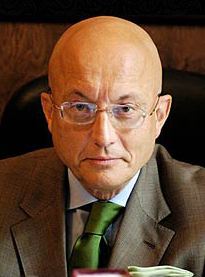
Sergey Karaganov

Sergey Karaganov wrote recently about Russia’s need for a military buildup.  His article appeared in Vedomosti, Russia in Global Affairs, and finally on the Valday discussion club’s site.

He sets out to explain why Russia needs a buildup, and why conventional military power is still relevant in today’s world.  He tries to square the buildup with a “record low” military threat to Russia.  But most of his text criticizes Kremlin intentions.

Down on Russia’s armaments plan, he’s high (probably too high) on the results of Serdyukov’s defense reforms.

It’s worth extracting and distilling some of Karaganov’s points into a stronger concentration.

He gives this as a general rule, but doesn’t (but should) emphasize how this applies to Russia:

“. . . nation states have lost much of their original strength.  Their ability to control information, financial, economic and political processes in their territories is wearing thin.  Also, they are becoming ever more dependent on the outside world.  There emerges another argument in favor of greater reliance on arms as the only tool of which the states almost entirely keep control.”

So Russia, like other states (perhaps to a greater degree), looks to its armed forces as the lone attribute of its sovereignty?

Russia, Karaganov contends, faces no external threat through the medium term.  A strong China is a problem, but not necessarily a military one.  Threats from the south are not like existential ones that shaped Russian history for centuries.  And the threat of a U.S. strike on Russian territory looks “ridiculous.”

Karaganov continues, saying the buildup is more about politics than anything else:

“I believe that in the eyes of the Russian leadership the need for gaining greater military strength will stem first and foremost from the factors of the country’s international positioning and the predetermined prospects of its political development.  Four years of sweet mumbling about modernization and practically no concrete action, except for Skolkovo, clearly demonstrates that neither society nor the elite is prepared for a modernization breakthrough.”

He describes why Russia’s ruler(s) opted for the buildup, then offers tepid support for it:

“It looks like the military buildup is expected to compensate for the relative weakness in other respects – economic, technological, ideological and psychological.”

“Criticizing this choice for being dissonant with the modern world is easy.  To a large extent this is really so.  But the modern world is changing so rapidly and unpredictably that quite possibly this choice is adequate.”

While lauding military reforms thus far, he admits:

“There are no well-considered re-armament plans behind them.”

“The process of rearmament is tough-going.  The defense-industrial complex has been bled white.  Still worse, it is not being reformed.  It is now a pale shadow of the Leviathan of the Soviet era. Just what the Russian army was only recently.”

Karaganov continues questioning the rationale for, and consequences of, the buildup:

“The military buildup policy is not only generally desirable for the ruling elite, and, possibly, for the country, but also inevitable.  The question is how and at what cost.  It will be important not to overspend, thereby ruining the development budgets.  In the meantime, it looks like a policy has been launched towards suicidal (for the country) cuts in spending on education, instead of its dramatic increase.  The reduction will upset even the beyond-horizon chances of making a modernization breakthrough.”

“It would be very silly to overspend and over-arm oneself beyond any measure only to breed more enemies, who would be looking at Russia with horror.”

“What makes the risk of mistakes still worse is that there are practically no institutional restrictions on the arms race.  Only two restraints exist at the moment.  The finance ministers – the current one and his predecessor – have been doing their utmost not to give as much as they were asked for.  And the defense minister has been trying to limit the appetite of what’s been left of the defense-industrial complex – thirsty for investment and, admittedly, corrupt as elsewhere.  In the current political system the national parliament is unable to play any tangible role in shaping a new military policy and in forming the budget.”

“No less alarming is the absence of an academic or public discussion of military policy priorities. In the meantime, there was such a discussion, although in a very limited form, even back in the last years of the USSR.  The academic think tanks created in those times are aging morally and physically.  From the right, liberal side the current military policy is criticized by a handful – literally two or three – of authors.  They surely deserve words of praise for being so bold.  But they lack knowledge and are politically engaged and biased.  In the center there is a group of experts close to the defense ministry, who are obliged to praise whatever it does and turn a blind eye on its mistakes.  And on the left side – in the mass media that are fortunately not quite available to the general reader – one can find publications by tens and even hundreds of specialists representing the remains of the financially and intellectually ruined academic part of the Soviet military-industrial complex.  I am not going to surprise the reader with the phantasmagoric threats these experts try to scare the country and themselves with.  Quite often their descriptions have no bearing on the reality and are nothing but caricature replicas of Soviet-era fantasies.”

“But to realize what is to be done, it is necessary to purposefully promote independent social, political and scientific analysis of the processes that are underway in the military sphere.  Or else there will be too many mistakes to be paid for too dearly.”

It’s pretty clear the new defense minister won’t be a brake on the OPK any time soon, if ever.

And Karaganov’s right, the lack of legislative or expert debate on defense policy is alarming.  But where in Russia hasn’t outside input and influence on politicians and policymakers waned?  His criticism of the state of press commentary on defense issues is a bit dramatic.

Anatoliy Serdyukov’s strength was making changes instead of talking them to death.  This approach engendered lots of resistance.  But, in the end, an intra-elite squabble rather than opposition to his policies brought his resignation.

Defense Ministry Collegium

Wednesday Defense Minister Serdyukov presided over a collegium dedicated primarily to military bases, housing issues, and flight security, according to available accounts.

Mil.ru reported Serdyukov and his subordinates discussed the deployment of troops in military towns, the outfitting of garrisons, and preparations for the coming heating season.

Rossiyskaya gazeta was more forthcoming stating that the Defense Ministry owes fuel suppliers the not-small amount of 4.5 billion rubles for earlier deliveries.

According to the paper, the Defense Minister repeated past declarations that the military plans to consolidate its current inventory of 7,500 facilities into 300 by concentrating personnel and units in larger bases and garrisons.

Serdyukov, in Kursk, said five units numbering 5,000 men will move to a military town near that city.  But he also indicated new infrastructure (barracks, housing, medical, recreation, and parking facilities) has to be built to accommodate them.

So it’s not just as easy as ordering them to go there.

Mil.ru wrote that the Defense Minister called provision of permanent housing to former servicemen in accordance with the president’s and prime minister’s instructions a “priority mission.”  He provided more details:

“Since the beginning of the year, 34 thousand servicemen have received apartments.  The number of territorial housing support organs has increased, the normative-legal base is being completed, and the simultaneous transmission of essential information to all levels of housing presentation has also been organized in the interest of fundamentally improving resolution of housing issues.”

Serdyukov also demanded that military leaders eliminate “violations of time periods for making decisions on the receipt of distributed housing by servicemen.”

Serdyukov met with President Putin a week ago to discuss military apartments.

According to Kremlin.ru, Serdyukov told the Supreme Glavk some 54,000 servicemen were owed apartments at the start of this year, and 33,000 have gotten them.  He said the handover of 1,500 to 1,650 apartments is completed every week, and, at that rate, he believes the housing line will disappear by early next year, at the latest.

Then Putin asked his Defense Minister if he dealt with excess bureaucracy in the process of giving out apartments.  Serdyukov replied that 37 additional offices are open for this purpose, and paperwork requirements have been cut.

Putin and Serdyukov seem focused only on procedure and process problems in handing over housing.  But military men have refused large numbers of  proffered apartments because they aren’t ready to inhabit, lack essential infrastructure, or are simply in places they have no desire to live.  It is more likely than not housing will still be an issue well into 2013 and beyond.  For background on substantially larger amounts of money required and 167,000 men awaiting housing, see Kommersant.ru here and here.

But back to the collegium . . .

RG noted the talk about flight safety came against a backdrop of more new airplanes and helicopters arriving — reportedly 150 in 2010 and 2011, 190 thus far in 2012, and perhaps 1,200 over the next seven years.  RIA Novosti hinted the fatal crash of a new Mi-35 helo, blamed on weather and human error, might have prompted discussion of aircraft accidents.

Defense News

Some Russian defense news from August 6, 7, and 8, 2012 . . .

Sukhorukov’s Press Conference (photo: Mil.ru)

Mil.ru provided a wrap on the First Deputy Defense Minister’s press-conference on GPV-2020.

Sukhorukov “particularly turned attention” to media reports that the program’s funding will be cut.  He told journalists such a step isn’t foreseen, and the government is talking only about “optimizing” the budget load between years by using good old state-guaranteed credits for the OPK.

Sukhorukov claims 95 percent of GOZ-2012 has been contracted, and 82 percent of funds disbursed.

Arms-expo.ru also covered this story.  It emphasized Sukhorukov’s statement that the rate of defective arms delivered by producers isn’t declining.

According to RIAN, Sukhorukov said Russia won’t buy more Israeli UAVs beyond its current contract.  He reiterated the Defense Ministry believes the BMD-4M doesn’t meet its requirements, and won’t buy it.

Sukhoy reports it’s now testing the new Tikhomirov phased array radar on PAK FA, T-50-3 to be exact.  See RIAN’s story.

Sukhoy also announced that its Su-35S is in “combat employment” testing within the process of state acceptance testing at GLITs.  The company says it meets all established requirements, and has flown more than 650 times.

New Navy CINC, Vice-Admiral Chirkov made an interesting visit to the State Missile Center named for Academic V. P. Makeyev on Monday.  The Makeyev design bureau is home, of course, to liquid-fueled SLBM development.  Could not find the last time this happened.  Might be prior to 2007.

Main Military Prosecutor Sergey Fridinskiy told the GenProk collegium yesterday that abuse or dedovshchina in the ranks is down a third this year.  But, according to ITAR-TASS, Fridinskiy noted that general crimes exceed purely military offenses by a factor of two.  Specifically, he said murders are up by half, bribery has almost doubled, and drug offenses have increased 27 percent.

Fridinskiy also said nearly 3,000 GOZ corruption cases and losses worth 400 million rubles were investigated in the first half of this year.  He said, for example, Dagdizel received 3 billion rubles in defense orders, but hasn’t sent a single product to the military, and bought farm equipment and building materials with the money.  He cited losses in purchasing apartments for military men at inflated prices as well as the problem of unfinished housing projects.

Izvestiya claims a large number of young pilots are leaving the Air Forces because the lion’s share of increased flight hours and promised higher pay are going to their commanders and older officers.  Could this be a continuation of Igor Sulim’s travails at Lipetsk?  The paper also reports a number of cleaning companies say the Defense Ministry owes them 5 billion rubles for housekeeping work outsourced over the last year.

Putin on Ground Troops and VDV

Meeting on GPV for Ground Troops and VDV

Kremlin.ru has the transcript of President Putin’s introductory remarks yesterday at a meeting on the land armaments portion of the State Armaments Program, the GPV.  This is his second review of where things stand.  Recall in mid-June he held a session on the Air Forces and the GPV.

Noting that “leading countries” are increasing the potential of their ground forces with new reconnaissance, C2, and “highly accurate” systems, as well as modern armor, Putin continued:

“I remind you in the framework of the state armaments program to 2020 it’s planned to allocate more than 2.6 trillion rubles to outfitting the Ground and Airborne forces.  We have to reequip units and sub-units, to fill the troops with new equipment with these resources.  By 2020 its share must be not less than 70 percent.”

“So 10 ‘Iskander-M’ brigade missile systems, 9 S-300V4 army brigade SAM systems, more than 2,300 tanks, nearly 2,000 self-propelled artillery and gun systems, and also more than 30,000 units of automotive equipment alone must enter the Ground Troops.  Besides this, it’s planned to introduce new communications, C2, advanced reconnaissance systems, individual soldier systems.”

As previously, the president stressed that complete fulfillment on schedule and at agreed prices is “very important.”

Then Putin turned to three problem areas.

First, fielding new weapons systems is complicated by the involvement of many sub-contractors.  A breakdown in one contract can cause an entire effort to fail.  Putin cited the VDV’s new BMD and YeSU TZ as examples:

“[BMDs] still haven’t gone through state testing and, as a result, haven’t been accepted into the inventory.  In turn, this is impeding development of practically all the VDV’s weapons sub-systems.  Today I’d like to hear, respected colleagues, why the task of the state program in the area of armor development and supply to the VDV hasn’t been fulfilled.”

“Creating a unified command and control system for troops and weapons at the tactical level [YeSU TZ] is another example.  The test model still doesn’t fully answer the requirements the Defense Ministry set out.  And I’d like also today to hear how this question is being resolved.”

Refer here and here for recent words on the BMD-4M and YeSU TZ.

Second, the Ground Troops and VDV spend too little on R&D (10 and 5 percent of what they spend on serial purchases and repairs respectively).  And the R&D money is put toward a small number of projects.  The president wants more work on advanced soldier systems, infantry weapons, individual protection, and comms.

Third, and finally, there’s a mess in Russia’s munitions industry.  There’s no long-term plan for ammunition makers, and this presents a problem for new arms systems.  The time has come, Putin said, to determine how the Defense Ministry and enterprises in this sector will interact.

President Putin has really seized on the GPV.  It seems near and dear to him.  Or perhaps it seems more tractable than Russia’s political and economic problems.  More amenable to his directive leadership and manual control.

The cases Putin mentioned are longstanding, well-known “poster children” for the problems of the OPK, i.e. easy and logical targets.  One wonders what more pressing and acute, if less publicly advertised, military-industrial difficulties were discussed.  Putin’s focus on R&D is also a bit odd when you consider it’s been blamed for waste and slashed.

Putin didn’t address strong rumors and denials of slipping the schedule for GPV 2011-2020 to 2016-2023.

Does the GPV Look Like This?

If Putin keeps on the GPV, perhaps we’ll gain a somewhat sharper picture of how it’s shared out.  It’d be interesting to learn where the RVSN and VVKO fit.

Realities of Rearmament

Pantsir-S (photo: Topwar.ru)

RIA Novosti yesterday quoted a VVKO spokesman who indicated a second battery of Pantsir-S anti-aircraft gun-missile systems will go into service this fall around Moscow.  For the record, he stated:

“At present, alongside an A-150 missile defense [PRO] division, two    S-400 anti-aircraft missile regiments in two-battalion configurations, deployed in Elektrostal and Dmitrov, provide Moscow with anti-air and anti-missile defense.  One of them already has a ‘Pantsir-S’ battery in its composition, in September-October, the second regiment will also receive the same battery complement.”

The spokesman added that, in August, the new Pantsir-S battery, along with its  S-400 regiment at Dmitrov, will be in Ashuluk to perform ‘test’ live firings against low-altitude targets.

Novosti has some video of the Pantsir as does a background piece by Arms-Expo.ru.

Let’s add things up as best we can.

First Deputy Defense Minister Sukhorukov has said the army will get 28 Pantsir-S systems in 2012.  The VVS CINC said there would be two more S-400 regiments (for a total of four) before the end of 2011.  But, there are, as the VVKO spokesman says, still only two.  The CINC also said the next six Pantsir-S systems would be for the Moscow area.  The first four went to Novorossiysk.

Recall there was some question whether ten delivered in 2010 were for Russian forces or some foreign customer.  Have we somehow lost track of six of those ten?

Now all these numbers are pretty low when there’s talk that 200, 600, or possibly (incredibly?!) as many as 1,000 Pantsir-S might really be required.

The case of the Pantsir-S is a good example of how, for all the worry about a massive Russian rearmament program, this rearming has been pretty slow thus far.

Putin, Aircraft, and the OPK

President Vladimir Putin met Thursday with Defense Ministry and aviation industry leaders to discuss military aircraft production.   Kremlin.ru covered his introductory remarks to the assembled group at the 393rd Air Base in Krasnodar Kray.

Putin Addresses the Meeting

Putin touched on PAK DA, UAVs, and damping down industry expectations of funding above and beyond GPV-2020.  To the OPK reps present, the president again stressed timely deliveries of high-quality equipment at reasonable prices.  He took a pretty hard line with the industry, saying it agreed with the GPV last year and there won’t be more than the 19 trillion rubles promised to buy arms and equipment for the Armed Forces.  It seemed odd he didn’t dwell at all on PAK FA development, or Su-34 or transport aircraft procurement.

Putin began by noting that most in attendance were at last year’s meeting on the OPK’s readiness to fulfill the Gosoboronzakaz.  He mentioned aviation’s “decisive role” in modern operations, and once again said that the military (in this case, the Air Forces) have to be prepared to complete missions beyond Russian Federation borders to fulfill Moscow’s alliance obligations.

Putin said the VVS will receive 4 trillion rubles, almost a quarter of the GPV money, for their rearmament by 2020.

He acknowledged that developing PAK DA would not be easy, but:

“If we don’t start promptly, I have the time frames for completing separate elements of this program in mind, we could miss the chance, because it’s impossible to extend the service life periods of existing equipment forever.”

He noted that essential modernization of Tu-160 and Tu-95MS strategic bombers has taken place, and a new ALCM is entering the inventory.

Putin next discussed UAVs and their growing role in combat operations.  He said Russia must develop them, and he plans to spend 400 billion rubles on pilotless aircraft by 2020.

On that pesky issue of buying drone technology abroad, Putin said pretty definitively:

“I turn your attention to the fact that it’s necessary and possible to use the groundwork of our foreign partners, but having this in mind, you well know:  no one will give us the most advanced things, the cutting edge.  We have to do it by ourselves, we need to use what we have at our disposal, and it’s necessary to use what was developed abroad, but we also have to make new advances ourselves.”

The president claimed 30 squadrons have already received new aircraft, and he repeated the familiar goal of providing the VVS 70 percent new equipment by 2020, including 600 new airplanes and 1,000 helicopters.

He mentioned work on Russia’s military airfield network.  During the last four years, four new airfields were built and 28 were reportedly modernized.  Work to the tune of 40 billion rubles is planned for nine more over the coming four years.

Putin took pains to emphasize that “everything” was agreed with the OPK last year.  The government will “support” enterprises and design bureaus as they modernize factories and facilities.  But, he again said, the demands will be severe.  Defense orders must be fulfilled fully, on time, with high quality, and at economically justified prices.  As earlier agreed with the Defense Ministry, profitability will be 15, 18, or even 20 percent.  And the military is supposedly paying Gosoboronzakaz contracts 100 percent in advance, he added.

Putin was particularly emphatic on his next point:

“There won’t be other money, greater than the amount allocated to 2020.  I’ve already talked about this 100 times.  At one recent conference, proposals were again heard to increase it.  We would be happy to increase it, perhaps, but there’s no money!”

He reminded participants most of them were present when Air Forces procurement plans were set, and most VVS contracts are long-term ones running out to 2015-2018.

Putin mentioned that long-term VVS procurement contracts are relying on government-guaranteed credits (i.e. not necessarily money out of this year’s budget).  Aircraft contracts for GOZ-2012 already amount to 2.5 billion rubles.

But isn’t that a very small amount?  The VVS will need to spend upwards of 450 billion a year for nine years to spend their 4 trillion, won’t they?  And 45 billion rubles for UAVs alone.  Ten billion will be spent on airfields annually through 2016. 

Defense News

Some Russian defense news from June 8, 2012 . . .

Kremlin.ru and other sites noted several designers of the prefab or modular Voronezh BMEW radar have received a 2011 State Prize for Science and Technology.  The new system can be deployed 3-4 times faster, costs four times less to operate, and requires six times fewer personnel to service than the previous generation of radars, according to press reports.  TsAMTO carried the story as well as a review of the state of Voronezh deployments.

Izvestiya reported details on a consolidation of Russia’s munitions producers.  It’s been predicted for many months.  The country’s 56 producers will be reorganized into 5 holdings, with Bazalt, Pribor, and Mashinostroitel leading three of them.  A Bazalt rep basically admits the sector’s a mess, and it’ll take several years to organize the industry.

But Bloomberg and other media reported U.S. defense firms are actually looking to Rosoboroneksport for the purchase of munitions from Russian producers.

Topwar.ru carried an Interfaks story saying Delta IV-class SSBN Novomoskovsk is nearing the end of a modernization to extend its service life to 2021.  The sub went to sea for some trials last week.  It is, by the way, the newest of the class.  Zvezdochka is also working on Verkhoturye, and both SSBNs will reportedly return to service by the end of 2012.  See this earlier-posted related item.

RIAN reported an OSK source claims the Navy will buy up to ten support ships per year starting in 2013 to rebuild Russia’s naval auxiliary fleet.

General Staff Chief Nikolay Makarov addressed the possibility of Finland joining NATO while in Helsinki.  He said this threatens Russia’s security.  But there were Western news service reports saying he said Finland’s military cooperation with NATO by itself is a threat to Moscow.  Voice of Russia covered the negative reactions of Finnish politicians as well as Russian commentators pointing out that the general’s view on another possible broadening of NATO is understandable.  VPK.name highlighted the story.

NVO interviewed new Ground Troops CINC, General-Colonel Vladimir Chirkin on his plans for army acquisition.  Chirkin said UAVs, reconnaissance systems like Strelets, Rys armored vehicles, S-300V4, Buk-M3, Tor-M2, and Verba SAMs, Iskander-M, Tornado-G (S), Msta-S, and Khrizantema-S missile and artillery systems, comms equipment, T-72B1(2), and BTR-82A will be procured out to 2015.  RIAN carried the abridged version.

Defense News

Some Russian defense news from Tuesday, April 24 . . .

Dmitriy Rogozin (photo: RIA Novosti / Aleksey Druzhinin)

Deputy Prime Minister Dmitriy Rogozin generated a good bit of news during his visit to the Urals last week.  It’s hard to keep up with him.  In a sense, it’d be a real shame if he’s not in the next government.

Krasnaya zvezda published a wrap of his remarks.

Rogozin indicated Russia will demand the best new weapons from its OPK, not “metal hulks” that are soon scrapped.  He laid out his reasons for not buying foreign armaments.  And, he says, Russia doesn’t want to be China, blindly copying foreign models.  But he said his country still wants ideas and technology, if not a lot of hardware, from abroad.

Rogozin blames Russia’s space launch woes of the weakness of its “element” or component base.

RIA Novosti reported his assessment that Russian military electronics lag foreign developments by 5-12 years.  Russia doubled its investment in electronics last year according to Rogozin.

But back to KZ . . . it gave this interesting Rogozin quote:

“Russia must no longer be a hydrocarbon partner, it’s time for us to become an industrial power [hasn’t this time passed?].  We could have become such a power in the last century.  Now it’s important to overcome the gap in Russia’s history.  If business won’t participate in the country’s development, then we won’t achieve anything.”

In some non-Rogozin stories . . .

Militaryparitet.com cited a blog citing Interfaks to the effect that Kurganmashzavod will not be asked to renew production of BMP-3s for the army despite earlier indications it would.  The item notes the President’s polpred in the Urals saying the army has also declined to buy the BMD-4M.

Mil.ru wrote about Ka-52 helo training at Chernigovka army air base in Primorskiy Kray.  More than half the base’s pilots already practiced on the Ka-52 at the Torzhok training center.  Chernigovka will be completely reequipped with the new helo this year, according to the Defense Ministry website.  The “intensity” of flight exercises at the base doubled over the last year and increased 45 percent in the first three months of 2012.

Mil.ru also mentioned the completion of LRA training in the Far East.  There were 40 bomber flights and ten cruise missile launches on the Litovka range according to the Defense Ministry.

Vzglyad citing Interfaks reported on Irkut’s president saying the company will make a combat version of the Yak-130 trainer.  It will have greater thrust and be intended for Russia and for export.

Last, an update on the Belevitin corruption case.  Former GVMU chief, Aleksandr Belevitin faces malfeasance and bribery charges that could net him a total of 22 years in prison.  Pretty harsh by Russian standards.  The state is also seeking 51 million rubles in damages from him.  His defense is still examining the prosecutor’s case against him.  Recall the state believes he and his deputy took bribes in return for procuring overpriced MRI machines from a foreign firm.

Defense News

Some Russian defense news for April 19-20, 2012 . . .

Krasnaya zvezda covered First Deputy Defense Minister Aleksandr Sukhorukov’s briefing on the progress of GOZ-2012.  He said contracting is at 77 percent, ahead of the last two years (50 and 47 percent).  The Defense Ministry’s GOZ funding was trimmed by 25 billion rubles, from a planned 704 to 677 billion (isn’t that 27 billion?).  GOZ money will be advanced in full, and 53 percent of contracts will be “long term,” according to Sukhorukov.

Sukhorukov's Press Conference

Sukhorukov told the media this year the Armed Forces will receive 28 Pantsir-S1, 58 aircraft, and 124 helicopters.  He discussed supplemental contracts for Mi-35, Mi-28N, and Mi-8MTSh helicopters.  The total GPV purchase of helicopters will apparently be 1,124.

ITAR-TASS reported Borey-class SSBN Yuriy Dolgorukiy will be accepted not later than mid-June.  Unit 2 Aleksandr Nevskiy will be accepted in August according to Sukhorukov.

This item also indicated Borey contracting for this year was almost done, and that units 4-8 will have 20 launch tubes.

Sukhorukov had no other specifics on defense procurement this year.

In its coverage of the press-conference, Arms-Expo.ru asked if GOZ-2012 isn’t broken already, at least in the munitions sector.

Meanwhile, in other OPK-related news . . .

Topwar.ru writes that small arms maker Izhmash’s bankruptcy is “going according to plan.”  Rostekhnologii’s plan, that is.

VPK.name reported the chairman of Ukrainian engine manufacturer Motor Sich’s board claims Russia will sign a contract for its first An-70 transport this year.  The GPV may include up to 60 of these aircraft.