Category Archives: Force Structure

VKO Game On

Yes, it’s game on in the fight for control over Russia’s future unified aerospace (air-space) defense or VKO.

General Staff Chief Nikolay Makarov’s recent statements sound like he’s hard over on putting VKO under the General Staff’s immediate control.  But the Space Troops (KV) definitely aren’t out of the game, and even the Air Forces (VVS) – running third right now – are still in the competition to own VKO.

Say VKO falls under the General Staff, is it up to the job of running what will amount to a service or major command?  This at a time when it’s been cut back, and refocused on strategic planning?  And, entirely aside from organizing or reorganizing for VKO, there’s an issue how much a unified VKO will actually improve current Russian capabilities.  Acquiring new capabilities is a different problem altogether.

But let’s recall how we reached this point.  In late 2010, President Dmitriy Medvedev set the task of unifying the command and control of VKO under a single strategic command by 1 December 2011.  He cited this as his third major task for the military in his 18 March speech before the expanded Defense Ministry collegium:

“This year a unitary air-space defense system must be established.  It is necessary to unite existing anti-air and anti-missile defense, missile attack warning, and space monitoring systems under common command and control.  Moreover, this needs to be done not in the abstract, on paper or in electronic form, but in the context of the current situation, including the decision of the issue of our participation or nonparticipation in the system of European anti-missile defense which is being established.  It is necessary to form several large air bases, taking into account the deployment of units.  This will increase the mobility of sub-units, and allow for the establishment of military infrastructure echeloned along main strategic axes.”

Medvedev sounds like he’s saying he won’t be fooled by bureaucratic paper lash-ups or procedures.  He wants blood drawn — forces and systems taken from one command and given to the new VKO command, whatever its shape or subordination.  The real sticking point, of course, is anti-air defense assets now under the VVS.

Friday’s Rossiyskaya gazeta reported Army General Makarov and Defense Ministry Serdyukov are currently studying proposals on VKO.  But they’re keeping them within a small circle, and don’t intend to create public debate on the issue.  And the paper thinks the form and control of VKO will be revealed in the next months, if not weeks.

Let’s turn for a moment to what Makarov’s been saying.

Interfaks reported Saturday that the General Staff Chief said flatly:

“Air-space defense will be created in the General Staff, under the General Staff’s leadership, and the General Staff will command and control it.”

Vesti.ru said he dismissed the idea of the KV running VKO:

“The Space Troops are only one element of all the components of this air-space defense.”

Well, you can say that, but they also appear to have three of VKO’s four cited components.

At any rate, Makarov continued, saying VKO:

“. . . has to be multilayered, by altitude and by range, and has to integrate all forces and means that exist, but are very few of now.  We are counting on production taking off, beginning literally next year.”

He also noted:

“No one will take back those means which are now transferring to the districts [MD / OSKs].  This [VKO] will be implemented in Troop PVO.”

The chief of Ground Troops’ Air Defense (ПВО СВ) also said as much in late December.

None of this is very different from what Makarov’s said all along.

Rossiyskaya gazeta summed Makarov up this way on 15 December:

“The thing is various military structures are involved in securing the skies at present.  The Space Troops answer for orbital reconnaissance and the work of missile attack warning stations.  The Air and Air Defense Armies with the aid of radar companies and border posts inform staffs about approaching enemy aircraft.  The Special Designation Command covers the Moscow Air Defense Zone.  Air defense troops and fighter aviation cover other important facilities.”

“The system is built on the service [видовой] principle and is therefore uncoordinated.  We need to make it integrated and place it under the Genshtab’s command.”

Despite Makarov’s strong words, Rossiyskaya gazeta has been told that the leadership is still studying putting VKO under the KV’s control.  Especially since, as noted, it already has 3 of 4 of its components – PRO, SPRN, and KKP.  But, the paper thinks, no one is talking about putting SAMs (ZRK) or Air Defense Aviation (APVO) under the KV.  However, the KV might get independent radar brigades and some SAM units equipped with the S-300, S-400, and the future S-500.

On 24 March, the KV’s spokesman repeated earlier statements from its commander, General-Lieutenant Oleg Ostapenko, saying basic documents setting out the establishment of VKO on the basis of KV have been prepared and presented to the Defense Ministry and General Staff.

On 27 January, Ostapenko told RIA Novosti:

“There’s already a decision that the system of VKO will be built on the base of the Space Troops.”

It might also be worth noting Vedomosti’s Defense Ministry sources were, at least at one point, reporting that KV had the upper hand in the VKO sweepstakes.

Lastly, the VVS remains a possible home for VKO.  The Air Forces might not have much to recommend them over the Genshtab or KV, but they operate the existing VKO prototype in the Moscow region’s Special Designation Command (KSpN).

Defense Ministry Reversal on Spetsnaz

The latest painful walk back started this week on the issue of returning just-moved Spetsnaz brigades from the Ground Troops to the General Staff’s Main Intelligence Directorate (GRU), at least presumably. 

This is not a done deal, and it’s certainly not entirely clear Spetsnaz will go back to the GRU.  The special operations men might go back to the General Staff in some form separate and distinct from the GRU, and answering directly to the Genshtab.

Spetsnaz weren’t gone long enough for anyone to decide that giving them to the Ground Troops and MD / OSK commanders wasn’t a good idea in a military sense.  No, this sudden shift is most likely the product of bureaucratic and political infighting.  And it seems like a blow to those close to the Defense Minister, and, to some extent, to Anatoliy Serdyukov himself.

In all this, one recalls past rumors about carving up the GRU.  The FSB and SVR wanted its agent operations.  And the FSB and Ground Troops wanted its Spetsnaz as part of a large, unified special operations force.  Kvachkov and Popovskikh called for Spetsnaz to be its own separate service branch.

At any rate, the story’s details . . .

On Tuesday, Moskovskiy komsomolets reported that the Defense Ministry intends to return Spetsnaz brigades to Main Intelligence Directorate (GRU) control just several months after giving them to the Ground Troops.  The idea of giving them to the army was recognized as a failure, according to the paper.

Spetsnaz officers at the time said it was a crazy idea that wouldn’t bring any positive results.  Just exactly whose concept it was is unknown to the public, but, according to MK, former Ground Troops Glavkom Army General Vladimir Boldyrev lobbied for the change to shore up his position after the five-day war with Georgia, and then-GRU Chief Valentin Korabelnikov wasn’t able to defend his Spetsnaz, and had to give them up.

MK implies the GRU focused on preserving its strategic intelligence operations [i.e. agent networks], and even leaders of its Spetsnaz directorate changed over to agent operations.  The “Senezh” Spetsnaz training center was taken from the GRU and subordinated to the General Staff.  According to MK, the Genshtab appointed former FSB Group A General Medoyev to head “Senezh.”  He was replaced within weeks by General Aleksandr Miroshnichenko, also a Group A or “Alpha” veteran. 

Your present author notes Medoyev’s replacement by Miroshnichenko was published in the presidential decree on military personnel from 26 October.  Medoyev was relieved and dismissed from the service by a decree from 1 October.  Both men were listed only as “assistant to the Defense Minister.”

A Genshtab source tells MK:

“The plan to transfer army Spetsnaz to the ground pounders was recognized as a failure.  For a year, no one managed them [the Spetsnaz], they left everything hanging.  Now on General Staff Chief Makarov’s desk there’s a document on their resubordination [to whom?].  It’s true it still isn’t signed.”

The same GRU Spetsnaz leaders who gave their brigades to the ground pounders are seeking a place in the new Spetsnaz leadership.  One can only imagine what the structure will become with these men participating in it.  A GRU source tells MK:

“Take, for example, General Russkov, whose service term expired long ago, he’s 57, but still in the ranks.  And, probably, not because he’s an outstanding military man.  How many promising young guys did they dismiss, but such “dinosaurs” are still serving.  And he’s the very one who provided the rationale for the intelligence directorate not needing Spetsnaz.  After all our brigades were resubordinated, he became an agent operator.  And his deputies and assistants, Colonels Mertvishchev, Shpilchin, and Sobol, who didn’t do anything to keep Spetsnaz in the GRU structure, are actively vying for the leadership of the new Genshtab structure which is being established.”

Argumenty nedeli’s less-nuanced version of the story followed MK’sArgumenty claims sending Spetsnaz back to the GRU will correct one of the biggest mistakes made by the Defense Ministry’s team of “effective managers.”  Its Genshtab source says the GRU might form a Special Operations Directorate [of course, the Genshtab might form its own instead].  The decision on moving Spetsnaz was made “at the very top,” and it weakens the position of Ground Troops Glavkom General-Colonel Aleksandr Postnikov.  Argumenty finishes its somewhat rambling version of the story by saying ex-FSB men – specifically “Senezh” Chief Miroshnichenko – will control the army Spetsnaz.

Special Command of the Long-Range Zone

This morning’s Nezavisimaya gazeta picked up an Interfaks report from an “informed Navy Main Staff source” that Russia will establish a so-called “special command of the long-range zone” in the Indian Ocean by 2013.  Such a naval group would have antipiracy as its primary, but not its sole, mission.

The Main Staff representative said the new command would be formed from Black Sea Fleet ships, and would be patterned after the Soviet-era 5th and 8th Operational Squadrons.  It would bear full-time responsibility for securing Russian civilian shipping in the Horn of Africa.

NG says questions about the new eskadra’s material-technical support (MTO) and temporary ship basing are now being considered.  The Soviet Mediterranean (5th) Eskadra used a material-technical support point (PMTO) in Tartus, Syria that represents the Russian Navy’s only current overseas facility.  But the paper notes Tartus is too distant to support Indian Ocean operations.  The Indian Ocean (8th) Eskadra used Yemen’s Socotra Island.

NG adds that Pacific Fleet’s Udaloy-class DDG Admiral Vinogradov, a tanker, and naval tug put in at Port Victoria, Seychelles early this month for replenishment after four straight months at sea.  The paper’s report trails off rather weakly adding that the new command will increase the effectiveness of Russian antipiracy operations.

Trud covered the story too.  Its experts think the new naval grouping’s missions will be broader than antipiracy.  A new command wouldn’t have to rely on ships from different fleets arriving every 2-3 months.  The command might have three frigates, a tanker, and tug at a permanent base in the Horn of Africa or Gulf of Aden.

Former Baltic Fleet Commander, Admiral Vladimir Valuyev tells Trud the 8th Eskadra’s mission was monitoring U.S. Navy ship movements and showing support for regimes friendly to the USSR.  But the paper says its former port infrastructure on Socotra is now in ruins.

Trud’s own Main Staff source says Russia doesn’t plan to return to Socotra, and other basing options are being considered.  It doesn’t even have to be a foreign port since an anchorage in neutral waters could be outfitted sufficiently.  Trud says Valuyev is sure antipiracy is a convenient excuse for Russia to demonstrate a naval presence in the Africa-Middle East region where new post-revolutionary regimes are taking shape.

But maybe it’s also a way to show why Russia needs a Navy as well as what it can do.

Postnikov on the Army and OPK (Part I)

Ground Troops CINC, General-Colonel Aleksandr Postnikov really stirred up the hornet’s nest on Tuesday.  Russia’s defense sector – its OPK or oboronki – feeling offended recently, is abuzz about his comments.  Postnikov told a session of the Federation Council’s Defense and Security Committee:

“Those models of weapons that industry produces, including armor, artillery and infantry weapons, don’t correspond to NATO’s or even China’s models in their characteristics.”

The military hadn’t criticized the domestic OPK’s heavy armor and artillery systems to this point.

Insulting Russian tanks is the particular point here.  According to Newsru.com, Postnikov apparently called the much-praised, newest T-90 in actuality just the 17th modification of the Soviet T-72.  And, at the current cost of 118 million rubles per tank, he suggested:

“It would be simpler for us to buy three ‘Leopards’ [German tanks] for this money.”

Newsru.com counters that Rosoboroneksport is proud of the T-90, its sales, and continued interest abroad, but admits it is weak against third generation ATGMs, modern sub-munitions, and “top attack” weapons.  The news outlet also notes that the Russian Defense Ministry has eschewed procurement of the T-95 and BMPT.

In its editorial entitled “Import Generals,” Vedomosti takes Postnikov to task, saying it’s not sure whether he means new or used Leopards, but the German tanks probably come in at $7.5 million a piece at least, against the T-90 at $4 million [i.e. only part of one Leopard for 118 million rubles].  And, says Vedomosti, comparing Russian tanks to Chinese ones is lamer still on Postnikov’s part.

According to the business daily, these criticisms of Russian armaments usually come with calls to buy the same systems abroad.  But the 2008 war with Georgia showed Russia’s deficiencies lay in soldier systems, comms, recce, C2, and some types of infantry weapons rather than in armor.  When Russia doesn’t make something like Mistral or it has inferior technology like UAVs, it’s understandable to buy foreign, but when it’s something like armor, it raises a lot of issues, according to Vedomosti.  Uralvagonzavod certainly needs tank orders.  The idea of large-scale foreign purchases is utopian, says Mikhail Barabanov.  The paper believes thoughts of buying Leopard tanks and Mistral mean Russia’s generalitet has plans beyond local wars.

BFM.ru says Postnikov put the Ground Troops’ modern arms and equipment at only 12 percent of its inventory at present with, again, the goal of 70 percent in 2020.  At the end of this year, the army will get its first brigade complement of the newest automated C2 (ASU) system [i.e. presumably YeSU TZ]:

“In November of this year, we plan to conduct research on the newest  ASU and hand down our verdict.”

According to BFM.ru, he said NATO and China already have analogous systems:

“But for us it is still the future.”

Nezavisimaya gazeta focused on Postnikov’s comments on Ground Troops brigades.  He said he now has 70, but plans for 109 by 2020, including “future type” brigades:

“There will be 42 brigades of the future type, in all there will be 47 military formations of the future type, including military bases abroad which will be built on the same principle.”

The Glavkom didn’t say how the new brigades will be different from the old.

Parsing what he’s talking about is a little tough.  At the end of 2008, the army talked about having 39 combined arms, 21 missile and artillery, 12 signal, 7 air defense, and 2 EW brigades for a total of 81, rather than Postnikov’s current 70.  One might guess a dozen arms storage bases in Siberia and the Far East could be fleshed out into maneuver brigades.  But where does the manpower come from?  Maybe some of the 70,000 officers cut and now being returned to the ranks by Defense Minister Serdyukov. 

Postnikov elaborated some on heavy, medium, and light brigades.  Heavy will have tanks and tracked armor.  NG concludes there won’t be a new tank.  Tanks in storage will get new electronics and Arena active defense systems.  According to Postnikov, medium brigades will get [among other things?] the Bumerang amphibious BTR now in development.  This, says NG, is the first time anyone’s heard Bumerang.  But if it isn’t successfully developed or produced in sufficient numbers by 2020, the army will just buy armored vehicles abroad since there’s already ample precedent for this.

Light brigades will have vehicles like the Tigr or the Italian LMV (Lynx), licensed production of which could begin in Russia this year.  One special Arctic brigade will be created at Pechenga. 

Several media outlets quoted Postnikov to the effect that there’s no plan to change 1-year conscription, but he noted:

“In the transition to one year military service, military men received only a headache.”

There’s lots more reaction to Postnikov’s statements, but it’s too much for one day.

VVS Taking VMF’s Land-Based Fighters and Bombers

Vesti.ru has rebroadcast Interfaks information from a Main Navy Staff source who says, on 1 April, Naval Aviation (VMA) will begin transferring its land-based fighter and bomber aircraft to the Air Forces (VVS).

By year’s end, the VVS will get the Navy’s remaining Su-27 fighters, MiG-31 fighter-interceptors, long-range Tu-22 [sic] supersonic bombers, and also part of the VMA’s transport aircraft.

Russian Naval Aviation Tu-22M3

The Interfaks report will probably get garbled into all aircraft, or all land-based aircraft, going to VVS, which is not the case, as it makes its way into other Russian and English language news stories.

VMA will retain control of its Il-38, Tu-142, and Be-12 ASW aircraft, and its deck-based aircraft, the Su-33 fighter and Ka-27 helicopters, according to the Interfaks source. 

According to the Vesti.ru article, missile-carrying naval aviation has deteriorated since the Soviet collapse, and only the Northern and Pacific Fleets have long-range ASW aircraft which, it claims, amount to only 25 Il-38 and 15 Tu-142.  It says the Baltic Fleet has no ASW aircraft, and the Black Sea Fleet only four old Be-12 likely to be completely worn out by 2015.

The article notes that the Su-33, Su-25UTG trainer, multipurpose Ka-27 and Ka-29 combat-transport helicopters will remain in the air wing of heavy aircraft-carrying cruiser Fleet Admiral of the Soviet Union Kuznetsov.  There are reported plans to procure 26 MiG-29K fighters for Kuznetsov.

Here’s a nicely done, data-filled Russian language Wiki article on Russian Naval Aviation.

VMA lost something else recently.  A BMW-X5 used by VMA Chief, General-Colonel Igor Khozhin was stolen in Moscow on Friday, according to Interfaks.

ITAR-TASS also reported Friday that more than 80 RVSN aircraft — An-72, An-26, and Mi-8 helicopters — will also be going over to the VVS starting on 1 April.

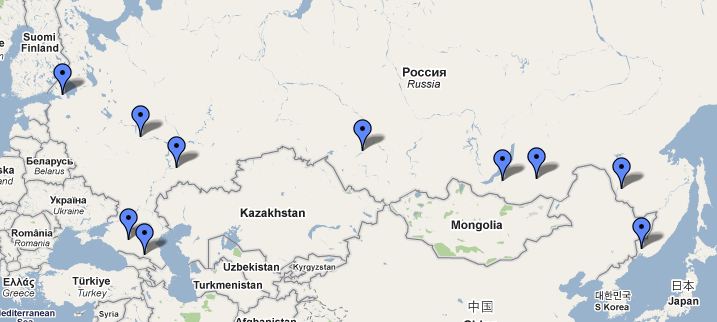
Ten Armies

The Russians have been talking for some time about adding three armies to their existing seven, and here they are, along with their commanders, after a little research.

Ten Armies

Army Headquarters MD / OSK Commander
6th CAA Agalatovo Western General-Major Yevgeniy Ustinov
20th CAA Nizhnyy Novgorod Western General-Major Sergey Yudin
49th CAA Stavropol Southern General-Major Sergey Kurilenko
58th CAA Vladikavkaz Southern General-Major Andrey Kartapolov
2nd CAA Samara Central General-Major Aleksandr Zhuravlev
41st CAA Novosibirsk Central General-Major Vasiliy Tonkoshkurov
36th CAA Ulan-Ude Eastern General-Major Vladimir Tsilko
29th CAA Chita Eastern General-Major Aleksandr Romanchuk
35th CAA Belogorsk Eastern General-Major Igor Turchenyuk
5th CAA Ussuriysk Eastern General-Major Andrey Serdyukov

Yuriy Dolgorukiy Headed for Pacific Fleet

In Vladivostok yesterday, Defense Minister Anatoliy Serdyukov made the surprising announcement that the first Borey-class SSBN, Yuriy Dolgorukiy, will deploy to Russia’s Pacific Fleet, once it becomes operational with its complement of Bulava SLBMs. 

To be precise, Serdyukov said:

“The first Borey will enter the TOF [Pacific Ocean Fleet].  This is how it is in our plans.  . . . new barracks are already built for crews of new submarines.  Since 2007, we’ve been taking down old barracks and building new ones, renovating the social infrastructure 100 percent.”

Serdyukov made the comments while inspecting new construction in Vilyuchinsk for Pacific Fleet contractees.

Basing the first Borey away from where it was built, and away from Russia’s Northern Fleet, is a sharp break from the Soviet / Russian Navy tradition of keeping the first units of new classes — especially SSBNs — close to their point of origin at Sevmash.  A Pacific Fleet deployment could complicate service and support not only for Yuriy Dolgorukiy, but for its new missile system as well, and make this more costly too. 

The Defense Ministry seems to have decided it needs to retain a two-fleet naval strategic nuclear deterrent.  And putting the first Borey there seems essential given that the Pacific Fleet has only a handful of 30-year-old Delta III-class SSBNs at this point.  This decision may also reflect what’s been presented several times as an increased Russian military focus on the Asia-Pacific region.

How’s It Look for VDV?

On Monday, Voyennoye obozreniye took a look at the VDV and their rearmament needs.  It notes they’ve received virtually nothing new since the USSR collapsed, and what new equipment has arrived came in small amounts.

The composition of the VDV has shrunk from 65,000 personnel in seven divisions to about 35,000 in four divisions (Novorossiysk, Tula, Ivanovo, and Pskov) today.  Its airborne combat vehicles include BMD-1, BMD-2 Budka, BMD-3 Bakhcha, and BMD-4 Bakhcha-U, armored personnel carriers include BTR-RD Robot and BTR-3D Skrezhet.

Here’s a RenTV video about the Bakhcha and Bakhcha-U.

Artillery includes ASU-57, ASU-85, 2S9 Nona-S, 2S25 Sprut-SD, and howitzers 2A18 D-30 and 2A18M D-30A.

In January 2007, then VDV Commander, General-Colonel Aleksandr Kolmakov said the troops would soon be getting BMD-4, 2S25 Sprut, BTR-D3 Rakushka, KamAZ-43501, D-10 and Arbalet parachutes, and new infantry and special weapons.  In 2010, the Defense Ministry reportedly said it was buying Italian-made IVECO LMV combat vehicles for its “winged infantry.”

According to VO, the press says VDV has gotten more than 300 BMD-4 since they were accepted for service in 2004.  The BMD-4M, however, basically remains in testing, and only 10 of them are being used in the VDV.  Its future with the airborne troops might be in doubt.  Last December, VDV air defense sub-units got their first Strela-10M3 self-propelled anti-aircraft systems.  They will replace aged ZU-23-2 anti-aircraft guns.

VO concludes the VDV need to reestablish both their air and ground mobility.  VTA has degraded and can’t support airborne operations large enough to seize and hold strategic or tactical objectives in enemy rear areas, or to destroy enemy government and military command and control systems:

“As it was in the USSR, so it is in the RF, airborne troops are really used like the best trained motorized rifle units — for example in Chechnya, Ossetia.”

For off-road mobility, VO says VDV need Tigr, Vodnik, dune buggies, and ATVs.

It argues VDV divisions need their own fixed- and rotary-wing aviation, including multipurpose, transport, strike, and reconnaissance aircraft and UAVs.

The missions of the VDV need to be formulated like Spetsnaz, so they aren’t used like regular infantry.

Finally, VO says the VDV need to be fully professional, with career personnel, and pay twice the country’s median wage.  It can’t be done with today’s contractees who are mostly lazy and drunk, but this is the fault of the army’s reformers, according to VO.

Then, VO concludes, the VDV would be a real elite of the Russian Army.

Golts on the Sudden Increase in Officers

Yezhednevnyy zhurnal’s Aleksandr Golts says Defense Minister Anatoliy Serdyukov’s explanation that 70,000 more officers are needed because of VKO doesn’t hold water since it will be created on the basis of existing formations and units.

Golts concludes that Russian military reform has reached its next turning point.  He recalls that cutting officers to 150,000 and eliminating a large number of cadre formations and units represented the rejection of the old mass mobilization army concept.

But the reduction of so many officers could not but bring bitter opposition.  Nevertheless, Serdyukov stubbornly implemented the cuts, ignoring cries about the destruction of the country’s glorious officer corps (which Golts says hasn’t existed in a very long time).

Then suddenly the chief of the military department reversed himself.  Suddenly, it appears there are not too many officers, but a shortage.  The Armed Forces agonizingly cut 200,000 officer positions just to reintroduce 70,000!

Golts thinks there are several possible reasons.

The most obvious is the state’s inability to meet its obligations (primarily permanent apartments) to dismissed officers.  In mid-2010, there was information about 70,000 officers outside the shtat (штат or TO&E).  Later in the year, the number given was 40,000.  But says Golts:

“. . . to find out how many officers are really outside the shtat is impossible:  whatever figure Defense Ministry officials want to name, they name.  It’s possible to suppose that, having realized their inability to settle up with future retirees, the military department simply decided to put them back in the shtat.”

The second possible cause, according to Golts, is that the Defense Ministry failed to fill the officer posts it cut with well-trained sergeants and civilian personnel because the wages it offered were too low.  On the issue of more sergeants, Golts concludes:

“Sergeant training programs are failing.  Training centers simply can’t put out as many junior commanders as the Armed Forces need – they require not less than 100 thousand.  There’s no where to get them from.  And so they decided again to use officers to perform sergeant functions in combat sub-units, as rear service guys, service personnel.  If so, then this is a serious blow to reform.  Because the officer will cease being the elite of the Armed Forces, again turning into a low-level functionary.”

And Golts provides his third, worst case possibility:

“The generals convinced the president, but most of all, the premier [Putin] that it’s possible to achieve combat readiness by returning to the old mobilization model.  This is an ultimate end to reforms.  If so, then after presidential elections in 2012 the term of conscript service will inevitably be raised.  And everything will be back to normal.”

Golts concludes this concession by Serdyukov – heretofore supported by President Medvedev and Prime Minister Putin – will make those who hate him conclude he’s lost support, and they will triple their attacks on reforms.  In the worst case, this will be the first step toward overturning them.

More on the Military Personnel Zigzag

Wednesday’s Argumenty nedeli looked briefly at the reversal of Defense Minister Serdyukov’s cuts in the Russian officer corps, as well as plans to increase officer pay.

AN said Serdyukov said 70 thousand officers were needed to establish Air-Space (Aerospace) Defense (VKO), but noted he didn’t say where he would find so many officers for such a complex and specialized military field.

Those thrown out of the service in the course of implementing the “new profile” can’t be brought back, and training new officers will take 10-12 years following the reform of the military education system and the liquidation of the Mozhayskiy Military-Space Academy.

And, says AN, radically increasing pay won’t be so simple.  The budgets for 2011 and 2012 have been approved, so pay raises will have to wait until 2013 and 2014, after a new Duma and president have been elected.  And increasing the number of contractees [also with higher pay] will be another factor in army financing problems.

A General Staff source told AN:

“The approximate manning of VKO in all duty positions, including conscripts, contractees, and officers, will be 20-22 thousand.  This means the majority of duty positions will transfer there from Space Troops (KV), air defense troops and missile defense.  But after the mass cuts there aren’t enough commanders on the level of company, regiment and even brigade commanders.  And in all services and branches of the Armed Forces at that.  Therefore, it’s incorrect to think that all 70 thousand are going into VKO.”

According to him, the establishment of any new service [if it is a service rather than a branch], especially one as high-tech as VKO, requires “decades of work by all staffs.”

AN also cites Aleksandr Khramchikhin:

“It seems to me that constant casting about on the size of the officer corps just says that military reform issues haven’t been worked out in a strategic plan.”

A short item that says a lot . . . just a couple comments:

  • This piece is saying that VKO officers and specialists will be taken from the ranks of those currently serving in KV, PVO, and PRO.
  • The 70,000 additional officers will plug holes in command positions throughout the Armed Forces.
  • It would be difficult to bring back dismissed officers.  But there are lots of serving officers living in limbo outside the shtat (штат), outside the TO&E at the disposition (распоряжение) of their commanders, who could be called back to their units.
  • Military education’s been hammered, but it looks like Mozhayskiy’s still operating.
  • Delivering the promised new higher pay system in 2012 will be difficult under current and projected budgetary constraints.  So it’s another opportunity for the regime to fail.  But the Kremlin and White House don’t really need to worry about military votes anyway.
  • Kramchikhin’s right on.  Serdyukov’s idea to cut the officer corps in half – from more than 30 to 15 percent of Armed Forces personnel – was right.  But he failed to plan properly for it, and he tried to do it too fast.  Without accounting, or compensating, for the myriad historical, economic, and cultural reasons Russia had so many officers in the first place – reliance on conscripts and the lack of a strong NCO corps being first and foremost.  So another correct step is discredited by hubris, lack of foresight, and poor execution.  Serdyukov didn’t need to measure seven times before cutting, but twice would have been nice.
  • Taking “decades” to put VKO in place would certainly be the old-fashioned speed of Russian military reform.  But if it’s to be done quickly and successfully, it has to be done with more care than Serdyukov’s demonstrated over the last four years.