Category Archives: Ground Troops

Postnikov on the Army and OPK (Part I)

Ground Troops CINC, General-Colonel Aleksandr Postnikov really stirred up the hornet’s nest on Tuesday.  Russia’s defense sector – its OPK or oboronki – feeling offended recently, is abuzz about his comments.  Postnikov told a session of the Federation Council’s Defense and Security Committee:

“Those models of weapons that industry produces, including armor, artillery and infantry weapons, don’t correspond to NATO’s or even China’s models in their characteristics.”

The military hadn’t criticized the domestic OPK’s heavy armor and artillery systems to this point.

Insulting Russian tanks is the particular point here.  According to Newsru.com, Postnikov apparently called the much-praised, newest T-90 in actuality just the 17th modification of the Soviet T-72.  And, at the current cost of 118 million rubles per tank, he suggested:

“It would be simpler for us to buy three ‘Leopards’ [German tanks] for this money.”

Newsru.com counters that Rosoboroneksport is proud of the T-90, its sales, and continued interest abroad, but admits it is weak against third generation ATGMs, modern sub-munitions, and “top attack” weapons.  The news outlet also notes that the Russian Defense Ministry has eschewed procurement of the T-95 and BMPT.

In its editorial entitled “Import Generals,” Vedomosti takes Postnikov to task, saying it’s not sure whether he means new or used Leopards, but the German tanks probably come in at $7.5 million a piece at least, against the T-90 at $4 million [i.e. only part of one Leopard for 118 million rubles].  And, says Vedomosti, comparing Russian tanks to Chinese ones is lamer still on Postnikov’s part.

According to the business daily, these criticisms of Russian armaments usually come with calls to buy the same systems abroad.  But the 2008 war with Georgia showed Russia’s deficiencies lay in soldier systems, comms, recce, C2, and some types of infantry weapons rather than in armor.  When Russia doesn’t make something like Mistral or it has inferior technology like UAVs, it’s understandable to buy foreign, but when it’s something like armor, it raises a lot of issues, according to Vedomosti.  Uralvagonzavod certainly needs tank orders.  The idea of large-scale foreign purchases is utopian, says Mikhail Barabanov.  The paper believes thoughts of buying Leopard tanks and Mistral mean Russia’s generalitet has plans beyond local wars.

BFM.ru says Postnikov put the Ground Troops’ modern arms and equipment at only 12 percent of its inventory at present with, again, the goal of 70 percent in 2020.  At the end of this year, the army will get its first brigade complement of the newest automated C2 (ASU) system [i.e. presumably YeSU TZ]:

“In November of this year, we plan to conduct research on the newest  ASU and hand down our verdict.”

According to BFM.ru, he said NATO and China already have analogous systems:

“But for us it is still the future.”

Nezavisimaya gazeta focused on Postnikov’s comments on Ground Troops brigades.  He said he now has 70, but plans for 109 by 2020, including “future type” brigades:

“There will be 42 brigades of the future type, in all there will be 47 military formations of the future type, including military bases abroad which will be built on the same principle.”

The Glavkom didn’t say how the new brigades will be different from the old.

Parsing what he’s talking about is a little tough.  At the end of 2008, the army talked about having 39 combined arms, 21 missile and artillery, 12 signal, 7 air defense, and 2 EW brigades for a total of 81, rather than Postnikov’s current 70.  One might guess a dozen arms storage bases in Siberia and the Far East could be fleshed out into maneuver brigades.  But where does the manpower come from?  Maybe some of the 70,000 officers cut and now being returned to the ranks by Defense Minister Serdyukov. 

Postnikov elaborated some on heavy, medium, and light brigades.  Heavy will have tanks and tracked armor.  NG concludes there won’t be a new tank.  Tanks in storage will get new electronics and Arena active defense systems.  According to Postnikov, medium brigades will get [among other things?] the Bumerang amphibious BTR now in development.  This, says NG, is the first time anyone’s heard Bumerang.  But if it isn’t successfully developed or produced in sufficient numbers by 2020, the army will just buy armored vehicles abroad since there’s already ample precedent for this.

Light brigades will have vehicles like the Tigr or the Italian LMV (Lynx), licensed production of which could begin in Russia this year.  One special Arctic brigade will be created at Pechenga. 

Several media outlets quoted Postnikov to the effect that there’s no plan to change 1-year conscription, but he noted:

“In the transition to one year military service, military men received only a headache.”

There’s lots more reaction to Postnikov’s statements, but it’s too much for one day.

Israeli and Russian UAVs for Ground Troops

Yesterday Aviaport.ru wrote that Defense Minister Anatoliy Serdyukov, his First Deputies, Vladimir Popovkin and Nikolay Makarov, Air Forces CINC, Aleksandr Zelin, and industry representatives attended a demonstration of Russian and Israeli UAVs at Kubinka on 10 March. 

The systems shown included the Israeli mini Bird Eye 400 and medium-range Searcher MkII, and also an unnamed Russian mini selected in comparative testing last fall. 

Aviaport.ru says Russian systems were only on static display, but Israeli ones were actively demonstrated.  The Searcher MkII performed a six-hour continuous flight in the vicinity of Kubinka at an altitude of  five km, relaying imagery to its ground station in real time.

Israeli drones arrived in Russia last year, and operators and technicians were trained, but they are only just starting to be used.  A Defense Ministry source tells Aviaport.ru these UAVs are already receiving high marks from the military.

UAV.ru’s editor-in-chief Denis Fedutinov thinks new pilotless aircraft will be based at the 924th Combat Training and Personnel Retraining Center.  The Center’s personnel previously used only Russian-made UAVs, the most modern of which was the 1980s-vintage Pchela.  Fedutinov says:

“Compared with them [Pchela], the impression of Israeli systems will be like switching from a Zhiguli to a Mercedes.”

Nevertheless, according to Fedutinov, the “door isn’t closed” for Russian developers.  The tests of the mini-UAV last year showed an increase in quality of Russian systems, and there was a promise to buy several dozen Russian systems for experimental use in the Ground Troops.  

The tactical-class segment still isn’t occupied, and there are two Russian contenders — VEGA’s Tipchak and Kronshtadt’s Dozor-100.  The latter is reportedly preferred given Popovkin’s negative comments about the former.

Fedutinov thinks when it comes to larger systems there’s still a possibility for cooperation with the Israelis, and there is Russian interest in the Heron system.  But decisions on this issue are essentially political.

After meeting his French counterpart in Paris — mainly about the Mistral acquisition, Defense Minister Serdyukov declared his interest in procuring all types of UAVs, from reconnaissance to strike variants, according to ITAR-TASS.  Serdyukov stated:

“At present, we’re studying the line-up of Israeli pilotless aircraft in detail.  As is known, ‘Helicopters of Russia’ has agreed with the Israelis on establishing an SP [joint venture] to produce such systems.”

Serdyukov added that a UAV operator training center will be set up soon:

“Where this center will be located isn’t decided yet.  These systems will be part of the Ground Troops.”

He said the Defense Ministry wants to buy all types, from light to heavy UAVs.  Russia is also interested in the foreign practice of using satellites to control unmanned reconnaissance and strike aircraft, Serdyukov said.

“New Profile” in Transbaykal

Nezavisimoye voyennoye obozreniye’s Viktor Litovkin wrote recently about his Defenders’ Day press pool visit to the 212th District Training Center (OUTs or ОУЦ) in Peschanka, and to the 29th Combined Arms Army in Chita.  Formerly part of the Siberian MD, they’re now in the Eastern MD or OSK East.  Litovkin set out to see how the military’s “new profile” has been implemented in the four years since he last traveled to Transbaykal.

Litovkin said the army’s future “junior specialists,” i.e. better trained conscript sergeants, aren’t just using simulators, and there’s lots of live action on OUTs ranges and training grounds.

Simulators at Peschanka (photo: V. Litovkin)

The majority of trainees were in training for a minimum of 8 hours a day, not including individual training and PT time.

OUTs Chief, General-Major Sergey Sudakov is new himself, but says much has changed at the center.  He says they’ve gotten new simulators, training buildings and barracks have been renovated, and the mess hall’s been outsourced so conscript-trainees no longer have to pull KP.

Four years ago, the Siberian MD listed 5,970 personnel without housing, but now only 120.  Those without apartments have been taken off the local books, and all their data’s been sent to the Defense Ministry’s Housing Support Department in Moscow. 

Now, however, there are rasporyazhentsy (распоряженцы), those officers, warrants, or sergeants at their commanders’ disposition, in all, more than 200 waiting for permanent apartments outside Transbaykal.  But only 2-3 per month are getting a “letter of happiness” from Moscow saying they’ve been allocated housing, and, in many cases, it’s not in the location they wanted.

The rasporyazhentsy were once commanders and chiefs but now they muster every morning to get orders from their former subordinates.  They don’t get anything serious to do.  They pull assistant duty officer for a unit once a week, or carry out a major’s orders for less than half their old pay.

Medic Senior Sergeant Zhanna Litvinenko is a rasporyazhenitsa who’s waited two years for an apartment in Rostov-na-Donu or Krasnodar Kray.  While waiting to return to “mainland” Russia, she lives on “bare pay,” without supplements, of 16,900 rubles, of which 3,200 pays for her dorm room.

Litovkin visited the officers’ dormitory to see what’s changed since 2007.  He describes familiar noisy corridors with common toilets, showers, and kitchens for officers and their families.  The building’s been renovated, old wooden window frames and the boiler have been replaced, kitchens updated, and showers divided so men and women don’t have to use them on alternating days.

One Captain Rinat Abubekirov and his wife say the load on officers has grown sharply now that there are fewer of them.  The tank training regiment had 140 officers previously, now 98, in a company, there were 7, now 5, and the number of additional duties is unchanged.  A company commander is now a captain, rather than a major as in the past.  Abubekirov has been an O-3 for five years, and no one can tell him when he might make O-4.

Litvinenko and the Abubekirovs in the Officers' Dorm (photo: V. Litovkin)

Training their conscript charges has changed.  Instead of six months, they now have three to do it.  The trainees’ education level varies greatly now — from higher education to some who didn’t finish high school.  Many conscripts arrived in poor health, and the severe Transbaykal winter doesn’t help either.  Minus forty isn’t rare, and -30° (-22° F) is the norm.  They are just not physically or psychologically prepared.  Nevertheless, OUTs Commander Sudakov says fewer are sick this winter than last.

Then, Litovkin turns to the Chita-based 29th Combined Arms Army commanded by General-Major Aleksandr Romanchuk, where the NVO editor says he sees “solid changes.”  All its units are fully manned and permanently combat ready.  In what’s become a fairly common refrain, Romanchuk believes his army’s combat potential exceeds that of its predecessor [the Siberian MD]. He said he and his deputy spent a month at the General Staff Academy learning the new automated command and control system.  He said his best subordinates can earn 100,000 rubles per month in bonuses.

Litovkin says there are questions about the introduction of new equipment in Romanchuk’s command.  It would be good if its tanks and combat vehicles could be replaced quicker.  There are no UAVs or PGMs.  The army relies on T-72B1, BMP-2, Strela-10 and towed air defense guns, and self-propelled Akatsiya and Msta-B artillery.

Litovkin concludes that, while no one believes Mongolia or China will threaten Russia’s borders today or tomorrow, this army needs to train in a real way, with equipment from the 21st century, not the last one.

But this, he continues, is not even the greatest problem.  He was told at every level that it’s simply not possible to make yesterday’s schoolboy into a good specialist in a year.  The commander of the 29th CAA’s 200th Artillery Brigade, Colonel Dmitriy Kozlovskiy, told Litovkin this spring he’ll lose 70 percent of his personnel.  New gun commanders, gunners, radiomen, and reconnaissance, topographic, and meteorological specialists will arrive and in less than a month they’ll need to work like crews, platoons, and batteries, like a unified combat mechanism.  They will learn and leave the army, and the process will begin again.

Sounds like a Russian O-6’s plea for professional enlisted and NCOs . . . .

Litovkin finishes with a story from Romanchuk.  He tells of a tank gunner conscript who hit his target [a 1 — an excellent in Russian training terms] on his 39th day of service.  He said he just did everything as he was taught, and as he did on the simulators.  In times past, according to Romanchuk, tank gunners got to fire live rounds only after serving six months, and this guy scored a 1 on his 39th day.  But Litovkin asked how his buddies did.  Romanchuk answered 2s and 3s.

Ground Troops and the GOZ

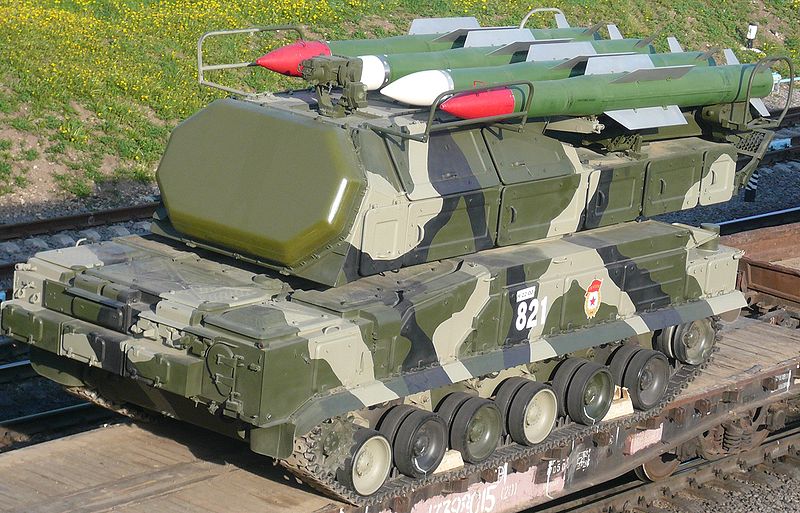
Buk-M2 (SA-17 / Grizzly)

Discussions of service wish-lists for State Armaments Program (GPV) 2011-2020 have tended to overlook the Ground Troops.  It seems they don’t enjoy the same priority as other services.

But in late February and early March, there was a flurry of press detailing what the land forces intend to procure, at least in the short term. 

Arms-expo.ru, Lenta.ru, and other media outlets put out brief items on Ground Troops’ acquisition.  They indicated the Ground Troops will emphasize air defense, command and control, fire support, and BTRs and support vehicles.

But the best run-down of all came from Ground Troops CINC General-Colonel Aleksandr Postnikov himself in Krasnaya zvezda.

Postnikov told the Defense Ministry daily that the main feature of GOZ-2011 is the transition from the repair and modernization of existing systems to the purchase of new, modern ones to reequip Ground Troops formations and units completely.

First and foremost, according to the CINC, the Ground Troops will buy modern digital communications equipment and tactical-level automated command and control systems (ASU), like Polyana-D4M1 for air defense brigades.  He said Ground Troops’ Air Defense will also receive modernized S-300V4 systems, Buk-M2 and Buk-M3, short-range Tor-M2U(M) SAMs, and manportable Igla-S and Verba SAMs.

Postnikov says they will continue equipping missile and artillery brigades with the Iskander-M, new MLRS, self-propelled Khosta and Nona-SVK guns, Khrisantema-S antitank missiles and Sprut-SD antitank guns.

The Ground Troops CINC says he foresees purchases of a new modification of the BTR-82A, BREM-K armored recovery vehicles built on a BTR-80 base and BREM-L on a BMP-3 base, Iveco, Tigr, and Volk armored vehicles, and new KamAZ trucks from the Mustang series.

NBC defense (RKhBZ) troops will get the heavy flamethrower system TOS-1A, RPO PDM-A thermobaric missiles with increased range and power, and VKR airborne radiological reconnaissance systems.  Engineering units will get the newest water purification system on a KamAZ chassis (SKO-10/5).

In the longer term, Postnikov sees rearmament as one of his main tasks, and he repeated President Medvedev’s statement that the Ground Troops should have 30 percent modern equipment by 2015, and 70 percent by 2020.  He laid special stress on getting YeSU TZ into the troops.  Postnikov’s Glavkomat has a Concept for the Development of the Ground Troops Armament System to 2025 emphasizing standardization, multi-functionality, modular construction, and electronic compatibility across several general areas:  armor and military vehicles, tube artillery and MLRS, SSMs, antitank systems, air defense, reconnaissance-information support, UAVs, communications, automated command and control, and soldier and close combat systems.

Ten Armies

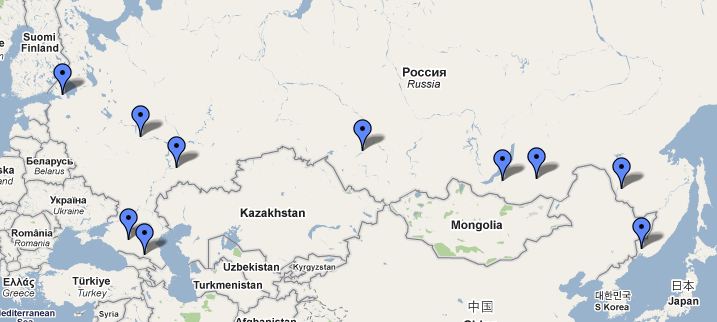
The Russians have been talking for some time about adding three armies to their existing seven, and here they are, along with their commanders, after a little research.

Ten Armies

Army Headquarters MD / OSK Commander
6th CAA Agalatovo Western General-Major Yevgeniy Ustinov
20th CAA Nizhnyy Novgorod Western General-Major Sergey Yudin
49th CAA Stavropol Southern General-Major Sergey Kurilenko
58th CAA Vladikavkaz Southern General-Major Andrey Kartapolov
2nd CAA Samara Central General-Major Aleksandr Zhuravlev
41st CAA Novosibirsk Central General-Major Vasiliy Tonkoshkurov
36th CAA Ulan-Ude Eastern General-Major Vladimir Tsilko
29th CAA Chita Eastern General-Major Aleksandr Romanchuk
35th CAA Belogorsk Eastern General-Major Igor Turchenyuk
5th CAA Ussuriysk Eastern General-Major Andrey Serdyukov

The Results of Reform

Trud’s Mikhail Lukanin offered an interesting one last Wednesday . . . with help from other frequent commentators, he takes a swag at describing the results of Anatoliy Serdyukov’s nearly 4-year tenure as Defense Minister.

It’s interesting because it’s unclear if Lukanin’s article is intended to damn by faint praise, to be sarcastic, or was ordered by someone.  Maybe he intends to say these are just results, the good and the bad.

It’s easy to see some good in Lukanin’s first five, but his final three are pretty much unleavened.

The Army’s Become More Mobile

Lukanin quotes Vitaliy Shlykov:

“Until 2008, our army looked like fragments of the old, Soviet one, weighed down with heavy weapons, oriented toward global nuclear war with practically the entire world.”

He says even in the August war against Georgia the army was still “Soviet” — slow to stand up, with an archaic command and control structure.  But now the situation’s changed with mobile brigades that can answer an alert in 1 hour instead of days.

The Army’s Rid Itself of the Spirit of the Barracks

Valentina Melnikova tells Lukanin that the soldier’s life has changed cardinally under Serdyukov.  She says, until recently, one-third of soldiers were typically involved in nonmilitary work every day.  Now soldiers are gradually being freed from such duties as commercial firms take them on.

New Equipment Has Come to the Troops

Lukanin writes that finally a start’s been given to the largest rearmament of the army in post-Soviet times.  One that will take new weapons and equipment from about 10 percent of today’s inventory to 90-100 percent [official sources only claim 70 percent] by 2020.

Lukanin quotes Ruslan Pukhov:

“The Navy alone will receive 40 submarines and 36 new ships, and the Air Forces 1,500 aircraft in the next decade.”

Officer Pay Has Grown

Lukanin says lieutenants and majors made 14 and 20 thousand rubles per month respectively before Serdyukov’s reform,  but now 50 and 70 thousand if they receive premium pay for outstanding combat training results.  And from 2012, premium payments will be included in their permanent duty pay, and 50 thousand rubles will be the minimum base pay for officers.

Lukanin quotes Aleksandr Khramchikhin: 

“The officers of our army are actually comparable with the armies of developed countries in pay levels. “

They Didn’t Talk Reform to Death

Lukanin says experts think it’s good Serdyukov’s reform was pursued energetically, without lengthy discussion and debate.  Pukhov gives the cut from 6 to 4 military districts as an example:

“At one time, it would have taken years to transfer a huge quantity of officers and generals from place to place, but the Defense Ministry did this in just 4-5 months.”

They Stopped Training Officers

Lukanin refers to Serdyukov’s halt to inducting new cadets into officer commissioning schools until at least 2012.  He says 2010 graduates were either released or accepted sergeant positions.  This led to the departure of experienced instructors, and their replacement with younger officers lacking the necessary experience.

Sergeants Almost Ceased to Exist

Contract sergeants were dispersed in 2009-2010.  The Defense Ministry considers them poorly trained, and in no way superior to ordinary [conscript] soldiers.  Now it’s counting completely on conscripts with an even lower level of training.

There’s Nothing to Defend Against China

Here Lukanin notes that some results of reform have put people on guard.  Anatoliy Tsyganok tells him tank units have been practically eliminated: 

“Now only 2,000 tanks, old models at that, remain in the army.”

In Tsyganok’s opinion, tanks are still very relevant for the defense of Russia’s border with China.

What do we make of all this?

  • It’s good that the Russian Army was restructured into smaller, more combat ready formations, i.e. brigades, and sub-units. 
  • We really have no clear picture of the extent and success of outsourcing nonmilitary tasks in the army.  Meanwhile, the “spirit of the barracks” is alive and well when it comes to dedovshchina and violence in the ranks. 
  • The promise of another rearmament program shimmers on the horizon, but it’s not delivering much yet, and there are plenty of serious obstacles to completing it. 
  • The officer pay picture has improved, but the Defense Ministry has real work to do this year to implement a fully new pay system next year.  Meanwhile, several years of premium pay have caused divisions and disaffection in the officer corps. 
  • Moving out smartly on reform was a change over endless talk, but there are areas where more circumspection might have served Serdyukov well. 
  • The Defense Ministry definitely had to stop feeding more officers into an army with a 1:1 officer-conscript ratio.  We’ll have to see what kind of officers the remaining VVUZy produce when the induction of cadets restarts. 
  • Aborting contract service cut the army’s losses on the failed centerpiece military personnel policy of the 2000s.  But something will have to take its place eventually to produce more professional NCOs and soldiers. 
  • Russia is probably right to deemphasize its heavy armor.  It doesn’t appear to have much of a place in the coming rearmament plan.  And tanks really aren’t the answer to Moscow’s largely unstated security concerns vis-a-vis China anyway.

So what’s Serdyukov’s scorecard?  A mixed bag.  Probably more good than bad, but we’ll have to wait to see which results stand and prove positive over the long term.  Definitely superior to his predecessor’s tenure.  Expect more Serdyukov anniversary articles as 15 February approaches.

Trainer-in-Chief

Mil.ru made it official today.  General-Lieutenant Nikolay Bogdanovskiy, late of the Leningrad MD, is now the military’s trainer-in-chief.  According to the Defense Ministry website:

“On 1 December 2010, the Combat Training Directorate of the Ground Troops was transformed into the Main Combat Training Directorate (GUBP or ГУБП) of the Ground Troops, and given the function of coordinating the training of the RF Armed Forces services and troop branches.”

And Bogdanovskiy is now a Deputy Ground Troops CINC heading the new GUBP, according to the latest personnel decree.

General-Lieutenant Bogdanovskiy

We’re left wondering how far his new writ extends . . . just combined arms training, or to the VDV, RVSN, and Space Troops?  Recall also there was speculation that new Deputy General Staff Chief, General-Colonel Gerasimov, late of the Moscow MD, might be the main training supervisor.

A little background on Bogdanovskiy as long as it’s here. 

He was born in 1957.  He’s a graduate of the Moscow Higher Combined Arms Command School, the Frunze Military Academy, and the General Staff Academy.

He’s served as commander of a reconnaissance platoon, a company, chief of staff, then commander of a motorized rifle battalion in the Southern Group of Forces [i.e. Hungary], chief of staff of a fortified region, commander of a motorized rifle regiment, chief of staff of a motorized division, chief of a district junior specialist training center, chief of staff and commander of the 35th Army, Deputy Commander of the Far East MD, Chief of the Main Staff and First Deputy CINC of the Ground Troops, and Commander, Leningrad MD.

Southern MD and Black Sea Fleet

BSF Commander Vladimir Korolev told IA Rosbalt today he thinks resubordinating the BSF to the Southern MD will allow for resolving a large number of missions:

“The South-Western Axis which existed in Soviet times allowed us to coordinate the efforts of various services and troop branches.  This experience is extremely opportune today.”

Korolev acknowledged that military reform may progress painfully:

“Fundamental changes in any structure aren’t coped with easily, naturally, they can’t proceed painlessly in an organism as complex as the fleet.  The strategic command isn’t swallowing the fleet, the BSF will become an integral part of it with its specific sphere of missions.  Adjusting the synchronization of the work of structures, processes, mutual adaptation, delineation of authorities — all this is not simple at all, but it’s very important because such large-scale changes are happening for the first time in the history of our Armed Forces.  But we have to go for this in order for the fleet to develop, to get stronger in accordance with modern requirements.”

He called ‘synergistic cooperation’ the main benefit of establishing the common command uniting the fleet and army:

“The fleet, aviation, and ground units won’t compete among themselves, but organically supplement and support each other.  The events of August 2008 showed how important it is to have a powerful grouping of varied forces which have to act according to a single plan, dispose of an entire arsenal of forces and means, including modern communications systems, on the Southern, as well as on any other axis.”

Rosbalt said the BSF and Caspian Flotilla will transform into the Operational Command of Naval Forces (OKMS or ОКМС) within the Southern MD.

Now it seems Korolev’s putting a happy face on this; it won’t be easy.  Establishing real unified commands is just as hard as it is necessary.  Like it or not, the BSF is getting swallowed and subordinated.  It will operate according to plans made largely by green uniforms in Rostov-na-Donu.

If true, what Rosbalt says about the naval ‘Operational Command’ is very significant.  Remember the much-ballyhooed shift to a three-tier command structure?  The tiers are military district, operational command, and brigade.  The name sounds like the fleet’s being reduced from equal of the MD to equivalent of an army, another operational-level command.  Quite a come down.

Makarov’s Year-Ender

On Tuesday, General Staff Chief Nikolay Makarov provided his year-end wrap-up on the ‘new profile’ of the Armed Forces in the form of a press-conference featuring a videolink with the four new MD / OSK commanders.

It was pretty much a self-congratulatory celebration of how Makarov and company have turned everything in the Russian military around for the better.  As Moskovskiy komsomolets put it, “Nikolay Makarov told the media how bad it was in the army in the past, and how good it will be in the future.”

Rossiyskaya gazeta paraphrased Makarov’s remarks, giving only a couple direct quotes.  First up was President Medvedev’s call for unified aerospace defense (VKO) before the end of 2011.

RG says Makarov said VKO will be fully operational in 2020 when new reconnaissance and weapons systems have been deployed.  He said its purpose is to defend the state [interestingly the state, not the country] from ballistic and cruise missiles.  It needs to be an umbrella against any kind of threat, including low-altitude ones.

Makarov said different military structures have been occupied with the security of the skies.  Space Troops do orbital reconnaissance and ground-based missile early warning.  The air forces and air defense armies (АВВСиПВО or АВВСПВО) and radar troops monitor air space for approaching hostile aircraft.  The Special Designation Command (КСпН) covers the Moscow air defense zone [didn’t this long ago change its name to the OSK VKO?].  Air defense troops (ЗРВ) and fighter aviation cover other important facilities.  The system was set-up on a service (видовой) basis and that’s why it was uncoordinated.  It needs to be made integrated and put under the command of the General Staff [of course – this sounds like Olga Bozhyeva in MK].  In the Defense Ministry, they understand unification won’t be quick and will require a lot of resources, but there’s simply no other way.

Izvestiya proffered a quotation on this one:

“If we look at how this system was built earlier, then it’s possible to see that it acted separately by services and branches of troops, and also by regions.  So, Space Troops answered for space reconnaissance, the work of missile attack warning stations.  The Ground Troops for the activity of radar units.  Now we are uniting all these separate organizations in a unitary whole.  We need to establish the foundation of this system in 2011.  To finish its formation completely by 2020.”

According to RG, Makarov said a modern army would be useless without a new command and control system for the Armed Forces.  Russia’s move to a unified information environment will cost 300 billion rubles, and will be phased, with the initial phase being the replacement of all analog equipment with digital systems by 2012.  Command and control systems will be developed and produced in Russia, but other weapons will be bought abroad.  This is when he broke the news about Mistral winning the amphibious command ship tender.

RG concludes Makarov called for a fully professional Armed Forces, but the words it quoted aren’t particularly convincing:

“Now we can’t do them like this.  But year by year we’ll increase the selection of contract servicemen with commensurate pay.”

However, Moskovskiy komsomolets quoted the General Staff Chief this way:

“We are aiming for a contract army.  Now we can’t make it so instantly, but year by year the number of contract servicemen, with commensurate pay, will increase.”

Olga Bozhyeva viewed this as a total reversal of Makarov’s earlier rejection of contractees and insistence on conscripts as the backbone of the army.

Makarov also talked about efforts to create ‘human’ service and living conditions.  He referred, as always, to outsourcing and civilianizing mess hall and other housekeeping duties.  He repeated that, starting in 2012, officer pay will increase by several times.  According to Krasnaya zvezda, Makarov said 50 percent of officers now receive higher pay through premiums and incentives.  Officers and their families will be moved from remote garrison towns to oblast centers where their children can get a better education and wives can find work.  About the large cut in military towns, he said:

“We had about 22 thousand of them, approximately 5,500 remain, but in all, we’re taking the number of military towns to 180.”

Of course, he didn’t mention who will take care of large numbers of retirees left behind in that archipelago of abandoned military towns.

KZ gave its own recap of Makarov’s press-conference, and it’s interesting to hear his rehash of why the army needed a ‘new profile.’  His remarks blow up any lingering myth about the 2000s, at least the Putin years, as the time of the Russian military’s rejuvenation.  He said:

“Before 2009, 87 percent of the Armed Forces consisted of formations and military units with abbreviated personnel and cadres, practically not having personnel.  They almost didn’t conduct operational and combat training.  The army didn’t just degrade.  During this time, we grew an entire generation of officers and generals who ceased to understand the very essence of military service, they didn’t have experience in training and educating personnel.”

KZ paraphrases more of Makarov.  The personnel training system caused complaints.  VVUZy were teaching the Great Patriotic War.  Low pay and poor prospects for housing made the officer’s profession a low-prestige one.  In units, personnel weren’t occupied with combat training, but serving themselves, and military discipline fell as a result.  On the whole, the Armed Forces stopped fulfilling the missions for which they are intended, and could scarcely react to threats and challenges beyond the state’s borders and inside the country.

Makarov addressed how the MDs were changed to meet future threats and challenges:

“Planning and troop employment happened with significant difficulties, since each of six military districts had a series of missions where one often contradicted another.  Moreover, four air forces and air defense armies were established, as a result, the zones of responsibility of the military districts and these armies didn’t coincide at all.  This led to confusion in employing air defense forces.  At the same time, experience showed that military actions in recent decades are conducted, as a rule, by unified force groupings and forces under a unitary command.  Each of our districts and each of our four fleets existed independently. Each had its own zone of responsibility, not matching the others.  In order to organize any kind of joint actions, it was necessary to establish temporary commands, temporary structures, which, as a rule, were poorly prepared, didn’t have corresponding experience.  All this led to unsatisfactory results.”

Izvestiya quoted him:

“In the bounds of the ongoing transformations, full-blooded troop groupings have been established on all strategic axes.  Four full-blooded commands have appeared for us which, having in their composition and immediately subordinate to them all forces and means, can react adequately to all challenges and threats to the borders of our districts.  Changes in the Armed Forces command and control structure are a necessary occurrence since the old administrative-territorial division had stopped answering the challenges and threats of the time.”

New MDs (photo: ITAR-TASS)

Then Makarov brought in MD commanders over the video so they could attest to how it’s going.  They remarked on how cutting intermediate, redundant command levels has made their jobs easier.  Western MD Commander, General-Colonel Arkadiy Bakhin said 40 percent of his formations and units have outsourced some support functions. 

KZ says earlier MD commanders answered only for Ground Troops, and when they needed forces from another service or branch, they had to get permission from above.  Southern MD Commander, General-Lieutenant Aleksandr Galkin claims making these requests cost the commander time, but now all forces and means are in one command, the fundamentally new unified strategic command (OSK).  Galkin also says freeing soldiers from support tasks means there are now 20-22 training days per month instead of 15-16.

Sick in Siberia

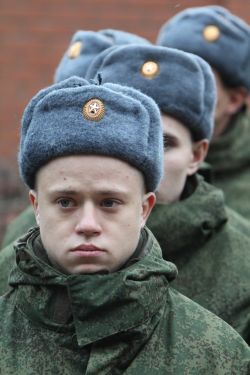
Is Yudashkin Warm Enough? (photo: Viktor Vasenin)

Or maybe “Central MD Public Relations Nightmare.”

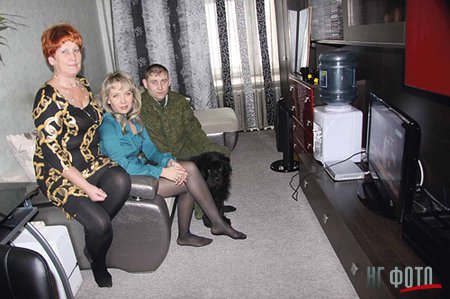
Mass illnesses among conscripts are a familiar, though less common, occurrence nowadays.  This time it’s the Central MD’s 74th Independent Motorized Rifle Brigade (v/ch 21005) in Yurga, Kemerovo Oblast.

What we have are assorted versions of what’s happened in Yurga.  There’s backpedaling and softpedaling.  The prosecutor’s only too happy to probe the army’s mistakes.  There have been cuts in military medicine and reorganizations under Serdyukov that are to blame.  His fondness for the expensive new uniforms by fashion designer Yudashkin are an easy target too.  Yes, Russian draftees are unhealthy when they arrive, but why are they drafted then?  And there’s always gross neglect by commanders who see conscripts as sub-human.  And General Staff Chief Makarov just chalks it all up to the ‘slovenliness’ of the command.

With all that said . . .

The MD command, district medical service representatives, and military prosecutors blame ‘oversights’ in the work of the brigade’s command for an outbreak of acute upper respiratory infections (colds) that have afflicted 126 conscripts since mid-October, according to ITAR-TASS.

They blame the command  for poorly “organizing the daily activity of sub-units in conditions of severe frost going as low as minus 40 degrees (-40 F).”  They also cite the lack of timely preventative measures. 

This is, of course, Russian official euphemistic language that’s used rather than describing more graphically exactly what’s happening.

One hundred men are currently in isolation, but none are in serious or critical condition according to the army.  The MD reinforced the formation’s medical staff, and provided special immunity-boosting medications.  It also emphasized that all conscripts are fully supplied with essential winter clothing and footwear.

A second ITAR-TASS account emphasizing the prosecutor’s investigation of the situation reported:

“The causes of the growth in illness among the brigade’s servicemen are weak support of the medical company and branch hospital with medicines and other prophylactic means [not more than 15 percent of requirements], but also the overloading of the medical ward.”

The prosecutor’s inquiries include the chief of the Central MD’s medical service, the commander of the 41st Army, and the chief of the military hospital.  The prosecutor’s already informed the Main Military-Medical Directorate about the unsatisfactory supply of medicines in the Yurga branch of the 321st Military Hospital.  At the prosecutor’s prompting, an extra isolation ward of 130 beds has been deployed, antiviral drugs supplied, soldiers put in valenki and sheepskin coats, and outside activity cut to a minimum.

According to Gazeta.ru, the South-Siberian Legal Defense Center says there are 160 to 250 men who have been ill, including several in critical condition.  It says conscripts have been wearing new and inadequate Yudashkin uniforms  while standing outside the brigade’s tiny mess hall three times a day in -20 (-4 F).  One old lady reported her grandson was sleeping in an unheated area.

Moskovskiy komsomolets reports the military denies the outbreak of illness is related to the new uniform, and says the men still have their winter boots and valenki.  One specialist who helped develop the new uniforms told the paper few soldiers have the new Yudashkin uniform, and the Defense Ministry is trying to come up with a cheaper version of it.

Svpressa.ru talked at length to the legal defense center’s Yelena Lapina.  She says mothers started complaining after a long oath-taking ceremony conducted outside at the end of November.  It was between -15 and -20 (5 and -4 F).  Parents said their sons were wearing new uniforms not suited to Siberian conditions.

Svpressa.ru also interviewed the mother of Stanislav Karpenko who remains in very serious condition in Kemerovo’s main civilian hospital with kidney failure.  She said no one from command even contacted her after her son was transported from his unit:

“No one called or came.  And generally, you know, this reeks of a concentration camp, not the army.”

Rossiyskaya gazeta reports the men weren’t given proper winter gear, and didn’t have warm places to sleep.  Many ended up sick, the formation’s branch hospital overflowed, and didn’t even have enough medicine.  Karpenko, who had double pneumonia and kidney failure, was treated only with aspirin and paracetamol.

And an army spokesman named Yuriy Sivokhin (described variously as representing the Central MD or the 41st Army) had this to say about the problems:

“The weak health of today’s youth that has come is not suited.  From homemade pirozhki and into the barracks is acclimatization, a clear matter.  Conscripts are sick every winter.  And the statistics on ORZ [URI] are practically on the same level.  But here, of course, father-commanders have to look out not to leave the boys out in the cold for a long time.  Of course, in the new uniform, they’re in leather boots and not what they came to the unit wearing, and no one’s taken their foot wrappings, just issued them later.  Yes and they’ve fallen under a reorganization again:  the Siberian MD is eliminated, hospitals consolidated, medics finalizing new contracts . . . It’s possible at such a time there wasn’t enough of something.  But now the unit’s supplied with medicines, everything is under control.  And, by my data, there are now 60 men in the hospital, not 250.”

Does this guy need lessons or what?  So the boys are weaklings, should they really have been drafted?  If the sickness stats are the same as last year, why is this in the news?  Does he expect anyone to believe him?  He does mention some chaotic reorganization as a possible factor.  No one claimed 250 were in the hospital right now.

Newsru.com got Sivokhin again:

“The lad, whose old lady who raised a stink, had a cold.  But he’s not in the hospital, but in the [formation’s] medical unit.  And not with pneumonia, but a URI.  And why Yudashkin here, when now we have such puny soldiers arriving?”

He needs to be driving a tank, not talking to the media.

The army said 54 guys with a pneumonia diagnosis didn’t amount to an outbreak in the formation.  It did admit one needed intensive care for kidney failure in Kemerovo.  The Central MD said all the men of the formation were fully outfitted in suitable new winter gear, and the new winter uniform uses better fabrics with a higher level of thermal protection than the old one.

These varying accounts clearly don’t add up, but it’s hard to tell who’s lying and about what.