Category Archives: Military Housing

Creating ‘New Profile’ Army Not Easy in Far East

A variety of press reports indicate establishing a ‘new profile’ army in the Far East is a difficult and increasingly protracted process.

On 7 September, ITAR-TASS said General Staff Chief, Army General Nikolay Makarov was in Chita to resolve a number of army problems.  The press service noted Makarov was accompanied by new Eastern Military District (MD) Commander, Vice-Admiral Konstantin Sidenko.

Specifically, Makarov was in eastern Siberia (now part of the Eastern MD) working on ‘military organizational development [строительство]’ – a Russian euphemism for TO&E changes and force restructuring – and development of base military towns and their social infrastructure.  In plain English, the General Staff Chief was in the Transbaykal sticks sorting out which units go into this or that brigade, or get disbanded, and how to provide housing and a modicum of other basic services for their soldiers, officers, and families.

But Makarov and Sidenko may have worse problems further east.

On 8 September, ITAR-TASS published a small, but significant report claiming that Khabarovsk Kray’s military garrisons and towns are not ready for winter.

Preparation for heating season in the majority of military buildings in Khabarovsk Kray is breaking down, according to the Kray’s emergency situations commission.  The poor state of preparation of communal infrastructure (i.e. boilers, coal supplies, steam pipes, etc.) and apartment blocks in Lazo, Bikin, and Vanino Rayons is alarming.

A Kray official said, “. . . supplies of winter fuel haven’t been established, boiler equipment hasn’t been repaired, facilities don’t have personnel.”  In Vanino, workers repairing a major boiler received layoff notices.  Days before the start of heating season, several boilers have been completely dismantled and there are no supplies of coal, according to the news agency.

 The emergency situations commission noted that:

“The Defense Ministry has begun transferring housing-communal servicing functions for its garrisons to private organizations, but this process has bogged down.”

The military’s Housing Management Directorate (KEU) representatives in the Far East didn’t deny the problems, but blamed them on a catastrophic lack of financing.  The military’s indebtedness to Far East communal services providers over the first 7 months of the year is 181.6 million rubles, and Khabarovsk Kray accounts for more than 88 million of this amount.

The first deputy chairman of the Khabarovsk Kray government has asked military prosecutors to intervene and force the army to prepare the region’s military towns and villages adequately and forestall emergency situations this winter.

All this comes on top of reports of similar problems last fall.  

Half of Russia’s 85 new army brigades had to move units and construct new barracks, housing, and other essential infrastructure for them, and this was proving especially difficult in the Far East. 

Almost a year ago, Vladivostok’s largest newspaper Zolotoy rog reported that officers in two newly organized brigades in the Far East were in danger of being stranded in ‘open fields,’ or field conditions, because they lacked materials and funding to prepare their garrisons.  However, the deputy commander of 5th Combined Arms Army assured the media that barracks and other buildings were being repaired for brigades at Barabash and Sibirtsevo.

Zolotoy rog reported that one battalion commander took out a private loan to repair barracks for his men.  Some officers who arrived at Barabash left after seeing the condition of their new garrison, and the brigade also had trouble keeping battalion commanders for the same reason.  The brigades reportedly turned to Primorskiy Kray’s governor for help.

So what are we to make of all this?

First, having Makarov travel out east to straighten up a mess is something of a no-confidence vote in new Eastern MD Commander Sidenko.  It’s a particularly inauspicious start since many eyes are on Sidenko to see how he performs as the first naval officer to lead this major ground-oriented command.

Second, Khabarovsk Kray had some pretty stark criticism for Defense Minister Serdyukov’s policy of privatizing logistics support functions for the army.  What might work in the new Western or Southern MDs may not work well in the remote reaches of the Eastern MD.

Third, this early warning of problems may be an attempt to prevent another ‘Steppe’ garrison crisis in Transbaykal this winter.  And the problems are not confined to active military garrisons.  Lots of remote former garrisons – with real living retirees – are caught in limbo between military and civilian municipal services.  Pereyaslavka’s problems last winter are just one case of this.  Pereyaslavka happens to be the administrative center of Lazo Rayon, cited this year as the scene of potential problems this winter.

So while the Defense Ministry and media focus almost exclusively on the attractive leading edge of the army’s ‘new profile,’ it pays to remember that Russian military reform has a large, messy trailing edge that’s found in places like Lazo, Bikin, Vanino, Barabash, Sibirtsevo, and Pereyaslavka.
Winners and Losers in Organizing New MDs and Armies

Today a Ground Troops spokesman told ITAR-TASS three current Leningrad Military District (MD) brigades will form a 6th Combined Arms Army (CAA) in the new Western MD.  The 200th, 138th, and 25th Motorized Rifle Brigades will comprise the new army, and its headquarters will probably be Agalatovo, just north of St. Petersburg.  The spokesman also said a surface-to-air missile brigade and independent engineering brigade will be added to the Western MD.

These comments came in conjunction with a visit by Ground Troops CINC, General-Colonel Aleksandr Postnikov to the region to check on the formation of the new MD.  The spokesman said Postnikov may be working on peacetime coordination between the district’s Ground Troops, the Northern and Baltic Fleets, and Air Forces units.  He said, in wartime, “everything’s clear – [the district’s] commander directly commands everything deployed within the district’s boundaries.  But there’s still no experience of coordination in peacetime and we need to get it.”

Nezavisimaya gazeta’s Vladimir Mukhin also wrote today that the third new CAA will be based in Maykop, Southern MD.  Mukhin says that staffs, commands, formations, and military units in the Far East, Siberian, and Moscow MDs are being liquidated in the shift to four new MDs / OSKs, and, as a result, several thousand officers will be placed outside the TO&E beginning 1 September.  He thinks many of them won’t find vacant posts, and will be discharged from the army.

Serdyukov’s Defense Ministry will also be putting some soon-to-be-vacant properties up for sale, e.g. Moscow MD headquarters (Polina Osipenko Street, Moscow), Far East MD headquarters (Seryshev Street, Khabarovsk).  The initial asking prices for these buildings and land will be several billion U.S. dollars.  As long planned, proceeds from these sales, along with the sale of the Navy Main Staff, military educational institutions, and other military establishments in Moscow, are supposed to fund construction of housing for servicemen as well as military garrison infrastructure in new army deployment locations.

Mukhin talked to General-Lieutenant Yuriy Netkachev about Maykop.  Netkachev says Moscow is resurrecting the army headquarters located there until 1993.  He believes Maykop was chosen to reinforce against threats from Georgia as well as threats to the 2014 Winter Olympics in Sochi.

In the Central MD, Mukhin says the 67th Spetsnaz Brigade will move yet again, from IVVAIU in Irkutsk to Chita or Transbaykal Kray.  The IVVAIU building will be sold.

Mukhin sees Moscow’s demilitarization and moving forces closer to their likely operational theaters as the right policy, but asks if it’s underpinned with resources.  It has serious impact on servicemen and their families, and they’ve been forgotten in this process.

Mukhin quotes servicemen’s union chief Oleg Shvedkov:

“Continuing steps to transition the troops into a new profile supposes not only a significant cut in professional servicemen, but also their relocation to a new place of service.  And this means new everyday life problems are possible:  transfers, absence of housing, work for spouses, education for children, and the like.  The Defense Ministry is trying to resolve these issues on its own, but it would be more correct for the government to work on them through a special federal program.”

Bulgakov Adds More to His Portfolio?

General-Colonel Bulgakov

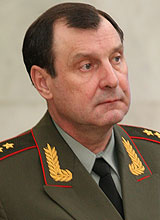
In addition to his new title Deputy Defense Minister for Material-Technical Support and his responsibility for arms and equipment supplies, General-Colonel Dmitriy Bulgakov has apparently also picked up Grigoriy Naginskiy’s duties as Chief of Housing and Construction. 

Bulgakov accompanied Prime Minister Putin on a tour of military apartments under construction in Volgograd today.  The contractor told Putin the land was acquired three years ago, but delays in installing utilities held up construction until this year.  They also complicated the process and added 5,000 rubles to the per-square-meter cost of the apartments. 

Bulgakov was quoted saying the first batch of apartments in the new mikrorayon for servicemen (739 apartments) will be turned over in December.  He also said 1,978 servicemen need housing in the city.

Deputy Signals Chief Goes Down for Corruption

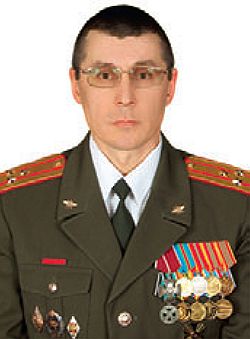
Colonel Andrey Kolupov (photo: Kommersant)

While President Medvedev may despair of the continuing corruption plague in Russian government and society, the Defense Ministry went after a fairly high-ranking figure this week. 

There’s been nothing general on the military corruption situation since earlier this year, so the Kolupov case is just an interesting, isolated one. 

A decorated combat veteran of Chechnya and Dagestan, Colonel Kolupov is the General Staff’s Deputy Chief of Communications, and he was in line to succeed his retiring boss until a check uncovered his failure to return a Defense Ministry apartment in Voronezh when he received another one in Moscow. 

In 1996, he had a 54-square-meter apartment in Voronezh with his wife and daughter.  In 2002, Kolupov became a senior officer of the MVO’s communications directorate.  Two years later he had a second daughter and received a three-room, 81.7-square-meter Moscow apartment, which he privatized in 2008, according to Kommersant

Meanwhile, Kolupov let his mother-in-law to privatize the service apartment in Voronezh rather than returning it to the Defense Ministry.  The loss to the state was put at 6.3 million rubles.  The colonel has been charged with large-scale fraud.  He apparently hasn’t acknowledged wrongdoing, and refused to speak with Kommersant

Kolupov’s housing machinations are less egregious than ones occurring in the Railroad Troops Command in recent years.  But there seems to be a campaign against apartment manipulations by senior military officers.  Generally, it might be possible to conclude that the Defense Ministry’s anticorruption efforts are relatively more vigorous and effective than those of other ministries, but it would also be impossible to prove this with any certainty.  And the key word is relatively.  The scale of Defense Ministry efforts may not be significant in an absolute sense against the scope of its overall corruption problem.  One can easily think of other apartment- and housing-related corruption, involving military men and civilians, that isn’t scrutinized similarly.

Naginskiy ‘Freed’ From Housing Duties

Grigoriy Naginskiy

This morning’s press reported (with varying degrees of accuracy) that the Chief of Housing and Construction, Deputy Defense Minister Grigoriy Naginskiy has been ‘freed’ from his principal duties, but remains a Deputy Defense Minister.  See Kremlin.ru for the text of President Medvedev’s decree.

The midst of a year of trying to deliver on huge permanent military housing promises seems an odd time to make yet another change of housing chief.

The decree also moved a two-star named Sergey Zhirov from his post as Chief of Staff, First Deputy Chief of Rear Services to a position called “Director of the Department of Planning and Coordination of Rear Support of the Defense Ministry.”

These could be the opening moves in Defense Minister Serdyukov’s reported effort to establish a unified material support establishment responsible for arms, equipment, and all logistics.

Serdyukov on Contract Service

Wednesday Defense Minister Anatoliy Serdyukov appeared before a closed session of the Federation Council’s ‘government hour,’ and answered 30 prepared questions. 

ITAR-TASS reported the upper legislative chamber’s Speaker Sergey Mironov summarized Serdyukov’s presentation as follows:

“Objectively speaking, we received exhaustive explanations on several positions, some answers explained the situation which had called forth serious questions from the senators.”

Mironov added that Serdyukov’s answers:

“. . . did not completely satisfy FC members.  Personally I and many of my colleagues remained with our own opinions about what is happening in the armed forces.”

Defense and Security Committee Chairman Viktor Ozerov delivered the gist of Serdyukov’s answers to the Russian media, although Serdyukov answered some direct press questions after his session with the legislators.

According to RIA Novosti, Serdyukov said:

“We talked about the transition to the new profile, the numerical composition of the armed forces, the new structure, military units which are being created, draft legislation on pay and proposals concerning the provision of housing to servicemen.”

The major news out of Serdyukov’s parliamentary appearance was the report that he denied Russia is abandoning professional contract service or returning to Soviet-style, all-conscript armed forces.  This contrasted with the recent Newsru.com report saying contractees will soon be drastically cut everywhere except in permanent readiness units, as well as with General Staff Chief Makarov’s February admission that contract service has failed. 

Several media sources reported that Serdyukov indicated contractees would increase 50 percent from a current level of 150,000 to between 200,000 and 250,000.  ITAR-TASS reported his words as:

“In the future it [the number of contractees] will grow, there is potential for this.  In the future the number of contractees will grow to 200-250 thousand, such conditions will be created for them so that they can fulfill their duties as real professionals.”

However, BFM.ru and Regions.ru heard it quite differently.  They reported:

“The Russian Army has not abandoned contract service.  Now in the Armed Forces of Russia there are 150 thousand contractees.  At minimum, this number will be preserved.  If the financial potential of the government allows, we will broaden this component.  Ideally, according to our calculations, the quantity of contractees should be about 200-250 thousand.  They should occupy duties demanding good training and knowledge, service experience.”

According to Ozerov and press sources, Serdyukov addressed other miscellany.

The Defense Minister said the LDPR’s recent draft law proposing to allow young men to buy their way out of the draft for 1 million rubles “raises a whole series of issues.”  He claimed this would interfere with the country’s mobilization potential.  He apparently didn’t say how many guys he thought could afford that much, but he must think a lot can, if it could affect Russia’s human mobilization resources.

Despite recent press indicating a strong presumption that Serdyukov is ready to euthanize premilitary Suvorov and Nakhimov schools (much as VVUZy have been paired back), he told the Federation Council that Suvorov schools will be preserved and strengthened.

Serdyukov demurred from the possibility of more Russian bases abroad, calling them an “expensive pleasure.”

He said the military’s 8,000 plus military towns will be reduced and consolidated into only 184, and those cut would be turned over to the oblasts and republics in which they are located.  The Defense Ministry will discuss with RF subjects and local governments the transfer of housing and other social infrastructure in military towns to their jurisdiction. 

This harks back to the late April announcement about constructing new, large ‘core military towns.’  The smaller number of garrisons sounds more appropriate for a million-man army than 8,000, but taking care of those left stranded without utilities and other services in former garrisons is much more troublesome than simply transferring them to the control of oblasts or local governments.

Serdyukov said the Defense Ministry will acquire 51,000, rather than 45,000 permament apartments for servicemen this year.  He doesn’t see any problem with providing service apartments to every military man by the end of 2012.

He regrets that the Defense Ministry’s request for indexing military pay and pensions has not been approved, but he said this issue is not decided yet.

On the Black Sea Fleet, Ozerov said Serdyukov said the fleet’s personnel will be less than the 24,000 stationed there earlier.  He said Serdyukov said he expects the new Ukrainian government to be much more amenable to discussing deliveries of new weapons and equipment of the Russian fleet.

More on ‘Virtual’ Apartments

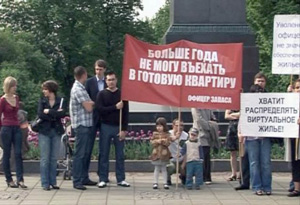
On Friday, TV Tsentr broadcast a story on former military men waiting over a year for new apartments due to the lack of proper transfer and ownership documents.  Two of the men and a military wife were interviewed.  The footage showed a quiet demonstration on Gogolevskiy Bulvar, several blocks from the Defense Ministry.

One officer showed the camera crew his family’s room in an officer’s dormitory.  Another walks through a finished apartment building, saying he is into his second year of waiting.  The ‘virtual’ apartments exist, but the documents for them don’t.  A military wife says their lives and obtaining services are difficult without a permanent place of residence. 

The chief of the regional capital construction directorate talked to the demonstrators about ‘complex relations with the contractor,’ but assured them their apartment problems will be resolved in the next month.

‘Virtual’ Apartments and the Army’s Protest Mood

Ex-Military Men Protesting 'Virtual' Apartments (photo: RIA Novosti)

In Monday’s Nezavisimaya gazeta, Vladimir Mukhin described a 15 May demonstration outside the Defense Ministry by former officers who were allocated ‘virtual’ apartments in Balashikha six months ago, but have been unable to occupy them due to slow paperwork.  Their demands are simple:  these retirees want bureaucratic obstacles removed.  

The protest was not covered by the media, or received only scant coverage.  However, the Defense Ministry’s promise to fix the problems for former servicemen from Balashikha was reported widely in the press. 

Mukhin’s subtitle for the article reads, “Unfulfilled Presidential housing program for the military leading to protest actions.”  He concludes that military demonstrations have been so rare in post-Soviet history that, if they occur, they have to be symptomatic of something.  He says similar protests have happened in other regions with large military garrisons. 

Everyone remembers Defense Minister Serdyukov’s reports about fulfilling the military housing program in 2009.  However, it’s becoming clear that this didn’t happen.  New military housing and construction chief Grigoriy Naginskiy not long ago announced that of 45,000 permanent apartments handed out in 2009, less than half have been occupied.  So the plan wasn’t achieved.  This has provoked a protest mood in the army, and the authorities, it seems, prefer not to notice it.  

Mukhin cites similar situations and actions in Bashkiriya, and elsewhere in  Moscow’s far suburbs.  The All-Russian Professional Union of Servicemen (OPSV or ОПСВ) tells Mukhin it’s pretty simple.  A garrison is drawn down, and officers who don’t want to relocate are put out of their apartments (sometimes into the street).  The garrison is then sold by Defense Ministry officials with a direct interest in this.  Mukhin concludes, that’s the ‘new profile’ army for you. 

OPSV Chairman Oleg Shvedkov told Mukhin several thousand retired officers and servicemen participated in May 1 protests around the country.  They protested not just housing, but also pension and pay problems.  But, of course, active-duty servicemen are prohibited from participating in political actions under the law. 

Viktor Baranets also addressed the plight of former officers in Balashikha in a 12 May article. 

According to ITAR-TASS and RIA Novosti, a Defense Ministry housing official promised on 15 May that the problem of 80 retired servicemen and the apartments allocated to them in Balashikha would be resolved before the end of June.  He said the process of preparing all the necessary documents would be complete by that time. 

A Defense Ministry spokesman said a meeting with an ‘initiative group’ [i.e. the protesters] was held in the ministry.  He also indicated the Defense Ministry is trying to speed up and smooth out the process of preparing and registering survey and property ownership documents.

Phantom Apartments

Yesterday NTV aired an expose which helps explain how the Defense Ministry claims it  built 45,600 apartments for officers in a single year.

It’s a bit surprising that a national channel aired this piece.  It depicts quite a mess in military housing, although it doesn’t venture to say how widespread this problem might be.  Recall that the military prosecutor was investigating a case of 8 unfinished buildings in Chekhov back in January. 

It’s unclear how such messes could be cleaned up–how unfinished apartments could be completed, who would do it, and, most importantly, who would pay.  Previous reports made clear the turmoil in the Defense Ministry’s Housing and Construction Service when civilian Grigoriy Naginskiy replaced General-Colonel Filippov at the beginning of 2010.

NTV also hints at pervasive corruption in the military housing program, but doesn’t address this directly. 

Brewing military housing scandals could lead not just to questions about poor management in Serdyukov’s Defense Ministry, but also about Prime Minister Putin’s (and President Medvedev’s) ability to delivery on oft-repeated promises to servicemen.

The video shows poor quality work on an apartment building in a way text alone could never describe it.  The looks and expressions of the jilted officers would similarly be difficult to capture in words.

NTV says officers of the Ufa garrison are thinking not about the upcoming 9 May Victory Day holiday, but about resolution of their everyday problems.  Because of bureaucrats, they and their families could end up out in the street.  They were allocated apartments in a new building where they can’t live.  The multi-story building is incomplete, and several parts of it haven’t even been started.

But according to the documents everything is in order.  There are even acts of acceptance for the nonexistent apartments.  The chief of every organization involved in the project hurried to put check marks on reports about the completion of this state construction order.  For this reason, it will be hard to determine exactly who’s to blame.

The camera turns to one Lieutenant Colonel Valeyev, effectively out of the service for 7 years, but unable to retire (he hasn’t received permanent housing).  He had to surrender his service apartment, and lives in the kitchen of an officer’s dormitory while his daughter lives in his room.  Valeyev concludes simply, “It’s shameful to live in such a situation.”

The construction contract for 350 apartments on the outskirts of Ufa was signed a year ago, and the work was to be finished in just three months, understood to be unrealistic and impossible from the very beginning.  The builders didn’t finish for understandable reasons, but the acts of delivery-acceptance were signed on time.  It turns out this housing existed on paper, but not in reality.

They managed to build only one-third of the apartments promised, and even those remain incomplete after six months.  Nevertheless, the chief of the Ufa KECh (housing management unit or КЭЧ), who distributes housing to servicemen, signed for ceramic tile, linoleum, and wallpaper back in October (so where did these materials end up?).

Asked why the acceptance was signed if the apartments weren’t ready, the KECh chief says only, “It was signed, so to speak, in advance.”

Meanwhile, the other two apartment buildings are just holes in the ground, as shown in the video.  These unbuilt apartments have been distributed already, so 100 military families have housing on paper.

Ufa garrison officers can’t go back to their old service apartments that have been given to others already.  It’s also possible their assigned permanent apartments, when and if completed, could be sold to civilian buyers now that the original contract’s been voided.  The officers will claim they have documents for the apartments, but the builder will tell them to take it up with those that gave them the papers (i.e. the KECh and the Defense Ministry).

The contractor complains that the Defense Ministry contract was lower than market price by one-fourth (well, why did they agree?).  And he claims he went ahead with his own money and now the apartments are more expensive (he seems to be preparing to justify selling them on the private market).

The officers don’t even have anyone with whom they can argue.  The previous KECh chief is under investigation on bribery charges.  And dismissed officers from distant Ural garrisons are being sent back to their units to ask their old commanders for some living space.

Putin Reports on OPK and Military Housing

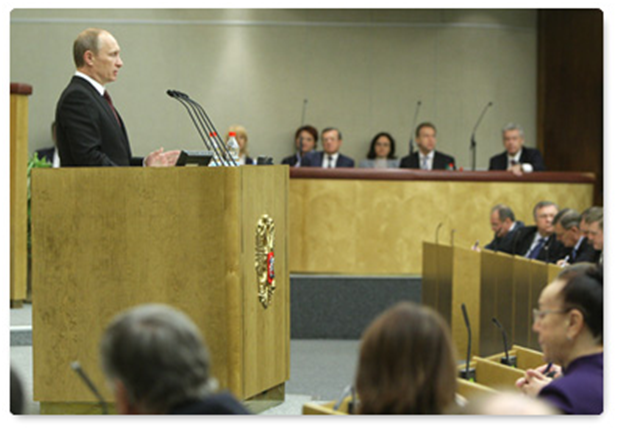
Putin Reports to the Duma

Yesterday Prime Minister Vladimir Putin reported on the government’s work over the last year to the State Duma.  His remarks focused on government efforts to handle ‘bread and butter’ economic and social issues during the 2009 crisis.

There was relatively little on military issues, except for some remarks on defense industry and military housing. 

He largely reiterated familiar themes like increasing modern weapons to 70-80 percent of the inventory; he congratulated those working on the fifth generation PAK FA and he emphasized development of a new strategic bomber.  Without being too specific, Putin suggested that OPK enterprises with heavy tax arrears might be getting some relief.

On housing Putin promised almost 52,000 military apartments this year.  But Duma deputies didn’t ask him about press reports that many of the 45,600 built last year remain empty because of construction defects, bureaucratic red tape, and even the fact that some were not really built in the first place.  Putin reiterated an earlier promise to house servicemen who didn’t get apartments in the first post-Soviet decade.  And he noted that privatization of service housing remains a possibility since the deadline has moved back.

First Putin’s description of the economic scene.

Putin said Russia’s GDP fell a record 7.9 percent, and industrial production declined 10.8 percent last year, but the government responded by greatly increasing budget expenditures—27 percent more than in 2008—even though revenue declined almost 21 percent.  Putin said the government used Russia’s accumulated reserves to finance the shortfall.  It spent 5 trillion rubles—1 trillion more than in 2008—on pay, pensions, social benefits, education, health, and housing, according to Putin.  He said 1.65 trillion rubles were invested in ‘developing the economy.’  Putin concluded that most of the government’s anticrisis program, the use of the budget, reserves, Central Bank resources, and state guarantees worked, and prevented the destruction of the real economy and the financial system.

Last year’s State Defense Order (GOZ) was one part of last year’s government spending program to counter the economic crisis.  Putin says the government spent 1.1 trillion rubles—150 billion more than in 2008.  He continued:

“During the crisis we also rendered targeted support to the defense-industrial complex and high-technology enterprises.  Last year’s gloomy forecasts by some politicians on the collapse of the defense-industrial complex were not borne out.”

“I know how many serious problems have accumulated here, we’ve been seriously occupied with this.  If you noticed, I’m always conducting special meetings on distinct sectors, there we deeply immerse ourselves in these problems.  Yet the volume of output of military production in 2009 increased by almost 13 percent—this during a general contraction!  The growth of production in shipbuilding generally was 31.6 percent, in the missile-space industry—16.5 percent, in aviation—9 percent.”

“Tests of fifth generation fighters are going successfully, and I want again to thank everyone who worked on this machine, who now gets it ‘on its wings.’ “

“Of course, we do not limits ourselves to just this.  Following the fighter we need to begin work on the future aviation system long-range aviation [PAK DA], this is new Russian strategic bomber, missile carrier.  We conducted a serious inventory in the defense-industrial complex and are embarking on formation of long-term programs of rearmament in all fundamental combat systems:  in command and control and intelligence systems, armored and naval equipment, highly-accurate weapons.  As a result, the share of modern weapons in the troops should increase to 70-80 percent, and this will indeed be  weapons of a new generation.”

“The question of restructuring the tax arrears of OPK enterprises has come from [Duma] deputies.  Enterprises have such a possibility.”

“In December 2009 the government issued a corresponding decree, calculated for 2010.  It talks about indebtedness which arose before 1 January 2009 (the KPRF raised these questions).”

 On military housing, Putin first addressed war veterans in line since before 2005.  He said 28,000 of these veterans have been housed, and he wants to house any who were left out or joined the queue later.  The government has directed 34.5 billion rubles at this, according to Putin.

Turning to more recent servicemen, Putin says:

“We have also not retreated from another most important task, another priority.  In 2009 the Defense Ministry delivered 45,600 new apartments to servicemen.  You know there has never been such a thing.  In 2010 another 51,900 apartments will be allocated.  That is, over two years—almost  one hundred thousand.  As a result, we will finally end the demand of armed forces servicemen for permanent housing, as we promised.”

“But we have another category of people whom we should not forget.  The question is about those who retired from military service in the 1990s or beginning of the 2000s, without receiving housing.  I remind you, in that time due to the inpossibility of solving this problem at the federal level, they sent them into municipal lines [for housing], where, unfortunately, things are moving slowly.  Or more precisely—practically not moving.”

“Of course, people are not to blame for the fact that at the time the government simply could not afford to meet its obligations to them.  And we were obliged to return to this issue.”

“It was originally planned to complete the provision of housing to such citizens in 2012-2013.  But I think we can do it earlier—to give retired military men housing in 2010-2011.  For this purpose we will ask you [Duma deputies] to direct an additional 34 billion rubles.”

“Incidentally, free housing privatization has been extended until 2013.  Now, veterans and servicemen can calmly arrange ownership of housing.”

Just to complete this picture, Deputy Defense Minister and Chief of Housing and Infrastructure, Grigoriy Naginskiy, recently admitted that only 21,061 of those 45,600 apartments from 2009 are actually occupied because of poor construction and problems formulating ‘social lease contracts.’  But Naginskiy promises that 99 percent of the 45,600 will be occupied before 1 June.  That’s quite a promise.  Viktor Baranets has written recently about builders’ efforts to ‘economize’ and squeeze out extra profits on military apartments.  Olga Bozhyeva has written about servicemen turning to the courts over housing issues, as well as ‘virtual’ Defense Ministry apartments that don’t exist.  The Main Military Prosecutor has actually investigated cases of this in Chekhov.

To round out the economic picture, Putin asserted that signs of recovery include a forecast of 3 percent or more GDP growth for 2010, and industrial production growth of 5.8 percent and real income growth of 7.4 percent for the first quarter of the year.