Category Archives: Naval Modernization

Bulava Test in Second Half of September

Defense Minister Anatoliy Serdyukov talked to the press today about the next Bulava SLBM test:

“The next test launch of the Bulava could happen, most likely, in September, but not in the first half of the month.  Definitely.”

“We’ve tried to control the entire process of assembling these missiles as precisely as possible to produce the same parameters. There will be three missiles at a minimum, we need to understand that if failures are repeated in the launches, we’ll learn the cause of unsuccessful launches.”

After reiterating how previous failures had different causes, Serdyukov continued:

“Now at every level and phase of assembly of the missile there was strict control and analysis.  Moreover the commission established to explore the results of the last unsuccessful launch also worked here.  It gave recommendations, we incorporated all of them in preparing for new tests.”

“I believe that launches will be conducted most likely in September according to their readiness.”

Possible Bulava Test By Mid-September

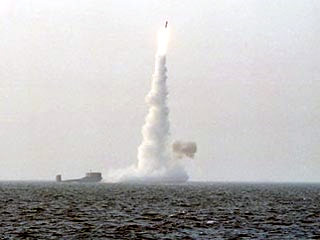
Bulava (photo: Newsru.com)

An OPK source has told ITAR-TASS the next Bulava SLBM test is expected in the first half of September.  The source said the state commission investigating the last Bulava failure is scheduled to meet 6 September, and the launch window for the next test opens on 9 September.

A missile industry source told Interfaks the commission will meet in the 5-7 September timeframe, and it could fix a launch date sometime at the end of the first ten days of September.

Newsru.com recalled that three tests are planned for 2010:  two from Dmitriy Donskoy and one from Borey-class SSBN Yuriy Dolgorukiy.  The website’s Defense Ministry source unofficially repeated claims that, if all three firings are successful, the Bulava will be accepted into the armaments inventory next year.

ITAR-TASS also reported today that Dolgorukiy successfully completed its latest phase of factory underway trials, and is preparing to go sea again next month.  Sevmash reports the new SSBN completed its cruise program, showing “good performance characteristics and reliable working of all onboard systems.”

Proyekt 636 Subs Being Laid Down for BSF

On 17 August, Russian news agencies reported that Admiralty will build a proyekt 636 diesel-electric submarine for the Black Sea Fleet (BSF).  The keel-laying was scheduled for 20 August.  Navy CINC Admiral Vladimir Vysotskiy says, in all, three proyekt 636 submarines will be laid down for the BSF before year’s end. 

Krasnaya zvezda writes that, although Admiralty has produced export submarines since 1983, Novorossiysk will be its first proyekt 636 for the Russian Navy.

Ocean TV reports Novorossiysk will be complete in 2013, and the other two in 2014.

The Rubin Central Design Bureau of Naval Technology has made changes in the construction of systems and equipment of the proyekt 636 for its use in the Russian Navy.  RIA Novosti said the new BSF submarines will be armed with the Klab-S antiship cruise missiles.

The Navy Main Staff calls Novorossiysk the start of its long-term plan to restore the BSF’s combat readiness.  The fleet is also slated to receive the Sevastopol, the third unit of new fourth generation proyekt 677 submarines.  According to Krasnaya zvezda, the transfer of Baltic Fleet Neustrashimyy and Yaroslav Mudryy frigates to the BSF is still being worked, and could take place in the next year.

A related aside . . . it’s been almost four months and there’s no mention of the BSF basing report that, on 1 May, President Medvedev ordered Defense Minister Serdyukov to present in a month.

Is the Helicopter Carrier Tender for Real?

Speaking in Yerevan today, Defense Minister Serdyukov told journalists:

“We have announced an international tender for construction of a helicopter-carrying ship.”

He indicated Russia is talking about two ships.  He also welcomed the French builders of the Mistral to join in the tender.

The tender will take place next month, and the winning bid will be selected before year’s end.

After months of negotiations with France on building Mistral-class amphibious assault ships, the Russians couldn’t reach agreement on the terms of a deal.

The two sides may have agreed on building two ships in France’s STX shipyard.  French President Sarkozy told its workers last month they’d be building two ships with the Russians.

Maybe the Russians wanted to buy one and build three, but Serdyukov says the international tender is for two ships, so it seems likely Paris and Moscow had agreed on a ‘2+2’ formula.  So something else is probably the sticking point.

RIA Novosti suggests talks with Paris stalled over its unwillingness to sell Moscow the NATO standard tactical communications system aboard Mistral, according to an unnamed expert who spoke to Ouest-France.

The expert said the comms system is tied to the SENIT 9 tactical combat information system.  It’s described as an important node NATO isn’t prepared to share with Russia.  The French expert says the Russians “don’t have a very good command of military computers and are trying to fill the gap.” 

Officially, the Elysee says negotiations with Russia continue, it’s confident of a successful outcome, and it isn’t worried about the Russian tender.  It hasn’t commented on participating in it either.  Meanwhile, the French media claims Moscow has stopped its exclusive talks with Paris.

Tender for Helicopter Carriers May Just Be Formality

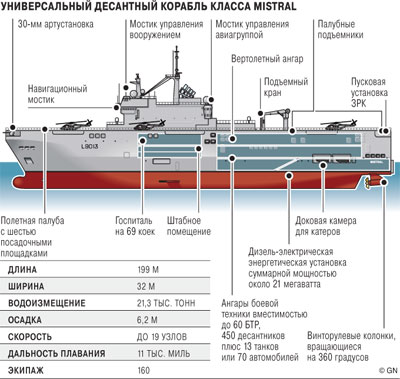
Mistral Schematic

Kommersant reports today that United Shipbuilding Corporation (OSK) has gotten the Defense Ministry’s permission to hold an open tender for procurement of helicopter carriers.  The paper concludes the Defense Ministry is refraining from a sole-source purchase of the French Mistral, and will consider similar proposals from OSK’s shipyards.  But the military [at least some military officials] haven’t hidden the fact that they prefer Mistral [but Defense Minister Serdyukov has always maintained they’ve been talking to other suppliers], so the tender could just be a formality. 

OSK President Roman Trotsenko says a special commission from the Ministry of Industry and Trade will conduct the tender, but details are sketchy.  A Defense Ministry source told Kommersant that, without a tender, a deal to buy a helicopter carrier [presumably Mistral] would be considered illegal.  So there won’t be a sole-source buy despite a year of government-to-government talks.

The paper reminds readers of OSK’s recent unsuccessful antimonopoly complaint in regard to the government’s consideration of Mistral.  Although the complaint was not reviewed, it must have had some impact on the decision to compete the helicopter carrier purchase.  Kommersant sources say OSK Board Chairman Igor Sechin also had something to do with it.

Trotsenko says far east shipbuilding plant ‘Zvezda,’ Petersburg’s ‘Admiralty Wharves,’ and Kaliningrad’s ‘Yantar’ will bid for the ships.  ‘Zvezda’ already has a joint venture in place with South Korea’s Daewoo – builder of the Dokdo helicopter carrier.  The OSK President says ‘Admiralty’ and ‘Yantar’ might work with ‘Northern’ shipyard or a foreign builder. 

Kommersant has a letter sent from Sechin to Prime Minister Putin this spring saying not only is Dokdo an alternative to Mistral, but Dutch and Spanish helicopter carriers are as well.

Trotsenko says OSK yards can build a helicopter carrier in 30 months for $500-700 million against a Mistral pricetag of €420-680 million.

Kommersant concludes the tender won’t end the conflict between OSK and the Defense Ministry.  Mistral will remain the latter’s priority.  The paper’s sources don’t know if the military wants to buy Mistral itself or place an order for a new unit in a French shipyard (STX).  OSK hasn’t been able to arrange a cooperative agreement with STX.

Mezhprombank-controlled ‘Northern’ and ‘Baltic’ shipyards will participate in the tender according to a representative of the bank. Kommersant’s sources think Mezhprombank, its owner Sergey Pugachev, and shipyards are the favorites among Russian contenders.  Pugachev was an early supporter of buying French, then building other units in his shipyards.  And, according to Kommersant, the Defense Ministry supports Pugachev.

Alongside Pugachev and Mezhprombank, OSK feels its chances to win the tender aren’t great.  Moscow Defense Brief analyst Mikhail Barabanov also says Mezhprombank yards are the favorites to build Mistral in Russia.  Such a deal’s been reached at a political level between Paris and Moscow, so the tender might just be a formality.  CAST’s Konstantin Makiyenko agrees.  But he thinks Mistral orders will go to ‘Baltic,’ since ‘Northern’ is loaded with frigate and corvette orders.  Meanwhile, OSK would like to buy both yards from Mezhprombank, but the sides haven’t reached agreement on a price.

Update on Next Bulava Test

Today’s Kommersant cites Interfaks saying a session of the state commission deciding on the next Bulava SLBM test will happen during the next week.  Kommersant’s own OPK source confirmed this, calling the session a formality since the commission’s already announced that testing needs to continue in the near future.  The source says, after the commission meets, another week is needed to prepare for a launch, so look for the next test in late August or early September.

Kommersant quotes an unnamed OPK official who said the planned launch in the 11-13 August timeframe was postponed because “additional stand tests of the system were conducted with the goal of more rigorous preparation for the launches.”

Kommersant reminds readers three launches are planned before year’s end — two from Dmitriy Donskoy (proyekt 941U Akula) and one from Yuriy Dolgorukiy (proyekt 955 Borey).

The paper’s OPK source claims, in view of Bulava’s failures, “this strategic missile system will only be accepted into the inventory after a minimum of five consecutive successful tests.”

Bulava Test Delayed Two or Three Weeks

ITAR-TASS reported this morning that the expected Bulava SLBM test has been put off for two or three weeks.  The state commission looking at the December 2009 Bulava failure apparently made the decision today ahead of an anticipated launch between 11 and 14 August.  A defense industry source didn’t give a reason for the postponement.

Vysotskiy’s Navy Day Interview

Press coverage of Navy Day (25 July) was replete with interesting stories of plans to revivify Russia’s Kirov-class CGNs and even the Orlan-class wing-in-ground effect vehicle.  There was more talk about moving the Neustrashimyy and Yaroslav Mudryy to the BSF.  Navy CINC Admiral Vladimir Vysotskiy’s interview with Ekho Moskvy, however, didn’t get a lot of attention beyond a couple RIA Novosti and ITAR-TASS sound bytes.

Discussing development of Russia’s fleet of the future, Vysotskiy emphasized the long lead time required to get it:

“Today it takes 10-12 years to get some kind of definite design.  We understand that we have to go according to some operational-tactical requirements, perhaps even operational-strategic ones in this design, of course.  So, it means the development or construction of a series is approximately another 5-7 years, up to 10 years.  Perhaps more, the service life of the design is 20 to 25 years.  In other words, if today we make a decision on constructing some full-scale fleet, then we have to understand we’ll receive this fleet in about 50 years.  Well, at a minimum, beginning from the main component in 35 years.”

Vysotskiy’s comments on Bulava were also captured by the wire services:

“Well, the question which we, military men bearing certain responsibility for this, of course, well, honestly speaking, we are already tired of answering because there is one cause — a deep, I underscore, failure of primary production technology for such expensive missile systems.”  

“We all very simply understand well:  when we began to arrange the process of our work incorrectly from the beginning, and here everything was not done as it needed to be.  Here, of course, we’ll get big problems in the process of the work itself.  This means, in my view, in the last 2 years, a serious move in the direction of us receiving this system has been made nonetheless.  But we need to understand that getting this system in its current form is not the final step of the work.  But we have a fair chance all the same to complete this work successfully, well, so we’ll say, in the course of the coming year.”

“When a systemic mistake is found, it’s simpler,  In this instance, an entire systemic mistake was found precisely in the lack of a system.  That is, to put it properly, forgive such a tautology or, on the other hand, a paradox.  But, what we’ve got is what we’ve got.”

And Vysotskiy said lots of other interesting things that went unnoticed.

He naturally supported Vice-Admiral Sidenko as Far East OSK Commander, saying it made sense and reflected the country’s maritime interests in the Pacific and Indian Oceans. 

He connected the acquisition of the Mistral to drawing down mobilization resources in favor of permanent readiness.  He said PR units could be put on Mistral and the ship could be a mobile command point for an OSK’s inter-service grouping.  He defended turning abroad by saying it would take Russian yards 1.5 to 3 years to even prepare to make such a ship if they started today.

Vysotskiy wants the BSF to pick up the antipiracy load so the distant fleets don’t have to send their ships.

He discussed Russia’s long-term search and rescue support program, and he emphasized rapid information transfer and international cooperation and combined training, like NATO’s Bold Monarch exercise, as essential ingredients for success.

On the loss of the Kursk ten years ago, Vysotskiy said the accident started with a technical cause — errors in handling a peroxide-fueled torpedo — but there was an accumulation of mistakes, including organizational and command ones, that led to the tragedy.

Russia is working on its organizational and technical problems in SAR, both buying equipment and learning to use it abroad.  Vysotskiy cited an ‘absolute understanding’ on cooperation with foreign partners.

He was evasive on moving the Navy’s headquarters to St. Petersburg, saying a remote command and control point is there, and other steps in this direction are being taken.  But the overall military C2 reform has to be completed this year before he can really answer questions.

Lastly, on foreign bases for the Navy.  He’d like to have them, and there’s movement in this direction, at least compared with the recent past.  The Navy is working with a number of states to arrange for simplified port access for its ships in some strategic places, and it’s almost like having a base.

Defective Bulava Nozzle

That same highly-placed RIA Novosti source in the Navy Main Staff also said the next Bulava SLBM test will occur in August or September from Dmitriy Donskoy.  A favorable outcome would led to another test launch from Dmitriy Donskoy, then a third launch from the missile’s intended platform Yuriy Dolgorukiy.

RIA Novosti also reported a source — close to the state commission investigating the cause of the last failed Bulava launch — said yesterday that the cause of the unsuccessful December 2009 test was a malfunctioning rocket nozzle.  He said:

“The state commission established that the nondeployment of Bulava’s extendible nozzle between the missile’s first and second stages was the cause of the last unsuccessful launch.”

He added that the nozzle problem was not caused by a design flaw, but by a production defect, and the missile was simply made incorrectly.

RIA Novosti recalled that First Deputy Defense Minister Popovkin, on 30 June, said only that the commission had recommended continuing Bulava testing.  He didn’t comment on any conclusions on the cause of the last Bulava failure.

Buy Two, Build Two

RIA Novosti reported yesterday that the purchase format for Mistral helicopter carriers hasn’t been determined, but a Russian Navy source says a ‘2+2’ variant is possible.

A highly-placed Navy Main Staff representative told the news agency that Russia could buy two and build two of the ships, and such a ‘2+2’ scheme is being discussed in negotiations in Paris.  

Initially, Moscow wanted to buy one and build three under license in Russian shipyards.  But French President Sarkozy mentioned a ‘2+2’ format earlier this year.

RIA Novosti’s source said the two Russian-made ships might be built at Sevmash, Baltic, Yantar, or Northern Wharf.