Category Archives: Navy

Poor Health of Potential Conscripts

The Defense Ministry press service today revealed some scarcely concealed official irritation with the poor health of its pool of potential conscripts.

ITAR-TASS reported that almost half the men called to draft commissions have been sent for medical observation.  The press service source told ITAR-TASS:

“As of 21 May draft commissions have made decisions on 155,300 of those called up, more than 70,800 men have been sent to places of service.  Since the beginning of the call-up, military commissariats have sent nearly 67,000 young men for medical observation.”

The draft campaign which began 1 April will call 270,000 men into the armed forces and other militarized structures.  The largest numbers of conscripts thus far have come from the Volga-Ural region and Siberia.  In last year’s competition for citizens best prepared for military service, Tatarstan was first, Stavropol second, and Arkhangelsk third.

ITAR-TASS concludes, in the Defense Ministry, they remained worried as before by the weak health of Russian conscripts.  In the 2009 call-up [not clear if this means spring, fall, or both draft campaigns taken together], 68 percent of those appearing at draft commissions were found fit for military service without limitations or with insignificant limitations, but of the number actually inducted into the service, more than half had various limitations because of their health.  This prevented sending them to military units with high demands on servicemen–the VDV, VMF, MVD VV, and others.

ITAR-TASS reports doctors were forced [spring, fall, all of 2009?] to send nearly 86,400 of those called-up to ambulatory or in-patient observation in medical facilities because of unsatisfactory health indicators.  And their fitness for service can only be determined once they complete medical observation.  The item notes that, over time, 1-3 percent of young guys go ‘AWOL’ from observation and don’t complete it.  The fact that young men manifest health problems for the first time when they’re in front of the draft commission shows the weaknesses of the health care system.  The Defense Ministry also believes this shows that medical prophylactic measures for young people are poorly organized in the regions.

Serdyukov on Mistral

Defense Minister Serdyukov today said Moscow still plans on acquiring four Mistral amphibious assault ships.  He said Russia is talking not just with France, but also Spain and the Netherlands, about Mistral

According to RIA Novosti, Serdyukov said:

“At present, we’re in pre-contract negotiations on this type of ship with three governments.  They are Spain, the Netherlands, and France.  We plan to sign a contract for four of these ships.”

He also said one ship would be completely foreign-made, but Russian shipbuilders would participate in building the other three.  And the fourth ship will be built, to the maximum extent, in Russia.  

Serdyukov reiterated that the Defense Ministry is working on this acquisition according to President Medvedev’s decision.  And the Defense Minister added: 

“We are now occupied with the issue very seriously.” 

He concluded that the issue of buying the ships will be resolved positively “if there aren’t any revisions, including in the financing question.”  And finally Serdyukov noted:

“We understand now that the Northern and Pacific Fleets need these ships.”

Meanwhile, Baltic Shipbuilding Plant ‘Yantar’ is trying to tout its proyekt 11711 large amphibious ship Ivan Gren as an alternative to buying or building foreign ships.  VPK.name published a version of this story based on an earlier Interfaks report.

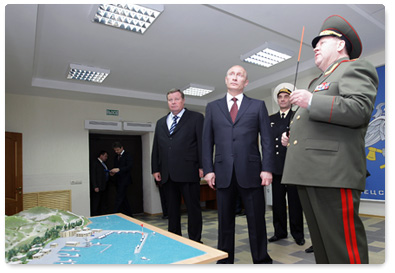
Medvedev Can Wait for His BSF Basing Report

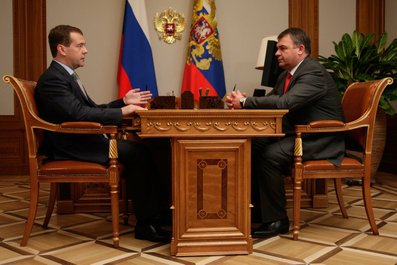
Medvedev and Serdyukov Meeting on 1 May

Whatever the complaints of some Ukrainians, the 21 April deal extending Russia’s basing privileges in Sevastopol is a good deal for Kyiv.  It’s now using the relatively meaningless Russian Black Sea Fleet (BSF) presence to secure a valuable 30 percent discount on Russian natural gas supplies.  

Moreover, in one suited for the ‘be careful what you wish for’ file, Moscow is also left holding the bag when it comes to the economy and infrastructure of Sevastopol, and much of Crimea as well, instead of Kyiv having to worry about assuming responsibility in a few short years. 

On 1 May, President Medvedev ordered Defense Minister Serdyukov to prepare a plan for developing the BSF’s naval base in Sevastopol, and to conclude an agreement with Ukraine on its social infrastructure.  According to Kremlin.ru, Medvedev said: 

“. . . today I want to touch on an issue with you which has taken on particular acuteness for our country in recent times.” 

“We need to think about the social arrangements for this base, that is very important to us, so that our sailors live in modern, full-fledged human conditions, have the chance for recreation and other opportunities a base is supposed to provide.” 

“So we’re agreed that our base will conclude a corresponding agreement with the Ukrainian side, with Sevastopol.  In accordance with this agreement, special support, social-economic support will be rendered to a series of Sevastopol city programs.” 

“This city is really not foreign to us and we need to think in what way to participate in these programs both along Defense Ministry lines and along the lines of other executive organs and business structures.  That’s the task.” 

Medvedev said Serdyukov should present his plan for approval in a month, and the latter responded that he would. 

Curiously, on 7 May, General Staff Chief Nikolay Makarov told RIA Novosti

“A working group’s been created which will evaluate the real condition of the basing point in Sevastopol and make its proposals.  I think this will take not less than two months.” 

“Practically nothing’s been invested there in recent years.” 

One wonders, would Makarov have unilaterally announced that Putin, when he was president, would have to wait an extra month or longer for the plan he ordered? 

Makarov said the Genshtab has no plans to freeze development of other basing points:   

“The fleet has to be.  The more basing points, the better.  And Novorossiysk is one of the key basing points.  And we intend to develop it.” 

Without elaboration, he said the Defense Ministry has modernization plans for the fleet’s ships, submarines, and aircraft to 2020.  Makarov was with Prime Minister Putin visiting the construction work at Novorossiysk.  

Putin Briefed on Novorossiysk

On 24 April, Anatoliy Tsyganok told RIA Novosti conditions at Novorossiysk are not particularly well suited for major base.  He noted it’s only 25 percent complete, and its price tag is continuously rising. 

Nevertheless, Putin reaffirmed Moscow’s commitment to Novorossiysk.  He acknowledged only 13 billions rubles have been spent, and he’s looking at an ultimate cost of 92 billion.  The base is slated for completion by 2020. 

But Moscow, Medvedev, and Putin may need to worry more about new ships and submarines than about infrastructure when it comes to the BSF. 

On 2 May, Anatoliy Baranov in Forum.msk pointed out that there’s practically no fleet there; a minimum of 2 more first rank ships and a submarine are needed for an adequate order-of-battle.  He says the social infrastructure’s not so bad, but 40- and 50-year-old civilian engineers and technicians have to go out with fleet units to conduct training.  What will the Navy do when they retire?  

Rosbalt.ru described a wave of new officer and civilian dismissals in the BSF, which occurred simultaneously with the new agreement with Kyiv.  The fleet, it says, is nothing more than a mixed force division’s worth of units and personnel.   Viktor Yadukha concludes: 

“NATO’s gracious reaction to the BSF lease extension didn’t surprise politicians more.  But if Western special services knew about real plans for its reinforcement, the reaction would have been very severe.” 

Lastly, in today’s Nezavisimaya gazeta, Aleksandr Khramchikhin says: 

“. . . renting empty piers for a great amount of money is not a mistake, but thoughtless, considering how many ships and how well-outfitted a base in Novorossiysk this money could build.” 

He calls today’s BSF a unique collection of floating antiques.  Even if the oldest units were dropped, most BSF ships would still be 20- to 25-years-old.  It will be impossible to avoid sending ships from the 1960s and 1970s off for scrap soon, as has been officially acknowledged.  Khramchikhin recommends placing what’s left at Novorossiysk as a ‘water area security’ (OVR or ОВР) brigade.

Hint of Navy Main Staff Move?

Forum.msk.ru yesterday provided a hint that the Navy Main Staff might soon leave Moscow for St. Petersburg.

It reported that a ‘tasty morsel’ of Defense Ministry property in Tushino is being prepared for sale–the base of the Central Fleet Depot, Naval Infantry v/ch 40135, as well as large Military Polyclinic No. 10 (which is apparently being closed as no longer needed).  The old buildings are coming down and the grounds will become a shopping center.

According to the report, the Central Fleet Depot includes:

  • V/ch 40135–a convoy battalion and service company;
  • The Navy Main Staff security battalion–a full-fledged combat capable sub-unit;
  • A construction company; 
  • The Navy Orchestra; 
  • A training unit for the units of central subordination;
  • Polyclinic No. 6; 
  • An automotive battalion.

All of these are effectively service and support elements for the Navy Main Staff.

The depot is a transit point for Navy conscripts as well as transferring officers.  It has a small hotel for the Main Staff.  Until this winter, there was also a branch of the Central Navy Archives here, but it was closed and sent to Gatchina, near Piter.  Now it seems the Central Navy Depot has been closed too.  The sailors and anchors at its gates have been replaced by civilian security guards.

Look for the rest of these Navy Main Staff support elements to turn up near Piter.

BSF Expects Frigates and Subs

To counter recent predictions of the fleet’s demise, a BSF staff source today told RIA Novosti 3-4 frigates and a similar number of diesel-electric submarines would meet the fleet’s needs in the coming five years.  He pointed to the Admiral Gorshkov class frigate at Northern Wharf and proyekt 677 submarine Sevastopol at Admiralty.

The source said:

“In the course of the next five years, new class frigates and diesel-electric submarines will be included in the order-of-battle of the Black Sea Fleet.  The need to replenish the BSF order-of-battle is caused by the decommissioning of obsolete ships of various classes.”

He said new ships would also support the fleet’s full participation in exercises with NATO and Ukraine, and also exercises and long-distance cruises planned by the RF Navy’s command.  He noted that the renewal of the BSF’s ships in no way would contradict the provisions of Russia’s basing agreement in Ukraine.  He called Russia’s plans transparent and a subject for discussion in the sessions of the Russian-Ukrainian BSF sub-commission.

These hopes are basically the same as those expressed back in February when another source said 2 frigates and 3 submarines.

Other media today reported the possibility that Moscow could get a base agreement extension in return for higher rent payments or lower gas prices for Kyiv.

Viktor Litovkin on BSF

Writing in Friday’s Nezavisimaya gazeta, Viktor Litovkin talked about the procurement of proyekt 20380 corvettes from Piter’s Northern Wharf.  The second unit Soobrazitelnyy was just launched, and three more have been laid down, but it’s not clear when they’ll enter of the order-of-battle.  A total of 20 are planned, but the specialists say everything depends on financing.

Then Litovkin turns to last week’s reports of imminent decommissioning for Ochakov, Kerch, etc.  He says this’ll leave the BSF with about 40 ships (12 of which are either in repair or a ‘conservation’ status).  He puts the average age of the remaining fleet units at 25-30 years, and the youngest are its proyekt 1239 small air cushion missile ships.

As far as capabilities go, the BSF is still stronger than Ukraine and Georgia (at least), but there is a question as to whether it can defend the country’s interests.  But maybe it doesn’t have to be so powerful when the country still has the RVSN, and the BSF wasn’t really challenged in the August 2008 war with Georgia, and it can still show the flag in the Mediterranean, defend the country’s economic zones, and participate in antipiracy operations off the Horn of Africa.  No one would take it into their head to compare it with the U.S. 6th Fleet.

But still Litovkin wants to answer why the BSF reached its current state.  Because the ‘Orange Revolution’ Ukrainians wouldn’t permit Moscow to renew the BSF’s potential in ships, aircraft, or personnel.  And Moscow was busy trying to modernize and preserve parts of the military other than surface ships.  He says:

“It built them for India, China, Vietnam.  Only now is it beginning to launch new corvettes and frigates for the Navy.  But by a drop (by one) per year.  And this is for all four fleets and a flotilla.”

“According to experts’ assertions, in the coming 10-15 years there are no possibilities for renewing the composition of the surface fleet.  Despite even the fact that today two frigates for the distant naval zone are laid down (proyekt 22350), five corvettes of proyekt 20380, three small gun ships of proyekt 21630, large landing ship of proyekt 11711… But even if the program of their construction is successful, they won’t under any circumstances compensate for the ships withdrawn due to age.”

“Even the Mistral won’t help here.”

Incredible Disappearing Fleet

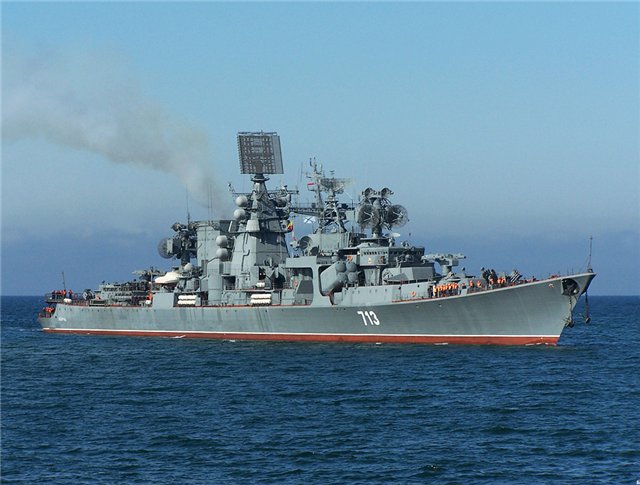
Kara-class CG Kerch (713)

The Black Sea Fleet’s predicament is hardly a news story.  The press in recent months has featured stories claiming that the BSF will receive new ships to replace its aging order-of-battle.

But Gzt.ru maintains the BSF is just about rusted through, and its ships will be unable to go to sea by 2015.  A Navy Main Staff source says the average age of BSF ships exceeds 30 years—the practical limit for naval vessels.  He claims the fleet’s sailors keep their ships in good condition, but, since metal has its limits, their hulls are reaching a point where “no one will risk going to sea in such ships.”

The source says the oldest BSF ships—whose service lives have expired and don’t warrant further investment—will be written off.  They include the Kara-class CG Ochakov (707), Tango-class SS Saint Prince Georgiy (B-380), probably Kara-class CG Kerch (713), and various transport and auxiliary ships.  Ochakov is 37 years old, and spent the past 18 years in the repair yard.  The disappearance of the Ochakov and Kerch will leave the BSF with only two major surface combatants—Slava-class CG Moskva (121) and Kashin-class DDG Smetlivyy (810).  And there is apparently a rumor that the Moskva will remain in the Pacific after participating in Vostok-2010 this summer.  The BSF will also be down to a lone submarine, Kilo-class Alrosa (B-871), which reportedly awaits repair after an engineering casualty during a recent training cruise. 

The final decision to write off some ships is driven by a 30 percent cut in the fleet’s maintenance budget [recall Defense Minister Serdyukov saying the repair budget has been cut by 28-30 percent, supposedly in favor of new procurement].  Since February, personnel at the 13th and 91st ship repair plants have been reduced by 2 times, according to Newsru.com.  And the repair plants have practically no work this year.

So they’re not fixing old ships, but neither are new ones in sight . . . the press noted that the BSF didn’t get new units in the 2000s, will get no new ships this year, and the introduction of new ones isn’t planned.

A BSF staff representative told Gzt.ru that several new corvettes of the Steregushchiy type (proyekt 20380) would restore the BSF’s combat potential. The Steregushchiy is in the Baltic Fleet, and a second unit of the class was just launched on 31 March.  This seems too slow to help the BSF, even if any of these ships were destined for Sevastopol.

 A source tells Gzt.ru the basic problem is the lack of production capacity:

“All shipbuilding plants are overflowing with foreign orders for several years ahead, and even if there is money it’s very complicated to arrange additional production for the Russian Navy’s needs since there isn’t the right quantity of milling machinists, lathe operators, and welders.  There’s great productive potential in Ukraine, and we consider that the warming in Russian-Ukrainian relations could lead to realizing a number of projects on Ukrainian building ways, which never worked for the USSR’s Black Sea Fleet.”

Gazeta.ru provided the opinion of Vladimir Yevseyev, who believes, until the BSF gets a new main base, it won’t get any new ships.  He says all the fleet’s problems are connected with its basing.  Most Ukrainian politicians oppose extending Russia’s presence in Sevastopol beyond 2017.  And Moscow has allocated a billion rubles to build a new base at Novorossiysk, but billions of dollars are required to create modern infrastructure there.  Yevseyev doesn’t like Novorossiysk, or Ochamchira:

“But we need to choose, otherwise the fleet could simply be liquidated.  Russia is just simply marking time.”

Svpressa.ru seconds this line of thought, concluding that malicious people say the fleet’s fate has been decided, and Russia’s Crimean base is folding up, and, in order to avoid a furor, its order-of-battle will be liquidated by taking units out of service.

Winter War 2010

The Russian press has noted the 6 March article in leading Finnish daily Helsingin Sanomat describing how a Russo-Finnish war might play out in 2010.  With the conveniently provided English, one can read for oneself.  But here’s a capsule version.

The imaginary war scenario begins with a Russian cruise missile strike on the Finnish Broadcasting Company compound.  Under the State of Defense Law, mobilization begins and the Chief of Defense becomes Commander-in-Chief of the Finnish Defense Forces.  Russian fighter aircraft engage Finnish F/A-18 Hornets around Helsinki.  Finnish government entities evacuate to safer locations.  Russia’s motorized offensive presses across the Karelian isthmus, trying to reach the Finnish capital in two days.  The Finns respond with antitank weapons and German-made Leopard tanks.  Russian airborne are dropped in Helsinki to disrupt rear areas; fierce urban warfare ensues. Civilian casualties mount and noncombatants flee for Sweden.  The Russians and Finns are engage each other on the electronic front [but few details are fleshed out].

The war is decided in the air.  Russian air power overwhelms Finland’s 100 combat-capable aircraft.  But it’s no quick victory for Moscow, and the Finns receive lots of international support [it makes them feel much better to be sure].

There’s obviously a lot to question in the conjecture above.

Rossiyskaya gazeta from 19 March indicated that there’s buzz about the article in Russia and Finland, and people mostly want to know why such a ‘provocation’ has been published.  So RG asked the Finnish paper’s editor to comment, and he replied:

“In the last two months we’ve written a lot about the Winter War and its results.  And this article was part of that series of publications.  I want to note that in this material a fictional war scenario is presented.  Its purpose was to show how such a situation would develop if such a conflict broke out like at the start of the Winter War.”

“I’m not prepared to talk about what kind of war scenarios exist in the Finnish military.  This is exclusively their business.  We just published our view of an imaginary war.”

“It’s not possible here to say that we, in any case, wanted somehow to harm the relations of Finns toward Russia with our publication.  I don’t think it’s possible to do this with one article.  Or just the same draw Finland closer to NATO membership.  Therefore I ask you not to find any kind of secret designs in our publication.”

“I want to note that our material cannot be put in the same row with reporting on a Russian attack on Georgia from Georgian television station ‘Imedi.’  The aim of the story of our Caucasian colleagues was to shake up the country’s population.  In our material, we immediately indicated that the published war scenario was completely fictional.”

On 17 March, Argumenty nedeli criticized the author of the war scenario for not explaining why Russia and Finland would end up in a war.  Even in the Cold War, Finland was a better friend to Moscow than some of its socialist allies.

According to Argumenty nedeli’s defense correspondent Yaroslav Vyatkin, Helsinki lived pretty well off trade with the USSR from the 1950s to the 1980s.  But in the 1990s, an anti-Russian mood came over Finnish society.  Finland forgot about its role as bridge between East and West, and reoriented its economy toward the EU.  Some social movements actively agitated for Finland to join NATO.  Vyatkin believes the U.S. has stoked these sentiments in hopes of broadening NATO’s northern flank.

But, according to Vyatkin, Finns who want NATO membership don’t understand that the alliance can’t defend them, whatever it promises.  But he has confidence in the rational and calm Finns to make the right choice when it comes to Russia and NATO.

Then Vyatkin takes a closer look at the article’s military propositions and Finnish forces–about 90 Leopard and 65 T-72 tanks, about 200 BMPs and 800 BTRs.  BUK-M1 air defense systems around Helsinki (which it stopped procuring due to reported unhappiness with their poor resistance to jamming).  Vyatkin says the Finns’ F/A-18s and Hawk trainers would just meet a glorious death in close combat with A-50 controlled Su-27, MiG-29, and MiG-31B fighters. He thinks, though not strong, the Baltic Fleet is more than a match for the Finnish Navy.  However, he acknowledges that only the 138th Independent Motorized Rifle Brigade and 76th Airborne-Assault Division are adjacent and immediately available for action against Finland.

Vyatkin tails off by noting that, although brave, and not badly trained and equipped, the Finns lose, but Russians and Finns won’t be fighting anyway.

Vyatkin’s assessment seems a bit overconfident.  Russia’s Genshtab surely wouldn’t be this sure of easily subduing the Finns, especially or hopefully not after what was nearly, in many ways, a debacle against the Georgians in South Ossetia two years ago.

Svobodnaya pressa talked to Leonid Ivashov’s assistant at the ‘Academy of Geopolitical Problems,’ Konstantin Sivkov, about the new Winter War scenario.  Sivkov calls it nonsense, saying it sounds like someone confused Russia with the U.S., since backward Russia’s not capable of such operations. He adds that he really doesn’t want to comment on such stupidity.  Sivkov’s hard-pressed to come up with any conceivable reason why Moscow would want to go to war with Helsinki.  So, he chalks this all, like the ‘Imedi’ incident, up to an effort to cast Russia in the role of an enemy, and to prepare for Western aggression against Moscow.

In early March, Voyenno-promyshlennyy kuryer published an article on northern Europe and NATO written by a candidate of military sciences, corresponding member of the Russian Academy of Rocket and Artillery Sciences and the chief of the scientific-research department of the Defense Ministry’s Military History Institute.  The authors examined the possible negative consequences of Sweden and Finland joining NATO.  They concluded that Finland has been a true military neutral, but domestic political debate and swings in public opinion on joining NATO have become more pronounced since the late 1990s.  Some Finnish leaders have favored NATO, while others have argued for orienting more toward the U.N. or EU instead of joining NATO, which would, in their view, only add to international tension.  The authors note that, despite its formal military neutrality, Helsinki has taken practical steps toward more integration with NATO, including going over to NATO arms standards, conducting joint maneuvers with NATO, and using Partnership for Peace to promote military compatibility.

Regarding the ‘Atlanticization’ of northern Europe, they conclude that the region’s military-political configuration and balance of forces would change radically if Sweden and Finland joined NATO.  For Moscow, they recommend not only following the situation closely, but adopting a more clearly ‘multivariate and weighted’ line in relation to these countries.  It is noted that, even if they joined NATO, they might not agree to host foreign troops.

Finally, the authors say that Finnish military policy could have particular significance for northern European security in coming years.

More on Carriers from Gorshkov Conference

Navy CINC Vysotskiy (photo: RIA Novosti)

RIA Novosti has more coverage of Navy CINC Vysotskiy’s carrier comments from yesterday.  Vysotskiy said there’s a plan to build and launch an aircraft carrier by 2020, and the technical proposal for it has to be developed and ready by the end of 2010.

“According to the plan, by year’s end we’ll receive the technical proposal for a future aircraft carrier with the basic tactical-technical characteristics.  Then development of the working documentation will begin.” 

He said experimental-design work (OKR) was already under way.

Vysotskiy noted that a Federal Goal Program (FTsP) was needed to construct an aircraft carrier, because financing to do it in the State Defense Order (GOZ) would be very complex.

Former Navy CINC, now advisor to the Defense Minister, Vladimir Masorin, remarked that carriers make it possible to influence the situation in the world, and its different regions.  He added that, if Russia wants to become a great naval power, it has to have carriers and they will have to be nuclear-powered.  He believes the main thing is preserving Russia’s scientific potential and carrier pilot skills:

“Aircraft carriers can’t be built in a short period.  We have to preserve our scientists, designers, and pilots.”

Navy CINC Vysotskiy on Parity, Space, Carriers

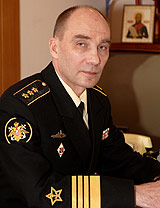
Navy CINC Vysotskiy

ITAR-TASS reported Navy CINC Vladimir Vysotskiy’s remarks at a military-historical conference dedicated to the 100th anniversary of the birth of long-time Soviet Navy CINC Sergey Gorshkov.  Vysotskiy said: 

“For the first time in history Russia threw down the gauntlet to old naval powers.  Having achieved nuclear parity with the U.S. Navy, the [Soviet] Navy became a strategic service of the armed forces.  Thanks to this we are developing many of the most serious goals to ensure keeping this parity, and we are correcting all approaches which were laid down in the ‘unforgettable’ 1990s.  Russia is the inheritor of a great state that has to possess an oceanic fleet capable of defending national interests wherever they are.  And they are everywhere in the world’s oceans.” 

In Vysotskiy’s estimation, “putting the fleet into operationally important areas of the world’s oceans allows us to look with certainty into the future, with the support of the Supreme CINC.”

Vysotskiy pointed to Gorshkov’s emphasis on nuclear weapons, submarines, and naval aviation, and noted that, “The memory of Gorshkov allows us to stand not on a crude defense, but to move forward.” 

RIA Novosti’s account quoted Vysotskiy on space and aircraft carriers:

“Without air supremacy it’s impossible to conquer space.  The one who understands this is on the right path.” 

He observed that space and air forces are the main danger even for submarines.  And submarines have to rely on space-based comms.  Vysotskiy said it’s essential for Russia to build ‘aviation-carrying systems’ which are very similar to space systems in their own way. 

“Today it’s necessary to understand the significance of these systems, it’s necessary to do this today, this must be a collective work of the state.” 

In other words, he wants the state to see things the same way and pay for it. 

He said today 9 countries have ‘aviation-carrying fleets,’ and 14 will by 2014. 

“If China intends to have one, this is understood, and if even Thailand intends to have one, then we also need to understand this in Russia today.” 

He also noted that costly investment in [naval] construction is justified even in a time of crisis since 90 percent of the world’s cargo is delivered by ships which need to be protected.  But one wonders how much of Russia’s is.  All in all, a weak justification.